Friday, September 11, 2015

Intermission: Cooking acorns


Now we are approaching to the season of acorns. So, in this post, I report my cooking adventure of acorns last year. Actually, I nurtured my ambition for eating acorns that can be found very easily in almost any forests of Yokohama. They looked so appetizing. My ambition grew year by year … 


There were several excavations of prehistoric settlements in Japanese archipelago where researchers found numerous evidences of our ancestors eating nuts, acorns inclusive. Meanwhile, some of my friends told me their mums warned not to cook or eat acorns since “They are bad for your memorizing skills!” Hmmmmmmmmmmm … are they a kind of tranquilizer? Another friend taught me eating acorns are quite common and traditional in Tohoku area of Japan and in Korean peninsula. The most traditional Korean recipe is dotorimuk (or tot'orimuk), i.e. acorn jelly, she said. Well, at least, they are edible, then. Last year, a book was published from Yamakei Library, titled “I’ll be a stone-age man!” written by Hideki Sekine (2014,ヤマケイ文庫「縄文人になる!縄文式生活技術教本」関根秀樹著). There, Sekine explains how to cook acorns. Хорошо! So, I followed his instructions at first …

1. I collected acorns.
I’ve been to the forest of 2014 Art Exhibition in the Forest of Yokohama, and collected acorns of sawtooth oaks for about 2kg. That forest had many other acorns as well, but I thought large acorns of sawtooth oaks were “cost effective.” It was INDEED so.

Sawtooth oaks
and beneath.
There was one of the installations for 2014 Exhibition,
“Wind Communicator”
by Katsuyuki Ishiyama and Takeshi Fududa.

2. I washed acorns.
At this stage, I discarded acorns with cracks and warm holes.


3. I soaked acorns in fresh water for 3 days.
I changed water in the morning and evening. I thought peeling the skin of acorns would be similar to peeling the skin of chest nuts. Some of those worms within the acorns came out and drowned. Amen.

Water became brownish, though transparent.

4. I peeled the skin of acorns, and soaked the skinned acorns in fresh water again for about 1 week.
What I learned: Acorns are very hard to skin. All of my fingers got blistered, and the scars remained until spring. In the process, I beheaded several worms hided within the nuts … Amen, amen. I changed water every morning and evening as before.


5. When the water became somehow less brownish, I crashed the acorns in the food processor, and soaked the acorn meals again for a week.
I several times strained the meal by cheese cloth, and returned them to the clean water. Up to this point, it was as written in the book. The water became somehow transparent in the morning after a week or so, but still brownish, which Sekine did not mention. So, I decided to take the matter in a different direction from the book.

The water was murky
immediately after soaking the acorn meal.
A week later

6. I decided to boil the acorn meals.
The acorn meals rendered lots of lye. So probably what I did was not that bad.

The pan was full of lye. 
7. When the pan reached to the boil, I removed it from the heat, and strained the acorn meals with cheese cloth. 
After letting it cool, I stored it in a Ziploc bag. 2kg acorns became 650 g acorn meal.

Immediately after heating
Acorn meal in a ziploc
(er, well, IKEA bag, really)

The acorn meal I made was probably too coarse for making dotorimuk; it did not settle. I mixed it with agar powder for the muk. The taste was … very light (or “no taste at all”). It was strange because the acorn meal itself remained somehow oily after boiling. It may be because of agar. I did not use all the acorn meal for dotorimuk. They kept well in the freezer, and I used the remaining meal for “Acorn Bread” later in winter. I substituted bananas with acorn meal for the standard recipe of banana bread. The bread had a distinctively nutty flavor, which was different from any other bread. Success!

But … reaching to this point, I found myself not being tempted to collect acorns to eat any more … I still had aching fingers with scars of blisters. I now know why many of our ancestors stopped eating acorns … we are impatient bunch. People in Tohoku and Korea are awesome!


Friday, September 4, 2015

Developing: Kawawa Citizen Forest 川和市民の森


I mentioned in my first post that there are 42 Citizen Forests in Yokohama. True, but 7 of them are not yet open for the public, as of September 2015. For the remaining 35 Forests, 7 of them have opened in the last 3 years. I.e. roughly 30% of the Yokohama Citizen Forests are VERY new. Kawawa Citizen Forest 川和市民の森 is one of those babies. It opened its “gate” in April 2014. As such, 4 ha Kawawa Forest does not have an official web-site or a link to the map. Though, it seems to me the Forest will be a part of a nice half-day walking destination within few years. It is developing.


Kawawa Citizen Forest is the only Citizen Forest in Tsuzuki Ward 都筑区 currently. It’s located near Kawawa Station of Yokohama Municipal Subway Green Line. We leave the station from the South Exit by going down the steps. Then, the forest is just over there, in less than 10 minutes’ walk from the station. From this direction, the Forest is beyond a farm land and a cemetery. There is a tombstone with the date of the 1860s. The village around here was relatively new. Tsuzuki Ward itself is full of new towns, including Kohoku New Town 港北ニュータウン, one of the mega-residential developments in metropolitan Tokyo, where young families are building their lives. On the other hand, the Ward has the largest agricultural population in Yokohama. So, it’s a bit strange that Kawawa Forest is the only Citizen Forest in Tsuzuki. Actually, Tsuzuki Ward is preparing for another Citizen Forest, Ikebe Citizen Forest 池辺市民の森, in the southwest of Kwawawa Forest. I suspect the City is waiting for Ikebe Forest to be ready before providing us official internet links and the like to Kawawa Forest. Although such things are new around Kawawa Forest, between Kawawa and Ikebe Forests, there is pre-historic remains that is called Kagahara Remains 加賀原遺跡 in Tsukidematsu Park 月出松公園 (in front of the Yokohama Lab of KYOCERA). According to the Board of Education of Yokohama, the remains could date back to 2500 BC. People are living in the area for millennia. When Ikebe Forest is open, a walk for Kawawa Forest, Tsukidematsu Park, and Ikebe Forest would be a fun. Things are developing now. 

Going down this steps from the Station,
then, the Kawawa Forest is over there on the right
 (when facing to the direction of
Tsuzuki Fureai no Oka Station of the Subway).
Vegetable fields and a cemetery in front of the Forest
Tsukidematsu Park.
Excavation was done in 1977,
and the remains are now returned underground.
So, at the moment, the only map of Kawawa Forest I can provide for you is this one.

Map of Kawawa Forest
As it’s a new Citizen Forest, everything in the forest is new, including small trees planted probably quite recently. The road is simple and gentle for our knees to walk. The Forest is a hill of 4 ha. At the top, there is an open place surrounded by bamboos and large sawtooth oaks. The top of the hill also has a picnic table. So the trekking road of Kawawa Forest is first climb up to the open space, and then go down to the foot of the hill. In the middle of the road on the side of the City Subway station, there is a wooden deck where in a fine day we can see Tanzawa Mountains and Mt. Fuji.

Up from the entrance, Kawawa Station side

Bamboos and oaks,
a typical combo in Kawawa Forest
Everything is new here.
Though, trees are high.
When I go there, Mt. Fuji was under the cloud.
At the top of the hill
Basically, Kawawa area is comprised of farm lands and residential areas so that the Forest itself is very quiet and calm. I found many sawtooth oaks and their green acorns in August. I guess, before the area provided lots of foods for animals, humans inclusive. Japanese before the Emperor family declared the dominance in the 5th century ate lots of acorns, along with newly introduced rice … Have you heard that this summer City of Sagamihara, neighbor of Yokohama, had a problem of bears coming to town to feed themselves out of trash bins? 


If you find a problem in the Park, please make a contact with

Office for the Park Greeneries in the North 北部公園緑地事務所
Yokohama Municipal Government Creative Environment Policy Bureau 横浜市環境創造局
Phone: 045-311-2016 (I guess in Japanese only)
FAX: 045-316-8420 (I hope there is somebody who can read English …)


Sunday, August 30, 2015

Rain, Forest: Laboratory of the Forest 2015 横浜の森美術展


Hi there! A bit late weekly posting for Adventure this time. I report you this year’s annual exhibition, “Art Exhibition in the Forest of Yokohama 横浜の森美術展” by Laboratory of the Forest 森ラボ, August 30 - September 23, 2015. The event is organized by GROUP the Creation and Voice of the Woods 創造と森の声. (Phone/FAX: 045-933-1460, Mobile: 090-1777-5881, Email: morinokoe2@yahoo.co.jp. Membership fee: 1,000 yen. Their Facebook is here.) GROUP was active since 1997, and this is their 19th annual art exhibition within the forest. The exhibition titled Art Exhibition in the Forest of Yokohama is its 8th this year, with the theme “Shinso Kaiten 森創開展.” As a related event, during August 23 - September 13 there will be an exhibition for the concept of the event, “Woods-ArtLand-Town,” in the concourse of Nakayama Station of Yokohama CitySubway. From August 23, a weekend event is going on just beyond the exhibition entrance to create an installation with flags by anybody who bother to go there. (10:00-14:00, free.)  Today, 30 August 2015, an opening party was held, where artists presented their installations by themselves, and later open-air concerts. The photos and video of today’s party would be uploaded at the Facebook page of GROUP, eventually (they say). So let’s just keep crossing our fingers …


The easiest access to the exhibition is to ride a bus either from JR Nakayama 中山 station or Sotetsu Tsurugamine 鶴ヶ峰 Station. There are the routes Asahi 11, 13, 14, and 15 all of which connect two stations. (From Nakayama, the time tables are here and here. From Tsurugamine, the tables are here.)  If you take a bus from Nakayama, get off the bus at Kohdan-Shukaijoh-mae 公団集会場前. If you turn right from the bus stop, beyond the traffic light, you’ll find a building looks like an old school. It is now-closed Hikarigaoka Elementary School ひかりが丘小学校 (as this Hikarigaoka Housing Complex becomes the town of elderly people with very few kids). If you ride the bus from Tsurugamine for Nishi-Hikarigaoka 西ひかりが丘, it actually takes you in front of this building at the bus stop, called Nishi-Hikarigaoka, the final stop.

Kohdan-Shukaijoh-mae stop
if you take a bus from Nakayama
Nishi-Hikarigaoka stop
if you take a bus from Tsurugamine
Former Hikarigaoka Elementary School
seen from the direction of the Exhibition

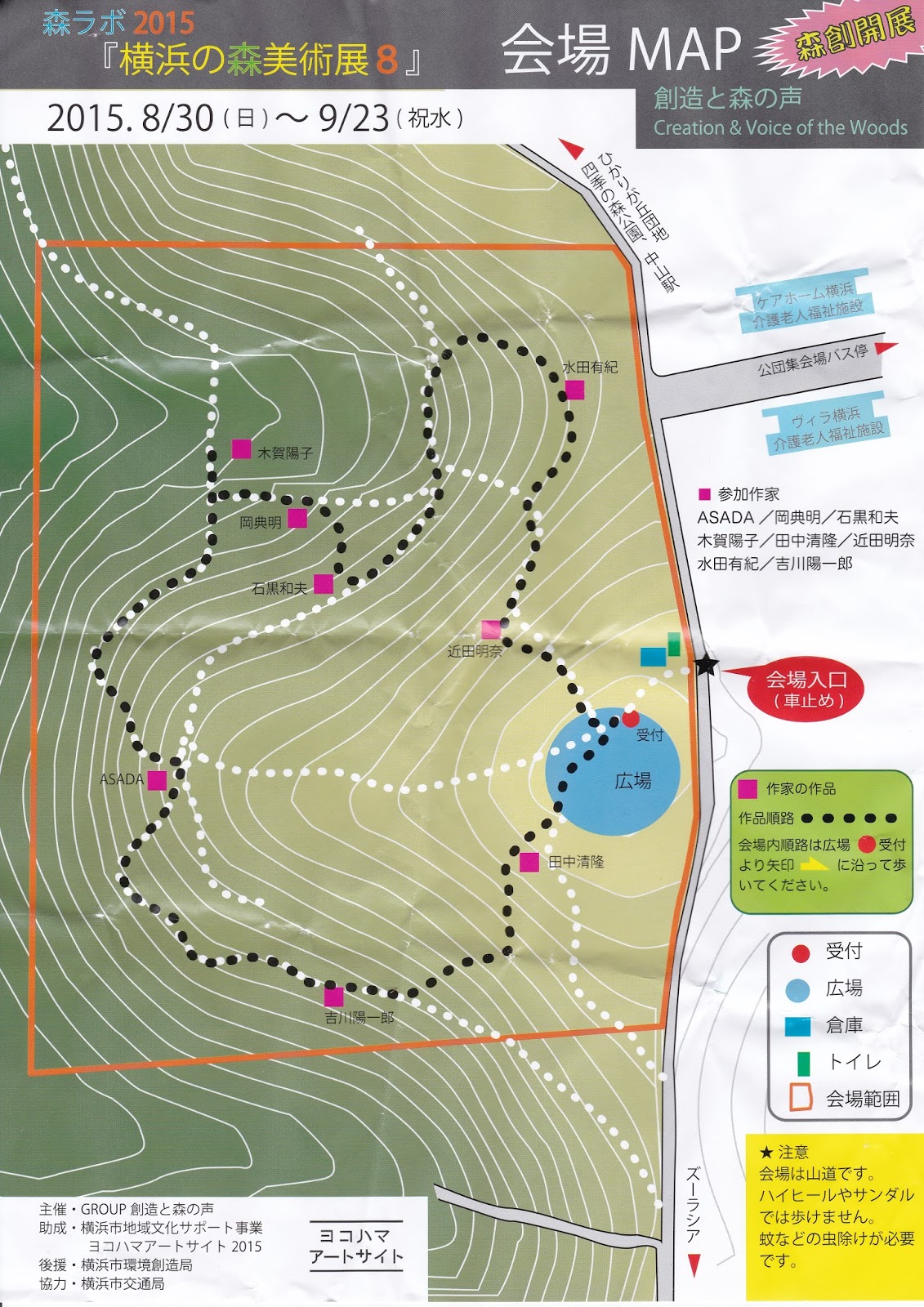
First, you walk to the gate of Hikarigaoka Elementary. On the left, there is the South Gate of Kanagawa University High School 神奈川大学付属中高 (with a forest through which, of course, we cannot trespass). Walk toward this direction for 30 m or so, we meet a T-crossing. Turn left and proceed, then there comes a sign with yellow arrow, saying “this way to 2015 Laboratory of the Forest.” The arrows appear along the way, so simply follow their direction. Eventually, you enter a small, paved and climbing-up road between the forest on the right and a retirement housing complex, Care Home Yokohama and VillaYokohama, on the left. Almost at the top of the hill, there is a downing slope on the left between the Care Home and Villa, and on the right, we can see the Banner, proclaiming “ GROUP the Creation and Voice of the Woods 創造と森の声.” Keep on going 10 m or so along the forest, and on the right we see the entrance for this year’s exhibition. There is a small desk at the entrance with a guest book and a map of the forest for the exhibition.

The road goes like this.
Arrows
Welcome!
The entrance to the exhibition
This year’s exhibition map
An installation moved from the previous site
is now for serving water. Ha ha

The first act of today’s concert was by Sushi-oke Drum Fuching すし桶ドラムふーちん, a cute drumming gal with a TWIST. (She plays drums for acoustic musical unit Libera Cielo.) Almost all of her “percussions” made of tools for daily lives, such as camping cups and a sushi bowl. She plays them with at most dexterity. Hers was a fun! (TEQUILA!) She said when her stomach is empty, she’s playing in Ueno Park of Tokyo, so if we are lucky (and she is unlucky), we can see her again there. Her next “official” gig will be in Ebina next month. Here is the link of her blog and tweets.

Fuching in the forest

Next, we had an organic acoustic trio SORA. (Their official web site, here.) Their guitar, African drum, and a vocal echoed so pure, and became a part of the misty forest. Their repertory included original composition, and songs with verses translated from Nepali and Swahili. I loved that Nepali song of beautiful sonnets and somehow nostalgic melody. They’ll play Yume Kannon Asia Festival in Ofna next month.

SORA

The closing of today’s concert was by Naoyuki Tsuchiya 土屋直之. (His web site, here.) He was a master of delighting the audience with his warm voice and a guitar that became an orchestra with the chorus of cicadas in the forest. It is funnily soothing. Today he played originals and his take of Jackson Brown. The final song was collaboration of him and SORA. A relaxing finale.


Naoyuki and SORA
The concert was held just in front of the installation of flags, “Flag Tree.” From this point, following the yellow arrows as we’ve done to come here, we can see the installations of this year.

Venus, Kiyotaka Tanaka
11 Weight
Youichiro Yoshikawa
Bath house with
sunlight filtering through trees,
Yokohama Branch,
Open for Business,
Today ThanQRU,
ASADA
Connecting Ties, Yoko Koga
We move into our sweet home in the forest!
Noriaki Oka
Flower Hairpin
Yuki Mizuta

The Tower-man started
to climb the Forest Tower,
wishing to be a King Kong
Kazuo Ishikuro
by Akina Chikada (This one is funny!)
During the show, the art-tour will be held every Sunday and National Holidays (September 21-23) from 11:00. Also several workshops are planned every weekend during the event. First 20 anybody who shows up by the meeting time can join. The fee is 500 yen each. This is the menu for this year: 

Date
Time
Name of the event
What's we are doing?
6-Sep
10:00-12:00
Large Fan, Small Fan
大きなウチワ、小さいウチワ
Making fan and fun with bamboo grass in the forest, with Kazuo Ishiguro 石黒和夫
6-Sep
13:00-15:00
In Search for Forest Venus
森にビーナスを探して
Finding sexy trees in the forest, and let them wear the costume, with Kiyotaka Tanaka 田中清隆
13-Sep
10:00-12:00
Gold Medals for the Forest
つくっておくろう森のメダル
Crafting medals with leaves, nuts, etc found in the forest, with Akina Chikada 近田明奈. At the end of the event, we present the gold medal to the forest.
13-Sep
13:00-15:00
Moving into Our Forest Houses
森の家にお引越し!
Designing hand-held houses to live in the forest by materials found in the forest, with Noriaki Oka 岡典明.
21-Sep
10:00-12:00
Forest with Marble Kaleidoscipe
ビー玉万華鏡を作って森を見よう
Walking in the forest to observe small and large world of forest through hand-made marble kaleidoscope, with ASADA.
21-Sep
13:00-15:00
Create Lucky Charm for 2016
森で作る縁起物
Crafting lucky battledores with leaves, nuts, etc found in the forest, with Yoko Koga 木賀陽子.

If you find a problem in the site introduced in this post, the best contact address will be GROUP the Creation and Voice of the Woods. The events also receives grants from Culture and Tourism Bureau of the City 横浜市文化観光局. The contact address of the Bureau is

Minatocho, Naka-ku, Yokohama, 231-0017
TEL
: 045-671-3715 FAX: 045-663-5606
URL: http://www.city.yokohama.lg.jp/bunka/bunshin/torikumi/artsite/