Friday, July 16, 2021

Seasonal task: making Umeboshi, Part 1


In Japan, the most traditional way to deal with Ume plums (Prunus mume) is making Ume pickles, aka Umeboshi. It’s a sort of life-long mission to establish “one and only” kind of recipe for Umeboshi … There are several nonagenarians (such as she, or she) who are still honing today their 70+ years of Ume pickle making career. Naomi is a sort of new-born baby in front of these incredible seniors … But, actually, the recipe for making pickles is simple. The real crux of the matter lies in somewhere else, like the condition of fruits, weather, climate, or mental condition of the pickler … Anyway, this week and the next are for my recipe of making Umeboshi.


First we have to prepare fruits for pickling. For Umebobshi, preferably, Ume plums have ripened to yellow, not in unripen green. But I found we can use still young green fruits. The preparation method is exactly the same as for making Ume compote (; my post on June 21, 2019), except for perforating the fruits with bamboo skewers. As fruits are fully ripen, we do not need to hasten the “detoxification,” i.e. no need for nicking. When we use green Ume, we soak them in water longer, and still no need to puncture the fruit. Making pickles is easier than cooking Ume compote, I tell you.

Washed and prepared Ume fruits.
 Yeah, they are still green but not so much.
 It’s OK to use this level of ripening.
 Could you see their skin does not have punctuation?

Second, sprinkle distilled strong alcohol, like vodka or gin, over the fruits and gently smear the liquid to the entire Ume by hand. At the same time, sprinkle the same alcohol to the sanitized pickling container. It’s to make it easy for salt to be attached to the whole fruits. Next, weigh salt for pickling. Once it was standard to use salt in the amount of 20% of weight of Ume fruits for Umeboshi. So, if the entire Ume plums prepared was 1Kg, the salt to be used was 200g. When we consider health problems of too much salt, this recipe was … er, risky. So, these days standard recipe for Umeboshi recommends 15-18%, or even 12%, of weight for fruits. But, I tell you, for novices, reducing the amount of salt is tricky. Especially for hot and humid Japanese summer, insufficient amount of salt will make the pickles rotting quickly. After many tears dropped, I’ve settled at 18%.

Alcohol-smeared fruits.
 I used Shochu, distilled Japanese beverage.

Leave 1/3 of salt for the final coating and sprinkle enough salt from the rest over the bottom of pickling container. Gently place liquor-coated Ume fruit one-by-one to cover the entire base of the container. When the bottom becomes invisible due to the fruits, scatter the salt over the fruits and make the second layer. Repeat this until the entire fruits are neatly stored in the container. Cover the top layer with the saved 1/3 of salt.

The bottom of the pickling container

The top layer with 1/3 of salt over it.

Seal the salted Ume fruits with plastic wrap. Avoiding the exposure to outside air is the best for the pickles not getting moldy. Considering the problem with plastics, there would be better way to seal Ume pickles … I still cannot find it. So sorry. Next, put on sanitized weight over the salted and covered Ume fruits. Ideally, the load is 2 to 3 times heavier than the fruits. If you use 1Kg of fruits, the weight would be 2-3kg. We can use lighter weight, as sometimes the container cannot have that large mass. I’ve found the lighter the weight, the longer it takes for the fruits to reach to the final process. If you want to make pretty pickles, I recommend to follow “2 to 3 times heavier” standard.

After sealing the pickles with plastic wrap,
 I place a small plate to hold weights
 without crushing the fruits.

My weights.
 They are rocks of Tanzawa
丹沢 harvested from
 Yadoriki Water Source Forest
やどりき水源林. 😊

Clean the inside wall of the container with sanitized cheese cloths or paper towel. Cover the container tightly and leave it in a cool and dark corner of your home. Check daily the condition of the pickles. In about a week or so, clear liquid will ooze out. It’s the sign pickling goes OK. If you cannot find the liquid after 7 days, your weight is too light. Better considering more load over the fruits. The fluid is white Ume plum vinegar, salty but very useful ingredients for our daily cooking. Just leave them as such for 2 to 3 weeks more. If the contents start getting moldy, gently remove and discard the molded part (fruits and vinegar), spray strong distilled alcohol to the remaining pickles, and clean the inside wall of the container with paper towel dampened by vodka or gin.

My pickling jar.
 Originally, this container was for making miso paste.
 The mouth of the jar is a bit small for Umeboshi making.
Now I’m searching for a better container
 in a reasonable price range …

In Japanese supermarket, 2-3 weeks later from yellow Ume plum fruits appeared for sale, red shiso (perilla) comes. It’s the sign we should start second stage for Ume pickling. I’ll tell you how next week. Please stay tuned. 😉


If you find a problem in the greenery of north-half of Yokohama, please make a contact with

Office for the Park Greeneries in the North
北部公園緑地事務所
Yokohama Municipal Government Creative Environment Policy Bureau
横浜市環境創造局
Phone: 045-311-2016
FAX: 045-316-8420


Friday, July 9, 2021

Kindergarten of baby pines: Koyurugui Greenery of Oiso 大磯こゆるぎ緑地


Although the rim of Sagami Bay 相模湾 is adorned by greenery, often they are not natural vegetation. The coastline of Miura 三浦半島 and Izu 伊豆半島 Peninsulas is less intervened area, as the mountains of the peninsulas rapidly descend and dive into the bay. i.e. Not much flat area is available for humans … That would be one of the reasons in Atami City 熱海市 with massive debris flow and lots of death. In a fashionable resort city of Atami, people tried to have nice-view houses in upstream, reclaimed land by filling natural valleys, and triggered humongous collapse of the mountain … In contrast, from Zushi 逗子 to Odawara 小田原, the coastal land is relatively flat or having alluvial fan. People lived in these smooth area for millennia. The problem is, such place is easy to be eroded by Pacific Ocean. Sandy beach will bring constant mini-sandstorms on sea breeze … Worse, once tsunami comes, all could be washed away. So, people have tried to deal with the problem in one way or the other. Creating greenery along the coast is one of such traditional approach.

Pacific Ocean

I told you my adventure for tending such artificially created “forests” near Tsujidoh Beach 辻堂 (; my post on October 12, 2018). They were about 60 years old with tall and lush enough pine trees sufficient to prevent sandy wind from constant ocean wind. Yeah, inside, their forest floor on sand is not much as in forests of Tanzawa 丹沢 or Hakone 箱根. We keep crossing our fingers they will sustain the ground from rising sea levels of global warming … Of course, before reaching to such working stage, any seaside protection forest must start from somewhere. Unlike for fertile land, for sandy ground to have a sustainable forest, it would be better to nurture seedlings that would stay there without disturbance of their root. i.e., People plant seeds on the shore, and nurture them patiently. Actually we can visit and enjoy such baby seaside protection forest in Oiso Town 大磯. It is called Koyurugui Greenery こゆるぎ緑地.


In 1986, following the National Trust model of the UK, Kanagawa Prefecture established trust fund to secure greenery especially in urban area of the prefecture. At the same time, the prefectural assembly established public interest incorporated foundation named Kanagawa Green Trust かながわトラストみどり財団 that raises and manages the fund. By this scheme, in 2003 Oiso Town and the Green Trust bought a sliver of ocean-facing land, 0.17ha to be exact, almost glued to the former summer house PM Saionji Kinmochi 西園寺公望 (12th and 14th PM), and later of the 14th Governor of BOJ, Ikeda Shigeaki 池田成彬 (; my post on March 25, 2021). The volunteers of Oiso Town are sowing pinecones since 2008 and tending seedlings there. Now they are pine kids standing neatly in the secured land, with nice strolling path for human visitors.


The strolling path for Koyurugui Greenery

The access to Koyurugui Greenery is easy. First, please go to the residence of the final Crown Prince of Korean Empire, Prince Yi Un 李垠, which is now currently undergoing complete reconstruction (; my post on March 24, 2021). At the corner of the west-most part of Crown Prince’s place, there is a small way from National Route 1 国道1号線. The entrance part of this small road is the gate for PM Saionji’s summer house, but the alley itself is sneaking further to the sea and Seisho Bypass Motor Way 西湘バイパス. Please take this. It’s slightly going up, and at the “peak” of this sandy hill on our right, there is small steps with a sign saying “Koyurugui Greenery.” Welcome to the kindergarten of black pines.

Please turn left here.

Then,
we see this former summer house for PM Saionji on our right.

Please just go straight.

Here it is. The sign post.

The “forest” of black pine kids is spreading along Seisho Bypass Motor Way but we can see the Pacific Ocean beyond the toll road. It is a very bright forest, almost an oxymoron of forests in Kanagawa. As trees are 2-3 meters high at a max, and 10 or so centimeters in diameter at the fattest, there is no imposing atmosphere whatsoever from the pines. The forest floor is the same as the sandy beach so that we cannot find much undergrowth. A pedestrian route runs flat in the middle of the forest, demarcated at around 50cm high ropes. It’s almost a garden, and a quiet place. The strolling path has stools here and there so that we can relax in this well-lit forest with tea in hand, gazing blankly the Pacific Ocean over there … Although the trees are still young, they bear lots of pinecones. Many of them are rolling around the sunny forest floor. The trees look healthy and fine. Yeah, it’s a nice kindergarten!

Pacific Ocean over there

Sturdy stools

Healthy kids!

The other side of the entrance

The pedestrian way of Koyurugui Greenery runs on the ridge of sandy hill. The Greenery itself is rapidly descending to Seisho Bypass. Between the motorway and the forest, there is a pedestrian/cyclist route running along the Seisho Bypass. It’s a part of Pacific Cycling Road of Japan, running from Chiba Prefecture 千葉県 to Wakayama Prefecture 和歌山県 to Osaka 大阪. For Oiso Part, the beginning is at Oiso Fishing Port 大磯漁港 where we can borrow a bike for in-town usage. Last spring, the town opened a new café in the port where we can enjoy fresh catch of the day for nice lunch. Instead of entering Koyurugui Greenery from National Meiji Memorial Garden 明治記念大磯邸園, you can walk/ride from the Fishing Port along the Pacific Cycling Road, with packed lunch purchased in the port. Anyway, this summer, the Oiso Town again decided to close Oiso Northshore 大磯北浜 due to COVID-19. It might give us a chance to enjoy less-congested ocean side of Oiso Town in summer … (Whoops, the Town recommends “Not to Come!”)

Pacific Cycling Road

The Café in Oiso Port

If it had been fine,
we could have admired Mt. Fuji
 beyond Hakone mountains …


Oiso Town Hall 大磯町役場
183 Higashikoiso, Oiso-cho, Naka-gun, Kanagawa, 255-8555
〒255-8555 神奈川県中郡大磯町東小磯183
Phone: 0463-61-4100
Fax: 0463-61-1991
http://www.town.oiso.kanagawa.jp/isotabi/index.html http://www.town.oiso.kanagawa.jp/oisomuseum/index.html

Friday, July 2, 2021

If Violetta was not ill; Camellias in Olympics/Paralympics Village for Tokyo 2020 Games


Olympics/Paralympics Village for Tokyo 2020 Games stands on one of the oldest reclaimed lands in Tokyo Bay. The area is called “Harumi 晴海” which means “the place where we can observe sea under always clear sky.” The construction of the land was completed in 1931. 90 years later, we’ll have the Olympics/Paralympics Village on it. So, the soil beneath the Village is not natural, but brought from the other places. Moreover, as Harumi is the area once it was sea, especially garden section has sandy composition stabilized by plant and grasses artificially introduced there … Well, it’s inevitable when we try to create land from not-so-shallow bay. Do you know even today the deepest point of Tokyo Bay is 700m?

The skyscrapers in Harumi where
 half of Tokyo 2020 Organizing Committee resides.


The vegetation in the Village is all planted recently by the developers. The trees are still thin. I’m sure the landscapers will take care of the young garden plants during the Games meticulously, staking Japan’s international reputation on the line. Yet among those very new trees and shrubs, it seems to me, one kind is already showing their resilience. They are camellia.


From the Village,
we can observe the entire Toyosu Market,
 the central wholesale market of Tokyo.

Common camellia, Camellia japonica, is Japanese endemic species, spreading along the coast of Japanese archipelago from Okinawa to Hokkaido. They do not care much about the soil structure, as long as the place is not so cold. Yeah, they prefer not being under direct sun, but the plant is anyway capable to survive in sunny pedestrian area. The camellias in the Village are young. They are transplanted from some professional nurseries. Yet, they have many, very large and shiny fruits dangling and smiling. Strong babies. I guess they will be established trees in 10 years’ time, whatever COVID-19 would do to the Tokyo 2020 Games. They might be a hidden symbol tree of this strange Olympics/Paralympics …


Hmmmmm. Large fruits!

I’ve found out there are several Japanese forest-related elements for Tokyo 2020 Games. I try to report them to you during the Games. Please stay tuned!


Friday, June 25, 2021

Resilience: Aquatic lives in Yadoriki Water Source Forest, summer 2021 やどりき水源林


In Yokohama, very urban place, a part of megalopolis Tokyo, people play THE major role for messing up the habitat for aquatic creatures, such as dragonfly. In the same prefecture, I mean Kanagawa Prefecture, story can be different. The case in point: Yadoriki Water Source Forest やどりき水源林. There, the protagonist, it seems to me, is in the end Mother Nature. Let me tell you my recent adventure there.


Kanagawa Forest Instructors are doing a guiding service at Yadoriki Water Source Forest. At 10:00 and 13:00 every weekend between March and November, two forest instructors are on duty at Yadoriki admin cottage near the gate. We are showing the forest for visitors. The place has lots of interesting things like vegetation, animals, and geological features that seasonally change. Our guiding is on demand base. If a visitor request to see flowers in season, for example, we guide the person according to the theme. We also have a rough half-day program to suggest if you don’t have a particular idea about Yadoriki Forest (; the calendar is available from here). The themes we offer every month are,

1. General nature experience, aka small hiking
2. Forest relaxation walk
3. A bit of woodcraft experience, and
4. Visiting Forests of Growing (; my post on June 9, 2017)

In addition, we have a special program only for July and August. It’s a small observation session of aquatic creatures.


Actually, this summer-only program is popular. What we do is catching tiny water creatures from Yadoriki Stream and observing them swimming in a tray. After the session, we return the living things to the stream. The educational level of the program is for 4-5 years old, and up. Often parents, not kids, become too involved in and we instructors must do babysitting to ensure the safety of participating babies. Elementary school kids can have a fun day and finish their homework of “independent research over the summer holiday.” Visitors don’t have to bring anything. We instructors bring all the necessary equipment, including pencil and a note. Above all, it’s free! Bargain, don’t you think?

A larva of caddisfly

So, we, Kanagawa Forest Instructors, are watching Yadoriki Stream all year around to make it sure we will have special summer program safely. Meanwhile two mega-typhoons hit the area during September and October of 2019. The feature of Yadoriki Stream was changed radically + there has been some possibility of debris avalanche to the downstream. Luckily or not last year, due to COVID-19 the entire summer program for Yadoriki was cancelled. The prefectural office was busy stabilizing the banks and riverbed of the Stream. In early spring this year, the scenery of the area where kindergarteners once enjoyed their hunt for aquatic creatures was totally different (; my post on March 18). In March, one of my senior Instructors watched bulldozed riverbed and murmured “… how cheerless …” We were worried if we could have aquatic observation session this summer.

Yadoriki stream in spring 2019.
 It was before the monster typhoons …

In fall 2019. Typhoons changed the scenery.

In April 2021.
 The riverbed of Yadoriki Stream was bulldozed.

The major construction works for Yadoriki Stream was completed in April. Since then, there were several mini storms, if not typhoons, for Yadoriki area. When I returned Yadoriki early June, once mechanically excavated river flow was already altered with crumbling banks constructed by bulldozers. Hmmmmmmm … maybe from civil engineers’ point of view it was a depressing scenery. But for us forest instructors, the situation offered a hope for fun observation of aquatic creatures once again with kids. “Let us check 3 points along Yadoriki Stream. One in the mainstream, and the other for two branch valleys.” We entered the water course with nets and buckets. It turned out we were not disappointed.

Whatever the civil engineers intended,
 the artificial riverbanks are crumbling now,
 by just  tiny storms.

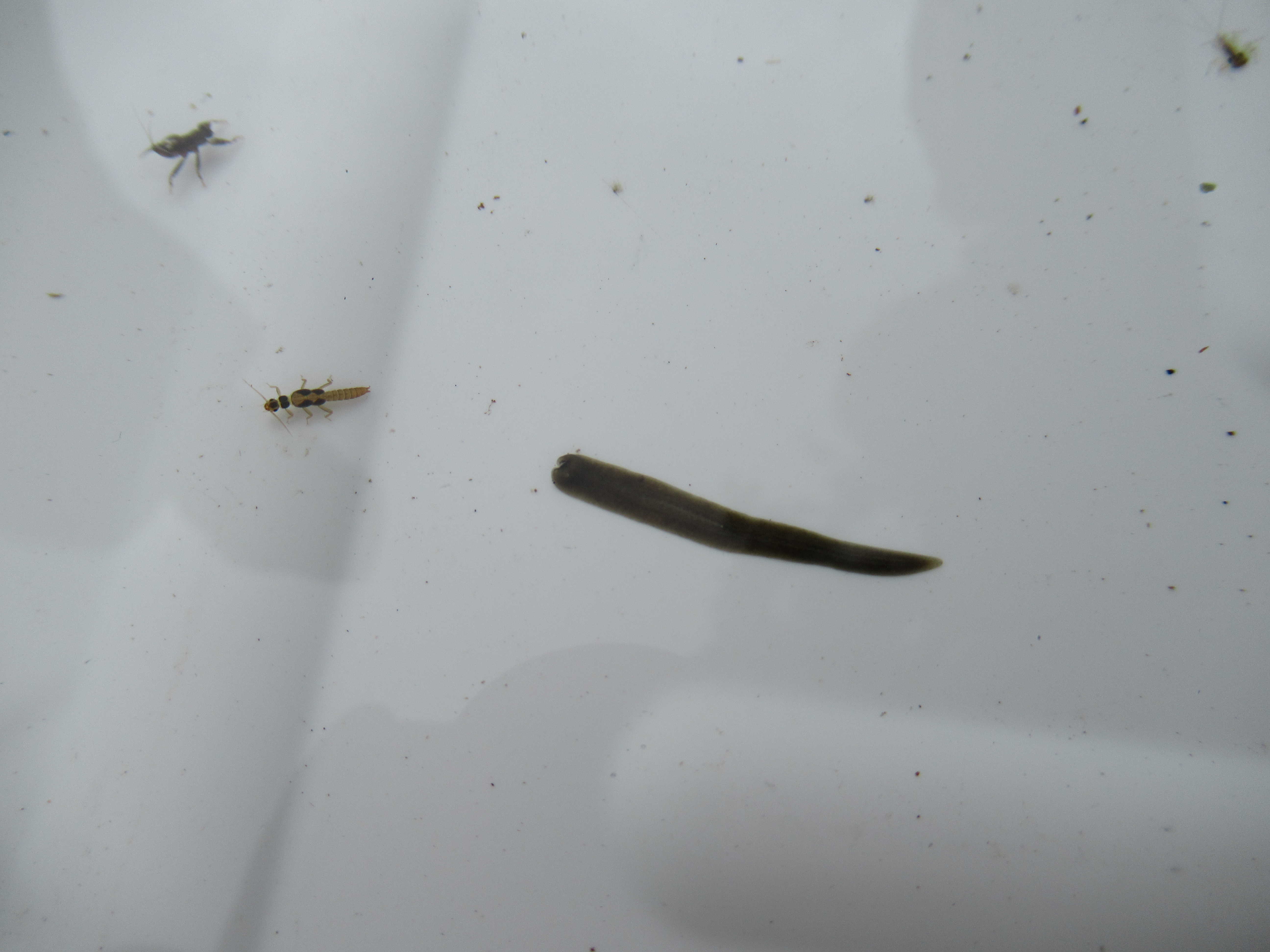
Water was still a bit cold. But we could find several nests of caddisfly larva here and there at the bottom of rocks. Lots of small nymph of stonefly came out of our nets. Tadpoles of Buerger’s flog were swimming in small but many pools of warmer water diverted from the stream. Amphibs of several dragonflies and megaloptera were already in certain size, meaning they were eating well as predator of the other smaller aquatic living things. We even found planarian flatworms, in plural.

A planarian flatworm and friends

“Well, it was needless anxiety, in the end.” “Yes. It may be difficult for kindergarteners to enter several spots we’ve checked today. But there are the other corners of the stream we would bring them for observational sessions.” “Indeed. For adults, we may think to prepare some facilities down to the stream.” “That’s a matter of budget.” “Hmmmm …” In any case, weekends of this summer, we forest instructors could guide you for observation fun of aquatic creatures. Thinking such an industrial vista of last March, it is amazing Yadoriki Water Source Forest recovering its natural environment this quick. Don’t underestimate Mother Nature, I presume.

These days,
 many families are having picnic on the Yadoriki Stream.

Oh, by the way, a wild serow may have decided to make Yadoriki Water Source Forest its territory. As we encounter it so many times, it seems to me the animal doesn’t have any problem having lunch next to us humans. Please let it be naturally in peace if you’re lucky enough to see her/him munching grass along the forestry road.

A photo taken not in a zoo


If you find environmental issues in Kanagawa Prefecture, please make a contact with Kanagawa Natural Environment Conservation Center 神奈川県自然環境保全センター

657 Nanasawa, Atsugi City, 243-0121
〒243-0121 厚木市七沢657
Phone: 046-248-0323

You may send an enquiry to them by clicking the bottom line of their homepage at http://www.pref.kanagawa.jp/div/1644/

Friday, June 18, 2021

Here Be Dragons: Dragonflies in Yokohama


Japan is an archipelago of dragonflies. The number of dragonflies identified here so far is 214. Compared to this, number of scientifically counted dragonfly species is 54 for UK, and 117 for the EU. You’ve got the idea, right? Actually, just about 70 or 80 years ago, dragonflies were found en masse in the area of JR Shinjuku Station, aka the downtown Tokyo. In misty eyes, elderly Tokyonites spoke their sweet memory of childhood, like, “You know, after school, we sneaked in the parade ground of the army in Shinjuku to hunt for dragonflies. It was so easy to catch them by Buri.” Buri? “Yeah. Pick two small stones and tie them with thread. That’s Buri. It’s like a delicate rope with weights in both sides. We threw it high in the flock of dragonflies. The thread dangled at least one dragonfly and the catch fell down to the ground. It’s difficult for the first graders to throw Buri that high. The elder kids always dominated the game …” Oh … it’s difficult now to imagine such scenery when we stand in front of skyscrapers, including Tokyo City Hall …

Orthetrum melania

Many Japanese dragonflies has their type locality here in Yokohama. It’s because Yokohama was the first large international port for Japan. The beginning was the middle of the 19th century, the time when Darwin adventured all over the globe. Many naturalists from Europe disembarked at Yokohama to enter Japan, with their insect nets. They found yet very pastoral scenery next to their hotels. Lots of dragonflies flew about above their head. I imagine if we came in such environment from the region of 117 species, every morning must have been a thrilling fiesta. They enthusiastically identified their catches to put Latin names.

Female Lyriothemis pachygastra,
 along Umeda River near Niiharu Citizen Forest
新治市民の森

Those were the days. Now, Yokohama is the second largest city in Japan. Very urban. Rice paddies once comfy home for dragonfly larva were gone. Small streams for another kind of larva become culvert to secure more space for human activity. The number of adult dragonflies inevitably dwindles. American bullfrog and Louisiana crawfish both of which were imported after the World War II to be possible foods for humans, and Pond slider that was brought in to be sold as pets, are multiplied in Yokohama’s water. They are predators for dragonfly babies. Finally, new types of neonicotinoid pesticides, allowed for usage from 2000, are killing off aquatic insects. Many dragonfly species were extinct in Yokohama, even if their registered type locality was Yokohama. Well, there is more, not only urbanization that affected life of dragonflies in Yokohama, according to Mr. Takashi Umeda 梅田孝, dragonfly expert for the Children’s Botanical Garden of Yokohama (; my post on November 4, 2016).
 

Dragonflies are delicate. Their population wildly fluctuates with environmental change. In the process of urbanization, rice paddies in Yokohama were first abandoned for cultivation. It allowed the dragonflies living in wet land to multiply for a while. Rice paddies are inherently artificial landscape where farmers control water flow. Yeah, if the original place was a wetland, abandoned rice paddies return to abandoned wetland. If paddies had water by human intervention, once they are abandoned, the place eventually returns to dry land. From rice paddies to abandoned dryland was a typical story for Yokohama. In dry former-paddies, nymphs for dragonflies cannot survive. The explosion of dragonfly population can end up with rapid extinction. Mr. Umeda who’s researching the ecosystem for dragonflies pointed out Sympetrum parvulum and Libellula quadrimaculata asahinai Selys were such species of tragic story. They became so ubiquitous during the 1980s and the 1990s. But now, they are gone. For Yokohama, there are so many other dragonfly species which are probably on the verge of extinction because the environment of rice paddies is abandoned, if not bulldozed for urbanization …

Beautiful Calopteryx atrata,
which is getting rarer and rarer in Yokohama …

Mr. Umeda said these days we can also find several tropical dragonflies in Yokohama. You may think “Ah-ha, that’s due to Global Warming!” Er, yes, and no. The ability to fly for some dragonflies is indeed phenomenal. They can move around between continents. Some dragonflies in Yokohama, like Ictinogomphus pertinax or Aciagion migratum, are considered gradually flying to the north as the climate change continues. But most tropical dragonflies identified in Yokohama are not natural travelers. Why are they here? Mr. Umeda explained that’s the story of another unintended consequences. Until some 10 years or so ago, it was fashionable for urban schools and parks to create biotopes. The purpose at that time was to provide place of education for sustainable development for city kids whose life is cut off from waterfront with aquatic lives. Good adults thought if there was no place for human kids to experience nature, money could buy it for their school backyard. Many elementary schools in Japanese cities landscaped their school garden with a man-made pond completed with transferred aquatic vegetation. Often, they were transplanted from warmer area of the planet. They carried soil from their homeland, containing eggs and seeds of foreign species. Eggs of tropical dragonflies were such new settlers. Kids of tropical dragonflies were brought from their original home without any intention to come to Yokohama. “You know? So, we are getting familiar with Ceriagrion auranticum ryukyuanum, Lestes japonicus, etc.” In a similar context, Mr. Umeda has a reservation about releasing fireflies for tourism purpose. “Well, to make fireflies happy, the event holders eventually release freshwater snails and vegetable scraps for feeding nymphs of the bug. They would start feeding carps that provide nitrogen and phosphorus from their feces. Yeah, such minerals could be good for increasing phytoplankton that are food for water snails. But, in the end, what would happen for the original ecosystem of the place? Is it a sustainable way to manage greenery?”

Sympetram risi risi

Well, humans could wreck a havoc for natural environment even with good intentions. But we can be not-so-much a troublemaker sometimes. Scientifically well-thought of maintenance job for Yokohama’s greenery could restore the eco-system gradually. Once Futatsu-ike 二ッ池, a large pond next to Shishigaya Citizen Forest 獅子ヶ谷市民の森 (; my post on June 12, 2015), was a garbage water bath because of illegal dumping. Locals, police, and the city office cleaned up the place, and now it’s a nice pond with lots of southern cattail (Typha domingensis). The last sighting for dragonfly Aeschnophlebia longistigma in Yokohama was in 1936, but they were identified once again in Futatsu-ike in 2006. These days we can find Atrocalopteryx atrata very easily in Yokohama’s water ways. During the 1960s and 70s they were considered for extinction. Now, because aquatic vegetation is returning to Yokohama’s rivers, the environment for their home is recovering and the population of Atrocalopteryx atrata is getting larger.

Futatsu-ike, early spring

And so, one day this May, Mr. Umeda called a session with us forest volunteers in the Children’s Botanical Garden to teach sustainable way to maintain aquatic environment in Yokohama. He said “Dragonflies need continuous environment. Open water surface is crucial for female dragonflies to lay eggs. Water must be clean enough for nurturing larva. Then, for dragonflies to emerge from water, they need not so tall grass along the waterway or around the pond. While some male dragonflies declare territory over certain size of open water, female dragonflies often prefer resting in a bush next to open dry space. Or, the other species spend their entire adult life within the aquatic bush of reed. They require a delicate balance between water and dryland. Our mission is to maintain such equilibrium.” Hm, OK. “So, for example, this mulberry tree is spreading its bough over the stream. It hides the water surface from the eyes of dragonflies flying above 10 to 30m high. We cut it down!” He thinned that mulberry without hesitation. Well, it’s ubiquitous mulberry … (; my post on May 28, 2021).

This mulberry must go.

“Now, look at chameleon plants, sasa bamboos, and Japanese sweet flags, along the waterway.” “Weren’t sweet flags intentionally planted here by professional landscapers?” Mr. Umeda replied. “Yes, indeed. And that’s a huge mistake of yesteryears. These glasses accelerate aridification of swampy waterside. When they wither, they add riverbed more organic matter which can eventually make the place very muddy. Water creatures often dwell in riverbed made of so-so gravelly sands and mud. The composition is very important for them to breath. Too muddy, they will suffocate. At the end of the day water flow itself is overwhelmed by the plants and dies down. No place remains for dragonfly larva to survive. The destruction of aquatic ecosystem, you know? To stop it, we need to mow them, or preferably root them out!” So, we donned long rubber boots and ventured in the stream of Children’s Recreation Park. It was a small place. The work itself was not much, to be frank. Though, as it is a popular garden, so many visitors passed by. They saw us in surprise, or sometimes with eyes of horrors. “Are you destroying the garden?” For each question, Mr. Umeda explained patiently keeping the environment sustainable is not leaving it but adding proper human intervention … Hmmmmmm. In the end, to make a place happy for dragonflies rests on the unwearied communication … Thanks to Mr. Umeda’s endeavor, dragonflies, including some rare species, of Children’s Garden and Park are maintaining their population. He is also presiding educational classes at Children’s Botanical Garden for kids and adults who love insects. If you’re interested in it, please check the calendar here.

This is the site to be cleared.

This is the runner of Japanese sweet flags to be removed.

After our work done.

Sympetrum eroticum


Yokohama Children’s Recreation Park 横浜児童遊園地
https://www.hama-midorinokyokai.or.jp/park/jidoyuen/
Yokohama Children’s Botanical Garden 横浜こども植物園
https://www.hama-midorinokyokai.or.jp/kodomo/

213 Karibacho, Hodogaya-ku, Yokohama, 240-0025

Phone: 045-741-1015