Northeast
corner of the City of Yokohama has famously complicated “borders.” Because of
historical reasons, City of Machida 町田市 of
Tokyo and City of Kawasaki 川崎市 maintain
an enclave each within the border of Yokohama. (And there are lots jokes about
behavior of Tokyo Metropolitan Police and Kanagawa Prefectural Police.) Jike
Citizen Forest 寺家ふるさとの森 is
situated right next to the enclave of Machida. As such, we can find many number
plates of Tokyo, e.g. Shinagawa 品川, Tama 多摩, Adachi 足立, Setagaya 世田谷 …, for Tokyonites coming to picnic. West of the
Forest is the Kodomono-kuni Park こどもの国 that
was a wedding gift from the current Emperor when he was still the crown prince.
(Yeah, Emperor must give present to the people when he gets married.) The south
is the campus of Nippon Sports Science University 日本体育大学 where
lots of Japanese Olympians hone their skills days in and out. (Info for a fun of
male gymnastics; the current world champion for floor exercises, 19 years old
Kenzo Shirai, studies here.) Yes, this place is a hidden popular spot for
metropolitan family fun!
 |
A
weekend in June,
Jike rice paddies in Machida side organized
a rice-planting
party for volunteer-cum-tourists, |
 |
with
BBQ
“serving freshly harvested Madake bamboo shoots!” |
Name of Jike
Forest is a bit different from other Citizen Forest. Its official name, “Jike
Furusato no Mori 寺家ふるさとの森,” means “Jike Our Country Home
Forest.” The difference of Country Home Forest and Citizen Forest is, Country Home Forest is a part of larger community development program while Citizen
Forest has relatively more emphasis on nature conservation itself. Jike Our
Country Home Charter manifests their thinking very clearly.
Nature
and agriculture are the treasures for us.
We
know for generations the preciousness of nurturing our land and all the life
upon it.
We
humans are just a part of this beautiful community,
So
we never forget gentle and caring spirit for our mother nature.
Do you remember the Charter of Niiharu? Don’t you
think this Charter is a bit different from Niiharu’s?
Jike Town
寺家町 has an ancient history. Northwest of the town has a cemetery of the 5th and
6th century, i.e. people have lived here for at least 1500 years.
The most famous people from this community were the group of warriors who
helped Minamotono Yoritomo 源頼朝, the founder of the City of Kamakura 鎌倉 in the
12th century. Although the landlords of the area lost their
“samurai” status in the late 16th century due to the disarmament
policy (called Katanagari 刀狩) of Toyotomi Hideyoshi 豊臣秀吉 and
Tokugawa Ieyasu 徳川家康, they are the proud custodian of their ancestral
land. According to the research of local ethnologists, the map of Jike Town
does not show changes between 1703 and 2015 in its basic composition. In 1816, they
even revolted against Tokugawa Shogunate despite of the threat of beheading,
when the Edo (Tokyo) government tried to squeeze more tax by further
development. They are determined to keep the land as it is.
 |
This
is the vista of rice paddies
without much change for 300 years. |
After Tokyu Den’entoshi
Line 東急田園都市線 opened
its Aobadai Station 青葉台駅 in
1966, the housing development accelerated the pace of assault toward the Jike
community. In the late 1970s, the wave reached to the southern tip of the
village, young people stopped cultivating the ancestral land, and the forests showed
the stress of neglect. The locals decided to act. The entire town of Jike introduced
the city’s help with 3 Goals for Jike Country Home Program. They are
1. To Preserve
beauty of pastoral scenery and utilize natural and human resources and land in
agricultural village;
2. In order for
sustainable development of village community, to promote agricultural tourism
graduating from simple primary industry and providing employment opportunity;
3. For children
and new comers of the community to experience nature, agriculture and pastoral
culture and to attain human development of wholesome health, which will deepen
mutual understanding between urban and rural cultures.
With
these in mind, the entire village of 86.1 ha re-organized its structure from
1983 to 1987 for agricultural tourism. They promoted locally produced vegetables and fruits for tourists, developed a 9-hole golf course and a tennisclub (as it was the time of pre-Japanese Bubble), several art ateliers,
galleries, and cafes with traditional houses, and established Jike Forest. Jike
Town markets itself as “Jike Furusato Mura” 寺家ふるさと村 (Jike
Our Country Home, homepage here). So, the Forest is a part of “industrial” plan
for this community to survive without destroying the historical landscape.
 |
The
opposite of the Forest,
there is the community of landlords.
This popular house
sells
freshly harvested vegetables weekends.
Going to the left road into the
community,
there is a pottery atelier. |
 |
This
stand of a jaunty matron sells red onions
and Italian veggies, together with
rice, organic. |
To
visit Jike Our Country Home Forest, the nearest station is Aobadai Station 青葉台 of
Tokyu Denentoshi Line 東急田園都市線. Leave the station to the north, to the opposite
side for Aobadai Forum Hotel (Michelin one star hotel), and take Blue 30 Tokyu
Bus (Jike-cho Junkan 寺家町循環) or Blue 31 Tokyu Bus (Kamoshida Danchi Iki 鴨志田団地行) from #2 Aobadai bus stop. If you take #30, the
bus will go to Jike Town itself whose entrance stop is Shiki-no-Ie 四季の家. #31 ends a stop before, Kamoshida Danchi 鴨志田団地. The difference between 2 stops is about a block by
the campus for Kamoshida Junior High 鴨志田中学校. It’s not that much. If you have a will to go back
one more bus stop, from Kamoshida Danchi to Danchi-chuo 団地中央, in front of the Danchi-chuo stop there is a
patisserie, Blancfleuve, whose owner-chef won the grand-prix for 2015 Yokohama
Sweets Paradise Contest. (The awarded cake is, “The chocolate cream sandwich by
dacquoise in the shape of a smiling teddy bear, which can be eaten as a cake
with normal temperature, or as an ice cream sandwich if frozen.”) If you visit
Jike Town by car, there are lots of parking lots (and on the road parking spaces), so no need to worry.
 |
The
road crossing Yamada Yato.
The bus stop is in the middle of 2 power poles. |
Shiki-no-ie
bus stop is in the middle of a road crossing Yamada Yato 山田谷戸, a yato-type expansion of rice paddies. To the
southeast from the stop, there is a narrow road running along the rice paddies
to the east, and we see several banner flags, which is a sign for Shiki-no-Ie.
Shiki-no-Ie (Open Wed-Mon, 9:00-17:00, homepage here) is the visitor center for
Jike Our Country Home, with a small natural museum (explaining the habitat of
Jike Town), 5 meeting rooms (RSVP), a corner selling local organic vegetables, and
one Japanese restaurant, Jike-no-Manryo 寺家之鰻寮 (open
Wed-Mon, 11:00-21:00, phone: 045-962-7338). The restaurant serves Japanese
dishes with a modern touch using the bounties from Jike Town (e.g. “Bagna Cauda
with vegetables from Jike,” “Kabayaki eel,” etc). It seems to me this
restaurant is popular among locals (and beyond). For a weekend lunch in June,
the parking and the tables were full. Considering the location (; the area
around Aobadai Station boasts numerous Michelin Starred venues), Jike-no-Manryo
should provide a good meal. … Hmmm, decisions, decisions … here for a petit luxury
with fresh organic vegetables and Kabayaki, or not here with a nice picnic meal
in the forest? (I chose picnic ... I had sandwiches ...)
 |
| Shiki-no-Ie |
 |
| Small
natural museum |
 |
The
menu for Jike-no-Manryo.
They have more detailed ones inside. |
 |
Toilet
of Shiki-no-Ie.
They are fully-equipped Japanese toilets
with automatic
flashing system. |
To
some extent, Jike Town’s commercial strategy has a wider meaning.
Geographically speaking, Jike Town is located about the center of Tama Hills 多摩丘陵 spreading
from the east side of Takaosan Mountain 高尾山 to
Enkaisan Mountain 円海山 (which
is another Citizen Forest in the south of Yokohama; stay tuned!). The preserved
natural habitat and agricultural scenery of Jike was a kind of “typical” for
the south of Metropolitan Tokyo till the middle of the 20th century. Sure, the houses in Jike have satellite
dishes. Priuses are running around the area. But, the place has a déjà vu atmosphere that attracts us for weekend. Now Jike Our Country Home (managed by
Ag-cooperative of Jike Town) organizes many activities including guided tours
for a large group of people (with main emphasis on the natural habitat of
plants). Many of them require a reservation by phone at Shiki-no-Ie with
045-962-7414 from a month before the schedule. They also have classes for kids
up to 6th graders to learn nature and culture of Jike, and to experience
creative activities. (For enquiry, please make a contact with Mr. Toshiya
Urabe, jike@childws.com, phone: 044-954-2758.) For 2015 fiscal year, these
are the planned activities;
(1) Cooking lessons
with Jike’s Harvests (for all of them, fees are inclusive for ingredients’ cost.)
May 5, June 21, July 19, September 20, October 18, November 15
|
Cooking lessons for gentlemen
|
For beginners, 12,000 yen lamp sum for all the lessons.
Reservation closed.
|
10-Oct
|
Family Buckwheat Noodle Making
|
For 5th and 6th Graders and their guardian, 2,500 yen.
|
November 14, December 12, January 9 (2016), February 13 (2016)
|
Buckwheat Noodle Making
|
For everybody, each day presents an independent lesson. 2,200
yen each.
|
November 2015, January and February 2016
|
Planned Miso-paste making lessons
|
The detail will be announced after September 20
|
(2) For craft
lovers (RSVP by phone 045-962-7414)
6-Dec
|
Christmas wreaths making with acorns
|
For high-schoolers and up. Admission free.
|
13-Dec
|
“Moss Ball” (haha, NOT “moth ball”) making lesson
|
Adults only. Admission free.
|
(3) Educational tours
for the lovers of Jike, for 1st graders and up, admission free.
First Sunday of each month (except August and December)
|
Guided Tours for Jike Village
|
10:00-12:00
|
Third Sunday (except August, December – February)
|
Tour for wild flowers
|
10:00-12:00
|
12-Sep
|
Tour for dragonfly lovers
|
10:00-12:00
|
October 11, December 13, February 14, March 13
|
Guided Bird Watching Party
|
9:00-11:30
|
Shiki-no-Ie also has the latest information of
events in the entire Jike Our Home Country, in addition to the maps of Citizen
Forests. It’s worth a visit before plunging in to the area.


Jike
Forest has 12.4 ha with 1,500 m of road and 3 ponds. They are the member of 5 man-made
ponds in Jike Town. All the ponds in the town can be found in the map of 1703.
Jike’s agriculture depends on rainwater and the community dug and maintained the
ponds collectively, with the strict rule for the usage of water. Large trees
were never planted on the bank as its rooting system can destroy the structure.
Aquatic plants were intentionally and strategically planted to control the
volume of stream. Now the main banks and canals of the ponds toward rice
paddies are concreted with mechanized pumps, though here and there we can find
older structures still running strong. The water from the ponds is used, as
before, for rice paddies of organic planting in order to preserve the local eco-system.
The ponds in Jike Town provides home for many aquatic creatures, such as
bitterlings, killifishes, mud snails, fireflys … It is prohibited to harvest
any of them without municipal permission. Though, Kumano Pond 熊野池 within
the Forest is remodeled as a fishing hole for recreational fishing of crucians.
 |
At the
end of Mujina Pond むじな池.
Probably, hundreds of years ago,
people saw it
and thought
it was a good place to dig a pond. |
 |
The
main water gate (mechanized)
of the canal to the lower paddies |
 |
The
canal from Mujina Pond to Yamada Yato,
which still maintains the older
technology. |
 |
| Water
mill to adjust the flow from Shin-ike Pond 新池 |
 |
| The
pump for Oike Pond (Big Pond) 大池 |
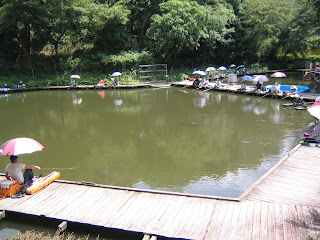 |
| Kumano
Pond Fishing Hole |
 |
| Signposts
are located at each point. |
The
Jike Citizen Forest itself is not that large. All the roads surrounding the
ponds are fenced probably for safety. The road connecting Mujina Pond and
Kumano Pond is cobbled so that it is easy to walk. Picnic benches are situated
here and there in the forest, which makes it easy to take a break, and enjoy
meditation while listening the birds and voices of athletes practicing in another
side of the hill. Picnic tables are often under a gazebo, i.e., useful in case
of rain. The toilet is located in the parking lot for Kumano Pond where potable
water faucet is also available.
 |
| The
promenade along the Oike Pond |
 |
| From
Kumano Pond to Mujina Pond |
 |
| Picnic
benches |
 |
This
picnic gazebo is surrounded by wild cherries.
It would be spectacular in early
spring. |
 |
| Toilet
(the structure with red wall) next to Kumano Pond |
All
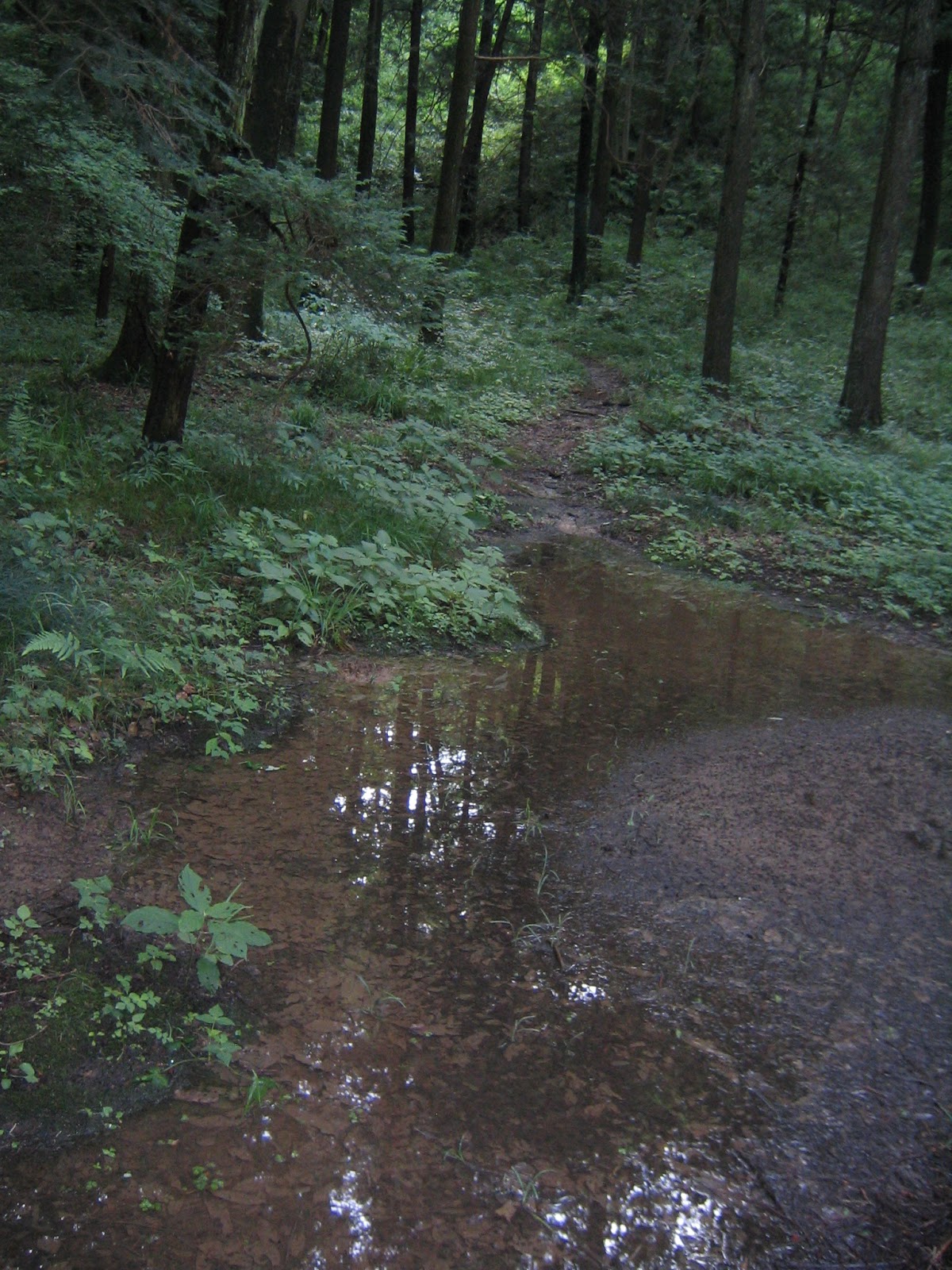
may sound the Forest rather like a well-equipped park. Though, the place maintains
the feeling of wild rain forest, the original landscape of Tama Hills. Big applause
for descendants of samurai in Jike. Variety of broad leaf trees dominates the
forest, rather than the planted coniferous trees or bamboos. The under-canopy
is dense with many kinds of plants. After rain, various mushrooms sprout out. Suddenly,
a snake more than 1 m long crossed in front of me. The roads are not compacted
so that they are kind for hikers. Actually, I met many trail-run athletes
running within the forest. Future Olympians, perhaps?
 |
| Hello |
 |
| Hello, hello |
 |
| Hello, hello, hello |
If you find a problem in the Park,
please make a contact with
Office for the Park Greeneries in the
North 北部公園緑地事務所
Yokohama Municipal Government
Creative Environment Policy Bureau 横浜市環境創造局
Phone: 045-311-2016 (I guess in
Japanese only)
FAX: 045-316-8420 (I hope there is somebody who can
read English …)