Friday, June 12, 2020

Un thé pensant: making (oh, yeah) tea from tea leaves (and Amabie bonus)


Probably thanks to COVID-19, this spring I had a chance to make English tea leaves from fresh leaves harvested in Niiharu Citizen Forest 新治市民の森. Niiharu Citizen Forest has tea plant (Camellia sinensis) which were planted by the first Chairman of Lovers Association, Mr. Heihachi Nakamaru. They yearly provide fresh leaves without fail. Every spring on the day of Spring Kids’ Festival, people picked “first flash” from the trees and made Japanese tea leaves (; pls. see my post on May 20, 2016). As posted here on February 7th, Niiharu Lovers Association planned this year’s Spring Kids’ Festival for May 10 when kids and families were to harvest tea leaves and prepare fresh Japanese green tea in a traditional way. The State of Emergency negated our plan. On the other hand, such things are none of their business for Camellia sinensis. They had lots of first flashes as every year. They definitely needed to trim the bang.


Tea plants in Niiharu Citizen Forest, early May this year.


“Well, Naomi, if you think so, you can pick the first flash by yourself.” “Really?” “Yeah, but this year we cannot provide the facilities to make Japanese tea leaves. No large steamer. No large cooking pan heated with charcoals. And of course, no crowds of helpers to massage leaves for hours.” “Indeed, what are you going to do with those leaves after picking?” Hm. Naomi had an idea. “Er, I cannot say for sure if it works, but I at least have a plan. Can I have those picked leaves for myself.” “OK. If you say so, try that.” Wow! So, this week is about my adventure to produce English tea leaves from scratch. Why English tea? I googled and found out the way to prepare tea leaves without infrared heater or hours of hand massaging of leaves. It was to make English Tea.


Venerable Twinings …


On this planet there are 3 large categories of tea made of leaves from tea plant: green tea, Chinese tea, and English tea. When we pick tea leaves, they first wither, and then start to ferment with oxygen. These 3 kinds of tea differ in the timing when oxidative fermentation is stopped by cooking. Japanese tea is green tea, for which tea leaves are prevented from fermentation by cooking as soon as possible after harvesting. Various Chinese teas are made by choosing different levels of fermentation. It sounds demanding for amateurs to pick the right moment to cook leaves. English tea is of tea leaves reached to the edible-max of fermentation. To make tea leaves with limited availability of skill and equipment, English tea is the most feasible option to take, it seems to me. So, here is the way I took, based on a HP of Japanese tea merchant.


First, we have to pick the leaves. As you can see in the above photo, first flash tea leaves have distinctive lime green and soft shoot. We pick the top 3 new leaves from each branch.


This year, we have collected this much of tea leaves. Several senior Lovers took some of these. “I’m going to make Tempura this evening with these leaves!” The fresh tea leaves are edible, but we have to be careful. They have lots of Vitamin C and caffeine. Too much consumption for supper can bring us insomnia …


This is the portion I had from 2020 tea leaves of Niiharu Forest. I washed them, and, THIS IS IMPORTANT, left them withering for about 24-48 hours in a shade with good air circulation. My space was filled with fresh scent from the drying first flash …


For Darjeeling First Flash, two days for natural drying are best, they say. So, I waited 48 hours. Niiharu’s leaves were withered to this level. It is time to “massage” tea leaves.”


The way to do is like kneading dough for bread, preferably on a flat bamboo basket for easy circulation of air during the process. The leaves soon became a ball, and my hands could feel a sort of stickiness with tea aroma.


After kneading the leaves for about 30 minutes, the leaves reached the stage to stick each other and did not fall off from the ball. It’s time to stop, and separate the held-together “tea leaf ball” like this photo. It seems to me if we left the ball as a ball, we can never separate the leaves. Spreading them out is important.


I put them in a plastic bag, closed the bag, and left it for half a day at room temperature. The massaging broke the membrane of leaves, which lets protein inside the cell oozing out. That substance acts as catalyst for tea tannin to be oxidized, which is “fermentation of tea.” So, it’s the process different from fermentation done by, say, lactic acid bacteria. In order to stimulate oxidization, I put the massaged leaves in a closed bag and locate it not too hot/cold environment.


The result of 12 hours’ oxidization, or fermentation. It certainly had floral scent. My expectation rose … According to the instruction, 12 hours inside a plastic bag is for first flash tea expecting fresher aroma. If we don’t mind too much about the flavor, 3-4 hours in a bag would be enough. Anyway, to stop fermentation here, we have to “cook” the leaves. The way to do is simple: bake them in an oven at 120°C for 10 minutes.
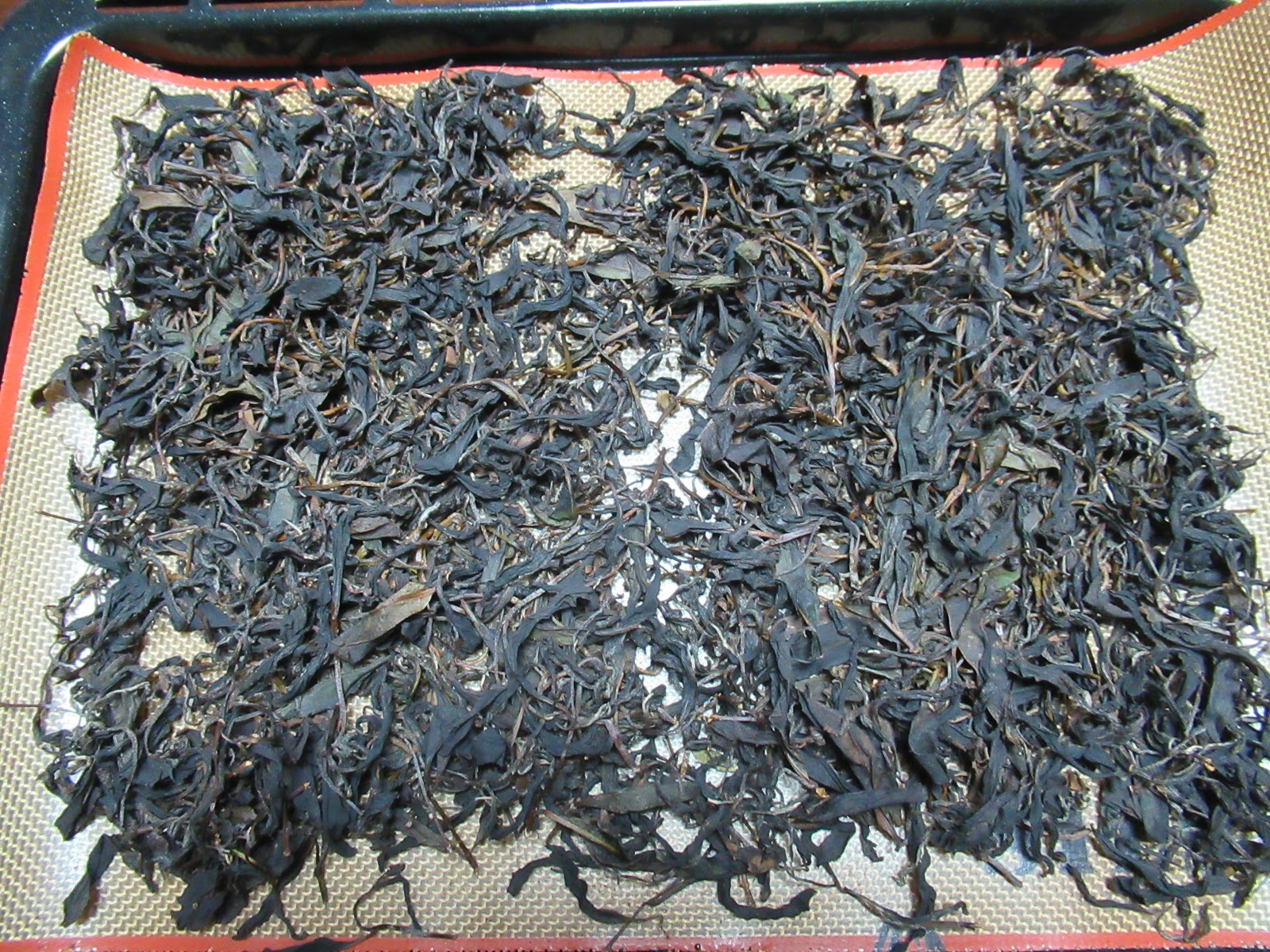


Done. Wooooow, it looks like leaves of Fortmason Tea! Yeah, we can taste it here. But, you’d better dry it further in room temperature for few hours before storing. Or fllowing the advice from the HP I referred, I decided to let them mature and have sweeter scent by leaving them in a closed container with packets of oxygen absorbent. It will take half to one year more before tasting them ...


I keep throwing in oxygen absorbents from chocolate boxes.


Come to think of it, English found their tea brought from Mumbai by sailing ships of East India Co. The merchants crossed steaming-hot Indian Ocean, went round the Cape of Good Hope and arrived London or Liverpool at last. It would take 6 months or more, passing the equator twice. During the voyage, the barrels of tea had a good sleep at the bottom of the holds … Mine is in a corner of my house now, ready to wave over steaming-hot Japanese summer in a port city of Yokohama. Let me see how they would turn out!


If you find a problem in Yokohama’s North Forests, please make a contact with

Office for the Park Greeneries in the North 北部公園緑地事務所
Yokohama Municipal Government Creative Environment Policy Bureau 横浜市環境創造局
Phone: 045-311-2016
FAX: 045-316-8420

If you find environmental issues in Kanagawa Prefecture, please make a contact with Kanagawa Natural Environment Conservation Center 神奈川県自然環境保全センター

657 Nanasawa, Atsugi City, 243-0121
〒243-0121 厚木市七沢657
Phone: 046-248-0323

You can send an enquiry to them by clicking the bottom line of their homepage at http://www.pref.kanagawa.jp/div/1644/


Bonus for this post. I found this sweet in Depachika of Sogo Department Store Yokohama. It’s Dorayaki, a pancake sandwich of red bean paste. (Do you know Doraemon, a cat robot? It’s his favorite.) Could you see a strange figure on a pancake? Now this drawing of Amabie is hot here in Japan. It is said that Amabie is … er, magical spirit appeared early May 1846 in the beach of Ariake Sea 有明海 of Kumamoto 熊本. First, villagers noticed something was shining in sea for several nights. They thought it strange and reported the incidents to Samurai Lord in Kumamoto Castle. He dispatched his subordinates to investigate to the beach. Then, that light approached slowly to the officers waiting on the beach. A strange creature, the one on the pancake, appeared. It said “I am Amabie. I tell you, humans, you’ll have 6 years of good harvests from this fall. You also have terrible epidemic during the time. You have to make picture of mine and spread my figure all over the country.” Amabie then returned to the sea. The officers were astounded, and reported the story to his Lord. From there it became national news. 1846 was not a particular year, epidemic-wise, for Japan, but it was the time of Irish Famine, right? How to interpret her warning …? The “newspaper” issued in Edo (Tokyo) at that time is now in the library of Kyoto University as a historical document. First forward to the 21st century, Ms. Amabie who loves to be seen by millions is THE Japanese Idol under COVID-19. Here is the site you can check the latest cutie Amabie created by Japanese artists. Happy Social Distance Life, and stay safe.

Friday, June 5, 2020

Un Smilax china pensant: Cooking sweet dumpling with leaves of China root


Euonymus oxyphyllus


Whatever COVID-19 does for us, I love sweets! This week I tell you another cooking adventure of mine using leaves from forest. This week’s leaf is, I’ve heard, regulars for sweets in western provinces of Japan. It’s leaf of China root (Smilax china). China root is a climbing plant native in Japanese archipelago, Korean Peninsula, and China. People in western part of Japan, i.e. Kin’ki 近畿, Shikoku 四国, Chugoku 中国, and Kyushu 九州 areas, use traditionally the leaf of Smilax china for wrapping sweet dumpling made for an annual May 5th festival to rejoice healthy growth of kids, called “Kodomo-no-Hi (Kids’ Day) こどもの日.” In my post for May 22, 2020, I reported my adventure to cook Chimaki sweet with reeds for Kids’ Day. Another, and more popular, sweet for Kids’ Day is sweet dumpling called Kashiwa-mochi. Today I make Kashiwa-mochi with leaves of China root.


Strawberry Geranium (Saxifraga stolonifera)


In contemporary Japanese language, Kashiwa means Japanese Emperor (Sweet) Oak (Quercus dentata). In eastern Japan, we wrap dumplings for Kids’ Day with leaves of Kashiwa. I’ve heard it’s the reason for the name of the sweet. Though, according to Mr. Hiroshi Taoda 垰田宏, a retired officer for the Forestry Agency of Japan, the truth was different. He reports there was a marketing ploy some 300 years ago for Emperor Oak to replace China root in Eastern Japan. Before Tokyo became Japanese political center, people used ubiquitous China root to make dumpling for the kids’ festival. After Tokugawa Ieyasu 徳川家康 started his shogunate government in 1600, the population of Edo (Tokyo), which was till then a remote corner of Japan, exploded. Tokyoite people soon found shortage of leaves for sweet dumpling of Kids’ Day. Kids’ Day festival was important for samurai who dominated Edo then. It was the ritual to pray for their offspring growing stronger, and for their clan prospering further into the future. Eating sweet dumpling was the MUST. Pâtissiers in Edo had to satisfy high demand of dumpling with substitute leaves. They used leaves of Kashiwa tree that were used locally around the birthplace of Tokugawa Ieyasu, and rationalize their choice by saying “Look, old leaves of Kashiwa do not fall off until young leaves become robust enough. That’s the way to promote success of a clan, as Lord Tokugawa does! We use leaves of Kashiwa for this very important symbolism.” Well, it’s a Confucian catch copy, but anyway became popular in Tokyo. Not all the people in Japan were samurai, especially in old western part of islands. They simply pooh-poohed this “new trend from once rural area of the East” and continued using leaves of Smilax china.


Kashiwa-mochi, Edo-style.
 These days, they are available in
 supermarkets all year round.


In classic Japanese, any large leaves were called “Kashiwa.” According to Mr. Taoda, there are linguistic studies why this “Kashiwa” became the name for emperor oak. Patisserie business of Tokyo utilized such verbal confusion to market their newer approach, I guess. In any case, Kashiwa tree loves chillier places. Western part of Japanese archipelago has milder climate. Kashiwa down there are often planted for luxurious garden. My mom who came from Shikoku Island told me she was surprised to see “Kashiwa-mochi” was actually wrapped in Kashiwa leaf when she first visited Tokyo. Well, a daughter of her, born in Tokyo and grew up in the suburb of Tokyo, has never seen Kashiwa-mochi wrapped in leaves of China root. Having said that, (with a fearless smile on Naomi’s face) I now know where to go for leaves of China root in Yokohama. In addition, Google gives us recipe, right? My adventure begins.


Yokohama’s China root in May.
 It’s growing strong.
 Could you figure out its stems with green hooks?
 As the plant matures,
 they become real hangers causing a mess for anybody
 who ventures into their bush.
 Japanese name for China root is Sarutoriibara.
 “Saru = monkey, tori = catching, ibara = thorns.”
 Got it?


First, harvesting. China root has beautiful, and tons of, red currants in late autumn. I found many of them lying around on trekking roads while I walked in Yokohama’s forests. Several years back, I was tempted to plant it in our garden … and so, did a bit of research. Without fail, the recommendation was, “Don’t, unless you have acres of forest as your private park. It is a strong and dominating climber that should cause havocs in your garden for sure.” Well, indeed, China root is ubiquitous in Yokohama’s forests. It’s not at all difficult to find them. In addition, incentive to remove Smilax china from forests is lower. Their leaves are feed grass of the larva of Blue Admiral (Kaniska canace). Afficionados of butterflies value the existence of the plant as a sort of insurance for their Blue Admiral to dance coming summer. When I checked the leaves of Smilax china, I often met with voracious larva munching the leaves continuously … Sorry, I take just little bit of these leaves, and I hope you don’t mind, caterpillar. 😄


In winter the red currants of China root become matured seeds.
 Don’t you think they are inviting us to do endozoochory?
 Devil’s temptation …
The real very hungry caterpillar for Blue Admiral


Next, strategy. Commercial Kashiwa-mochi uses Kashiwa leaves only to wrap sweet dumpling. It’s a sort of boring, isn’t it? Besides, in Japan, the entire Smilax china plant has been used as an ingredient for traditional herbal medicine. Leaves of Smilax china are edible when they are young. The leaves have slightly sweet flavor, it is said. I decided to sandwich the dough of sweet dumpling with young leaves of China root and to eat all together. Here is the recipe I used for cooking Kashiwa-mochi dumpling with young leaves of China root:


Young leaves of Smilax china


2020 Kids’ Dumpling with China root leaves

<Ingredients for 10 Dumplings>

200g Joshinko 上新粉: rice flour made from non-glutinous rice which is available in large supermarkets.
200cc of lukewarm H2O: Er, I tell you this amount was, it turned out to be, too much. I should not use all 200cc… please look below.

200g Anko: Sweet red bean paste. In Japan, we can find many brands for the paste in ordinary supermarkets. Yeah, if you like, you can make it by yourself. But it’s something of the most important ingredient for Japanese sweet. The maestros of Japanese pâtissiers compete each other to make theirs even better. I didn’t intend to join their life-long pursuit for perfection, and settled with the popular edition.

20 young leaves of China root: to eat leaves, we have to harvest them while they are still young. I collected them in mid-April. Inevitably, the size of leaves is smaller, and so we need a set of 2 leaves to wrap one dumpling. We can collect young leaves and freeze them fresh until usage.


Joshinko and too much lukewarm water …
Anko pouch
Frozen young leaves of Smilax china


<Essential Tools>
Steamer

<Directions>

1. Add lukewarm water little by little in a bowl of Joshinko, and mix well. Don’t damp the liquid at once. It will create lamps of flour which will be difficult to incorporate into the dough smoothly. Also, I found out 200cc was too much to have a dough formed. Mine turned out to be syrupy. I confess I panicked and added one spoonful of Kinako (roasted soy bean flour) to recover from the situation. Why Kinako? Er, our fridge stored lots of them, to be honest. Anyway, it’s very healthy ingredient, you know.


The beginning of mixing …
Kinako was added to too-soft dough of 200c water.
 I was upset …
After-Kinako dough. It was over-mixed, I presumed.


2. Divide the dough and Anko in 10, and wrap one potion of Anko with one portion of dough. My way of doing it was (1) flatten the dough with slightly dimpled center, (2) put Anko in the center, and (3) wrap Anko with dough. It’s just like what we did for kindergarten!3. Sandwich the formed dough with leaves of China root, and steam them for 15-20 minutes.


Anko wrapped by dough and sitting pretty on Smilax china leaves
and sandwiched by another leaves, and situated in a steamer


4. Bon Appetite! 


My mom tried the treat and said “Well, 20 minutes of steaming made the leaves stringy which is irritating for senior citizens with denture.” OK, OK, OK. “And, you mixed too much the dough, didn’t you? Over-mixture can make dumpling not so soft. Next time, you should know when to stop.” Er … Yeah, I panicked and frantically mixed the dough. Though, I think it was a tasty treat with sweet flavor of spring forest. Traditional Kids’ day is around this time of the year, in early June according to the lunar calendar. The leaves of China root now are far larger in Yokohama. Traditional way of cooking the dumpling is wrapping, not sandwiching, the dough by one leaf, and remove the leaves before biting. This week may be good for making Kashiwa-mochi again. Next time, I shall know the time to stop adding water and to avoid over mixing …


Deutzia crenata


If you find a problem in Yokohama’s North Forests, please make a contact with

Office for the Park Greeneries in the North 北部公園緑地事務所
Yokohama Municipal Government Creative Environment Policy Bureau 横浜市環境創造局
Phone: 045-311-2016
FAX: 045-316-8420

If you find environmental issues in Kanagawa Prefecture, please make a contact with Kanagawa Natural Environment Conservation Center 神奈川県自然環境保全センター

657 Nanasawa, Atsugi City, 243-0121
〒243-0121 厚木市七沢657
Phone: 046-248-0323

You can send an enquiry to them by clicking the bottom line of their homepage at http://www.pref.kanagawa.jp/div/1644/

Friday, May 29, 2020

Un Yuzu pensant: Cooking sweet steamed treats with leaves of Yuzu under the State of Emergency


Continuing last week’s theme, this week I tell you my adventure in cooking with leaves. This time, the green comes from a garden (alas, not forest) of my family. They are of Yuzu. It’s a sort of ubiquitous garden tree, at least in Yokohama. Our tree is not large, but bears lots of yellow fruits every winter。Our family makes jam, juice, etc. with them. May is the season Yuzu trees unfurl fresh leaves. I’ve heard in Spain people make fried donuts by putting dough on leaves of lemon. The treat has citrusy flavor. Well, then, why not with Yuzu? I employed leaves from our Yuzu tree for steamed sweet ban. Er … I admit with this state of emergency things, I’m worrying my weight these days … steamed foods have lower calorie count than fried ones, right?


Our Yuzu tree. It has lots of thorns.


Steamed Treats with Yuzu leaves

<Ingredients for 6-8 Treat>
120g All-purpose flour
3 Tbsp full of Brown sugar. This determines the taste of this treat, so make it sure its quality.
1.5 Tsp Baking powder
110g H2O
Yuzu leaves (a lot)

<Essential Tools>
Steamer

<Directions>

First, I harvested fresh leaves and washed them well. Ours is surely organic, no chemicals applied but regular feeding of used coffee grounds.


Washed leaves


(1.) Dissolve sugar in water. It may take some time for this to complete. You can heat / microwave water to hasten the process. Pour sugary water in a large bowl.


Brown-sugar water


(2.) Sift flour and baking powder in the sugar water. Mix well. The dough is very watery, which gave me a challenge. You see, the point of this recipe is how to transfer citrusy flavor of Yuzu leaves. I hoped the molecule from the leaves penetrated the dough during steaming. For that, it should be easy for the vapor to move around in the steamer. I tried two way.


Dry stuff was sifted in.
The dough


(3.1) I spooned the dough in silicon molds lined with Yuzu leaves. As leaves contacted directly with the dough, it must have been easier for the flavor to be transferred. However, leaves were of thick ever-green tree. It was difficult to stabilize the filled molds. I crammed them in a steamer hoping they could stay as-was while cooking. The prepared steamer became like this. You see, it’s rather untidy.


Ready to be steamed.


(3.2) Another I tried was using paper molds and lined the filled-cups on the bed of Yuzu leaves. Though paper molds were of wax paper, I thought they could still allow flavor vapor from Yuzu leaves to reach to the dough. The prepared steamer became like this.


The blue cup is of silicon.
 It’s a control in order to see if there is any difference
 between paper and silicon molds.


(4) I then steamed the pan for 10-15 minutes until nothing gooey came with a skewer inserted to the treats. They came out like these.


Version 3.1
Version 3.2


Taste-wise, Version 3.1 had stronger flavor of Yuzu. The shortcoming of this approach is, watery dough poured between the layers of leaves. Although we can make tea from Yuzu leaves, they are too bitter to eat. So, after steaming, we had to struggle for separating the treat from the leaves. It was not so fun. In contrast, Version 3.2 created nice-looking steamed treat which is easy to eat. But flavor of Yuzu is definitely weaker than that for version 3.1. Mmmmmmmmmmmmmm.


Thistles are flowering now in Yokohama.
 I’ve heard their young leaves are edible.


My mom advised me to try using just one leaf at the bottom of each paper mold and steam them over the carpet of leaves. This way, the container will be stable and the dough is in direct contact with the leaf. OK. I visited the nearest supermarket to buy another packet of flour, and … met with an empty shelf for baking ingredients. It’s the thing of COVID-19 … From when Japanese became so crazy to use wheat flour!? Aren’t we rice eaters, huh?


If you find a problem in Yokohama’s North Forests, please make a contact with

Office for the Park Greeneries in the North 北部公園緑地事務所
Yokohama Municipal Government Creative Environment Policy Bureau 横浜市環境創造局
Phone: 045-311-2016
FAX: 045-316-8420

If you find environmental issues in Kanagawa Prefecture, please make a contact with Kanagawa Natural Environment Conservation Center 神奈川県自然環境保全センター


657 Nanasawa, Atsugi City, 243-0121
〒243-0121 厚木市七沢657
Phone: 046-248-0323

You can send an enquiry to them by clicking the bottom line of their homepage at http://www.pref.kanagawa.jp/div/1644/


Friday, May 22, 2020

Un roseau pensant: Cooking Chimaki treats with leaves of reeds under the State of Emergency


The Lovers Association for Niiharu Citizen Forest is now suspending our weekly forestry due to the State of Emergency against COVID-19. In forests, this is the time all the plants burst into fresh greens. We should have started mowing now. Especially for those wetlands in Niiharu, it is vital to control the spread of reeds; otherwise, aridification of bogs starts and the ecosystem will be lost. We cannot begin such care this year, at least yet …


A field of reed in a part of Niiharu Forest, May 2020
 … which should not be.
 We have to cut the reed out
 in order to keep the water to flow this area.


“Man is but a reed, the most feeble thing in nature, but he is a thinking reed,” right? Here is my small resistance against COVID-19. I made sweets using the leaves of reed. In Japan, May 5th (yeah, Cinco de Mayo) is for an annual festival to rejoice healthy growth of kids. The day is called “Kodomo-no-Hi (Kids’ Day) こどもの日,” a National Holiday. Traditionally, we make rice cakes for the occasion. One recipe is sticky rice treat, called Chimaki ちまき, wrapped in fresh new leaves from forests. The common recipe for Chimaki uses new leaves of sasa bamboos, but there is regional variety (; for a research paper about the topic, you can download it from here). I’ve found using reeds is the second popular. Well, I’m a thinking reed in front of COVID-19.


I googled for recipes and combined their suggestions to accommodate the constraints we have now … Thanks to restrictions to visit markets and uber-congestion of on-line shopping, I made a do with ingredients I had in my fridge and the thing I can find in my nearest supermarket. So below is Chimaki recipe purely “Naomi Original.” It’s easy to make. Here is how:

2020 Kids’ Chimaki for the State of Emergency

<Ingredients for 10 Chimaki>

50g Joshinko 上新粉: rice flour made from non-glutinous rice which is available in large supermarkets (even under COVID-19)

50g Shiratamako 白玉粉: rice flour made from glutinous rice which is available in large supermarkets (even under COVID-19, ditto!)

16g Katakuriko 片栗粉: starch taken from the rhizome of Asian fawnlily (Erythronium japonicum). Yeah, we can buy in small supermarket a cheap bag of “Katakuriko” which is potato starch. I do not recommend it. For this recipe, potato starch cannot give us enough stickiness for Chimaki. I happen to have the thing from fawnlily in my pantry.

160g Brown sugar

12g Kudzu powder 葛粉: starch taken from roots of Kudzu. It can give transparent texture to the treat. This too could be difficult to find in an ordinary supermarket. Mine is from my pantry.

150cc of H2O

<Essential Tools>
  • Microwave
  • Steamer
  • Microwavable bowl.
  • 15m of kitchen string; cut into 10 pieces, 1.5m each
  • 10 boiled leaves of reed: I harvested reed leaves and boiled them. By doing so, we can keep their green in a freezer until we are ready for cooking.

Frozen reed leaves


<Directions>


1. Sift Joshinko, Shiratamako, and Katakuriko, then mix brown sugar well in a bowl. 


Don’t leave lumps of brown sugar.

2. In a cup, dissolve Kudzu powder with water. You should never damp Kudze powder in water at once. If you do that, you’ll have very hard time to make Kudzu water. Add H2O little by little, especially at the beginning, and create 150cc of Kudzu liquid.


When 12g of Kudzu powder is dissolved, it looks like this.
 Now you can add all the remaining water at once.


3. Add Kudzu liquid little by little to the bowl of 1, while mixing all continuously. Avoid leaving any lumpy stuff in the bowl.


The beginning of drizzling Kudzu liquid.
The mixture of dry stuff and Kudzu liquid.


4. Loosely cover the bowl and microwave it at 500w for 3 minutes.

5. Take out the bowl from the machine, and mix well the contents. At this stage, the mixture is still very soupy.


Immediately after the first microwave,
 the content of the bowl looked like this.
Mix well, and the bowl is ready for the second microwave.


6. Cover the bowl and microwave again at 500w for 4 minuets.

7. Now the mixture is stickier, mochi-like stuff. Mix or knead it again until it becomes a smooth ball. Mind you, it’s hot! You’d better prepare cold water near you while you do this.


The result of the second microwave. It’s steaming hot.
Knead or mix it well with a wooden spoon.


8. Divide the dough into 10 pieces, and make 10 elongated cones that can be wrapped each by a leaf of reed. The length of a cone is slightly less than a half of a leaf. The easiest way to make a cone is

8.1. First make a ball.


8.2. Next make a cylinder from the ball.

8.3. Finally, form a cone from the cylinder. You did it in your kindergarten, right?


9. Wrap the cone with a leaf. Below is how to:


Position the treat on a leaf this way.


Wrap it from both sides. Place a 1.5m cooking twine in the middle. You’ll make one side for about 1.2m that is long enough to rolling up the wrapped treat.


Fold the leaf at the half, putting the twine in the leaf. Twist the twine at the bottom of the wrap, and


Wind around the leaf-wrapped cone to the top. Pick the shorter end of the twine. Fasten the twine at the top end of a treat. At this point, if your rolling is not secure enough, the twine could be unfolded. So, make it sure the winding is tight enough.


Or, you can secure the wrap with two twines at once like here. In this method, you place middle of the twine at the folding edge of a leaf, and secure the top,


Like these.


Put them in a steamer and cook it for 4-5 minutes.


Mmmmmm … the contents burst out with the steam …


Dunk steamed Chimaki in a cold water, and pat them dry.


Here they are. 10 Chimaki treats wrapped by reed leaves. Bon Appétit!

I found them easy to eat when we tried it immediately after the water-bath. We could use reed leaves as a sort of burger wrap. In contrast, next day after storing them in fridge, the texture became very gooey. We had to use spoon to scrape the treat from leaf. I may have had to add more kudzu powder … Anyway, they were VERY sweet in complex taste of brown sugar. I guess the flavor of this treat is determined which brown sugar we choose … When can we return to forestry in Niiharu? We’ll have a ton of reed leaves eventually …


If you find a problem in Yokohama’s North Forests, please make a contact with

Office for the Park Greeneries in the North 北部公園緑地事務所
Yokohama Municipal Government Creative Environment Policy Bureau 横浜市環境創造局
Phone: 045-311-2016
FAX: 045-316-8420

If you find environmental issues in Kanagawa Prefecture, please make a contact with Kanagawa Natural Environment Conservation Center 神奈川県自然環境保全センター

657 Nanasawa, Atsugi City, 243-0121
〒243-0121 厚木市七沢657
Phone: 046-248-0323

You can send an enquiry to them by clicking the bottom line of their homepage at http://www.pref.kanagawa.jp/div/1644/