Showing posts with label Spring herbs. Show all posts

Sunday, May 11, 2025

The Last Dish of Spring: Cooking Japanese butterbur


Now the flowering season of spring ephemeral is over. Day by day, gardens, parks, forests, etc. are covered more and more with green leaves. The colors of leaves started from pale green, then become darker. We’re entering the season of mowing. We keep crossing our fingers for this summer not being so harsh as the last year … We could avoid perils of heat shocks during forestry work, couldn’t we? Well, before walking into the inferno, we have a small pleasure in a prep of scything. We harvest butterbur.

Minois dryas

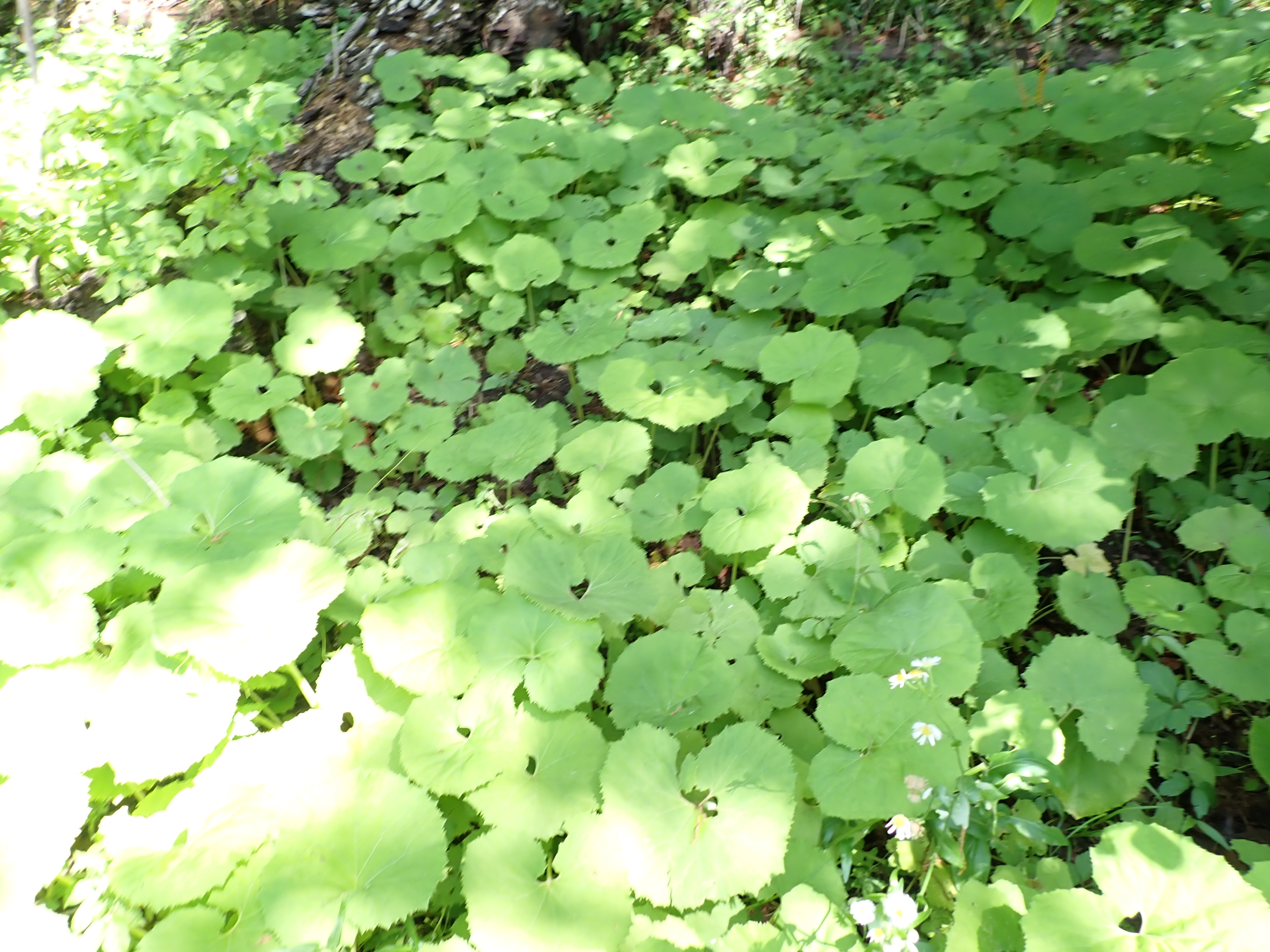
Butterbur, Petasites japonicus or Fuki in Japanese, is herbaceous plant native to Japan. Sometimes farmers nurture them for their business. And we can find wild Fuki in forests around us. It loves sunny, wet, and less windy margins of forest. They multiply through its underground stem, just like bamboos. From the rhizome, green stems shoot out and at the top is a heart-shaped large leaf. Kids can play with the leaves, making face masks or umbrellas of forest. In our climate of Kanagawa Prefecture, fuki won’t grow much tall nor with larger leaves compared with those in more northern areas of Japan. Still, in Yokohama they can be 50cm or so tall and with approx. 30cm in diameter leaves. As long as the condition is met, they dominate the field as “weed.” So, in Niiharu Citizen Forest we mow them at the end of spring to control their spread. Never mind. They will cover the ground again before winter. Oh, one more thing before cutting hard. We have to harvest them for our spring dish.


Fuki is covering completely the ground.

Yeah. Young fuki is edible. Professional farmers of colder climate distribute them for supermarkets as spring delicacy. Theirs can have 1m long with Ø1cm or more of stems. The way to cook them is similar to angelica. We peel the skin of it before cooking and stew in soy sauce, et al ... a bit cumbersome process. In Yokohama, we won’t expect that size from our fuki. Actually, it’s easier to cook Yokohama size. Let me tell you how.

Harvested fuki

First, we cut off the leaves from harvested fuki. In this recipe, we need a certain amount of fuki stems. They will be mowed as weed before long. i.e. Be greedy to have as much stem as possible! Several regional cuisines cook the leaves as well. I once tried it, and found they gave us an “acquired taste of bitterness.” Also, rhizome and roots of fuki are poisonous. Please be careful. In this post, I tell you about an easier dish with stems only.

Lots of stems

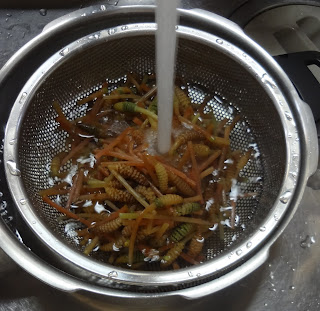
Next, cut the stems in 1 inch or so long BEFORE washing. Chopped fuki stems will be washed under running water until the downy hairs covering the surface are rinsed over. They can be removed easily in this way. If you find relatively thick stems, peel their skin. Otherwise, Yokohama-size, Ø0.5cm or so, can be prepared tender without peeling. Don’t worry.

Chopped fuki before washing.
I add salt for rinsing the fuki.
Though, it is not necessary.

By washing, hairs can be removed this much.

Chopped and washed stems are thrown in a pot. Cover with a lid, and heat it over medium heat for 30 to 50 minutes. The stems are steamed with their own moisture. I cooked 400g of fuki stems for 30 minutes. A senior of Niiharu Lovers who every year cooked fuki with this recipe said, “I normally cook 4 kg or more of it.” In her case probably 50 minutes of steaming would be appropriate. After heating, leave and cool the pot overnight with a lid.

Chopped and washed fuki stems

Next morning, add 6 tbspn (for 400g of fuki) of soy sauce, put a lid, and heat the pot until it resumes steaming. When the steam comes out, turn off the burner and leave it cool naturally. In the evening, shake the cooled pot to stir the content, then turn on the heat again until the pot emits the steam. Stop the fire and cool it naturally overnight.

After first steaming

On the third day, add 2 tbspn of sugar, and follow the same routine as above.

Cooled fuki after sugar added

And for the final day, add 5 tbspn of Sake in the same way as for soy sauce and sugar. Let it cool overnight. In the next morning, the dish is done.

Cooled fuki after sake added.
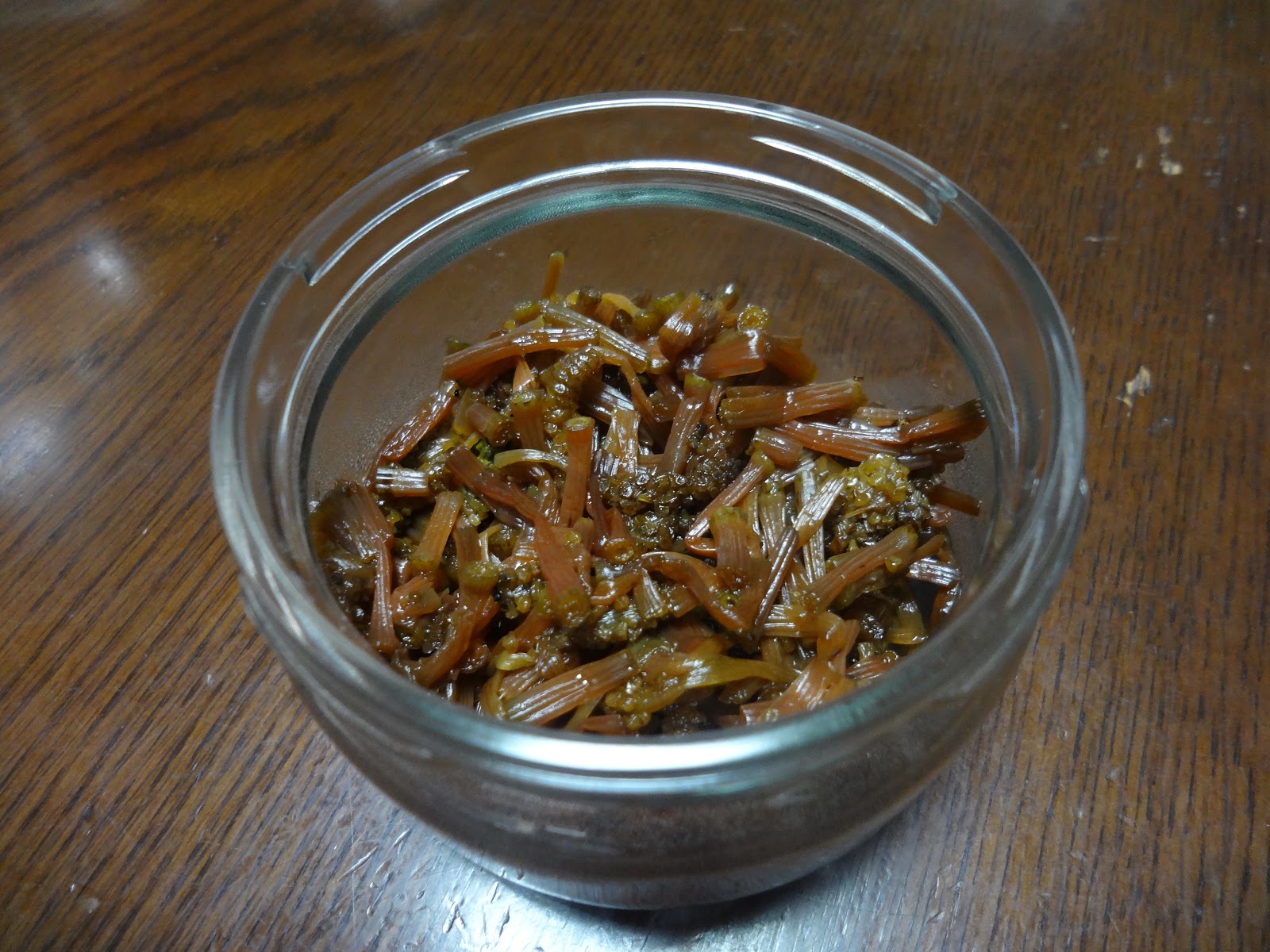
This recipe gives glaze over the veggie when it’s done.

It’s a nice dish for a spring breakfast with steamed rice. Mine was only 400g. The cooked fuki will be eaten up quickly. My Niiharu senior with 4kg of cooked fuki freezes her dish and defrosts necessary amount when she provides it for a family meal. “Oh, it can last for 10 months or so if you wish. But for my family it does not take that much to finish. 😊” Sweet and salty with Umami taste from glutamic acid of soy sauce softens the bitterness of fuki. It’s the end of spring treat. When you have a chance, please try.

Good morning!


If you have any questions about Yokohama’s Green Tax and Green Up Plan, please make a contact with

Strategic Planning Division, Green Environment Bureau, City of Yokohama
横浜市みどり環境局戦略企画課

Phone: 045-671-2712
FAX: 045-550-4093 

Friday, May 10, 2019

Sweet smell of Japanese spring: making paste from Japanese mugwort (Yomogui)


In Japanese fields, there are several kinds of plants that are edible only for new shoots. This week I tell you my cooking excursion for one of such herbs. It is Japanese mugwort (Artemisia princeps), or Yomogui in Japanese. Actually, this is a weed we can find almost anywhere, even in roadsides of downtown Tokyo. We also frequently taste their slightly bitter flavor in many dishes, like green Udon pasta, bread, cookies, cakes, donuts, traditional Japanese sweets, etc. etc. We can buy powdered Japanese mugwort, and knead it into dough for such things all year round. Though, I think using paste made of freshly picked Japanese mugwort yields the best result. Here is how I prepared such paste this year.


In a supermarket.
 Everybody loves Yomogui sweet dumplings!


First, let’s identify the site where we can legally pick fresh AND uncontaminated Japanese mugwort. … er, it would be a matter of opinion … Yeah, you can pick new shoots of Yomogui from a roadside near Tokyo Station. I think there is no guarantee that plant is free from car exhaust, or pee of city poodles normally dwelling in a high rise of the area. I prefer safer option, and go to a large forest with clean air. 😉


I prefer not taking them.
Very young leaves of Japanese mugwort


The plant loves sunshine. We have to search for an open space with lesser possibility for daily walking routes of pooch … it would be tricky in city parks, I presume. Anyway, you go there and find plant, and pick just young shoots of it, preferably during morning. You bring your harvest to your kitchen ASAP, and start working with them. They are young weak shoots. They soon become very soggy, and taste bitter. The way to prepare Yomogui is easy, but takes 2 days to complete. Here is how:


First, wash the leaves well with cold running water
 to remove any grits or else.
Next, you put them in a large pan
 of boiling water with baking soda.
 A rough standard is,
 for 300g of fresh Yomogi,
 we need 5-6L of H2O with
 a heaping teaspoonful of baking soda.
Boil them until the leaves become creamy
 when you pick them with your finger.
 For 300g, it would take about 5-6 minutes.
When leaves are soft enough and
 boiling water turns into yellow-green,
Take them in a bowl of cold water,
 and leave them for at least 12 hours.
 If you like,
 you can change water several times.
 But it seems to me too much of it
 removes flavor of the herb.
After 12 hours, take them in a colander,
 squeeze them (not too much) and
 put them in a food processor.
 If you don’t have the gadget,
 you can chop them with your knife.
 The point is
Cut their fiber as much as possible by mincing them finely.
We can freeze the paste in Ziploc to use it all year round.


When we dry completely boiled Japanese mugwort with sunshine (or microwave; er, this way is popular, actually), and powdered it in a food mill, that’s Yomogui powder we find in high-end food stores. (You can dry leaves without boiling or steaming. But they turn brown as they dry without being cooked.) As the other herbs, dried version has stronger but simpler flavor. I love frozen version. Especially when we bake bread by kneading defrosted Yomogui paste into dough, my kitchen smells very sweet. The bread has strikingly clear color of spring green! For one home-bakery cycle 1 tbsp of paste is enough. Please try. It’s a spring delicacy of Japan. 😄


White and Yomogui versions of bean-paste buns.
 We can find them in any supermarket in Japan.
 Yammy. 😋


If you find an environmental issues in Kanagawa Prefecture, please make a contact with Kanagawa Natural Environment Conservation Center 神奈川県自然環境保全センター

657 Nanasawa, Atsugi City, 243-0121 〒243-0121 厚木市七沢657
Phone: 046-248-0323

You can send an enquiry to them by clicking the bottom line of their homepage at http://www.pref.kanagawa.jp/div/1644/

Friday, April 13, 2018

Where have all the memories gone? Gathering Tsukushi in my neighborhood


Spring has come! There are lots of ways to enjoy warm weather in Japan. One of them is welcoming spring wild herbs in kitchen. Er, well, we can go to supermarket and buy some of these commercially grown from somewhere, with price tags reflecting the food mileage. As you may know it already, they are not cheap. When a head of cabbage is 200 yen ($2), 50g of wild herb could cost more than 500 yen ($5) … If you know well wild edible plants of the area, AND (which would be the most important) the landlord of the place, with the permission of the property-owner we can gather wild herbs by ourselves. Unfortunately, here in Japan the power of proprietor over land is strong, and normally it’s difficult to have blessing from landlords to enjoy wild herb gathering …


My family lives in “rural” part of the city of Yokohama where there still are lots of bamboo forests. Last spring, when my dad did his daily walking exercise with his backpack for purse, his driver’s license and a water bottle, a policeman stopped him to check his bag. He was astonished but obliged by opening his almost empty knapsack. The police apologized to my dad “many many times” (so he said) and explained why the officer had to do this. According to him, thanks to a revival in appreciating “country life,” many people from the downtown ventured into the field and forests of our neighborhood. (Our town is in just a 15-minutes’ commuter train ride from Yokohama Station 横浜駅.) Downtown people didn’t know anything, and without any permission of the owner of the land “collected tomato from a field or dug bamboo shoots from the ground right next to landlord’s house.” Hence, these 2 or 3 years when spring comes, the local police receive lots of 110 (which is 911 for the US) from the local farmers, reporting “burglary of bamboo shoots” and “theft of cabbage.” Police rushed into a bamboo forest and “arrested” thieves red-handed when they were smiling and staffing their bag with bamboo shoots. The “criminals” were often dumbfounded and asked the authority “Huh? Is it a crime?” So, in spring, the policemen of our neighborhood are busy in a park asking people with a daypack to open their bag for inspection. Listening the story of my dad’s experience, the Chairman of Niiharu Lovers’ Association 新治市民の森愛護会 who is one of the landlords of Niiharu Citizen Forest 新治市民の森 said “Oh, yes, that’s very serious in Niiharu as well. It’s a lamentable situation in Yokohama …” I thought my dad’s conversation with a police was evidence how far we in city have been separated from the nature of our neighborhood … City rats simply don’t know how to enjoy spring bounty in a civilized manner. Recently, I’ve noticed another thing for not many people knowing a very easy spring herb which I took for granted as elementary. That’s Tsukushi of Equisetum arvense, or a reproductive shoot of the field horsetail.


A photo taken in a park near my home.
The majority of plants here are wild
and edible in spring.
No Tsukushi here, though.


Equisetum arvense is of fern family ubiquitous in Japan. It loves sunny wetlands but can thrive in farm field. The plant rapidly spreads by rhizome and pore. For agriculture, it’s simply a weed to be removed. We can find it at edges of commercial ag-land, or in the suburb of Tokyo such as Yokohama, in front yards of large condo or detached houses. For adults, it’s extremely stubborn nuisance for garden. Though, I have a warm memory of its reproductive shoot, Tsukushi in Japanese. When I was three or four years old, my mom taught me it was edible. The plant has a very distinctive and cute shape easy to be recognized even by kindergarten kids. “It’s cute and mom said we can eat it. There are many, and no one cares!” So, we neighborhood kids ventured in sunny suburban roads and gathered them. Lots of them. Adults did not like the weed to thrive so we often had praise. “Oh, good girls! Thank you for cleaning up my garden / cabbage et al patch!” These days, kids in Yokohama are busy in programmed after-school activities or video games. But Tsukushi come out in the same place as decades ago. Their status as weeds for commercial agriculture or gardening has not been changed. Unless we enter deeply into a private property, picking Tsukushi does not raise eye brows much, let alone (yet) calling the police. To enjoy spring herb easily, it offers us the best (and cheapest) option!


Tsukushi. Cute.


One sunny recent weekend, I took a walk to my childhood territory that was still farm lands. Yeah, Yokohama is a good place to live … skyscrapers and idyllic countryside co-habit … Yeah, as before, cute Tsukushi came out freely, and no one cared. I gathered them for about half an hour until my small plastic bag became full. Many strollers saw me doing the thing, and wondered what I was up to. “Why does she pick them?” “Dunno …” “Oh, I’ve heard we can eat them!” “But how?” Listening their conversations in my back, I realized people have forgotten about Tsukushi … But we kindergarten kids did the same and our moms cooked them for supper. Where have all the memories gone?


Lots of Tsukushi!


For one thing, although Tsukushi is edible, the plant contains thiaminase, alkaloid, and silicon so that consumption of lots of it is not at all recommended as it can cause deficiency for vitamin B1. For patients of heart or kidney disease, or people allergic to nicotine, eating Tsukushi is contraindicated. For another, preparation for cooking is cumbersome with Tsukushi. I suspect the latter is the dominant reason why city people forgot eating abundant Tsukushi in spring. But if you don’t mind quiet preparation of Tsukushi, it’s a fun even with a broken wrist like mine. Here is how I did it this time.
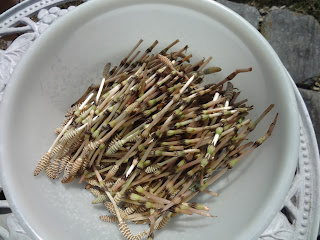

My harvest


First, we must know the brown “leaves” wrapping the stem are not edible. We have to remove them. We can peel the leaves of course, but much easier way is to cut the bottom of a leaf …


Leaves of Tsukushi
You can peal a leaf like this, or
Cut the bottom of a leaf.
A leaf slips out like this.


Continue “cut-and-slip” to remove all the leaves. If you are not strong with bitter veggies like chicory or radicchio, cut off the ear as well. I personally think the best part of dishes with Tuskushi is in the bitterness from the ear, but it’s really a matter of choice.


All the leaves are removed.


Dunk the processed Tsukushi in water preferably as you continue working with the rest for removing the leaves. Though, it’s OK you rinse all the processed Tsukushi at once. Wash them until there is no trace of grits at the bottom of a bowl. Next, leave them for a while (about 10 minutes) under running water. It is to get rid of the tartness from Tsukushi.


Wash-and-soak stage


Next, drain Tsukushi. Some recipe (for example, here or here) suggests to cook Tsukushi at this stage. But they can taste still harsh, and might be for an acquired taste. To cook them I recommend you to boil them next. You can simply boil them, or add a bit of salt as you cook pasta. I took pasta-way this year. You first dump them in a plenty of boiling water, and wait. When the pan returns boiling, drain Tsukushi quickly. Don’t overcook. A bit of crunchiness is a charm of dishes with Tsukushi.


Boiling Tsukushi
I washed the boiled Tsukushi after draining the water,
to stop over-cooking and to remove the bitterness further.


Now we can sauté them, or eat them as condiments for salad. (Sans ear) Tsukushi omelet was in a spring menu of our family when we were in kindergarten. You can keep it as is in refrig for several days.


Prepared Tsukushi.
After draining the water, I squeezed Tsukushi a bit.
Don’t over-squeeze! Don’t’ crush them!


This year, I cooked Tsukudani 佃煮 with Tsukushi. The recipe is simple. For 140g of prepared Tukushi as above, add 2 tbsp of soy source, and 1 tbsp of sake, mirin, and sugar. Cook it until the liquid almost evaporates, and let the pan cool completely. We can keep it in refrig for about a month. It’s tasty spring tapas accompanying for good Japanese sake … Though, in our household, it lasted for only 3 days. Cheers!


My Tsukushi Tsukudani


<Bonus info>

Recently, I’ve found an easy way to concoct skin tonner. In Japan, we have many kinds of citrus with which often contain lots of large seeds. Carefully remove the seeds when you eat a fruit (don’t lick them!), and gather them in a jar. Next, pour white liquor 10 times of the volume of seeds. Leave the jar for at least 7 days in a dark place, and Voila! Citrus skin tonner is ready for your daily skin care. It’s cheap and we can use it as much as we want. By applying it continuously, I’ve noticed my skin becomes smooth and soft. Though, I haven’t made it with sweet citrus like orange as I think they contain too much sugar. In contrast, lemon seeds have become a good lotion. Try it!


My citrus skin toner.
The finished product has a bit of consistency but smooth
when you apply it to your skin.