Showing posts with label Yokohama Subway Blue Line. Show all posts

Friday, September 18, 2015

Rhinoceros Beetle! Nakada-Miyanodai Citizen Forest 中田宮の台市民の森


Whatever people say, this is the news: this summer, I’ve met a Japanese rhinoceros beetle (aka Kabutomushi かぶと虫) in Nakada-Miyanodai Forest! They were the superstar of every summer when we were in elementary school. It was a ritual of the battle of will between the noble insects and greedy kids during long summer vacation. Of course the top secret was the name of the forest we could find rhinoceros beetles. … And nowadays, kids in Yokohama ask their parents in shopping malls if they can check pet shops if they find rhinoceros beetle there … TRAVESTY! I proudly declare I’ve met your highness strolling majestically within the quiet Yokohama Citizen Forest this summer. Proof: please see the photo above. This is THE legitimate way to be allowed an audience of our king! J


Actually, Nakada-Miyanodai Forest is a new and very small Citizen Forest, opened in the summer of 2012. It is a toddler Citizen Forest of 1.3 ha whose circumference is only 350 m. There is no internet homepage or links to official map for the Forest. The nearest railway stations of the Forest are Yayoidai Station 弥生台駅 of Sotetsu Line or Nakada Station 中田駅 of Yokohama Subway Blue Line. From either station, the key to find the way to the Forest is heading to ancient Goryo Shrine (五霊神社 “Nakada no Goryo-sama”) of roughly 1000 years of history. From Nakada Station, it is something of climbing up north within the residential area and the Forest is over there next to the Shrine. As this tiny Forest does not have toilet, using the toilet in the Shrine (next to Boy Scout’s Office) could be a nice move. From Yayoidai Station, we first climb up the slope and do a bit of walking along a local ridge way where in a fine day we can see large Mt. Ohyama 大山 and Mt. Fuji on the right. The distance to the Forest is about the same from Nakada Station or Yayoidai Station. Here is the Forest’s map.

To Goryo Shrine, exit
from the Southwest corner of this map
and take the left road.
Goryo Shrine
Carps in Goryo Shrine
Toiletin Goryo Shrine

As I love open views, here I report you the way from Yayoidai Station to the Forest. We leave the station from the south exit where bus stops are. Take the bus road in front of the station. Go past Mos Burger, and the venerable local establishment, Coffee-en Café 珈琲園 (where locals and expats have regular English-speaking party) on the left to meet Yayoidai-Iriguchi traffic light 弥生台駅入口信号. Turn left and walk a bit to meet Yayoidai Post Office, Bakery La Pignon on the left, and Kokusaishinzen General Hospital 国際親善病院 on the right. Cross the bus road at the end of main Hospital entrance where Kokusaishinzen-Sogo-Byoin-mae 国際親善病院前 traffic light is, and climb up the hill along the hospital campus. At the end of the campus is Nakada-kita traffic light 中田北信号. Turn right there to the direction of parking lots for the Hospital. Climb up a bit more, and at Nakada-cho-Miyanodai traffic light 中田町宮の台信号, we reach to the ridge way. If it’s a fine day, huge Mt Fuji is in front of you.   

In front of the South Exit of the Yayoidai Station
Bakery La Pignon
The crossing
at Kokusaishinzen-Sogo-Byoin-mae traffic light
Nakada-cho-Miyanodai traffic light

Turn left at Nakada-cho-Miyanodai traffic light, and enjoy a bit of panorama beyond the farm land. Soon we’ll see Miyanodai Missionary Kindergarten 宮の台幼稚園 along the ridge way. Take the narrow road at the end of the Kindergarten on the right. Now, simply follow the road in front of you, past the first small crossroad within the ordinary residential area, After 10 houses or so on the left, there is a tiny road with its end as the entrance to Nakada-Miyanodai Citizen Forest.

Ordinary residential area to the Forest
An entrance to the Forest

The Forest is designed like a garden. About a meter or so clearing surrounds the trees of broadleaves in the middle. The clearing is a circular road where we can find benches. The road inside the forest runs very slightly up-and-down. Having said that, the forest is nearly flat that gives us more impression of “garden.” The vegetation is very rich, and the volunteers are busy clearing and planting in the forest. This year they were doing the maintenance every Thursday morning (9:00-11:00), though they are taking summer vacation for July to September. (For volunteering enquiry in this Forest, please call city’s Office for the Park Greeneries in the South; phone number below.) The entire trekking road of the forest is covered by mulch of wood chips that gives us very gentle touch for our knees. All in all, its tiny size gives us a homely feeling. It seems to me at least one cat is making this place as her territory. And, yes, rhinoceros beetles, stag beetles, butterflies …

The outer road of the Forest
Just outside of the Southwest exit
from the outer road is another clearing.
When I’ve been there
I could see Mt. Ohyama.
Mt. Fuji was under the clouds …
Road within the forest

At the end of the summer, the grounds of Nakada-Miyanodai Forest started to be covered by acorns. Cluster Amaryllis began blossoming. Autumn equinox is just around the corner.


If you find a problem in the Park, please make a contact with

Office for the Park Greeneries in the South 南部公園緑地事務所
Yokohama Municipal Government Creative Environment Policy Bureau 横浜市環境創造局
Phone: 045-831-8484 (I guess in Japanese only)
FAX: 045-831-9389 (I hope there is somebody who can read English …)


Friday, August 21, 2015

An Old Tale: Masakarigafuchi and Fukaya Citizen Forest まさかりが淵・深谷市民の森


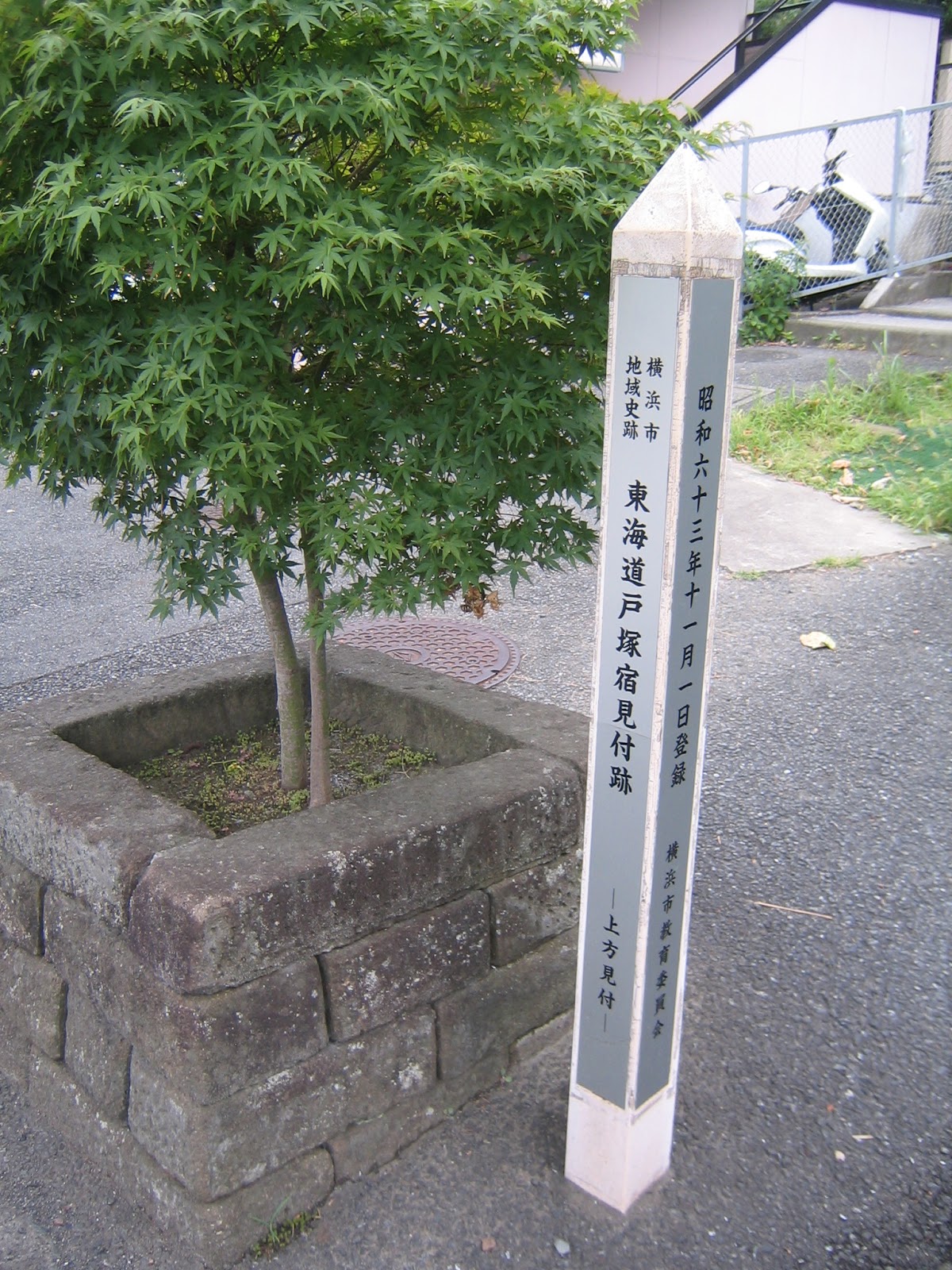
Totsuka Ward 戸塚区 of the City of Yokohama is an old town. During Tokugawa Shogunate period of 1600-1867, the area had Totsuka Hatagomachi (旅籠町 “the towns for the travelers to have a rest”), with the official license to hold large inns supervised by a designated police officer, called Mitsuke 見附, dispatched from Edo (i.e. Tokyo) government. At that time, Japanese did not have freedom of movement even within the country, and needed exit visas from their home town wherever they wanted to travel. Using horses or any vehicles to travel was a privilege allowed only to high-ranking samurais and aristocrats. For an able-bodied adult departing in the morning from Nihonbashi, i.e. the Bank of Japan, to Kyoto / Osaka via Tokaido 東海道 on foot, Hodogaya 保土谷 or Totsuka was the town to spend their first night, and to expect inspections by the police. (For present-day hotels around Totsuka Station, you can find them here and here.) As such, Totsuka town has a history of ordinary lives of people, with fairly tales. Masakarigafuchi まさかりが淵 and adjacent Fukaya 深谷 Citizen Forests are situated around the edge of this Totsuka town. (Forest map, here. There is no parking space for the Forests.)

Hodogaya
by Andoh Hiroshige
安藤広重
Totsuka, by Andoh Hiroshige
The signpost to commemorate
Mitsuke Office in Totsuka

For the access to these forests, I think the loveliest route is starting from Odoriba Station 踊場駅 of Yokohama City Subway Blue Line, and return to JR Totsuka Station 戸塚駅, as this map suggests. Odoriba means “Place of Dancing Party.” The legend has it that this was the place where local cats congregated regularly to have a dancing party. Possibly there was a field of catnips … now an ordinary residential area. Leave the station to the direction of Odoriba Post Office, and start walking to Totsuka High School, and then to Nakamura Junction 中村三叉路 traffic light. The forest we can see from the Junction on the left is Masakarigafuchi Forest. The area of Nakamura Junction had remains of pre-historic human settlement (a Johmon Remain 縄文遺跡), excavated in1932. It is indeed an old town. To leave the Forest to Totsuka Station, return to the Forest exit nearest to Nakamura Junction, and take the road to Komugyo Bridge 小無行橋 over Udagawa River宇田川. Simply walking along the road ahead to the east, we encounter Hohjuin Temple 宝寿院 (with a kindergarten), Goryo Shrine 五霊神社, and Totsuka Police Station. (Well, for this one we don’t have to show exit visa, ha ha.) Cross the 4-lane National Route 1 Bypass at the Police Station traffic light and keep going straight along the road to a T crossing with the old Route 1, or Tokaido. Turn left, and first we find Tomizuka Hachiman Shrine 冨塚八幡宮 which provides the origin of the name Totsuka, and then Yasaka Shrine 八坂神社. At Yasaka Shrine, every July 14th, there is a festival where men with female costume and beautiful makeup dedicate their dance to God Susano’o 素戔嗚 and Goddess Kushinadahime 櫛名田比売, and strew the talisman to the audience. The object is believed to have superpower against communicative diseases. If you plan to visit somewhere with WHO warnings, it might be handy to collect some. ;) From Yasaka Shrine, we can see the buildings of JR Totsuka Station just over there.

Komugyo Bridge
Route 1 Bypass
Tomizuka Hachiman Shrine
Along the way, we can find these structures,
called Koshin-zuka
庚申塚,
built in the 17th – 18th centuries
as a part of folk belief of the time.

Both Masakarigafuchi and Fukaya Forests spread over a hill up from Udagawa River. Masakarigafuchi means “Deep Water Pool of Broadax.” When we take the promenade along Udagawa River and the Forest coming from Nakamura Junction, the water pool is under a small waterfall just before the second bridge, below a cow farm. This place has a legend:

Once upon a time, there was a guy called Hikoroku in the village.
One day, Hikoroku went into a forest to gather firewood.
As he worked so enthusiastically in the woods,
His broadax slipped out from his hands,
And fell into a deep pool of Udagawa.
Hikoroku panicked and rushed to the edge of the waterfall.
Then, suddenly, a beautiful princess came out of the pool,
And said, “Your broadax subdued the evil giant snake
Which tormented me for so long.
I’d like to express my gratitude to you.
Please come to my palace.”
She brought Hikoroku to her place in the pool,
And entertained him extravagantly for 3 days.
At the end of 3 days, Hikoroku excused himself to her.
The princess said, “You never mention me in front of the other people.
Otherwise, you will die.”
When he returned to his village,
The people was holding a memorial service of Hikoroku
On the third year of his death.
His neighbors were astonished to see him,
and interrogated Hikoroku what happened.
Hikoroku was forced to tell his experience with the Princess.
But, immediately after completing his story, he perished.  


… Come to think of it, God Susano’o and Goddess Kushinada also related to a legend of large snake, Yamata-no-orochi 八岐大蛇. The area around the Forests may have something with a large snake …

The promenade along Udagawa
On the right from this bridge is Masakarigafuchi
Masakarigafuchi

Very fortunately, or unfortunately, the water pool nowadays does not seem to contain a palace or a big snake. It is a small and quiet place with occasional moos of cows. Leaving the Masakarigafuchi, keep going along the Udagawa, and we find Murakami Bridge 村上橋. From here, enter the residential area on the left for about 50 m, and find a trekking road climbing up the hill which goes through Fukaya Citizen Forest. This place became Citizen Forest in 2012 so that it is a new comer. The Fukaya Forest has 3.1 ha of size, with a single trekking route of less than 300m. The road is well-cared and almost entirely climbing up from the bridge with plenteous undergrowth in both sides. Within less than 10 minutes, we reach to the other side that is a well-established residential area, called Shochikudai 松竹台, surrounded by Fukaya and Masakarigafuchi Citizen Forests. It seems to me the houses could be built some 30 or 40 years ago so that the residential development came first, and later the Citizen Forests. Crossing the area to the northeast, we see another forest ahead which is Masakarigafuchi Forest.


The entrance for Fukaya Forest
Up, up

Ordinary Japanese lives
The entrance to Masakarigafuchi Forest
from Shochikudai.
Never mind the gate.
There are gaps at the both sides of the gate
where locals freely pass to enter the Forest.

Masakarigafuchi Forest joined the Citizen Forest Family in 1984 with 6.6 ha of the area and 1100 m of trekking road. It is also a well-tended forest by the volunteers who meet every 2nd Saturday and 4th Sunday monthly. It has 3 open spaces with benches and/or picnic tables. Fuchinoue Hiroba (淵の上広場 “Above the Water Pool Open Space”) is the largest with picnic benches. From there, we can climb up to Tonoyama Hiroba 殿山広場 surrounded by large broadleaf trees, or to Kodomo Hiroba こども広場 with an arbor and toilets. In August, the forest is occupied by a gigantic chorus of cicadas, along with dancing butterflies and dragonflies between well-established trees. Kodomo Hiroba has a 3-step structure, each with large cherry trees. In spring, this is the place where locals have cherry blossom parties.


Fuchinoue Hiroba
Picnic benches at Fuchinoue Hiroba


The signposts are clear and well-cared.


Kodomo Hiroba
Toilet


Actually we can go to Wuethrich Forest with some 1.5 k walk from here. Just find a way from Shochikudai to the direction of Yokohama Medical Center 横浜医療センター. It takes less than 30 minutes on foot. J


Nest week, I report you on Sunday for 2015 Art Exhibition in the Forest of Yokohama. J


If you find a problem in the Park, please make a contact with

Office for the Park Greeneries in the South 南部公園緑地事務所
Yokohama Municipal Government Creative Environment Policy Bureau 横浜市環境創造局
Phone: 045-831-8484 (I guess in Japanese only)

FAX: 045-831-9389 (I hope there is somebody who can read English …)