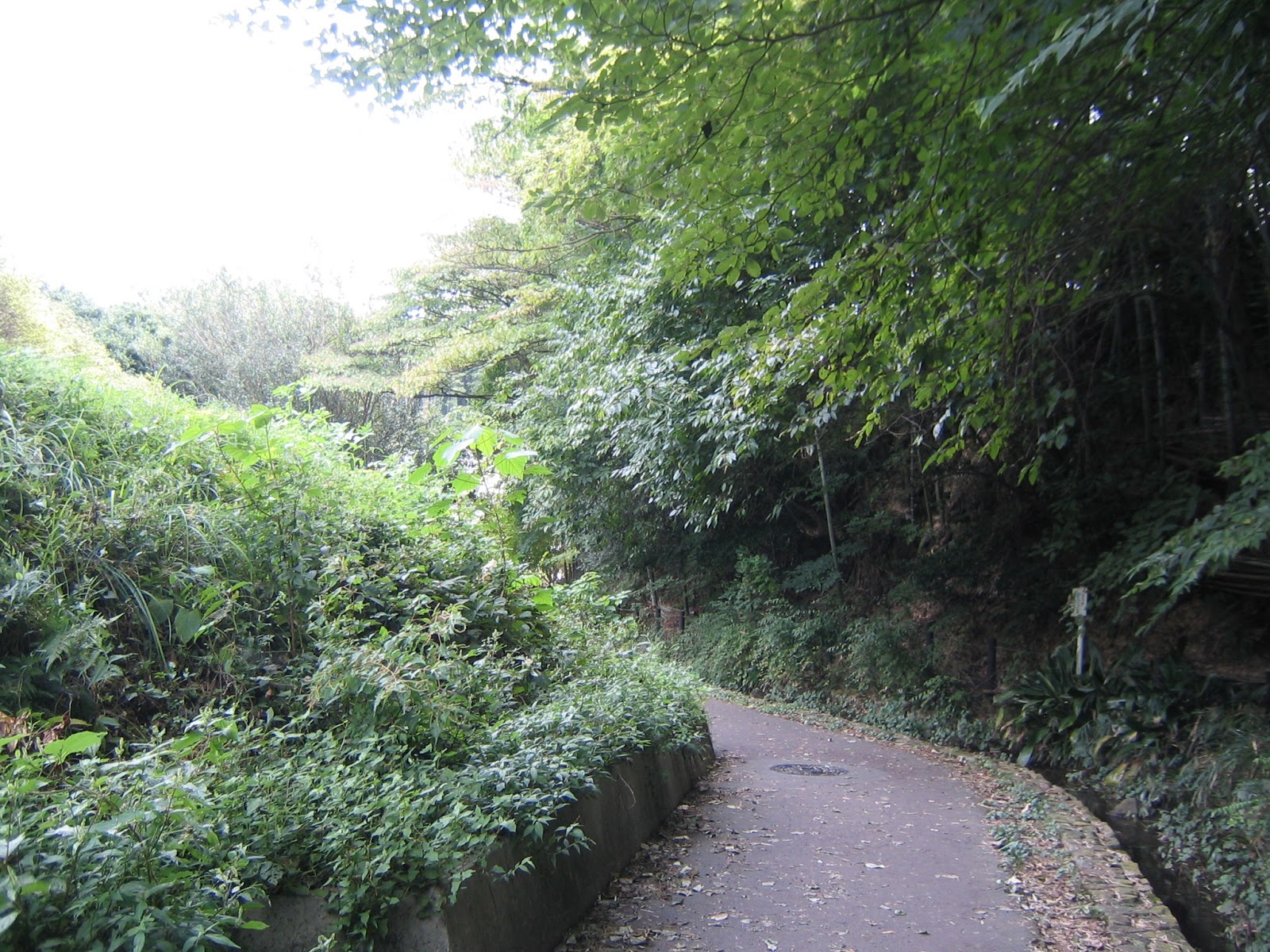
One of the smallest Yokohama Citizen Forest is
near from Yokohama Station. It has only 2.3ha, attached to Bugenji Temple 豊顕寺, next to Mitsuzawa Park 三ツ沢公園. Mitsuzawa Park is one of the most established
park for physical activities in Yokohama, with TRiM courses, and horse riding
facilities. You can combine your visit to Bugenji Forest with Mitsuzawa Park
for your weekend exercises, if you find Bugenji Citizen Forest too small. Bugenji
Citizen Forest was officially opened as a Citizen Forest in April 1983. Map of
the Forest is (in Japanese) here.
 |
| Bugenji Temple 豊顕寺 |
The temple itself has about 500 years of history. Originally it was Honkenji Temple 本顕寺 in currently Aichi Prefecture, established in 1515 by a warlord, Tame Moto’oki
多米元興. Tame moved the temple to the current place and changed the name to
make it his home after his retirement in the late 16th Century. The
family of this warlord was extinct when in 1590 Toyotomi Hideyoshi 豊臣秀吉, the
ultimate chief warlord of the late 16th century, attacked them who were
a strong ally of Go-Hojoh 後北条 family, the original owner of Odawara Castle 小田原城 near Hakone and the last enemy
of Hideyoshi. When we enter through the main gate of the temple, there is a
complex of tomb stones that is for the Tame family.
After
Tokugawa Shohgunate 徳川幕府 was established in 1600, the political center
of Japan moved to Edo 江戸 and Tokugawa Shohgun wanted to have something
cultural near his home castle in Edo (Imperial Palace now). In 1720, the Shohgunate
allowed Bugenji temple to have a school for Buddhist monks, called MitsuzawaDanrin 三沢檀林 teaching the Jinmon lineage of Hokke sect 法華宗陣門流 with an emphasis on the importance of the mantra
of Hail Lotus Stra. The school thrived. At its heydays, Bugenji-Mitsuzawa
Danrin had more than 300 student monks with 25 dorms and 5 teaching buildings.
 |
| Mitsuzawa Danrin. I thank for the kindness of Kanagawa Sunako (金川砂子) |
It
seems to me the students at that time were a bit of hot-headed young kids;
there is a saying that “You’d better waiting for a fight until you completed
your cherry blossom party at Bugenji.” And so, the Bugenji Citizen Forest is
famous for its gorgeous cherry blossoms of Yae-zakura and Somei-yoshino kind in
spring.
It might
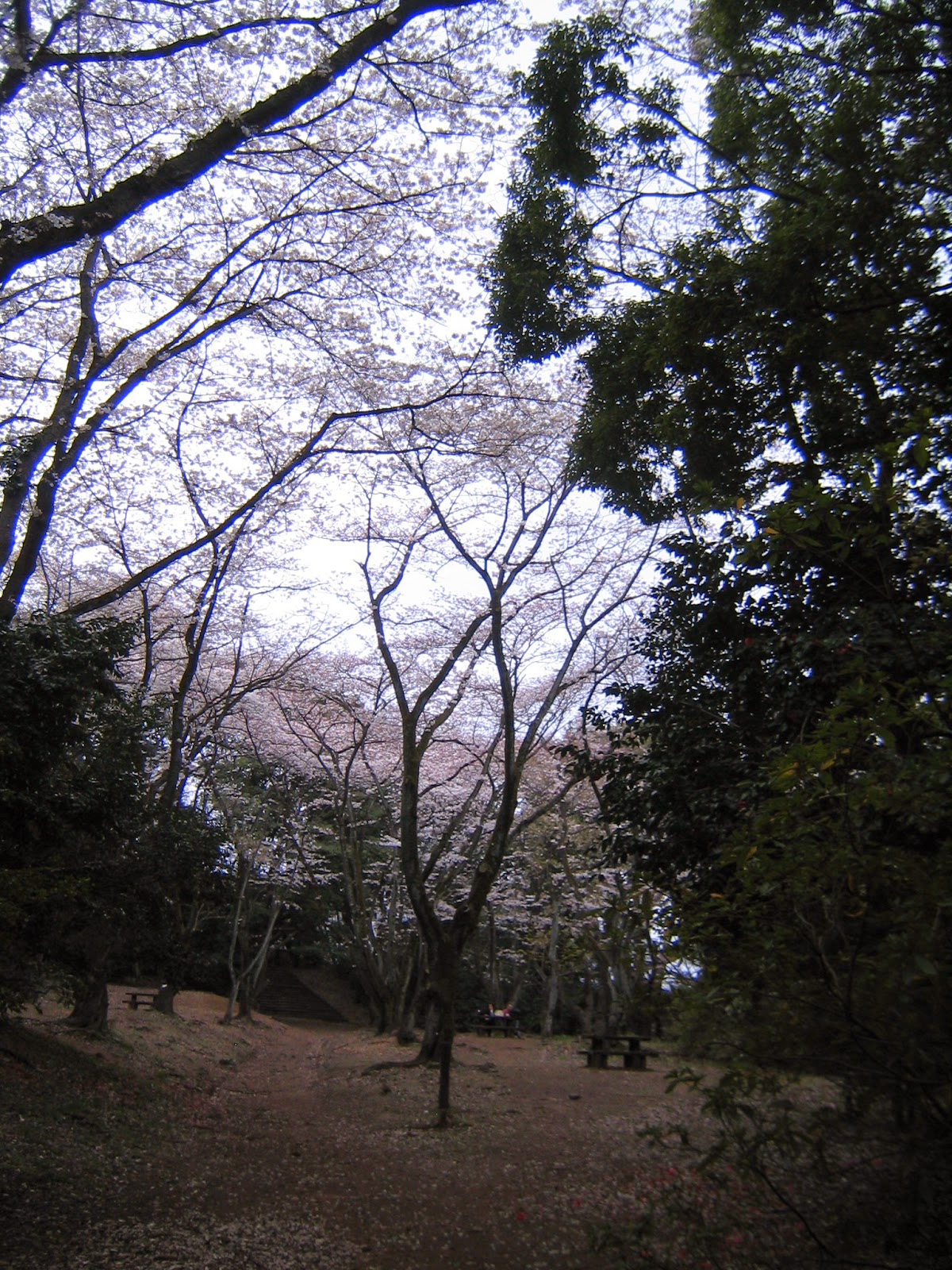
be the nearest cherry blossom party spot from Yokohama Station. If you enter
from the main gate of the temple, it’s just less than 5 minutes small hill walk
to find the huge canopy of cherry blossom trees in Sakura Hiroba (“Cherry
Blossom Square” 桜広場). There are several picnic tables where you can enjoy your
meal. Mind
you, the place is well-known for the locals. At the peak of the cherry
blossoms, there always is a fierce competition among many groups to secure the
space for lunch parties. I suggest to go there early morning; the air is clean,
the park is calm, and above all the blossom is magnificent.
 |
| Sakura
Hiroba |
From the
Sakura Hiroba, we will continue walking up to Fujidada Hiroba (“Wisteria trails
Square” 藤棚広場) and Hachiman Hiroba 八幡広場 where
the other side is Mitsuzawa Park. These
two squares also have beautiful flower trees including wisteria and the other
kinds of cherry blossoms. (Do you know there are more than 2,000 kinds of
cherry blossoms in Japan?) The entire Bugenji Citizen Forest has a cozy feel of
neighborhood garden. To circulate the entire “Forest,” it takes less than 15
minutes for a healthy adult. If schools are off, many kids of the area come
here to play.
 |
| Hachiman Hiroba |
 |
| No Smoking in the Forest |
 |
| It is not the toilet of the temple, but for the Forest. It is in Western style. ;-) |
By the
way, if you are interested in the latest information of Japanese cemetery, it
is a good place to watch what is going on. Bugenji temple is now tiny, but a well-established
institution. As such, it has a cemetery for its parishioners, which is also
ancient.

In the standard
Japanese practice for a cemetery attached to a temple, aside from investing
lamp-sum for the right of using a patch of land for a grave, a family must become
a parishioner, then, pays dues to the temple in order for keeping their space.
A typical expense consists of annual “membership” fee, regular donations to
each religious festival, and a special donation when the temple plans to
renovate their facilities such as a prayer dome where the main statue of Buddha
is situated. As you can imagine, it is not cheap. In addition, unless your
family gets deeply involved in religious matters of the temple, you will visit
the grave of your family once in a year at maximum, especially when the place
is far from your current home. Hence, these days it is very common many graves
become “muen-botoke” 無縁仏 meaning “the grave without clear genealogical title,”
i.e., the grave which the temple does not have a clear grasp of the “owner” of
the site. If a tomb does not have a visit for years (; some say, the standard
criteria is 30 years), a temple automatically considers the site is abandoned
as “muen-botoke,” and clear the place for the new parishioner family who wants
to have a grave in that temple. When the nation observes rapid aging and a
temple is in the densely populated city like Yokohama, the cycle of this
sorting game is short.
So, it
seems to me, Bugenji temple is busy sorting out their timeworn cemetery. There
are many notices saying “Please make a contact with the temple office, if you
are related to this grave.”
Indeed,
it is difficult to read the date when some of these graves were established. One
tomb stone says it was about 150 years ago when the person under the tomb stone
died (, and marked as “muen-botoke”). I visited the temple one Sunday, and noticed
a monk was busy showing the possible grave sites for the parishioner
candidates.
… er,
well, yes, monks must eat to survive. I have heard many of the temples in rural
Japan face difficulties to maintain their institution as many parishioners
simply disappear, probably to Tokyo or Yokohama, and no funding become
available. There is a horror story that the remaining parishioners are asked to
pay 2 million yen each for a repair of the temple; long ago, the cost of such
things could be divided by many families, but now … Then, Bugenji will be OK.
It has many visitors now, for cherry blossom parties, or for a grave site that had
been occupied before by somebody … As 2015 is the 500 anniversary year of its
original temple of Honkenji, Bugenji is raising money to renovate its
facilities, including toilets to become in Western style which is easier to use
for elderly people waiting to move into their final home.

Bugenji Citizen Forest is accessible on foot with
about 15 minutes stroll in Mitsuzawa Park. From the West Exit Square of
Yokohama Station, Yokohama Municipal Bus (Service 34, 35, 44, 50, 83, 87, and
291) and Sotetsu Bus (Hama 5, Hama 11, and Hama 7) operate services to
Mitsuzawa Sogo Ground Entrance 三ツ沢総合グランド入口. It’s
about a 5-minute bus ride so that you may choose to walk from Yokohama Station.
The nearest subway station for
Bugenji Forest is Mitsuzawa-kamicho 三ッ沢上町 of Yokohama Municipal Subway Blue Line. Go out
from Exit 1 of Mitsuzawa-Kamicho Station. At the mouth of Exit 1 facing the
Route 1, go to the right, then turn right at the second next corner. Ahead, if
you visit the Forest in the cherry blossom season, it is easy to recognize the
entrance of Bugenji Temple.

By the
way, Route 1 is an ancient road Tokaido 東海道 connecting Edo (Tokyo) and
Kyoto-Osaka. When you go along the Route 1 between Mitsuzawa-kamicho Station
and Tan’machi 反町 Station of Tokyu Toyoko Line, there are several shops, such as a
Japanese sweet shop, that can be traced back its history for ages. The Bugenji
Citizen Forest is about in the middle of two Hatagomachis, (旅籠町 “the towns for the travelers
to have a rest”; do you remember Ukiyoes by Hiroshige?), Kanagawa 神奈川 and
Hodogaya 保土ヶ谷.
 |
| From
Yokohama to Shizuoka |
 |
| Er,
OK, we’re now above 24m from the sea level. |
If you
find a problem in the Park, please make a contact with
Office
for the Park Greeneries in the North 北部公園緑地事務所
Yokohama
Municipal Government Creative Environment Policy Bureau 横浜市環境創造局
Phone:
045-311-2016 (I guess in Japanese only)
FAX:
045-316-8420 (I hope there is somebody who can read English …)
If you
plan to make a contact with the Bugenji temple,
Phone:
045-411-7021 (in Japanese only, perhaps …)
FAX:
045-314-8890 (Again, I hope there is somebody who can read English …)