Friday, August 21, 2015

An Old Tale: Masakarigafuchi and Fukaya Citizen Forest まさかりが淵・深谷市民の森


Totsuka Ward 戸塚区 of the City of Yokohama is an old town. During Tokugawa Shogunate period of 1600-1867, the area had Totsuka Hatagomachi (旅籠町 “the towns for the travelers to have a rest”), with the official license to hold large inns supervised by a designated police officer, called Mitsuke 見附, dispatched from Edo (i.e. Tokyo) government. At that time, Japanese did not have freedom of movement even within the country, and needed exit visas from their home town wherever they wanted to travel. Using horses or any vehicles to travel was a privilege allowed only to high-ranking samurais and aristocrats. For an able-bodied adult departing in the morning from Nihonbashi, i.e. the Bank of Japan, to Kyoto / Osaka via Tokaido 東海道 on foot, Hodogaya 保土谷 or Totsuka was the town to spend their first night, and to expect inspections by the police. (For present-day hotels around Totsuka Station, you can find them here and here.) As such, Totsuka town has a history of ordinary lives of people, with fairly tales. Masakarigafuchi まさかりが淵 and adjacent Fukaya 深谷 Citizen Forests are situated around the edge of this Totsuka town. (Forest map, here. There is no parking space for the Forests.)

Hodogaya
by Andoh Hiroshige
安藤広重
Totsuka, by Andoh Hiroshige
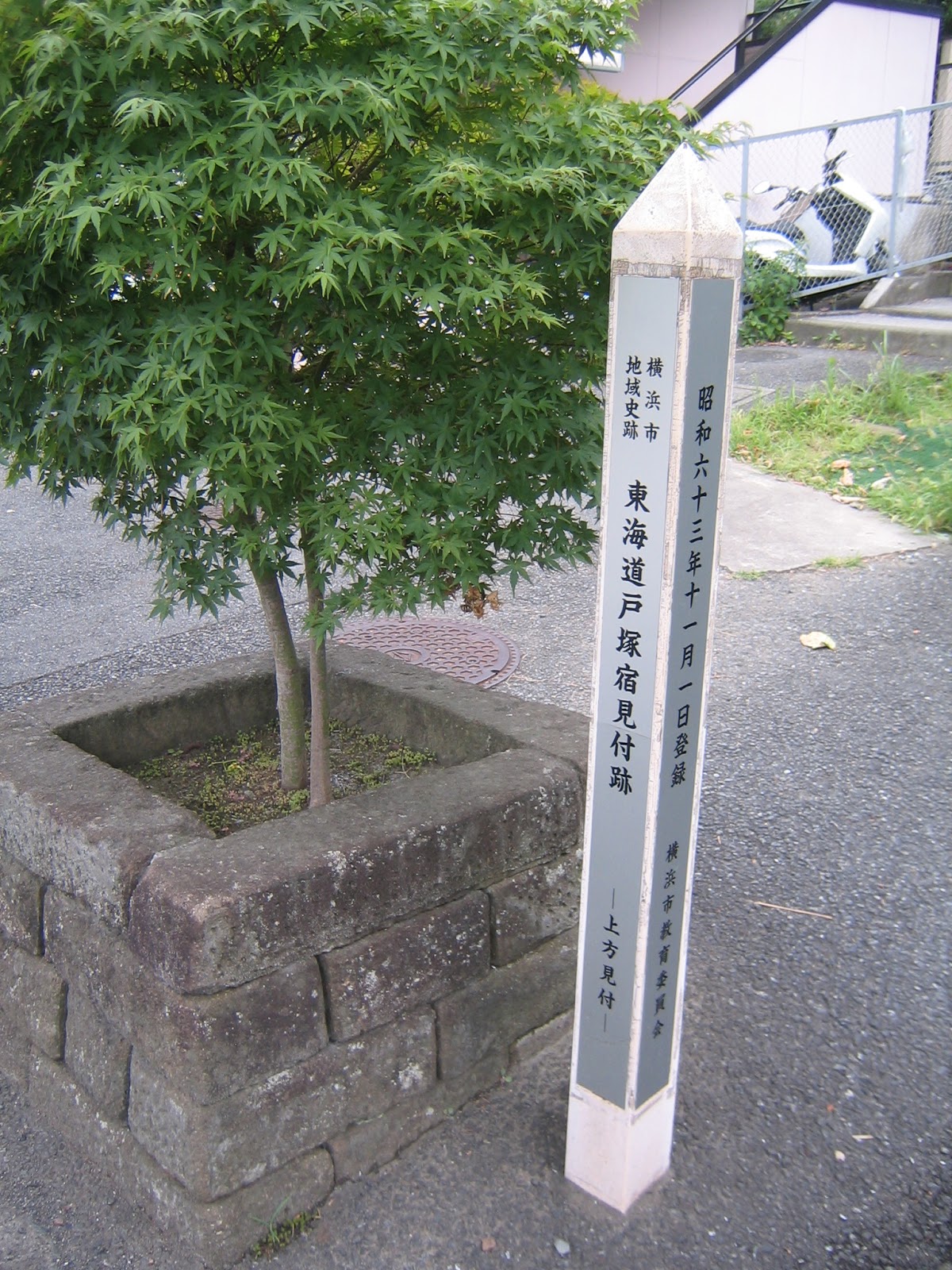
The signpost to commemorate
Mitsuke Office in Totsuka

For the access to these forests, I think the loveliest route is starting from Odoriba Station 踊場駅 of Yokohama City Subway Blue Line, and return to JR Totsuka Station 戸塚駅, as this map suggests. Odoriba means “Place of Dancing Party.” The legend has it that this was the place where local cats congregated regularly to have a dancing party. Possibly there was a field of catnips … now an ordinary residential area. Leave the station to the direction of Odoriba Post Office, and start walking to Totsuka High School, and then to Nakamura Junction 中村三叉路 traffic light. The forest we can see from the Junction on the left is Masakarigafuchi Forest. The area of Nakamura Junction had remains of pre-historic human settlement (a Johmon Remain 縄文遺跡), excavated in1932. It is indeed an old town. To leave the Forest to Totsuka Station, return to the Forest exit nearest to Nakamura Junction, and take the road to Komugyo Bridge 小無行橋 over Udagawa River宇田川. Simply walking along the road ahead to the east, we encounter Hohjuin Temple 宝寿院 (with a kindergarten), Goryo Shrine 五霊神社, and Totsuka Police Station. (Well, for this one we don’t have to show exit visa, ha ha.) Cross the 4-lane National Route 1 Bypass at the Police Station traffic light and keep going straight along the road to a T crossing with the old Route 1, or Tokaido. Turn left, and first we find Tomizuka Hachiman Shrine 冨塚八幡宮 which provides the origin of the name Totsuka, and then Yasaka Shrine 八坂神社. At Yasaka Shrine, every July 14th, there is a festival where men with female costume and beautiful makeup dedicate their dance to God Susano’o 素戔嗚 and Goddess Kushinadahime 櫛名田比売, and strew the talisman to the audience. The object is believed to have superpower against communicative diseases. If you plan to visit somewhere with WHO warnings, it might be handy to collect some. ;) From Yasaka Shrine, we can see the buildings of JR Totsuka Station just over there.

Komugyo Bridge
Route 1 Bypass
Tomizuka Hachiman Shrine
Along the way, we can find these structures,
called Koshin-zuka
庚申塚,
built in the 17th – 18th centuries
as a part of folk belief of the time.

Both Masakarigafuchi and Fukaya Forests spread over a hill up from Udagawa River. Masakarigafuchi means “Deep Water Pool of Broadax.” When we take the promenade along Udagawa River and the Forest coming from Nakamura Junction, the water pool is under a small waterfall just before the second bridge, below a cow farm. This place has a legend:

Once upon a time, there was a guy called Hikoroku in the village.
One day, Hikoroku went into a forest to gather firewood.
As he worked so enthusiastically in the woods,
His broadax slipped out from his hands,
And fell into a deep pool of Udagawa.
Hikoroku panicked and rushed to the edge of the waterfall.
Then, suddenly, a beautiful princess came out of the pool,
And said, “Your broadax subdued the evil giant snake
Which tormented me for so long.
I’d like to express my gratitude to you.
Please come to my palace.”
She brought Hikoroku to her place in the pool,
And entertained him extravagantly for 3 days.
At the end of 3 days, Hikoroku excused himself to her.
The princess said, “You never mention me in front of the other people.
Otherwise, you will die.”
When he returned to his village,
The people was holding a memorial service of Hikoroku
On the third year of his death.
His neighbors were astonished to see him,
and interrogated Hikoroku what happened.
Hikoroku was forced to tell his experience with the Princess.
But, immediately after completing his story, he perished.  


… Come to think of it, God Susano’o and Goddess Kushinada also related to a legend of large snake, Yamata-no-orochi 八岐大蛇. The area around the Forests may have something with a large snake …

The promenade along Udagawa
On the right from this bridge is Masakarigafuchi
Masakarigafuchi

Very fortunately, or unfortunately, the water pool nowadays does not seem to contain a palace or a big snake. It is a small and quiet place with occasional moos of cows. Leaving the Masakarigafuchi, keep going along the Udagawa, and we find Murakami Bridge 村上橋. From here, enter the residential area on the left for about 50 m, and find a trekking road climbing up the hill which goes through Fukaya Citizen Forest. This place became Citizen Forest in 2012 so that it is a new comer. The Fukaya Forest has 3.1 ha of size, with a single trekking route of less than 300m. The road is well-cared and almost entirely climbing up from the bridge with plenteous undergrowth in both sides. Within less than 10 minutes, we reach to the other side that is a well-established residential area, called Shochikudai 松竹台, surrounded by Fukaya and Masakarigafuchi Citizen Forests. It seems to me the houses could be built some 30 or 40 years ago so that the residential development came first, and later the Citizen Forests. Crossing the area to the northeast, we see another forest ahead which is Masakarigafuchi Forest.


The entrance for Fukaya Forest
Up, up

Ordinary Japanese lives
The entrance to Masakarigafuchi Forest
from Shochikudai.
Never mind the gate.
There are gaps at the both sides of the gate
where locals freely pass to enter the Forest.

Masakarigafuchi Forest joined the Citizen Forest Family in 1984 with 6.6 ha of the area and 1100 m of trekking road. It is also a well-tended forest by the volunteers who meet every 2nd Saturday and 4th Sunday monthly. It has 3 open spaces with benches and/or picnic tables. Fuchinoue Hiroba (淵の上広場 “Above the Water Pool Open Space”) is the largest with picnic benches. From there, we can climb up to Tonoyama Hiroba 殿山広場 surrounded by large broadleaf trees, or to Kodomo Hiroba こども広場 with an arbor and toilets. In August, the forest is occupied by a gigantic chorus of cicadas, along with dancing butterflies and dragonflies between well-established trees. Kodomo Hiroba has a 3-step structure, each with large cherry trees. In spring, this is the place where locals have cherry blossom parties.


Fuchinoue Hiroba
Picnic benches at Fuchinoue Hiroba


The signposts are clear and well-cared.


Kodomo Hiroba
Toilet


Actually we can go to Wuethrich Forest with some 1.5 k walk from here. Just find a way from Shochikudai to the direction of Yokohama Medical Center 横浜医療センター. It takes less than 30 minutes on foot. J


Nest week, I report you on Sunday for 2015 Art Exhibition in the Forest of Yokohama. J


If you find a problem in the Park, please make a contact with

Office for the Park Greeneries in the South 南部公園緑地事務所
Yokohama Municipal Government Creative Environment Policy Bureau 横浜市環境創造局
Phone: 045-831-8484 (I guess in Japanese only)

FAX: 045-831-9389 (I hope there is somebody who can read English …)


Friday, August 14, 2015

Home Sweet Home: Wuethrich Citizen Forest ウィトリッヒの森


After Commodore Matthew Perry of the US prized open a Japanese door in 1853, Yokohama became the first port of call for expats coming to Japan. Some of them decided to stay in the area and they gave the color of the City as an international place. One of those people who established a family of him/herself was Arnold Wuethrich. Wuethrich was born in Bern, Switzerland, became an engineer (wow, studied in the place where Einstein presented Theory of Relativity?), came to Japan, and married to a local girl, Hide Tsuda 津田ひ亭. In 1933, he built a house near JR Totsuka Station 戸塚駅, and died in 1983 in Yokohama. During the interwar years of the 1920s and the 30s, the southern area of the present-day Yokohama and the City of Kamakura were a fashionable area where upper-middle to upper class people built “western-style” houses. Their way of life, e.g., the design of houses, daily meals they ate, wives’ fashion, etc. became the foundation of the current Japanese styles. The Wuethrichs would have been one of those families contributed to the establishment of modern Japanese family life. Many of remaining houses including Wuethrich House around the area are now designated as “important cultural heritage” by local or national governments. During his long life in Japan, Arnold bought 3.2 ha land within a 10 minutes car-ride from his home. According to his widow Hide, he thought the place looked similar to the forest of his hometown in Switzerland. (Anything is relative …) Before passing away, Hide donated the forest to the City in 1985. The place joined Yokohama Citizen Forest family, and opened as Wuethrich Citizen Forest in 1987.

To go to Wuethrich Forest, the nearest railway station is Totsuka Station of JR Tokaido/Yokosuka Line. Leave the Station from the West Exit connected to Totsuka Bus Center. From there, take Kanachu Bus Route TO-55 or 56 (戸-55, 戸-56), and get off at Yokohama Medical Center 横浜医療センター. At the corner of the Medical Center, there is Taisho Fire Station 大正消防署 and a traffic light. We start to walk the pedestrian lane opposite to the Center and Fire Station, and turn right at the next corner from the traffic light. This road is straight; first on the right is Taisho Junior-high 大正中学校, and then on the left there is a care-house for elderly run by Franciscan Missionaries of Mary 聖母の園修道会. Keep proceeding, and we see the care-house eventually becomes a convent, and beyond is the forest. This is Wuethrich Forest. (Map here.) Unfortunately, there is no parking for Wuethrich Forest.

The straight road to the Forest
The sign post at the entrance of Wuethrich Forest

Mr. and Mrs. Wuethrich loved to tend this place. The trees and bamboos they cared in the 1940s and the 1950s now become a well-established forest. The undergrowth of the Forest preserves native orchids and ferns. They are vigorous. The couple planted several fruit trees around their arbor. The place once the structure stood is now called Arinko Hiroba (アリンコ広場 Ants Space), where the trees are still producing the bounty. The Forest is home for my insects … ants, cicadas, butterflies, beetles (of several kinds), fireflies, dragonflies, and, of course, mosquitos.

A very large persimmon tree
with lots of fruits.
They’ll be sweet coming fall.
J
Arinko Hiroba with picnic tables
I found a cast-off shell of a cicada in Arinko Hiroba.


The 900 m trekking road of the Forest is well-cared by the volunteers and without compaction. Following the standard of Yokohama Citizen Forest, Wuethrich Forest is hilly. When we enter the forest from the direction of the Medical Center, the entrance, Chirorin Open Space チロリン広場, is almost at the top of the Forest. The open space has a toilet, and the trekking roads go down from here with 25 m difference of elevation. I don’t think the place is Alpine. Arnold must have found something in the Forest. Home is where you think it is ... 

Toilet


The western entrance

If you find a problem in the Park, please make a contact with

Office for the Park Greeneries in the South 南部公園緑地事務所
Yokohama Municipal Government Creative Environment Policy Bureau 横浜市環境創造局
Phone: 045-831-8484 (I guess in Japanese only)
FAX: 045-831-9389 (I hope there is somebody who can read English …)


Friday, August 7, 2015

Battle Cry! Seya Citizen Forest 瀬谷市民の森


Probably thanks to our location next to Tokyo, unlike Okinawa, it does not become a huge political issue in Kanagawa about the existence of US military bases. The US 7th Fleet headquarters in Yokosuka. Atsugi has Army’s command, i.e. Camp Zama … Apart from strategic and logistical reasons, there is, to some extent, a historical reason for this. Before 1945, Kanagawa Prefecture hosted numerous military bases for Japanese Imperial Military. Imperial Navy even constructed underground HDQ for the “Final Battle” under the current campus of Keio University 慶応大学 in Hiyoshi 日吉, Yokohama. The area from Niiharu to Seya Citizen Forests could have preserved greenery relatively well because it was the training ground for Japanese Army.

Then, why it was so is, the northern part of Kanagawa Prefecture is not good for rice paddies. Oiwake or Miho Forests are situated near the edge of the City of Yokohama. They are the sources of major rivers for the City, which run west-east to Tokyo Bay. All the other rivers in Kanagawa go from north to south, from somewhere of Mount Fuji to Sagami Bay, and make the in-between areas, Sagamihara Plain 相模原台地, very dry. Loamy layer made by Mount Fuji lets the water retention of the ground not good for paddies. The stories of traditional life of the region depicted in “Averbatim Note of Diet in Kanagawa Prefecture (1992) 聞き書き神奈川の食事 ” imply harsh subsistence agriculture 70 years ago. The upshot was, unlike the standard geography of Yokohama, the expansion around cities from Yamato 大和 to Hatano 秦野 is flat, i.e. good for military. Then, not-for-nothing, US Navy Kamiseya Communication Unit resides at the north of Seya Citizen Forest, next to the Hodogaya Country Club 程ヶ谷カントリークラブ. 

Seya CitizenForest 瀬谷市民の森 is located west of the City of Yokohama, close to the border to the City of Yamato 大和市. To go there, the easiest would be from Seya Station 瀬谷駅 of Sotetsu Line 相鉄線. Leave from the North Exit of the station, and go northeast to the direction of Aizawa Elementary School 相沢小学校, and Seya High School 瀬谷高校. After Aizawa Elementary, we begin to see patches of small vegetable fields between houses, and then the forest beyond. It takes about 20 minutes on foot. The forest is Seya Citizen Forest, established relatively early in 1976. (Map, together with Oiwake and Yasashi Forests, here.) It surrounds Seya High School by about 19 ha of land and 3 k trekking roads. Its toilet is near to this entrance from Seya Station. On the other hand, if you come from Oiwake Forest, actually the Seya Forest is beyond the “Entrance to Seya High School 瀬谷高校入口” traffic light. By the way, to the west of the Seya Station, there runs “Navy Road 海軍道路” that is a straight North-South road (rarity in Metropolitan Tokyo area) going through the former field of US Navy Communication Unit. (The majority of the land of the Unit was returned to the landlords in the late 1990s.) This is a hidden spot for cherry blossom party early spring. The land still maintains grassy expansion ideal for kite flying, and old and large cherry trees line along the straight road with not much crowd around. It is the place for calm and relaxed picnic. J


Southwest tip of Seya Citizen Forest
Welcome to Seya Forest!

Seya Forest is, DIFFERENT, from the other Citizen Forests we have visited so far. It is flat. It is almost at the end of Tama Hills, and the beginning of Sagamihara Plain. The trees, both coniferous and broadleaved, look taller. I don’t know if they are really bigger, or it is due to optical illusion by the flat terrain, but the entire forest makes us believe it is larger than the other forests of hilly space. Come to think of it, next to the Japanese archipelago is Siberia, a flat and vast land-mass with lots of large trees. It might not be so strange to have a “continental” place within a tiny Japanese island.


Wasn’t there something like this
when Luke Skywalker competed with
stormtroopers on speeder bikes?

Flat space is good for military whenever it is. According to the local historians, this forest was a meeting point for a large number of soldiers several times. In 1333 the warlords, Nitta Yoshisada 新田義貞 and Ishikawa Yoshimitsu 石川義光, called for the rebellion against Kamakura national government. The large number of their sympathizers gathered in the area of Seya Forest to attack Hohjoh clan 北条氏 governing Japan from Kamakura. Hojoh clan was annihilated and Kamakura government was ended. Hmmm … the government established with the help of families in Jike Forest in 1192 was destroyed by the force from Seya Forest in 1333. Later, in 1417, Seya Forest again became a battle ground among another warlords in a sort of Braveheart style. The chief of the rebel, Uesugui Senshu 上杉禅秀, lost and killed himself. With very large trees spreading horizontally, it is easy to imagine the camping of soldiers with large swords and horses here and there, or the crash of samurais in spaces between large trunks. There is no picnic table for present day hikers in the Forest; only small stool “chairs” made of tree stems. Intentional design? As we should avoid stomping the ground between trees, we cannot sit on the ground as those samurais did 600 years ago. … Sitting on a stool can bring us to the time when no soldiers expected to have a well-crafted table for lunch …

Cute chairs
Camping ground for troops

The undergrowth is rich.

Japonica Saepestriata in Seya Forest

If you find a problem in the Park, please make a contact with

Office for the Park Greeneries in the North 北部公園緑地事務所
Yokohama Municipal Government Creative Environment Policy Bureau 横浜市環境創造局
Phone: 045-311-2016 (I guess in Japanese only)

FAX: 045-316-8420 (I hope there is somebody who can read English …)