Friday, September 22, 2023

Relaxed: 2023 Laboratory of Forest Art


On 17 September, aka last Sunday, it opened 2023 annual art show by the Laboratory of Forest Art. The closing will be on October 22, which means this year’s show is at least a week longer than the previous years. This is their 20th year for exhibition in the forest. Until this year, the GROUP the Creation and Voice of the Woods has received a grant from Midori Ward 緑区 for their art creation. But, Mr. Ishiyama, the coordinator of the Group, told me, “Naomi, we’ve received a sort of ultimatum saying that 2023 is the final year for the money from Midori Ward. Thank God, Asahi Ward 旭区 OKed to support us from next year, but it will be year-by-year basis … We’re thinking how to proceed from now on. In any case, receiving an art grant from Midori Ward for 20 consecutive years is extraordinary. We must be grateful for all …” Might be ironically (or not), their show has started, it seems to me, to be an annual event of the community in Midori and Asahi Wards of Yokohama. I’ve heard several casual strollers in the Niiharu Citizen Forest 新治市民の森, or in the area around Yokohama Zoorasia, chatted “Oh yeah, the annual show begins this Sunday!”. Many people, I included, visited the place before 8 o’clock in the morning to enjoy the art before the attack of heatwave. The Satoyama Garden Show by the City of Yokohama may help to disseminate info for their existence … The Laboratory is in the next forest, just 5 minutes’ walk from the Satoyama Garden (; Satoyama Garden Festa has begun on 16 September for Fall and will close on 15 October).


Anyway, let us see how things go for the next year (and beyond). This week I introduce you the new installations the artists located this year in the forest. It becomes, I would say, more natural conversations between the artists and the forest. I found the artists themselves are more relaxed than before and playing with the ever-changing scenery of nature. Let me begin.

The map for 2023 show
Follow me.

1. “Folk Art” in the Open Space at the entrance
Mr. Katsuyuki Ishiyama explained from this year some members of the Group who had been more forest volunteers than artists decided to show their art creation in the Forest. Their work is installed along the promenade from Zoorasia and in the Open Space at the entrance.

Late Summer Greetings from the Space, by Kiminito Zama

by Ryoko Iino

.color, by Mariko Kijima

by Hisako Watanabe & David Weiner

 A Parade of Seeds, by Katsuyuki Ishiyama

Life and Work in Satoyama, by David Weiner

Radiance in the Parallel World, by Norio Endoh

Balloons in a forest, by Yukiko and Kokona Hase

As always, at the entrance they provide maps for installations in the forest. Please take one, enjoy the Folk Art in the open space and follow the direction yellow arrows show. Here begins the installations (in the order from following the direction of yellow arrows);

2. Forest Wing Garden, by Toshikazu Kanai


Kanai’s last years’ installations,
the Journey of Ruined Boat,
became a sort of country hedge where
forest volunteers collect cripped grass and twigs inside.
It’s getting more and more dramatic …

3. Stranger in the Forest, by Haruna Chikada


It’s a warning for survival gamers who scatter plastics in the forest. They eventually contaminate the soil as microplastics …

Chikada for the Art Walk on September 17

4. Is the Tower Man a Sloth? by Kazuo Ishikuro


His last year’s Tower Men have now
accomplices of mushrooms.

5. In the Forest, by ASADA


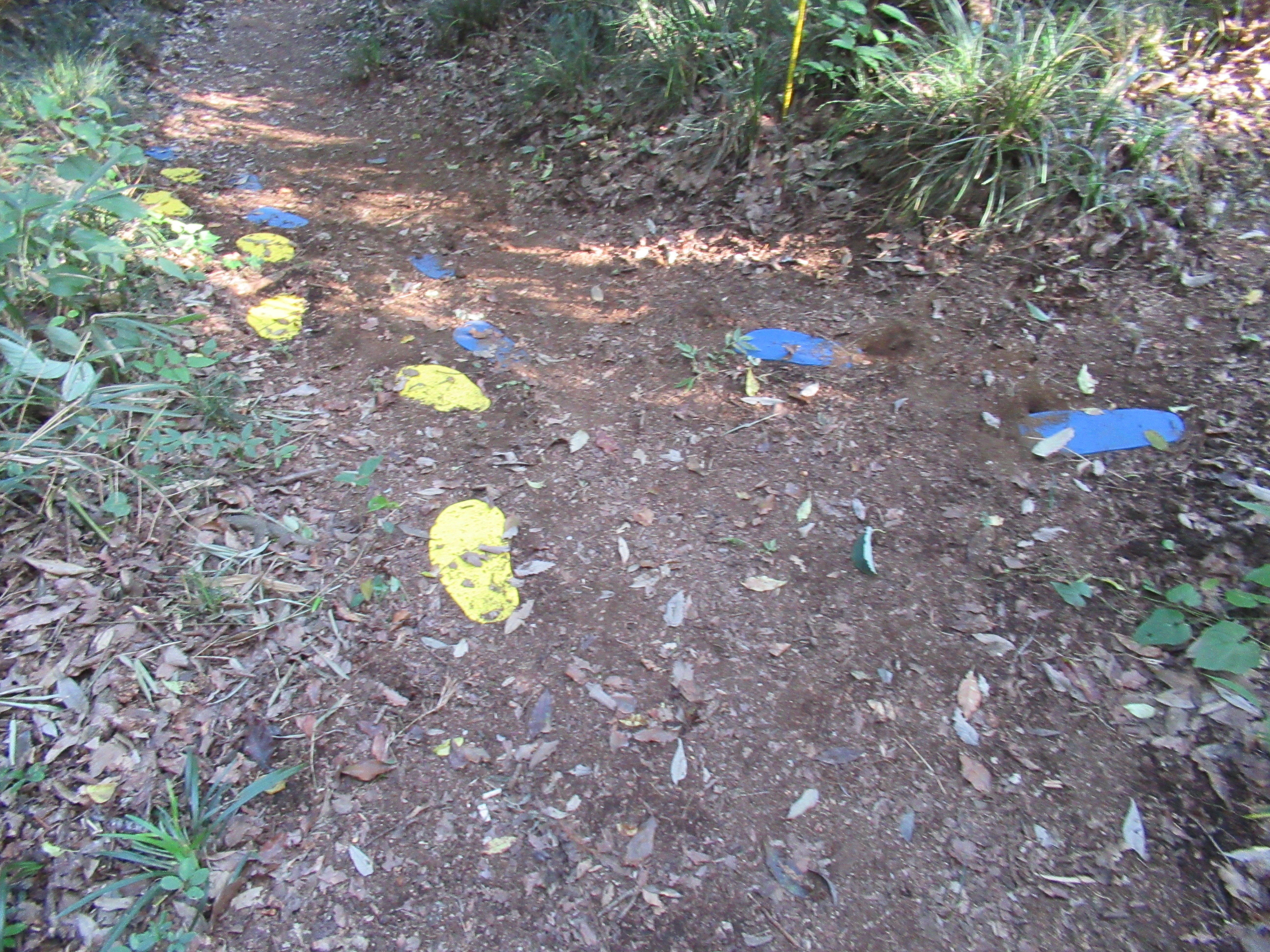
A sort of additional info ASADA has not written in the HP. Have you found these blue and yellow steps? They then join with red and white steps that go the same direction with blue and yellow. The white steps gradually getting smaller … (according to her, it symbolizes the flow of Japanese society …) Then, suddenly, large steps of red, blue and white blocks the trekking road trying to go the opposite direction. What you read from these color patterns is completely depending on you.

6. Sign, by Youichiro Yoshikawa


Have you noticed some cones are
swinging over Yoshikawa’s Lordless Garden?
He said
“Just try to find them and
you’ll see the swings of treetops and sky …
 It’s pure fun!”

7. Dust or Treasure, by Youko Kiga


I think Kiga’s theme these days is wondering along the border of human world and some magical world for which a forest has an entrance …

8. Bond (Wood Connect), by Akatsuki Harada


Harada said it has a solid structure and kids can come and play here safely.

9. And the last installation is by Katsuyuki Ishiyama, “Appearing, Disappearing”


The forest of the GROUP is as always next to Yokohama Zoorasia. Since there is no parking, a recommended access to the show is by bus. The most convenient transportation is a bus ride to Yokohama Zoorasia, from JR Nakayama 中山 Station, Sotetsu Tsurugamine 鶴ヶ峰 Station, or Sotetsu Mitsukyo 三ツ境 Station. (Timetables are here.) Get off the bus at the North Gate of Zoorasia that is the closest to the art exhibition entrance. When you leave the terminal stop of Zoorasia North Gate, go back a bit along the bus road, and on your left is the sign for the GROUP. From there enter the forest. The road is a relatively wide walking promenade. Soon you can see a big banner over there saying “the Creation and Voice of the Woods 創造と森の声.”

The banner you can find from the North Gate busstop.

Welcome!


If you find a problem in the site introduced in this post, the best contact address will be GROUP the Creation and Voice of the Woods.

https://morilab.amebaownd.com/
e-mail: morinokoe7@yahoo.co.jp

The city office which is in charge of this forest is

Office for the Park Greeneries in the North 北部公園緑地事務所
Yokohama Municipal Government Creative Environment Policy Bureau 横浜市環境創造局
Phone: 045-311-2016 
FAX: 045-316-8420

Friday, September 15, 2023

We Remember: Earthquake Pass in Sagamihara 地震峠


One hundred years ago, September 1, 1923, at 11:58, Magnitude 7.9 earthquake occurred off the coast of Kanagawa Prefecture. The calamity is well-known as roughly 100 thousand Tokyoites died due to the mega-fire caused by the collapsed wood houses. The downtowners were busy preparing for lunch with cooking stoves. … Er, exactly speaking, the epicenter of the Great Kanto Earthquake 関東大震災 was along Sagami Trough which runs from the point where Hakone mountains 箱根 falling off to Sagami Bay 相模湾 to off-Bosoh Peninsula 房総半島. The megathrust has 340km long where Philippines Plate crawls in the bottom of Eurasian Plate. The line is (at least for human time scale) stable and causes Magnitude 8-class earthquakes once in 180-590 years ... In any case, compared with the effect for Tokyo, the number of victims directly by the Earthquake was larger in Kanagawa Prefecture. Our area was situated almost “on” the epicenter. Yokohama where lots of expats built brick houses turned into a field of rubble. Our ancestors rebuilt the city and used the tons of debris to reclaim the destroyed port and shore which is now Yamashita Park 山下公園 where lots of tourists stroll to enjoy the view of Tokyo Bay.

Basically,
this part of the Port of Yokohama is made of rubble.

Western Kanagawa was affected more seriously. Reason? Just check the map how the Trough runs in the above linked websites ... The water source area of Nakamura River 中村川 which pours into Sagami Bay in Ninomiya Town 二宮 (eastern neighbor of Odawara City 小田原市) was completely collapsed. The landslide from a hill of the area dammed the flow and created Shinseiko Lake 震生湖 (; my post on November 15, 2019). At least two school kids were buried deep down the crumbled earth. There were once lively communities along Nishiyama Forestry Road 西山林道 up to near Black Dragon Water Fall 黒竜の滝 at the end (; my post on November 17, 2017). They were all engulfed by avalanches of earth and rocks caused by the Earthquake, the before and the after torrential rains + aftershocks. Another river named Shiraito River 白糸川 also became a corridor of debris flow that washed away Nebukawa Station 根府川駅 of Tokaido Line 東海道本線 together with a train going to the west and happened to entering the station at 12:02. 289 Nebukawa villagers and 131passengers and staff of the steam engine were killed … Such stories are ubiquitous in Kanagawa Prefecture.

Shinseiko Lake. It’s made by the Great Kanto Earthquake.
Last year,
it was registered as a National Disaster Ruins to be preserved.

Nishiyama Forestry Road runs along Kuzuha River 葛葉川
(my post on May 26, 2023),
and this river became a course for debris avalanche 100 years ago.

After March 11, 2011, the Great East Japan Earthquake, we Japanese noticed there were lots of old stone monuments on hills along the coast affected by the Tohoku Tsunami. They all say “At the time of year xyz earthquake, tsunami did not reach here and the villagers evacuated up to this point survived.” Sure enough, those who reached the monuments were able to escape from the 2011 Deluge. Now the communities, municipalities, and the national government are busy making a national database recording the address of these steles. Some of them record the survival of evacuees from Tsunami. The other is recording the casualties of a natural disaster and the subsequent recovery of the town. This type of stela can often be found in downtowns of cities of Japan. And the other are mourning the dead buried deep down the earth due to the debris avalanche. The stone monument at the entrance of Shinseiko Lake is one of these. One variant of the third type is found in Sagamihara City 相模原市.

The monument at the entrance of Shinsaiko Lake

The variant? Yep. After the Great Kanto Earthquake, the community renamed the place for the monument Jishin Toge 地震峠, aka Earthquake Pass where casualties could be buried deep down. According to a panel built last year by the City next to the monument, this is the place where the debris of one entire hill buried the flow of Kushikawa River 串川, a tributary of Sagami River 相模川, and changed the course of the river. In the process, 9 houses were destroyed and 16 people dead, among whom found by the rescue clue was only 8. A family of 6 was annihilated and missing. This shocking incident was commemorated by the name of the place, Earthquake Pass, and 3 monuments. If you have any chance to go to Miyagase Lake 宮ケ瀬湖 from the downtown Sagamihara City, please drop by and visit the place. It’s along Prefectural Road 513 going to Toriihara Park 鳥居原ふれあいの館 on the Lake. The nearest commuter bus stop of Kanachu Bus is Maishibashi 馬石橋 for Hashi-07 service (; timetable from Hashimoto Station 橋本駅 is here). The kids of Tsukui High 県立津久井高校 are studying the place and send messages in manga from what they’ve learned. Yeah. Memories of this must be transmitted to the next generation … The next one will surely come. Will it be in 2103, or sooner or later?

3 monuments at Jishin Toge.
Among the missing were several kids.
The central Buddhist statue is
Ksitigarbha
who is the guardian of kids.

The area is not necessarily surrounded by steep mountain slopes.
In addition, it’s in a walking distance from Lake Miyagase,
one of the largest national dams of Japan.
The geological features of the area are
robust enough for a mega dam.
Yet, we have this monument.
It’s very telling …

Kushi River is not large.
It’s like a trickle these days,
especially for your eyes from the continents …

Oh, one tourism info.
The Earthquake Pass is on the cycling road
which is a course for Tour of Japan race.
So, many cyclists use this road,
and these days the stores and cafes for tourists
equip such parking facilities for the visitors.
A part of the course for the Tour of Japan is
exactly the same for the course of 2020 Tokyo Olympics Game.


My next post is about 2023 Forest Lab Art Exhibition. Its opening is on September 17, the day after tomorrow. 😊


If you find environmental issues in Kanagawa Prefecture, please make a contact with Kanagawa Natural Environment Conservation Center 神奈川県自然環境保全センター

657 Nanasawa, Atsugi City, 243-0121
〒243-0121 厚木市七沢657
Phone: 046-248-0323

You can send an enquiry to them by clicking the bottom line of their homepage at http://www.pref.kanagawa.jp/div/1644/


Friday, September 8, 2023

Nuclear Deterrent: a new menace of dragonfly dolls, summer 2023 of Japan


This summer, probably due to the drought, the activities of mosquitos in my neighborhood are erratic. At least the number of incidents with bites for me is definitely lower than the average, Though, when it occurs, it’s really itchy. They do not bite us for fun, but for the survival of species … only female mosquitos do so to yield eggs. In really desiccated garden et al of the city they would be damned serious in biting business for stronger eggs that can endure limited amount of water. Maybe, prickly bites are good for producing robust babies … I’m just joking!

When you’re bitten,
here is the list of ointment et al in a drugstore …

continued …

This is a strong ointment some experts of
field research in forests are carrying,
containing
Diphenhydramine, an antihistamine.

Here is another for regular forest goers’ bag.
In addition to Diphenhydramine,
this one also contains PVA that can calm itchiness.
These two ointments work when we’re bitten by,
say, Brachycera, or vampire leeches.

The notoriety of bugs, not only mosquitos but also others, among humans would be mainly due to their biting habits. Many bites cause inflammation for our body that sometimes requires hospital visits. The worst-case scenario is an allergic reaction of anaphylaxis, a matter of life and death. Inevitably people go many miles to avoid such incidents. The standard approach is, as everybody knows, spraying or applying insect repellant over the body. There are many varieties in this category, starting from very organic usage of mint water, then to a bit stronger lemonglass or else … to DEET and Icaridin. All of these methods use chemicals that cause “yuck” reaction from insects, and thus they avoid coming near to such poisonous area, right? Now here comes a question. If these repellents are poisonous or disgusting for bugs, can they be OK for us, an animal species named homo sapience?

Now, a parade of insect repellent in a drug store …

Ctd. It’s a sticker containing a repelling chemical.
Popular among kids.
From experience, I don’t think it works much …

Ctd.
A towel of organic cotton with non-DEET repellent.

The left is a kind of accessary
kids (or we) can use as a bracelet or anklet.
The silicon based something contains repellent.
My experience with it?
Er … it won’t work much either.
The right pouch is for wet tissues with insect repellent.

And here are good-ol sprays.

Yep, we have larger body than pests that would guarantee more powerful ability of detox. The amount of substances to fend off tiny bugs would be minimal and it does not cause much harm for us … maybe. Or, the mosquitos simply do not like the smell of fresh mints, and we’re just happy with the herb. Is the aroma of lavender like chocolate for cats or dogs; lethal for them but OK for us to enjoy? Still, uneasiness remains. Whatever said, DEET is OK only when we use it in a proper way. So do the other chemicals, even if it’s organic mint. Is there any other way to protect us from insect bites? Tah-daaaaaaaaaah!!! Here comes a novel way to solve this conundrum. It’s by dolls!! Is it atomic Barbie? Nah. They are cute dolls of dragonflies, made of soft polymer ABS and PET.

This is a shelf for insecticides for homes.
It’s really poisonous at least for bugs.

Japanese moss balls.
It’s really easy to use as it is enclosed in paper.

The product has two types: one is with a pin to use them like badges, and another is with a strap. Budge-types are to be worn on hats, backpacks, or as accessories for your attire. With strap type, we can dangle it from a tarp-pole for camping, or on a rear-view mirror of car. The dolls are of two species of dragonflies. The larger-one is named Oniyanma-kun (Eh … maybe “Mr. Golden-ringed Dragonfly” in English). He has a little sister called Akane-chan with red body (“Ms. Autumn Darter”). The idea is, the living dragonflies are predators for some insects, including pesky Brachyceras, wasps, and mosquitos. When we wear these insect dolls, the biting bugs mistake the dolls for the real lethal enemy and so avoid coming near us. According to several internet-evaluations, Oniyanma-kun is good for larger Brachyceras and wasps, while Akane-chan is good at smaller bugs like mosquitos. Wow. So, I ordered them from Amazon.

Oniyanma-kun

Akane-chan

Yeah, they look indeed like real dragonflies. The insects could be fooled. They are soft: as long as we locate them in a proper place, they will not cause any harm for, say, small babies even if they play with them. Above all, they are not applied on our body directly. We don’t have to feel uneasiness of toxicity from insect repellent. All in all, they are great products, I think. But …

This is the real one.
The doll is really well-made, I think.

and the real Autumn darter.

When I tried to open the package and wear them on my attire for forest going, I felt I’m becoming a traitor. Yeah, it’s great if those wasps won’t come near me when I stroll in summer forest. For hoverflies etc I’m looked like carrying a very large bazooka, or a nuclear-tipped ballistic missile. They don’t bother coming to see my face. My risk of being bitten will be reduced. Great. Though, I think I will feel lonely. A wasp won’t bite us if we keep us still and show them we don’t have any intention to harm them. It will hover around us for a while, make it sure there’s no malice toward them, and leave us to continue a quiet walk in a life-filled summer forest. Do we have to arm, even if it is with decoy, in order to live a life in nature? I don’t think so.


So, my Oniyanma-kun and Akane-chan are still in a box. I may change my idea if something happens, like for a country whose neighbor suddenly sent battalions of tanks, or “little green men,” into their territory. I really hope it won’t happen … Er … I think I’m going to have allergy testing and ask a doc if I can have a prescription for EPIPEN … just in case. Is it like diplomatic membership for an Alliance?

If dragonflies work, so do the frogs, don’t you think?

Oh, I must add this: people say these dolls are really working, and hence they’re becoming best-seller in Japan. Recently, I’ve found several imitations from different manufacturers in nearby drug stores and home centers. Kids are asking moms and dads to have one. Yeah, their utility aside, they look cute. It will be a nice decoration for school bags. 😉


If you find environmental issues in Kanagawa Prefecture, please make a contact with Kanagawa Natural Environment Conservation Center 神奈川県自然環境保全センター

657 Nanasawa, Atsugi City, 243-0121
〒243-0121 厚木市七沢657
Phone: 046-248-0323

You can send an enquiry to them by clicking the bottom line of their homepage at http://www.pref.kanagawa.jp/div/1644/

Friday, September 1, 2023

Quiet Life: “beating” for studying bugs in Yadoriki Water Source Forest やどりき水源林


Nymphs of mayflies et al are normally hiding behind/beneath rocks under water and/or vegetation along riverbanks. Come to think of it, the imago from them appears openly before us humans only when there is artificial light (; my post last week). Otherwise, they continue living their hide-and-seek lives after metamorphoses. It’s ditto for non-aquatic insects on average. Those dragonflies, butterflies, and wasps would be exceptions. Territorial guys come to check if we intend to do any harm. When we run excited with insect nets after a golden-ringed dragon fly, the bug’s concern is met … Sorry, guys. Butterflies come to visit cute flowers with their beautiful wings, that stands out … Hmmm, why do they have such flashy wings in the first place? Anyway, the majority insects prefer having a quiet life. So, when we do field study for insects under direct sunshine and sweltering heat of summer, we really do not have much opportunity to catch a bag with our nets. Moreover, the kinds of insect we meet in this approach is limited, for sure. We Forest Instructors do bugs count regularly, but we realize there is room for improvement in our approach with nets. This year, a new method is introduced. It’s Beating.

A beating net

This guy does not need beating to meet.
Tettigonia orientalis.

The way of thinking for beating method is simple. Bugs are hiding in bushes or trees. We situate a beating net below the tree or bush, and beat the bush or tree to shake off the bugs clinging to them. The insects fall to the net, and we can study these guys scooped. It’s not the way to capture dragon flies or butterflies, but this summer we’ve met new kinds of bugs that are not so common to find by sweeping with nets. Here are some we’ve encountered this summer in Yadoriki Water Source Forest やどりき水源林:

Paratrachelophorus longicornis

Dromius

Ariamnes cylindrogaster.
It’s still small.
They can be 30cm or so long.
Maybe it’s a baby.

Keijia sterninotata with an egg sac

Aphrophora intermedia.
So, it’s the author for bubbles inside the forest
(; my post on June 24, 2022).

Tetragnatha praedonia

We beat several kinds of tree, and the guys falling down are the bugs known to love to live in these trees. Er, well, yeah, of course. Paratrachelophorus longicornis came from Euptelea polyandra. Aphrophora intermedia likes to be in broad-leaved trees, and we found it under sweet smell of Cercidiphyllum japonicum. These bugs are not large as swallowtail butterflies, but certainly cute. They live wisely hiding in the leaves known for them to love … Hmmm, these are very conservative creatures. Oh, so they can be an indicator to measure the health of the forest, I presume. Sorry guys, disturbing your quiet life.

Beating Euptelea polyandra

Taller person has an edge to do this task nicely.


By the way, the office for Niiharu Citizen Forest 新治里山公園 does professional counting for Mecopoda nipoesis every last Saturday of August. This year, they did it and the coordinator Ms. Yoshitake for the office said, “Look, this year it’s draught! We have found only 1 bug from our regular research field! Weather? Global Warming? Or too much mowing by the Lovers?” Oh my … Of course, they are indicator species for our planet.


If you find environmental issues in Kanagawa Prefecture, please make a contact with Kanagawa Natural Environment Conservation Center 神奈川県自然環境保全センター

657 Nanasawa, Atsugi City, 243-0121
〒243-0121 厚木市七沢657
Phone: 046-248-0323

You can send an enquiry to them by clicking the bottom line of their homepage at http://www.pref.kanagawa.jp/div/1644/