Friday, February 5, 2016

Forest Volunteering 101: 横浜森づくりボランティア入門講座体験記


So, Yokohama Citizen Forests need volunteers who can thin the undergrowth in the forests. On the other hand, Yokohama sits next to Tokyo and not many people have experience with even a small gardening. But, natural environment turns out to be essential even for city dwellers, and they can be eager care-givers of neighborhood forests, if they know how. Ideal condition for “Human Development” program, huh?


Yokohama Forest Volunteering 101 started in FY2012. It is a part of seminar series organized by the City with a help from civil society organizations that provide technical experts in urban forestry. Since 2014, the seminar is held once in a year in Niiharu Citizen Forest. The course consists of 3 weekend 9:30-15:00 seminar and practice sessions. Anybody who is 18+ years old and lives/works/studies in Yokohama can participate, free-of charge, provided s/he can attend all 3 days. Although the City organizes many other seminars for Forest volunteerism, this is the only course open to a person who has not started forest volunteering yet. The number of seats is limited at 30 on first-come-first-served basis that could be in full soon after the registration period begins. This fiscal year, for the seminars on October 17, November 14 and November 23, the application was accepted either by email or FAX between September 17 and October 2 at the Support Center for Civic Activity in Environmental Issues that belonged to the City’s Creative Environment Policy Bureau 環境創造局環境活動支援センター (FAX045-721-6356, email: ks-shiencenter@city.yokohama.jp). 30 Yokohama people of aged 20+, male and female, attended and had a weekend fun. I was one of them. J

A rainy October weekend
in Niiharu

All 3 days were made of a combo of lectures and labo (i.e. forestry volunteering exercises). Lectures in the first two days were held in the Main Room (Hiroma) of the Okutsu House. That was a splendid venue. Although it was either rainy or misty for all three training Saturdays last fall, the pure traditional room with tatami floor was warm and very comforting, or even therapeutic. I learned that in1994 the last patriarch of Okutsu Family rebuilt the house as “a traditional Japanese wooden house standing at least for 100 years without a problem.” The 3m main pillar, Daikoku-bashira 大黒柱, is zelkova, other pillars and liangs are cypress all of which do not have a knot. They were selected carefully from all over Japan. The sliding doors that partition rooms are one-wood panels (I mean, not plywood) from cedars of Akita and Yakushima Island (UNESCO World Heritage site). The carpenters were specialists of Japanese traditional architecture so that they built the Okutsu House with almost no nail. During intermissions, we all spread our legs on comfy cushions and said “If this were my house …” The grandpa of Okutsu Family commercially grew flowers in glasshouses stood on the land where now regular farmers’ Saturday market is held. Mr. Okutsu did not have an heir and donated the estate to the City. Niiharu Park and Citizen Forest were open in March 2000. Mr. Okutsu passed away in the fall of 2000. He was really a person.


Okutsu House
Sculptured window for a storage door
in the Main Room of Okutsu House.
Ideal café table
for intermissions during seminars
The traditional Japanese room is comfortable
with Powerpoint presentations.

The first morning lectures in October started by the people from Creative Environment Policy Bureau explaining Yokohama Green-up Plan and the biota of Yokohama. Then, Ms. Mihoko Yoshitake of NPO NORA introduced us the important and exciting roles of forest volunteers in the Green-up Plan. She is a veteran of civil society participation in Yokohama’s environmental policy. According to her, the 2010 change in national land legislation for agriculture facilitated the rental contracts of farm land, and clarified the role of volunteer organizations in urban forestry. Her story about the early days of forest volunteering in Yokohama was entertaining, but very educational. She pointed out 3 kinds of diversity in a forest of the City. Actors of urban forestry are many; landlords, neighborhood urbanites, hikers, municipalities, etc. with lots of crash of egos. Yokohama is in Japan where original biodiversity is very high so that the living creatures in the forests are various; sun worshippers, light haters, wet-soil lovers, drier-preferred, and don’t-care. This is the world of Darwinian “the survival of the fittest” in microenvironment. Finally, the place is so near to Tokyo and Kamakura that the area has rich geography and tradition; Tama Hills, Miura Peninsula, Sagami Plane, the yesteryear’s land usage, an incessant urbanization, legends and fairly-tales, village custom … come to think of it, we are in the birthplace of Mega-cities in the post-WW II era. Coordination Saves (Forests') Lives.  (“Coordination, coordination, coordination!”) The role of volunteers in Green-up Plan is to be facilitators and participants in planning, doing, monitoring and evaluation (“Project Cycle Management”) of urban forestry, with (“this is important”) finesse in a community. Hmmmmmmmmmm.


The second morning lectures in November discussed first the Guide Line for ForestCreation and Management 横浜市森づくりガイドラインと保全管理計画. The overall concept of the Guide Line is to aid a project cycle by volunteer organizations in a forest. First, the research about a forest is to be done (What are living inside? Who are coming to the forest for what? Is there any conflict of interest? …), and the result of the study must be shared by all the actors connected to the forest. Next, everybody is to agree with “the future of the forest,” zoning of the area, and the ways to manage the forest. Then, set a (short-term) target that is understood by all the participants: for this, the consideration for historical approach to the land management and the result of hearings from community elders should be shared by all. After all of these preparations, actual forest management activities begin, with continuous monitoring by all the members in forest management. The works in a forest are also subject to periodic evaluations, and if necessary changes in target and methodology are introduced for reaching to “the future of the forest.”


It seems to me the reason why the Guide Line takes this approach is from the experience in early days of forest volunteerism in Yokohama. It is funny when urbanites found the joy of forestry, the most exciting thing was to cut trees and clear vegetation no matter what (and lots of beer afterword), which left the mess on the ground … is it some kind of karmic thing of humans? Anyway, now many have realized it was not productive for peaceful neighborhood. In Green-up Program, the activities of volunteers should consider 5W2H always:
  • Why must it be done? To make the hiking road nice? To facilitate natural succession? …
  • What should be done for the objective? Research? Thinning? Clearing? …
  • When will we do it? E.g. Is it the right timing of work for nurturing the reproduction of owls? …
  • Where do we work? This particular point, or the entire area? …
  • Who will do it? Isn’t it better to leave it for professional? …
  • How will we do it? Do we use chainsaws? How many of us do it? What is the risk in activities? …
  • How long do we do it? For 1 hour minimizing the noise for raccoons? For several years? …

In this area of Niiharu, forest management is done by
Lovers of Niiharu Forest and local elementary schools.

As each forest has its own background, every work plan will be order-made. There is a strong merit of attentive and continuous works by volunteers coming from the neighborhood. Having said that, volunteers need to be well-versed in the management of the forest, intellectually and technically. So, the 101 seminar includes several sessions for very practical aspects of forest works. This part of the seminar was instructed by Mr. Ken’ichiro Jinbo of Kanoko Kankyo Produce Co., consisting of lectures about the basics of works in forest, such as about safe attire, about the necessary tools for works, where to procure poison removers against hornet stings (; it’s sold at Tokyu Hands), simulation technique for predicting dangers during forest works, and so on. We also had labos in the Niiharu Forest to learn the methodology of preliminary study / monitoring of forest sections. There was an exercise for the usage of sickles and ropes, a kind of scout training but specialized in forestry. I learned leaving weeded sasa bamboos or thinned trees on the ground could be harmful when the objective of a work is to enhance the biodiversity of the location. As the darkness of the ground is the main culprit making the neglected Yokohama forests less diverse, the work is to let the sunshine coming to the soil. If we leave the debris in the forest, since it is a humid city, mildews, molds, etc. can prosper at the “cleared” place and no light reaches to the ground. No mission accomplished, or worse: diseases can spread from there. After weeding and thinning, we have to carry out the cut branches and undergrowth to a designated compost heap. Hence rope works, such as Otoko-musubi, become very important.


Mr. volunteer lecturer from Lovers of Niiharu introduced
 us this part of the Forest as a spot being monitored
after weeding 3 years ago.
The work continues for several more years …
Monitoring exercise sheet I’ve done
with the field in the Forest
Quiz: Which rake is for forest works?
Answer: None.
All of them will destroy the dormant flora in the soil.
The best tool to rake forest floors after weeding is
a piece of wood.
How to use a traditional Japanese machete
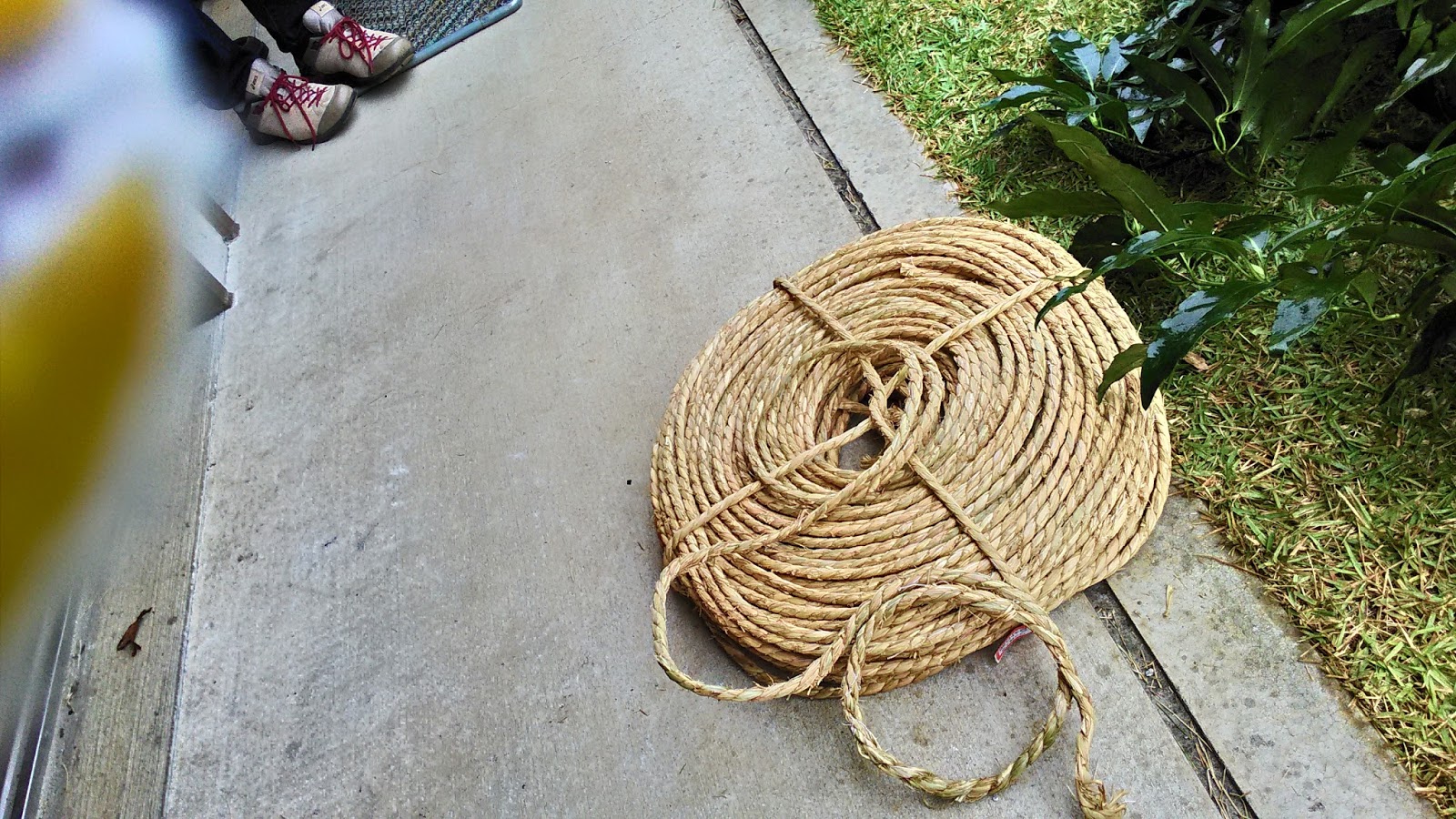
We use this rope for putting together cut sasa bamboos.
Once the grasses are arranged
in this way, it is easy to carry.
Now, our turn!

The third day started with an actual exercise on a slope near the C-5 entrance ofNiiharu Forest. For about 2.5 hours, we worked to weed sasa bamboos and other bushes with Japanese machete and scissors. The objective of the exercise was to create a space for anemone nikoensis and anemone flaccida whose seeds were dormant in the soil due to the overgrown sasa bamboos. “Let there be light!” During the labo, the instructors taught us the practical surveillance methodology, (“Such bushes could hold wasps’ nest. So, first check the place gently if dangerous creatures come out.” “Do you think the distance between the working place and the creek below is enough?” …), proper work postures (“Always draw back your leg which is in the direction of your machete movement” …), safe positioning (“Start from the bottom, then go up gradually.” “Maintain enough space between team members to avoid any injury” …), division of labor (“At least one of the team members must act as a sentry to warn members to keep safe distance, possible fallen objects, etc” …), how to weed (“the roots of sasa bamboos are to be disrupted as much as possible by inserting the machete in this way.” “Cut the stumps to the subterranean level. The hikers could stumble if a remnant pokes out.” …) It was a November day of misty cold rain … and such a fun! I was amused the concentration came naturally for all of us. 2.5 hours were so short, and at the end we admired the cleared space from many directions, imagining a new flower meadow next spring. In Kanagawa Prefecture, Hakone (National Park) has the richest biodiversity. Second position is held by Tanzawa Mountains (Quasi-national Park). The third one is (surprise, surprise) the area around Niiharu Forest. Well, people are really taking care of these places, men.


Our working site is over there.
First, check the safety of the place.
Before
After
”Let’s do ropes!”
After the work,
there was a lesson to care the tools.
“Grindstones are to be soaked
in water overnight.”

The seminar was concluded with a networking session between the seminar participants and forest volunteer organizations. Kanazawa Mori-dakusan no Kai かなざわ森沢山の会 told us their activities in collaboration with Kanazawa Zoo and Botanical Garden. Japan Bamboo Fun Club is now piloting a quasi-business scheme to develop new health foods using very young tip of bamboos. (“Unlike a standard forest, bamboo forests require annual thinning. We have to think how to dispose regularly occurring tons of deforested bamboos, in the most efficient and eco-friendly way.”) Lovers of Niiharu Forest work with 3 other volunteer organizations and surrounding communities active in Niiharu Park and Niiharu Citizen Forest, according to the Niiharu Forest Preservation and Management Plan 新治市民の森保全管理計画. Telling you the truth, I did not expect much from the seminar before attending. “Well, it’s organized by boring bureaucrats …” WRONG. The people from the City were very knowledgeable and good teachers. The lecturers and instructors from the civil society had wealth of information and experience to restore the biodiversity in the City. My fellow participants, comrades, and people from forest volunteer organizations were very friendly and eager to enjoy the forest. I had wonderful rainy weekends last fall. J


Powerpoint everywhere
Networking with
chocolates and rice crackers


The City Office who’s in charge of execution of Green-up Plan is

Yokohama Municipal Government Creative Environment Policy Bureau 横浜市環境創造局
Phone: 045-671-2891
FAX: 045-641-3490
http://www.city.yokohama.lg.jp/kankyo/


Friday, January 29, 2016

City Slickers in Yokohama Forests: Yokohama Green-up 5-year Plan 横浜みどりアップ計画

Deep Iijima Citizen Forest

Although the first Citizen Forest, Iijima Citizen Forest, was established in 1972, the program of urban forestry did not have much strategic direction for quite some time in Yokohama. The landlords who have been inheriting the forest for generations wanted to keep their family practice. But many of them could not find younger generations to carry on … in the end the families became typical metropolitan dwellers who were forgetting household tradition of forestry. While their tax burden, as property and inheritance taxes, skyrocketed due to Yokohama’s proximity to the center of Tokyo. It became more and more difficult to have somebody manage the forests. Trespassers and plant thieves came, people damped garbage or worse, and the forest floors were getting compacted daily. The high-tech civil engineering in the City prevents floods or forest fires, but at the same time it hinders natural cycle of plant succession. As the forests were abandoned in multiple ways, its biodiversity was reduced to a critical point for substantial soil runoffs that facilitated easy landslides in this rainy and earthquake-prone island.

Bony surface …
a compacted soil

Spoiled urbanites did not like the neighborhood forests that turned into rubbish collectors while depriving the “right of sunshine” for their new home-sweet-home built randomly around, or as the source of fallen leaves that clog the drainage of public roads. The spread of satellite TVs and cellphones also made them complain “those inconveniently standing trees over there.” The atmosphere in a community turned sour between newcomers to housing developments and traditional landlords. There was a definite need to deal with the mess. Then, the Burst of the Bubble in Japanese economy changed something during the early 1990s. Yokohama started to feel fed-up with go-go concrete buildings over the destroyed forests. People imagined protecting forest for the next generation, for agricultural land to know the agriculture and healthy foods, and for greenery to be enjoyed hands-on.

Kashiwa-cho Forest is just next to
a typical bed town of Tokyo.
Kumano Jinja Forest exists side-by-side
with the newly built houses.

Popular roads within a forest see visitors continuously.

Between 1996 and 2002, to nurture volunteer organizations in urban forestry, Yokohama Forest Forum よこはまの森フォーラム was organized by the collaboration between the civil society and the City. Although their activity culminated in 2002 with the establishment of an official Outline to Support Forest Volunteerism in Yokohama 森づくりボランティア団体育成・支援要綱, the coordination problem among actors was obvious for everybody joined the force. The former Forum members studied and discussed how to proceed for the environmental policy amicably agreed in a community, with more solid funding. The first comprehensive plan to achieve these was voted in the City Congress in 2008. Based on the decision, the systematized help for Citizen Forests began in 2009 with the introduction of Green Tax 横浜みどり税 and the first Yokohama Green-up 5-year Plan 横浜みどりアップ計画. Evenly split excess taxation was introduced for the individual and corporate citizens in Yokohama, currently 900 yen per year for individuals. 

Do you remember this one at Segami Forest?
Two volunteer organizations are coordinating each other …

The money collected with this levy, roughly 2.4 billion yen per year, is pooled in the special fund for supporting natural conservation and restoration programs of forests 緑の保全及び創造に資する事業の充実を図るための基金. The money is strictly ear-marked for the management and improvement in the quality of greenery in the City, and to support more preferential tax treatment for the forest owners, such as active purchases of land by the City when landlords plan to sell them for inheritance tax. In 2013 a technical Guide Line for ForestCreation and Management 横浜市森づくりガイドラインと保全管理計画 was finalized in order for making practical activity plans at each forest. (This documentation is actually fun to read as an eco-friendly gardening guide!) Later in 2014, the program entered in the 2nd 5-year plan. So far it has preserved vegetation in the city at about 14 square meters per citizen … well, certainly, a man cannot live with food sprouting from 14 square meters of land alone. Even Astronaut Watney had more Martian spaces to survive. Yokohama is definitely not an independently sustainable city. Though, the policy has achieved something, I guess.

Kawawa Citizen Forest is next to an agricultural land.
Carrots in Maioka Forest

The City’s Green-up Program supports 2 kinds of forest: one category is closed private forests under the legal restriction in development, and another is open for ordinary citizens (i.e. not landlords) to enjoy. The first one (Greenery Preservation Area, Forests of Water Sources, Special Greenery Preservation Area 緑地保存地区・源流の森・特別緑地保全地区) is for conservation of greenery with more emphasis on natural disaster prevention and water-source preservation. Especially once the land is designated as “Special Greenery Preservation Area” which is based on the land legislation at national level, the development of the forest is prohibited in perpetuity, in return for good preferential tax treatments. The second category includes our Citizen Forest family and urban parks. The parks are registered by a national act, Urban Park Act, and defined for "usage," so that it obeys the regulation concerning visitor facilities, such as barrier-free access, toilets and (at least some) paved roads. Kanazawa Botanical Park 金沢自然公園 next to Kamariya Citizen Forest is in this group. Yokohama Nature Sanctuary, Citizen Forests (of mainly 2 ha +), and their smaller cousin Friendship Forests ふれあい樹林 (of less than 2 ha) provide minimum facility for usage, but have more emphasis on nature conservation. 

This is a Garden, in Kanazawa Botanical Park.

The parks under Urban Park Act and Nature Sanctuaries are owned by (national, prefectural, or municipal) governments. The rest is privately owned, and hence the overall responsible party is landlords. Nevertheless once a private land joins in the Green-up Program, the large forestry works, such as thinning overgrown trees and construction works for landslide prevention, are done by the money from the special fund of Green Tax. That is great, but the City and landlords alone cannot restore the biodiversity of the forests. The job in Satoyama was done by everybody in the community before Yokohama became a big city. So, the 21st century forest maintenance asks the new neighbors for help. The urbanites in Yokohama are called in to be forest volunteers to collaborate with landlords to manage at least a part of the forests of any kind, including parks.

Sent by the City, the professional contractors are
dealing with the large trees.
Large landscaping by professionals
in order to stop landslides to adjacent houses

The strongest merits in neighborhood forest maintenance are their careful, thorough, and continuous care, even if the work coverage at one time would be limited. People live nearby, so it is sustainable. As villagers of 200 years ago did, the 21st century volunteers could study and monitor constantly the environment in detail, and if necessary smarten up the mess in a gentle way. They can also tell their kids how things are going in their forest, as village elders did to their next generation ... if they know how to do it.

Volunteers are busy thinning a bamboo grove: proud owners of personal saw.

Providing educational opportunities for citizens who can participate in the program is one of the main ways of using the money from the Green Tax Fund. The city and the people who have been active for forest protection before the green tax created an education program of 3 stages. The first is for the people who are “just curious” and may visit to a promotional booth at festivals in the city. There, poster presentations and videos advertise several fun and educational activities in the forest. Some of them may actually come to visit and join the entertainment in the forest, where the City recruits potential volunteers by promoting individual “volunteer registration.” At the second stage, the City provides technical seminars for those who could join the volunteer troops listed at the City. The seminars start from “Forest volunteering 101: introduction to Yokohama Forest Volunteer Program.” In the third stage, the people actually join in a Forest Volunteer organization to participate in forest activities. They walk in the forest to learn and monitor the environment, care the forest by picking trashes and clearing overgrown forest floor with modest methodology, and organize visitor fun days to let the people know the delight of having rich forest nearby. Meanwhile, advanced training courses are provided, free of charge, throughout a year for the volunteers to hone their skills. As of FY 2015, there are more than 100 groups for forests in Yokohama (; it is excluding the number of organizations for urban parks, for stream lovers, or for hiking clubs). Some are specialized in a particular forest, or even a specific part of one forest. We’ve met them in each of Citizen Forests, like Girl Scouts for Yasashi Forest. Others focus on a special vegetation or landscape, e.g. Japan Bamboo Fun Club for Kozukue Castle Forest. Segami Forest has several organizations demarcating their activity area, geographically and by vegetation. 

Proud agricultural cooperative of Jike
collectively maintain Satoyama tradition.

I’ve attended Forest Volunteering 101 course last fall. In the next post, I’ll report about it. It was really a fun!


The City Office who’s in charge of execution of Green-up Plan is

Yokohama Municipal Government Creative Environment Policy Bureau 横浜市環境創造局
Phone: 045-671-2891
FAX: 045-641-3490

http://www.city.yokohama.lg.jp/kankyo/


Friday, January 22, 2016

A Fairy Tale of Lost Children: Yokohama Nature Sanctuary 横浜自然観察の森


Strictly speaking, 45 ha of Yokohama Nature Sanctuary is not a member of Yokohama Citizen Forests, but one of the 10 elite educational Nature Sanctuary Forestsin Japan established by partial grants from national budget. In the context of countrywide environmental policy, the Sanctuaries are expected to be the forefront of protecting nature against random urbanization, for the archipelago defined as a “Hotspot” of unique but endangered biodiversity by the Conservation International.  So, the difference between Nature Sanctuaries and National Parks in Japan is Sanctuaries’ proximity to the mass of ordinary people. Nature Sanctuaries are to provide as much as possible educational experience for urban kids and quality-of-life enhancement for adult city-dwellers. The management of Nature Sanctuary Forests is done by collaboration of municipal governments and private sectors. The Ministry of the Environment plays advisory role + monitors the usage of national expenditure in these places. Naturally, these days Sanctuary Forests are gateway to eco-tourism as a part of economic trend: many many people come, rain or shine. 

Yokohama Nature Sanctuary has
many educational signboards.
Each route inside the Sanctuary
has educational theme.

The Yokohama Nature Sanctuary opened its door in 1986 as the first Nature Sanctuary in Japan, with the national and prefectural grants. The City subcontracted the daily management of the place to Wild Bird Society of Japan who provides us the guidance of professional rangers stationed at the Nature Observation Center in the Forest. The Center (open 9:00-16:30, closed Monday; free) has library and interactive museum space where we can see, touch, and listen “animal, vegetable, mineral” of the Sanctuary. The Wild Bird Society and the governmental offices provide many educational events throughout the year in the Sanctuary. The large landscaping and natural-disaster resistant construction within the Sanctuary are by public entity, but selective undergrowth thinning and re-creation of traditional farming are done by 200+ volunteers who are registered at the Friends of Yokohama Nature Sanctuary (est. 1988). The Friends has their own pretty meeting place, Gorosuke-kan, next to the Nature Observation Center, and a charcoal making hut … well, the space with 4 structures is large enough to call it a play-garden. Not only engaging in the forest maintenance works, the Friends holds weekend educational tours for under-15 kids (and adults) to enjoy the Forest, in addition to the events by the Sanctuary management. (Their FY 2015 event list is here and here.) Often the lecturers of the events in the Sanctuary are college professors, and lotteries are held for choosing participants; they are crazy-popular. Coming February 11th, there will be a seminar for teenagers to learn frog habitat protection; application deadline is February 4th either by email, FAX, or reply-paid postcard to the Sanctuary (link, here); the seats are allocated by the draw. Frog lovers, Good Luck! We can download the result of these educational and environmental research activities in 2013 Report from “HOME” of their homepage.

Nature Observation Center
First Sunday of each month is for Kids’ tours.
Gorosuke-kan for volunteers
Charcoal making “huts”
Re-creation of traditional vegetable plots
At the moment, Tampopo (Dandelion) 11-13 Area is
closed till February 2017
due to the construction of anti-earthquake measures
for an underground flood-prevention pond.
(Yes, for an artificial pond.)
Coming April, it will be the brand-new barrier-free toilets
at Nagakura-guchi Entrance.
The barrier-free toilet near the charcoal making huts.
All toilets in the Sanctuary are clean and barrier-free;
soaps provided.

The access to the Nature Sanctuary is either from Kanazawa Forest along Beetles Trail, or directly by bus from Keikyu Kanazawa Hakkei Station 京急金沢八景駅. At the moment, Kanazawa Hakkei Station is undergoing a renovation so that it may be tricky to find a bus stop to the Nature Sanctuary. We leave the station, and cross Route 16 to the direction of Kanazawa Hakkei Station of Kanazawa Seaside Line monorail at Kanazawa Hakkei Ekimae Traffic Light 金沢八景駅前交差点. Turn right to the direction of Sumitomo Mitsui Bank. A bus stop in front of the building next to the bank is for the services to Nature Sanctuary. Take Kanachu Bus 神奈中バス from there to JR Ofuna Station JR 大船駅 with Funa-08 08 (time table here) or Kana-28 28 (time table here) services, or to Kamigo Neopolis 上郷ネオポリス with Kana-24 or -25 24, 25 services (time tables, here and here). For the Sanctuary, we can get off the bus at 4 stops starting from Yokohama Reien-mae Bus Stop 横浜霊園前, Mori-no-ie Stop 森の家, Kamigo Stop 上郷, and Nagakura-cho Stop 長倉町. When you ride the bus, you tell the driver which stop you plan to take; s/he will charge you accordingly. From Yokohama Reien-mae Stop, there is an entrance of the Sanctuary on the other side of the road climbing up steeply to the Nature Observation Center. From Mori-no-ie Stop and Kamigo Stop, climb the road on the other side to reach first in the middle of the hill to Kamigo Mori-no-ie 上郷森の家 which is a conference center/hotel/BBQ field/spa/baden within the forest, managed by Yokohama Greenery Foundation 横浜市緑の協会. Passing the facilities of Mori-no-ie, we soon arrive at the main entrance to the Sanctuary. If you come to the Sanctuary by car, you can use the parking of Mori-no-ie (; 500 yen per day). Oh, by the way, the bus route of to the Sanctuary crosses Asahina IC of Yokohama-Yokosuka Road. Just before the IC, there is Asahina Bus Stop 朝比奈 from which we can enter the historical Asaina Kiridoshi Pass 朝夷奈切通 to Kamakura. It is one of the 12 natural barriers that protected medieval Kamakura Government from outside till 1333. This geological point is one of the reasons why Enkaisan Area has experienced human interventions for millennia.


Kanazawa Hakkei Station
Cross Route 16
to the direction of the Seaside Line station.
Bus Stop to the Nature Sanctuary
Entrance from Kamakura-Reien Bus Stop ...
It goooooes up in this way …
From Kamigo Bus Stop, the entrance to Mori-no-ie
Mori-no-ie
Entrance to the Nature Sanctuary from Mori-no-ie

Having said that, if you go to the Nature Sanctuary directly from Kanazawa Hakkei, I recommend getting off the bus at Nagakura-cho Stop, because we can enjoy a gently sloped promenade to the Sanctuary along Itachi River. The road is easy to walk, with the 4 picture-boards to the Sanctuary depicting a local fairy tale painted by the kids of Noshichiri Elementary 野七里小学校. The School does not exist anymore: it was closed 10 years ago due to the aging population around Nagakura community. Signboard #4 is almost at the entrance to the Sanctuary. er, yes, the tale is written in Japanese … translation:


Once upon a time, at the end of Shodo community 庄戸  and Kodo community 神戸, there was a pond called Nagakura where a large snake lived for ages.
One hot summer day, a local man called Yasaburo entered the forest around the pond for work.
He became very thirsty, and drank water from Nagakura Pond.
That night, Yasaburo had a high fever, and lost consciousness.
Tasaburo had a daughter called Okinu.
Okinu was very angry because she thought the snake in Nagakura Pond made her dad very ill.
So she went to the Pond and shouted “Hey, Snake, why have you made my dad sick!?”
The snake appeared from the pond and told her she was lonely and cried a lot. Her tears made anybody who drank the water from the pond ill.
Okinu felt sorry for the snake. She played with the snake to comfort her.
When Okinu returned home after playing with the snake, she found Yasaburo had recovered completely.
So, Okinu and her human friends started to play with the snake everyday, with lots of laughter.
The snake was a messenger from the heaven. Eventually she accomplished her mission, and transformed into a dragon returning to the heaven.

Nagakura-cho Stop
Story #1
Start of the promenade
It goes into the forest …
Story #4, and
To the entrance to the Nature Sanctuary
This is Nagakura Entrance:
the brand-new toilet is over there.

Nagakura Entrance is Blue-13 in the map of the Sanctuary. The route with blue numbers in the map is called Dogwood Trail ミズキの道 of 1.6 K. This route is circular where the Marsh of Luciola Lateralis 平家ボタルの湿地, the smallest 3 native fireflies in Japan, is at the highest point. From Nagakura Entrance, if you take the right paved road along Itachi River proper, we first find on the left an area, the Valley of Luciola Cruciata 源氏ボタルの谷, in Itachi River. Soon after, on the right is a small pond called Whirligig Beetle Pond ミズスマシの池 that receives water from Dogwood Valley ミズキの谷 above. Then, in front of us, there is a birds-observation hut that allows us to watch wild birds enjoying their water life in the Dogwood Valley. The point is the “official” source of Itachi River, and Katase River pouring to Sagami Bay at Katase-Enoshima Beach. The paved road simply continues to climb up to Colias Erate Plaza モンキチョウのひろば (#1) in front of Nature Observation Center (#0).  When we don’t proceed to Blue -3, we can take the route from Nature Observation Center to the Sanctuary entrance to Mori-no-ie that is a similarly paved road passing in front of the charcoal making huts and the construction site. It is the easiest way in the Forest.  The vegetation around Nature Observation Center is educationally planted for kids to touch and investigate forest environments, with lots of picnic benches in Colias Erate Plaza. It is a very busy area during weekends with lots of people.

Marsh of Luciola Lateralis
The paved road slowly goes up
along the Valley of Luciola Cruciata.
Whirligig Beetle Pond
Birds Observation Hut
er, well, no bird here.
The pergola in Colias Erate Plaza
Educational instruction!

The rest of the road in the map, Blue 2-13 (a part of Dogwood Trail), Orange 3-10 (a part of 800m Dandelion Trail タンポポの道), Green 6-14 (a part of 700m Nightingale Trail うぐいすの道), and Red 2-11 (a part of Quercus Serrata / Beetles Trail コナラの道・ビートルズトレイル that is 1.7K within the Sanctuary), is more of the standard trekking road in the mountains. Each has its own charm. Orange 3-10 skirts the backside of the construction area. It was once a productive community forest when people used the place for agriculture. Now the place is designated to preserve traditional forestry method of subsistence village life. The space near to the entrance from Mori-no-ie is named Sympetrum Frequens Hill アキアカネの丘 where a shallow pool appears when it rains due to a small rough terrain with various grasses. The management keeps the place as such by regular mowing in order to protect the animal and vegetable lives that thrive in such condition. From there down a bit, there is a Sawtooth Oak Open Space クヌギの林 where volunteers recreated a traditional Sawtooth Oak forest and open working space that was common all over Japan when people harvested forest vegetation for fuels and fertilizers. The Orange Trail itself is kept to maintain the traditional village life atmosphere by the Friends.


Sympetrum Frequens Hill


Re-created traditional utility forest …
and its open space where
I met lots of mole life.
This Sanctuary is managed by Wild Bird Society,
oh yeah.

Green 6-14 is a bush forest where wild insects and animals lives, … I met lots of Taiwanese squirrels there, gnawing barks here and there, NOT fearing me AT ALL. The Chief Ranger Mr. Kominami told me this fall the harvest of acorns was not enough + their home country does not have winter so that in Yokohama they are a kind of desperate to chew little bit of honey out of the barks … He is a so kind-hearted animal loving person … Maybe the bush trees in the Sanctuary are strong enough to withstand the Attack of Squirrels …  Red 2-11 is the continuation from Isshindo Plaza. The ridge way is wide and well-trod as we visited last week. The valley on the right from the Oomaruyama climbing point to Red 11 is “completely off-limit” area for human intervention. The last human involvement there was before 1940 so that we can see someday how the things will go if the nature dictates to Yokohama. It’s a kind of funny lots of people walking along very popular hiking course peek into a steeply tumbling down slope of trees that is strictly prohibited. We can observe continuous roofs of houses in Shodo community and beyond starting at the end of the forbidden forest. How will the environment evolve …?

The road of Nightingales
The table manner of squirrels
The road from Oomaruyama
The off-limit forest for humans,
but hungry Taiwanese squirrels are gnawing the barks
(please see the tree on the right).
Sekiyaoku Viewing Point 関谷奥見晴台 in Beetles Trail

Blue 1-13 is along a valley joining Itachi River at Blue 13 where its north is the off-limit area for conservation. I would say this is the wildest trekking road of all the accessible routes in the Sanctuary. From Blue 13 to 8 is a steep slope of about 500m running along the valley of deep forest. Though precipitous, stairs, wooden decks and bridges and narrow hiking route are well maintained. We’ll find some trees along the road with a number card wrapped around the bark. It is for the hikers to identify each tree according to the free Tree Watching Map we can take from the Nature Observation Center. In January, I have seen lots of wild euonymus hamiltonianus there with its pretty pink seed skin. The undergrowth is sometimes of large ferns. The contrast of innocent pink and untainted green in pure winter air is … sublime. Oh, the road of this part is so narrow that no photo stand is allowed. Hold your camera with your muscle! The space around Blue 8 point is named Asteroideae Plaza ノギクのひろば and from there to the crossing with the Beetles Trail at Blue/Red 6 is more flat, wider and dry. Asteriudeae Plaza is sometimes used for educational excavation as we can find lots of fossils of sea creatures. (Of course, nothing is allowed to remove from the Sanctuary!) The Sanctuary is in the south of Enkaisan; the seabed was raised by tectonic crash 2 million years ago.

This much of steepness
The tree number goes like this.
#25 is for lindera umbellate that can be manufactured
into the best quality utensils
for the highest prestige tea ceremony.
Hey, the place is for conservation.
This tree must stay there as such.
The valley
Those ferns thrive on a vertical hardpan.
Asteriudeae Plaza
The road from the valley to the Plaza is definitely drier.
Do you notice sasa bamboos here have
impressive dark brown barks?
Route to Blue/Red 6 is almost a ridge way
with a view to the west.


The entire area from Mine Citizen Forest to Yokohama Nature Sanctuary is considered as the core of Yokohama Forest of Relationship Program 横浜つながりの森構想. This program is a part of municipal policy, Yokohama Action Plan for Biodiversity (Yokohama b-Plan), where nature conservation in a highly urbanized city envisages to act for the welfare improvement of current generation and beyond. In 2014, the Ministry of the Environment published an environmental assessment report for the area with eco-tourism promotion in mind. The place has a long history of interaction between the forest and humans. Yokohama people, volunteers, private business including farmers, municipal and national governments, all try to make the place better for future. Sure … do you know the biodiversity of the area is smaller than the area around Niiharu and Zoorasia? (According to the data from 2006 Kanagawa Prefecture Red Data Biological Research Report 神奈川県レッドデータ生物調査報告書.)  The difference between these 2 areas? Enkaisan Area is visibly and invisibly dissected by heavy-traffic roads …  Tomei Highway, the main artery of the Japanese economy, runs 1K north of Niiharu Forest, but does not come into the Forest …


If you find a problem in the Forest, please make a contact with

Yokohama Nature Observation Center at Yokohama Nature Sanctuary
横浜自然観察の森自然観察センター
Phone: 045-894-7484
FAX: 045-894-8892