Showing posts with label Waterfall. Show all posts

Friday, April 14, 2017

Mt. Oyama and Deathly Dolls: Lower Afuri Shrine and a mini-hike to Miharashidai 大山阿夫利神社下社


Oyama Afuri Shrine 大山阿夫利神社 has 2 campuses. One is the Upper Shrine 上社, which is on the top of the mountain. Another is the Lower Shrine 下社 that we visit in this post. Once you’ve experienced Otoko-zaka 男坂 and/or On’na-zaka 女坂, you may have realized why there is the Lower Shrine. The way to the Lower Shrine is steep enough. In Mt. Oyama, the higher the elevation is, the sharper the slope.  In addition, until 1868 the main hall of Oyama Temple 大山寺 was at the location for the current Lower Shrine. Pilgrims to Oyama until then made the Temple their first destination to dedicate their wooden sword. After the Oyama Temple moved to the current site, the place was both spiritually and logistically good place to have the Lower Shrine, I guess. The most frequented route to the Shrine these days is using a cable car service from Oyama Town to the Lower Afuri Shrine 阿夫利神社下社, an elevation of 700m. There are lots of people who are happy enough to make a do at the Lower Shrine only. We can actually have a splendid view of Sagami Bay from the Lower Shrine. For New Year’s Eve and the autumn-leaves season, the town of Oyama has light-up events when they operate Cable Car at night. We can enjoy even the night view from the Lower Shrine during this period without risking night-time hike. The god of Mt. Oyama is generous. 😄
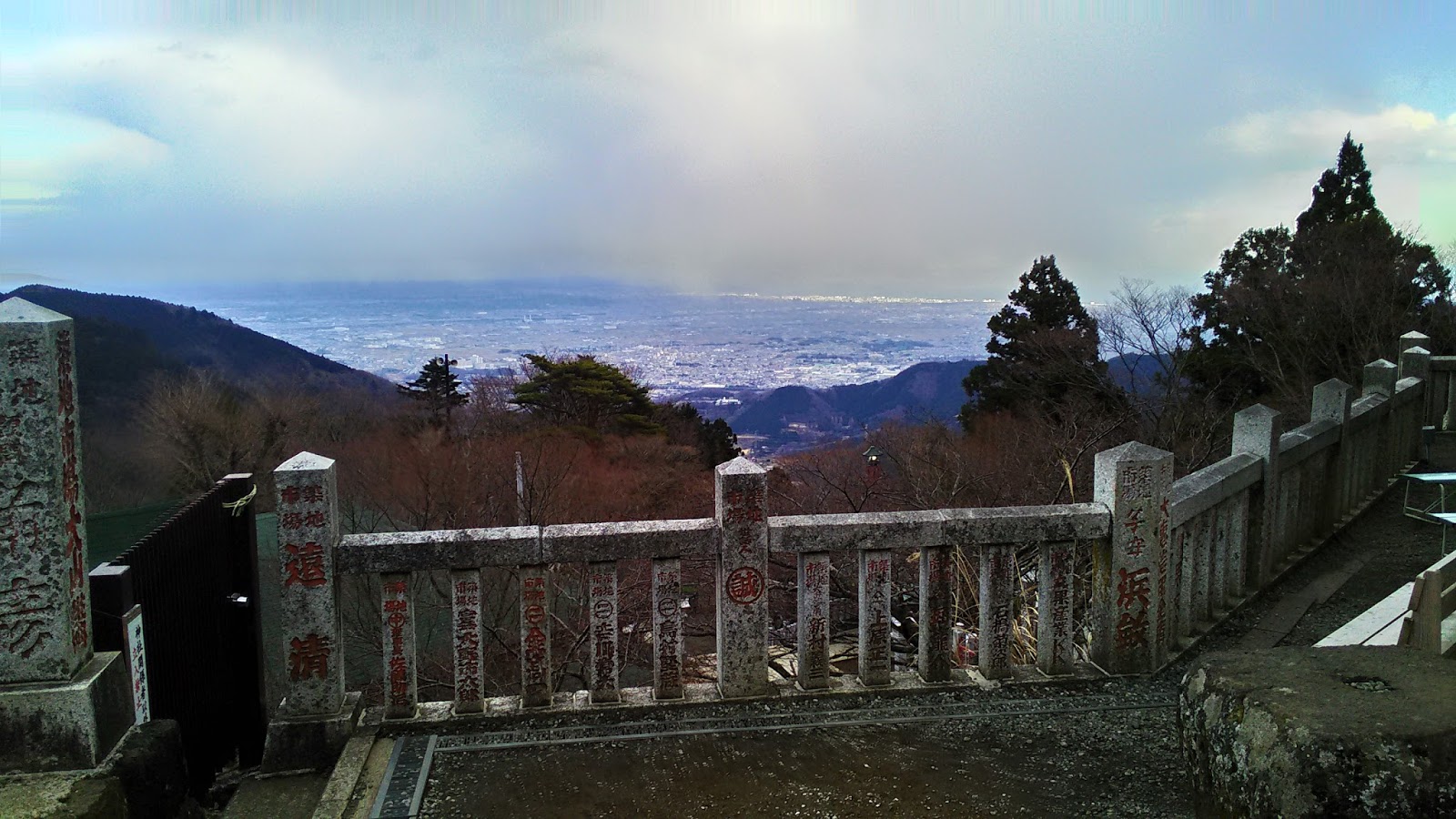

A view from the Lower Afuri Shrine
to Sagami Bay and the cities along Shonan Beach.
We can see all from Yugawara
湯河原 to Misaki 三崎.


The campus of Lower Afuri Shrine is not so big. Whichever route we take from Oyama Town, we reach to the bottom of marble steps going up to the quasi-main shrine, called Haiden 拝殿, of the Lower Shrine. (The real main shrine is at the top of the mountain.) Around Haiden, there are 2 small shrines (Asama Yashiro 浅間社 and Ten’mangu 天満宮; I tell you about Asama Yashiro when we go to Yabitsu route later) and the other structures dealing with, er, business matters of the Shrine. You may notice the place is surrounded by stone fences of 70cm or so high. Each pillar has Chinese characters inscribed in a font similar to the ones found in Kabuki posters. The name of the font is Edo-moji that was originally designed during the 17th to 19th centuries. Those pillars have been donated by Oyama Koh 大山講 that are travel clubs organized by the pilgrim-wannabes. When the members of Koh visit the Shrine, they contribute to the construction works of the shrine’s and the temple’s structures. In return, they could carve the name of their Koh just like park benches in Central Park. The tradition goes strong in the 21st century. We can find brand-new pillars by reading the date engraved on the stone. I found many corporations for Tsukiji Fish Market 築地卸売市場 are donating to the Shrine, with their names inscribed on marbles in proudly vivid red. That would explain why we can feel the atmosphere of the Lower Shrine very vibrant, just like the daily morning auction in Tsukiji.


The Haiden of Lower Afuri Shrine
The frog says “Safe go home.”
With these steps,
the advice is appreciated.
One of the pillars is a donation from
the “Class of 1964 of Oyama Elementary.”


Between Haiden and talisman shop, there is a small opening that can lead us to the underground of Haiden. When we enter there, immediately we are greeted by a spring where we can collect “Pure Sacred Mt. Oyama Water” which is potable … I’m not sure if it’s truly a natural spring since no municipality in Japan legally allows distribution of unsanitised water as “drinkable.” But, it would be purified water (of the 21st century Japanese health standard) coming from Mt. Oyama who is the god of rain. If we come this far, why not bring the water home? In case you do not bring your own empty water bottle, don’t worry. The shrine is selling a plastic bottle, 200 yen, for water collection at the site. You proceed further into the basement, and there are exhibitions of old attire and wooden sword brought by yesteryear pilgrims, then a candle dedication shrine. There you choose your wish from a list of … er, I haven’t counted but surely more than 50 items, like “good health,” “finding a good lover,” “money,” etc. etc., and purchase a candle (300 yen) for each. Light a fire, leave it on the shelf of your wish, and you’ve done for asking. (Fingers crossed …) At the end of the underground corridor, there is a corner where we can have a sip of sake, without price tag but with a poster “Thank you for your donation.” … considering the locale, I donated a nominal amount in coin, and tasted it. Gooooooooood sake. Afuri Shrine has lots of patrons of sake makers (; their list is here). If Mt. Oyama presides rain, the deity is also for water, and hence, sake. Since 1947, Afuri Shrine has annual sake festival in May. This year, 26th of May is for general public older than 20 years old to join sake-tasting festival. Hic.


The entrance to
the underground corridor of Haiden
I’m so sorry … the spring is out of focus …
Candle ritual place
And sake tasting corner!


In the west of Haiden, there is a gate named Tohai-mon 登拝門 that is the beginning of real Mt. Oyama hike from the Lower Afuri Shrine. The route from Tohai-mon is called Omotesandoh 表参道 (of Oyama, of course, not that fashion district in Tokyo) that will be joined after 1K+ steep elevation by Urasandoh 裏参道 … well, it’s a matter of opinion, but reading a 1/25000 map of Tanzawa, I think this approach might be the quickest, but of the most arduous climb to the Upper Afuri Shrine 阿夫利神社上社, an elevation of 1252m. To climb up Mt. Oyama, there are 4 routes. Using Omotesandoh is one of them … In my posts from next week, I tell you my climb from Hinata Yakushi 日向薬師, Yabitsu Pass ヤビツ峠, and Kotakuji Temple 広沢寺, and going down via Omotesandoh and Urasandoh. Meanwhile, without reaching to the top, we can have a mini-hike from the Lower Shrine via a 1.5K road far gentler than those to the top (… it sounds very allegorical, doesn’t it?). It’s “Oyama Lite” to Miharashidai 見晴台 via Niju-taki 二重滝. The starting point of this walk is on the right of the bottom of marble steps, which is in front of you when you come from the Cable Car Station.


Tohai-mon,
aka
the beginning of Oyama Omotesandoh
Here is the entrance for “Oyama Lite.”


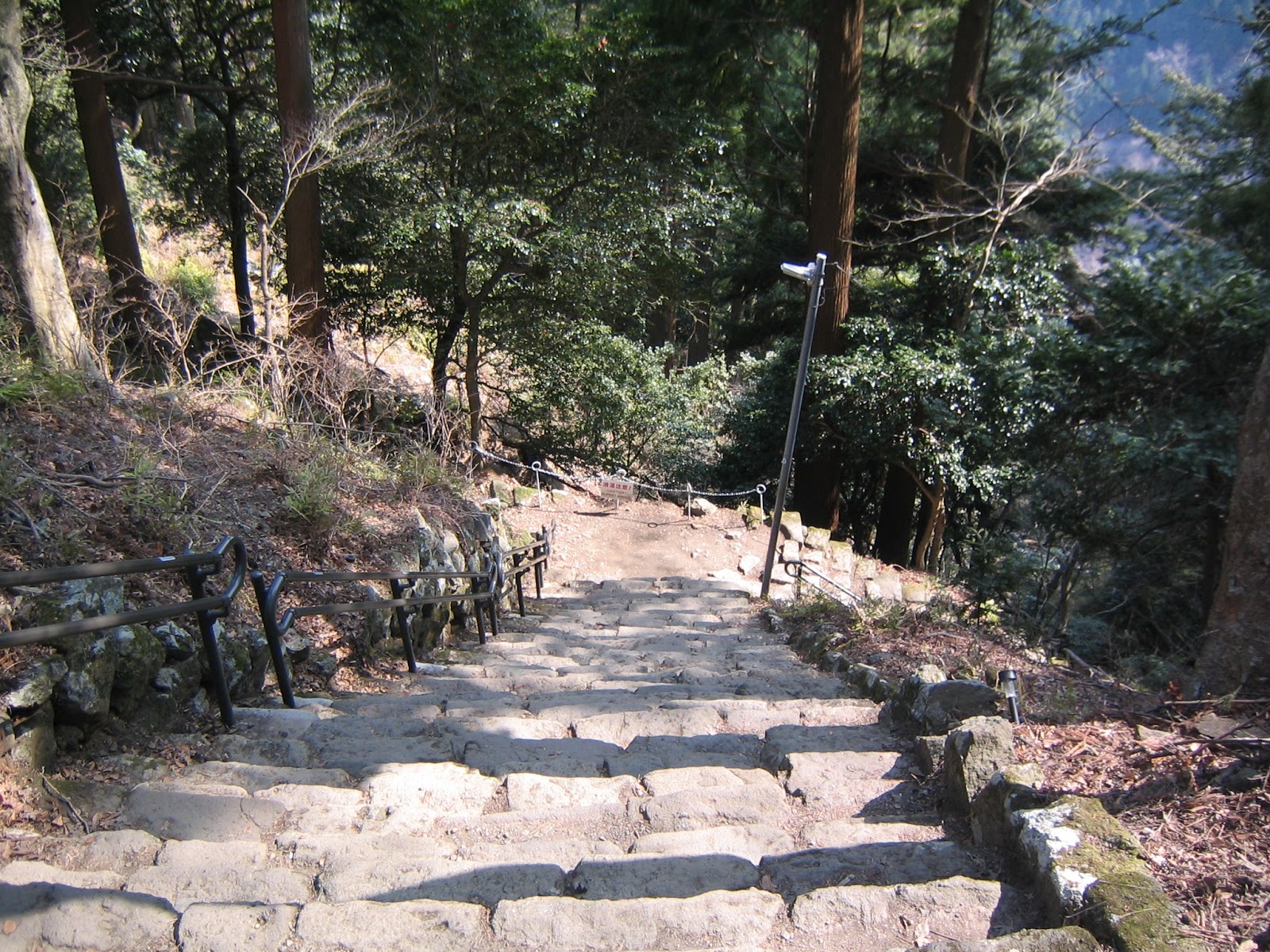
The beginning of the route to Miharashidai is almost identical to the stone steps of Otoko-zaka 男坂 / On’na-zaka 女坂. Then, the road becomes something similar to the trekking course we can find in Yokohama’s Citizen Forests: not scree-covered slope, but with moderate inclination. The difference between Yokohama’s Satoyama (里山 forests near human community) and Oyama’s Okuyama (奥山 otherwise forests) is, the valley of Oyama River 大山川. It is far deeper than that of, say, Hitorizawa Forest 氷取沢市民の森. Please be careful. The vegetation along the Oyama River around here and up is mainly primeval forest and designated as the Natural Treasure of Kanagawa Prefecture 神奈川県天然記念物 that should be protected. We start to see Abies Firma which, at the latitude of Kanagawa, typically grows in-between areas of Satoyama’s broad-leaved trees and Okuyama’s Fagus crenata. Oyama is the only remaining eco-system in Kanagawa Prefecture where we can find wild Abies Firma …


The stone steps from
the Lower Afuri Shrine to Miharashidai.
When we go down there …
The road is like this. Not bad, isn’t it?
The natural treasure of us


About 0.45K from the Lower Shrine, there is a small bridge over Oyama River valley. A notice board at the beginning of the overpass warns us. “Unless you cross this bridge concentrated with pure mind, you shall fall to the deep valley for death.” An alarmist’s advice for safe hiking? At the other end of the overpass there is a shrine called Niju Yashiro 二重社. This structure is situated right next to a double waterfall named Niju-taki 二重滝, and hence this designation. Though tiny, the shrine has a long history, and it was one of those purification sites for pilgrims, and Yamabushi 山伏. People believed the waterfall was actually a dragon deity, Takaokami-no-kami 高おかみの神, who is the main god of water appeared in Japanese mythology. It means, the power of this site was considered VERY strong. There is another explanation board next to the shrine, informing us before the GreatKanto Earthquake there stood a formidable cypress next to the waterfall which was used for Ushino-koku-Mairi 丑の刻参り rituals. … This is a kind of black magic in Shintoism. When a sorcerer wants to kill somebody by cursing, s/he wears white kimono and iron tiara decorated by lit candles, and visits a sacred tree in a shrine during AM1:00-3:00, “Ushino-koku” in old Japanese time, for 7 consecutive days. There, a necromancer nails a doll made of straws on a sacred tree with incantation for 2 hours. The doll is a substitute of a person incurred the enmity, and the place nailed down is believed to be hurt in the real body. If somebody saw the operation, that person must be killed by the sorcerer. If the jinx fails to be executed for 7 uninterrupted nights, the death comes in return to those who curse. In short, it’s a horrible magic, and I now understood the meaning of the post before the bridge … When somebody must have come this deep in the forest for such a purpose, how was the desperation that person felt … 50m or so from the shrine on the left, there are 2 large trees decorated with Shimenawa 注連縄, i.e. sacred trees near the shrine. Are they for the purpose? No way …


The bridge with forewarning
Niju Yashiro
Niju-taki.
It was dry when I’ve been there late March.
No cypress. (Relieved …)
At least I haven’t found any doll on them.


From Niju Yashiro, the road runs along the contour of a deep and steeply forest composed of large trees. Here and there, the edge of the forest and the road reveals the soil of Tanzawa that is rocky with shallow soil. It’s understandable why this area suffered massive landslides by Great Kanto Earthquake … Nonetheless, the huge trees have kept standing for millennia … Cool. The route starts to climb with hairpin curves, and soon, we reach to an opening, i.e. Miharashidai. On the right there is a gazebo, and on the left are picnic tables looking the southeast of the Mt. Oyama. “Miharashidai 見晴台” means “the platform with a view.” Certainly. From this point, we can figure out downtown skyscrapers in Yokohama. Although it’s not so spectacular as the views from the peak, the scenery from Miharashidai is a good deal after not so demanding trekking road. Yet, when we look up, the peak of Mt. Oyama, which is supposed to be in the northwest from Miharashidai, is shielded by the forest. Well, it’s time to go up! 


Keep walking, but no grudges, pls.
Wow
The route is well-maintained.
As long as you stay on track, you’ll be OK.
One more bridge to cross a gorge.
I didn’t find a magic site here.
Why must this tree choose this point to grow?
… or the boulders came later?
When you start to climb more forcefully,
and the trees become neatly lined (i.e. forested) cedars,
it’s the sign Miharashidai is very near.
Just before Miharashidai,
there is a warning about … bears!
Miharashidai picnic space
Spring is hazy season in Kanagawa …
could you recognize the Landmark Tower over there?
In Miharashidai.
“To the peak, 2.25K. To Hinata Yakushi, 4.2K.”


Oyama Afuri Shrine 大山阿夫利神社社務局
355 Oyama, Isehara City, 259-1107 伊勢原市大山355
(phone) 0463-95-2006


If you find environmental problems in Mt. Oyama, please make a contact to
 
Kanagawa Nature Conservation Center 神奈川県自然環境保全センター
657 Nanasawa, Atsugi City, 243-0121 〒243-0121 厚木市七沢657
Phone: 046-248-0323

You can send an enquiry to them by clicking the bottom line of their homepage at http://www.pref.kanagawa.jp/div/1644/


Friday, April 7, 2017

Heavy Metal! Oyama Town and Oyama Temple 大山寺


This week, let me tell you my experience with Oyama Temple and the town of Oyama. When you plan to visit them directly from Isehara Station 伊勢原駅 of Odakyu Odawara Line 小田急小田原線, please take Kanachu Bus 神奈中バス I-10伊10 or I-11 伊11 from the Terminal #4 in the North Exit of Isehara Station. (Time Table, here.) It’s a 25 minuets’ bus ride to Oyama Cable 大山ケーブル Bus Stop (terminal stop). From the train ticket gate to the North Bus Terminal in Isehara Station, if you use steps rather than escalator to go down you’ll find a tourist information center on the right at the landing. They have a good free tourism brochure in English. As they open only for 9:00-17:00, the service may not be so convenient especially when you plan to hike Oyama Area (9:00 is the time you start walking in the mountain!) … but if you happen to be there during their business hours, the place is worth a visit. The office is run by Isehara Tourist Association. As of April 2017, their home page does not have a link to the brochure to download. Sad. From the north exit of the station, you may notice a big Torii 鳥居 next to Isehara Branch of Resona Bank. That’s the sign we have reached this near to Afuri Shrine in Oyama Pilgrimage Road ... I with a sort of pious feeling … The bus route runs mainly a narrow historical road, “Old Oyama Road,” where both sides show lots of banners saying “Welcome to Oyama.” You may notice, in addition to the 21st century marketing, the road has many ancient looking signposts made of stones.

Torii next to the Bank

One of the signs the pilgrims built
as a commemoration of their visit


Until about 100 years ago, people walked this route, and before reaching to Oyama Temple and Afuri Shrine purified themselves by taking “shower” under the sacred waterfalls along the way. One of the purification site is Misogi-no-Otaki (禊の大滝 “the Big Waterfall for Purification”) that is less than 10 minutes’ walk from Shamukyoku-Iriguchi Bus Stop 社務局入口 of the I-10伊10 service (; the stops of I-10 can be checked here). I found the waterfall and the way leading to the place are far from tidied-up for the 21st century tourists, but may preserve the atmosphere of ancient pilgrimage. Two more stops from Shamukyoku-Iriguchi Stop is Roben-taki Stop 良弁滝 which is penultimate stop for the bus services. From the bus stop, we can see another popular bathing point, Roben-taki (“Roben Fall”), on the right. The site was so popular that there are Ukiyoes by Hokusai and the others and a scene in Kabuki repertoire “Oyama and Shougun Iemitsu大山と家光” that employed the waterfall as a motif. Simply imagining people who took showers there during winter … I thought they must have had a good reason. Some say the admiration of Oyama Pilgrimage was partially due to popular contests of endurance among male artisan class of Tokyo (Edo). They formed travel clubs, called Koh 講, according to their occupation or address, and saved money collectively. A group did not travel together, but members visited Oyama in turn probably due to economic reason. “Hey, their group purified themselves for 3 minutes under the ice-cold shower last week. We must do it for 5 minutes.” “Mr. A of Carpenter Koh had a beautiful tattoo on his back, and people admired his art under Roben Fall. So, this time we, Steeplejack Koh, must send Mr. B with even better coloring!” Hm, well, those days guys took freezing showers to show off how macho they were. OK, if you must …


Seen from
Shamukyoku-Iriguchi Bus Stop (inbound to Isehara Station),
this is an entrance to the road leading to Misogi-no-Otaki.
A bit messy trekking road
to Misogi-no-Otaki
Another Torii over there is
the sign for the waterfall.
Misogi-no-Otaki.
Eventually, the road via Misogi-no-Otaki
will meet with a paved forest road
that reaches to Minoge Town
蓑毛 of Hadano City 秦野.
In a later post,
we’ll visit Minogue as a relay point
for one of the hiking routes to Mt. Oyama.
From Roben-taki Bus Stop,
cross this red bridge over Oyama River
大山川,
and you’ll meet Roben Fall.
The Fall situates
almost among the inns of the town.


Between Roben Fall and the terminal bus stop, Oyama Cable Stop, is about 200m, not much. From the terminal stop, the uphill road ahead is available only on foot. Next to the terminal stop there is a municipal car parking + toilets on the right, and a tourism information house on the left. Soon, we’ll be greeted by an arcade and rows of souvenir shops, inns, and restaurants on the both sides. The street is called Koma-sando こま参道. Sando 参道 means “an entrance path to a temple / Shinto shrine”. (“Omotesando” is an entrance path to Meiji-Jingu Shrine. Got it?) Koma-sando is an entrance path to Oyama Temple and Oyama Afuri Shrine. And, just like Mont. Saint Michel, the way to the sanctuary is a perfect place for doing business with tourists! I think Jesus did not prohibit business outside the place of worship, did he? Actually, from around Oyama Elementary School Bus Stop, we are greeted by many traditional Japanese Inns on the both sides of the road. (The list is here.) Many could claim their origin as Sendoshi/Oshi 先導師・御師, who were travel agents with hotel services until about 100 years ago. This town is also famous for tofu cuisine so that many Inns have a restaurant where we can enjoy a full-course meal of tofu, and of gibier meats. The third weekend of March every year since 1990, the town has Oyama Tofu Festival. During the event, the restaurants offer bargain menus + Free Yu-tofu Pot serving in Lower Afuri Shrine + Quick Tofu Eating Contest (… an endurance contest for the 21st century, I guess) + music concerts, etc. Although not all the meals are vegetarian, you can try many variations of tofu dishes during the event. 😋


Oyama Cable Terminal Stop
Tourism Info on the left
Municipal parking and toilet on the right
To Koma-sando
from the Terminal Stop
There is a paved road parallel to
Koma-sando running along Oyama River.
It’s for the residents of Koma-sando only,
and ends with a dead end.
A traditional inn on Koma-sando.
Before, each inn was “membership only,”
having exclusive contracts with a particular Koh
講.
Now they are standard inns so that we can make reservations
without being a member of a specific travel club.
Koma-sando is practically steep steps with lots of shops.
Traditional souvenir from Oyama is Koma,
wooden tops, and so,
the street is “Koma-sando.”
They are cute.
One of the oldest Inn, Togakuboh 東学坊 established in 1600,
near Atago-taki Bus Stop, before reaching to Koma-sando.
Here, they can arrange your sessions for
meditation and transcribing sutras in
Oyama Temple and Lower Afuri Shrine.
My afternoon tea at Togakuboh:
maccha tea,
with a tofu-based “Flower Petal” mochi-cake
and a warm moist tofu and coarse rice powder cake
wrapped by camellia leaves.
DE-LI-CIOUS.
We can purchase tofu in town as well.
This photo was taken in one of those tofu shops,
Yusui-koboh
湧水工房.


At the end of Koma-sando is the entrance to Oyama temple, and then Afuri Shrine. Here we have 3 choices. Choice 1: use cable car service from Oyama Cable Station. Even if you wear pin-heels, this strategy can transport us almost to the entrance doors of Oyama Temple (adult one-way ticket, 350 yen) and of Lower Afuri Shrine (adult one way ticket, 630 yen). Time table and the other info for Oyama Cable is here. Choice 2: take Otoko-zaka 男坂on the right of Oyama Cable Station to the foot of Lower Afuri Shrine. If you plan to hike to the Lower Shrine in the shortest way, this is the route which takes about 55 min of VERY steep climb of steps covered by moss. Choice 3: go On’na-zaka 女坂 which from the left of Oyama Cable Station goes to Oyama Temple first, and then to the Lower Afuri Shrine. The suggested time required for On’na-zaka to the Lower Shrine is 1 hour. You may notice it’s just a 5 min difference between Otoko-zaka and On’na-zaka, even though On’na-zaka is via the Temple. i.e., Both of the routes are extremely steep and moss-covered. I warn you some steps feel like a ladder against stone wall. Definitely we need good hiking shoes to conquer them. Elementary school kids could call help easily far before the goal. I would say the routes may simply be dangerous for uninitiated, but can offer a special satisfaction of “I did it!” (in addition to economizing the cable car fares … not for nothing the service is “not cheap.”)


Oyama Cable Station
which can bring us to Afuri Shrine Station here.
I warn you unless there is a special event
in the Lower Afuri Shrine,
the last service from the Shrine to Koma-sando is
at 16:30.
If you miss it,
the only way you go down is on foot.
The beginning of Otoko-zaka
Otoko-zaka is basically a continuation
like this for at least 55 min.
The beginning of On’na-zaka
Comparing with Otoko-zaka,
the scenery along On’na-zaka is more diverse.
The lower part of On’na-zaka is surrounded by
Edgeworthia chrysantha of pretty yellow flowers late March.
On’na-zaka is also much closer to Oyama River.
This place is one of the sources of the River.
Legend says it never dries up.
Sure enough, when I visited there late March,
the upstream from the point did not have water.
And so,
we cross bridges several times in On’na-zaka.
Along On’na-zaka, I found an image of Buddha
which is said that famous abbot Koboh
弘法大師sculpted only with his nails overnight.
It might be possible to do that given a weak soil of Tanzawa.
I’ll return to the issue
when we visit the environmental problems in Tanzawa later.
Please do not think On’na-zaka is flat …
The cable car track seen from On’na-zaka


Roughly ½ point of On’na-zaka, there is Oyama Temple. Theologically, the Temple is dedicated to Acalanaatha 不動明王 expressed in the iron image of the 13th century (said to be) done by abbot Gangyo 願行. The statue and its attendants Kimkara 矜羯羅童子 and Cetaka 制多迦童子, are registered as a National Important Cultural Property 国重要文化財. The Temple opens the special cabinet for them situated in the main hall on 8th, 18th, and 28th of every month. Japanese iron statues were made mainly during the 12-13th century, but the technique to express intricate details was not so sophisticated. Even though, the images in Oyama Temple are relatively well-casted, the experts say. Well, they would be good enough to attract lots of funs who made pilgrimage to Oyama Temple.


The steps leading us to Oyama Temple.
The images of attendants for Acalanaatha welcome us.
They are actually cute.


Legend says the Temple was established by abbot Roben 良弁 in 755 after he became the first head priest of Todaiji Temple in Nara. According to another legend, later in the 9th century Kukai 空海 became the third chief priest of Oyama Temple. Both of them were advisors to the Emperor. Academically, these stories are not verified, but we can say this for sure: the place has been well-known in the center of Japanese national politics for more than millennium. The couple of Minamoto no Yoritomo 源頼朝 and Masako 政子, who started Kamakura Shogunate Government 鎌倉幕府 in 1192, patronized the place. There is a record that Yoritomo offered a splendid sword for victories in wars. 500 years later, this sword giving story was mimicked by pilgrims who presented ridiculously long wooden sword to the temple, and became a symbol of Oyama Pilgrimage. The power of the first samurai Shogun continued a lot for Oyama Temple. Tokugawa Ieyasu 徳川家康, the first Shogun who made in 1600 for the first time Tokyo (Edo) the center of Japanese national politics, directly involved in Oyama Temple management in the early 17th century, and the Tokugawa Shogunate continued to be a powerful patron till 1868. During the Tokugawa Shogunate, the Temple had several buildings in the mountain, and the place of current Lower Afuri Shrine was the center of the temple sanctuary. Meiji government abolished Oyama Temple completely once … anything done by the previous government must have been “horrible” for them … But the institution was resurrected in 1885 and moved to the current place. In the end, people who loved Oyama Pilgrimage won.


The main hall


You may have noticed Acalanaatha and his pageboys are having ferocious faces … They are suitable for a temple which had patrons of samurais for centuries. In fact, the priests of mountain worship to Mt. Oyama, Yamabushi 山伏, are to some extent the descendants of samurai spirits. They make Oyama Temple as their hub and perform their rite … in a wild way. I met one of their rituals. As they did for Yoritomo or Ieyasu, the Temple is accepting requests anytime from the believers for purification ritual, called O-goma-kitoh お護摩祈祷. During the ceremony, the monks recite mantra and burn wood chips with herbs, fragrant oil, and the other magically meaningful things in front of Acalanaatha image. Wood chips are the symbol of worldly desires that make us miserable. We purify ourselves by burning them with a help of Acalanaatha ... OK, good ... The abbot of Oyama Temple does this with loud speakers. I mean, electronic loud speakers. When I’ve been to On’na-zaka, suddenly there came a mantra recitation with deep intimidating voice accompanied by heavy and relentless beats of drums, echoing in the cavernous mountain valley … At the beginning I was upset, but after kept listening it for a while the “music” from the speakers sounded hypnotic like … Black Sabbath.


Together with “Black Sabbath”-ish ritual,
you can purify yourself by circling 3 times
clockwise around this tower in the Temple campus.
Your worries will be pacified …
This bell is not for O-goma-kitoh,
but it can sound overpowering from Oyama Temple …


Otoko-zaka and On’na Zaka will meet at the foot of final steps to the Lower AfuriShrine.  Before climbing up glittering marble steps of the Shrine, there is a toilet structure on your left. Actually, it is the last toilet available for us when we enter the higher altitude of Mt. Oyama. Please use the opportunity well. 😉 Otoko-zaka and On’na Zaka will meet at the foot of final steps to the Lower Afuri Shrine.  Before climbing up glittering marble steps of the Shrine, there is a toilet structure on your left. Actually, it is the last toilet available for us when we enter the higher altitude of Mt. Oyama. Please use the opportunity well. ;-) Let’s visit the Lower Afuri Shrine 阿夫利神社下社 and do a small walk to Miharashi-dai 見晴台 next week for “Oyama Lite.”


Looking down from the toilet at Afuri Shrine.
To the left is Otoko-zaka.
To the right, On’na-zaka.
The public toilets for the Lower Afuri Shrine.
The flushing is always weak as we are nearer to the peak.
Donation box is situated at the entrance.
Any amount is welcome to keep the toilet clean.


Oh, by the way, this ancient pilgrimage route to the Lower Afuri Shrine via On’na-zaka is for one of the venerable citizen marathon events in Japan, Oyama Hiking Marathon 大山登山マラソン. It is held on the second Sunday of March every year since 1985. Although it’s only 9km, the difference in elevation between the starting point (Isehara Station) and the goal (Lower Afuri Shrine) is 650m and the course is almost entirely uphill. It seems to me running this marathon is addictive. I know at least 2 regulars who’re participating for more than 20 years. (“Roll-over Tokyo Marathon!”) The entry starts every November 1st. If you dare, please check their homepage here. Other than these festivals, Oyama Town has many annual events, such as Japanese Sake Festival (this year, on May 28), Autumn Festival in the last week of August, Noh Theatre dedication in October by artists of Living National Treasure, and the others. Please check here for this year’s calendar. Oyama Town is proudly a tourism community! 


An ideal marathon course … ?


Oyama Temple 大山寺
724 Oyama, Isehara City, 259-1107 伊勢原市大山724
(phone) 0463-95-2011
http://www.oyamadera.jp/