Friday, November 9, 2018

I’m ready for my close-up: Bugs world in Yokohama


It was a hot hot summer this year in Yokohama … and in September we had super-typhoons that brought sea salt inland with its rainless wind (my previous post on October 19th). I guess bugs have had a difficult life this year. For one thing, we did not have much mosquito bites during summer. People said too hot weather discouraged mosquito from searching for pray. Wow. Then, the super-typhoons browned the leaves and broke the trees. As humans flooded by the storms, the bugs must have lost meals (leaves, et al) and homes (shattered plants) … Thanks to warming planet, in October, we had relatively warmer weather, if not lots of sunshine. It let those plants that had to dishevel the leaves in September to sprout new leaves, as in early spring. Now in November, the tired bugs were meandering between the browned leaves, still green remaining plants, and strangely fresh green of buds. As a candidate of becoming a creepy-crawly for the next reincarnation, I am observing the life of bugs this autumn. It seems it has been not at all easy. (A free internet horoscope concluded my next reincarnation is an insect; please see my previous post on July 6th, 2018) Well, I have to accept their life, perhaps.


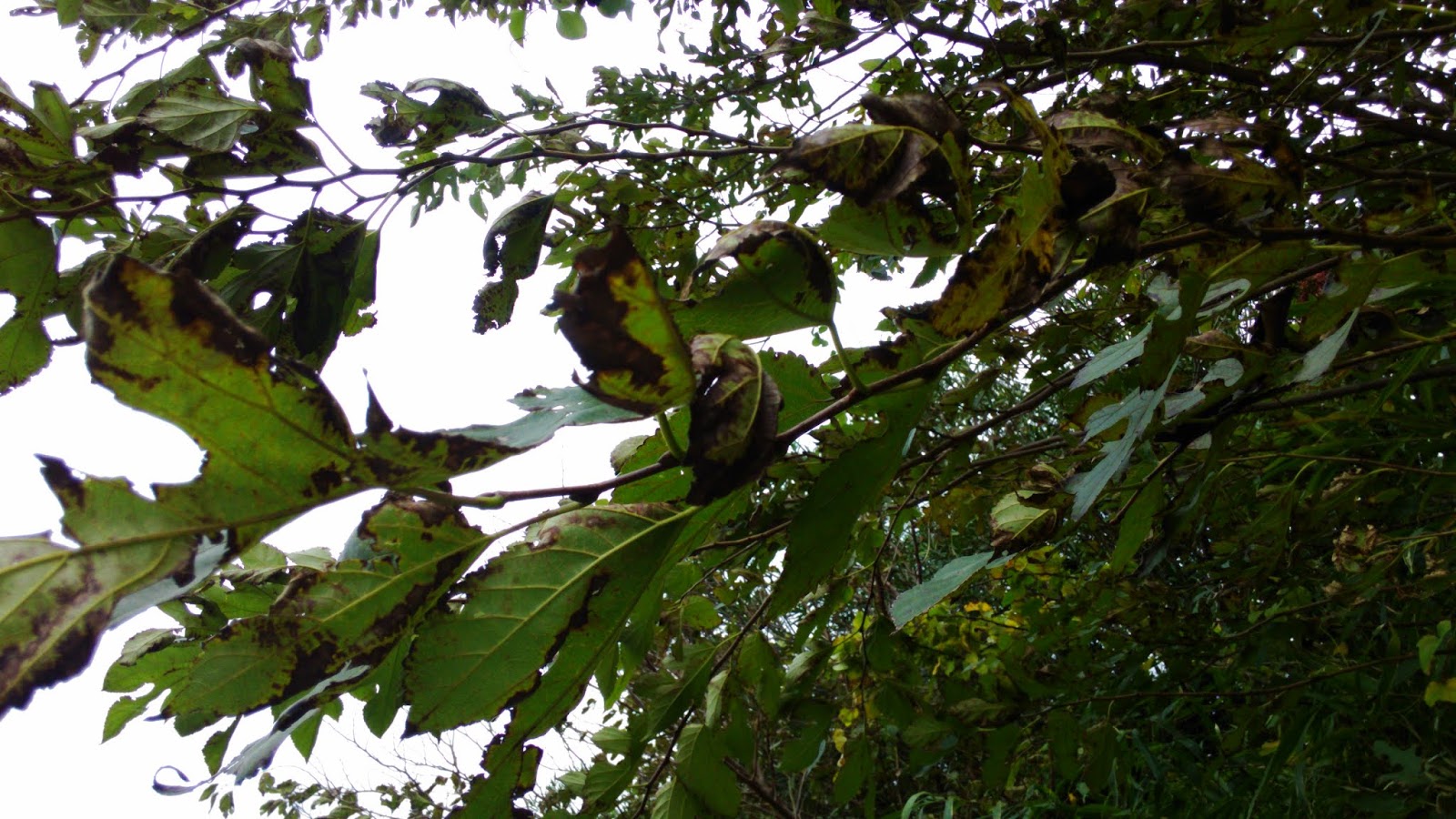
A Japanese walnut tree
 in the middle of this November in Yokohama.
 It has desiccated leaves due to salt damage
 … and fresh new leaves sprouting.
 What are they going to do during winter?
Lamium amplexicaule flowering this November.
 It’s one of those early spring flowers.
 Something is wrong …


One of the shocking sceneries I encountered this summer was caterpillar fungus 冬虫夏草. When we forest instructors did a vegetation census along Hadano Forestry Road 秦野林道, one of my seniors spotted a ghostly white cicada almost pasted on a rock. It was a corpse of the insect infested by sac fungi. The bug was “frozen” on the spot, and from all over its body, numerous white tiny protuberances sprouting. Scientifically speaking, it was yet at the stage of fungi imperfecti so that mycelia were spreading over the body of the cicada by asexual reproduction. Perhaps the bug was dead quite recently. Eventually, the fungus would produce sporocarp, a more familiar version of Cordyceps explained in illustrated references (such as this one). Cicadas spend 99% of their life underground sucking liquid from conducting vessel of plants. Nutritionally speaking, it’s a poor meal, but the insect rears symbiotic bacteria inside which can help maximizing the dietary value of their drinks. Recently, Japanese scholars found that the DNA of the bacteria has evolutionally close and on-going relation with caterpillar fungi that kill the cicadas. Caterpillar fungus is one of the most expensive ingredients of Chinese medicine, although scientific analysis of their medicinal effects has not progressed much. More molecular study of cicada, bacteria, and caterpillar fungus can yield break-through for medicines of immune activation, antibacterial, and immunosuppressive substances, the scholars expect ... If I were that cicada after the reincarnation, and my infested body would be a part of scientific progress of humans, I think I could murmur “I accept …” According to this HP of a company developing beds of edible mushrooms, there are about 450 kinds of known caterpillar fungi, and Japan had roughly 350 of them. Ours is a wet country and inevitably fungi infested bodies of insects are abundant in the forest, if you look.


A Cicada infested by
  caterpillar fungus in Hadano Forestry Road


In summer, butterflies are busy finding their mate. After flush dances of couples to mate, females lay eggs on trees suitable for their baby. In September, caterpillars still have time to be adults before winter arrives. But sometimes, the babies would come too late, like in November, to survive in freezing environment of coming season. Meanwhile, in late autumn those once flashy butterfly adults could have worn-out wings, but still wander for the dwindling supply of honey and pollens of flowers … This week in downtown Yokohama, I’ve observed a literally drop-dead Pseudozizeenriu maha in front of my step. It came fluttering among steps of busy people, and then stalled to fall on the asphalt. Why it came to such a concreted space, I don’t know. That’s … a philosophical incident. When I would reincarnate in a tiny butterfly, and go popped-off on the pavement, what might I think at the last moment? Or a bug cannot think or feel?


A Daimio tethys near Lake Sagami 相模湖 this July.
 They rest characteristically on leaves and flowers
 by opening their wings like this,
 which look like a costume of high-ranking Samurai,
 aka Daimio, 200 years ago.
 Maybe it completed mating duty already
 and took a mini-break.
 Their caterpillars overwinter under fallen leaves
 in a form of last instar larvae.
A dating of Old world swallowtail near Lake Sagami.
 They were so busy and didn’t care while I took photos.
A caterpillar of Dark evening brown in
 Yadoriki Water Source Forest
やどりき水源林 this September
. It will soon be a pupa, and become an autumn adult
 (; this butterfly also has summer adult which has darker color)
to sleep under warm fallen leaves during winter.
A caterpillar of Cabbage white in November.
 It overwinters in pupa.
 I hope it can find a winter home before a car crumples it flat.
A Silver-washed fritillary in Yokohama’s November.
 Don’t you think the right wing is incomplete?
 It flew unsteadily from flower to flower.
 As they overwinter in egg or 1 instar larvae,
 this individual was ending its life …


In one October weekend for Niiharu Citizen Forest, I met a large, about 10cm long, Hierodula patellifera (praying mantis) whose left wing was tragically missing. It displayed the soft under wing and belly normally covered by seemingly strong outer wing. It was easy to recognize its 2 oviducts sticking out from the tale. It was she. To reach to that size, I imagined she has survived many near-misses … and was finally caught up with her fate. It slowly proceeded on a narrow community road that is used by visitors and farmers, with occasional cars and motorbikes. Yet, the insect sidled up to somewhere safer, with nobility. The scene was like a shot in a tragic action movie where an amazing heroin was killed in action … I was a sort of moved … If I would reincarnate …


Bette Davis in Niiharu Citizen Forest
She was stunning from the back as well.


Grasshoppers are normally green in mid-summer for camouflage. By October the majority of them has finished the job of reproduction, and turns brown as plants preparing for winter. In late autumn of Yokohama, many Acrida cinerea (Chinese grasshopper) grow big, like 5-7cm, or more, long. They are ending their life, but their ability to hop is still going strong even when they are brown and large. In Yokohama’s suburb, they are hopping from gardens to gardens by crossing paved roads that are busy with cars. One day in November, I saw a large brown Chinese grasshopper hopped along a road running through a row of detached houses. It took its pace to move around, not in a hurry. Then, from a corner, a car appeared and turned to the direction of the bug. I expected to observe a tragedy. Nope. The senior insect rhythmically avoided the ferociously approaching tires. After the monster had gone, it kept hopping at its own speed and disappeared in a garden nearby. I was impressed. When I reincarnate, I hope I could act with dignity like that Acrida cinerea. Someday, perhaps.


A Chinese grasshopper in Yadoriki Forest, this September.
 It was about 7cm long,
 large enough to consider a fully-grown individual,
 but not yet turned brown.
 It simply mimics the color of the environment,
 and Yadoriki in September is still green enough.
The survivor grasshopper after an attack of a car monster.
 For the bug a Toyota must have looked like a huge mountain
 moving toward it without any consideration of its existence.
 It simply let the machine past by hopping.
 Amazing …
A Yellow spotted stink bug,
 in a lady’s room of a department store of downtown Yokohama!


If you find an environmental issues in Kanagawa Prefecture, please make a contact with Kanagawa Natural Environment Conservation Center 神奈川県自然環境保全センター

657 Nanasawa, Atsugi City, 243-0121 2430121 厚木市七沢657
Phone: 046-248-0323


You can send an enquiry to them by clicking the bottom line of their homepage at http://www.pref.kanagawa.jp/div/1644/


Friday, November 2, 2018

Spicy autumn in Yokohama: Harvesting Sansho 山椒


Japanese cuisine is of soy source and miso paste, generally. We are not so conscious for spices. I’ve just counted how many seasoning we have that can be called as “spice.” Hmmm … Wasabi, aka Japanese horseradish, that is surely endemic in Japan. To cultivate the plant, we need damned pure and cold water flowing over graveled river bed so that the growing district of Wasabi is always near or in mountainous national parks with high altitude. Shichimi is in the end a sub-product of red chili peppers coming from America … Well, our mustard is made of mustard seed powder and water w/o vinegar, so I consider it as Japanese specific, but mustard itself is universal … We have ginger powder, but using ginger as spice would be something of recent introduction; for Japanese recipes, here is the list of popular dishes with ginger powder, but none of these are so-called “traditional” Japanese food ... We have pickled, dried, and powdered leaves of beefsteak plant that is often used for Japanese traditional meals (recipe, here). I first thought the plant is Japanese endemic. Nope. It is said that they were imported from China, and used extensively in Southeast and East Asia. OK, … what’s else? Oh, yeah, we have Japanese cinnamon (Cinnamomum sieboldii Meisn.) which does not contain eugenol, a particular ingredient for tropical cinnamon (Cinnamomum verum or Cinnamomum cassia). If you’ve been to Kyoto, you’ll find a ubiquitous triangular sweet, Nama-Yatsuhashi, made of sticky rice crepe with the taste of cinnamon. That’s not with tropical cinnamon, but with Japanese cinnamon that is made of roots, not bark, of the tree. As such, the number of available Japanese cinnamon trees is dwindling fast these days ... oh so dangerous appetite of ours … 


A large Japanese cinnamon tree survived
 for all of these years in Kanagawa Prefecture …


What’s else do we have as Japanese “spice”? There is one naturally growing very near from our home in Yokohama. That’s Sansho, Japanese pepper. The most widely known aroma of this spice is as condiments for Kabayaki eel. Can you recall that spicy but lemony scent of the powder you find in a small packet attached to the frozen Kabayaki in your nearby supermarket? That’s Sansho. Actually, we can find a tree of Sansho in a garden of our neighbors. The tree grows also in the southern provinces of Korean Peninsula, but the origin of the species is in this archipelago. For one thing, it has odd−pinnately compound leaf with opposite thorns on its trunks and branches. i.e. Very good for protecting houses from intruders. (Why do I mention the order of leaves and thorns here? More for that, below.) In addition, the whole body of the plant has that particular aroma that is not at all bad to waft in our garden. The trunk of a tree with about 3-4cm in diameter can be a very good pestle that can yield the citrus scent to your dish. In early spring when its leaves are young, soft, and edible, we can pick them for salad or food decoration as herbs. In early summer, the tree bears small green and young fruits which can be stewed to be condiments of Japanese cuisine (recipes, here; I warn you, it takes at least two days to complete the entire process). In autumn, we collect ripen red berries to make powdered spice (; recipes with powdered Sansho, here.) Not many Japanese know how the ripen berries of Sansho becomes the condiments for Kabayaki. Actually, I didn’t know it until recently, but found out it’s soooooo easy to make. Here is the How-to.


The green bottles are
 supermarket version of Sansho Powder.
The pestles in the bottom of the left of this photo
 are made of Sansho tree.
A Sansho tree in spring.
 The leaves are young and suitable for salad.


First, you have to find Sansho tree in a forest near your place. As the entire body of the plant is very useful, many landlords are protective for their tree. Before entering the forest, you’d better check with the police or somebody who knows the owner of the place if it’s OK to collect some fruits or leaves from the forest. Next, we have to find the tree. In a Japanese ordinary forest, there are 3 similar-looking trees with thorns and odd−pinnately compound leaves. All are in the family of oranges, dioecious, and their flowers waft sweet scent. They are equally homes for larvae of many kinds of swallowtail butterflies. But, only the berries of Sansho, aka Zanthoxylum piperitum, can give us worthwhile aroma for dishes. The characteristics of a tree of Sansho is “odd−pinnately compound leaves with opposite thorns on its trunks and branches.” Remembering it is the first step to find a tree. It’s also useful to know the features of the other two.


A Sansho tree with red berries in September.
 They are still young as we cannot find many opened fruits.


The one for another two, Fagara schinifolium (in Japanese, Inu-zansho) cannot produce enough kick as a spice. To find one, if we encounter odd-pinnately compound leaves that look suspiciously for Sansho, but its thorns are locating alternately along the trunks and branches, that’s Inu-zansho. Another “not Sansho” is Fagara ailanthoides, Karasu-zansho in Japanese, which would be easier to find in a forest than the other two. It’s a pioneer plant. In Yokohama, when people thinned trees and do not mow the opened ground during summer, the site will quickly turn into a forest of spiky Karasu-zansho. When a tree is young, the leaves of Karasu-zansho look very similar to Sansho, but its thorns are decorating the body of the tree really randomly, not in the opposite order as Sansho. It’s easy to identify Karasu-zansho in this way. Karasu-zansho can be a large tree once it can survive in a wild competition for continuous supply of sunshine. Sometimes, in a well-established forest long-past the pioneer stage from the disturbance, we can find a tree of Karasu-zansho of more than 10m tall and 30cm or so diameter, with very large “odd−pinnately compound leaves.” During fall, its fruits spread sickeningly sweet scent that is popular among birds. Their aroma has certainly a connotation of food decay, and, because of this perhaps, I could not find an article for human consumption with the berries of Karasu-zansho. Though, during early spring, their young leaves can be eaten for Tempura, and their branches can be a pestle after removing the thorns. Flowers of Karasu-zansho can give honey of very soothing taste, and so apiculturists love to find large flowering Karasu-zansho trees near their beehives. VERY interestingly, when Karasu-zansho becomes big and old enough, it loses its thorns … it’s nearing to nirvana, maybe, just like happily aging senior citizens of human world …


It’s really difficult to identify
 it’s Sansho or Inu-zansho,
 unless you come close and
 check the way the thorns deployed
 on the branches and trunks.
Answer: Inu-zansho.
The landlord of this place
 thinned the trees about 6 months ago.
 Now, with better access to sunshine,
 the place becomes a forest of young Karasu-zansho.
 Could you see very congested odd−pinnately compound leaves
 in the middle of this picture?
 They are Karasu-Zansho.
 Which one would survive for better sun?
 Or, the landlord will annihilate them
 before the conclusion of the competition?


Now you have obtained OK from the landlord for a bit of offerings from their forest, and found a Sansho tree. If that’s early spring, prick few leaves and sprinkle them over your simply cooked pasta. Mission accomplished. If you find green Sansho berries in June, collect some, and stew them to accompany with your traditional Japanese summer dish. Sansho berries turn to bright red in late September. One day, maybe in October, they open the mouth and dangle a small black seed from the red husk. Their red quickly fades to greenish brown. That’s the time to harvest Sansho spice. Carefully collect the berries with open mouth, and dry them in chilly but sunny October air. It’s OK to mix not-yet opened red berries for drying. If they are dried completely, the red berries open their mouth and show black seed poking from the brownish husks. Separate the husk from the seed, and store the husks in pepper mill. Mission accomplished. Yes, Sansho spice is not from the seed, but from the husk. Although we can buy Sansho powder in ordinary Japanese supermarket, the aroma of the spice will be lost rapidly once you powder the husk, The ideal way to enjoy simultaneously zesty and citrus flavor with Sansho spice, you’d better mill the husks just before you eat the dish. So, we use pepper mill to crush the husk for just sufficient amount of Sansho powder at the time. Please try. If you can collect enough Sansho berries for 3cm*4cm*4cm tapper ware, you would have enough Sansho spice for a year until we have another fresh supply of red Sansho berries. It’s not much, really. Forest in Yokohama can be this generous. (Japanese recipes using Sansho is here. Google translation can be handy. 😋) Oh, by the way, Chinese Sichuan Pepper (Zanthoxylum bungeanum) is not Japanese Sansho: they taste different each other, in definite.


This year I’ve harvested Sansho
 from this tree which had this red berries, and
… open mouthed ones.
 Could you figure out black seeds
 dangling from the husk?
My harvest for 2018.
 Could you see some red berries included here?
All berries, including the red ones,
 will open their mouth eventually after drying.
 They are now ready to be …
… stored in a pepper mill.
Actually, a luxurious version of
 commercial Sansho powder is
 sold in this way,
 in a mill just like mine.
 It’s 5 times more expensive
 than the supermarket version.
 Wow.
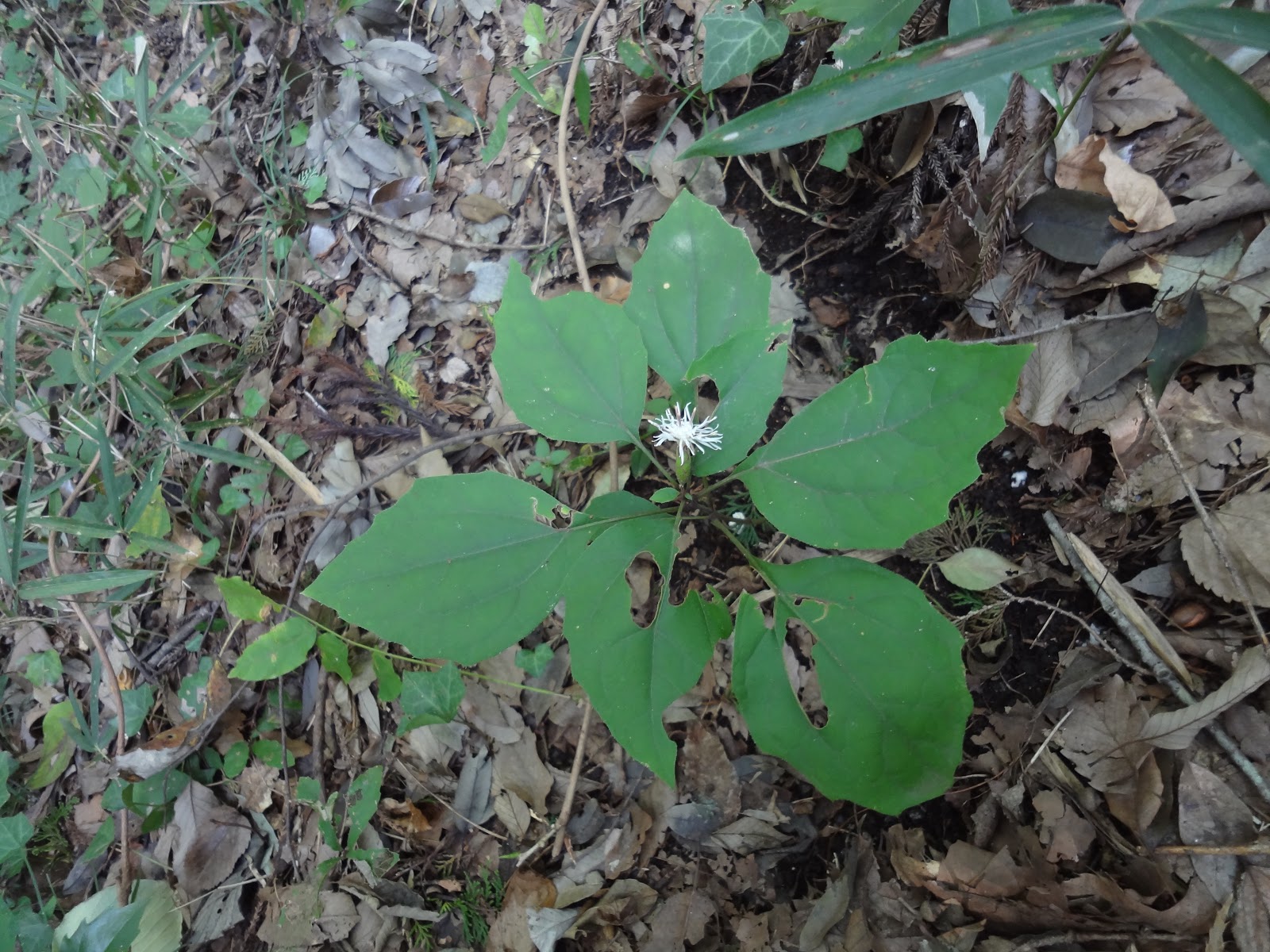
Pertya robusta in Niiharu Citizen Forest.
 It’s endemic in Japan.


If you find an environmental issues in Kanagawa Prefecture, please make a contact with Kanagawa Natural Environment Conservation Center 神奈川県自然環境保全センター

657 Nanasawa, Atsugi City, 243-0121 〒243-0121 厚木市七沢657
Phone: 046-248-0323


You can send an enquiry to them by clicking the bottom line of their homepage at http://www.pref.kanagawa.jp/div/1644/

Friday, October 26, 2018

Adachi-ga-hara 安達ヶ原: Yes! Happy Halloween!


I think it is typically a Japanese gender issue. Ages ago, Japanese mountains or deep forest was off-limit for women. I told you until about 150 years ago, Mt. Oyama 大山 (ASL 1252m) was closed for women (; my post on May 26, 2017). In the middle of Ura-Sandoh 裏参道 hiking route for the peak of Mt. Oyama, there still stands a big notice made of a stone saying “From here no woman is allowed to go forward”. Carefree Japanese old guys are often chatting like “Oh, yeah, that’s because the goddess of a mountain is often ugly, and so they are jealous of women entering in their territory, ha ha ha!” … I assure you, younger generation and women smile embarrassingly when we encounter such casual yesteryear remarks in this “#Me Too” age, even in Japan. But this notion could have some deep-seated something about Japanese traditional femininity, AND general attitude toward nature. This year’s program for Oyama Torch Light Noh Festival 大山薪能 happened to express such thinking in the most refined way. On October 2nd, 2018, the theatrical troop led by Kanze Kiyokazu 観世清和 performed “Adachi-ga-hara 安達ヶ原,” a story of a witch living in a deep forest.


The ancient notice saying
 “No woman allowed from here” in Mt. Oyama


The drama is based on a legend of a faithful nanny, called Iwate 岩手, for a baby princess who was a daughter of a rich minister in Kyoto. The princess could not speak, even after her 5th birthday. The parents worried a lot, and asked fortune tellers if there was a remedy. One of them recommended preparing her a meal made of inner organs of a living baby who was still in a womb. The parents were horrified, but ordered the nanny to cook such dish. This power-harassed employee departed Kyoto to procure the ingredient, leaving her daughter in Kyoto with her hand-made talisman. She reached to Adachi-ga-hara that locates in a deep forest of the present-day Fukushima Prefecture 福島県, and decided to stay there until ‘a suitable pregnant woman’ comes to her shabby dwelling. Years’ passed. Iwate became an old woman. One day, a young travelling man with a pregnant wife came to Iwate’s place and asked if they can stay for one night. Iwate was “delighted,” and let them in her hut. Soon the labor of a young wife started. Iwate cheated the young husband to go outside for a while, killed his wife, drug out the baby from the womb, and killed the baby to procure the magic ingredient. When Iwate began clearing-off the crime scene, she noticed the victim wore a familiar looking talisman. That was the thing Iwate hand-made for her baby girl. She realized she killed her daughter and grandkid. Iwate became a human-eating demon from that time on.


This year, Suzukawa River 鈴川 running next to the Oyama Noh Stage had
 really abundant water.


Noh play of Adachi-ga-hara is the after-story for this witch Iwate. Another years passed and a holy yamabushi monk of Yukei Tokoh-boh 阿闍梨裕慶東光坊 came to Iwate’s hut in cold forest after dark. He and his servants lost their way and asked the witch one night stay. She reluctantly allowed them to her hut, and let them see her “ordinary job” of spinning threads (Oh, so Jungian scenery …) while she lamented her “unlucky” and “painful” life. It grew late so that her stock of firewood became thinner. She told them she went in the forest to procure woods, and asked “Never open the door of my bedroom.” The party of the monks said goodnight for Iwate, and began napping. However, a servant of the monk could not resist the temptation to have a peep of the bedroom. (This is another symbolic development!) He slightly opened the door of the chamber and found a pile of human bodies dripping with blood. They were horrorstruck, and ran into the forest panicking. The witch found them escaping after discovering the contents of her bedroom. She was furious and chased them in a supernatural speed. The holy monk recited the mantra of Acala with all his might. Hey, presto, the witch could not trail them anymore. At the top of her voice, she cursed her tormented life and betrayal of male guests who not only forced into her shabby lodging but also saw her secret. She then melted in the dark forest … The end, … a sad story.


The stage on October 2nd, 2018.


In Noh performance, the main actor (called “Shite” in Noh terminology) plays Iwate, and is expected to express a dramatic contrast between the old woman reluctantly accepted stranger in her domain, and the witch furiously chasing the rude guys for revenge on everything. The costume of the first half is understating greyish kimono called “Ironashi-Karaori無紅唐織 with the stylized face mask, named Fukai-no-men 深井の面, representing an elder woman. The performance is done mainly sitting. With the minimum gesture in front of the spindle, Shite by Kanze expressed irritation and hidden menace of a seemingly frail elderly woman. Then, for the second half of the plot, as a female demon, Shite wraps the upper part of Ironashi-Karaori around his waist, and wears Hannya 般若 mask representing female face filled with jealousy and resentment. The performance is a violent dance chasing for the monks. This year in Oyama, Kanze played the latter part in almost Kabuki like craziness in front of the real black pine of Oyama Noh Stage. The agony he expressed at Shite-bashira (the corner of the main stage that connects with corridor like space, Hashigakari) was something of heart-broken … The air of Mt. Oyama was damp and chilly on October 2nd this year, which made the despair of a cursed woman more real in the forest. 


The Noh stage for Oyama Afuri Shrine.
 The scenery normally painted in the other Noh stages
 is made of real vegetation here.
 This is something.


Adachi-ga-hara, the story of Iwate, is a sort of prototype for female demon in Japanese culture. The tale has a backdrop of shining human city that is Kyoto, and a deep forest where the cussed woman was practically expelled. The tormented witch was swallowed by a cold forest at the end of the play. In contrast, the famous monk went back to the marvelous world of man-kind with a help of Acala. After viewing the play, I had an uneasy feeling of witnessing unfairness for the poor nanny, and for the forest of Oyama. I don’t know why this year Kanze Company chose this play in Mt. Oyama where once we females were off-limit. Deep in the forest of Mt. Oyama  the place once had even a cedar tree that was used for black magic to kill, which was often performed by women (; my post on April 14, 2017) … I don’t think the witch and the forest voluntarily chose to have such experience, oh yeah. If we can say something in the 21st century, the problem Iwate had could have been avoided if she had said “No” to her abusive employer who ordered her to commit an abominable crime for their benefit. Women of the world, be brave and clarify to the world, No means NO! OK, OK, OK … It’s difficult, but we can do it, yeah. But how about the forest? The connotation of tormented female life and the forest is another creation of Japanese way of thinking. The place can be abused, but would devour us if it wants to ... Is it a perception we hold for such a long time? If so, what would we do for forests in this age of global warming?


The place once had a cedar tree
 specialized in the black magic.
 It was destroyed
 when the Great Kanto Earthquake
 caused a massive landslide here.


If you find an environmental issues in Kanagawa Prefecture, please make a contact with Kanagawa Natural Environment Conservation Center 神奈川県自然環境保全センター

657 Nanasawa, Atsugi City, 243-0121 2430121 厚木市七沢657
Phone: 046-248-0323


You can send an enquiry to them by clicking the bottom line of their homepage at http://www.pref.kanagawa.jp/div/1644/


Friday, October 19, 2018

Beyond the Sea: Damage in Kanagawa Prefecture by Super Typhoon Trami


Last week, I reported my experience with the forest for coastal erosion control along Shonan Beach 湘南海岸砂防林. It turned out not only the beach front but also inland areas of Kanagawa Prefecture 神奈川県 can be affected by seawater. The case in point: salt damages Super Typhoon Trami brought us on October 1st, 2018. As a rule of thumb, in the Northern Hemisphere the Coriolis Effect gave the momentum to wind speed in the east of the eye of a storm. Super Typhoon Trami ran almost along the center of Honshu Island 本州, which meant Kanagawa Prefecture was on the east of the eye of Trami, i.e. we had mega punches of storm wind. Yokohama recorded 18.2 m/s of winds, and the Shonan Beach had 24.5 m/s by this typhoon. Not only the power of wind Trami displayed, but also it flung up the seawater and carried it to the inland until the wind hit high mountains that blocked the wind. Moreover, Trami did not bring enough rain water with it. The brine from the sea was not washed away. The results in our forests? We had lots of wringed trees by swirling winds and browned leaves by salt damage. The particles of salt and other minerals in the seawater blocked the pores of broad leaves. Poor leaves were suffocated, and died. Yeah, it’s not only near the sea, but in the inland we can find the effect.


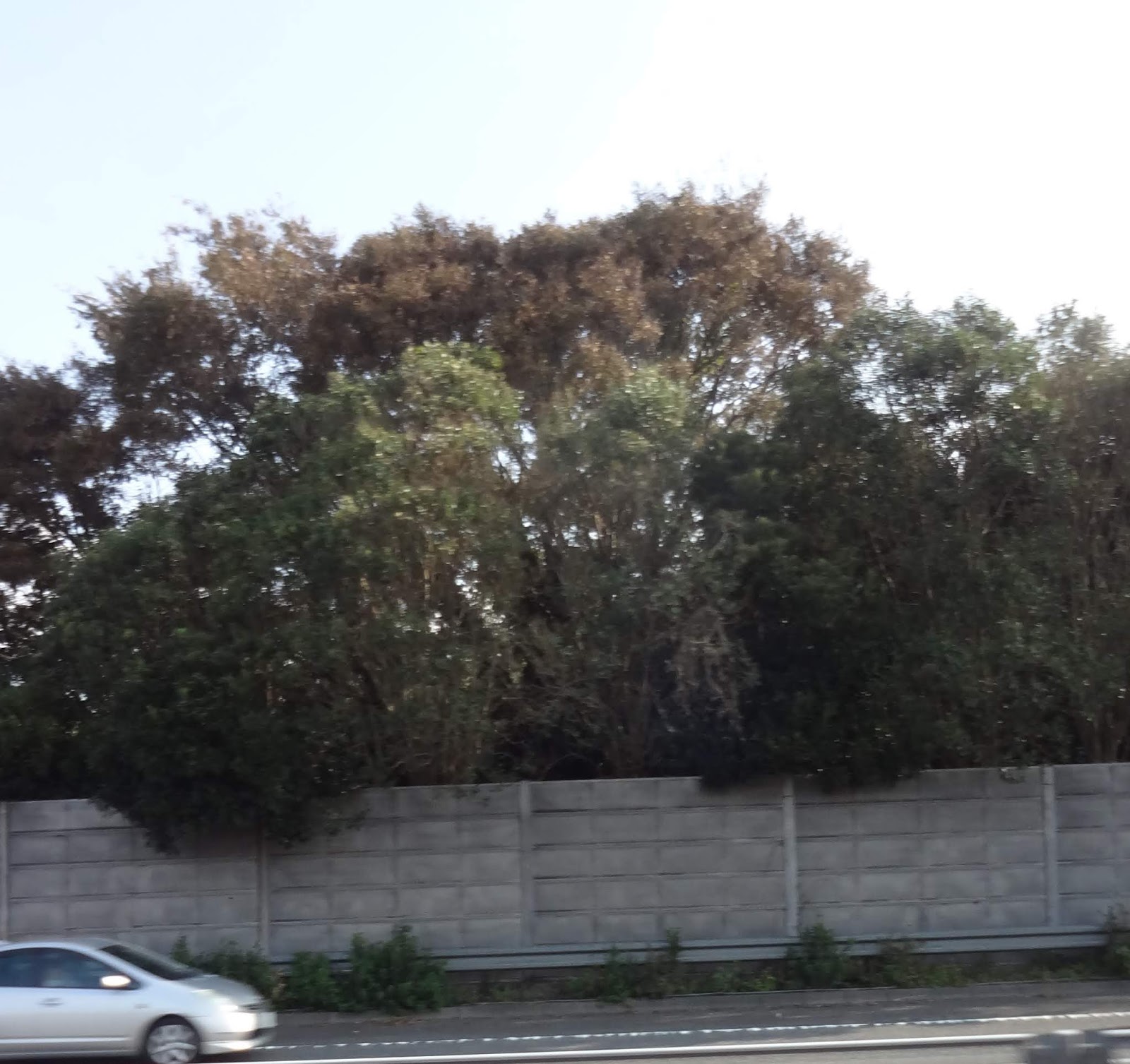
Trees we can find along Hodogaya Bypass 保土ヶ谷バイパス near Yokohama-Machida IC of Tomei Express Way, early October.
 The place is about 14km inlands from the Port of Yokohama,
 beyond the hilly downtown.
 Still, the leaves turned brown.


NiiharuCitizen Forest 新治市民の森 near Yokohama-Machida IC of Tomei Express Way was hard-hit. Some members of Lovers of Niiharu who live right next to the forest went in there next day, and found lots of damages here and there. “Several large trees were uprooted and blocked trekking roads.” “Some bamboo forest became a tangled mess of broken trunks!” “Immature cones of cypresses were blew up and ended up covering the slopes. The route was like a slide with ball-bearings spreading the surface!” “Branches of plum trees were damaged severely …” Now, almost 3 weeks later after the Typhoon, the Lovers of Niiharu still devote the weekend activities to clean up the mess. Broad leaved trees like Quercus acutissima and Quercus serrata have browned and often desiccated outlook, which looks like autumn leaves for uninitiated, but definitely in more tired appearance. When weather is normal, deciduous trees in lower altitude of Kanagawa Prefecture, Yokohama included, change their color in early December. “Er, well, we should not expect bright autumn colors this year …” *Sign*


Wooooooooooooow … an uprooted tree in Niiharu.
Poor Quercus actissima in Niiharu …
 A large branch of this tree was wrung off by the wind.
 We Lovers of Niiharu were relieved that
 no one was hurt by such damages, at least so far …
The Niiharu Lovers are removing a broken tree
 threatening the safety of trekking roads.
For a large, well-rooted tree to be broken in this way,
 strong winds must have been swirling …
The Lovers swept the ball bearing,
 aka cypress cones,
 to the side of the slopes.
Salt-damaged reeds in a biotope of Niiharu.
 In October, they should have been green yet …
“Well, let’s leave the damages off the trekking roads.
 We have already plenty of things to tend!”


Niiharu Citizen Forest is some 14km away from Tokyo Bay 東京湾. Yadoriki Water Source Forest やどりき水源林 on the foot of Mt. Nabewari 鍋割山 is located about 23km inlands from Sagami Bay 相模湾, tucked in mountains of Omote-Tanzawa 表丹沢. Was it spared from the power of the Super Typhoon? Unfortunately, no. The place may have had larger damages than Niiharu. It is reported that Hadano Forestry Road 秦野林道 has new collapses … (That part is now closed.) Tall afforested coniferous trees some 50 or more years’ old were uprooted here and there. Walking trekking routes was literally wading through deep debris of fallen branches to open up the trail. The place had several “Forests of Growing 成長の森” afforested by kids some 10 or so years ago. They were protected by sturdy wire-meshed fences against hungry deer. Their fences were destroyed in several places by the fallen large trees. “We need to mend it ASAP. Otherwise, deer will come in and eat up the kids’ trees.” The slope of mountains were dotted with brownish colors that were not autumn leaves but salt damages. “We cannot expect a beautiful December … *Sigh*”


Few days after the storm,
 the tree behind the admin cottage of Yadoriki had
 yellow leaves of salt damage.
 We hope it can survive …
Beyond Yadoriki Bridge 寄大橋 on Hadano Forestry Road.
 Woooooooooooow.
This is … dramatic.
Destroyed fence.
 The Prefecture has allocated the budget to deal with it.
Believe it or not, ahead of us is a road.
It looks like a beginning of autumn leaves.
 They are not.
 Instead of turning into yellow or red,
 the trees with brownish color here have more desiccated tone.
 They will shed the leaves before December.


The other side of Tanzawa Mountains, there is Doshi Village 道志村. At the moment, National Route 413 (2020 Tokyo Olympics’ course for the road race) is closed around the border of Yamanashi 山梨県 and Kanagawa Prefectures, due to the massive landslide. i.e. Doshi Village had lots of rain with the Super Typhoon. Because of it, or seawater could not reach there? I don’t know. Early October, Japanese Rowan was brightly red in Doshi at ASL 600m. Villagers told me salt damage did not reach to their place. … I now have a renewed awe toward the Mother Nature … People say global warming will bring more frequent monster typhoons to Japan … Would it be difficult for us to expect regular joy of autumn leaves any more?


Early October in Doshi Village, this year.
 Trees are preparing for autumn leaves …
December, several years ago in Yokohama, near my home.
 If the condition turns all right,
 we should be able to enjoy this ...


If you find an environmental issues in Kanagawa Prefecture, please make a contact with Kanagawa Natural Environment Conservation Center 神奈川県自然環境保全センター

657 Nanasawa, Atsugi City, 243-0121 2430121 厚木市七沢657
Phone: 046-248-0323


You can send an enquiry to them by clicking the bottom line of their homepage at http://www.pref.kanagawa.jp/div/1644/