Showing posts with label mixotrophic plants. Show all posts

Friday, August 5, 2022

Touchy Beautiful Madams: popular spring orchids in Kanagawa’s forests


You may be surprised to hear that Yokohama’s forests are homes for wild orchids. The most known and popular wild orchid we meet in Yokohama is Cymbidium goeringii, aka Shunran シュンラン. It opens its flower first in spring, which is the reason of its Japanese name: Shun = spring and ran= orchid. They are so popular that we can sometimes find it in high-end garden centers. Frankly speaking, no one has succeeded in artificial nurturing of it. So, I bet those Cymbidium goeringii in shops are brought from wild. It has bushy narrow leaves. People can think it can produce enough saccharine by photosynthesis for urban life in lanais of high-rise apartments. Nah. Recent study found their photosynthesis covers only 40% of energy necessary for plant’s survival. The remaining 60% comes from mycorrhizal fungus that transfer saccharine made by nearby plants. Inevitably, keeping Cymbidium goeringii in artificial environment is extremely tricky. They will die out within a couple of years or so in your pretty pot. Many associations of forest volunteers in Kanagawa situate out-door notice to tell possible “thieves” their labor to dig out the Cymbidium goeringii is futile. In Niiharu, the damage these days are kept minimum. But we’re watchful, especially when they open their flower early spring ...

Cymbidium goeringii in Yokohama.
I won’t tell you where I’ve taken this photo
😉

Another popular wild orchid in Yokohama’s forest is Cephalanthera falcata, aka Kinran キンラン. They come out in April after Shunran. Kin means gold in Japanese. At the tip, about 30cm high from the ground, they have a cluster of bright yellow flowers in the form of tiny tulip. They stand out in dim forest. It‘s understandable their flower language is “Brilliant Beau.” Though this beauty is also very hard to please. Unlike Shunran, it cannot last not long when it’s transplanted in a pot. It has seemingly robust green leaves which would do vigorous photosynthesis but that’s obviously not enough to sustain gorgeous presentation. Compared with Shunran, it is bigger Kinran’s dependency on mycorrhizal fungus and the habitat that sustain the world of fungi. The lady is difficult … Kinran is categorized as “VU” in the 2020 Red List of Endangered Species in Japan.
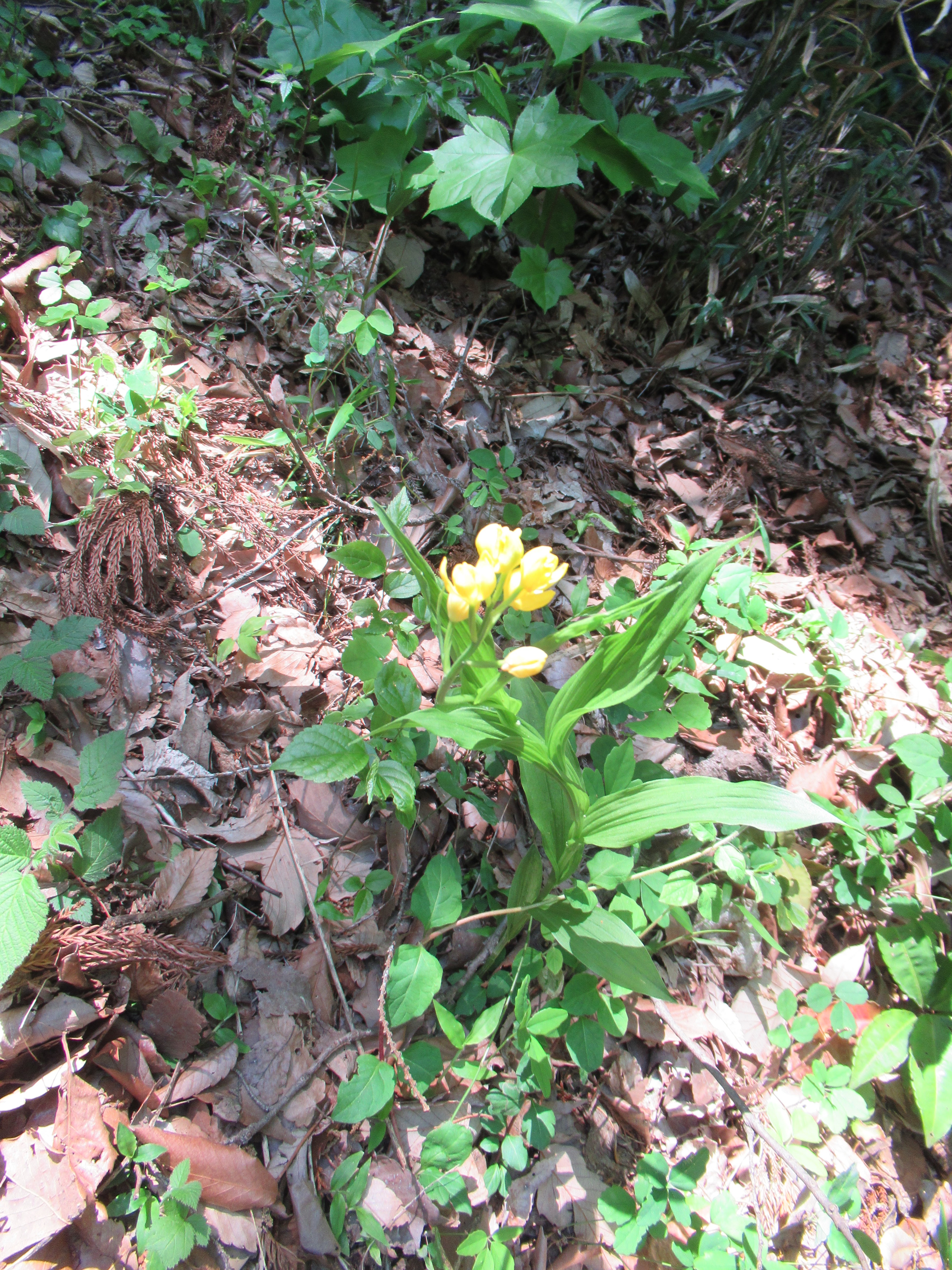
Cephalanthera falcata

When there is “gold,” “silver” appears unsurprisingly. A few days later than for Kinran, Yokohama’s forests welcome Cephalanthera erecta, aka Ginran ギンラン. Gin means “silver.” The size of this orchid is about 10-15cm high with smaller number of flowers in one cluster. Their flower language is “Modest lady.” Having said that, the degree of fastidiousness from these unpretentious madams does not differ from Kinran. Ginran is not able to survive either in a flowerpot. As they are choosy for their environment, we humans become very careful to maintain the habitat of their home. If we take care properly, we can meet them every spring in the same area. If you meet Kinran or Ginran in a forest, please admire them in situ, and come back same time next year. 😉

Cephalanthera erecta

These 3 very popular spring orchids in Yokohama’s forest have green leaves. They do some photosynthesis, if not vigorous enough to sustain themselves alone. Come to think of it, almost all vegetation needs network of mycorrhizal fungus and the other plants for survival. The standard way of plants’ way of life is like this: plants do photosynthesis that create amino acid as food for themselves; fungus receive some portion of such nutrients created through photosynthesis and in return give the plants minerals the fungi digested from the soil. Many plants can produce enough carbon for their survival and the spills for fungus. It’s just like international trade, as Ricardo recommended for easier economic development. “You’re good at this, and I’m at that. Let’s exchange the product at an agreed price and all are happy!” Orchids cannot join this circle.

Cephalanthera longibracteata.
It looks like Cephalanthera erecta,
but its leaves are longer and
grew taller than the cluster of flowers.
It’s another orchid we can meet
in Yokohama’s forest in spring.
They cannot survive in pot, of course.

Yep, orchids also create some nutrients by themselves with their nominally green leaves, but they cannot survive only with their product. They definitely need suitable environment that can carry enough food from outside via fungi. Moreover, they choose the fungi that specializes in delivering food for them. If they cannot have their chosen carrier, they die. Yeah, orchids provide nice home for specialized mycorrhizal fungus, maybe like human body for COVID-19 virus. Still, it seems to me scholars themselves are wondering what the fungi gets in return from orchids. Some say orchids provide some carbon for fungi in return to their service, but the amount orchids receive is disproportionately larger. Many plants do not care much for the kinds of fungi that can help them to obtain minerals from the ground. By becoming picky for fungi and hence for environment, some say orchids exploit the specific environment the fungi need for survival. Orchids economize the energy of photosynthesis they otherwise would have to spend to get food. ... I one day heard that’s one of the reasons why orchids are at the pinnacle of plants evolution: they are in that sense very efficient to earn nutrients for survival. Oh, OK, yeah, humans these days do not spend a whole day running around the field for protein or nuts to eat. We’re using the other creatures producing food for us … But, is that really so? What do we give in return to animal and vegetable? If it is the world of comparative advantage, such relation could be unsustainable ... And there are more “advanced” plants if hanging-on fungi to eat is a clever move for plants’ evolution. More to them next week. These days I’m thrilled to meet such wonder of nature so near in our backyard …

Calanthe discolor.
This is also one of the spring orchids
categorized as “VU”
in the 2020 Red List of Endangered Species in Japan.
Technically speaking,
propagators can use similar technique
as for tropical orchids to nurture this plant artificially.
But the market price of the flower does not pay
for the cost of commercial production.
It means if you find them in a garden center,
it should be brought by theft,
or the landlord does not care his or her forest.
OK, when you’re ready to take care of it
properly as for Phalaenopsis orchid,
you can own it.
Otherwise, it will soon die in your pot,
and the degree of biodiversity of the planet is reduced.


If you find environmental issues in Kanagawa Prefecture, please make a contact with Kanagawa Natural Environment Conservation Center 神奈川県自然環境保全センター

657 Nanasawa, Atsugi City, 243-0121
〒243-0121 厚木市七沢657
Phone: 046-248-0323

You can send an enquiry to them by clicking the bottom line of their homepage at http://www.pref.kanagawa.jp/div/1644/


Friday, July 29, 2022

Oh Sister, I Can’t Let You Go: flower thieves, irrational


Once upon a time, when Niiharu Forest became a citizen forest for the City of Yokohama, the place was known for its beautiful wild Asian fawnlily (Erythronium japonicum). It was white lilies of 30cm or so height, nobly opened their flowers early spring. Now, there is no wild Asian fawnlily in Niiharu Citizen Forest 新治市民の森. We Lovers of Niiharu is protecting yellow horticultural variety planted by the mother of Mr. Okutsu for her private “garden,” before the place became the Citizen Forest. (I won’t tell you exactly where.) For one thing, wild Asian fawnlily is a beautiful plant decorating spring. It is popular among gardeners. The entire plant of Asian fawnlily is edible. Many may have entered the Niiharu Forest to collect the fawnlilies for spring treat … The root of the plant is THE high-quality starch that can give silky texture for dishes. The starch, called “REAL katakuriko 純正カタクリ粉” is extremely difficult to find in stores on site or online. I guess only a couple of top-end Japanese restaurants in Tokyo or Kyoto use it for a select few customers. The starch is from specialty farm carefully nurturing Asian fawnlily … So, if someone came and found wild colonies of precious Asian fawnlily, that person may have concluded “Well, there are so many. I can bring one of them to my flowerpot, free. It’s a treasure!” Ha. So, beautiful and delicious Asian fawnlily was gone years ago from Niiharu. By theft.

Saxifraga stolonifera. Its leaves are also edible.
Very luckily, they are not endangered.
Many homes in mountainous area plant them in their garden
 and pick the leaves early spring for their meal.
I guess Asian fawnlily was once like them …

That kind of story is rife in Japan. “Celebrated plant hunter” could sound paradoxical … I simply wonder what kind of cultural difference exists between Britain and Japan ... Anyway, one day, I asked a veteran Kanagawa Forest Instructor why some people steal wild rare species from nature. He said, “Well … there is certain allure to ‘possess’ something special … It’s not possible to explain logically.” He was a ranger for Southern Japanese Alps and retired as a celebrated microbiologist for one of the leading Japanese Pharma. Such resume of his cannot explain this strange behavior of humans. “You see? These days I myself is addicted to collect primulas. I don’t care how far I drive to obtain a pot of rare primula. At that very moment when I get the flower, I don’t think how difficult it is to preserve the beauty. I feel extremely happy imagining my conservatory with new collection sitting pretty. ‘Owning’ has a strong meaning, I guess. Later, more clear-headed I realize the intricacy of taking care of the plants.” Gee. Even though, he always keeps his rationality not to dig up extremely rare species. He, a microbiologist, knows very well such vegetation cannot survive out of nature, unless high-tech labo provide 24/7 complicated care in test tubes. Let me explain.


Any living things on the planet depend on each other for survival. Homo sapience needs healthy microbiome in digestive organ. For flora, yeah, the common plants manufacture nutrients by themselves with photosynthesis. But even they need help from mycorrhizal fungus that can provide minerals underground that are indispensable for survival of plants. In return for subsistence the fungi receive saccharides produced by plant’s photosynthesis. “You scratch my back, and I’ll scratch yours.” Many plants have relaxed attitude for fungal collaboration, like “Basically I’m not so picky to collaborate for obtaining underground minerals or the like as long as the fungi are in XYZ phylum (division).” If their chosen phylum is for lots of common fungi, such plant species can survive in a variety of circumstances. They only need enough sunlight, water, and ubiquitous fungi belonging to their phylum. When a plant hunter has a success for moving plants from their native home, they are such species that can endure new environments with omnivorous tendencies for collaborating fungi, I presume. On the other hand, there are the other kinds of flora which are choosy regarding to their partner fungi. The most known such headstrong family is orchids.


According to Wikipedia, their often astonishingly beautiful and characteristic flowers have high efficiency in attracting insects for pollination. Some even evolve themselves together with the evolution of insects in order to speed up procreation. Hmmmmmmm. They also use other living things for their sustenance. They DO need very specific kinds of fungi for nutrients. Yes, many have green leaves some of which are large ones, but orchids are mixotrophic plants, i.e. they cannot prepare enough nutrition by self-photosynthesis only. Fungi is a medium that syphons not only minerals of the ground but also sugars from the other photosynthesizing plants (; more to it next week). Just like homo sapience, they utilize the other living things for individual and family survival. That’s the reason why they are sometimes called the most evolutionally advanced plants. The orchids we find in flower shops are epiphyte, when growing in wild they are on a bough of tropical rainforest. As you know they have thick, pipe-like roots, called mycorrhiza, that are rooms for collaborating fungi. But such semi-floating existence does not restrain the lives of tropical orchids in complex soil and fungi relationships. In their native tropical rain forest, they have frequent showers every day that can wash away soil and/or fungi before they establish an interactive structure. The orchids are OK if they can have enough nutrients in whatever form. When farmers nurture their commercial tropical orchids, they give them man-made nutritious medium for their sterilized seeds. The plant produces beautiful flowers with artificially concocted high-powered fertilizer juice only. It’s like protein powder for bodybuilders. They do not need fungi for survival but need courteous care of humans. They are using homo sapience as a collaborator of survival.

Your highness opened during a dead winter
 after fully utilizing our family’s labor force.

Wikipedia continues there are roughly 15000 known species of orchids that grow everywhere on the planet except in Antarctic. The orchids growing outside the tropical area are often not epiphyte. They sprout from ground, highly dependent on specific fungi thriving in the locale. In Japan there are about 230 known species of orchids. Many of them are not epiphyte. This means, they really need the environment of the soil they stand in which their chosen mycorrhizal fungus prospers. And here comes the origin of the problem. Say, you walk in Japanese forest and find a beautiful flower on the ground. You fell in love. You dig up the root, gently wrap the plant in a plastic bag with a little bit of water and hurry up home to transfer the flower in your pot. Alas, that’s flower is from orchid family. Your store-bought soil does not contain enough fungi as the flower’s home. The soil that attached to the mycorrhiza may have spare supply of fungi, but mycellium themselves need forest environment for survival. Soon fungi die and your lover will follow their microscopic buddy to perish. You’ll have an empty pot. The tragedy keeps happening when somebody tries to get wild orchids from Japanese forest. Many of them are now in the category of “Endangered species.”

Thrixspermum japonicum.
One of a handful of Japanese endemic orchids which is epiphyte.
Even though, it is extremely difficult to nurture it artificially.
It is small plant that cannot store nutrition much.
Once it is removed from its wild environment,
it cannot survive long with its small food pantry inside.
Good news is, it is commonly found in deep mountains of Kanagawa
whether the forest is broad-leaved or coniferous.
It seems to us it only needs proper humidity, sunlight, wind,
and rainfall coming down via the tree boughs carrying nutrition.
Better advised not to remove them from wild.
Please admire the flowers in April on your hiking road.

In addition,the problem is not only for orchids, but also with the other species of mixotrophic or even mycoheterotrophic plants. More to it for next week. Please stay tuned.


If you find environmental issues in Kanagawa Prefecture, please make a contact with Kanagawa Natural Environment Conservation Center 神奈川県自然環境保全センター

657 Nanasawa, Atsugi City, 243-0121
〒243-0121 厚木市七沢657
Phone: 046-248-0323

You can send an enquiry to them by clicking the bottom line of their homepage at http://www.pref.kanagawa.jp/div/1644/