
This is the time of a year GROUP the Creation and Voice of the Woods holds annual art show, 2020 Laboratory of Forest Art, in a Yokohama’s forest. As in my post on September 4th, this year’s event puts an emphasis on online presentation which has started on September 6th. Having said that, on September 20th the works of artists in the forest are ready for 2020 Exhibition. The installations are there until October 18th. You can visit the forest next to Satoyama Garden festival and enjoy the art show for this fall. In today’s post, I report my experience with the new works the artists created for 2020. I have an impression they are deepening their way of conversation with the forest. It’s something, really.

First, the access to the venue. Since there is no parking, a recommended way is by bus. The most convenient transportation is a bus ride to Yokohama Zoorasia, from JR Nakayama 中山 Station, Sotetsu Tsurugamine 鶴ヶ峰 Station, or Sotetsu Mitsukyo 三ツ境 Station. (Timetables are here.) Get off the bus at Yokohama Zoorasia and proceed further along for about 400m to the direction of #2 Parking of the Zoo. On your right, there will be a small gate with the sign GROUP the Creation and Voice of the Woods. If you visit the place during weekends, many buses will take us to the North Gate of Zoorasia that is the closest to the art exhibition entrance. When you leave the terminal stop of Zoorasia North Gate, go back a bit along the bus road, and on your left is the sign for the GROUP. From there enter the forest. The road is a relatively wide walking promenade. Soon you can see a big banner over there saying “the Creation and Voice of the Woods 創造と森の声.”

Let’s enter the forest, following their map to start with the Exhibition #1.

Exhibition #1
Haruna Chikada, “Dive into the Forest”
In this installation, she built iron pillars with horizontal stems of bamboo-leaf oaks (Quercus myrsinifolia), a dominant species for the North Forests of Yokohama. At the entrance of her art, the oaks are laid on the ground. They then are gradually lift up by iron pillars to reach high above our head at the end. Actually, the height of the last and highest pillars is at the same “altitude” of the stems on the ground at the entrance. The effect of this geometrical exercise is a mesmerizing expression of the depth of Yokohama’s forest on not-so-gentle slopes of our port city. In this way, Chikada chats with Yokohama’s forest with her amazement to the nature. It is an exciting beginning of 2020 show.
 |
| Haruna Chikada |
Noriaki Oka, “Glancing, Passing, and
Forgetting”
Oka has made a skeletal tunnel made of stems harvested from the forest and dangled several wire coils and kids-made figurines from the last year’s workshop. We walk through it and observe the dissected forest beyond the wall of the tunnel. The coils and figurines can sometimes be looked like “an eye of a fish or an animal.” Or, with your imagination, the scenery seen from “inside” of the tunnel can transform into whatever way you like. It’s a fun installation. Please enjoy it with kids!
 |
| Noriaki Oka |
Toshikazu Kanai, “The Garden of Fallen Tree”
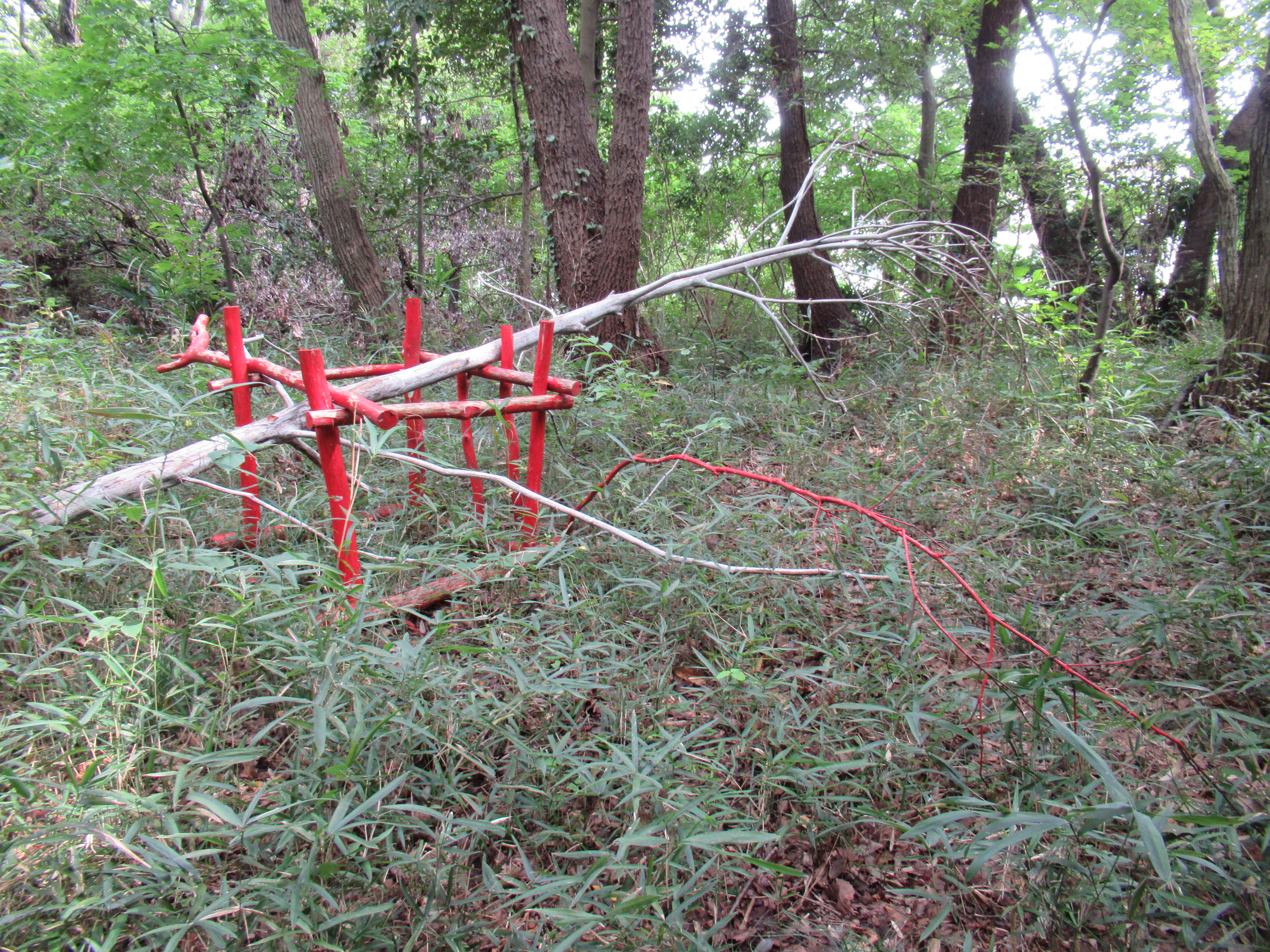
The material of Kanai’s installation is violently broken Quercus serrata by the last year’s typhoons. He cleared space around the fallen tree and glued marbles here and there on the dead body of the oak. He said during the process, he was amazed by the existence of the tree. He felt he was creating a bridge between the tree and human body. The broken tree is slowly decomposing so that the same scenery won’t be available next year, perhaps. For him it is a funeral of a tree that will be nutrients for the next generation. This is a beautiful work. If you have a chance, please go there and join meditative memorial service. + There is one piece of ceramic nearby, which Kanai made in his atelier. Could you find it?
 |
| Toshikazu Kanai |
ASADA, “Tree Pondering Spring”
ASADA said these days she often hikes with her teenage son. He is in a difficult stage of life, full of “Strum und Drang.” In arduous journeys with him in mountains, she had the brainwave for this installation. People who come to meet this can add more woods to the pile, or, she said it is perfectly OK to demolish the structure all together. She was sure, constructing it or not the doer for this work must experience meditation to some unforeseen result, just like teenagers facing their future, especially now with rapidly changing world. In the process, the nature surrounding the player will influence the entire process. Imagine what would happen if a strong wind of typhoons visits the pile? She recalls the spring of youth is always in such a state of mind … Please add/subtract wood for this pile by yourself.
 |
| ASADA |
Akatsuki Harada, “Regeneration”
Last year, an old member of the GROUP, Mr. Fukuda, passed away. He was a leader when they took care of the forest. One of his last work was to fell a damaged old Cerasus jamasakura. It was a huge tree. Harada decided to show a respect to Mr. Fukuda with 5 installations out of the logs harvested from the cherry tree. For 2020, he returned his site to continue his work with the remaining logs of cherry tree. He found an astonishing scenery. From the stamp Mr. Fukuda created, the cherry tree has started a coppice regeneration. Harada recalled the words of Mr. Fukuda. “Once an old tree fell, its body is decayed by the other creatures in the forest to be a part of the soil. Not only that, the way sunlight comes in, the wind blows, the rainwater runs … all of these things for the spot once a large tree stood must be changed due to the absence of a large tree. This way, forest never dies. It regenerate, you know.” So, this year, Harada decided to raise the main trunk of the cherry Mr. Fukuda fell, next to the coppicing tree. It is for the teaching of Mr. Fukuda. The new installation stands with the regenerated tree and the 5 smaller installations Harada created last year. 2019 work has started to be covered by moss and mushrooms. The fallen leaves are dangling on their head. They are becoming a part of the forest more, just as Mr. Fukuda said …
 |
| Akatsuki Harada |
Kazuo Ishikuro, “Oh-Mori-mori (Giant Salamander
of the Forest)”
I really recommend going the forest to meet this creature. It’s HUGE! Ishikuro said “It’s a powered-up version of last year’s ‘spirit of the forest.’ He’s worrying. He’s heard something of virus. He plans to come to human world and work with magical creatures like Amabie (my post on June 12, 2020) about COVID things …” Ishikuro constructed the basic form of Oh-Mori-mori with wire mesh and covered it with a rough lattice made of stems of sasa bamboos dominated the site when Oh-Mori-mori ‘came’ here. We see his tail wagging, as the sasa-mesh is intentionally woven loose. By the end of the exhibition, his body could be covered more with fallen leaves … and so the creature is ready to MOVE! (Wooooooooooow) Oh, by the way, Oh-Mori-mori has 4 attendants near him. Could you find them?
 |
| Kazuo Ishikuro |
Naoko Kobayashi, “Awake Quietly”
This is Kobayashi’s debut installation for Laboratory of Forest Art. She filled many colorful plastic containers with the soil of the site where her work now situates. The ground must be the home of many creatures, microbes, insects, sleeping seeds, etc. etc. What will happen with the colorful dots of containers with soil? They will awake quietly without any attention from humans … Let us see.
 |
| Naoko Kobayashi |
Youichiro Yoshikawa, “Furrow”
This is a continuation of Yoshikawa’s project since 2018. The beginning of the installation was his manifestation about art: the instantaneous communication of almost immortal nature and temporal human being. He created his “garden” within the forest as a conversation with the nature. He moved dwarf lilyturf harvested in the forest to make a circle and meandering “promenades” for humans to stroll. Several ‘nice looking natural logs’ were collected and intentionally erected at the current positions ‘just like designing a garden.’ He’s pruning the vegetation he purposefully left in 2018. By September 2020, the place has a circle border of dwarf lily and passages with more established “garden greens.” This time, Yoshikawa brought road-measure like wheels to walk around his ‘garden turf’ to ‘mark the furrow in the forest.’ At least for me, this is a strong testament from an artist to work with the forest. Any wheels, bikes, motored vehicles, baby carriages, or road-measures, can consume the natural spongy soil of forest very easily. In the climate of Kanagawa Prefecture, once 1 cm of topsoil is lost in this way, it takes 100 years for the forest to recover from the ‘damage.’ Forest scientists for the Prefecture’s Forest Labo are busy calculating this number to budget maintenance works for water source forests. Yoshikawa defiantly runs the wheel since “It is the relationship between mortal men and eternal nature.” Hmmmmmmmm. Thought provoking …
 |
| Youichiro Yoshikawa |
Exhibition 9
Youko Kiga, “From the Framework, 2020”
If we enter the forest to see this installation, it’s there at the same place for the 2019 Show. The way the work presented is the same as well. Though, the passing of time from 2019 to 2020 is recognizable with worn-off paints and sunburns of the materials. Kiga recorded these changes in forest-time and created her installation for 2020 to be presented in YouTube. Please check here and enter to see her latest installation. I haven’t seen it yet. She plans to publish it on September 26th. Let’s stay tuned.
 |
| Youko Kiga |
The first impression of mine for this year’s show is, their forest is becoming more lively. Yeah, Japanese oak tree wilt is killing many large Quercus serrata. The GROUP is covering the bottom of their symbol oak standing at the entrance of their forest, in order to protect it from the infection. Browned patches of canopy are visible here and there. In addition, the damages caused by the last year’s typhoons are still remaining. Though, the place has less impression of abandonment. The bushes of overwhelming sasa bamboos are not so dominating as before when the GROUP moved from the previous site which is now for the Satoyama Garden Gramping business. The artists have taken care of the forest. Such relationship with the place is becoming a part of characteristics of the Exhibition. Before, they were sometimes quarrelling with the forest. Or, an installation could lose the direction in a mess of sasa bamboos and mosquitos. This year, it seems to me, they are getting the grip for conversation with the forest. Even with the desiccated Quercus serrata, atmosphere of the show is more relaxing and soothing. If you have a chance to visit Satoyama Garden fiesta held till October 18th, please drop in the Exhibition as well. It’s so stimulating to see the artists developing their dialogue with the nature. Maybe, such effort is something we all need in this age of global warming and COVID-19.

If you find a problem in the site introduced in this post, the best contact address will be GROUP the Creation and Voice of the Woods.
https://morilab.amebaownd.com/
e-mail: morinokoe7@yahoo.co.jp
The city office which is in
charge of this forest is
Office for the Park Greeneries in the North 北部公園緑地事務所
Yokohama Municipal Government
Creative Environment Policy Bureau 横浜市環境創造局
Phone: 045-311-2016


