Showing posts with label Typhoon. Show all posts

Friday, November 25, 2022

This year, autumn leaves in Kanagawa are beautiful …


Megalopolis Tokyo area is in relatively temperate region, at about 36°N of latitude. Adding global warming, autumn and winter here are (it seems to me) getting milder. That would be a nice thing for humans withstanding cold weather. But, for the beauty of autumn forest, it is a drawback. Especially for Kanagawa Prefecture, we are in the south of border that is a boundary for deciduous Japanese beech to thrive in lower altitude. Yokohama is too warm for beech to be ubiquitous. (FYI, the border is the ridge way of Mt. Takao. Please see my posts on February 25, March 4 and 11 this year.) Fall temperatures here are often hesitating to go down in November and December. Accordingly, leaves are left at the whim of going up and down of warmth. They say leaves turn colors in autumn in order to cope with weakening photosynthesis due to shorter days but still strong ultraviolet rays. When photosynthesis becomes less, their body starts to reduce inside green chlorophyll, which makes remaining yellow carotenoid stand out. Then, the trees produce anthocyanin that can absorb ultraviolet rays and so ward off toxicity. Lots of anthocyanin renders such beautiful red. If the shortening of days is insufficient as in 36°N, and climate is milder for ordinary deciduous trees, their leaves may be confused “to be colored, or not to be colored.”


The autumn colors in lower part of Kanagawa are often of a mixed result … We Kanagawa Forest Instructors speculate so. Especially those senior instructors whose hometowns were in Hokkaido or Tohoku areas, this theory would sound very strong. “You see? The forests of my birthplace have far more beautiful autumn than in Kanagawa.” “Oh, mine in Iwate Prefecture as well.” “Hm. Kanagawa is too close to the Pacific Ocean and strong impacts of typhoons can remain. In contrast, not for my Hokkaido (with quiet ha-ha-ha from inner pride) …” “You know, typhoons can wind up salty vapor from sea, and let it down in raindrops.” “That’s damage the leaves. Salt.” “Oh, yes. Here is a good warm place, but too temperate for charming autumn leaves.” … Normally, conversation goes like this. Certainly, when we see yellowish but wearied tone of mountain slopes in front of us, it is hard to deny such claims …


That was our conversation around this time of the year. HOWEVER! With some sort of miracle, the 2022 autumn colors in Kanagawa is SPECTACULAR. We’re a bit taken aback. “Why?” “COP27 says the World is definitely warming …” “It means our maple trees are more in a disadvantaged.” “Yep, even so, Look!!!” Come to think of it, this year we have not had a strong typhoon landing on our prefecture. That would be why the yellows and reds in our forests are so vivid. And it’s still a beginning. Kanagawa’s autumn colors will be peaked around the end of November! Mmmmmmmmmmmmmmmmmmmmmmmmmmmmm …. Please come out and have a nice stroll in beautiful fall forests. Rain or shine, the atmosphere is so calming …


It’s early November around ASL1100m.
 Beautiful Japanese beeches …

Lower Tanzawa

I think they are Conocephalum toyotae, but not sure.
 Does moss turn colors in autumn?


If you find environmental issues in Kanagawa Prefecture, please make a contact with Kanagawa Natural Environment Conservation Center 神奈川県自然環境保全センター

657 Nanasawa, Atsugi City, 243-0121
〒243-0121 厚木市七沢657
Phone: 046-248-0323

You can send an enquiry to them by clicking the bottom line of their homepage at http://www.pref.kanagawa.jp/div/1644/


Thursday, September 24, 2020

Let’s Have a Talk: 2020 Laboratory of Forest Art, Yokohama


This is the time of a year GROUP the Creation and Voice of the Woods holds annual art show, 2020 Laboratory of Forest Art, in a Yokohama’s forest. As in my post on September 4th, this year’s event puts an emphasis on online presentation which has started on September 6th. Having said that, on September 20th the works of artists in the forest are ready for 2020 Exhibition. The installations are there until October 18th. You can visit the forest next to Satoyama Garden festival and enjoy the art show for this fall. In today’s post, I report my experience with the new works the artists created for 2020. I have an impression they are deepening their way of conversation with the forest. It’s something, really.


First, the access to the venue. Since there is no parking, a recommended way is by bus. The most convenient transportation is a bus ride to Yokohama Zoorasia, from JR Nakayama 中山 Station, Sotetsu Tsurugamine 鶴ヶ峰 Station, or Sotetsu Mitsukyo 三ツ境 Station. (Timetables are here.) Get off the bus at Yokohama Zoorasia and proceed further along for about 400m to the direction of #2 Parking of the Zoo. On your right, there will be a small gate with the sign GROUP the Creation and Voice of the Woods. If you visit the place during weekends, many buses will take us to the North Gate of Zoorasia that is the closest to the art exhibition entrance. When you leave the terminal stop of Zoorasia North Gate, go back a bit along the bus road, and on your left is the sign for the GROUP. From there enter the forest. The road is a relatively wide walking promenade. Soon you can see a big banner over there saying “the Creation and Voice of the Woods 創造と森の声.”


Let’s enter the forest, following their map to start with the Exhibition #1.


Exhibition #1

Haruna Chikada, “Dive into the Forest”

In this installation, she built iron pillars with horizontal stems of bamboo-leaf oaks (Quercus myrsinifolia), a dominant species for the North Forests of Yokohama. At the entrance of her art, the oaks are laid on the ground. They then are gradually lift up by iron pillars to reach high above our head at the end. Actually, the height of the last and highest pillars is at the same “altitude” of the stems on the ground at the entrance. The effect of this geometrical exercise is a mesmerizing expression of the depth of Yokohama’s forest on not-so-gentle slopes of our port city. In this way, Chikada chats with Yokohama’s forest with her amazement to the nature. It is an exciting beginning of 2020 show.


Haruna Chikada

Exhibition #2

Noriaki Oka, “Glancing, Passing, and Forgetting”

Oka has made a skeletal tunnel made of stems harvested from the forest and dangled several wire coils and kids-made figurines from the last year’s workshop. We walk through it and observe the dissected forest beyond the wall of the tunnel. The coils and figurines can sometimes be looked like “an eye of a fish or an animal.” Or, with your imagination, the scenery seen from “inside” of the tunnel can transform into whatever way you like. It’s a fun installation. Please enjoy it with kids!


Noriaki Oka

Exhibition #3

Toshikazu Kanai, “The Garden of Fallen Tree”

The material of Kanai’s installation is violently broken Quercus serrata by the last year’s typhoons. He cleared space around the fallen tree and glued marbles here and there on the dead body of the oak. He said during the process, he was amazed by the existence of the tree. He felt he was creating a bridge between the tree and human body. The broken tree is slowly decomposing so that the same scenery won’t be available next year, perhaps. For him it is a funeral of a tree that will be nutrients for the next generation. This is a beautiful work. If you have a chance, please go there and join meditative memorial service. + There is one piece of ceramic nearby, which Kanai made in his atelier. Could you find it?


Toshikazu Kanai

Exhibition #4

ASADA, “Tree Pondering Spring”

ASADA said these days she often hikes with her teenage son. He is in a difficult stage of life, full of “Strum und Drang.” In arduous journeys with him in mountains, she had the brainwave for this installation. People who come to meet this can add more woods to the pile, or, she said it is perfectly OK to demolish the structure all together. She was sure, constructing it or not the doer for this work must experience meditation to some unforeseen result, just like teenagers facing their future, especially now with rapidly changing world. In the process, the nature surrounding the player will influence the entire process. Imagine what would happen if a strong wind of typhoons visits the pile? She recalls the spring of youth is always in such a state of mind … Please add/subtract wood for this pile by yourself.


ASADA

Exhibition 5

Akatsuki Harada, “Regeneration”

Last year, an old member of the GROUP, Mr. Fukuda, passed away. He was a leader when they took care of the forest. One of his last work was to fell a damaged old Cerasus jamasakura. It was a huge tree. Harada decided to show a respect to Mr. Fukuda with 5 installations out of the logs harvested from the cherry tree. For 2020, he returned his site to continue his work with the remaining logs of cherry tree. He found an astonishing scenery. From the stamp Mr. Fukuda created, the cherry tree has started a coppice regeneration. Harada recalled the words of Mr. Fukuda. “Once an old tree fell, its body is decayed by the other creatures in the forest to be a part of the soil. Not only that, the way sunlight comes in, the wind blows, the rainwater runs … all of these things for the spot once a large tree stood must be changed due to the absence of a large tree. This way, forest never dies. It regenerate, you know.” So, this year, Harada decided to raise the main trunk of the cherry Mr. Fukuda fell, next to the coppicing tree. It is for the teaching of Mr. Fukuda. The new installation stands with the regenerated tree and the 5 smaller installations Harada created last year. 2019 work has started to be covered by moss and mushrooms. The fallen leaves are dangling on their head. They are becoming a part of the forest more, just as Mr. Fukuda said …


Akatsuki Harada

Exhibition 6

Kazuo Ishikuro, “Oh-Mori-mori (Giant Salamander of the Forest)”

I really recommend going the forest to meet this creature. It’s HUGE! Ishikuro said “It’s a powered-up version of last year’s ‘spirit of the forest.’ He’s worrying. He’s heard something of virus. He plans to come to human world and work with magical creatures like Amabie (my post on June 12, 2020) about COVID things …” Ishikuro constructed the basic form of Oh-Mori-mori with wire mesh and covered it with a rough lattice made of stems of sasa bamboos dominated the site when Oh-Mori-mori ‘came’ here. We see his tail wagging, as the sasa-mesh is intentionally woven loose. By the end of the exhibition, his body could be covered more with fallen leaves … and so the creature is ready to MOVE! (Wooooooooooow) Oh, by the way, Oh-Mori-mori has 4 attendants near him. Could you find them?


Kazuo Ishikuro

Exhibition 7

Naoko Kobayashi, “Awake Quietly”

This is Kobayashi’s debut installation for Laboratory of Forest Art. She filled many colorful plastic containers with the soil of the site where her work now situates. The ground must be the home of many creatures, microbes, insects, sleeping seeds, etc. etc. What will happen with the colorful dots of containers with soil? They will awake quietly without any attention from humans … Let us see.


Naoko Kobayashi

Exhibition 8

Youichiro Yoshikawa, “Furrow”

This is a continuation of Yoshikawa’s project since 2018. The beginning of the installation was his manifestation about art: the instantaneous communication of almost immortal nature and temporal human being. He created his “garden” within the forest as a conversation with the nature. He moved dwarf lilyturf harvested in the forest to make a circle and meandering “promenades” for humans to stroll. Several ‘nice looking natural logs’ were collected and intentionally erected at the current positions ‘just like designing a garden.’ He’s pruning the vegetation he purposefully left in 2018. By September 2020, the place has a circle border of dwarf lily and passages with more established “garden greens.” This time, Yoshikawa brought road-measure like wheels to walk around his ‘garden turf’ to ‘mark the furrow in the forest.’ At least for me, this is a strong testament from an artist to work with the forest. Any wheels, bikes, motored vehicles, baby carriages, or road-measures, can consume the natural spongy soil of forest very easily. In the climate of Kanagawa Prefecture, once 1 cm of topsoil is lost in this way, it takes 100 years for the forest to recover from the ‘damage.’ Forest scientists for the Prefecture’s Forest Labo are busy calculating this number to budget maintenance works for water source forests. Yoshikawa defiantly runs the wheel since “It is the relationship between mortal men and eternal nature.” Hmmmmmmmm. Thought provoking …


Youichiro Yoshikawa

Exhibition 9

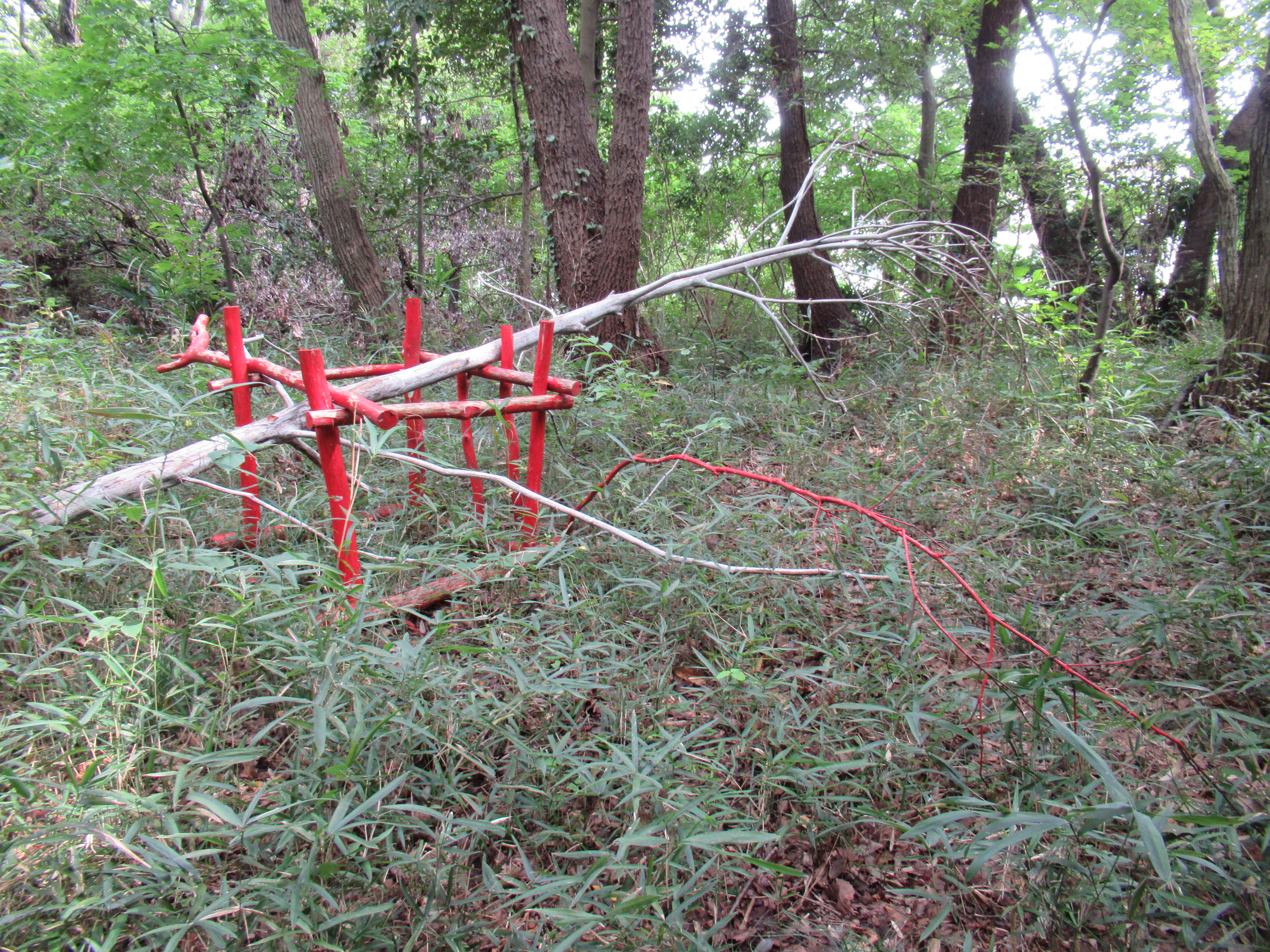
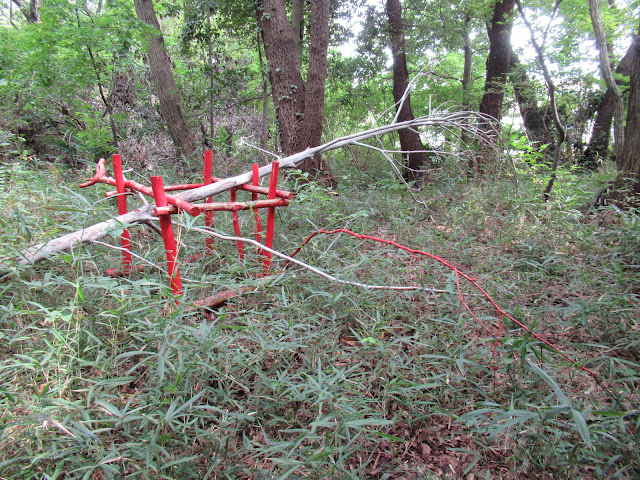
Youko Kiga, “From the Framework, 2020”

If we enter the forest to see this installation, it’s there at the same place for the 2019 Show. The way the work presented is the same as well. Though, the passing of time from 2019 to 2020 is recognizable with worn-off paints and sunburns of the materials. Kiga recorded these changes in forest-time and created her installation for 2020 to be presented in YouTube. Please check here and enter to see her latest installation. I haven’t seen it yet. She plans to publish it on September 26th. Let’s stay tuned.

Youko Kiga

The first impression of mine for this year’s show is, their forest is becoming more lively. Yeah, Japanese oak tree wilt is killing many large Quercus serrata. The GROUP is covering the bottom of their symbol oak standing at the entrance of their forest, in order to protect it from the infection. Browned patches of canopy are visible here and there. In addition, the damages caused by the last year’s typhoons are still remaining. Though, the place has less impression of abandonment. The bushes of overwhelming sasa bamboos are not so dominating as before when the GROUP moved from the previous site which is now for the Satoyama Garden Gramping business. The artists have taken care of the forest. Such relationship with the place is becoming a part of characteristics of the Exhibition. Before, they were sometimes quarrelling with the forest. Or, an installation could lose the direction in a mess of sasa bamboos and mosquitos. This year, it seems to me, they are getting the grip for conversation with the forest. Even with the desiccated Quercus serrata, atmosphere of the show is more relaxing and soothing. If you have a chance to visit Satoyama Garden fiesta held till October 18th, please drop in the Exhibition as well. It’s so stimulating to see the artists developing their dialogue with the nature. Maybe, such effort is something we all need in this age of global warming and COVID-19.


If you find a problem in the site introduced in this post, the best contact address will be GROUP the Creation and Voice of the Woods.

https://morilab.amebaownd.com/

e-mail: morinokoe7@yahoo.co.jp


The city office which is in charge of this forest is

Office for the Park Greeneries in the North 北部公園緑地事務所

Yokohama Municipal Government Creative Environment Policy Bureau 横浜市環境創造局

Phone: 045-311-2016

FAX: 045-316-8420


Thursday, September 3, 2020

A Trailer: Laboratory of Forest Art 2020


This year, we had a very long monsoon season. It was unusually wet and even cold. Then, suddenly, when the calendar turned into August, we are thrown into sunny and damned hot summer. It seems to me the condition was perfect for Platypus quercivorus to establish colonies in old oak trees in Kanagawa Prefecture. The oaks, mainly Quercus serrata, that have been spared from the infection of the bugs before the rain are now blasted here and there. It’s the beginning of rapid spread of Japanese Oak Tree Wilt. I’ve heard in Togawa Park 神奈川県立秦野戸川公園 (; my post on February 14, 2020), the most popular entrance to Tanzawa mountains, decided to hire pros to cut lots of died oaks in order to prevent accident by diseased oaks falling over the hikers … Here in more urban Yokohama, many Quercus serrata have abruptly turned brown under bright sunshine. They are dying.


These two trees are dying side-by-side
 in a park near Niiharu …


We Niiharu Lovers are somehow sanguine about the situation. We last year found a tree on the popular road in Niiharu that was infected by the disease. The City cut it, and we have been, a sort of, waiting for the result. Now this. “Well, if we have not taken care of the forest for a long time and let the oaks to be bigger like now, the explosion of infectious disease has been a disaster in waiting.” Yes. If people have harvested fuel logs and used the tree for cultivating mushrooms, such thing could not happen. Platypus quercivorus are picky home buyers. They live only in large oaks. In the 1960s and onwards, the society chose the convenience of petrol-based activities. Traditional usage of Satoyama forest was forgotten. Oaks that were before coppiced every 15-20 years were abandoned and become formidable size. Bugs have found the large supply of the best property for their sweet home with thousands of babies per couple … The thing we can do now, apart from treating the infected trees, is to keep doing our voluntary work of forest management, isn’t it?


Niiharu’s infected trees … They looked OK in July …


Such unintended consequence of human activity is becoming undercurrent for this year’s Laboratory of Forest Art. For one thing, last year’s typhoons made great damages in the entire North Forests of Yokohama. It shocked the artists. I’ve heard the power of typhoon has been treated as the important element of 2020 exhibition since last fall. Next came COVID-19 pandemic, which put another constraint for their activities especially when they plan to have art workshops. Finally, at the end of monsoon the preparation of the 2020 show has started, and the oaks of their place started to dieback. The members of the Creation and Voice of the Woods 創造と森の声 are now digesting all of these things to be reflected in their new installation for coming September.


The forest for Laboratory of Forest Art is
 having lots of Japanese Oak Tree Wilt …
This is due to last year’s typhoons
 in their forest.


So, Laboratory of Forest Art 2020 is planned to be a bit different from the previous years. They do not have opening and closing parties, but present their work for a longer period of time, from September 6th to October 18th, via internet. One or two families will be allowed to join several workshops with RSVP at first-come-first-served base. Please check their HP here, and see the availability of workshop, videos about their activity, etc. The 2020 show will be from 27th of September to October 18th. We can just check internet, or go there and see how artists are coping with this new world’s situation in the forest. I hope, by then, at least this hot summer days are somehow ending …


Mr. Kazuo Ishikuro is in the forest for this year’s installation
 … His is a sort of shocking creature.
 Please stay tuned!
Mr. Youichiro Yoshikawa’s creation looks like this now.
 How will he treat it this year?


If you find a problem in the site introduced in this post, the best contact address will be GROUP the Creation and Voice of the Woods.

https://morilab.amebaownd.com/

e-mail: morinokoe7@yahoo.co.jp


The city office which is in charge of this forest is

Office for the Park Greeneries in the North 北部公園緑地事務所

Yokohama Municipal Government Creative Environment Policy Bureau 横浜市環境創造局

Phone: 045-311-2016

FAX: 045-316-8420


Friday, February 28, 2020

Here be Dragons: A bit of info if you meet with natural disasters in Japan


Hm. This week, my post deviates a bit from the theme of this blog, “about forests in Yokohama and Kanagawa.” After writing last week’s post, I realized I may be of some help for you guys who happen to be in Megalopolis Tokyo, or in Japan, when natural disaster hits. Many people say especially casual visitors, or people who don’t understand Japanese, have difficulty to obtain vital info for typhoon, floods, tsunami, etc. Yeah. Earthquake is terrible, but it comes suddenly. The level of preparedness, at least mentally, for it would be the same between locals and visitors. In contrast, natural disasters with water, like storms and tsunamis, take some time to come. A monster tsunami took 10 minutes to gulp Manazuru Peninsula 真鶴半島 in 1923. Having good info as quickly as possible could be a matter of life or death. So, today, I tell you some sources for info issued by local and national pubic entities about natural disasters.


The first line of defense of this matter in Japan is local offices. Say, you live in one of those wards in Yokohama or Tokyo. Then, the ward office has many information for disaster risk reduction. It includes

a.      Map for the location of designated evacuation center near you,
b.      Map for the location of delivery for water and any other emergency supplies by the public office,
c.      Map of medical services ready for opening the door whatever happens,
d.      Map of the area where the office thinks it has a high possibility to suffer water disaster, and earthquake; these two things can mean the same thing, i.e. fragile land = landslides and flood-prone swamp,
e.      Nice booklets for you to prepare for the disaster. The most famous one is by Tokyo, called “Tokyo Bousai 東京防災“ which was distributed for Tokyoites. This book keeps its #1 Best Seller position in this genre in Japan, and downloadable as Kindle, free of charge, from here.

If you have any question you can ask to the desk they have in the local government office building. Actually, their HP has the above info so that you can go there first before physically visiting the place. They also have services for emergency alert system to the people who stay in their ward / city / town, like living there, or working in the area. You go to their HP, and register your email address, or SNS account. When an evacuation order is issued, they will notify via your contact addresses you’ve left in this page.


Inside Tokyo Bousai, showing the evacuation flow chart.


But sometimes we need info for much larger geographical coverage. If a heavy rain causes trouble in upper stream, people in the region of lower down will have problems eventually. Or, knowing a super-typhoon is approaching from the east of the Philippines, we can have more time to prepare. About the weather forecast in general, there are several apps for your phone. You can choose whichever you like during your stay in Japan. We locals check NHK news in TV or, with their app, downloadable from any app store, free of charge. NHK has obtained the trust of us through decades of major disasters like last years’ super typhoons, Fukushima Nukes, or numerous earthquakes. They also have English app pages so that you don’t have to rely heavily on Google translation to know the latest info. Their info is not only for weather but also evacuation order or the like. In terms of detail, NHK is inevitably not so good as the info delivered from your registered ward. But, say, if you happen to be in the affected area which is away from your registration, you may know what is going on around you from the NHK site.


In Google Play, app for NHK news looks like this.


These two places I mentioned above are a sort of info aggregators who receive the data from the public offices such as Japan Meteorological Agency, and Ministry of Land, Infrastructure, Transport, and Tourism. The primary sources also have their HP whose info is constantly updated, especially when the disaster is hitting. Needless to say, their info is the fastest, but we need finesse to navigate such pages as they are mainly for experts. Having said that, they have, er, well, a kind of, one-stop shop for the general public to obtain info directly from them. From the Meteorological Agency, you can go there, and your phone or PC’s GPS automatically sends your location data for the Agency to show the relevant disaster-related weather condition. I’ve found out they do not make this particular page in foreign language. That’s a pity. But if you find somebody who can tell you what’s on the page, it is the info for that translating someone would love to know urgently.


English version of Japanese Met Agency HP
 starts from the general portal.
 You have to dig into from here.
 It’s cumbersome …


About the condition of dams, banks, and water flows for the river, bays, sea, … the primary info comes from the Ministry. You go there, and click whatever info you need from the icons. The same info is available from your smartphone from


and, hurrrrah, they have an English version from


 (er, yeah, it’s a bit abbreviated info.)
They contain live video streaming from ministerial cameras situated at the strategic points for possible disaster. We can also combine data such as the risk of tsunami, flood, volcano, and (known) active faults to assess comprehensively a location, and to make a hazard map. Please play around with the site for a while, and we can prepare before the next one comes. Also, the Ministry has this site of detailed hazard map. There, we can layer the risks of flood, landslides, tsunami, road-related disasters on particular address within Japan. Not only for preparing evacuation, but also in case you plan to purchase a real estate in Japan, this info could be vital. Please check it.


Japanese portal for the HP of River Info looks like this.
 We click any of these boxes and play around.


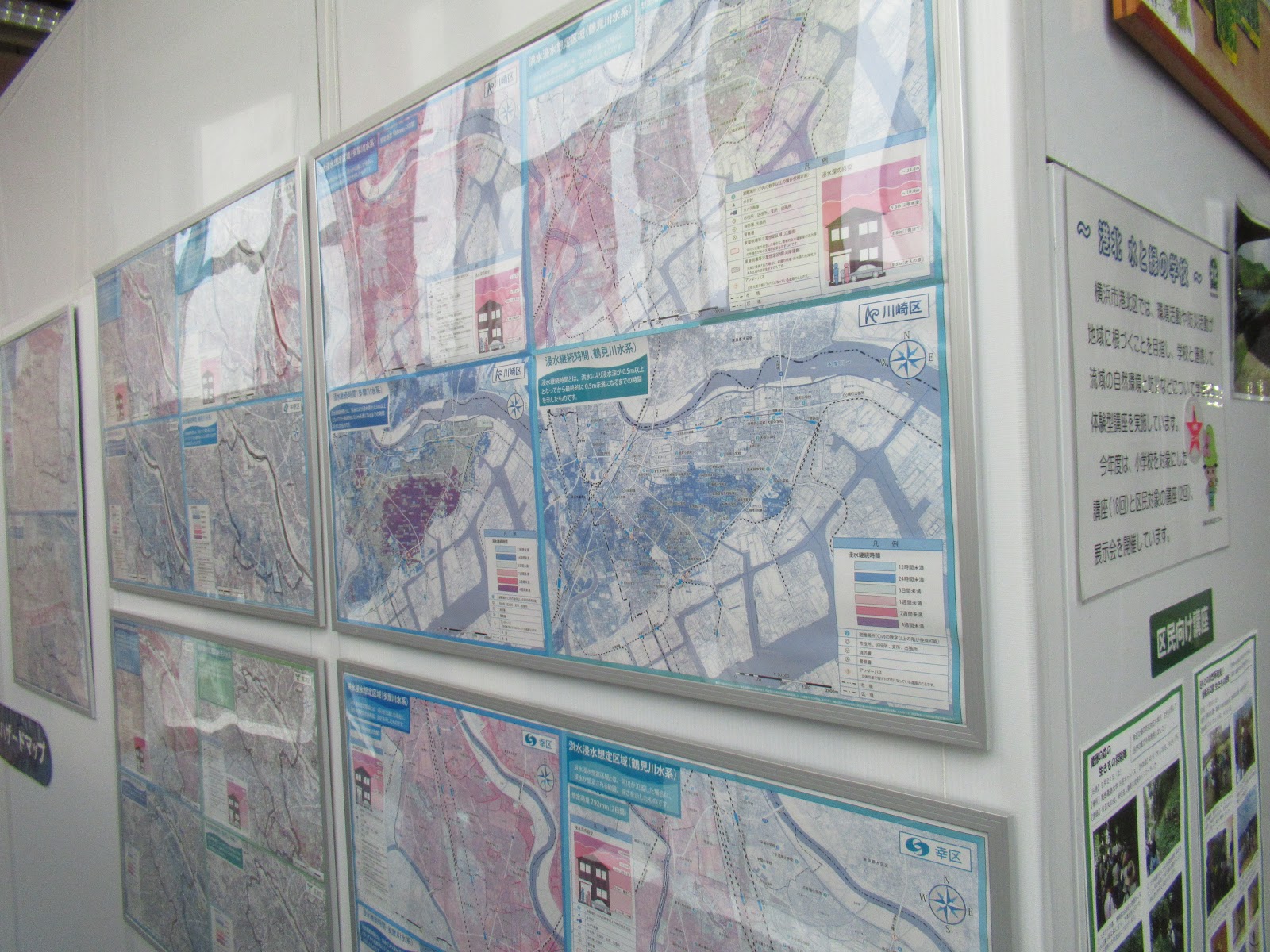
Speaking of having fun to prepare for disaster, Tsurumi River has a nice facility by the Ministry. It’s Tsurumi River Watershed Center 鶴見川流域センター, next to the New Yokohama Sports Park 新横浜公園. Basically, the place is to offer info about Tsurumi River, including geological feature, history, biodiversity, the volunteers for the River, and advises for preparing possible flood, tsunami, and the other disasters caused by the River. It’s a family-friendly place with aquarium for water creatures living in Tsurumi River. They have a mini-library where we can borrow encyclopedia for nature, history and any other books about the area. The place also organizes public event such as workshops like I introduced you last week, concerts, movies, etc. They are often free of charge, or only for a nominal fee. The Center has a large display of hazard maps for towns in Machida, Kawasaki, and Yokohama that are along Tsurumi River. It covers the area of Kawasaki next to Tama River. It could be a vital info for your survival in the area. If you have any chance to visit the New Yokohama Sports Park, please consider visiting the Center. It’s fun there!


Tsurumi River Watershed Center.
 Could you see a forest in their back?
 It’s Kozukue Citizen Forest.
A photo when the Sports Park was hit by the largest flood in 2014,
 shown in the Center.
 Yeah, it’s a scary photo,
 but the park did not reach to the max.
 Amazing.
He’s from Tsurumi River.
Hazard maps shown for the cities along Tsurumi River.
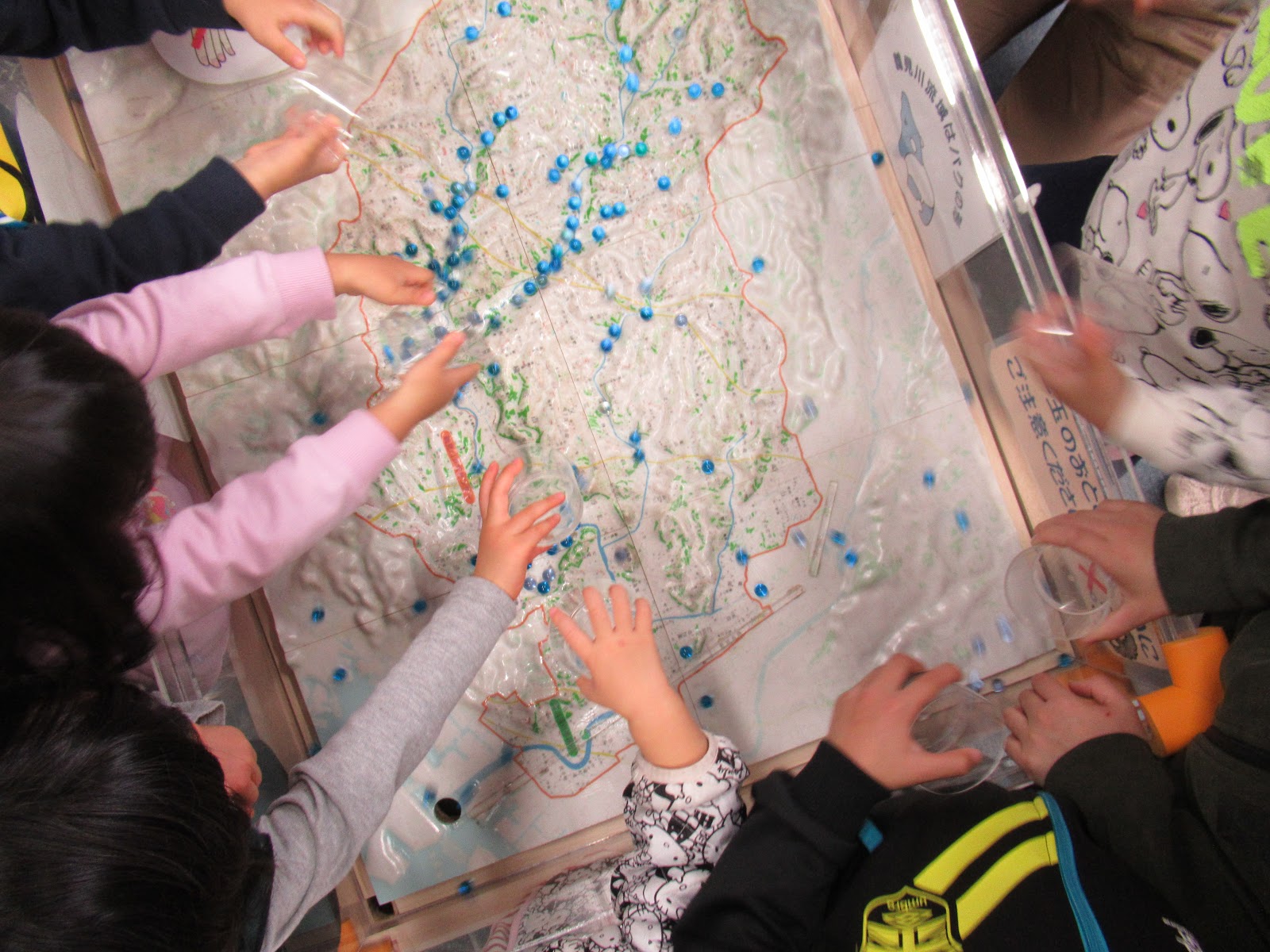
Every Sunday at 13:00, the Center has a fun event
 for kids to know how rainwater runs in Tsurumi River Basin,
 using diorama and marbles.
 It’s really an eye-opening experiment for adults as well.
 We can understand why the Sports Park
 and Nissan Stadium must be in that location
 to tame the damage of flood
 on population and industry center of Tokyo Bay.


And finally, those are the tree lingo for alert during the emergency. Yap, they are mouthful even for locals (; they are legal terms, in the end), but it’s not useless to know the meaning of it.

1.      Hinanjunbi-Koreisha-toh-Hinankaishi 避難準備・高齢者等避難開始 “Be ready to evacuate, and if you’re in a certain condition, move to the evacuation center.” That is to say, you must be ready to evacuate if this alert is issued, but do not have to move yet. Though, if you are handicapped due to physical and /or mental condition, or you’re a senior citizen, you should move to the evacuation shelter now.

2.      Hinankankoku 避難勧告 “Recommendation to evacuate.” Now is the time for all of us to move to the evacuation shelter.

3.      Hinanshiji (Kinkyu) 避難指示(緊急)”Immediate evacuation order.” People say if the situation reaches to this point, your travel for evacuation is very likely to be in Hollywood’s action movie. Better avoiding it, and act while the level is still in Hinankankoku, I suppose.

The local offices, Meteorological Agency, or any other governmental entity will use one of these three words when the time comes. Furthermore, for the preparation of us citizens, last December Japanese government started a campaign to create “Our timeline for evacuation” by ourselves. To support the task, they have this portal. Although the content is for 10 years’ old kids and up, it’s not in English, regrettably. If you know somebody who can read Japanese, please try together. The process completing the timeline is a fun group work, and very educational experience, I bet.


My Time Line portal by the Ministry


Tsurumi River Watershed Center
Open: 10:00-17:00, Wed-Mon
2081 Kozukue-cho, Kohoku-ku, Yokohama 222-0036
230-0051 神奈川県横浜市港北区2081
Phone: 045-475-1998
FAX: 045-475-1999

Also, Keihin River Office of Kanto Development Bureau is asking people to send digital photos of water disaster from Tsurumi/Tama/Sagami River. The picture will be used for PR to inform general public about the risk of flood. (Copywrite will be of the Ministry.) You can send a JPG file to
with you name, contact address, the place and time you took the photo in your email, titled: Flood photo of Tsurumi or Tama or Sagami River. If you prefer you can send CD-R or DVD-R to

Keihin River Office, Kanto Development Bureau
Ministry of Land, Infrastructure and Transport of Japan
国土交通省 関東地方整備局 京浜河川事務所
2-18-1 Tsurumi-chuoh, Tsurumi Ward, Yokohama, 230-0051
230-0051 神奈川県横浜市鶴見区鶴見中央2-18-1
Phone: 045-503-4000