Showing posts with label Fireflies. Show all posts

Friday, June 11, 2021

Magical Lantern: Campanula punctata


In Yokohama every early summer, around the beginning of rainy season in June, bell-shaped flowers come to bloom along pedestrian ways of greenery. It’s Campanula punctata. I would say they are ubiquitous this time of year. The flower could be one of the first species Japanese kindergarten kids remember their name. At least I think I was one of such babies. They have a very peculiar shape. They have several colors like hydrangea. They have not-so-small flowers. They are easy to learn for novices, you know? They simply are a part of early summer landscape in Yokohama.


During a casual stroll around north forests of Yokohama, we can find many Campanula punctata. Though, once we dive into deeper areas of forest, they disappear, it seems to me. They love sun light, or they may prefer flowering near humans. 😊 Scientifically Japan has known 5 species of Campanula each of which lives in a particular area. “Campanula punctata Lam. var. hondoensis (Kitam.) Ohwi is for more mountainous areas,” etc. I think Yokohama’s is Campanula punctata, but they can change their color along just 50m or so long road. 5m from very deep purple wild Campanula, we encounter white bunch of flowers, and so on. A quick Google search suggests it’s due to very microclimate, such as of soil moisture, of chemical composition of the ground, and the amount of sun light the particular point would receive. It’s something of natural wonder even in very urban environment … Babies love it, naturally.

This and the next are flowering almost side-by-side,
 about 1m apart.

Campanula punctata has several Japanese names. Here in Kanagawa, we call it Hotaru-bukuro ホタルブクロ, meaning “a sachet for firefly.” The season when Campanula flowers appear is the time for fireflies emerge for elegant mating dance. When Japanese field was mainly for rice cultivation, admiring dreamy evening lights of fireflies was seasonal tradition in villages. Kids caught fireflies, kept one bug each in a Campanula flower, and secured the opening with spindly leaves of pine. While they returned home in dark country road, the Campanula punctata could be a petit lantern with magical lights of firefly. One of my senior forest instructors, who presides a nature school for kids in Hakone 箱根, told me when they can have lots of firefly kids can enjoy this traditional game, but “It becomes once in several years adventure these days, you know.” Oh … even in a National Park. One popular solution for such environmental change has been “Buy hundreds of commercial larva of firefly and release them in a stream to prepare for seasonal tourists attraction!” Hmmmm … Though the things have started to change, which is the topic for the next week. Please stay tuned. 😉


By the way, annual firefly season in the forests of north Yokohama is now ending. If it is a normal year, Shikinomori Park 四季の森公園 (my post on June 26, 2020) would hold “Firefly Festival” in the first week or so of June. The event is popular with lots of visitors from all over Metropolis Tokyo. COVID-19 has stopped the fun for these two consecutive years … Can we recover it next year? … In any case, fireflies along Umeda River 梅田川, including in Niiharu 新治, have been fine, COVID or not. 😊


If you find a problem in the greenery of north-half of Yokohama, please make a contact with

Office for the Park Greeneries in the North
北部公園緑地事務所
Yokohama Municipal Government Creative Environment Policy Bureau
横浜市環境創造局
Phone: 045-311-2016
FAX: 045-316-8420


Friday, August 17, 2018

On Reincarnation: My Meditative Insect Observation in Yadoriki River 寄沢


What do you think they are?

Exhibit 1

Duration of Adult Life (approx. ave. max): a week

Feeding as an adult: none

Exhibit 2
Duration of Adult Life (approx. ave. max): two weeks
Feeding as an adult: none

Exhibit 3
Duration of Adult Life (approx. ave. max): a day
Feeding as an adult: none

Exhibit 4
Duration of Adult Life (approx. ave. max): 10 days

Feeding as an adult: none

Exhibit 5
Duration of Adult Life (approx. ave. max): two weeks

Feeding as an adult: none

Exhibit 6
Duration of Adult Life (approx. ave. max): 50 days

Feeding as an adult: meat-eater

Exhibit 7
Duration of Adult Life (approx. ave. max): two weeks

Feeding as an adult: none


They are larvae for aquatic insects all regularly found in Yodoriki River 寄沢 running through Yadoriki Water Source Forest やどりき水源林 of Tanzawa. Their presence is a good thing for us in Kanagawa Prefecture. Japanese Ministries of Environment and of Land, Transport and Infrastructure publish study guides for kids to try water quality testing (; the texts are retrievable from here and here). Both of them cite above babies of bugs to be found in the best quality water-flows in Japan. Yadoriki River is a tributary of Sakawa River 酒匂川 that provides roughly 1/3 of water for us, the City of Yokohama inclusive. Wonderful. One day, one of my senior Forest Instructors went deep upstream of Yadoriki River with an ambition to collect “pure” water from the source of the source. He reached there and found lots of these officially designated indicator species happily wriggling in a river bed of the transparent stream. Could he collect water for his best tea without catching them or their excrements? He decided not to try, and returned with his empty water bottle … A lesson learned: knowing a thing can sometimes limit your action.


Could you see something oblong in left corner of a plastic vessel?
 It’s a casing of a caddisfly larva.
 It collects particles of sand,
 glue them around its body with its excrement,
 and hide inside,
 probably dreaming for its very short adult days …
 FYI, We returned them after making an observation record.
Don’t you think there is something down there in the riverbed?
So I tried water-proof cover for my cell-phone
 to take a photo inside of the stream
 … Couldn’t catch any clear-cut shot
… but it’s an arty photo, isn’t it?


Utility-wise, finding them in our water source is re-assuring for sure … But after learning a bit of their life, I felt a sort of melancholy. Those bugs spend roughly 1 year (or 2-3 years for Protohermes grandis) as larva, to eat voraciously underwater ... Having larva of fireflies as pets is a hobby requires 300,000 -400,000 yen per year to purchase living pond snails to satisfy their appetite … They then become adults one day, within few days find their mate, lay eggs, and die. Many of them even do not eat during their very short adult days. Latin name of Mayflies, Ephemeroptera, says everything. Ephemeral. It’s just a fact of nature, and they don’t argue about it … How holy they are …


During the season of firefly mating,
 you can of course visit the places
 in the evening to watch their illuminated dance.
 But at least in Metropolitan Tokyo area,
 it’s a bit congested attraction.
 So, I recommend you to visit the places daytime,
 and quietly search for the bugs resting beneath the leaves.
 This guy was sleeping in Niiharu
新治市民の森 this summer.
Ditto in Yokohama’s Nature Observation Forest 横浜自然観察の森.


One day, in internet, I found a free fortune telling to predict my reincarnation. According to this, after the current cycle as a human, “You’ll be an insect. At least it won’t last long enough for you to suffer, so you should be happy about it.” … Yes, sure, indeed. Thank you, internet. I’m now looking forward to being a larva of crane fly in Yadoriki, inspected my junior Forest Instructors someday, and die quickly. Oh so divine!


A scene of Yadoriki River after heavy rain.
 Those larvae are surviving this …


By the way, if you visit Yadoriki Water Source Forest on 18, 19, 25 of this month, we Forest Instructors will assist you, free of charge and all the equipment provided, to hunt larvae of water insects from Yadoriki River. (Weather permitting, of course.) Please come to the entrance gate of the forest either at 10:00 or 13:00 during the above weekend. The temperature of Yadoriki Forest is at least 3°C lower than in downtown, always.😊


If you find an environmental issues in Tanzawa, please make a contact with Kanagawa Natural Environment Conservation Center 神奈川県自然環境保全センター

657 Nanasawa, Atsugi City, 243-0121 2430121 厚木市七沢657
Phone: 046-248-0323

You can send an enquiry to them by clicking the bottom line of their homepage at http://www.pref.kanagawa.jp/div/1644/


Friday, November 6, 2015

Nature, Art, and Sunshine: Sekigaya Citizen Forest 関ヶ谷市民の森


Kanazawa Bunko 金沢文庫 is an old town. It first appeared in Japan history in the middle of 13th century. Why? Since then, the town has a library, and learning places of higher education. (More for this, when we visit Shomyoji Temple Citizen Forest 称名寺市民の森.) Today, the area has Kanazawa Hakkei Campus of Yokohama City University 横浜市立大学金沢八景キャンパス and Kanazawa Bunko Campus of Kanto Gaguin University 関東学院大学金沢文庫キャンパス. Sekigaya Citizen Forest is right next to the forest of Kanto Gakuin. It spreads over east-facing slope of 2ha with 600m trekking road. Well, yes, it is small, but the difference in height between its valley way and the ridge is 40m. It is a typical Citizen Forest of Yokohama, of small but with very steep hills.


The Forest became the 25th member of Yokohama Citizen Forest family in October 2004. (Map, here.) It can also serve as a southern entrance to the Enkaisan Mountain Nature Sanctuary of Yokohama 円海山. If you plan to do a full-day hike reaching to Kamigo Forest from Sekigaya Forest, the easiest approach to Sekigaya Forest is first going to Kanazawa Bunko Campus of Kanto Gakuin Univ. by Keikyu bus 京急バス. We leave Kanazawa Bunko Station of Keikyu Line 京急from the West Exit. The bus terminal, Kanazawa Bunko Station West Exit Terminal 金沢文庫駅西口, is in front of us when we go down the steps of the West Exit. Take Bun-7 -7 Line to Kanazawa Bunko Campus of Kanto Gakuin Univ., and ride to the final stop which is Kanto Gakuin Univ. (Time table, here) About 100m or so to the west from the stop is the main entrance of Kanto Gakuin Univ. At the opposite to the gate of the University, there is a steep step going down in the forest. At the mouth of the forest, a sign board says “Sekigaya Forest, this way.” The step goes through the forest slope of the University, and brings us to Ikoi-no-Hiroba (いこいの広場 Relaxation Open Space) of Sekigaya Forest. Between Univ. forest and Sekigaya Forest, there is a parking lot for bikes where students leave their bikes. If you come to Sekigaya Forest by bike, I think you are able to park yours here as well. Otherwise, there is no parking facility for Sekigaya Forest. Let’s minimize our carbon foot print!

Kanazawa Bunko Station
Kanto Gakuin Univ. bus stop
Left is the entrance to the campus.
Could you figure out the entrance
to the steps on the right?
Steps to Sekigaya Forest
Bikes
Ikoi-no-Hiroba

As Enkaisan is the southern limit of Tama Hills, Kanazawa Bunko town is almost the northern limit of Miura Peninsula that is a child of a tectonic crash between continental and oceanic plates. So, the town and the surrounding area host two small independent rivers, Miyagawa River 宮川 and Jijuhgawa River 侍従川, that do not belong to any larger water system, probably as signs of earth-faults slicing the Peninsula. Miyagawa starts from Kamariya Citizen Forest 釜利谷市民の森 which is a part of Enkaizan Area, and from Sekigaya Citizen Forest. Between the bike racks and Ikoi-no-Hiroba, there is a small stream where the volunteers of theSekigaya Forest treasure for the habitat of fireflies. This is a source of Miyagawa at Sekigaya Forest side. We cross a tiny bridge to enter Ikoi-no-Hiroba. This place is snuggled in a tiny farm land and the Forest. The atmosphere is almost secluded, with lots of sunshine and well-kept undergrowth and flowers. I had a very good lunch on the bench in calm, relaxing air. We can feel that the volunteers are nurturing the place, really.

The declaration of love
by the volunteers for fireflies

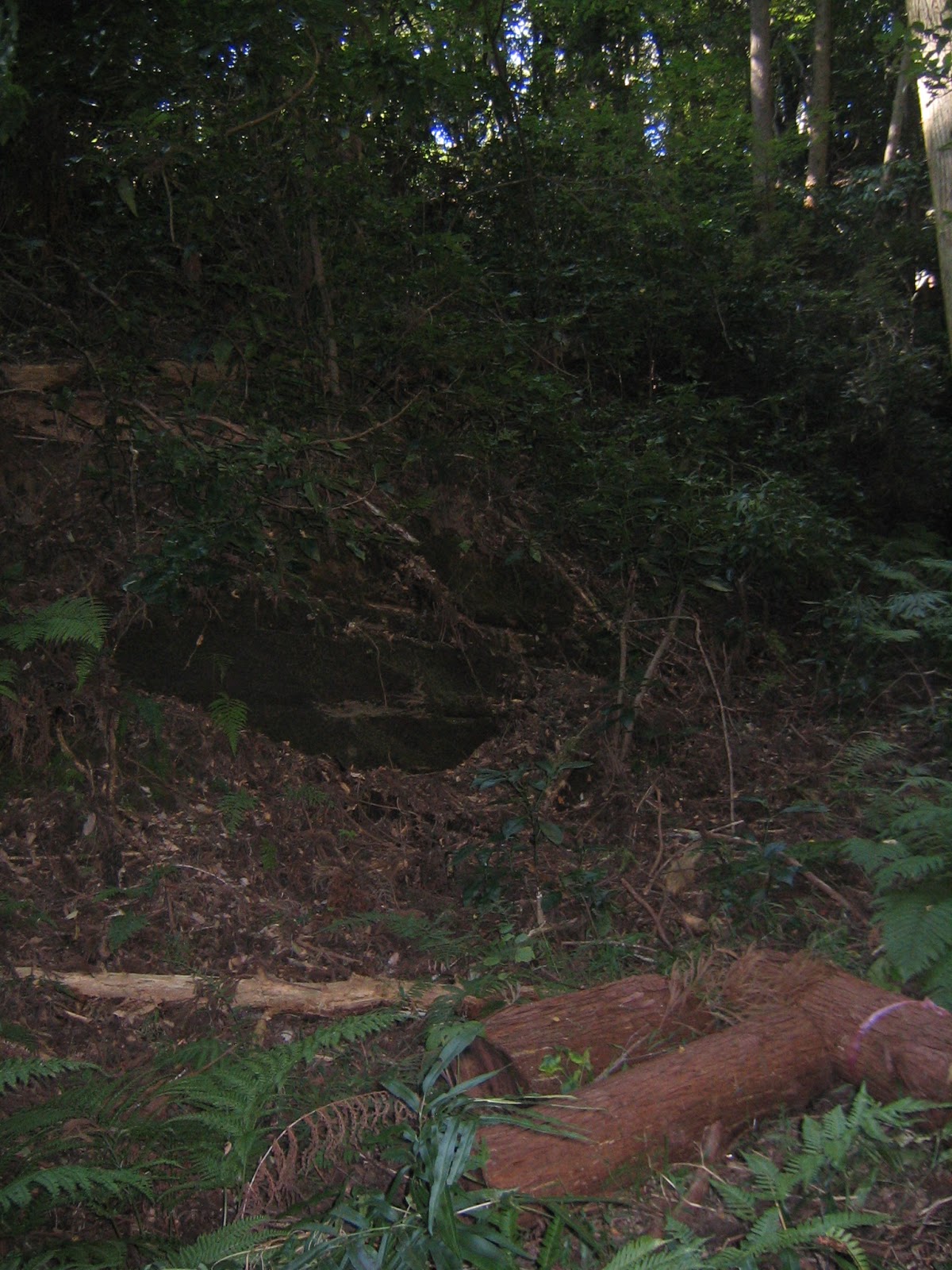
From the Ikoi-no-Hiroba, two routes are going up to conquer the 40m height. The one goes to the left is climbing almost straight up to the peak. Large Japanese cedars are planted along the way, and hence this road is called Cedar Way すぎこだちの道. (Cedars do not belong to biota of Yokohama.) There are several logs rested along the road. Volunteers are doing heavy thinning activities. We can find geological structure of the Forest here: beneath the thin layers of soil, there is a hardpan. I also found several impressive artworks by earth and nature … ferns and moss decorate boulders and hard faces of the hill. With the smell of cedars, the steep ascent gives us an occasion of meditation …

Cedar Way


Co-habitation of human activity
and tectonic crash

Another road from Ikoi-no-Hiroba goes into the forest of evergreen broad-leaved trees. This way is called “Komorebi-no-michi” (こもれびの道 the Way where sunshine filters through foliage). It climbs up the hill very slowly with lots of zig-zags. The atmosphere is definitely lighter than Cedar Way with sunshine coming from the canopy. Good naming! There are acorns and chestnuts lying over the road. Come to think of it, I could not even sense the existence of Taiwanese squirrels there … Why?

Komorebi-no-michi

Acorns
Reaching to the end of Komorebi-no-michi …

Cedar Way and Komorebi-no-michi meet around Oikoshi Hiroba おいこし広場. Oikoshi Hiroba has a picnic bench, and we can see Enkaisan Nature Complex beyond Kamariya-nishi residential area 釜利谷西町 from there. The road from Oikoshi Hiroba is gently going down along a dry valley to the northwest. When we meet a small bamboo forest, it is almost at the end of the Forest.  Descending the steps, we enter the residential area, and soon to the signpost “Yamanote Entrance to Sekigaya Forest 山の手入口.” If we take a road going to the other side of the house next to the signpost, we meet a small stream for fireflies on the right along the way and return to Ikoi-no-Hiroba with the bike-parking space. Go straight to the north from Yamanote Exit for about 500m, we arrive Kanazawa Zoo 金沢動物園, and Kamariya Citizen Forest. To the east from the signpost, we soon meet a pedestrian promenade along a small stream, which is a part of Miyagawa River. The way goes leisurely in the residential area of detached houses, and the stream eventually becomes Miyagawa River. If you take a promenade along the river, you’ll return to Kanazawa Bunko Station. From Yamanote Entrance of Sekigaya Forest to the Station via this route, it takes 30 minutes or so in a stroll. It’s not bad either. J   

Oikoshi Hiroba
Over there must be Kamariya Forest.
Going down
The valley
The bamboo forest
Almost autumn
Sign post at Yamanote Entrance
The zoo is there.
If you plan to join the volunteer group for Sekigaya Forest, or find a problem in the Park, please make a contact with

Office for the Park Greeneries in the South 南部公園緑地事務所
Yokohama Municipal Government Creative Environment Policy Bureau 横浜市環境創造局
Phone: 045-831-8484 (I guess in Japanese only)

FAX: 045-831-9389 (I hope there is somebody who can read English …)