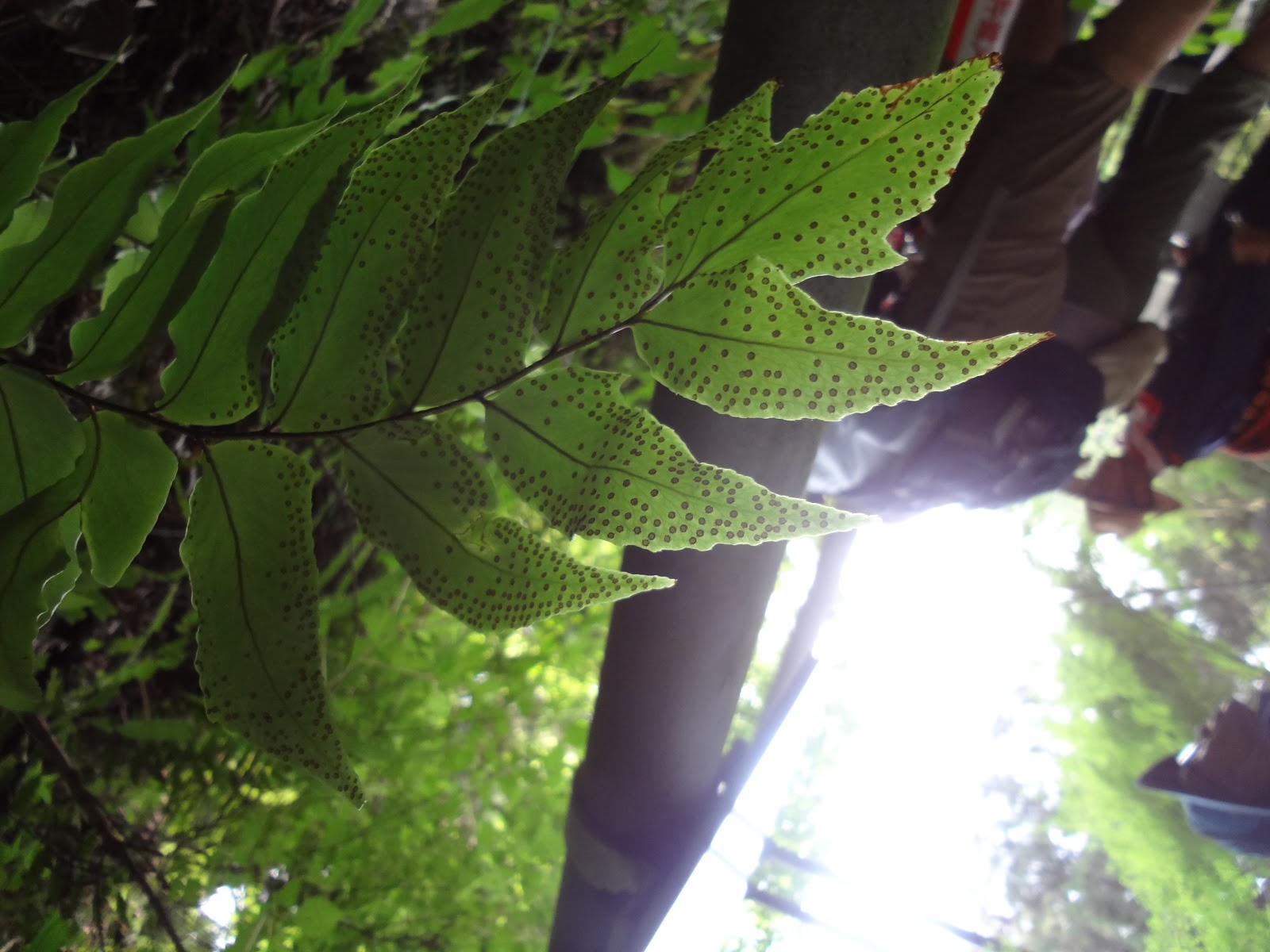
Showing posts with label Forest bathing. Show all posts

Friday, July 27, 2018

Jurassic! Ferns, ferns, ferns …


Don’t you think it’s something of human nature boasting “I have special something”? That exclusive can be “Japanese endemic species” for Japanese forest, and so I myself have said it many times in this blog. Though, we Japanese belong to only one species, Homo Sapience, which spreads everywhere on the Planet Earth. It’s natural to expect we find another cosmopolitan species in the forest of Japanese archipelago, isn’t it? Recently, I’ve learned there is one such kind. Pteriodophytes, aka ferns.


Petris Cretica L. with mushrooms.
 This fern is really cosmopolitan.
 We can find it in Africa, Europe, Asia, and America.

According to Botanic Gardens Conservation International, Japan has roughly 7000 kinds of flora where about 2900 (40%) of them are endemic. It is a bit of pride of us on small islands. “Well, our nation is tiny compared with the continental neighbors, but we have such a rich biodiversity of our own!” Hmmm … I simply thought this applies for every plant of our land, ferns and moss included. In addition, intricate hues of greens in ferns or moss match perfectly well with Zen and tea ceremony both of which are the treasure of our culture. Look at the beauty of moss garden in Zen temples! So, my unassuming brain regarded many ferns we meet in our forest are uniquely Japanese, oh-so-Japanese plants. I was naïvely wrong.


Beautiful Polystichum polyblepharum,
 or Inode in Japanese,
 found in Miho CitizenForest
三保市民の森.
 It’s very common fern in Yokohama’s Citizen Forests.
The beloved cedar forest with ferns
 in Niiharu Citizen Forest
新治市民の森.


According to Atsushi Ebihara of National Museum of Nature and Science of Japan, when analyzing their DNA, 31.7% of seed plants are endemic in Japanese natural environment. In contrast, only 18%, or 112 species, of ferns are endemic and no family of Pteriodophytes in Japan belongs to endemic genus. (i.e. Japan has roughly 700-800 species of ferns in total.) Ebihara said it might be due to insufficient coverage of field studies about the genus. But the same families of Pteriodophytes and Bryophyte (aka moss) often spread all over the planet, regardless of Pacific, Atlantic, or Indian Ocean. Therefore, it is not surprising for Japan having smaller uniqueness of ferns and moss, he concluded. Wow. Is that so? Moreover, many Japanese endemic ferns are found in remote islands such as Okinawa 沖縄, Ogasawara Islands 小笠原群島 or Yakushima 屋久島. i.e. Absolute majority of the ferns and moss we find in Kanagawa Prefecture are international kinds that have relatives who could live in the opposite side of the planet. That’s … amazing. What a globalized world of ferns! 


I think it’s Thelypteris torresiana var. clavata,
 or Himewarabe in Japanese.
 According to Wikipedia, we can find it in
 East and Southeast Asia, Australia, and North America.
 A globe trotter, it is.
Thelypteris decursive-pinnata (van Hall).
  Wikipedia says we can encounter it in
 South, East and Southeast Asia.
 Its siblings must be experiencing vigorous economic growth now …


Then, I’ve learned in the 19th century Britons were crazy about ferns, which created a word “Pteridomania.” Of course, Chinese have been eating ferns for millennium. In Hawaii, palapalai, aka Microlepia strigose, is important symbol for island culture. Kiwis of New Zealand have certainly a good reason to take satisfaction in their unique world of ferns where they have rich list of endemic species. Ashanti of Ghana has well-established symbol of Aya, i.e. fern fronds, in their Adinkra symbols. Native American tribes, and people in Kerala of India have mythology with ferns … ad infinitum.


Hena pattern which is one of the standards
 of Liberty Print of London, with peacock-motif.
 When I bought it,
 I had a connotation with ferns somehow …
And actually, there is a fern called Maidenhair Fern,
 aka Adiantum pedatum, or Kujakushida in Japanese.
 “Kujaku” in Japanese means peacock.


Come to think of it, coals are fossils of ancient ferns some 300 million years ago. Many ferns are survivors of Jurassic period, adopting their reproduction strategy in keeping with changing environment for many many years. Patronizing them as “uniquely ours” must be laughably nonsense for this miraculous plant. Rather, they are patronizing us …? A sure thing is, finding their composed green in a forest during this scorching summer is literally cool. Let’s have a forest bathing next to ferns sighing in winds from mountain stream …
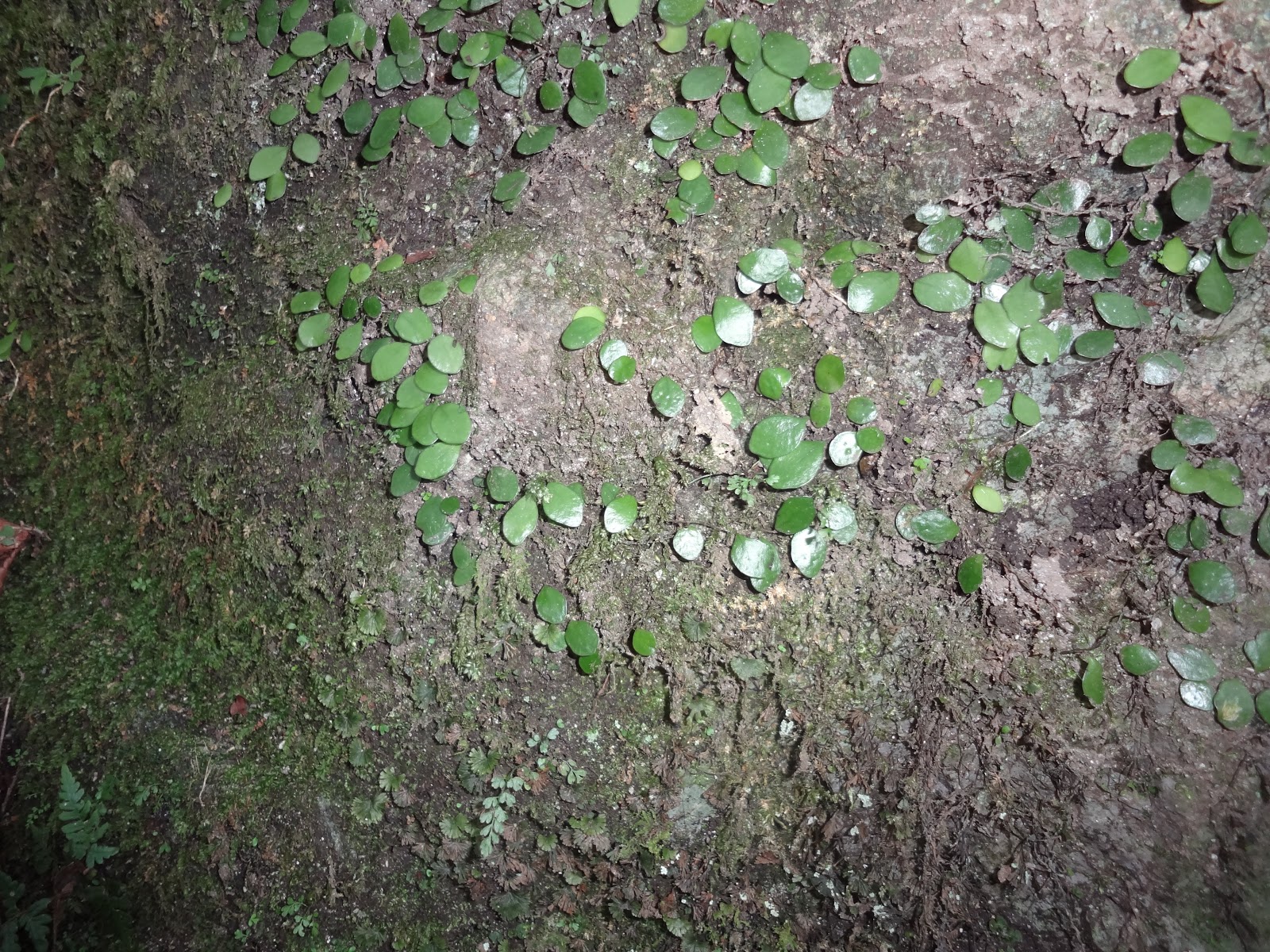

Could you see in this photo
Lemmaphyllum microphyllum Presl (Mamezuta in Japanese),
Crepidomanes Minutum (Uchiwagoke in Japanese),
 and Adiantum monochlamys Eaton (Hakoneshida in Japanese)?
Mamezuta can be found in East and Southeast Asia.
Hakoneshida is for East Asia.
Uchiwagoke is spreading all over
 from Africa to Polynesia along the equator.
 These tiny guys are tough.
Bushes of Hypolepis punctate (Thunb.) Mett. ex.Kuhn,
 or Iwahimewarabi in Japanese.
 Another regulars in East and Southeast Asia.
 In Japan it has reputation as a pioneer plant
 that comes out first after deforestation.
Yeah,
 a baby cicada found the place near ferns
 was comfortable to be an adult …

Just for our cooling-off …


If you find an environmental issues in Kanagawa Prefecture, please make a contact with Kanagawa Natural Environment Conservation Center 神奈川県自然環境保全センター

657 Nanasawa, Atsugi City, 243-0121 2430121 厚木市七沢657
Phone: 046-248-0323

You can send an enquiry to them by clicking the bottom line of their homepage at http://www.pref.kanagawa.jp/div/1644/


Friday, July 20, 2018

Scent of the forest: Hinoki cypress, Kuromoji, …


Oh it’s so hot these days in Yokohama …
 let’s have an imaginary breeze from this mountain stream …


One of the main activities for forest bathing is enjoying the smell of forest. I think everyone knows when we enter a forest of whatever kind, it smells nice normally, doesn’t it? It helps us to relax, and that’s the first step to the benefit of forest bathing. Those are the scents spewed massively from living trees through their photosynthesis. In addition to such basic waft within a forest, there are several trees that have fragrance almost like perfume. They are raw materials of essential oils. Japanese traditional culture does not have essential oil, but our people have used such aromatic trees in different ways. I’m studying some of these trees now. Let me tell you what I’ve learned so far.


First, ubiquitous (at least in Kanagawa) Hinoki cypress, or Chamaecyparis obtusa. Their smell is the very reason why they are planted massively in afforested area of Japan. It has noble and soothing aroma. In addition, as a construction material properly treated wood of Hinoki keeps its close grain for centuries. So, Japanese has been used the tree for important structures such as temples and shrines. Horyuji Temple 法隆寺 in Nara Prefecture 奈良県 is the world-oldest wooden structure, built with Hinoki cypress. I imagine when the temple was inaugurated in the early 7th century, the whole sanctuary must have been filled with noble scent … Though, when we find Hinoki essential oils in stores, the ingredient, hinokitiol, is normally extracted not from Hinoki cypress, but from Thujopsis dolabrata, aka Hiba or Asunaro in Japanese. That’s because while Hinoki trees contain negligible amount of hinokitiol, Hiba can yield enough amount of it for commercialization.


It’s a formidable Hinoki cypress in Yadoriki Water Source Forest やどりき水源林.


Thujopsis dolabrata is endemic tree of Japan, and has certain connotation of inferiority compared with Hinoki trees. (This Wikipedia entry explains it nicely). Come to think of it, it’s very strange. As a construction material, Hiba has the same quality as Hinoki, and it contains more of hinokitiol. Why Hinoki is more appreciated than Hiba? … At the moment, the substantial afforested area with Hiba expands snowy regions of Japan such as Tohoku 東北 or Hokuriku 北陸 areas. I guess when rich and powerful of the 7th century around Nara, much warmer than Tohoku, searched for nice trees for their mansions and temples, what they found nearby was Hinoki, not Hiba. Perhaps it was the beginning of celebrity status of Hinoki, and the reputation continues to the 21st century. Typical QWERTY… In any case, we can extract only 1kg oil of hinokitiol from 100kg of tips of Hiba trees. I’ve learned that’s almost a typical thing to harvest essential oil from trees. i.e. We need to cut them massively to have a tiny bottle of essential oil. 


This Thujopsis dolabrata was planted
 in some 30 or so years ago in Tanzawa 
丹沢,
 and it is still small.
 I guess the climate of Kanagawa is warm form them.


Lindera umbellate, aka Kuromoji in Japanese, is another scented superstar in Japanese forests, though it cannot be construction material as its adult size is 5-6m high with ø10cm of biggish boughs. Even though, it is appreciated with noble aroma we can receive from whichever part of the plant. We just pick a leaf from Kuromoji tree, and tear it a bit. The smell of Kuromoji will remain on our fingers. During tea ceremony, the best utensils to serve sweets are made of Lindera umbellate. Its blackish tone matches well to the serenity of tea ceremony, while its gracious but reserved smell blends perfectly well with delicate sweets for Maccha tea. When dried, its young leaves and stems can be herbal tea that contains linalool and geraniol (C10H18O), and so if properly taken the tree extract could have sedative and anti-inflammatory effects. These days, several Japanese makers (such as this one) extract essential oil from Kuromoji, though from 1kg of tree we can have only 1-3ml of oil. In the forests of Kanagawa, we can find a tree of Lindera umbellate once in 2-3 times of hiking, although they are bushy trees of often less than 1m tall. I once had an ambition to extract aromatic oil from Kuromoji by myself, but realized I had to cut a lot such smallish trees to have a meaningful amount of essential oil. That would be the reason anyway why utensils and teas of Kuromoji can demand such a cool price tag …


Small and bushy Kuromoji
This is a full-grown tree of Lindera umbellate in Tanzawa.
 Could you see berries?
 I squashed one of these, and to my surprise,  it did not render aromatic oil.
 Was it too young?


Kuromoji is in Lauraceae family, and trees of Lauraceae have a nice scent. Aromatic Parabezoin praecox, aka Aburachan in Japanese, belongs to the same Lauraceae family. Though its aroma is not as noble as Kuromoji, the tree renders similar scented whiff that gave me a flashback memory of visiting a store of Niel’s Yard Remedies. Early summer is the time when Abrachan started to bear round berries of about ø1cm. As they are still young and green, we can squash them by our finger tips. Sure enough the berries ooze slightly sticky liquid with nice scent, but the juice is rapidly oxidized and stains our fingers with tar like color. Before gas or electric light, oil extracted from berries and stems of Abrachan was used for lamps in Japan. I guess Abrachan lamps gave people soothing aroma when they quietly read books before go to bed … That’s lovely, isn’t it?


Aburachan flowers early spring in Tanzawa.
And in early summer, they become these cute berries.


I’m now learning such fragrant trees in forests of Kanagawa. And sometimes, I found my judgement for “lovely scent” does not consistent with traditional naming of a plant. I think Japanese name for Skunkvine (Paederia foetida), Hekusokazura, is unfair to this cute flowering vine. “He” = fart, and “Kuso” = poop; you’ve got the idea, right? Hm … English name of the plant is Skunkvine so that it might be global to regard the smell of this vine belongs to toilet. But, so far, I have not found the smell of it Hekusogazura that horrible. Yeah, it might be a bit tricky smell, but at least it’s not coming from bathroom, I think. The language of Hekusogazura is “Misanthrope; Misunderstood; Unexpected.” Huh, … smell is such an delicate issue even in phytoncide-full of forest … 


Paederia foetida. As long as you don’t tear them, they just smell grassy,
 believe me.


If you find an environmental issues in the forests of Kanagawa, please make a contact with Kanagawa Natural Environment Conservation Center 神奈川県自然環境保全センター

657 Nanasawa, Atsugi City, 243-0121 〒243-0121 厚木市七沢657
Phone: 046-248-0323
You can send an enquiry to them by clicking the bottom line of their homepage at http://www.pref.kanagawa.jp/div/1644/


Friday, April 6, 2018

Inhale deeeeeeeeeeeply … : my first experience with a forest bathing program


What do you expect from forests? As the sources for H2O, for sure. Amazon Rain Forest is to stop global warming, certainly. Increasing your property value if your mansion happens to be in front of the Central Park, OK, OK. For me, especially now with the aching broken right wrist, visiting forest is to have much needed relaxation … (Today’s X-ray said my bone is recovering. Thank you really for your moral support.) As some of you may know, in parts of the world, people recognize the healing power of forests. A calm walking in a forest is like bathing in a therapeutic spa, thus here comes the naming of “forest bathing.” Oh, by the way, I’ve heard an American journalist went a forest bathing session in swimming suit to interview participants. That was a HUGE misunderstanding. Let me explain a bit what is “forest bathing” this week. My forest instructor seniors told me in South Korea people can claim public health insurance coverage for forest bathing as a part of treatments for diseases. That’s super! (I need it now!) Unfortunately, Japan has not reached the stage yet, but we are inching closer. To attract health tourists, several Japanese local offices combine their beautiful natural resources (forest, spa, beach …) with local produces (veggies, diary, fish, gibier, organic meat, …) and the advanced hospital treatments and health check-ups. The vanguard is Nagano Prefecture 長野県, but in Kanagawa Prefecture 神奈川県 Yamakita Town 山北町, where we’ve visited in last week’s post, offers “Therapy Roads” program as well.


Several Therapy roads are designated near
Hohki Sugi (
箒杉 Hohki cedar, aka the Treasure Tree)
in Yamakita Town.


Yamakita’s program goes like this. The town hall chooses Therapy Roads from numerous hiking courses. Visitors can simply visit a route by ourselves as hikers, i.e., a sort of self-medication. We would also join forest therapy events organized by the town for which the registered forest therapists act as MC. They guides us a slow and calming walk in a Therapy Road, and give us yoga sessions, and/or aroma therapy experience from the nature, and/or meditation, and/or … you’ve got an idea, haven’t you? These events are pre-packaged tours for a particular theme, like “Yoga in fresh spring forest.” Instead, if you have a specific need for relaxation, you could call the town office to arrange an order-made forest bathing session with the therapist. For about 4 hour session, 7500+ yen, RSVP ... MY WRIST NEEDS IT!  … Er, well, no. I have to continue rehab exercise first before hiking, I know. Though, honestly, I’m stressed out with my injury and DO need some occasion of forest therapy. Then, by chance, an opportunity came. For novice forest instructors like us, Kanagawa Forest Instructor Association organized a one-day introductory course for forest therapy. It was consisted of lectures and actual demonstration/experience sessions. Experience! So I and my aching wrist signed up. That was really GOOOOOOOOOOOOOOOD.


Novice Forest Instructors are in lesson for bathing.


The effect of forest “therapy” may not yet be in the established thinking of clinical world.  Even though, its scientific notion has about 90 years of history. In 1928, a Russian biochemist of Leningrad University, Boris P. Tokin, coined the term “phytoncide” that describes chemicals plants produce as an antibody to predators like insects, animals, fungus, etc. Warding-off bad elements to a body = Good for health, right? It seems to me the notion was combined with local knowledge of Russia and Ukraine and spread eastwards of the Eurasian Continent. At the terminal point we Japanese happened to be able to recognize the possibility of the notion, as we traditionally live with lots of forests and similar ideas. Meanwhile, the benefit of pink noise is getting acceptance within psychotherapeutic community of the Western, or main-stream, medicine, and forests naturally offer lots of 1/f wave length for strollers … fluctuation by winds of leaves, twigs, grass … birds chirping … gargling from mountain stream … dances of sun shine through tree canopy … Phytoncide and pink noises of a forest enhance all the 5 (or 6) senses in a very meditative way. It could yield medical benefit endorsed by scientific data, which is the current thinking in Japan. Actually, the National Forest Research and Management Organization, 森林総合研究所 has a team of scientists who are studying the issue. From my personal experience, I do believe there is something beyond quackery, which gives a good reason for spending tax-payers’ money on their research. Someday, their research would be the basis for public health policy ...


Of course, to claim therapeutic result from a procedure, we need medical license. The majority of Kanagawa Forest Instructors are not from medical profession so that the training was for us forest instructors to educate ourselves in order to communicate possible health benefits to the visitors of forests. The Kanagawa Forest Instructor Association calls a program focusing on relaxation in a forest “Forest Soothing 森林癒し.” The most basic menu goes like this:

1. First, taking a deep breath in a forest, with a small stretching session especially for limbs and shoulders. It also acts as a warm-up for a walk.


2. Changing a scenery, sit at a good view point to observe the nature, like large shape of mountain, numerous hues of green of a forest, rapid mountain stream, floating clouds … In the process, the participant try to concentrate on our own deep breaths in ways of yoga or chi kung.


3. Enter into a forest of large trees where forest instructors provide a large picnic blanket for the participant to lie down on the forest floor. The participants stay there for at least 10 minutes in silence and watch the canopy of the forest drifting about with winds and flowing clouds in the sky. No problem if you end up sleeping on the blanket ...


Preparation for bathing
Over there seen from me lying on the forest floor
… lots of 1/f … zzzzzzzzz

4. Moving to another part of forest preferably near a mountain stream. There, forest instructors prepare hammocks and the participants can lie down in it. We will stay there for at least 10 minutes again in silence to enjoy gentle sway of the hammock and burbling of the stream in sync. Sleeping is encouraged.


We exercised too to learn how to secure the hammocks.


5. We move near to the stream and listen the flow of water. If you have a walking stick, or there is driftwood in good size nearby, you can dip a tip of the pole in rapids and listen the sound of the stream by attaching your ear to another end. Very interestingly, we can certainly hear comforting sound of stream …


Listening water


During the entire session, an MC takes a lead of slow and very quiet walk in the forest, which becomes naturally meditative. The chat is deliberately controlled to be minimum for the participants to immerse ourselves fully in phytoncide and pink noise, using our own 5 (or 6) senses. When an MC finds a plant of fragrance, like trees of Lauraceae family, s/he can invite the participant to smell it to stimulate our sense of smell. Before the conclusion, or at the beginning, of the session, a cup of herb tea, like chamomile or peppermint, is offered for soothing the sense of taste. 


Edgeworthia chrysantha. They smell sweet …


Although it was an educational session for us forest instructors to know the standard process of forest bathing, I found it soooooooooooooooo relaxing. It was a fine early spring weekend, still a bit cold in Tanzawa mountains. Between the canopies of large cedar trees, I could see a very blue sky with cotton-candy clouds. Fresh green twigs and clouds all wafting quietly 30m (or beyond) above us. From somewhere near, we heard warbling of Japanese tits, wrens, Japanese robins … A part of the forest was populated by flowering Edgeworthia chrysantha. Sweet and lemony scent wafted from their pale yellow flowers … Sound of torrents from melted snow was warm … maybe it was a memory from the womb of our mom ... One of my friends who is a professional MC for forest therapy told me, the skill of a MC is measured by his/her ability to provide relaxing time in silence. I asked her if it is like zen meditation at temples in Kamakura 鎌倉 (for example, here or here). “Er, no. You know, unless we are really skilled in zen meditation, the practitioners are always afraid of being beaten by a zen stick. Granted, there is a good objective for a zen stick to achieve an effective zen. But it’s different from forest bathing …” Hmmmmmmmmmm … I’m a still a baby forest instructor. Let me think and feel about forest soothing more with my aching wrist …


If you find environmental problems in Tanzawa mountains please make a contact to

Kanagawa Nature Conservation Center 神奈川県自然環境保全センター
657 Nanasawa, Atsugi City, 243-0121 2430121 厚木市七沢657
Phone: 046-248-0323

You can send an enquiry to them by clicking the bottom line of their homepage at http://www.pref.kanagawa.jp/div/1644/

For more general enquiry about tourism in the area, the contact address is

Office of Policy Planning, Yamakita Town 山北町役場企画政策課 企画班
Phone: 0465-75-1122, FAX: 0465-75-3660

You can send an enquiry to them from here.