Showing posts with label Endemic Species. Show all posts

Friday, July 27, 2018

Jurassic! Ferns, ferns, ferns …


Don’t you think it’s something of human nature boasting “I have special something”? That exclusive can be “Japanese endemic species” for Japanese forest, and so I myself have said it many times in this blog. Though, we Japanese belong to only one species, Homo Sapience, which spreads everywhere on the Planet Earth. It’s natural to expect we find another cosmopolitan species in the forest of Japanese archipelago, isn’t it? Recently, I’ve learned there is one such kind. Pteriodophytes, aka ferns.


Petris Cretica L. with mushrooms.
 This fern is really cosmopolitan.
 We can find it in Africa, Europe, Asia, and America.

According to Botanic Gardens Conservation International, Japan has roughly 7000 kinds of flora where about 2900 (40%) of them are endemic. It is a bit of pride of us on small islands. “Well, our nation is tiny compared with the continental neighbors, but we have such a rich biodiversity of our own!” Hmmm … I simply thought this applies for every plant of our land, ferns and moss included. In addition, intricate hues of greens in ferns or moss match perfectly well with Zen and tea ceremony both of which are the treasure of our culture. Look at the beauty of moss garden in Zen temples! So, my unassuming brain regarded many ferns we meet in our forest are uniquely Japanese, oh-so-Japanese plants. I was naïvely wrong.


Beautiful Polystichum polyblepharum,
 or Inode in Japanese,
 found in Miho CitizenForest
三保市民の森.
 It’s very common fern in Yokohama’s Citizen Forests.
The beloved cedar forest with ferns
 in Niiharu Citizen Forest
新治市民の森.


According to Atsushi Ebihara of National Museum of Nature and Science of Japan, when analyzing their DNA, 31.7% of seed plants are endemic in Japanese natural environment. In contrast, only 18%, or 112 species, of ferns are endemic and no family of Pteriodophytes in Japan belongs to endemic genus. (i.e. Japan has roughly 700-800 species of ferns in total.) Ebihara said it might be due to insufficient coverage of field studies about the genus. But the same families of Pteriodophytes and Bryophyte (aka moss) often spread all over the planet, regardless of Pacific, Atlantic, or Indian Ocean. Therefore, it is not surprising for Japan having smaller uniqueness of ferns and moss, he concluded. Wow. Is that so? Moreover, many Japanese endemic ferns are found in remote islands such as Okinawa 沖縄, Ogasawara Islands 小笠原群島 or Yakushima 屋久島. i.e. Absolute majority of the ferns and moss we find in Kanagawa Prefecture are international kinds that have relatives who could live in the opposite side of the planet. That’s … amazing. What a globalized world of ferns! 


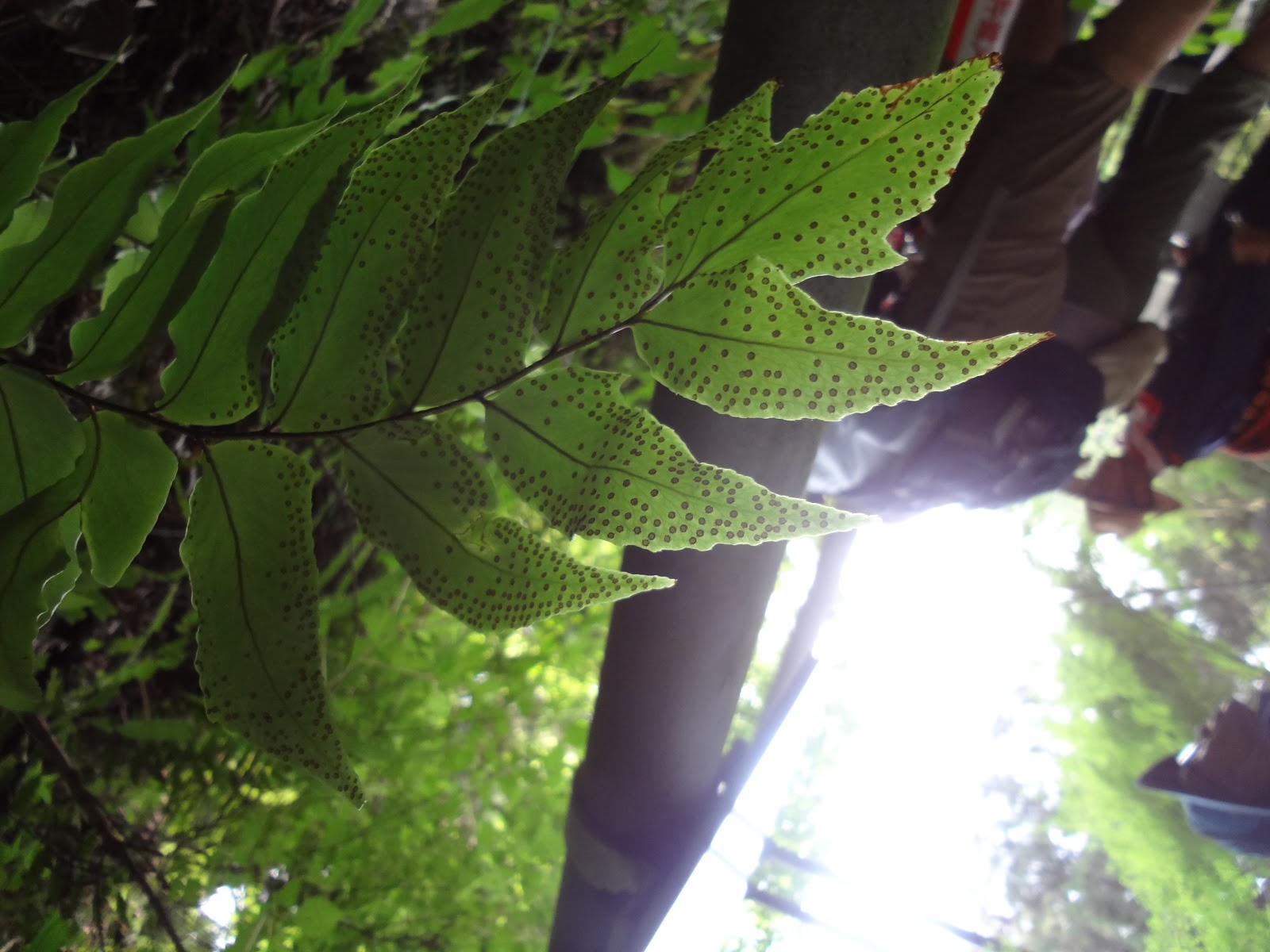
I think it’s Thelypteris torresiana var. clavata,
 or Himewarabe in Japanese.
 According to Wikipedia, we can find it in
 East and Southeast Asia, Australia, and North America.
 A globe trotter, it is.
Thelypteris decursive-pinnata (van Hall).
  Wikipedia says we can encounter it in
 South, East and Southeast Asia.
 Its siblings must be experiencing vigorous economic growth now …


Then, I’ve learned in the 19th century Britons were crazy about ferns, which created a word “Pteridomania.” Of course, Chinese have been eating ferns for millennium. In Hawaii, palapalai, aka Microlepia strigose, is important symbol for island culture. Kiwis of New Zealand have certainly a good reason to take satisfaction in their unique world of ferns where they have rich list of endemic species. Ashanti of Ghana has well-established symbol of Aya, i.e. fern fronds, in their Adinkra symbols. Native American tribes, and people in Kerala of India have mythology with ferns … ad infinitum.


Hena pattern which is one of the standards
 of Liberty Print of London, with peacock-motif.
 When I bought it,
 I had a connotation with ferns somehow …
And actually, there is a fern called Maidenhair Fern,
 aka Adiantum pedatum, or Kujakushida in Japanese.
 “Kujaku” in Japanese means peacock.


Come to think of it, coals are fossils of ancient ferns some 300 million years ago. Many ferns are survivors of Jurassic period, adopting their reproduction strategy in keeping with changing environment for many many years. Patronizing them as “uniquely ours” must be laughably nonsense for this miraculous plant. Rather, they are patronizing us …? A sure thing is, finding their composed green in a forest during this scorching summer is literally cool. Let’s have a forest bathing next to ferns sighing in winds from mountain stream …
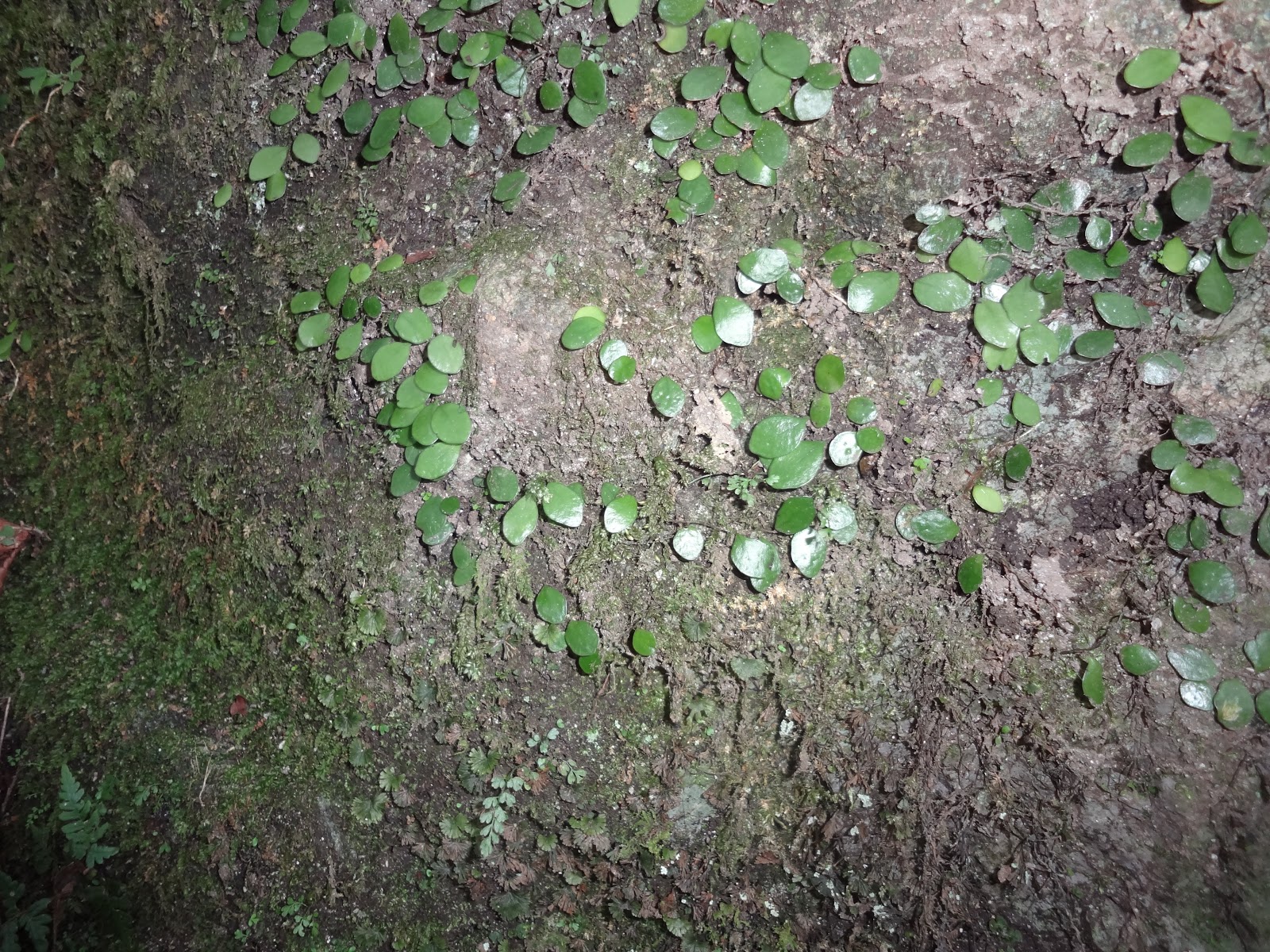

Could you see in this photo
Lemmaphyllum microphyllum Presl (Mamezuta in Japanese),
Crepidomanes Minutum (Uchiwagoke in Japanese),
 and Adiantum monochlamys Eaton (Hakoneshida in Japanese)?
Mamezuta can be found in East and Southeast Asia.
Hakoneshida is for East Asia.
Uchiwagoke is spreading all over
 from Africa to Polynesia along the equator.
 These tiny guys are tough.
Bushes of Hypolepis punctate (Thunb.) Mett. ex.Kuhn,
 or Iwahimewarabi in Japanese.
 Another regulars in East and Southeast Asia.
 In Japan it has reputation as a pioneer plant
 that comes out first after deforestation.
Yeah,
 a baby cicada found the place near ferns
 was comfortable to be an adult …

Just for our cooling-off …


If you find an environmental issues in Kanagawa Prefecture, please make a contact with Kanagawa Natural Environment Conservation Center 神奈川県自然環境保全センター

657 Nanasawa, Atsugi City, 243-0121 2430121 厚木市七沢657
Phone: 046-248-0323

You can send an enquiry to them by clicking the bottom line of their homepage at http://www.pref.kanagawa.jp/div/1644/


Friday, December 16, 2016

In search for hay-fever-less trees in Japan


Because of historical and cultural reason, direct engagement in forest management is one item in the job description of all the prefectural governors in Japan. Anyway, it gives Dr. Hidetsugu Saitoh of Kanagawa Natural Environment Conservation Center 神奈川県自然環境保全センター a job to improve reproductive process of trees in Kanagawa. One urgent to do list for him is to establish supply system of seedlings for cedar and cypress that produce fewer or no pollen, since their pollens are major allergen of hay fever for the mass of people these days.


Using Mendel’s Law, the methodology of creating such cedars and cypresses is relatively straight-forward. ... I didn’t know using male sterility is a well-established way to create “higher utility” crops and veggies. The defining gene for pollen counts in cedar and cypress is like human genes about blood types. Let’s call “AA” the gene of cedar that creates lots of pollens. We can also find “aa” gene in another cedar that does not produce pollen at all (i.e. “male sterility”). From here, it’s a high-school biology class. If we can match over 2 “aA” trees, there is ¼ chance of producing “aa” tree that is pollen-less. i.e. Recessive Inheritance. Better still, when a mom has “aa”, the chances of “aa” baby coming out is 50%. (… We can never have an “aa” dad, OK?) It’s same for cypress. So, the challenge for Dr. Saitoh is to make the plan operational.

The experimental scion garden for few / no pollen cedars
in the Kanagawa Natural Environment Conservation Center

Although, say, in 2010 cedar afforestation was done only for 1ha in Kanagawa, people did not plant just one tree in 100m*100m field. Actually, 13,000 cedar babies from “fewer pollen” lineage was planted in that year, where many of them will be thinned eventually. Moreover, trees are long-living plants that are definitely different from Mendel’s peas whose reproduction cycle can be less than one year. The number of original fewer pollen family lines was 17 in Kanagawa. Sure, it could be a matter of opinion if the biodiversity is enough at the gene level with 17 families for 13,000 seedlings of slowly maturing species … Everybody agrees the more diverse, the better the sustainability. “We need more families of aA and aa mom-trees.”

The cedars in the experimental scion garden in the Center

In Japan, a person who first found aa cedar tree in 1992 was Dr. Hideaki Taira who is now the professor emeritus for Niigata University. Dr. Taira’s approach was a standard mass-mobilization of college kids. They were dispatched into the deep forests of Toyama Prefecture early spring, each armed with a high-twig shear. They tap a flowering cedar one by one. When a tree was looked like emitting fewer or no pollen, the kids collected male flowers from the high-above twigs and brought them back to the Professor’s labo to inspect each anther under electron microscopes. The result was, statistically speaking, one in 5,000 cedars in Toyama has male sterility. … I haven’t read Dr. Taira’s celebrated paper, but I guess for reaching to this conclusion the army of kids must have tapped tens of thousands of cedars, and carried tens of thousands of anthers for checking. Even under a luckier scenario, Dr. Saitoh has to tap 5,000 cedars to identify one “aa,” doesn’t he? Fortunately, along with this “go fishing” approach, Dr Saitoh could use 17 families of aA in Kanagawa. He checked 888 (yet!) seedlings in the scion garden and found one aa in 2004. As of October 2016, the prefectural scientists who found their local sterile males in cedar forests are in Toyama, Ishikawa, Shizuoka, Oamori, and Kanagawa, i.e. 5 prefectures out of 47 … hmmmm, it’s a difficult task. Dr. Saitoh has managed it and is still searching for more aa.

The young cedars and cypresses in the Center’s field.
They are still too young to be moved to the scion garden.

Finding a tree is one thing. Preparing for the replacement of allergen spewing forest is another. The next task for Team Saitoh is realizing the mass production of aa cedar seedlings. Dr. Saitoh paired the pistil of this aa with aA pollen in a secluded glass house for controlled fertilization. It takes one more year after pollination for cedars to produce a fruit. He harvested 92g (2007) and 37g (2008) of seeds eventually. The Team then sowed the seeds in the professional cedar seedling farm (who is under the strict national regulation; more to this in the later post 😀). Cedars take 2 years from seeds to seedlings for planting. In the 2nd year, the Team Saitoh manually collected the male flowers from all the 4,816 seedlings to see if any of them were sterile. In the end, there were 1130 male sterile seedlings (39% of total). Dr. Saitoh keeps producing cousins for the 39% from the first aa and the other newly found aA and aa to expand the DNA pool ... His quest for achieving theoretically expected value of 50% from aa –aA is continuing ...

The fruits of cedar harvested this October.
They are handpicked one-by-one
from the trees in the scion garden.
They then are dried for a while.
Like pine, with enough dryness
they start to open their cones to release the seeds ...
Like these.

Dr. Saitoh is also doing the same for cypress … painstakingly labor intensive tasks all over again. According to him, for cedars or cypresses, the entire process is sometimes difficult to be understood by his non-scientist peers. Going into forest to tap trees, coming back to shut yourself for microscopic study, fertilize tiny flowers one-by-one by hands in a quiet glass house, harvesting Ø1cm cones in fine October day, tending carefully the seedlings in the fresh-air garden … all sounds quite a fun for uninitiated office workers. Especially for cypress, the pollen season of theirs is short and overlaps with the transition period of Japanese fiscal years. His office being in bureaucracy, the people are very busy to wrap up previous year’s documentations when Dr. Saitoh says “I go to mountain for cypress.” An inevitable reaction, it seems to me, has been “WHAT!?” I myself did not know harvesting cedar and cypress cones make your hands bruised with lots of scabs and hard-to-remove tree resins ...


The lesson learned from Japanese hay fever and Dr. Saitoh’s struggle is, once we’ve messed up with the nature it can bring us unintended consequences that is difficult to modify. We patients can only treat symptoms from the attack of pollens … We forest volunteers may be able to do something more, I guess. The easiest thing I can think of now is, joining afforestation exercise with aa cedars, or broadleaved trees … Planting trees are not that simple, in the end.


Seeds are sown first in pods.


The contact address for Kanagawa Natural Environment Conservation Center 神奈川県自然環境保全センター is

657 Nanasawa, Atsugi City, 243-0121 〒243-0121 厚木市七沢657
Phone: 046-248-0323

You can send an enquiry to them by clicking the bottom line of their homepage at http://www.pref.kanagawa.jp/div/1644/

Friday, December 9, 2016

Hay Fever!


Ah, December, the season of festivity ... “If winter comes, can spring be far behind?” That is to say, the time of year for hay fever is approaching fast. According to the Q&A site of Ministry of Health, Labor and Welfare of Japan, in Kanto Region the main culprits of our sneezing and itchy eyes are pollens of Cryptomeria japonica (cedar) and Japanese cypress. Cedars are used to cause troubles during February - April, and cypresses would do the same during April – May. Though, probably because of global warming, the beginning of the season could be even December and the amount of pollens is becoming larger with warmer climate. I don’t know if it’s true … the Ministry’s website says hay fever due to cedars is very very endemic in Japan. Their document diagnoses 70% of Japanese hay fever patients is due to cedars. Heck. I have to make a schedule to visit my otorhinolaryngologist for prescription … his office is always VERY congested during the hay fever months 😑.


OTC medications for hay fever are
year-round available these days.

I did not have problem like that before, but about 10 or so years ago the symptom suddenly attacked me. For some time I thought it was because I was not young enough anymore … my resignation was misplaced. It was because of the failure in Japanese economic policy 70 years ago! Immediately after the World War II, the government engaged in vigorous forestry promotion, which created vast artificial forests of cedars and cypresses. Now 18% (or 44% of artificial) forests in Japan is made of cedars, and 10% (or 25% of artificial) forests is of cypresses. The problem is, they were planted in quite a short period of time at once. Worse, in a forest they are often clones from cuttings. They grow in unison and have reached to maturity simultaneously. Around the turn of the century, lots of lots of cedars and cypresses in Japan started to puff out their pollens all together. The result? Seasonal weather forecast notifies us “Tomorrow, the amount of cedar pollens will reach to a critical amount. Please cover your nose and mouth with finely meshed masks. Never forget to take your medication …” TV news shows yellow mist covering the forest near you. Gosh.


… it’s a matter of perception …
the idyllic scenery of Okuyama
… the mass of pollen production site ...

Cedars start producing buds of female flowers in July. When July has fewer rain and lots of sunshine, the number of flower buds of cedars increases, which is a bad omen. During summer, they keep growing and maturing. In mid-October, the female flowers bloom and the male buds start to grow in the same tree. The guys keep maturing and begin spewing out Ø33 microns or so pollens in December or January. The cypresses also start in July the preparation for flowers of next year in a similar way, but they need cold spells to make their male flowers to mature. Dry and sunny July followed by freezing cold winter is ominous sign for sufferers of cypress pollens. In Kanagawa Prefecture, cypress males spurt out pollens of a bit smaller Ø30 microns during March to May. Cedar or cypress, the more vigorous the trees and the more numerous the flowers, the more pollens will be ejected. One saving grace might be when cedars produce lots of pollen early by warm winter, cypresses may not have enough cold weather for theirs. The overall hay fever season could be shorter, with intensive cedar pollens ... L  In the current environment in Yokohama, we have no choice other than confronting the problem with medication. S***!


In October, the cedars in scion gardens in
Kanagawa Natural Environment Conservation Center
are already having male and female buds
… They look innocently cute.

The life cycle of cedars and cypresses says we can at least know in the fall of 2016 the condition for 2017 hay fever. One of the perks as a trainee for Kanagawa Forest Volunteer is, we have rather quickly the latest research result done by the professional forest scientists. Dr. Hidetsugu Saitoh of Kanagawa Natural Environment Conservation Center 神奈川県自然環境保全センター is an expert in the reproduction of trees. Actually, he is the person responsible to the information about pollen counts in Kanagawa. In October 2016, he confidently notified us 2017 is better than 2016 in Kanto Region. i.e. The number of flower buds for cedar and cypress is fewer this year. Come to think of it, we had lots of rain and typhoon last July and August. A-ha.


Could you see an instrument shelter over there
at the bottom of this photo?
It’s one of pollen counting facilities in Kanagawa Prefecture.
During the season, the officials of
the Natural Environment Conservation Center
count once a day (normally in the morning)
how many pollens they can find
in 1cm2 of a board situated there.
In one October weekend morning this year,
Dr. Saitoh found one pollen already.
According to him,
one of those sites in the Center will be moved
to Hiratsuka City by the end of 2016
before the serious hay fever comes.
It’s in order to capture more accurately
the condition of residential area, he said.
Reasonable.

As an expert, Dr. Saitoh did organize thinning and other forest husbandry to mitigate the clouds of yellow pollens for some time. In the end he reached to the consensus conclusion of forest scientists in Japan: it’s futile to treat adult trees to solve the problem except by massive deforestation. Meanwhile, in Kyushu Island where traditionally cedar and cypress forestry is mainly with propagation by cutting, the problem is smaller due to fewer pollens. So, the possible treatment would be the choice of individual trees that produce fewer or no pollens. The key here is to consider the importance of local gene in trees. Especially for cedars, the locality issue was known for generations. Actually, Japanese forestry policy made a serious blunder in the early 20th century due to ignorance to this fact. (More to this, in a post next year.) Among scientists, the most popular theory for strong localization in Japanese coniferous trees refers to the ecology during the last Glacial Period in the North East Asia. The variation in cedars due to the climate is obvious even for a complete amateur like me. Cedars in the area directly facing to the Sea of Japan / East Sea have very edgy shape as their boughs develop tight to the trunk. They’ve evolved for avoiding the damage caused by wet and heavy snow fall. (Do you know Sea of Japan side in Japan is recording the world heaviest snow falls?) The cedars in the Pacific side are of more easy-going DNA for their boughs spreading (comparatively) wide.


The front garden of
Kanagawa Natural Environment Conservation Center
has several species of coniferous trees
imported from all over the world.
They were expected to be useful for daily lives of Kanagawa,
but the majority of them failed to pass the utility test.
Take the pine trees from Europe shown here.
They came to Japan about 50 years ago
with hope to be pest-resilient shelterbelt
against sand along Shonan Beach.
It turned out they could not withstand strong winds
from the Pacific Ocean.
The beachside forest now is from seedlings of pinus thunbergii,
Japanese and Korean endemic species, found in Kanagawa.
The Europeans in the Center are the remnants of a failed project.

So, Japanese forest scientists of each prefecture are searching for suitable local lineage of less or no pollen trees. In 1996, the prefectural scientists in Chiba identified 13 pedigrees of cedar with fewer pollens. Kanagawa followed Chiba’s pioneering feat with 17 local family lines in 1998, and in 2000 established the scion garden of cedars with fewer pollens, which was the nation’s first. In 2004, all the supply of cedar seedlings in Kanagawa Prefecture was switched to the special scion gardens for fewer pollens. Why such a total control is possible is due to Japanese forestry policy. (I’ll tell you about that later.) Anyway, the quest for fewer or no pollen cedars and cypresses in Kanagawa is continuing for Dr. Saitoh. His story was very interesting. I’ll report his tale more in the next week’s post. 😀


The prefectural model scion garden for less or no pollen cedars.
Their growth point is cut off
to make them bushy for easier access to flowers = seeds.
Could you see they spread their boughs?

The contact address for Kanagawa Natural Environment Conservation Center 神奈川県自然環境保全センター is

657 Nanasawa, Atsugi City, 243-0121 〒243-0121 厚木市七沢657
Phone: 046-248-0323

You can send an enquiry to them by clicking the bottom line of their homepage at http://www.pref.kanagawa.jp/div/1644/

Friday, December 2, 2016

Planting trees for hugging them … is not so simple, mate


Niiharu Citizen Forest is one of the Satoyama representations in Yokohama. Satoyama 里山 means “Sato = where humans live daily lives” + “Yama = hill or mountain.” So, Niiharu is a place where ordinary Yokohama people have lived our lives for millennia within a typical Japanese environment. In Satoyama, people used to harvest logs for fuel, leaf mold for rice paddies / veggie field, bamboos for kitchen gadget materials, and any other goodies like wild silk cocoons, walnuts, and berries. The most trees and bamboos there were intentionally planted generations ago by our ancestors. The place has been very familiar. When developers planned to construct condos and detached houses, Satoyama was naturally the first target to bulldoze. The rapid disappearance of greenery in the city of Yokohama has occurred in Satoyama. …


In a fine October weekend afternoon,
a bonfire from rice straws was made in Yatoda rice paddy in Niiharu
by the volunteers for the Group of Protecting Niiharu Yatoda

新治谷戸田を守る会
of the Organization for Promoting Niiharu Satoyama Community
新治里山「わ」を広げる会.
 They made ashes from the fire
and scattered the product throughout the paddies
as fertilizer for the next year.
It is a traditional way of growing organic rice in Yokohama.

The other day one of the people from the city office told me when he was young decades ago there was a fierce debate within the bureau about the change in the way of calculating green space ratio. Till then, the greenery was defined as Satoyama and ag land. 40 years ago when half the city was covered by greenery, the statistics consisted of Satoyama, rice paddies and vegetable fields, but no palm trees on the roof of department stores. If the city had maintained the definition that way, the green space in Yokohama could have been alarmingly minute. So, in the end the city decided to include tiny lawn turfs and roof-top gardens of the buildings in downtown to count “greenery.” The currently most cited ratio, 28.8% (2014), to describe the green environment of Yokohama takes in completely artificial “gardens” of shopping centers. If you see Kanagawa Prefecture in Google Earth, you will see about 2/3 of the prefecture is just like Yokohama. The satellite photo of us is a continuation of gray concrete with a bit of green dots here and there … We are living in the age of certain sadness, honestly.


A part of 28.8%

Forest Instructor Training by the Kanagawa Green Trust is for these remaining Satoyama forests, and another 1/3 of the prefecture. 1/3 includes National Park of Hakone, and Tanzawa Semi-National Park. The area also has lots of municipal / private lands. To some extent, the reason they look green from the space is they are not so near to Satoyama. Actually, there is corresponding concept for Satoyama in Japanese, which is called Okuyama 奥山. “Oku” means “somewhere beyond the familiar environment.” It says all, doesn’t it? Even though, especially between 400m and 800m above sea level, Okuyama in Kanagawa Prefecture has lots of artificial forests ... Anyway, during the Forest Instructor training, Dr. Jun Tamura of Kanagawa Natural Environment Conservation Center 神奈川県自然環境保全センター told us afforested or not, forests could have soil conservation function that is a foundation for biodiversity, water source protection, and greenhouse gas absorption. Any forest has its own samsara sans bulldozers … first there is bare earth due to natural disaster such as volcanic eruption or flash flood. As long as there are water and sunshine, the seeds would sprout. They were buried already before the natural disaster, and / or carried by birds, winds, streams, etc. afterwards. Within decades, the originally desolate area becomes very congested with young trees. Eventually, the weaker trees fell down, which lets sunshine to penetrate in the forest floor. The undergrowth will grow between the remaining fittest trees. Over 100 years or more, some trees would die a natural death, whereas the others go strong for millennia.  If we can see such old forest from the sky, Okuyama would look like a mosaic of various tree tops. It is a signal of biodiversity.


The 21st Century Forest of Kanagawa Prefecture 神奈川県立21世紀の森.
It shows a mosaic pattern somehow.
The place is a half natural park for hikers,
and a half forestry labo for scientists working for the Prefecture.
On the left is an artificial forest of coniferous trees
that was created according to the national policy of Japan.
I will report you later Japanese forestry policy,
which I find very intriguing.

In the forests of Kanagawa that are situated around N.L. 35°, the trees which can grow the most easily is for the temperate zone. Up to 800m ASL they should be evergreen broadleaved forests so that the majority of coniferous trees of Kanagawa found below 800m ASL are artificially planted. If not, they are the survivors of Ice Age, like the forest of firs around Oyama Afuri Jinja Shrine. For an artificial forest, the trees planted are often not only the same species but also have very similar DNA, or even clones by cutting. It means the competitions for survival is difficult to occur. Left unattended, the trees grow tall and lanky in a congested field without undergrowth, until their bare soil is washed away by torrential rains and all the trees die simultaneously. On the other hand, when humans thin the forest from time to time, the sunshine reaches to the ground that would stimulate the variegated undergrowth. Then, over centuries, the originally artificial forest can become somehow similar to a natural forest with biodiversity. The key here, according to Dr. Tamura, is how to facilitate the nature to do this job easily.


Forest Instructor Exercise:
learning how to thin an
artificial forest of cryptomeria japonica
in Tsukahara Volunteer Field
.
Th
is forest near Hakone is a property
of the Prefecture to train forest volunteers.
According to our instructor Mr. Toshio Shiba,
this tree becomes “2 headed”
because when there was a weeding exercise years ago
its growing point was accidentally cut off
and the remaining top 2 branches grew as such.
Oh my …

Between 800m and 1600m ASL of Kanagawa (; the highest point in our prefecture is the peak of 1673m Hirugatake Mountain in Tanzawa), the climate in Kanagawa is suitable for deciduous broad leaved trees such as beeches. So, in order to recover greenery in our community, we can simply plant according to the ASL these species brought from somewhere … right? Wrong. Dr. Tamura and Dr. Hidetsugu Saitoh, both from Kanagawa Natural Environment Conservation Center, told us plants are very local. Take beech (Fagus crenata Blume). In the early 2000s, Prof. Noriyuki Fujii of Kumamoto University found, very intriguingly, the chloroplast DNA of beeches in Hakone differs from the genes of beeches in neighboring Tanzawa. The beeches have anemophilous flowers so that the dispersion of their DNA within the steeply mountainous area is quite limited. Why, then, do they differ in such a small area? Probably at the beginning of the current interglacial period, due to the existence of Mt. Fuji beeches danced a complicated choreography of adaptation to the changing climate. They settled to have a genetic border somewhere around Ohi-Matsuda IC of Tomei Express Way. Corollary: careless artificial planting of beeches in Kanagawa will degrade the natural diversity at the gene level at best, or normally be unsuccessful with withering young seedlings.


Forest Instructor Exercise: Going into the Forest
Forest Instructor Exercise:
planting a sawtooth oak in Tsukahara Forest.
The seedling was from an acorn harvested nearby,
with the funding of none other than Emperor Akihito.
Thank you, Your Majesty!

Throwing the climate change here, the issue becomes more complex. Dr. Saitoh said, “Look, many trees live to a great old age and survive through mini-disruptions, like the 1780s’ or the 1930s’ cold weather. Now we say rapid global warming, but it cannot give us a carte blanche to plant imported tropical trees in Kanagawa Prefecture. The optimal human intervention should be maintenance of the currently known local biodiversity down to the gene level, and let the nature decide how they become 10,000 years later. If the process includes afforestation, we must be mindful about this scientific fact.” Their discourse resonated with the lamentation Dr. Kitagawa last spring about the invasive plants to Niiharu …
How many of them will survive?
By the way, as you can see this planting field is
sealed off by a sturdy wire-mesh fence.
It’s not because of Imperial seedlings,
but in order to fend off the deer.
There is an interesting story about deer and human activities
in Japanese Okuyama forests that I will report you later.

According to the web site of JNCC who is a statutory advisor to the UK government, the entire British Isles (315,200 km2) has recognized 2951 kinds of plants including “casuals = non-natives” (2002). In contrast, Japanese archipelago (378,000 km2) counts 8,800 plant species (Ministry of the Environment, 2008) where 40% of them are endemics. So, probably, Japan must stick to our gun to “Build the Wall” in order to preserve our neighborhood diversity as those professional biologists say. … Oh my Buddha, that’s sounds very contradictory to “globalization ó diversity” common sense. I guess that’s why the forests of our neighborhood are so fascinating. J


The scenery in
Kanagawa Natural Environment Conservation Center

Incidentally, the access from Tokyo to the 21st Century Forest (in Tanzawa) or Tsukahara Volunteer Field (in Hakone) of Kanagawa Prefecture is, first you go to Odakyu Shinmatsuda Station 小田急新松田駅 which is next to JR Central Japan (yeah, it’s NOT JR East) Matsuda StationJR東海松田駅. For the 21st Century Forest you can either rent a car at Shinmatsuda Station, or proceed to JR Central Japan Gotenba Line to Higashi-Yamakita or Yamakita Station 東山北・山北駅 to find another rent-a-car booth. To Tsukahara Forest, you can rent a car at Shinmatsuda, or go from Odawara 小田原 (the terminal station of Odakyu) to Daiyuzan Station 大雄山駅 (the terminal station) by Izu-Hakone Line 伊豆箱根鉄道大雄山線 and visit a rent-a-car desk. In either case, we have to drive at least 40 minute to reach to the place of the above photos. To the 21st Century Forest, there is a commuter bus service from Yamakita Station to the nearby town. The bus stop is about 1h hiking distance from the 21st Century Forest for sure. Hey, they are “Okuyama.” The Forests are actually a part of popular (and serious) hiking routes for Tanzawa and Hakone ;-)


The map of the 21st Century Forest of Kanagawa Prefecture
In the 21st Century Forest
The map of Tsukahara Forest

The contact address for the 21st Century Forest of Kanagawa Prefecture 県立21世紀の森 is

2870-5 Uchiyama, Minami-Ashigara City 250-0131, 250-0131 南足柄市内山2870-5
Phone: 0465-72-0404
Email: k21seiki@ak.wakwak.com

The contact address for Kanagawa Natural Environment Conservation Center 神奈川県自然環境保全センター is

657 Nanasawa, Atsugi City, 243-0121 2430121 厚木市七沢657
Phone: 046-248-0323

You can send an enquiry to them by clicking the bottom line of their homepage at http://www.pref.kanagawa.jp/div/1644/