Showing posts with label Miura Alps. Show all posts

Sunday, July 13, 2025

In Memory of Bugs and Those Who Loved These Tiny Creatures: Bugs Memorial Service in Kenchoji Temple, Kamakura 建長寺虫供養


How to visit Kenchoji Temple 建長寺 must be in any tourists’ guide for Kamakura. So, I just start from the main gate of the Temple. We arrive there by walking from JR Kitakamakura Station 北鎌倉駅or by bus from Kamakura / Ofuna Station. We enter the gate and pay 500 yen for the fee. Immediately before us is the temple complex where monks pray, meditate and instruct us during Zen meditation sessions. Please check the map inside the Temple here. Could you notice there is a road going north to Hansohboh 半僧坊 on the north-west side of the complex? When we walked Miura Alps from Yokohama side, Hansohboh was one of the goals and we walked through the Temple Complex to the JR station. At that time, Kenchoji Temple did not charge us entrance fee from Hansohboh. Alas, no more. Bank of Japan ended "unprecedented monetary easing," and one of the main issue for the coming Upper House Election (7/20) is inflation. There is no reason for Zen monks being uninterested in the matter … Anyway, the Memorial for Bugs does not ask us to reach Hansohboh.

From Kitakamakura Station to Kenchoji Temple

The main gate for Kenchoji Temple

Please pay the entrance fee there.

Inside the sanctuary

This road is to Hansohboh.

We walk a small commuter road, pass several houses which are residences for monks, then the road becomes wider but in a full forest. The steps over there will lead us to Hansohboh. Turning our eyes to the left, there is a small bank with bamboo forest. Please walk up a bit and find the way to enter this petite hill. You’ll recognize several installations with sculptures of insects over there. That’s the bugs’ memorial authored by Kengo Kuma. Combined metallic cages are surrounded by bushes of azalea. In the middle of the cages is a sculpture for a weevil. Weevil? Oh yeah, they are the beloved insects by Prof. Takeshi Yoroh. Outside the cage there are sculptures for a dragonfly, a stag beetles, several weevils, and a jewel beetle. Those outside the cage are, I would say, beautiful and some have a nice size and curvature for becoming a bench …

The commuter road becomes wider
when the forest becomes “in honest.”
Please take the left way.

To Hansohboh

A petit hill for the Memorial

The entrance to the Bugs’ Memorial

A stag beetle

Here is another.

Weevil #1

Weevil #2

Another weevil.
I think weevils are really loved by the Professor.

A jewel beetle.
Hm, it’s a bit tricky to sit on it.

A dragonfly.
All the sculptures are beautiful, don’t you think?
 It’s LOVE, mate.

… It looks sorry … in the cage …

The Memorial is decorated with white azaleas.


On June 4th, I arrived at the Memorial before noon. No sign of religious ceremony at all. Several people were unsurely meandering around the installation. I joined them for a while, and felt nervous if the ceremony was over already. Eventually, a murmur spread. “The service starts at 14:00.” Relieved! I decided to have lunch. There is no café inside the sanctuary, but just outside the main gate, there is a famous café, Tenshinan 点心庵 where they serve Kenchinjiru Soup by the traditional recipe from Kenchoji Temple. (We can go there if we ask at the gate to return the sanctuary after lunch. They will tell you you keep the half-ticket for the entrance and show it when you return.) Kenchinjiru is a pure vegetarian, nay vegan to be exact, soup created more than 700 years ago by zen monks of Kenchoji Temple. The endorsement and reference recipe from the Ministry of Agriculture, Forestry and Fisheries is here! Now the menu is one of the standards for Japanese home or otherwise cooking. If you do not mind lunch without meat, please try. I love this soup. Oh, they serve meat if you choose such a menu for lunch. + The evening is for only one party with reservation per day. Later I learned monks, Prof. Yoroh and his friends always dine there after the service for bugs. So, every June 4th, evening at Tenshinan is taken and no chance for a newcomer muscle in the schedule. 😉

Kamakura Tenshinan

Inside the café,
they have a special room for zen tea ceremony
where they occasionally hold tea ceremony.
For the schedule, please check their HP.

After lunch, I returned to the memorial place around 13:00. Already lots of people were there. I guess there were more than 100 of us. An alter table and folding chairs were situated in front of the cage. Several monks were busy perfecting the alter. Around 14:00, Prof. Yoroh, Mr. Kuma, and their entourage slowly came into the alter space in the forest. It was said that Prof. Yoroh of the great age has lung cancer. He was scheduled to be hospitalized soon. He walked slowly, and perhaps his daughter (; she takes after the professor) supported his walk. His troop sat on the rows of folding chairs. Then, the Head of Kenchoji Temple entered the space and took the podium. The service began.

Many people near the altar

The altar. This is a serious thing, you know.

Monks are busy.

Prof. Yoroh and the monks for Kenchoji Temple

The professor and friends

Telling you the truth, I could not understand a word from the mantra in Sanskrit the Head of the Temple recited. I was sure the chant is soothing the souls of bungs that were crushed between our fingers so far. The Head had low and calming voice. We quietly stationed in our space, sometimes closed eyes, and listened the monk’s saltation. It was a meditative experience in the forest ... After completing the recitation, the monks performed the praying ritual at the altar, then Prof. Yoroh took the podium. “Thank you for coming to remember these creatures. We did not advertise the occasion, but such many people attended our memorial. It is a great surprise.” He expressed his passion for insects and bugs, told us his several challenges of old age, and concluded “I wish I could hold the same memorial next year after discharged from the hospital.” Oh dear … The Professor’s speech ended and he and his associates approached the altar and performed Buddhist’s praying ritual. The monks for Kenchoji Temple announced it was our turn to pray at the altar. We proceeded to the table one by one and prayed for bugs, and for Prof. Yoroh. The Professor has lots of enthusiasts. Many people from all around Japan visited Kenchoji Temple on June 4th to share the same time and space with him. All the attendees of the Ceremony listened to his news and had a concern. We hoped we can have the same memorial service next year.

The Head of Kenchoji Temple reciting the mantra

The sermon

Professor’s speech

And they performed the ritual.

Our turn

The queue was long …

It was a sunny afternoon before the summer solstice. The air was soft, and the space surrounded by the forest was cozy. The mantra recited by the Head of the Temple gave a further meditative atmosphere. If bugs could listen to that, they could be comforted as well. These days, Kamakura is becoming a theme park for tourists with noisy hustle and bustle. But the space around the Memorial was curiously serene. On that June 4th a bit peculiar kind of people who loved bugs congregated without advertisement. If you have sympathy for bugs which are casually wasted by larger living things, spending a reflective day next to the Memorial would be nice. Me? The internet fortune teller once told me my next reincarnation will be a bug. I was serious about attending the occasion. Amen. Whoops, it’s a Buddhist ceremony!


Kenchoji Temple 建長寺

8 Yamanouchi, Kamakura
247-8525, Japan

〒247-8525 神奈川県鎌倉市山ノ内8

Phone: 0467-22-0981(8:30-16:30) 

Sunday, July 6, 2025

Bugs Day: Mushi-no-Hi 虫の日


Yep, humans celebrate our longevity on our birthdays. How about the other creatures? I’m sure there would be many special days, if not for birthdays. International Rabbit Day is 4th Saturday of every September (; 27 September 2025 this year). Insect Day is internationally organized by Greencity Solutions of IPBES, and it was April 3rd this year. Royal Entomological Society has just completed their annual Insect Week, this year for 23-29 June. Both are of scientific interest stating a clear agenda for environmental conservation. We Japanese have a similar titled day, Mushi-no-hi of June 4 every year. It is not advocated by academia, but originally by a group of enthusiasts. And it gives us a unique event on that day. This week and next, I will tell you about my adventure on June 4th this year.


To begin with, the reason why in Japan 4th of June is for bugs is a rhyming game. The day was publicly declared by Japan Insects Club in 1988. The Society was not of academia, but founded by Osamu Tezuka, the father of Japanese anime authored Phoenix, Astro Boy, etc. His pen name, Osamu 治虫, comes from Osamushi, or Carabinae for Japanese. He was an insect loving boy. Insects Club has too an agenda to promote the cohabitation between bugs and humans, just like IPBES and RES. But the approach for the matter is very anime. June is called “Minazuki 水無月” in old Japanese. Phonetically, Mi = “Mizu 水” or water, Na = “無”, and Zuki = “月” or month. Before global warming days, Japanese June was the month for monsoon rain filling rice paddies with rainwater. In old Japanese “Na” means “of.” So, “Minazuki” means the “Month of Water” for cultivating rice. Reasonable. But “無” normally means “nothing” and pronounced “Mu.” In this pronunciation, June 4th is “Mu-Shi” where “Shi” = 4, and “Mushi” in Japanese means bugs. Got it?


In 2018, Takeshi Yoroh 養老孟司, an anatomist and Prof. Emeritus for Tokyo University applied Japan Anniversary Association 日本記念日協会 to make June 4th (a sort of) official Day for Bugs. Prof. Yoroh also is an insect boy, letting his summer house in Hakone filled with specimen bugs he collected during 80+ years of his life. Dr. Yoroh said he wants to say thank you to these creatures who donated their body as specimens to help humans to understand nature, and to make Tezuka’s idea official. He has done another thing to advance the agenda. He asked his friend Kengo Kuma 隈研吾, the architect for Japan National Studium (aka Olympic Stadium), to build “Memorial” for bugs in a religious institution … very Japanese … They achieved their mission in Kenchoji Temple 建長寺 in Kamakura 鎌倉. Every June 4th since 2015 Prof. Yoroh hosts a special service for bugs in front of the memorial in Kenchoji Temple. It’s called “Mushi-kuyoh 虫供養.” Do you remember Kenchoji Temple was the goal / entrance to Miura Alps (; my post on April 29, 2016)? As such, the Memorial for Bugs in Kenchoji is in the middle of the forest of the sanctuary. The service is defined as religious opportunity presided by the head of Kenchoji, and it is not “advertised” to the public. Still, it is open for everybody to attend. To join the service, it is needed a sort of knack. Let me explain it next week.


Oh, I really have to mention this. Mushi-Kuyoh 虫供養, or Bugs’ Memorial is not the invention of Prof. Yoroh. This is old Japanese rural tradition whose written record can be going back to around 900 AD. Traditionally, villagers hold memorial service in autumn for departed souls of bugs after they harvested rice. Agriculture is a continuing battle with the creatures that can eat up the produces before they reach human table. Inevitably “massacre” of insects et al is a daily activity for food production. In many places Japanese have been feeling sorry for this and ask local religious institutions, Buddhist temple and/or Shintoism shrine, to hold the service after the harvest. You can ask AI when and where such service will be held this autumn. The tradition has a modern twist. Nowadays, insect loving kids who lament the passing of their summer pets of insects can ask their parents to hold “official funeral” and record the name of their passed-away friends in the list for such Bugs Memorial. In a more formal setting, Japanese makers of insecticide such as Earth Corporation, Kincho, or Fumakilla preside an annual service in dead serious ways as a part of their business activity. Prof. Yoroh’s way would be the 21st century evolution of Japanese tradition. Stay tuned for the next week!


Kenchoji Temple 建長寺

8 Yamanouchi, Kamakura
247-8525, Japan
〒247-8525 神奈川県鎌倉市山ノ内8

Phone: 0467-22-0981(8:30-16:30) 

Friday, September 9, 2022

Forest is Longing for the Sea 2, Epilogue: The recent episode for common eelgrass in Hirakata Bay, Yokohama


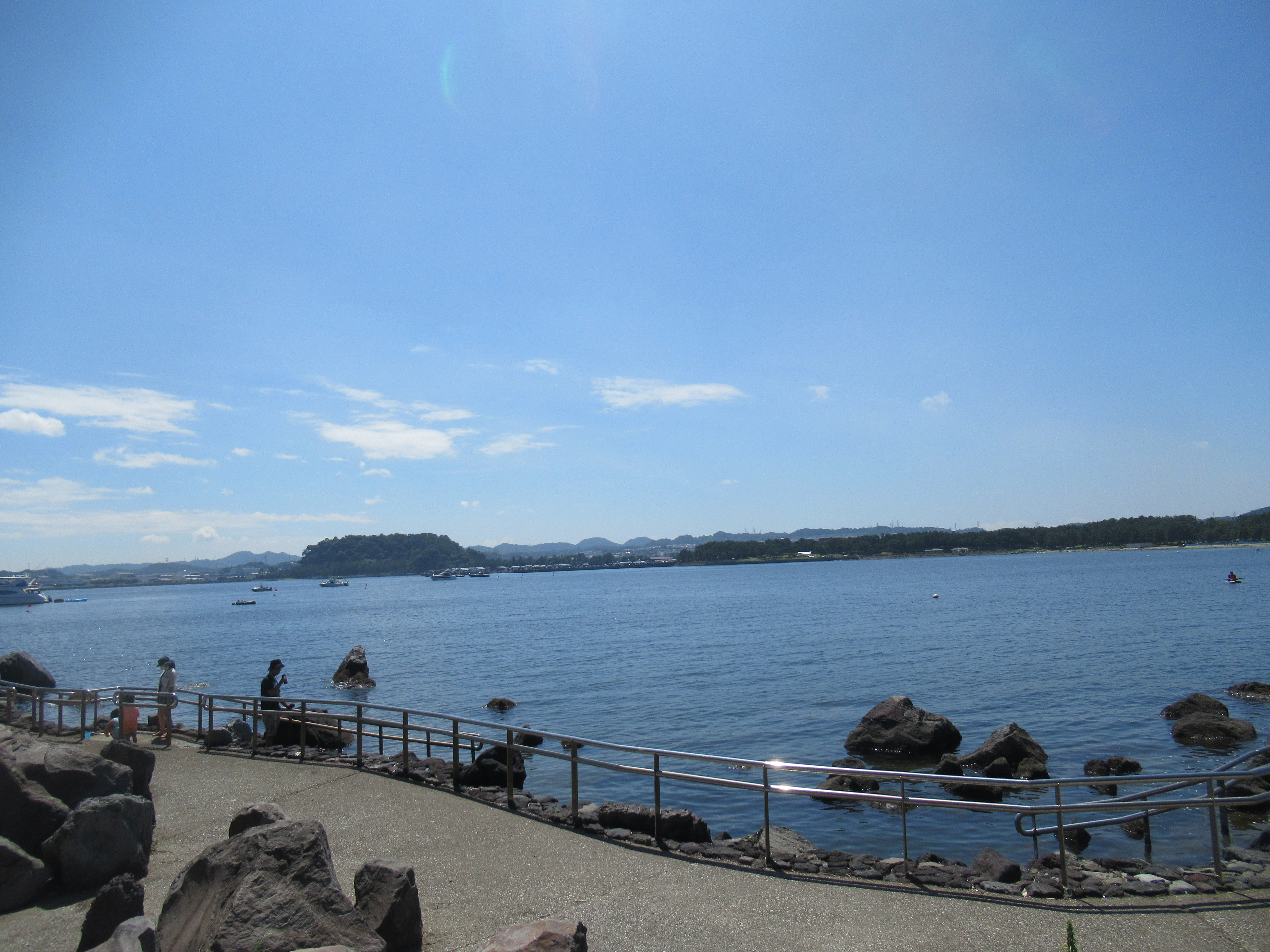
Nojima Island seen from Yokohama Marine Park

Typhoon Hynnamnor took very strange route. The tropical disturbance became a typhoon on August 28 near Iwo Jima, proceeded to the west until very near to Taiwan. It then turned right almost 90° degree to the north. Many communities in Okinawa, Kyushu, and South Korea experienced disaster … What I must tell you this week about this typhoon is, it also affected Yokohama. We did not have storm rain nor wind. But Hynnamnor disturbed the growth of common eelgrass (Zostera marina, or Amamo in Japanese) in Hirakata Bay 平潟湾.

Could you see strange sea water here?

The storm took time to move to the west from its inception. Strong and warm typhoon waves pounded Tokyo Bay for days. Unusual tropical water washed the beaches of Hirakata Bay for about a week. Eeelgrass does not like hot water. Relatively cold water rapidly coming down from Miura Alps is what eelgrass needs. Instead this time, tons of warm sea water could have helped another seaweeds, Ulva, to override the seabed of eelgrass. The incident may have happened at the bottom of Hirakata Bay. Moreover, strong typhoon wave uprooted and washed up a huge amount of Ulva to the beaches of Hirakata Bay. The artificially “white” sandy beach of Yokohama Marine Park 横浜海の公園 became green covered with Ulva. Worse. Under strong summer sunshine, the microbes quickly decomposed the seaweed on the beach. The green beach emitted rotten smell of hydrogen sulfide reaching to nearby residential area. It became Nation-wide news.

Yuk

The City Office somehow raked the seaweeds. When I’ve been there on 4th of September, the piles of ulva were dotted the beach where lots of people enjoyed late summer. It still smells weird although not so strongly … From the beach I could not know what was happening eelgrass at the bottom of the sea. For water purification Ulva is also effective, but for maintaining biodiversity of the bay …? In any case, the beginning of such strange ulva-hullaballoo was unusual movement of tropical low pressure/typhoon. People said it was due to strange high-pressure system around Japan this summer due to meandering jet stream. It would be due to global warming … Volunteers are planting eelgrass at the bottom of the sea to deal with such climate issues, but … *sigh*

Piles of ulva
A hill of ulva and a windsurfer …

Never mind for beach volleyballers

Yokohama Marine Park

If you find a problem in the Yokohama Marine Park, please make a contact with

Office for the Park Greeneries in the South 南部公園緑地事務所
Yokohama Municipal Government Creative Environment Policy Bureau 横浜市環境創造局
Phone: 045-831-8484
FAX: 045-831-9389

Friday, September 2, 2022

Forest is Longing for the Sea 2: Regeneration begins … Nojima Park 野島公園 2


Let’s go to Nojima Park 野島公園. It’s easy. The nearest commuter railway station is Keikyu Kanazawa Hakkei 京急金沢八景. If you’re resident of Nojima Island, you take Yokohama Seaside Line monorail from Kanazawa Hakkei, and get off at the next station named Nojimakoen 野島公園. But today we should check several points before Nojimakoen Station. I recommend you walking for today’s itinerary, not taking commuter bus or monorail service. It’s to feel why Ottomo Beach 乙舳海岸 is bountiful. 😉 We find National Route 16 running in front of the Kanazawa Hakkei station. We can already see Hirakata Bay 平潟湾 on our left. Almost next to the station, there is a large shrine named Seto Shrine 瀬戸神社.

When we come out from the ticket gate
 of Keikyu Kanazawa Hakkei,
 we can find the station for Yokohama Seaside Line
 just there on our left.
 But today we don’t use the service,
but go down these steps,

 to reach to the ground.
The road below the overpass of Seaside Line is National Route 16.
Oh, by the way,
if you plan to “watch” how ordinary Japanese do these days,
the best way is to drive entire Route 16
that runs through almost all the suburbs of Tokyo.
Demographers expect the area along Route 16
would not see population decrease at least until 2100.
It’s something for this age and time of shrinking Japan.
Turn left at the corner of the station and go along Route 16,
 there is Seto Shrine.

About 2000 years ago, the area along Route 16 from Kanazawa Hakkei Station to Kanazawa Bunko Station 金沢文庫 was an elongated inlet connected to Hirakata Bay in front of the Seto Shrine. There was difference in elevation for sea level between these two inlets that made rapids in a narrow joint by the ebb and flow of tide. Ancient people regarded such whirlpool of sea water as divine washing machine for everyday impurity. They built a shrine. At least archeological findings can be traced back to around AD 3C for the existence of Shrine. i.e. The seashore of ancient Tokyo Bay was at Route 16 more or less in front of Seto Shrine. As this is Japanese shrine, the forest around the old sanctuary has been kept intact for centuries (my post on May 22, 2015). So, today from the forest around Seto Shrine we can guess how the vegetation was along Tokyo Bay before the large reclamation.

In the sanctuary.
Typical for Miura Peninsula
三浦半島,
the ground for Kanazawa Hakkei area has
porous geological features that tell us
the place was once at the bottom of the sea,
but pushed up by tectonic crash of Philippines and North American Plates.
The forest of Seto Shrine stands on this very thin soil
in the vegetables’ way once ubiquitous here.

Another side of Route 16 from Seto Shrine, next to Lawson Convenience Store, there is a small way going to Biwajima Island 琵琶島 where in the middle there is a small shrine, called Biwajima Shrine 琵琶島神社. Before, there was a bridge that connected Seto Shrine and Biwajima Shrine. Those were the days Hirakata Bay was dotted by small green islands that attracted many artists to admire the scenery … Now the island has (probably concreted) permanent approach with pavement. But that’s not the point we should see here. Please go to the end of the island and check the sea at the tip of the island. We should find small planters lined under the water. It’s a nursery of common eelgrass (Zostera marina), or Amamo in Japanese.

The road to Biwajima Shrine

Biwajima Shrine

These stone walls indicate us
the original form of the “island” that was
 lute (Biwa in Japanese) shaped.

Common eelgrass was really ordinary seaweed found all over in beaches of Japan. It loves calm and shallow sandy sea floor with enough nutrition. It vigorously engages in photosynthesis, i.e. absorbs CO2 a lot. Meanwhile the underwater bushes of eelgrass become ideal homes for tiny sea creatures, planktons et al, and fishes. When it withers, it keeps absorbed CO2 in its dead body at the bottom of the sea. Here in Hirakata Bay once fishermen walked the seafloor almost bushwhacking the endless continuation of eelgrass … With rapid economic development and horrible water pollutions, many sea floors with common eelgrass, including for Hirakata Bay, had gone. However, now in Japan this plant is THE protagonist for national Blue Carbon policy. Around Nojima Island, volunteer divers of Amamo Revival Collaboration in Kanazawa-Hakkei 金沢八景-東京湾アマモ場再生会議 plant the common eelgrass strategically in order for recreating large undersea meadow funded by Toyo Construction. (They are a bit dated documents, but this and this pages – sorry in Japanese – neatly summarize volunteers’ activity.) The planter we can find at the tip of Biwajima Island is the nursery for this project. Last time they situated them on this underwater spot was in April 2019, before COVID, by lots of citizen volunteers. I guess they’ll have a similar ‘afforestation’ event in the sea near future. It could be worthwhile to check their facebook page to know the schedule.

… I could not recognize the ‘plant’ from the island.
The volunteers collect the seeds of eelgrass
and sow them in the nursery.

Seeing Nojima Island from the tip of Biwajima Island.

Now we return to Route 16 and go north along the bottom of Hirakata Bay. Let’s turn right at the first corner which is of Seto Jinja-Mae 瀬戸神社前 (“In front of Seto Shrine”) traffic light. We immediately cross Seto Bridge 瀬戸橋 and enter a residential commuter road. Seto Bridge is to cross the former inlet which is now a river called 3km Miyakawa River 宮川 starting from the forest of Kanazawa Citizen Forest (my post on June 3, 2016) of Miura Alps (my post on April 29, 2016). This is important for today’s topic. Would you please remember that, wouldn’t you? In front of us is a green hill that is Nojima Island. About 300m or so from Seto Bridge, a small green garden named Suzaki Park 須崎公園 is waiting on our right. The place itself is nothing special. Green grass, all-weather pavement and a bench. What we should check here is the scenery we can find beyond Hirakata Bay from the garden. Over there is a continuation of green hills which is Miura Alps. This is important, I tell you.

Seto Jinja-Mae traffic light. Please turn right here.

Miyakawa River and Seto Bridge.
It is unbelievable the place was once sea.
The structures on both sides of riverbank are
 on the reclaimed land.
Seeing the other side of Hirakata Bay from Susaki Park.

200m more ahead from Suzaki Park, there is one of the three bridges that connect Nojjima Island with the main island (oh, it sounds so strange … anyway, downtown Yokohama is on Honshu Island, for sure). We don’t take this bridge so let’s turn left and walk below the overhead monorail track. Ahead of us is the entrance to Nojima Island Station. Just before the entrance there is the second bridge, Nojima Bridge 野島橋, to the island. Let’s take this and enter the Island. After crossing the bridge, we turn left and go straight. Over there we see the end of the island and green lawned space with black pines. That’s the beginning of Nojima Park. Entering the park we soon find on our right the villa-museum of PM Itoh I introduced you last week. A strolling path along the beach begins in front of the PM’s villa. Basically, the beach front path is paved, wide, and the access for motorized vehicle is limited, i.e. very family friendly. Along the way, there is the area for camping tents, BBQ and baseball (all RSVP at here). Before the COVID, when they had fireworks in Tokyo Bay, people of Yokohama went there, eat BBQ, and enjoyed party with fireworks. (Oh, hand-held fireworks are prohibited inside the Park, I must add.) Although the firework festival since 1975 was proud of its history, COVID-19 nulled the expectation of citizens again this year … I’m sure it shall return!

Go straight from Susaki Park, we reach to this traffic light.
 Let’s turn left there, and

walk under the monorail.
Nojima Island Station and Nojima Bridge are ahead of us.

A scenery from Nojima Bridge.
Basically, the area has lots of leisure service providers for sea fishing,
 in addition to professional fishery.

Nojima Bridge at Nojima side. Let’s turn left here, to

straight.

The entrance to Nojima Park.

PM Itoh’s villa is on our right.

We’re a sort of trespassing the PM’s garden

for arriving this point.

For beachside walk, this way please.

Such notice for clamming is posted here and there.

Mmmmmmmmmmmm. Summer!

Overnight tent needs reservation.

BBQ place.
It was before 11:00 AM,
and already lots of people started their charcoal.

Info booth for campers and BBQ.

In any case, today we must go another part of the park that is an observation platform. From PM’s villa along the beach, check the first crossing we meet. On our left is the continuation of beach-side walk, on our right is to the residential area of the island and small parking lots for the Park. In front of us there is a road climbing steeply. This is the route to the observatory at ASL 57m. At the crossing by the sea we’re more or less at ASL 1-2m. So, be ready to go up rapidly to the top! The wide paved road spirals up. The atmosphere of the route soon becomes that for a forest. In addition to the black pines the vegetation has lots of broad-leaved evergreens, such as Lithocarpus edulis and Persea thunbergia, and deciduous trees such as cherry trees and Ficus erecta. Before the land were reclaimed, this part of Tokyo Bay was dotted with tiny islands covered with such trees … We then reach to the top where a large white structure invites us to climb. Let’s go up.

This is the beginning to the observation platform.

Seaside forest

Ficus erecta. Hm, it was not at all tasty, I tell you.

The top of the hill with observation platform

A part of the open space at the summit is an archeological site
 where kitchen midden of 8000-7500 years ago was found in the 1940’s.
 This is the oldest known kitchen midden in Yokohama.

The vista from the top of the observatory is good. To the bottom of Tokyo Bay, we can recognize congested structures of Ports of Yokohama, Tokyo, and Chiba. The direction to Nissan Oppama Factory has more open as it is nearer to the Pacific Ocean. To the west, when it is fine, we can observe Mt. Fuji, Tanzawa, Hakone, and mountains of Izu Peninsula. But nearer greenery is Miura Alps that starts from the end of suburban scenery surrounding the island. We can understand Nojima Island is enclosed by sea to the east, and the other three directions are by Miura Alps. That’s close, and it is the reason why Ottomo Beach and the area at the mouth of Hirakata Bay is so copious. Before talking more about it, let’s examine one more thing in today’s walk.

From the observatory to the direction of Tokyo.

It’s to the Pacific Ocean.

And the rest is there with Mt. Fuji, and

there. The mountains / hills nearest to us is Miura Alps.

Going down from the observatory, passing the BBQ site and Nojima Youth Learning Center 野島青少年研修センター for the City of Yokohama (where they have lots of on-the-sea programs for kid’s fun), we return to the residential area of Nojima Island. Take a road running along the west side of the island. We soon find a row of workshops of local seaweed farmers. I don’t know why but historically they are immigrants from sea-less Nagano prefecture 長野県, or around Lake Suwa 諏訪湖 to be exact, who came to Yokohama about 100 years ago and established themselves as gourmet seaweed supplier. Their product is secretly important for the menu of Sobayoshi of Nihonbashi 日本橋そばよし, the best standing noodle restaurant in the entire Tokyo area. If you’re lucky enough to encounter a retail shop open here, please just drop in for souvenir! Anyway, after the seaweed farmers’ place, there comes the third bridge for Nojima Island called Yusho Bridge 夕照橋. Now it is a concreted bridge of busy traffic, but this is the point where Hiroshigue painted “Sunset from Nojima Island.” Tourism office of the City recommends the place for couples to come at the sunset and take a photo for Instagram … OK, OK. We cross the bridge and walk along Hirakata Bay. Going straight is to the Kanazawa Hakkei Station of Keikyu where we started today. Almost immediately after Yusho Bridge, we cross another bridge, Hirakata Bridge 平潟橋 which is over Jiju River 侍従川 of 4km which is originated from Asahina Pass 朝比奈峠 (my post on August 5, 2016) of Miura Alps. Seeing from Hirakata Bridge the river looks like a canal with concreted banks for both sides.

To the exit of the Park.

Outside is an ordinary residential area.

The row of workshops for seaweed farmers.

Tadahikomaru Shop.
I think this is the largest retail vender of the street.

Yusho Bridge can be seen from the workshop area.

Crossing Yusho Bridge. …
I cannot believe this is the same place Hiroshigue painted …

Hirakata Bridge crossing Jiju River

These yellow buoys are the sign for the mouth of Jiju River.

Jiju River coming down from Asahina Pass.

Today, we walked two bridges crossing rivers coming down from Miura Alps. Both Miyakawa and Jiju Rivers are short, which means the water contains lots of minerals from the forests of Miura Alps surrounding the Nojima Island. That’s another reason why the mouth of Hirakata Bay is a good place for common eelgrass. In general, fresh water discharged from forests contain large amount of CO2 and the other materials in the soil of forests it originates. If the river is short, such contents reach to the sea more directly. Common eelgrass does photosynthesis, which means lots of CO2 is good for their growth. They can also eat minerals from the forest more abundantly in Hirakata Bay. If eelgrass grows plentiful, it captures more carbon and provides homes for sea creatures that support biodiversity. The sea around Nojima Island of Hirakata Bay, Yokohama, has such potential thanks to its vicinity to Miura Alps and the forests there. It’s a site for small-scale replica of Kesen’numa Bay 気仙沼 and the Non-Profit Organization “Mori wa Umi no Koibito 森は海の恋人” in Miyage Prefecture (my post on June 17, 2022).

From Hirakata Bridge,
a nice promenade is provided for strollers.

And the end of this pedestrian way is Kanazawa Hakkei Station.

It is said that the amount of CO2 Blue Carbon can store is 2 times more than that for Green Carbon (aka forest) on the ground. Yeah. It would be so, but the sea around Nojima Island cannot be like that without Miura Alps. Yokohama has about 141km of coastline. But beach we can go near is only 1300m = Ottomo Beach (500m) + artificial beach of Marine Park (800m). And this place has such potential for growing common eelgrass that can capture CO2 as Blue Carbon. It is amazing the remaining tiny beach collaborating with the forests has huge potential in such a way. Forest is longing for the sea, and plays a part for the sea to act, mate.


If you find a problem in the Nojima Park, please make a contact with

Office for the Park Greeneries in the South 南部公園緑地事務所
Yokohama Municipal Government Creative Environment Policy Bureau 横浜市環境創造局
Phone: 045-831-8484 
FAX: 045-831-9389