Showing posts with label Noh. Show all posts

Friday, December 21, 2018

Frequent Flyer Program: observation sessions for Japanese Flying Squirrels


Yadoriki Water Source Forest やどりき水源林 is home for flying squirrels. They fly, or glide to be exact, from a tree to a tree, normally during night. To observe their activity clearly, afforested coniferous forests of 50 or more years’ old is the best. There, trees are planted geometrically, trunks are straight, and the plants don’t keep bushy boughs lower down. It is easy for humans to spot gliding squirrels between trees in dark. Two kinds of flying squirrels are dwelling in Yadoriki Forest. One is Japanese Giant Flying Squirrels (Petaurista leucogenys), and another is Japanese Dwarf Flying Squirrels (Pteromys momonga). Both use hollows in large trees for their nest, and avoid forest floors for their movement in order to protect themselves. The size of hollow is larger for Giant Flying Squirrels, whose entrance has at least about 7 or 8 cm in diameter, whereas “Dwarfs” can do with 5cm wide hole to enter. I’ve learned, except for nurturing pups, they use several hollows during their bouncing around in one night. I imagined, maybe, they slept in one of those their houses which happened to be their last during their busy traveling day in the forest … Real Frequent Flyers. To check if a hollow is used by flying squirrels, we study if the barks above and down the hole are splintered. The squirrels fly between the trees, but never intend to be a hole-in-one. They land on either upper or below the opening of their dwellings, and run down/up to the entrance. It makes the tree surface frayed. Ah-ha.


Could you figure out which tree has
 the scratch signs of flying squirrel?


The flying squirrels are diligent. Once they decide to have that nice looking hole for their new house, they remodel the place according to their preference. Is the size of entrance OK? If not, they nibble the hole to make their gate “just right.” They also adjust the space inside by gnawing and scrabbling. Then, the squirrels use something soft and dry, like finely shredded barks of cypresses, to make a large cushion, or cypress-scented carpet, covering the floor of their room. The animal actually cuts into fine threads by themselves the bark of coniferous trees to make their comfy bed. Theirs are ultimate beds naturally emit the vapor of cypress essential oil … As they use their home intensively, the edges of entrance wear off round nicely. Old cypress cushions are thrown away outside and new carpet is weaved by fresh and clean material. It’s important to look around those worn-off hollows and the floor in afforested coniferous forest. Could we find something fluffy lying on the ground of cedar and cypress forests?


This is an old rag for flying squirrel.


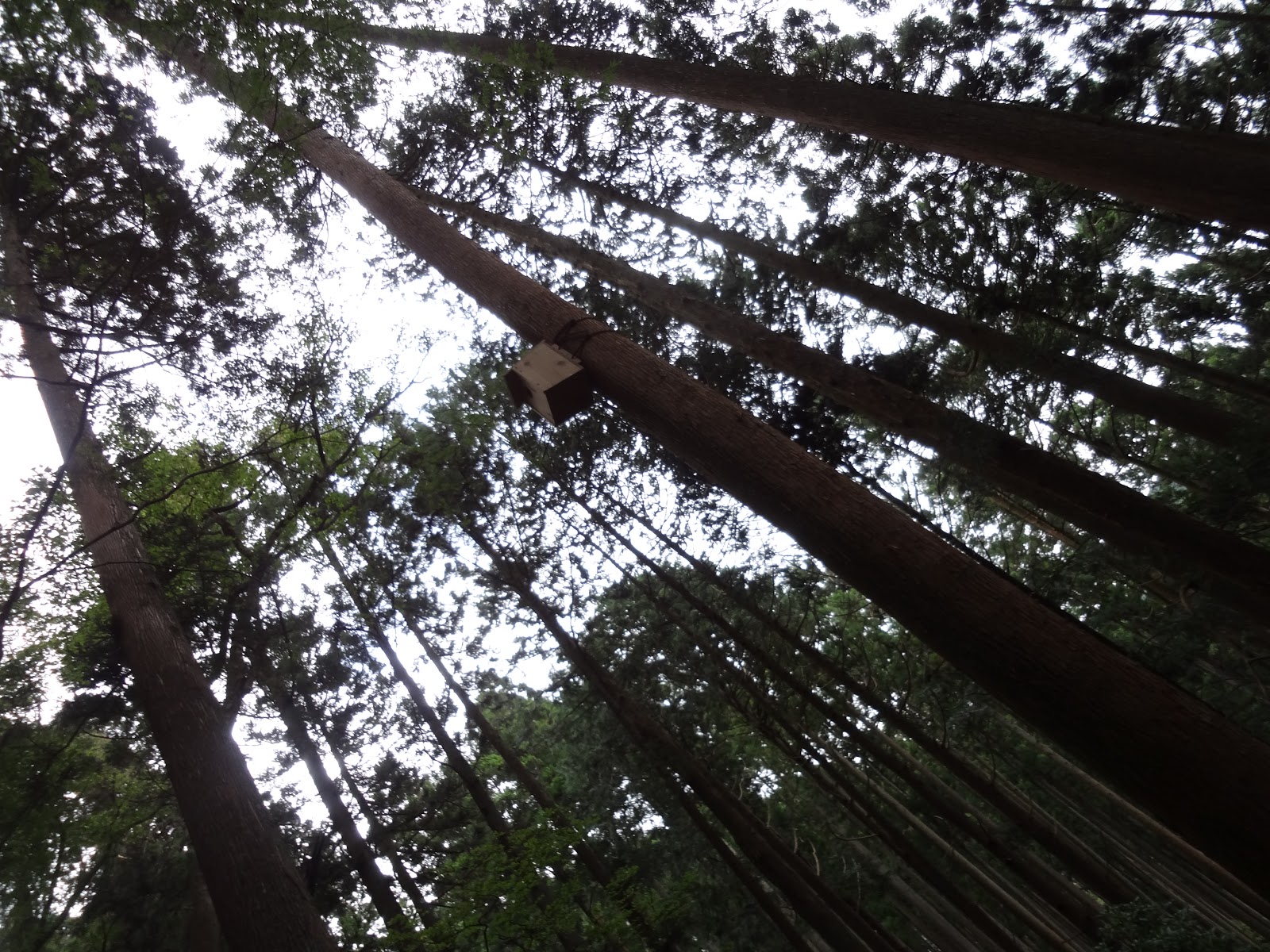
One veteran instructor told me a story of about 20 years ago. When the first idea of the Forest of Growing 成長の森 was floated for Yadoriki, several civil society organizations voiced their concern about deforestation of the area in order to create a space for planting. The current area for the Forest of Growing in Yadoriki Forest was known as habitat for Giant and Dwarf Flying Squirrels both of which need large enough trees. The opinion of the civil society produced a collaborative project between citizen scientists and those from academia, which was to identify the trees indispensable to preserve thriving communities of flying squirrels. Zones that had lots of such trees were kept as before, and comparatively less-used places were deforested and reforested by seedlings of deciduous trees with name plates of children who were financial backers for the water source forest. At that time, she continued, several trees were designated for nest boxes. I guess it was a sort of compensation by humans to flying squirrels after the disturbance of their habitat. Management of these flying squirrel houses is now done by Kanagawa Forest Instructor Association. During the observation sessions, together with natural hollows, instructors record the usage of nest boxes by animals. We also check if it is necessary to change the old boxes by new nests.


Yadoriki’s one of the Forests of Growing with deciduous trees,
 surrounded by the forest for the flying squirrels.
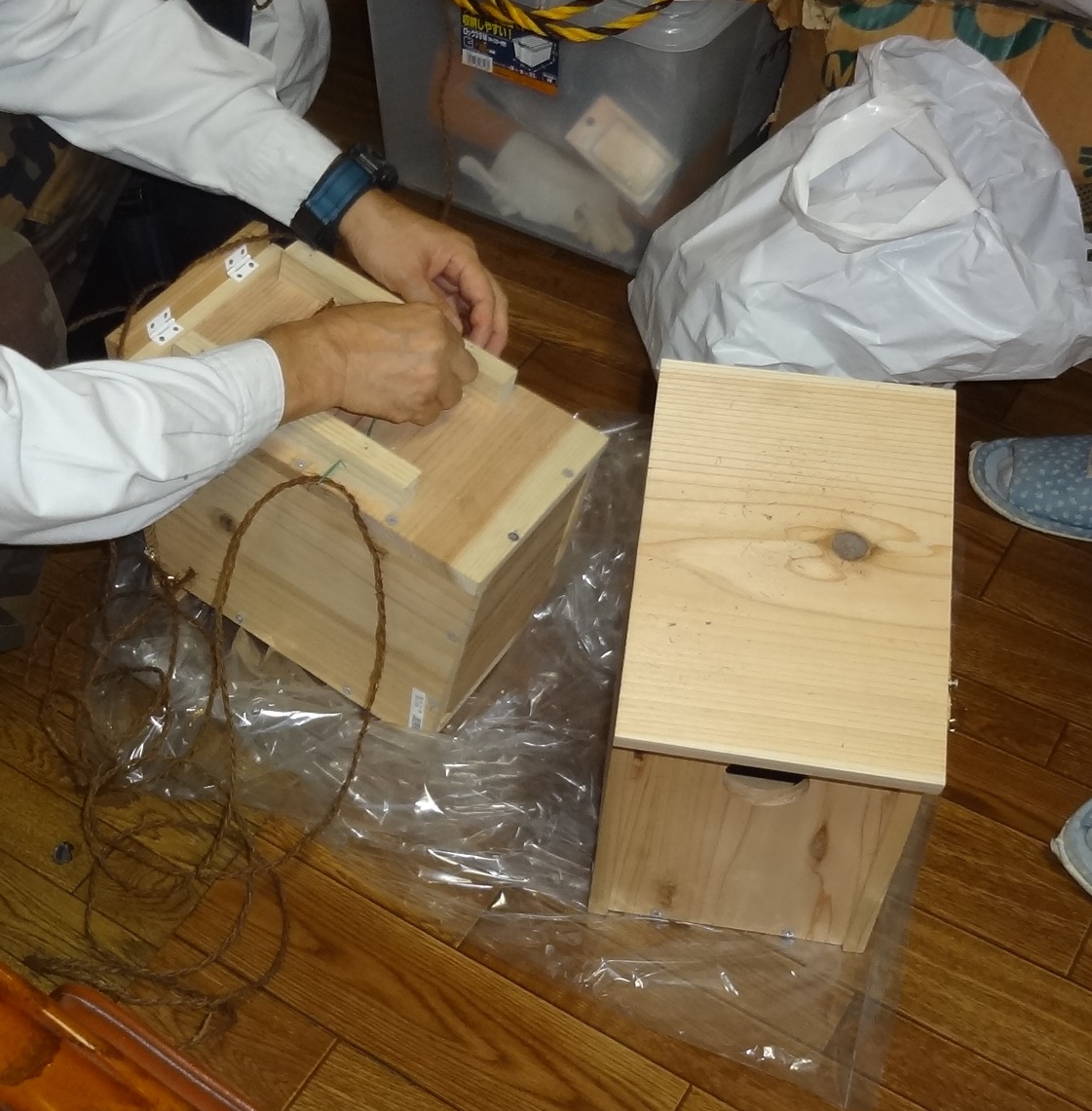
A preparation for new nest boxes


Early autumn, I joined an expedition of nest box changes for this year. Those were the boxes for Dwarf Flying Squirrels so that the houses were a size smaller compared with for Giants. We entered deep in Yadoriki Forest where no trekking road was available. Before starting the replacement, observing the old boxes quietly for a while was imperative. “You see? Man-made nest boxes are constructed by boards. They have definitely thinner walls than hollows of large trees. So, flying squirrels use them as a kind of temporary resting places before returning to their bed, especially during winter.” Hmmmmm, they are having a very reasonable life. It means it is possible for no one to use the box (which is very unlikely), or some other creatures utilized the man-made nest. My seniors told me not only flying squirrels but also bats and birds used the boxes for their housing. It is necessary to monitor who utilized the facility, and make adjustment if necessary. After recording the outer condition of the nest box, instructors set a ladder up against tall cedar trees and climbed up high to reach to the nest boxes. We then withdrew the old and installed a shiny new house at the same place.
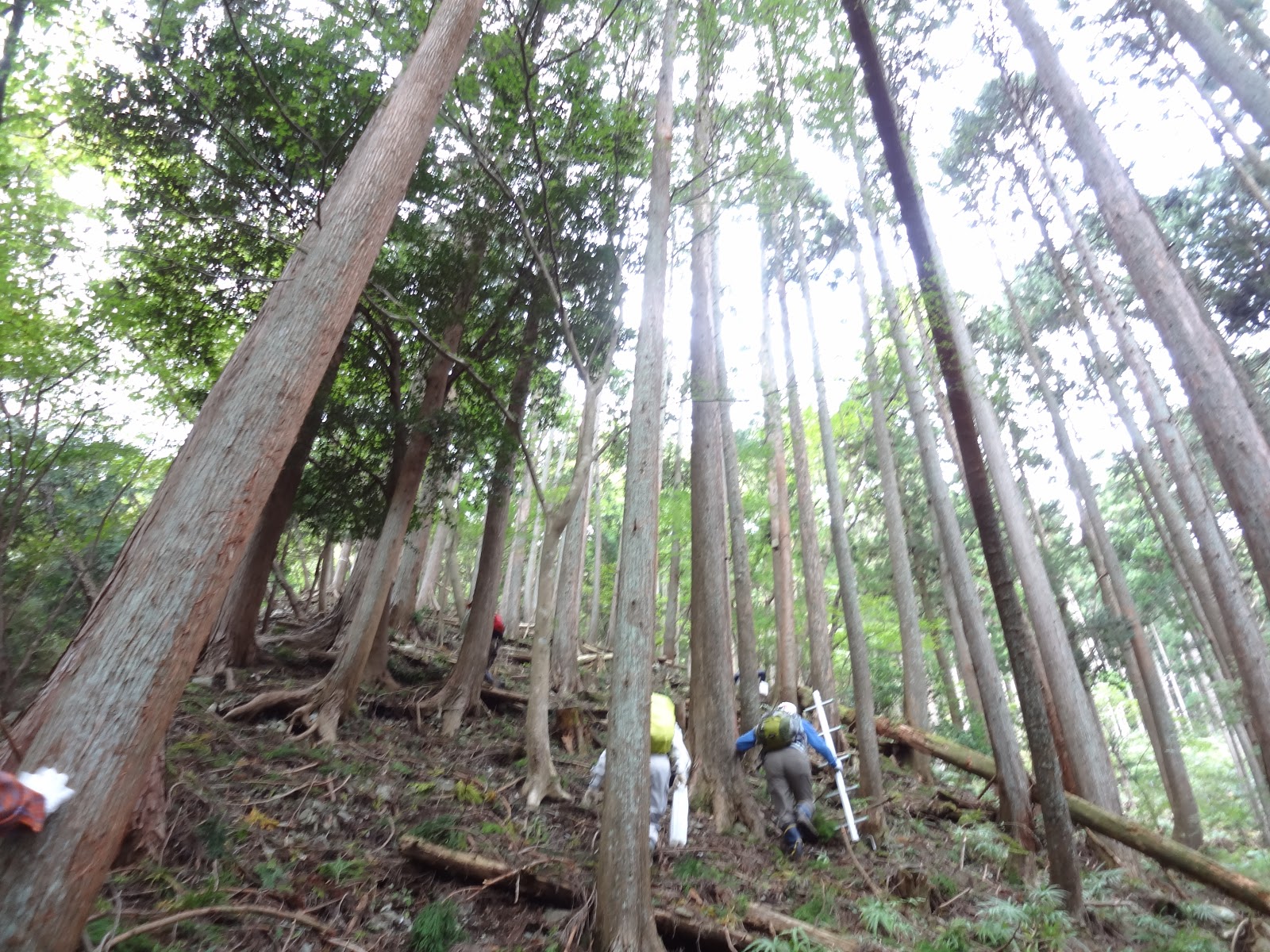

Kanagawa Forest Instructors with ladder
 enter deep into the Yadoriki Water Source Forest …
On our way to the nest boxes,
 I met Japanese Freshwater Crab (Geothelphusa dehaani).
 The place was at least 100m higher than the Yadoriki River.
 Tough guy, this crab is.
Setting the ladder …
Going up …
Changing to a new nest box ...
Done!
This box was completely broken.


It is important to bring back the old box to the admin office of the Yadoriki Forest. There, we examined the old nest to see how it was used, and checked the “cushion” inside. If the contents were like egg shells or even a dead fledgling, the box was used not by a squirrel, but by birds. If it was for flying squirrels, as they normally throw away their poop outside the house, the carpet is clean. On the other hand, if the place was abandoned, or else, we could find feces mixed in the cushion that would tell the health of the owner of the place. It was surprising to see the droppings of Dwarf Flying Squirrel … they were “Dwarf,” half the size of a grain of rice. A veterinarian told me if we examined it in microscope, we could identify what the flying squirrel ate. The animals also scratched the walls of the man-made house in order to make the inside cozy. All showed flying squirrels were home-loving creatures. Inside of their tree house now, are they dreaming for warmer next spring to come?


Fluffy inside.
The bark was shredded to this level.
Those black somethings are poops of Dwarf Flying Squirrel.
Home remodeling by the squirrel.
 Could you see the entrance is adjusted?
Wow. The wall was modified this much.


A grown-up Giant Flying Squirrel can have about 50cm long body. + They would have another 50cm long tail. So, home for Giant Flying Squirrels must be large enough for the “Giant” squirrel to cozy up. It means (1) a hollow for them must be in a large and old tree, and (2) the tree is structurally vulnerable to outer shocks such as earthquake or strong storm. On the foot of Yadoriki Ohashi Bridge 寄大橋, there was an old cedar tree with 2 holes that lead to two-story hollows inside (so my senior instructors said). It was a very popular nesting place for generations of Giant Flying Squirrel. Then, two super typhoons came this September, and devastated the trees in the forest. Very sadly, a beloved nest for a family of flying squirrel was also broken in half. I’m sure those squirrels were victims of natural disaster. “Where are they now?” “Well, they must have moved to their other nests in the forest.” “If they have survived, that is.” “Yeah.” That place was loved by forest instructors too. The tree stood almost next to the parking space and it was easily observable from Hadano Forestry Road 秦野林道. The flying squirrels are active from dusk to dawn so that it was precious the observation spot we did not have to enter deep in the forest during the night. “That was disappointing.” “Where do we go this year to have annual fall observation session for flying squirrels?” “Well …” In the end, one November weekend night, we’ve been to another hollow and a nest box relatively easy to approach from the forestry road. We waited about half an hour each to see if any flying squirrel, bat, or anything, using the sites. We strained our eyes to see those round holes in 10m beyond, using torch lights covered by red cellophanes. (Those creatures don’t care infrared light.) Both of the entrance looked smoothed that meant somebody was using them. However, no one came.


Devastation
Oh my … no roof for the squirrels.
A new observation site …
We were waiting, waiting, waiting …


It was a bit disappointing, though I personally enjoyed sitting quietly beneath a tall cedar tree in a deep night forest. I felt like doing a meditation in chilly but calm air of a large forest, and had a little thought about Iwate 岩手, that legendary old woman who killed her daughter and a grandkid in a deep forest to fulfill an order from her employer (my post on October 26, this year). Why did Iwate could not enjoy such pure air in a quiet forest? She must have been obsessed to be a good servant too much … pathetic. Flying squirrels are common in Japanese forests, er well, bears and boars, monkeys, etc., too. If she opened her heart to the environment surrounding her, not always thinking flashy city life and her rich employer, she could have had a jolly company in the middle of a forest …


A dusk of Yadoriki Forest …


Eventually, the leader of the observation session concluded “Er, OK, at least tonight, no animal came to use these spots. Let’s return to the site where the destroyed cedar with a nest stood, just in case.” So, we visited the place once again. The fallen tree was cut from the bottom by the Prefecture, and its log was neatly laid on a slope. We searched any traces of squirrel both on the boughs of nearby trees and the ground. Then, the leader muttered in a hashed voice. “Look, there is something moving around on the ground.” We tried hard to see the movement of the animal and whispered each other in the pitch black forest. “Japanese badger (Meles anakuma)?” “Hold on … let me watch it more …” “… I don’t think so. It does not have a long nose typical of badgers …” “Its face is more round …” “It’s a Japanese raccoon dog (Nyctereutes procyonoides viverrinus)!” “… Yeah, the bridge of its nose has black fur. That’s a raccoon dog.” The forestry road and the floor where the raccoon dog moved around were separated by a steep cliff of about 5m high. “Clever one. It knows we cannot go down there. The animal judged the situation is safe.” It observed us several times without any sign of nervousness, and engaged in its task, probably searching for food, at its own pace. After parading in front of us for about 3 minutes, it went in the deeper forest where our infrared light cannot reach. That was a sweet encounter. Our leader proclaimed “Oh, we are so lucky! I really wanted to embrace and kiss that raccoon dog!” Now I hypothesize the place once stood a nice hollow for flying squirrels is a good place for the other animals to find food, or live a life of forest. Maybe, in a forest, there are such “nice spots” where many creatures gather naturally. We need to be open-hearted and patient to encounter such sweet places in a mountain … Poor Iwate. She could have had parties in a charming plaza of the forest with the living creatures who would never have ordered horrible things to an employee ...


Could you figure out a white flush in the middle of this photo?
 It’s an eye of the raccoon dog we encountered.


It was fun to search for flying squirrels in Yadoriki Water Source Forest, though I do not recommend you to try without any guide who knows the area well. If you fancy joining observation sessions of flying squirrels around Tokyo, please enquire Mt. Takao 高尾山. There, the curators of Takao Visitor Center organize night observation tours every early summer. (Info is here. RSVP.) Its route is almost all paved and public transportation is available very near to the observation spots. Some business people go there from downtown Tokyo after their work. As flying squirrels are commonly found in Japanese rural forests, when you plan an overnight camping in a Japanese forest of big trees, you could have a chance to encounter them. Look around for the clues I explained above. Good luck, and don’t be Iwate in a night forest.😉


A tail of Giant Flying Squirrel.
 I took this photo in Ashigara Fureai Village
足柄ふれあいの村,
 not in Yadoriki unfortunately.


If you find an environmental issues in Kanagawa Prefecture, please make a contact with Kanagawa Natural Environment Conservation Center 神奈川県自然環境保全センター

657 Nanasawa, Atsugi City, 243-0121 2430121 厚木市七沢657
Phone: 046-248-0323


You can send an enquiry to them by clicking the bottom line of their homepage at http://www.pref.kanagawa.jp/div/1644/


Friday, October 6, 2017

An Empty Space in the Forest: Afuri Shrine Fire Festival and Torch Light Performance of Noh 大山阿夫利神社火祭薪能


This week, I tell you my metaphysical adventure of Noh theatre in the forest of Mt. Oyama Afuri Shrine 大山阿夫利神社. Besides being a weekend hiking destination for Tokyonites, Mt. Oyama has been a deity in Japanese mythology for centuries. Oyama Afuri Shrine is an interface between us mortals and the supernatural Mt. Oyama. Before iPhone X, such media has had many features for millennia to establish the link between humans and something beyond no-genius comprehension. Noh festival of Afuri Shrine is one of them.  For two nights before the first full-moon of every October, the shrine holds Noh theatre where the performance under the light of flaming torch is dedicated to God Oyama. Mt. Oyama presides over rain and thunder, i.e. fire, and so, the Noh under the flame makes sense. You may purchase a front seat for 4000 yen (or 3500 yen for an advance ticket; phone reservation only at 0463-95-2006 from 3 weeks before the first performance, 9:00-17:00). But the event has 1000 free tickets that are available only by postal application (detail at the end of this post). I of course chose a free ticket, and situated myself at the furthest, but the highest (in altitude) seat of the venue. That was a bingo. I could immerse myself naturally in a fantastic world of Noh surrounded by primeval forest of Mt. Oyama under the 13th night of beautiful moon … Yeah, you may prefer actors standing just before you. But don’t you think you can do it in National Noh Theatre in Harajuku, surrounded by the ocean of buildings in Tokyo? In Mt. Oyama, I’ve witnessed an effortless resonance between Noh and the forest. If you are in the metropolis Tokyo in October, Noh in Mt. Oyama is the event you should experience!


Actually, the performance is not held at the top of the mountain, nor the shrine sanctuary halfway up to the peak. The venue is at the administrative complex of Afuri Shrine near the hiking entrance to the purification site, Misogi-no-Otaki (禊の大滝 “the Big Waterfall for Purification”), where I reported my adventure last spring. The bus stop to the waterfall is Shamukyoku-Iriguchi Bus Stop 社務局入口. “Shaumukyoku” = Admin Office of the Shrine. Got it? When you plan to visit them directly from Isehara Station 伊勢原駅 of Odakyu Odawara Line 小田急小田原線, please take Kanachu Bus 神奈中バス I-1010 or I-11 11 from the Terminal #4 in the North Exit of Isehara Station. (Time Table, here.) It’s a 20 minuets’ bus ride to Shamukyoku-Iriguchi. The performance starts at 16:00 and the door is open at 15:00. BUT, there is almost no parking facility and the public transportation is only with Kanachu Bus. Although the organizer arranges special bus services from the station to Shamukyokku-Iriguchi stop, we’d better expect a long wait at Isehara Station for the next available bus. Our options are (1) arriving at Isehara Station at least by 14:00 to join the cue for the bus, (2) if you are a group of more than 4 people, take a taxi from the station and prepare to pay about twice as much as the bus ticket, or (3) hike Mt. Oyama on that day, and come down to the admin place of Afuri Shrine by 15:00.


At Isehara Station.
In this photo,
Terminal #4 itself cannot appear
as the line is too long …
From the north exit of the Isehara Station,
you may notice a big Torii
鳥居 next to Isehara Branch of Resona Bank.
On the day of Noh Festival,
there is a notice propped up on the pillar of Torii,
saying
“Afuri Shrine Fire Festival and Torch Light Performance of Noh.”
We are getting on the bus.
This signboard says
“Although Oyama Afuri Shrine has
Noh theatre performance tonight,
we cannot guarantee a fine weather.
Please accept any radical changes
in program due to weather.
All the seats are outdoors.
Please prepare yourself for rain or winds.
Usage of umbrellas is strongly discouraged.”
Shamukyoku-Iriguchi Bus Stop 社務局入口


At Shamukyoku-Iriguchi stop, we get off the bus, and cross the road and the bridge over Suzukawa River 鈴川. The road to the performance site is VERY congested from the bus stop. It’s difficult to get lost your way, so don’t worry. There is a community surrounding the administrative office of Afuri Shrine including several tofu shops. You can purchase tofu there before entering the venue, and ask the store people to keep your tofu in their refrige to be picked up after the performance. Their tofu is De-Li-Cious. If you are a bit more courageous, you can also ask them to give you tofu refuse, Okara おから in Japanese, made of soy beans. Normally, the people in Oyama town are generous and give you okara for free. Okara can be a very good veggie burger and many dishes (recipes here.) 😋 Once you situate yourself in the venue, just relax. Your fellow theatre goers may have a good time with beer and sake under the open air of Mt. Oyama … the atmosphere was very similar to summer concerts in the forest of Kenwood. Picnic foods, wine, laughter ...


Just follow the crowd.
Fire trucks are ready for the festival.
At the end of the road is the ticket booth for reserved seats.
Turn left at the booth for reservation,
and first right to the “free” seats.
You have to have an invitation postcard
to pass the gate over there.
More to this postcard at the end of this post.
One of the tofu shops
located in front of the admin office of the shrine
From the admin office,
we could admire the peak of Mt. Oyama,
under the cloud …


There is a bit of a story about Noh performance in Afuri Shrine. During the long history of Oyama worship, the most powerful patron for the shrine and Oyama Temple 大山寺 was Tokugawa Shogunate that governed Japan for 1600-1868. It was the time when Oyama pilgrimage from Tokyo (Edo 江戸) became uber-popular. Many people and, inevitably, conflicts were brought in to the sacred mountain. One of the most serious was a rivalry between temple monks and Yamabushi priests 山伏 affiliated with the shrine. Often, they were young and ambitious “religious males” to pursue the “purest doctrine of their belief” and disdained “unbelievers” active in the same Mt. Oyama domain. They fought, physically and daily. (Sounds eerily familiar in some other parts of the current world, doesn’t it?) Shogunate worried the escalation of violence, and envisaged a clever solution. In the late 17th century, they dispatched a Noh master, Kishi Matashichiroh 貴志又七郎, from Kishu Kanzeryu School 紀州観世流 to Mt. Oyama and let him organize twice-yearly official Noh performances acted by monks and priests TOGETHER. Creating a theatrical performance requires a damned-well team work. If that’s the order of Shogun with absolutely superior military power, young gangs in the mountain had no choice to study and work together under master Kishi. (Hm. Sometimes, a dictator could act very effectively ...) Eventually, they had no time to fight and the peace arrived in Mt. Oyama. The tradition of Noh performance continued till Americans started bombing Japanese cities in 1944. After the war, for a while, money and people were dissipated to hold performing arts in Mt. Oyama. Then, about 40 years ago, together with the previous chief priest of the Afuri Shrine, the largest school of Noh, Kanzeryu 観世流, and the oldest school of Kyogen 狂言, Okuraryu 大蔵流, began the project to resurrect the tradition. In 1980, the current style of “Afuri Shrine Fire Festival and Torch Light Performance of Noh” was established. The 2017 event is its 37th. Oh, by the way, for a full-Noh performance program, Noh and Kyogen must be presented alternately.


They are the seats for 4000 yen.
The Noh stage of Mt. Oyama Afuri Shrine.
It’s one of the best Noh stages in Japan.

The idea of revived Noh festival in Mt. Oyama is a combination of the fire festival traditionally held in late August and the Noh performance under torch lights with a community theatre component. This year, the first night of the festival was opened by Kaniyamabushi Kyogen story 蟹山伏 by Oyama Community Kyogen Group 大山狂言. It’s a classic comedy of arrogant Yamabushi who was tormented by a mountain crab goblin. The actors of the program were enthusiastic amateurs who train themselves to preserve 300 years’ tradition for a community theatre of peace. It was a fun! Come to think of it, the origin of the event was bigheaded behavior of Yamabushi and monks. Ordinary people laughing out loud their snobbism is the best fit for the occasion. After Kaniyamabushi, the mayor of the City of Isehara and the local representative for the National Diet gave a small speech to celebrate the festival. They were followed by a ritual of purification by the priests of the shrine to announce the beginning of the fire festival. Next, in time to ancient hypnotic court music played by priests, young shrine maidens brought the fire created at the peak of Mt. Oyama to the sacred space next to the Noh stage. A pile of firewood was situated at the center of the place demarcated by 4 pillars of purified bamboos on which the maidens lit the fire. Then, the priests recited the chant, expressing the gratitude to God Oyama, and asking peace in human world. The prayer was reinforced by following arrow-and-bow and Japanese pole sword rituals 弓矛神事 on the Noh stage. Finally, the priests transfer the sacred fire to the torches strategically located around the Noh theatre. When the community actors performed, the sun was still shining and the cicadas were singing merrily in the forest. By the time the priests made the fire torches, the voice of evening cicadas was echoing in the forest of slightly chilly but pure air. The stage was ready for the professional Noh actors.


Kaniyamabushi Kyogen
The shrine maidens to transfer the sacred fire
The fire ritual
The arrow and bow ritual
The priests are making torch lights for Noh performance.


The opening of a full Noh theatre is always Hitori-okina (“An Old Man Alone”) 一人翁. At the beginning of 2017 torch-light Noh in Mt. Oyama, a priest conducted a rite of purification for the actor and musicians of Hitori-okina on stage. Then, the Noh actor Kanze Yoshinobu 観世芳伸 performed the dance of offering to God Oyama, Hitori-okina. The beer-and-loud-chat atmosphere at the beginning completely disappeared. But unlike Noh theatres indoors, the forest in the mountain, darkening sky, smells of torch lights and water of nearby Suzukawa River … curiously claim their absolute existence during this semi-prayer dance. Hitori-okina was followed by two Shimai dance 仕舞, Dohkan 道灌 with Matsuki Chitoshi 松木千俊, and Matsukaze 松風 with Takeda Yukifusa 武田志房. Shimai is a sort of abridged Noh dance taken from a longer story and performed without masks or specific costume. I was amazed by simply-clad actor’s small movement of arm, or of a golden fan that could change the flow of air at once in the theatre. The expectation was mounting. The penultimate program was Jizohmai Kyogen 地蔵舞 performed by Yamamoto Tohjiro 山本東次郎 (an Living National Treasure title holder) and Yamamoto Yasutaroh 山本泰太郎. Jizohmai is a comedy where a monk declared abstinence during his pilgrimage but in his effort to find one-night shelter in a mountain succumbed to drinking and started to dance called Jizohmai. 80 years old Yamamoto Tohjiro sit very cute in the center of the stage, looked like an emoji of a teenage girl. The charm of Kyogen of that night was both programs incisively making sarcastic remarks about the self-importance of Buddhism monks and Shinto priests, without being cruel for anybody. Maybe, that’s the secret to settle a bickering among too-ardent religious people. By the end of Jizohmai, Mt. Oyama was in complete darkness where the torch fires illuminated brightly the stage, and the shadows of forests were drifting with the chorus of crickets. The entire space was vast-open, but the stage without any props was like a core of concentrated something. The conclusion of the evening was Funa-Benkei 船弁慶 which is a story of a defeated samurai master Minamoto-no Yoshitsune 源義経. During his rout, he had to bid a farewell to his beloved wife Shizuka 静御前 and battle against a ghost of slain enemy Taira-no Tomomori 平知盛, with a help of his faithful follower monk Benkei 武蔵坊弁慶. When the first protagonist Sizuka was on stage, the air was beautiful but painfully silent and tense. The actor Kanze Kiyokazu 観世清和 (the current grand master for Kanzeryu School and a recipient of L'Ordre des Arts et des Lettres) wore beautiful female mask and just by slightly changing a direction of his movement expressed silent agony of the brave but desperate wife. After the lovers separated, the second protagonist, the ghost of Taira-no Tomomori by Yamashina Yaemon 山階右衛門 (a younger brother of Kanze Kiyokazu), burst in the stage with a fury for revenge. He wore the mask of devil and menacingly approached to the party of Yoshitsune. The actor did not wear any bloody costume or smelly-looking gown like characters in Macbeth, but we could feel the death. I had a flush back of a scene I encountered ages ago in Bois de Vincennes for Théâtre du Soleil. My French is so rudimentary that it’s unfair to comment the intention of Ariane Mnouchkine … but I realized what she wanted to have in Paris could be this intensity in Oyama Noh created from the medieval script from Japan. Both stages were in the forest … Cartoucherie de Vincennes created a stage by closing off the space with a tent. Oyama Noh set a stage without any wall and let the forest to interact uncontrollably during the performance ... Oh what the difference a forest can make to human expression … Around the time Sizuka withdrew from the stage, the 13th night moon appeared above the stage, welcoming the ghost of defeated soldier. Over the waning moon, the clouds were moving slowly just like the movement of Noh actors. The moonlight and torch lights changed the silhouettes of the forest over the stage meditatively … The evening was ended by another prayer dedicated to God of Oyama. Great. The art in the forest.


Er, well, the photos of professional actors were not taken
as I thought there must be copy right issues.
But, the moon is beautiful, isn’t it?
An empty space again


If you plan to have an invitation ticket for a free seat for Oyama Noh Festival, you send a reply-paid postcard by Japan Post to

The Committee for Himatsuri-Takiginoh at Oyama Afuri Shrine 大山阿夫利神社社務局火祭薪能実行委員会
355 Oyama, Isehara City, 259-1107 伊勢原市大山355
(phone) 0463-95-2006

with your name, address, phone number and the date you plan to attend in message part. One application per person only. No group request accepted. Deadline of application is 2 weeks before the first performance. If the number of applications exceeds more than 1000, the shrine holds a lottery and luckies will receive an invitation postcard in reply. Otherwise, their reply says “we are sorry.” They accept the application from August every year. Good luck!