Showing posts with label Spring Ephemeral. Show all posts

Sunday, March 15, 2026

Coming: Early spring 2026, Niiharu Citizen Forest


Last week, Yokohama was cold. The temperature was around 8°C at best. Greens around us on street looked bleak … This weekend, the highest temperature has reached 14 or 15°C in the North Forest of Yokohama. Finally?


Tadpoles started swimming in Niiharu.
Spring ephemeral, Wind flowers now have florets.

This is also Spring ephemeral, Carex conica Boott.

Yellow avalanche lilies show their buds.

This time of the year,
Pertya scandens have pretty popping plumules.

In Niiharu,
there are lot of trees of Early stachyurus,
Japanese native.
But those receiving lots of sunshine open first.
Flowers are honest.
I think this year
Orychophragmus violaceus flower earlier than violets.
They came from China about 300 years ago.
I heard in China they are vegetable.
Here, we normally don’t eat them.

Er …
chestnuts at the tip of a tree remain there as such …

Fritillaria verticillata var. thunbergii open its flowers now.
They are the first comers for flowering
in early spring and become dormant in late May.

Spring is coming honestly, I feel. But like the very short autumn last year it could end quickly. When the cherry blossoms are gone, Yokohama might jump into hot summer … global warming. Let us see.

Sawtooth oaks have new buds now.

If you have any questions about Yokohama’s Green Tax and Green Up Plan, please make a contact with

Strategic Planning Division, Green Environment Bureau, City of Yokohama
横浜市みどり環境局戦略企画課

Phone: 045-671-2712 
FAX: 045-550-4093
Email: mk-kikaku@city.yokohama.lg.jp

Friday, April 17, 2020

Nauty-Pauty Jack-A-Dandy: Violets in Yokohama under the State of Emergency


Probably the most charming spring ephemeral in Yokohama is violets. They show off their small and lovely leaves and flowers wherever they find they can sprout. In Yokohama, people find Viola grypoceras in March and realize spring has come. Their petite cuteness can fool and let us imagine them coming from enchanting world of fairies. Buuuut, when they end their flowering time and bear fruits for procreation, they grow up to 20cm or more in height with very large leaves. In summer, they lose their prettiness and turn into uber vigorous undergrowth. In fall, their above ground parts wither but they are alive as underground rhizome to overwinter. Next spring, they become spring fairies again. It’s a well-thought-out plan. Do not underestimate their natural power, yeah.


Viola grypoceras


Violets bear “dehiscent” fruits so that their seeds will be ejected from pods when time comes. In addition, they have another clever strategy to disperse their offspring. They are one of the most famous plants whose seeds have elaiosome. The stuff attaches to their seed. It is rich in lipids and proteins. Ants and the other bugs find them very nutritious and collect elaiosome together with seed. They eat the elaiosome and throw away the seed. That’s the reason why we often find violets right next to an ant hole. And so, when a nest of ants has their entrance on a stone wall, or in the fissure of asphalt of commuter road, violets poke their flowers there.


Viola mandshurica
Viola phalacrocarpa
Viola keiskei


Then, there exists a strange pattern for me. Viola grypoceras are so ubiquitous. In Yokohama, omnipresent Viola grypoceras spread their colony in comfortable forest floors or lawns in parks. In contrast, those less common violet species are often situated in shoulders of paved roads. Although sometimes we can find their parents in a nearby garden, their kids find themselves literally stuck between a rock and a hard place of busy car road. We even encounter them at the feet of a pole for bus stop. Why? Why don’t they flower in nearby forest as Viola grypoceras? They might be brought by humans, not by ants … happen to find a fissure in car road to sprout? They could simply be unlucky … But why can Viola grypoceras dominate easy neighborhood, while those others put up with the urban jungle? Is it because of the survival of the fittest?


This Viola mandshurica has definitely a hard life …
While its parent is some 2m away in a garden nearby.
I’ve met this Viola betonicifolia at the foot of a bus stop in my neighborhood.


Regarding the matter of the “Fittest,” humans are sitting at the pinnacle of food chain, right? So, I decided to eat mighty Viola grypoceras. Many flowers of Viola are edible (but not all of them; beware of poisonous garden pansies, or Viola verecunda, etc.). Besides, Viola grypoceras are so many. It makes me feel less guilty to pick them. I made “Violet candy.” There are several recipes for the treat available online (for example here). Mine was from a classic cookbook for children, “the Mother Goose Cookbook” (1970) by Frances Sheridan Goulart. According to the book, we dissolve 1 cup of granulated sugar by 3/4 cup of H2O over stove until it becomes sticky. We then dunk the pan in a bowl full of ice. The sugar solution starts to crystalize. At this point, we steep washed flowers of Viola first in a warm tea (mine was Earl Gray) and next in the pan to coat the petals with syrup. Next, “dry” the sugary flowers in a chilled bowel. Here we can powder the flower with sugar again. The flower candy will be stored in the fridge for about a week. They are really charming, and SWEEEEEET. 😘


A colony of Viola grypoceras
I collected the flowers …
Then, I washed them gently
 with tap of water and trimmed the stem.
 Later, I found my trimming was a bad move.
 I could use the stem to coat the flower in syrup,
 and then cut them off.
 Anyway,
I dunked the pan of sugary solution in a bucket of ice.
Meanwhile, steeping the flower in Earl Gray, and
in the syrup.
Finally, the flower in the sugar bath.
I also steep the flowers
in the syrup after bathing them in tea.
 The jar on the left is this “Violet syrup.”
One on the right is for violet candy.
My morning yogurt with Violet syrup


Nauty-Pauty Jack-A-Dandy
Stole a piece of sugar candy
From the grocer’s shoppy shop,
And away did hoppy-hop.

I’ve learned this candy was loved by Chopin. Wow. It’s a tiny luxury while COVID-19 dominates our spring …


Viola verecunda, which is not edible.
 Come to think of it,
 we have many violet species in our neighborhood.
 It is said that in Japan
 there are more than 200 kinds of wild violets.


If you find a problem in Yokohama’s North Forests, please make a contact with

Office for the Park Greeneries in the North 北部公園緑地事務所
Yokohama Municipal Government Creative Environment Policy Bureau 横浜市環境創造局
Phone: 045-311-2016
FAX: 045-316-8420

If you find environmental issues in Kanagawa Prefecture, please make a contact with Kanagawa Natural Environment Conservation Center 神奈川県自然環境保全センター

657 Nanasawa, Atsugi City, 243-0121
〒243-0121 厚木市七沢657
Phone: 046-248-0323

You can send an enquiry to them by clicking the bottom line of their homepage at http://www.pref.kanagawa.jp/div/1644/


Friday, April 10, 2020

Rhapsody in Blue under the State of Emergency: Spring Ephemeral in Yokohama


Whatever COVID-19 says, spring has come to Yokohama. I happen to live near the North Forests of Yokohama, including Niiharu 新治市民の森. We’re still allowed to stroll in our neighborhood nature during weekends. So, I’m enjoying spring of our nearby forests these days. Above our head is the shower of falling cherry blossoms, which itself is gorgeous. Around our feet, it’s flowers of spring ephemeral. Air is warm. It’s a nice season in Yokohama, despite of the corona viruses, of course. I’m keeping 2m radius of social distancing … On April 7th, Kanagawa Prefecture is put under the state of emergency due to the pandemic.


Cute pinks of henbits competing non-native Red deadnettle. Bishops hats were already ending in early April. I know several spots for Rubus hirsutus. They are in full-bloom now. Can I collect enough fruits of them for homemade jam this year? Is it Ixeris stolonifera or debilis? Petite white flowers of chickweed tell us the power of numbers. Blue dots of cucumber herb smile us with its cute tiny baby blue. Wind flower has also started flower now. Their dense new leaves cover a patch of ground and white flowers of five petals come out here and there. In order to flower, they need such density, perhaps. Oh, their white “petals” are actually calyxes, do you know? Aucuba japonica has their flowers now. Their male flower comes out first, then females appear, at least a month later when it is still damned cold. The other day, we forest instructors wondered why male flowers must emerge that early. It might be stamens of Aucuba japonica need time to mature in freezing air. What doesn’t kill you makes you stronger … Once upon a time in Japan, the leaves of Aucuba japonica were used as antiseptic for external wounds. No wonder Robert Fortune visited Japan to collect male specimen of it, which was absent in Europe although female was introduced in the 18th century.


Red deadnettle
Henbits
Bishops hats
Rubus hirsutus
Youngia japonica
Ixeris stolonifera
Potentilla freyniana
Chickweed
Cucumber herb
Wind flower
Female flower of Aucuba japonica
They are male.


Chloranthus japonicus poke their brushy flowers. Its Japanese name is “Hitori Shizuka.” “Hitori” = alone. Shizuka is the name of a lover of Japanese historical hero, Minamoto no Yoshitsune 源義経. Shizuka was the most beautiful dancer in Kyoto at the end of the 12th century. Yoshitsune was defeated in politics against his brother, Minamoto no Yoritomo 源頼朝, the first Samurai Shogun. According to the 14th century historical document called Azuma-kagami 吾妻鏡, when Yoshitsune and his troops became the fugitive, Shizuka was caught by the army of Yoritomo and brought to Kamakura 鎌倉 for inquiry. The wife of Yoritomo, Hojo Masako 北条政子, asked Shizuka the “famous dance in Kyoto” in Tsurugaoka Hachiman Shrine 鶴岡八幡宮 of Kamakura. Shizuka gave a stunning performance, alone on the stage. And so, the name came for this flower of spring ephemeral. Though, it always flowers in colonies … I personally call it “Party Shizuka.” They don’t have to keep social distancing …  *sigh*


Chloranthus japonicus
Euphorbia helioscopia
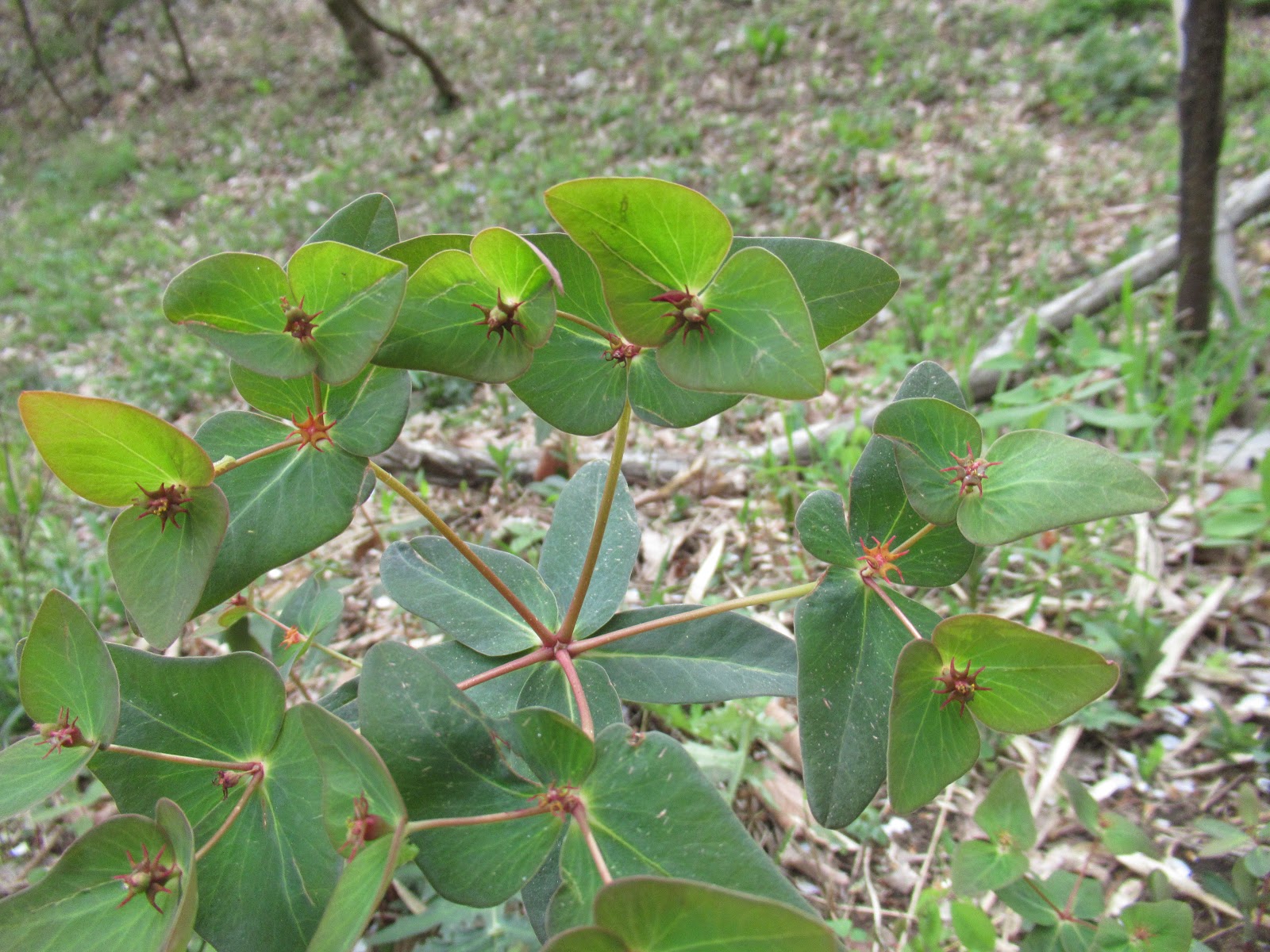
Euphorbia sieboldiana


Spring in my neighborhood is also a time for purplish small flowers. Ajuga decumbens are actually very common, although they flower silently below the leaves of other taller grasses. In Japan, people used entire Ajuga decumbens, or Kiranso in Japanese, for antiseptic purposes. Its another Japanese name is the “Lid for Devil’s Pan in Hell.” Standard explanation of this nickname is the grass spreads over the ground in round rosettes. But I’m more convinced of another reasoning. They must have been popular as disinfectant for common people. It maybe the time to try its power against COVID-19 … Another purplish small flower for Yokohama’s spring is alefoof. This also is ingredients of traditional Chinese medicine, but Japanese authority prohibits drinking alefoof tea or any product of them especially for those patients with seizure disorders. More study is really needed, I guess.


Ajuga decumbens
Alefoof


If you find a problem in Yokohama’s North Forests, please make a contact with

Office for the Park Greeneries in the North 北部公園緑地事務所
Yokohama Municipal Government Creative Environment Policy Bureau 横浜市環境創造局
Phone: 045-311-2016
FAX: 045-316-8420

If you find environmental issues in Kanagawa Prefecture, please make a contact with 

Kanagawa Natural Environment Conservation Center 神奈川県自然環境保全センター
657 Nanasawa, Atsugi City, 243-0121
〒243-0121 厚木市七沢657
Phone: 046-248-0323
 

You can send an enquiry to them by clicking the bottom line of their homepage at http://www.pref.kanagawa.jp/div/1644/


Solomon’s seal