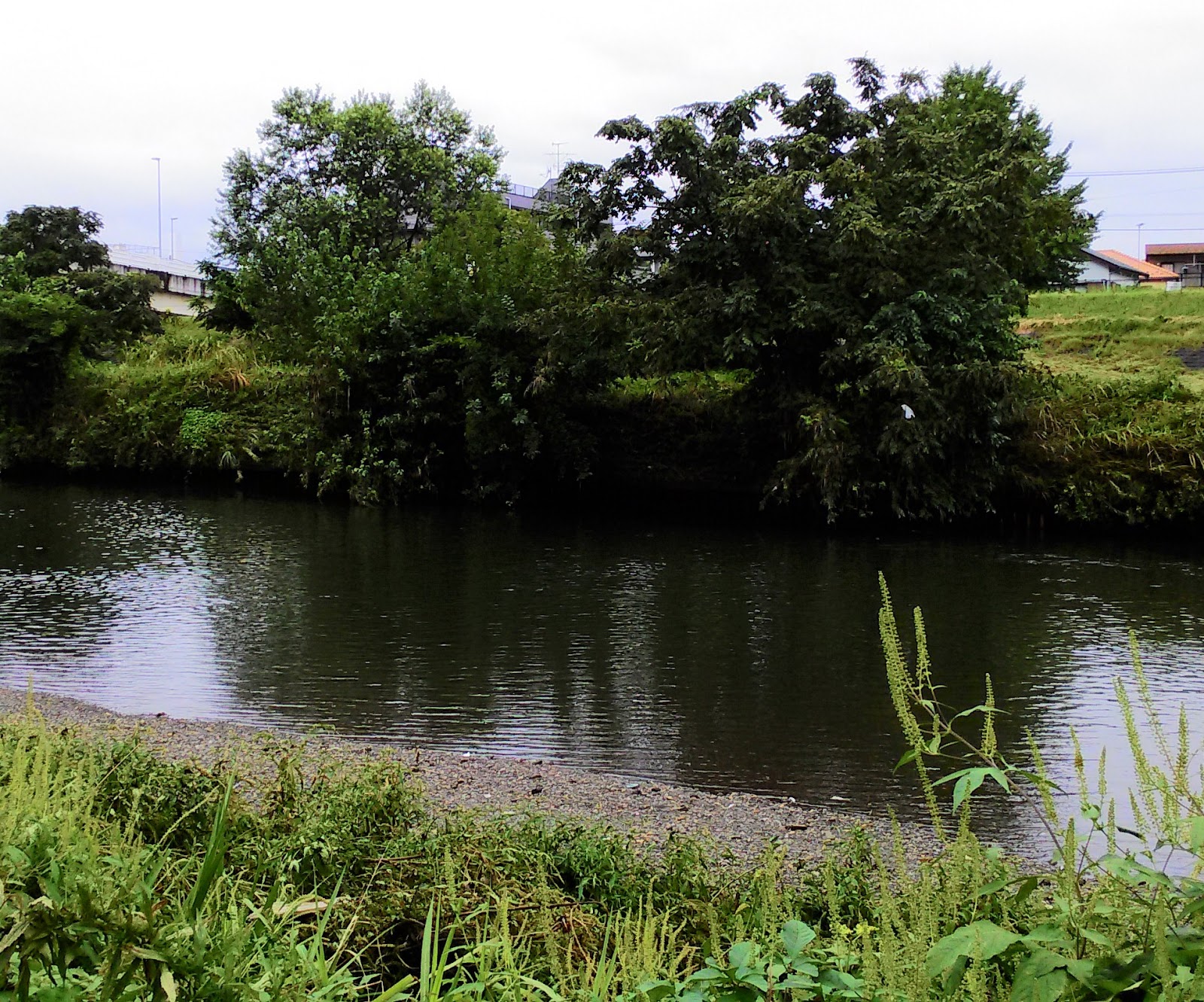
This week, I report you a bit different greenery in Yokohama. One component for Yokohama Green Up Plan is to train volunteers for the Plan. Roughly speaking, there are two kinds of volunteer education programmes. One is to acquire management skill for the greenery hands-on. The introduction of this module is Forest Volunteer 101 I attended last year. Another is several training courses to assist public relation of volunteer organizations such as the sessions for homepage making how-to, or an introductory course to be a nature interpreter. This latter category training is often held in Yokohama Children’s Amusement - Botanical Park in Hodogaya Ward. Hodogaya is one of the Citizen-Forest-less Wards of Yokohama. i.e. Children’s Amusement Park is located almost in the downtown, and the Park is, as we can imagine from its name, a horticultural creation. Even though, the place now has a well-established 14ha of greenery that includes British Common Wealth War Graves. I tell you a rough history of this place that is, I think, reminiscent for the evolution of Japanese thinking about forests.

First, the location of this Park is important to remember. To go there, take bus from JR Hodogaya Station (East Exit). The available services to our destination are City Bus #106 (time table here), City Bus #28 (time table here), Kanachu Bus #77 (time table here), Kanachu Bus #205 (time table here), Kanachu Bus #Ho-06 保06 (time table here), and Kanachu Bus #To-38 戸38 (time table here). i.e. A lot. We get off a bus at Gontazaka-ue Stop 権田坂上, or Jido-Yuenchi Iriguchi Stop 児童遊園地入口, both of them are on National Route 1. Yokohama Children’s Amusement - Botanical Park is spreading east hills along the Route 1.
 |
| Gontazaka-ue Stop arriving from Hodogaya Station |
 |
| Jido-Yuenchi Iriguchi Stop |
 |
| The place has a parking. JPY100 per 30 min. |
A direct translation of Gontazaka is “the Slope of Gonta.” Gonta is a male name. People said, once upon a time there lived somewhere around here an old guy, Gonta. One day, a tourist asked him the name of the long slope, and he mistook that person enquired his name. He replied “Gonta” and it became the name of the slope … More formal explanation is (from 1938 ethnographic study, “Hodogaya Kyodoshi 保土ヶ谷区郷土史.” You can ask librarians for the book in Yokohama City Library), a civil engineering work in the 18th century for the slope had a project manager called Fujita Gonzaemon 藤田権左衛門 … Gonzaemon, … Gonzamon, … Gonza, … Gonta … You’ve got the idea. When people travelled on foot from Edo (Tokyo) this very hilly area was the first chokepoint of Tokaido 東海道, the main arterial road between Tokyo and Kyoto. The historical Gontazaka is now a bit west from Route 1, running in a quiet residential area. When a developer bulldozed the area in the 1960s for housing, they found a deep pit along the old route beneath the ground, which was full of bones of animals, humans inclusive. Ancient chokepoint was a tricky spot for travelers who may have succumbed with exhaustion, or met unfortunate end with robbery. Their remains were thrown in the pit, which was called Nagekomi-zuka 投込塚. I did a bit of investigation for historical agriculture around Gontazaka. I could not find a reputation of the place for “productive agricultural village.” I guess as there were lots of traffic for centuries, the area was more for commercial activities such as restaurants and inns. The forest spreading over the both side of the highway was a tricky thing where “not-so-good” elements could hide.
 |
| This is the arterial road of the nation 200 years ago. |
 |
| Route
1 now in Gontazaka. On the left is the Park. Every Japanese knows this name, Gontazaka. This slope is one of the most thrilling stages, called “the Magnificent 2nd Section,” for Hakone-Ekiden 箱根駅伝. “Ekiden” is marathon relay game very popular in Japan. Hakone Ekiden is the most prestigious college marathon where the elite 20 colleges, the survivors of a year-long elimination matches, compete for 200K marathon relay of a round course between Tokyo Otemachi 大手町 and Ashinoko Lake 芦ノ湖 of Hakone on the 2nd and 3rd of January every year. The 2nd Section of the course is long with steep Gontazaka. Every team designates the fast runner for the 1st Section from Otemachi, which made passing the baton at the beginning of the 2nd Section in Tsurumi 鶴見 a sort of congested. Then, during long and almost continuously climbing, the 2nd Section presents a good opportunity for the star runner of a team to beat the opponents. It has often made a huge drama like the 20th (i.e. the last) team at the beginning of the 2nd Section passes the baton first at the relay point between the 2nd and 3rd sections in Totsuka 戸塚, which actually occurred in 2009 for the team of Nihon University. Hence, the nickname, “the Magnificent 2nd Section.” |
 |
| Nagekomi-zuka |
In 1911, Japanese government decided to celebrate 1922 as the 50th anniversary of the establishment of modern education system in Japan. Very intriguingly, the prefectural government solicited donation from school children (I think, in Kanagawa Prefecture) by the amount of 10-sen per head in order to procure the land along Gontazaka and to make a Children’s Amusement Park. It certainly is NOT Disney Land. The value of this money was something for luxurious lunch of adults in the downtown at that time … why did they ask such an amount to kids? Anyway, with this money, they developed previously dangerous forest into a modern city park opened in 1929, equipped with a picnic field, a swimming pool, and an athletic space. Before the World War II, the Park was THE destination of school trips for Yokohama kids. When Japan surrendered to the Allied Forces in 1945, the City of Yokohama was under the jurisdiction of Britain. When they arrived, they found lots of their comrades died in Japan due to the abysmal treatment of POWs by Japanese. In addition, they have 1917 decree to bury their fallen soldiers at the place they passed away. So the British government decided to use Yokohama’s Children’s Amusement Park as their official cemetery. After San Francisco Peace Treaty of 1951, British and Japanese government continued the negotiation for the project, and in 1955 Yokohama sold 8ha of the Park to Britain for 10 million yen with the condition the cemetery should be managed by the British government.
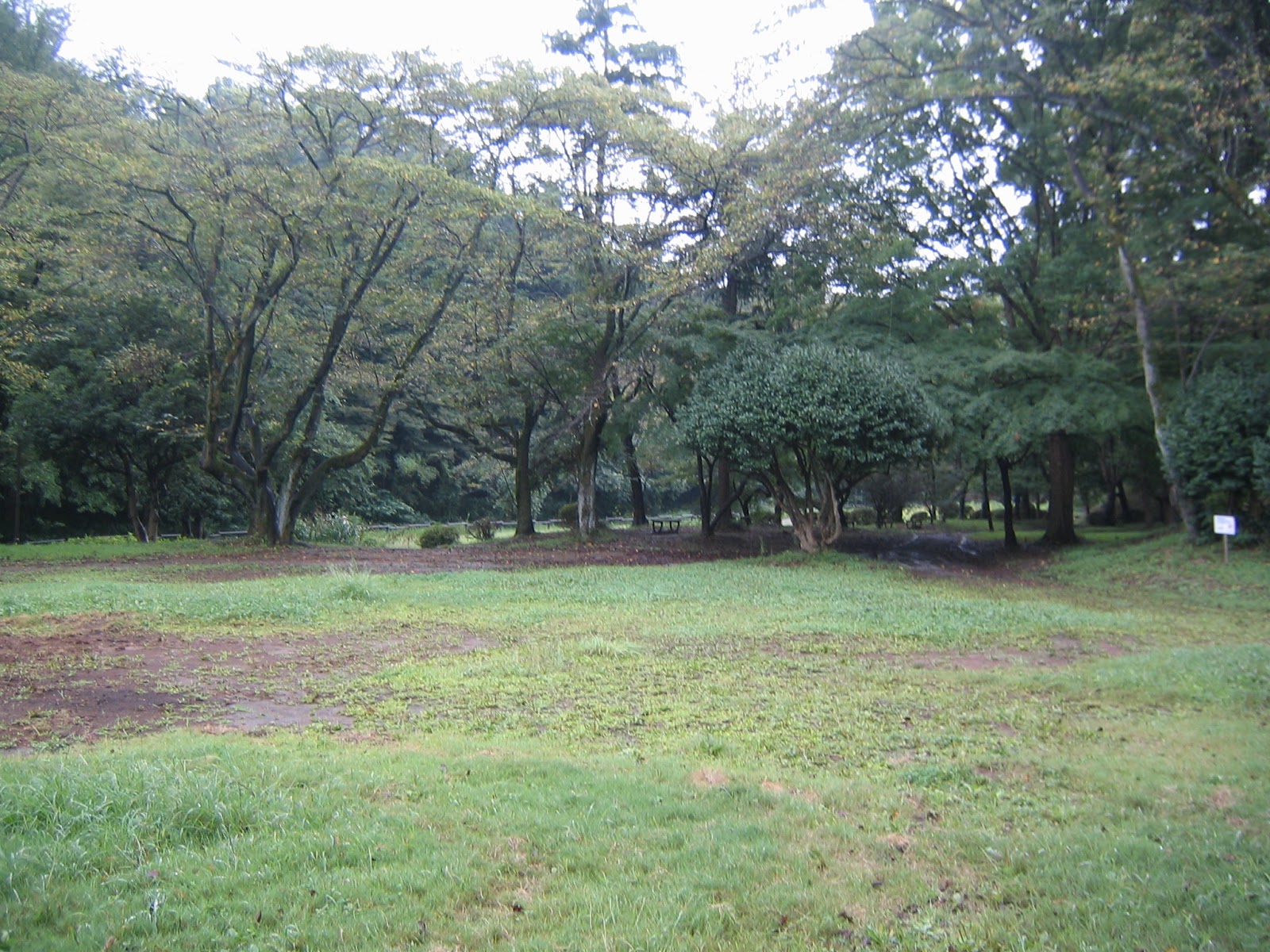 |
| A picnic field with rain |
 |
| An athletic
field of the early 20th century. These days, Yokohama people often hold time-trial running event here. |

 |
| A heated
swimming pool. The heat is coming from the waste incineration plant next to the Park. |
 |
| The
entrance to the Cemetery is located beyond the entrance to Botanical Garden. |
Since then, Britain made very British cemetery for Common Wealth POWs, and Japan has redeveloped the rest of the Children’s Amusement Park in Japanese way. In 1979, 3ha of a former flora genetics labo for Dr. Hitoshi Kihara was added as a botanical garden of the Amusement Park, which has completed the construction of the 14ha Park and Grave in the present-day form. The Botanical Garden has the city office for Yokohama people to bring any gardening question. The rest of the Garden is really a “garden” where the design is to facilitate biology classes during grade school trips. Non-grave part of the Amusement Park keeps picnic fields, athletic fields and a swimming pool, and added educational centers for the citizens. In addition to PR-related courses for forest volunteers, the place offers Yokohama urbanites to learn the technique in allotments using the farming field within the Park. The dangerous forest in the 18th century is now a training place for urbanites who don’t know how to grow foods …
 |
| You
can bring your gardening problem to this office in the Botanical Garden. |
 |
| The
Garden has a corner where an exemplary natural grass field in Yokohama is recreated. |
 |
| The glasshouses for gardening/farming training |
 |
| The farming labo for Yokohama citizenry |
 |
| In the
middle of the Park, there is this pond, always with the crowd sketching. |
 |
| The
right corner of this admin building is a visitor center for the Park. The full-time nature experts work there to answer your question about the Park. |
The BritishCommon Wealth War Graves is an English Park, really. It is NOT like those tiny “English Gardens” with roses we find here and there in Tokyo or Yokohama. Even though their trees and flowers are common in Japanese parks, the way to keep them is English … like Hampstead Cemetery. When you go there after strolling in Japanese Children’s Amusement Park, the subtle difference in landscaping approach between Britain and Japan could come out. Take ground cover. It seems to me Japanese landscaping do not care much for baring the soil in the forest. In contrast, Common Wealth War Graves are covering the ground with hedges … The place is the resting place of 1853 Common Wealth POWs where the largest population is from Britain. I had a feeling of uneasiness when I reach to the section where the tomb stones held Indian names written in Hindi or Arabic. They fought for British Empire … Whenever the British dignitaries, from the Queen to the PM, come to Japan, they visit here to pay their respect. Otherwise, the place is very quiet and calm, which is another difference from the Children’s Park where lots of local kids are running around. At the entrance there is a stone structure containing a guest book and some references for the place. They have hand-written letters, which look like the original correspondence between the family and the soldiers resting here. The stone structure in humid Yokohama is cold and damp space where, it seems to me, the air is damaging probably historical documentation. I hope the letters are just copies …
 |
| At the entrance for the cemetery |
 |
| The map of the Cemetery |
 |
| The resting place for British soldiers |
 |
| Australian Section |
 |
| New Zealand and Canadian Section |
 |
| Indian Section |
 |
| He shouldn’t be … |
 |
| It’s an English Park. |
 |
| We can have written information from here. |
I don’t think we Japanese share the view of Louis XIV about the nature to be conquered. But the entire space of Yokohama Children’s Amusement - Botanical Park is a kind of conclusion about “subduing” forest during Japanese westernization. The place even includes British cemetery. The Park is not a traditional Japanese garden. Certainly not the presentation of Satoyama as Niiharu. Maybe it’s very-Yokohama place, where 160 years ago the first large community of Europeans were established in Japan …
 |
| At
Sakaigi-jizo Temple 境木地蔵 near Nagekomi-zuka. Cute =) |
The City Office who’s in charge of execution of Green-up Plan is
Yokohama
Municipal Government Creative Environment Policy Bureau
横浜市環境創造局
Phone:
045-671-2891
FAX:
045-641-3490
http://www.city.yokohama.lg.jp/kankyo/