Showing posts with label e-DNA. Show all posts

Sunday, March 17, 2024

Study ctd.: FY2023 results for Citizen’s River Monitoring in Kanagawa Prefecture


Since 2007, Kanagawa Prefecture mobilizes citizen volunteers to monitor water source rivers of Sagami 相模川 and Sakawa 酒匂川 Rivers (; my post on October 28, 2022). Every February, the researchers for the Prefecture at Kanagawa Environmental Research Centre 神奈川県環境科学センター preside two report sessions that tell us the collected results from volunteers’ studies during a fiscal year. According to this year’s session, we are 156 citizen monitors, the biggest number in 18 years of the project. We checked 48 points on Sagami and Sakawa Rivers. Unfortunately (or not), we did not find critically endangered species this fiscal year. Among the findings, Mr. Hasebe of the Environmental Research Center said the checking of Japanese fluvial sculpin is probably increasing. The fish lives only in the purest water. So, we in Kanagawa Prefecture procure water of improving quality seeping out from our forest. The other day, I’ve heard we in Kanagawa Prefecture pays the lowest tariff for tap of water thanks to these within-prefecture water sources. We must be grateful of it.

We’re collecting our specimen.

Kanagawa Prefecture gives scores for several indicator families of aquatic creatures, which shows the water quality where the animal lives. The numbers are adjusted to Kanagawa’s river from the Japanese Biological Monitoring Working Party (BMWP) published in 2017 from the Ministry of Environment. Japanese BMWP itself is modified for Japan based on English version started in 1976. We identified our catch under microscopes, and if it has a defined point, we record it in the report. The observations’ numbers are summed up, then we divide the total by the number of species we’ve recorded. We do the math like

(Kamimuria quadrata’s score + Perissoneura Paradoxa’s score + Oyamia gibba’s score + Epeorus latifolium’s score) / (Number of species in this equation, i.e. 4)

= (9+9+9+9) / 4

= 9

Perfect score is 10, which says the stream has impeccable quality. 9 is the second highest grade. For fiscal 2023, the best scored point, 8.15, was at ASL950m confluence of Mizuhi Stream ミズヒ沢 and Shijuhasse River 四十八瀬川 on the slope of Mt Nabewari 鍋割山 (ASL 1272m). Our study in Yadoriki Stream 寄沢 earned the 2024 second position with score 8.11 at ASL425m confluence of Yadoriki and Takigoh 滝郷沢 Streams. Not bad.

The score 8.11

I’ve found a sort of “???” in the score calculation. Because of the math, a place, where we have found only a small number of creatures but each of them had a higher score, earns good evaluation. Let’s call this place A. Take another place, call it B which records more species including all the animals found in Place A + the other insects et al of lower score. Then, the evaluation of Place B can be lower than Place A … I also noticed compared with the last year’s expedition I did alone in Yadoriki Stream, in FY 2023 adventure with tons of help from the fellow Forest Instructors, we’ve recorded more families of aquatic animals. Power of number in this regard. OK, but the final score becomes lower. Let’s be philosophical, and read the earned grade with a pinch of salt. The pros in Kanagawa Environmental Research Centre said the computed score can be a rough indication unless the numbers are widely apart. Roughly, roughly, if the score is higher than 7, we can regard the water quality good for tap of water. Oh, caution. Yeah, we can drink them in mountains if you like. But we can find such several tiny water animals that can be identifiable only with microscopes and their DNAs are floating freely. Moreover, there are lots of wild animals roaming in the forest of Kanagawa. They don’t hesitate pee and poop near the streams. Your cup of water procured from the stream in deep mountain surely has such ingredients. Allow them going down to your stomach? It’s your choice!

A bit of photo gallery I’ve taken from the specimen.
It’s stonefly.
I always think the pattern of their back is so artistic.

Caddisfly.
Don’t you think it’s cute?
The thing next to the bug is its home.
I tell you it’s so difficult to destroy.

Hexatoma sp.
When it becomes adult,
it is like a large mosquito (but doesn’t bite).
 I personally think it is also very cute,
like a fluffy doll. 😍

Leuctridae.
By the way, I took all these phots with Google Pixel.
 Though it does not have macros camera,
 it does this good job. 😉

The result from environmental DNA is also very interesting. There are several mismatches. Some families of animals have been catalogued as specimen, but no e-DNA result, or vice versa. Yeah. We made specimen roughly 100m long area of stream, but DNA was collected from just one pin-point place. That could make a difference for sure. Also, there are lots of DNAs found for non-aquatic insects. Mr. Hasebe said “If an ant fall in the stream, and madly swam for survival, its DNA can be found, right?” Hm. Yeah, it’s a likely scenario. Mammalian DNAs are also found. Boar and Masked palm civet. DNA keeps its form in non-refreg aquatic environment for about an hour or so. Maybe, their pee and/or poop is constantly dissolving in stream … or, their hair? Carcass floating? Actually, the scholars are trying to collect environmental DNA for non-aquatic animals as well. A group tried to gather DNA from morning dews on leaves. Another tried adhesive handy cleaner on soil. Who knows same time next year, we may be given a new tool to collect DNA from another place? Let us see …

Stabilizing the collected DNA in a filter with chemical.

Oh, recently, I’ve learned one way of calculating opening of cherry blossoms in higher altitudes. It’s like

A day of beginning cherry blossoms in a place ASL X m

= A day of beginning blossoms in a nearby seaside + X*(2 or 3)/100

i.e. a place of 100m higher altitude will have 2 to 3 days delay in opening flowers. I’ll try this formula to plan this year’s cherry blossom hiking. 😊


For the issues of river monitoring in Kanagawa Prefecture, please make a contact with Kanagawa Environmental Research Center 神奈川県環境科学センター

1-3-39 Shinomiya, Hiratsuka City, 254-0014
〒254-0014平塚市四之宮1-3-39

Phone: 0463-24-3311
FAX: 0463-24-3300

k-center@k-erc.pref.kanagawa.jp

https://www.pref.kanagawa.jp/docs/b4f/index.html

Sunday, January 28, 2024

Cataloguing: visiting e-DNA lab for Kanagawa Prefecture 3


I guess you have noticed that for e-DNA primers are very important. Unless there is a suitable primer, no PCR is possible. And we will never be able to have DNA info for all the living creatures on earth, i.e., the catalogue of primers is forever incomplete. In the end, it‘s the realm of the God, Alah, or some deity ... Humans are nonetheless trying to augment the inventory of primers. There is a strong “economic“ incentive. E-DNA is far cheaper option when environmental impact assessment is required before development of some tangible things, like road, port, airport, building, shopping center, etc. Actually Japanese Ministry of Land, Infrastructure, Transport and Tourism will switch to e-DNA completely during project plannings from FY 2028.


You see? The thing we have to do for e-DNA from river is collecting a bottle of water, or straining the liquid. What we need is a bottle or a filter with a syringe, a bucket, and chemicals to stabilize the DNA specimen collected in the container. I first did it alone (; my post on February 17, 2023). Man-power wise, it‘s economical. When we check aquatic creatures from a stream in a good-ol way, we need an army of specimen hunters with, at least, a hand net, a white tray, a bottle of medical alcohol, vial containers, tweezers, and any other gears for humans to wade in the flow of water (; my post on October 28, 2022). Moreover, e-DNA requires less than 30 minutes to collect the specimen from a field, whereas the traditional way is for a one-day expedition. It‘s a simple math for accountants which one is cheaper even when they include the cost of chemicals such as Benzalkonium chloride or RNAlater + postage for courier service. Yup, we need pros for PCR analysis, but the demand for experts is the same for the old way. We need somebody to identify the collected specimen is really from a family of Dipteromimidae, which would guarantee the water quality where it lives is excellent. The labour cost in this regard is the same for new or old way. When it comes to the monetary benefit, there is always somebody who can fund the effort for scientific research. Thus, many endeavours are going to develop at least an operational catalogue of primers.

It’s the chemical to be added for the specimen
before the vial undergo the
centrifuge treatment.
The price tag: USD 340 for 10ml.

As of December 2023, Japanese aquatic e-DNA analyzers can use workable primers for fish (MiFish: Miya et al. 2015), crustacean (MiDeca: Komai et al. 2019), mammals (MiMammal: Ushio et al. 2016), birds (Mibird: Ushio eta al. 2018), amphibians (Amphi_16S: Sakata eta al.), eels (MiEel: Takeuchi et al. 2019), salamander (Hynobius: Sakai et al. 2019), and insects (MtInsect16S: Takenaka et al. 2021). Come to think of it, the first e-DNA for French bull flog was made public in 2008, and we have already come this far. This is saying something. Making these more comprehensive is an on-going process. For example, MtInsects, the latest workable addition for primers, is the product of long-hour toil in the lab of Shinshu University where they keep on cataloguing the DNA sequence of insects found in Japan. They hope someday their effort will lead to universal primer that can augment at once the sequence of various taxonomic groups from a bottle.

Someday, the scenery might be more simplified …

There also are several efforts to expand the method for collecting DNA. The lovely one I found is collecting rain droplets accumulated in a dimple of a leaf. It will gather the information of creatures come and go the leaf, won’t it? Romantic … Some are trying to collect them from the air. Sure, hay fever is coming from the airborne pollens constructed by their DNA. In Kobe, researchers are collecting soil for DNA in order to assess the effect of anti-deer measures in their forest. In short, many people in this archipelago try to utilize e-DNA analysis for cataloguing what’s dwelling in our land, besides the homo sapience.

Soon here becomes a safe for DNA data.

Moreover, currently the big project is taking place to make a database that is comprised of DNA data collected from all over Japan. Prof. Michio Kondoh of Tohoku University organized a consortium that establishes and manages a big DNA data gathered from the nation’s landscapes. It’s called ANEMONE. ANEMONE is already operational and anybody in this universe with internet access can search for DNA that is catalogued in Japan. Kanagawa Environmental Research Center is a proud founding member of the consortium (a bragging smile of Mr. Hasebe). This DB is a part of the Japanese effort in 30-by-30 roadmap corresponding to Kunming-Montreal Global Biodiversity Framework adopted at COP15 in 2022. As a national strategy, Japanese government pledges to aim for 30% of domain to be biodiversity sensitive, and there to achieve nature positive way of life. Prof. Kondoh and his gangs make ANEMONE open and to be used for anybody who engages in self-management of our nature that should yield sustainable co-existence of human community and wildlife. (… er, the DB has data from Japan, so I don’t think it is perfectly applicable to, say, Korean Peninsula …) In this regard, what we volunteers enjoy for monitoring water source forest of Yadoriki is in the context of SDGs (a bragging smile of Naomi 😊)!

The entrance page for ANEMONE DB

… yeah, that all sounds grandiose, but actually, it’s not that so serious. In the end, we forest instructors stroll Yadoriki Water Source Forest alone ourselves, or with visitors, and enjoy lots of findings of natural wonder, from trees, flowers, butterflies, fishes, gadflies, … Sometimes we are greeted by serows or flying squirrels, entertained by beautiful songs of blue-and-white flycathcer, while relaxed watching a flow of clouds in a clear blue sky. We simply record what we have met in the forest, and the result is feeding into the database. Our playground happens to be a part of global effort. Don‘t you think how lucky we are?


For the measures of e-DNA for environmental issues of Kanagawa Prefecture, please make a contact with Kanagawa Environmental Research Center 神奈川県環境科学センター

1-3-39 Shinomiya, Hiratsuka City, 254-0014
〒254-0014平塚市四之宮1-3-39
Phone: 0463-24-3311
FAX: 0463-24-3300

k-center@k-erc.pref.kanagawa.jp 

Sunday, January 21, 2024

Indeterminate PCR Test: visiting e-DNA lab for Kanagawa Prefecture 2


From a kind of easy guess of an amateur, it seems to me comprehensive detection of e-DNA is more complicated than the species-specific detection. If the thing somebody likes to know is the existence of a particular species in a pond, and the DNA sequence of the animal is known, we can just search for the chain clearly indicating the owner of this DNA arrangement. For a comprehensive search, the story would be different. For one thing, there is no “comprehensive” database for DNA whose owner can leave a bit of theirs in river, pond, lake, sea, … Such database is owned by the God, don’t you think? So, what the researchers can do, at least with today’s knowledge at hand, is finding a series that would represent the characteristics of a family, especially when the family have numerous members. The scientists do like this: as for the species-specific detection, researchers for comprehensive detection add the probe of fluorescence to identify the existence of a family within the sample. If there is a particular color or a pattern of emission of light, they can think the family of these creatures exists within the water. But how to read the strength of color or light from the PCR? Lots of illumination signify … lots of bugs of that family for sure, but lots of one particular species? or the variety within the family? or else? That’s a huge academic topic. This is the difficulty at the exit stage of analysis. But actually, the complication starts before that, from the beginning.


PCR machines in the Centre

For one thing, the time required for PCR to comprehensive detection is undeniably longer. Mr, Hasebe said “As the process of PCR is definitely more cumbersome than the species-specific case, I need at least 4 days to arrive at the analysis stage of the study for a sample.” Not only that, there still are species that do not have a proper primer manufactured for augmenting the target DNA sequence, like Ayu fish and Lampetrinae. If there is no suitable primer, PCR will not detect the existence of them, right? Then, there comes a problem of non-specificity in DNA sequence for a family. A family of taxonomy having lots of species in its umbrella is not like a clear-cut manifestation of features for a species. I guess it’s like “You love Mrs. Green Apple, and I’m crazy for SixTones (er, they have #1 and 2 positions for YouTube trending in J-pop category as of January 21). Now, in terms of DNA sequence, they both have J-pop DNA qualities that would be shown in the distributional pattern of nucleobase.” I.e. We would say Mrs. Green Apple can be in J-pop category in such-a-such probability, and so should be for SixTones. That’s far from a clear-cut conclusion of mathematical question with QED.

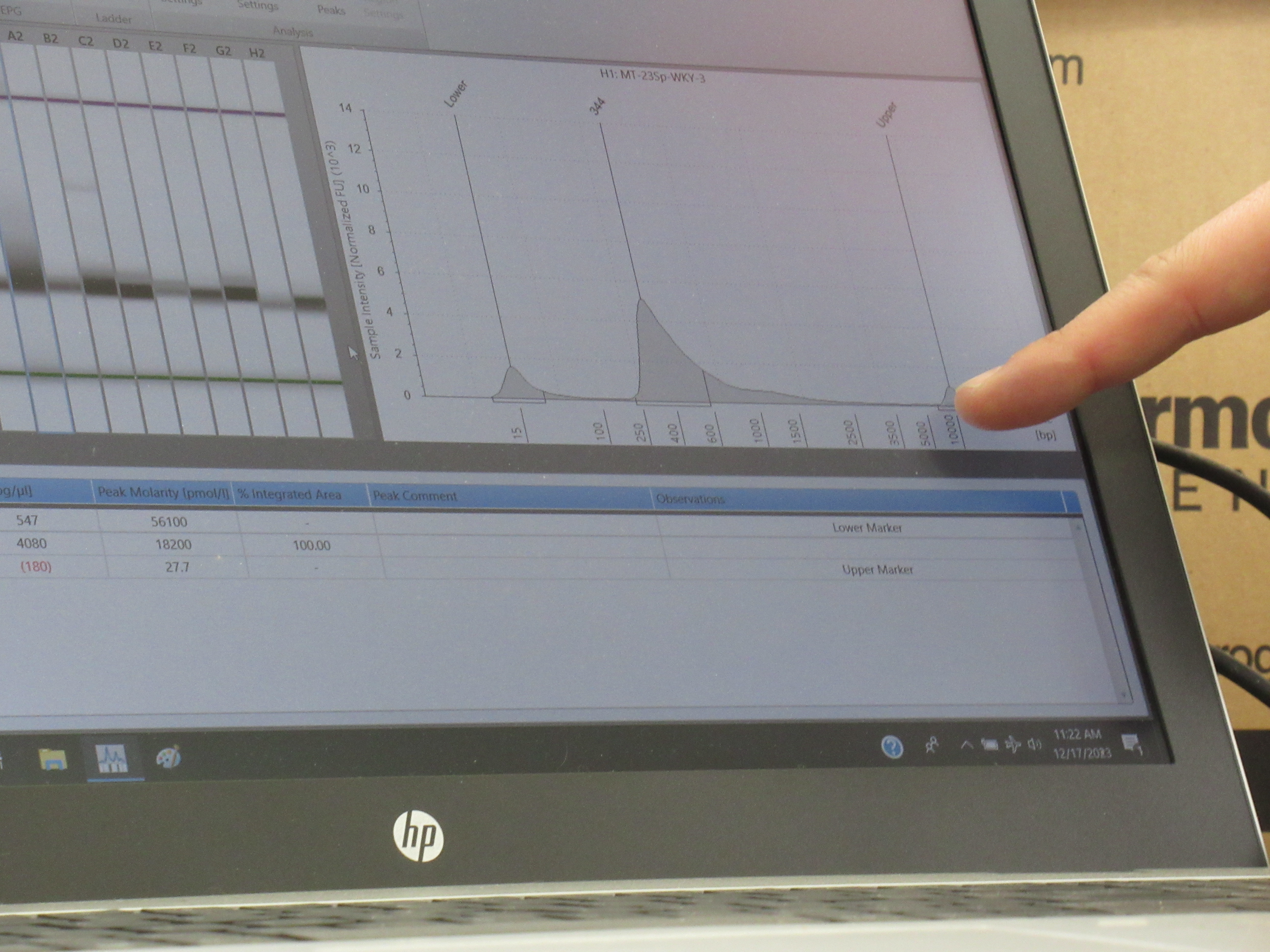
The result of one PCR ready for close inspection.

So, Mr. Hasebe regularly sits in front of his PC for long hours to check the PCR analysis showing a statistical curve for one DNA array matching the baseline-distributional pattern for one family. If the result does not fit well to the criterion curve, he returns to PCR to multiply more the target nucleobase hoping the next analysis produces more fit to the reference. “That’s where researchers are required to decide if a creature of a family exists in the sample, and in the end the environment where the sample comes from,” he said. I asked him if it is possible to automatize the decision which would make the job of the researcher easier. He answered, “Nay, at least in today’s technology. In the end the final part of examination is still done by human brain. Besides, the DNA database for creatures even at the family level is hopelessly incomplete. When the reference point is at the developmental stage, researchers must do with that constraint, you see?” Hmmmmmm …

The target sequences come out in such a distributional way.
Now, it’s your turn, human brain!

Until I became a forest instructor, I had a sort of romantic admiration for natural science. A disclosure of personal info: I’m a social scientist. We were hearing a quiet murmur in our heads what we’re measuring could be a complete illusion of society made of very human intentions. Can the numbers obtained from such things be objective, natural, reliable data worth analyzing by mathematical equations as science? But Mr. Hasebe grumbled to us it was sometimes laborious work to “purify” DNA data to identify the base sequence. After such an operation they conclude and catalogue the contents of biodiversity in our prefecture. … Oh. Then, it’s not much different from social scientists doing before checking the validity of a model, so I thought. It’s fun experiencing such wonders, endless wonders appearing from under our forest.


Next week, I tell you my understanding for the position of Kanagawa Prefecture’s effort to cataloguing biodiversity, including e-DNA approach. Please stay tuned 😊


For the measures of e-DNA for environmental issues of Kanagawa Prefecture, please make a contact with Kanagawa Environmental Research Center 神奈川県環境科学センター

1-3-39 Shinomiya, Hiratsuka City, 254-0014
〒254-0014平塚市四之宮1-3-39

Phone: 0463-24-3311
FAX: 0463-24-3300

k-center@k-erc.pref.kanagawa.jp 

Sunday, January 14, 2024

PCR Test Near Me (but not for COVID): visiting e-DNA lab for Kanagawa Prefecture 1


Since last year, Kanagawa Forest Instructor Association is collaborating with Kanagawa Environmental Research Center to gather biodiversity data of Yadoriki Stream and surrounding Water Source Forest. What we collect is not only photos and specimens of benthic animals et al, but also DNA. Environmental DNA (e-DNA) collection from water sounds very difficult, but actually, it’s simple and easy (; my post on February 17, March 3, and March 10, 2023). We gather water in a bottle, or filter river water with syringe, then add Benzalkonium chloride (for bottling method) or RNAlater (for filtering method) to stop DNA decomposing in the bottle/the filter. Finally, we rush to the nearest office of courier service, pack the sample as a refrigerated (for the bottle) or frozen (for the filter) delivery to the Center. For our part, it’s the end of the task. Period. What happens then for these packets arriving Environmental Research Center? Last month, the Center kindly organized a lab tour for us forest instructors to show the next procedures of DNA analysis. I realized what we’ve done is the easiest part of DNA study.

One of the labs for e-DNA analysis 
at Environmental Research Center

According to Mr. Yuta Hasebe, the Chief Researcher for Water Source Environment Analysis, these days there are private businesses that contract the species-specific detection method. That is to verify if a certain species exists in one particular aquatic environment for how much of their volume. Actually, I know the City of Yokohama hired such consultant some 2 years ago to check the situation of Montane brown frog in Niiharu Citizen Forest 新治市民の森. Mr. Hasebe added in 2023 kids from a couple of high schools in the Prefecture knocked on the door of Environmental Research Center to learn and do species-specific detection for their target species. They published the result of the research during the national competitions of scientific study by the highschoolers. They won the prizes. The level of e-DNA has reached this level in Kanagawa Prefecture. Wow. That’s said, the comprehensive detection method for assessing biodiversity of an environment is still at the pre-business stage, Mr. Hasebe said. The reason? Please keep on reading.

A summary of the study done by
Kamimizo-Minami High
県立上溝南高校
which reported at the national conference of
  Japanese Society for Preservation of Birds.
The kids did species-specific detection for
Lefua echigonia,
a fish listed as EN for Japanese red list
by the Ministry of Environment.

During the tour, first we went in the lab to filter DNA from the sample we brought in. There, the samples are filtered by motored strainers, then warmed at 56°C to be concentrated and purified for DNA using centrifuge and chemicals. In the process the DNA is harvested in test tubes. Mr. Hasebe said “The theory these machines use is the same as you do in the field with syringes and cartridges. The difference is, aside from mechanized power of the sieve and the centrifuge, collected DNAs are treated in the environment that can prevent the collapse of genetic alphabet. The temperature centrifuge operates is at just right. As we work with the sample one-by-one, each purified test tube must wait for their turn before going to PCR. So, we use powerful deep freezers for them until we’re ready to process them. You see? COVID-19 forced the Prefectural Government purchasing lots of high-end freezers for vaccination. Now some of them have retired from medical emergency, and we can introduce them to our lab, FREE! (a big grin)” Well, it’s really the Unintended Consequence. COVID is contributing to our community cataloguing the biodiversity. Not bad …(er …?)

The water is being filtered here.

The filtered water is “sanitized,” and

Put in a deep freezer until DNA extraction process.

It’s the freezer by courtesy of COVID-19.

Centrifuge.
The Center has several of it.
DNA is extracted from mitochondria.

The next step is Polymerase Chain Reaction, aka now-very-familiar-word PCR. It is the method invented by Dr. Kary Mullis who won the Nobel Prize for it in 1993. … I’m not sure if I can summarize it correctly, but let me try … First, the above purified DNA is heated at 94°C to untangle its doble helix structure, then the temperature of the DNA rope (or noodle maybe) is lowered to 60°C. Next, a massive dose of primer and polymerase is added. Primer is a chain of nucleobase that can connect to the part of DNA which signals the owner of it is such-a-such species, or from a particular family. Finally, the sample is heated again to 72°C in order for targeted parts of a DNA chain to be multiplied with a help of polymerase through connecting to lots of poured primer. By repeating such procedure for n>20 times, the intended segment of DNA will be multiplied to 2n pieces. For Covid-testing, the aimed DNA segment was of the virus. For environmental DNA analysis, the part of DNA to be augmented is the marker of a particular creature, being it at the species level (species-detection) or for class, order, and/or family level (comprehensive detection). In the process the target DNA is increased to the level unseen in natural world. It can contaminate the not-yet PCR-ed sample, and the environmental analysis should be ruined. So, the manuals for e-DNA from the Ministry of Environment, and by e-DNA Society of Japan recommends the practitioners to separate labs between DNA extraction room and PCR place. After showing us the process of DNA extraction, Mr. Hasebe introduced us to the next-door room for PCR and actual analysis.

PCR machine next door

The machine doing PCR is smaller than the centrifuge but connected to several PCs to report the measured output of DNA sequences. For researchers to spot a particular species by species-specific detection method, they add to DNA sequences the probe of fluorescence and quencher in addition to the primer and polymerase. If the target creature exists in the test tube, the PCR-ed sample will glow, and the presence of such living things is verified. In addition, if it shines more, there are more aimed DNA = that living thing lives en masse in that water. Such PCR and analysis can be done nowadays in the field, Mr. Hasebe said. He showed us a hand-held size machine that does just that, called real-time PCR. Ah-ha. So, the study can be done by highschoolers. The comprehensive detection method for biodiversity analysis takes another way … More to it next week. Please stay tuned, and if you’re an expert of the field, please correct my misunderstandings about e-DNA method. I do appreciate your help!

The bottles waiting for the next field study …

For the measures of e-DNA for environmental issues of Kanagawa Prefecture, please make a contact with Kanagawa Environmental Research Center 神奈川県環境科学センター

1-3-39 Shinomiya, Hiratsuka City, 254-0014
〒254-0014平塚市四之宮1-3-39
Phone: 0463-24-3311
FAX: 0463-24-3300

k-center@k-erc.pref.kanagawa.jp