Showing posts with label Cherry Blossom. Show all posts

Sunday, March 17, 2024

Study ctd.: FY2023 results for Citizen’s River Monitoring in Kanagawa Prefecture


Since 2007, Kanagawa Prefecture mobilizes citizen volunteers to monitor water source rivers of Sagami 相模川 and Sakawa 酒匂川 Rivers (; my post on October 28, 2022). Every February, the researchers for the Prefecture at Kanagawa Environmental Research Centre 神奈川県環境科学センター preside two report sessions that tell us the collected results from volunteers’ studies during a fiscal year. According to this year’s session, we are 156 citizen monitors, the biggest number in 18 years of the project. We checked 48 points on Sagami and Sakawa Rivers. Unfortunately (or not), we did not find critically endangered species this fiscal year. Among the findings, Mr. Hasebe of the Environmental Research Center said the checking of Japanese fluvial sculpin is probably increasing. The fish lives only in the purest water. So, we in Kanagawa Prefecture procure water of improving quality seeping out from our forest. The other day, I’ve heard we in Kanagawa Prefecture pays the lowest tariff for tap of water thanks to these within-prefecture water sources. We must be grateful of it.

We’re collecting our specimen.

Kanagawa Prefecture gives scores for several indicator families of aquatic creatures, which shows the water quality where the animal lives. The numbers are adjusted to Kanagawa’s river from the Japanese Biological Monitoring Working Party (BMWP) published in 2017 from the Ministry of Environment. Japanese BMWP itself is modified for Japan based on English version started in 1976. We identified our catch under microscopes, and if it has a defined point, we record it in the report. The observations’ numbers are summed up, then we divide the total by the number of species we’ve recorded. We do the math like

(Kamimuria quadrata’s score + Perissoneura Paradoxa’s score + Oyamia gibba’s score + Epeorus latifolium’s score) / (Number of species in this equation, i.e. 4)

= (9+9+9+9) / 4

= 9

Perfect score is 10, which says the stream has impeccable quality. 9 is the second highest grade. For fiscal 2023, the best scored point, 8.15, was at ASL950m confluence of Mizuhi Stream ミズヒ沢 and Shijuhasse River 四十八瀬川 on the slope of Mt Nabewari 鍋割山 (ASL 1272m). Our study in Yadoriki Stream 寄沢 earned the 2024 second position with score 8.11 at ASL425m confluence of Yadoriki and Takigoh 滝郷沢 Streams. Not bad.

The score 8.11

I’ve found a sort of “???” in the score calculation. Because of the math, a place, where we have found only a small number of creatures but each of them had a higher score, earns good evaluation. Let’s call this place A. Take another place, call it B which records more species including all the animals found in Place A + the other insects et al of lower score. Then, the evaluation of Place B can be lower than Place A … I also noticed compared with the last year’s expedition I did alone in Yadoriki Stream, in FY 2023 adventure with tons of help from the fellow Forest Instructors, we’ve recorded more families of aquatic animals. Power of number in this regard. OK, but the final score becomes lower. Let’s be philosophical, and read the earned grade with a pinch of salt. The pros in Kanagawa Environmental Research Centre said the computed score can be a rough indication unless the numbers are widely apart. Roughly, roughly, if the score is higher than 7, we can regard the water quality good for tap of water. Oh, caution. Yeah, we can drink them in mountains if you like. But we can find such several tiny water animals that can be identifiable only with microscopes and their DNAs are floating freely. Moreover, there are lots of wild animals roaming in the forest of Kanagawa. They don’t hesitate pee and poop near the streams. Your cup of water procured from the stream in deep mountain surely has such ingredients. Allow them going down to your stomach? It’s your choice!

A bit of photo gallery I’ve taken from the specimen.
It’s stonefly.
I always think the pattern of their back is so artistic.

Caddisfly.
Don’t you think it’s cute?
The thing next to the bug is its home.
I tell you it’s so difficult to destroy.

Hexatoma sp.
When it becomes adult,
it is like a large mosquito (but doesn’t bite).
 I personally think it is also very cute,
like a fluffy doll. 😍

Leuctridae.
By the way, I took all these phots with Google Pixel.
 Though it does not have macros camera,
 it does this good job. 😉

The result from environmental DNA is also very interesting. There are several mismatches. Some families of animals have been catalogued as specimen, but no e-DNA result, or vice versa. Yeah. We made specimen roughly 100m long area of stream, but DNA was collected from just one pin-point place. That could make a difference for sure. Also, there are lots of DNAs found for non-aquatic insects. Mr. Hasebe said “If an ant fall in the stream, and madly swam for survival, its DNA can be found, right?” Hm. Yeah, it’s a likely scenario. Mammalian DNAs are also found. Boar and Masked palm civet. DNA keeps its form in non-refreg aquatic environment for about an hour or so. Maybe, their pee and/or poop is constantly dissolving in stream … or, their hair? Carcass floating? Actually, the scholars are trying to collect environmental DNA for non-aquatic animals as well. A group tried to gather DNA from morning dews on leaves. Another tried adhesive handy cleaner on soil. Who knows same time next year, we may be given a new tool to collect DNA from another place? Let us see …

Stabilizing the collected DNA in a filter with chemical.

Oh, recently, I’ve learned one way of calculating opening of cherry blossoms in higher altitudes. It’s like

A day of beginning cherry blossoms in a place ASL X m

= A day of beginning blossoms in a nearby seaside + X*(2 or 3)/100

i.e. a place of 100m higher altitude will have 2 to 3 days delay in opening flowers. I’ll try this formula to plan this year’s cherry blossom hiking. 😊


For the issues of river monitoring in Kanagawa Prefecture, please make a contact with Kanagawa Environmental Research Center 神奈川県環境科学センター

1-3-39 Shinomiya, Hiratsuka City, 254-0014
〒254-0014平塚市四之宮1-3-39

Phone: 0463-24-3311
FAX: 0463-24-3300

k-center@k-erc.pref.kanagawa.jp

https://www.pref.kanagawa.jp/docs/b4f/index.html

Friday, April 2, 2021

Battle for Dominance: Henbit deadnettle and Red deadnettle in Yokohama, 2021


Recently one veteran of Kanagawa Forest Instructors said, “This year, it’s like a spring of north countries! All the blooms come at once in Kanagawa, don’t you think?” She was born in Tohoku region with lots of winter snow, knowing spring in the north. Indeed. It’s a bit strange spring this year here. Kobushi Magnolia started to bloom early March and ended their flowers before cherry blossoms. A bit too early. Cherry blossoms themselves became full everywhere in Japan one week earlier than the average of these 10 years. Cherries, peaches, plums, Japanese kerrias, mimosas … all have come to bloom at once in Yokohama, just like for northern countries. In addition, there are flowers which show the other-way-round apparition this year. I feel in Yokohama the number of dandelion flowers smaller than for usual April. It might be because people have picked many of them during suddenly popular urban strolls thanks to COVID-19, i.e. unintentional weeding ... (more to this in my later post). Violets also come out a bit late. And here are purple archangels.


Season of cherry blossoms

For some of you coming from European tradition, purple archangel, aka red deadnettle, is pretty and useful plant. In contrast, especially for nativist Japanese botanists, they are invasive species came to Japan from Europe around 1900. The reason they became “problematic” is, they compete with, and often win over, henbit deadnettle that has lived in this archipelago definitely longer than red deadnettle does. Henbit deadnettle has traditional Japanese name, Hotoke-no-za 仏の座 which means “a cushion for Buddha.” Don’t you think the moniker indicates some established feeling towards the plant in our culture? They were once a typical spring ephemeral and ubiquitous in Japanese villages and towns. Then, red deadnettle came to Japan about 100-150 years ago. They are small and pretty just like henbit deadnettle. Japan has endemic white deadnettle whose anatomy is similar to Red D but far larger. So, Japanese gave red deadnettle the name, Hime-odoriko-sou 姫オドリコソウ, meaning “Pretty princess deadnettle.” Er, pretty princess is becoming dominatrix these days to expel Henbit D from their traditional homes … National Institute for Environmental Studies of Japan has designated red deadnettle invasive to the point of threatening the habitat of Henbit D so that they are to be weeded.

Henbit deadnettle

Professors who held seminars in Niiharu Forest mentioned this problem of Henbit D and Red D. “Unfortunately, the number of Henbit deadnettle in Niiharu shows signs of decline. Red deadnettles are overtaking Henbit’s places.” It’s the power of information. With the input of professors’ point of view, I’ve felt it was difficult these years to find Henbit D but instead see lots of Red D in Niiharu. Then, something strange happened. It was not even in spring, but December 2020. One weekend before Christmas, I’ve found lots of Henbit deadnettle blossomed in Niiharu. I was like “Wow! They are escaping from the onslaught by Red D! Is it because of the competition they’ve come out this early? Have they changed their tactics for survival?” Er, maybe. Came February, March, and April. They remain ubiquitous in Niiharu. In contrast, I had difficult time to find Red deadnettle even in March. In normal years, it was Red D which came out early, say, in January. This spring, Covid-19 dominating 2021, the spring field in Yokohama is looked like the other way round for deadnettles.

Henbit D in winter

Actually, it was a bit of disappointment. Listening the sermon of botanists, I did a bit of study to combat Red D problem, and reached a conclusion such as “Well, to reduce their numbers, let’s eat them!” Unlike Henbit D, Red D can be edible if it’s not in a massive amount:

The whole plant is astringent, diaphoretic, diuretic, purgative and styptic. In terms of traditional medicinal uses, dried leaves have been used as a poultice to stem hemorrhaging whilst fresh bruised leaves have been applied to external wounds and cuts. The leaves are also made into a tea and drunk to promote perspiration and discharge from the kidneys in treating chills. Plantlife, UK

They are perfect for spring detox! So, for spring 2021, I waited for them to come out, just like a witch for Hansel and Gretel … They did not come soon as I expected. Have they noticed an atmosphere of menace from me?


Meanwhile, a female Daurian redstart is
 pondering the timing to return to the Continent …

In late March, around the time when cherry blossoms became full this year, Red Ds finally appear in the fields of Yokohama. Their local rival, Henbit Ds have already started to shrivel … Hmmmm. It could be that was a natural cycle for deadnettles in the field of Yokohama. Henbit D first, then Red D. The reason why Red D is regarded “invasive” is they sometimes came too early and looked pushy. Global warming may have given Henbit D to appear earlier than Red D … Really?

Finally, Red D.

Viola grypoceras come out too. Phew.


Well, here is a recipe I used to consume Red D. It’s a steamed rice bread, pure vegan.

<Steamed rice bread with spring ephemerals>

Ingredients for one 5” tube pan lined with a parchment paper:

  • A tiny bunch of Red deadnettle (about 6-7 stems with flowers), washed and chopped.
  • About 20 flowers of Viola grypoceras washed for garnish (: although V. grypoceras are edible, some other violets are poisonous, so be careful. Please refer to my post on April 17, 2020)
  • One cup of unsweetened soy milk
  • One cup of rice-flour made of non-glutinous flower. For this recipe moderately grind flour called Joshinko 上新粉 is the best.
  • One tablespoon of sugar or honey

The bouquet I used.

Instructions:

1. Whip soy milk until it becomes foamy. You can whip it with sweetener, especially when you add honey.

Whipped soy milk

2. Fold the rice flour and sweetener in foamed soy milk. Add and mix chopped red deadnettle. Please be careful not to destroy the soy milk foam.


Joshinko and brown sugar I employed this time.

The dry ingredients are folded,
 then chopped Red D added.

3. Pour 2 in a lined pan.


4. Steam the pan for 15-20 minutes. At the final 5 minutes’ point, sprinkle flowers of violet on the surface. This way, the color of violet is preserved.


The violets are sprinkled over the semi-cooked bread.


5. When you insert the skewer in the center of the pan and it comes out clean, the bread is fully cooked.


See? Violet Blue is preserved.

6. The bread is slightly sweet. Please have it with honey, jam and/or marmalade.


It’s a fun to eat wild edibles, but I don’t think consuming Red D this way won’t change anything about the war over the dominance between Red D and Henbit D. What humans can do is really limited, I presume ... More to this point, next week … Munching a piece of pretty steamed-bread, Naomi’s having a pensive spring. I hear once-again increasing number of patients with COVID-19.


If you find a problem in the greenery of north-half of Yokohama, please make a contact with

Office for the Park Greeneries in the North
北部公園緑地事務所
Yokohama Municipal Government Creative Environment Policy Bureau
横浜市環境創造局

Phone: 045-311-2016
FAX: 045-316-8420

Niiharu Administrative Office / Satoyama Exchange Center
新治管理事務所・里山交流センター

Phone: 045-931-4947
Fax: 045-937-0898
Email: info@niiharu.jp
http://www.niiharu.jp/


Friday, May 15, 2015

Underneath cherry trees, there are dead bodies: Bugenji Citizen Forest 豊顕寺市民の森

There are dead bodies buried underneath cherry trees! Kajii Motojiro桜の樹の下には屍体が埋まっている梶井基次

One of the smallest Yokohama Citizen Forest is near from Yokohama Station. It has only 2.3ha, attached to Bugenji Temple 豊顕寺, next to Mitsuzawa Park 三ツ沢公園Mitsuzawa Park is one of the most established park for physical activities in Yokohama, with TRiM courses, and horse riding facilities. You can combine your visit to Bugenji Forest with Mitsuzawa Park for your weekend exercises, if you find Bugenji Citizen Forest too small. Bugenji Citizen Forest was officially opened as a Citizen Forest in April 1983. Map of the Forest is (in Japanese) here.

Bugenji Temple 豊顕寺

The temple itself has about 500 years of history. Originally it was Honkenji Temple 本顕寺 in currently Aichi Prefecture, established in 1515 by a warlord, Tame Moto’oki 多米元興. Tame moved the temple to the current place and changed the name to make it his home after his retirement in the late 16th Century. The family of this warlord was extinct when in 1590 Toyotomi Hideyoshi 豊臣秀吉, the ultimate chief warlord of the late 16th century, attacked them who were a strong ally of Go-Hojoh 後北条 family, the original owner of Odawara Castle 小田原城 near Hakone and the last enemy of Hideyoshi. When we enter through the main gate of the temple, there is a complex of tomb stones that is for the Tame family.

After Tokugawa Shohgunate 徳川幕府 was established in 1600, the political center of Japan moved to Edo 江戸 and Tokugawa Shohgun wanted to have something cultural near his home castle in Edo (Imperial Palace now). In 1720, the Shohgunate allowed Bugenji temple to have a school for Buddhist monks, called MitsuzawaDanrin 三沢檀林 teaching the Jinmon lineage of Hokke sect 法華宗陣門 with an emphasis on the importance of the mantra of Hail Lotus Stra. The school thrived. At its heydays, Bugenji-Mitsuzawa Danrin had more than 300 student monks with 25 dorms and 5 teaching buildings.

Mitsuzawa Danrin. I thank for the kindness of Kanagawa Sunako (金川砂子

It seems to me the students at that time were a bit of hot-headed young kids; there is a saying that “You’d better waiting for a fight until you completed your cherry blossom party at Bugenji.” And so, the Bugenji Citizen Forest is famous for its gorgeous cherry blossoms of Yae-zakura and Somei-yoshino kind in spring.


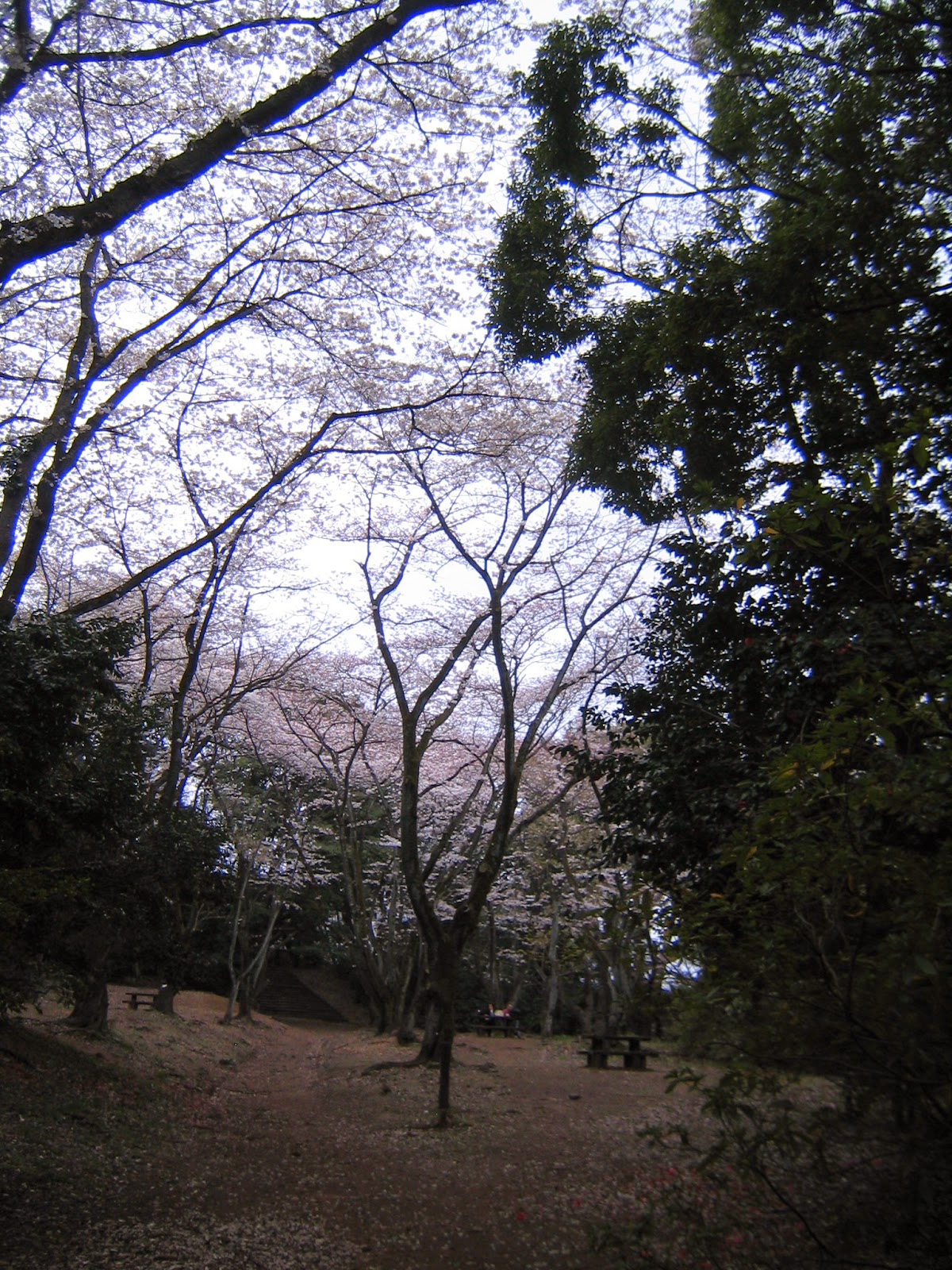
It might be the nearest cherry blossom party spot from Yokohama Station. If you enter from the main gate of the temple, it’s just less than 5 minutes small hill walk to find the huge canopy of cherry blossom trees in Sakura Hiroba (“Cherry Blossom Square” 広場). There are several picnic tables where you can enjoy your meal. Mind you, the place is well-known for the locals. At the peak of the cherry blossoms, there always is a fierce competition among many groups to secure the space for lunch parties. I suggest to go there early morning; the air is clean, the park is calm, and above all the blossom is magnificent.

Sakura Hiroba

From the Sakura Hiroba, we will continue walking up to Fujidada Hiroba (“Wisteria trails Square” 藤棚広場) and Hachiman Hiroba 八幡広場 where the other side is Mitsuzawa Park. These two squares also have beautiful flower trees including wisteria and the other kinds of cherry blossoms. (Do you know there are more than 2,000 kinds of cherry blossoms in Japan?) The entire Bugenji Citizen Forest has a cozy feel of neighborhood garden. To circulate the entire “Forest,” it takes less than 15 minutes for a healthy adult. If schools are off, many kids of the area come here to play.

Hachiman Hiroba
No Smoking in the Forest
It is not the toilet of the temple, but for the Forest. It is in Western style. ;-)

By the way, if you are interested in the latest information of Japanese cemetery, it is a good place to watch what is going on. Bugenji temple is now tiny, but a well-established institution. As such, it has a cemetery for its parishioners, which is also ancient.


In the standard Japanese practice for a cemetery attached to a temple, aside from investing lamp-sum for the right of using a patch of land for a grave, a family must become a parishioner, then, pays dues to the temple in order for keeping their space. A typical expense consists of annual “membership” fee, regular donations to each religious festival, and a special donation when the temple plans to renovate their facilities such as a prayer dome where the main statue of Buddha is situated. As you can imagine, it is not cheap. In addition, unless your family gets deeply involved in religious matters of the temple, you will visit the grave of your family once in a year at maximum, especially when the place is far from your current home. Hence, these days it is very common many graves become “muen-botoke” 無縁仏 meaning “the grave without clear genealogical title,” i.e., the grave which the temple does not have a clear grasp of the “owner” of the site. If a tomb does not have a visit for years (; some say, the standard criteria is 30 years), a temple automatically considers the site is abandoned as “muen-botoke,” and clear the place for the new parishioner family who wants to have a grave in that temple. When the nation observes rapid aging and a temple is in the densely populated city like Yokohama, the cycle of this sorting game is short.

So, it seems to me, Bugenji temple is busy sorting out their timeworn cemetery. There are many notices saying “Please make a contact with the temple office, if you are related to this grave.”


Indeed, it is difficult to read the date when some of these graves were established. One tomb stone says it was about 150 years ago when the person under the tomb stone died (, and marked as “muen-botoke”). I visited the temple one Sunday, and noticed a monk was busy showing the possible grave sites for the parishioner candidates.

… er, well, yes, monks must eat to survive. I have heard many of the temples in rural Japan face difficulties to maintain their institution as many parishioners simply disappear, probably to Tokyo or Yokohama, and no funding become available. There is a horror story that the remaining parishioners are asked to pay 2 million yen each for a repair of the temple; long ago, the cost of such things could be divided by many families, but now … Then, Bugenji will be OK. It has many visitors now, for cherry blossom parties, or for a grave site that had been occupied before by somebody … As 2015 is the 500 anniversary year of its original temple of Honkenji, Bugenji is raising money to renovate its facilities, including toilets to become in Western style which is easier to use for elderly people waiting to move into their final home.


Bugenji Citizen Forest is accessible on foot with about 15 minutes stroll in Mitsuzawa Park. From the West Exit Square of Yokohama Station, Yokohama Municipal Bus (Service 34, 35, 44, 50, 83, 87, and 291) and Sotetsu Bus (Hama 5, Hama 11, and Hama 7) operate services to Mitsuzawa Sogo Ground Entrance 三ツ沢総合グランド入口. It’s about a 5-minute bus ride so that you may choose to walk from Yokohama Station. The nearest subway station for Bugenji Forest is Mitsuzawa-kamicho 三ッ沢上町 of Yokohama Municipal Subway Blue LineGo out from Exit 1 of Mitsuzawa-Kamicho Station. At the mouth of Exit 1 facing the Route 1, go to the right, then turn right at the second next corner. Ahead, if you visit the Forest in the cherry blossom season, it is easy to recognize the entrance of Bugenji Temple.


By the way, Route 1 is an ancient road Tokaido 東海道 connecting Edo (Tokyo) and Kyoto-Osaka. When you go along the Route 1 between Mitsuzawa-kamicho Station and Tan’machi 反町 Station of Tokyu Toyoko Line, there are several shops, such as a Japanese sweet shop, that can be traced back its history for ages. The Bugenji Citizen Forest is about in the middle of two Hatagomachis, (旅籠町 “the towns for the travelers to have a rest”; do you remember Ukiyoes by Hiroshige?), Kanagawa 神奈川 and Hodogaya 保土ヶ谷.

From Yokohama to Shizuoka
Er, OK, we’re now above 24m from the sea level.

If you find a problem in the Park, please make a contact with

Office for the Park Greeneries in the North 北部公園緑地事務所
Yokohama Municipal Government Creative Environment Policy Bureau 横浜市環境創造局
Phone: 045-311-2016 (I guess in Japanese only)
FAX: 045-316-8420 (I hope there is somebody who can read English …)

If you plan to make a contact with the Bugenji temple,

Phone: 045-411-7021 (in Japanese only, perhaps …)
FAX: 045-314-8890 (Again, I hope there is somebody who can read English …)