Sunday, September 8, 2024

2024 Laboratory of Forest Art, pre-show events


This year 2024, the Laboratory of Forest Art will be held during September 29 – October 20 in the same forest of the previous years (; my adventure for 2023 Show can be checked here). Currently the artists are busy creating their presentations in the forest. If you’re interested in the process, you can visit the forest next to Yokohama Zoorasia, and chat with the artists. Since there is no parking, a recommended access to the Forest is by bus. The most convenient transportation is a bus ride to Yokohama Zoorasia, from JR Nakayama 中山 Station, Sotetsu Tsurugamine 鶴ヶ峰 Station, or Sotetsu Mitsukyo 三ツ境 Station. (Timetables are here.) Get off the bus at the North Gate of Zoorasia that is the closest to the art exhibition entrance. When you leave the terminal stop of Zoorasia North Gate, go back a bit along the bus road, and on your left is the sign for the GROUP. From there enter the forest. The road is a relatively wide walking promenade. Soon you can see a big banner over there saying “the Creation and Voice of the Woods 創造と森の声.”


In addition to the open production of installation, they have several programs this year for art lovers to enjoy forest with the artists. Last March, they received the 11th Yokohama Hito Machi Design Award (“Yokohama People-Town Design Award”) for their contributions connecting city forest and locals, especially kids, through sharing art-creation process. The honour is given once in two years to citizen groups who contributed making Yokohama more comfortable to visit and live. Their schedule for 2024 is to forward their activities to more people. You can check their Facebook page to know the calendar. Anyway, this week I tell you their plan for this fall as long as I know.


The dancing towermen are now like this.

One program is annual weekend Forest Marche from 10:00, 21 September – 14 October, in the entrance space of the forest of their art venue. For fund-raising, every weekend during the period they sell second-hand artbooks and small souvenir-sized artworks of the artists and distribute reports of previous years’ activities. If you’re interested in having small art on your desk by the artists of the Forest Labo, it’s a good place to explore. Another event in the Forest for the art show is by Akina Chikada on October 12 from 10:00, which is specifically programmed for school kids. They plan to walk in the Group‘s forest to find whatever interesting and with these treasures decorate a pergola made of Chinese evergreen oak thinned this spring.

The pergola is already standing.

The Group also collaborates with Satoyama Garden Festa, 14 September – 14 October, and holds 3 workshops from 10:00 at their tent situated in the open space for the Main Entrance area. All workshops ask for a donation of 500 yen for the const of materials et al. The first one is on September 22 titled “Making mushrooms from woods.” It’s a wordplay of homophones. In Japanese mushrooms are “Kinoko” whose sound can be written in Chinese characters as “Kids of woods 木の子” and so is the name of the workshop. Artists will help you make “Kinoko” from wood brought from the Forest after the artists did forest maintenance works. The second workshop is on September 28 led by Yoichiro Yoshikawa. He helps us to make a doll from wood chips harvested in the Forest. The last one is on October 6th with Komayuki to construct wood-stand, again using the materials from their Forest. I think they can accept drop-in to join the fun, but it would be kinder to let them know your coming beforehand. Thier contact email is here.


On the opening and closing days for the show, there is an art tour led by artists, starting at 11:00 from the open space of the entrance. After the tour, they will have a chat show from 13:00. The artists will talk and answer the questions from the audience about creation of art in forest. Before 13:00, it‘s a lunch time. You can bring your lunch, or make a reservation for purchasing lunch box via email. It‘ll be fun weekends in the Forest enjoying art. If you have a chance, please join.


When you find a problem in the site introduced in this post, the best contact address will be GROUP the Creation and Voice of the Woods.

https://morilab.amebaownd.com/
e-mail: morinokoe7@yahoo.co.jp

The city office which is in charge of this forest is

Office for the Park Greeneries in the North 北部公園緑地事務所
Yokohama Municipal Government Creative Environment Policy Bureau 横浜市環境創造局
Phone: 045-311-2016 
FAX: 045-316-8420

Sunday, September 1, 2024

Talking with Soil Creatures: counting soil animals in Yadoriki Water Source Forest やどりき水源林


Every July, we Forest Instructors for Kanagawa Prefecture do field research in Yadoriki Water Source Forest やどりき水源林. The main theme of this occasion is what kind of soil animals live underground of the Water Source Forest. We employ two approaches to collect tiny animals in the ground. One is collecting roughly 10cm deep dirt from 50cm*50cm square soil, sifting it by large sieve over a white plastic table cover, and inspecting the soil spreading over the cover to find out what comes out from the sieve. Another is using pitfall trap. 3 days before the research, we bury three medium-sized plastic containers with wide mouth. Each container has bites inside; chicken meat to lure carnivorous creatures, a banana for vegetarians, and for everybody crumbled kitchen paper drenched in brown sugar syrup. The opening of the boxes is at the surface level of the ground. It is covered by a lid with legs to shield the trap from pouring rain, but with wide enough gap for small living things visiting for bites. We make such instalments for two observation sites and go to see what’s inside 3 days after.


Collecting soil from 50*50

Three traps

Retrieved trap with chicken meat

This year, the team I joined was to check the soil creatures inside the fence before the toilet at the corner of the open space. The place is a mound made about 30 years ago when the water source forest was a commercial camping site. At that time, people made the heap there and planted seedlings of broad-leaved trees. They then enclosed the area by a fence in order to prevent deer came in and devour the baby trees. Now in 2024 surely we do not find droppings of deer inside the fence. But the trees remain lanky, and the entire ground is always dark as it is surrounded by tall coniferous trees. By simple guessing, we may expect there are lots of soil animals which in general do not like baking sun or drier soil condition … er, wait. Not so fast.

Surely, inside the fence is deer-free,
and rarely hosts vampire leech.
It’s a good place to install hammocks for nap.

First of all, there was an accident. We started our research from collecting the buried 3 boxes. In the box of chicken, there were lots of Anisodactylus signatus (in beetle family). Fine. In the box of syrup, there was not many bugs trapped. Syrup 3 days ago was almost dried up. The problem happened in the box of banana. This box was also almost empty, and above all, there was no banana, or the remnants of it. “Hmmmmmmmm. There must have been at least one thief.” “Indeed. It seems to me the thief came here early. May be immediately after we left this place. The box is so empty and clean.” “Wow.” “But how did it do it? The gap between the lid and the box is not wide, and it must have dug deep inside the box.” “No trace of pecking …” “It means the culprit was a mammal.” “But there is a fence!” “Somebody which is good at climbing up fences ...” Last year when we checked DNA from the water of Takigoh Fall 滝郷滝, near our soil study site, there were DNA bits of masked palm civet. It is a foreign species devouring commercial produce from farm fields. Also, the animal is good at climbing high, trees, roofs, etc. For it, penetrating inside the fence won’t be much problem. ***Sign*** We discussed how to make a lid of the trap from mammals. We have not reached the conclusion, but we must improve the design of the trap, for sure.

Empty bananas

Takigoh Fall.
Somewhere up there, masked palm civet is roaming.

Having said that, when we checked the number of families in the soil brought from the front forest for the toilet, it also was not much. Another location for the research was near the garage for forestry monorail. The number of creatures identified there this year was 53. The number we could identify from the artificial mound near the toilets was 45. Actually, such difference has been observed for several years.

Carrying collected soil for study

What’s there?

For example, here!
Geophilomorpha and earthworm.
Geophilomorpha can be found only in non-contaminated environments.
It
’s good news we could encounter it.

Come to think of it, inside the deer fence in front of the toilets shows only a small number of fungi either. According to Dr. Taizo Nakamori (2022) for Yokohama National University, fungi is like a sweet shop for soil animals. People often misunderstand soil animals like worms make fallen leaves or twigs on the ground into nutrients for soil, like nitrogen. Nah. That’s the job done by bacteria, not soil animals. Of course, tiny bugs eat such leaves to survive. But they eat them and simply poop them afterword, which makes the fallen leaves into a smaller bit for bacteria to digest. Their contribution for soil creation is in this way. Fallen leaves are litter after the plants stopped supplying sugar et al from their photosynthesis. The level of nutrients in it is inevitably low, consisting of mainly cellulose = hard to chew. The soil creatures make do with this poor diet. However, if the soil has lots of fungi which will become mushrooms when the climate is right, the story is different. Fungi decompose plant litter with their enzyme and recompose the nutrients to become fungi. For soil animals, eating fungi allows them skipping their hard labor of chewing cellulose. When mushrooms come out, the soil animals swam such “candy” which is a mass of fungi hypha. They will move to the ground of mushroom. i.e. When there are lots of mushrooms on the ground, there will be lots of soil animals. If not much mushrooms found, the number of soil creatures would be smaller. 

* Taizo Nakamori, Soil Animals and Fungi, in Tomoyuki Shimano; Motohiro Hasegawa, and Yasuo Ogiwara (eds.) “The Topics of Soil Creatures,” 39-56, Asakura Publishing, Tokyo, 2022.

A mushroom we found in a previous fall inside the deer fence.


“Is it because the place is made of artificially brought soil?” “Possibly. But the construction was tens of years ago, wasn’t it?” “Yeah, the effect still continues, maybe.” “Oh, … hmmmmmmmmmm …” “Why?” It’s a mystery. There would be an explanation why the shady artificial mound does not show the same level of biodiversity as the next door natural soil. Curious.


If you find environmental issues in Kanagawa Prefecture, please make a contact with Kanagawa Natural Environment Conservation Center 神奈川県自然環境保全センター

657 Nanasawa, Atsugi City, 243-0121
〒243-0121 厚木市七沢657
Phone: 046-248-0323

You can send an enquiry to them by clicking the bottom line of their homepage at http://www.pref.kanagawa.jp/div/1644/

Sunday, August 25, 2024

Good evening: birdwatching swallows in the mouth of Tama River II


This year, actually, city swallows chose a field of reeds near JR Kawasaki Station 川崎駅. Oh yes, that terminal station for industrial Kawasaki City 川崎市. The reeds are on Tokyo-side of the bank of Tama River, 多摩川 but watching birds from Tokyo side is blocked by the other vegetation like trees and plume grasses that love drier soil. Kawasaki-side is wide open and provides easier view for birdwatching in the reeds field spreading along the waterfront. That evening, we met at the north exit of Minatomachi Station 港町駅, the next stop from Kawasaki Station for Keikyu Daishi Line 京急大師線. The area was recently undergone a large “gentrification” development. Posh tower apartments are dominating the exit area of the station. Childcare facilities and indoor golf training gym are claiming their value with stylistic billboards. Very apt for city-slicker swallows waiting for an international flight, I thought.

Minatomachi Station

The tower apartments

Already in front of the station we could feel a wind of (relatively) cool evening air from Tama River and Tokyo Bay. We walk a couple of minutes along a boulevard between the modern skyscraper apartments, and the south bank of the River was just before us. Joggers and strollers enjoyed the evening after boiling heatwave of Tokyo. We took few steps up to the bank. The people of Wild Bird Society of Japan (WBSJ) are waiting for us with powerful monoculars focusing on the reed field on the Tokyo-side. At 18:15, the sun as not yet set, but the sky was definitely heading for night. The downstream of Tama River pours into the Bay at the right next to the Haneda Airport 羽田空港. It was busy evening and lots of airplanes coming and going over there. Huge bright lights of airplanes competing with the setting sun. The machine looked so near our position. I felt a wonder wild swallows make this scenery their home.

Boulevard. Could you see Tokyo-side over there?

People from WBSJ were waiting for us.

Lots of egrets were also there. This is Medium Egrets.

And airplanes.

We waited for several minutes. Somebody among us found tiny dots flying around above an apartment roof on Tokyo-side. “Swallows!” Murmur in a hashed voice spread among us. Just like us humans, evening swallows were heading home from their daily activities. The way they came home was also like us; individually. The birds were not a flock, but flied solo and looked like saying good evening as they encountered their neighbor in their bed town. In general, they flied around for a while before descending on the leaves to sleep. Many glided very near to the surface of the River where they could hunt bags for an evening meal. It’s like we dropping in supermarket for prep of evening meals. Several of them looked playing around with another swallows. Is it like enjoying happy hour in Izakaya?

Swallows made this area for their beds.

The first sighting was around here.
I couldn’t take a photo of them!

I thought I photographed the moment
a swallow flying over the water surface …

One by one they went “reed” home and made themselves comfortable to sleep. Some were staying “Tama River Izakaya” until the last (oh, yeah, literally) minutes before sunset. But in the end, they were in “bed” at the tip of reed leaves. It seemed to me they did not mind their neighbor swallow were there VERY near to their bed. … Like school dormitory, or, similar to us in apartment blocks with the neighbor’s door just next to us …?

In this photo, there are so many swallows.
Almost all the blackish dots at the end of reed are swallows ready to sleep.

At the sunset the event was over. WBSJ lent us very powerful binoculars to enjoy the birdwatching. They also explained us the lifecycle of swallows and shared their accumulated experience to watch swallows “Bedtime” event. They also gave us tips to take nice photos. I understood why this event was SO popular, with uber-competitive entries. Every year they start lottery entry for nation-wide events early July (; their HP is here). If you’re interested in nature watching, please try. It’s really worth experiencing it. Besides, having birdwatching on a cooler bank of Tama River after sweltering business day in Tokyo is really GOOD.


The binocular I borrowed.
People from WBSJ explains.


Wild Bird Society of Japan

Sunday, August 18, 2024

Schooling days: birdwatching swallows before they leave Japan


Swallows are birds living near us. They build their nest under the eaves of our home, the walls under the roof, things like that. In late spring they come to Japan, decide where to raise their chix, mate, hatch the eggs, feed their kids, … then? If lucky, the chix should grow big enough to leave such a small estate of their nest (; my post on July 5, 2019). Come to think of it, we see their childcare days, but not afterward. What will they do? Returning straight to southern places, like Taiwan, ASEAN countries …? Can the teenager swallows take such a long-distance flight without learning how to feed themselves and gaining enough strength for a long haul? Unlikely. What then do they do before they leave Japan?


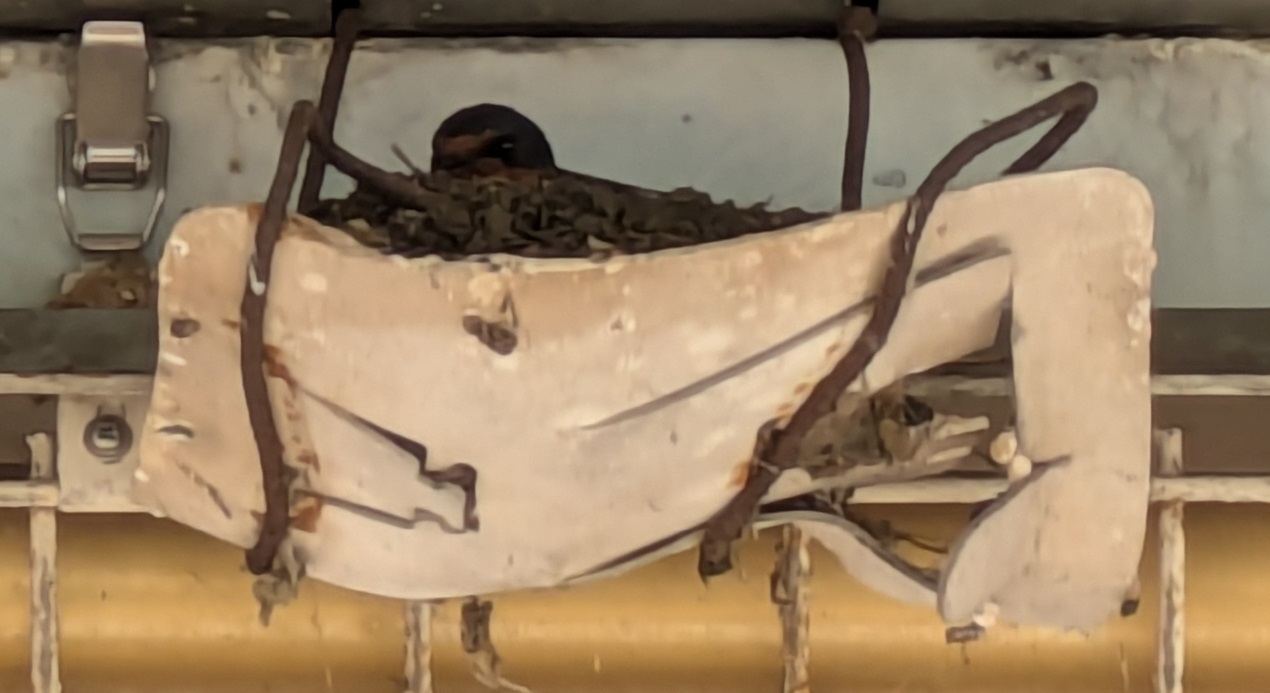
Busy holding eggs

According to the people for Wild Bird Society of Japan (WBSJ), swallows love to rear their chix in human settlement because of security reasons. Having their eggs near us could prevent onslaught by predators like snakes, mammals, etc., as we positively expel their approach. When the chix become big enough to leave their nest, young swallows fly around to learn feeding themselves first. Schooling days will last for about 3 to 4 months. When they think they have eaten sufficiently to maintain their stamina for returning to southern countries, they individually decide their departure. i.e. They do not build a flock like swans for migration. However, during their preparation days, they behave like a member of a group. Moreover, they do so only from dusk to dawn. They sleep in a particular place en masse. At sunrise and sunset, lots of lots of swallows congregate in a special place. In Japanese, such behavior is called “Bedtime for swallows つばめのねぐら入り.”

In any case, their tales are cute.

During the prep days for a long trip, swallows commute between such bedroom and their hunting sites daily. At dawn they leave home, hunt and eat during day time, then return to bed at dusk. Their bed is the top tips of reed leaves. The birds are so light that they can stabilize their body on such a delicate structure. Also, they do not use a pond with a handful of reeds. They sleep in a group to achieve a certain level of security by the power of numbers. So, they need a large field of reeds for Bedtime. i.e., If we plan birdwatching for Bedtime for swallows, we must go to a riverside with a sufficient colony of reeds.

It’s a scenery of Sagami River 相模川
where its downstream begins more or less.
Sure it has a bit of reeds on its bank,
but we don’t think it is “substantial.”
So do swallows. No hostels for them here.

WBSJ is yearly updating an introductory map for us to witness “Bedtime.” Some sites, like Watarase Yusuichi 渡良瀬遊水地 listed in the Ramsar list, the field of reed is large. For Watarase, they have 33 km2 of reeds and can accommodate constantly 30000-60000 swallows to sleep. Er, well, having said that, we do not have to plan a holiday travel for swallows, if we do not require the size of numbers for swallows. There are several spots in metropolitan Tokyo area where swallows sleep during summer. For example, Flood-ControlPark for Sakai River of Kanagawa Prefecture 神奈川県立境川遊水地公園 (; my post on January 28, 2022) has a size of field of reeds capable for being beds of 300-500 swallows. We can watch them come to sleep from late July to early August. A bit larger swallow hostel with good access (for humans) is near Haneda Airport. Yup. That International airport for Tokyo. It is in the estuary of Tama River 多摩川.

A beautiful sunset in Tama River, Tokyo

Every year, WBSJ holds a couple of “Bedtime” watching events near the airport. It’s a uber popular dusk and difficult to secure the seat, allocated through lottery. But, ta-da! This year, Naomi hit a Jack-pot, and had a chance to join the occasion! This week and the next, I tell you my adventure with swallows near Haneda, on the bank of Tama River. Due to hydrological reasons the fields of reeds normally appear on the Tokyo side of the bank, but it is easier observable from Kanagawa. So, in this adventure, I keep my foot in our home prefecture. 😉 The size of the field is definitely larger than that for Sakai River. The reeds along Tama River can host 3000-5000 swallows regularly. Oh, one caveat. Swallows and reeds do not stay in the same spot every year. People for WBSJ told us for 2024 they moved a bit upstream, away from Tokyo Bay. So, my report for this year may not exactly apply for the next year. Next week, I tell you where I’ve been. It was in 5 minutes’ walk from several stylish tower blocks. Lots of residents did their evening jog along the river. 😊

I think it’s a good place to sleep,
not only for swallows but also for humans.

Wild Bird Society of Japan

Monday, August 12, 2024

The Wall: Fluvial terrace and Sagamihara Dohogawa Park 道保川公園 II


Coming down to the riverside, first we meet with a well-maintained trekking road running north-south. The design of strolling paths for Dohogawa Park is roughly excursion style along the river (stream?). You can choose from one direction and return to the same point in the end. The northern part of the route from here runs in the mountain side, a bit higher than the river. Today, let’s take this route first. I guess it is the original commuter road for locals of yesteryears. It is still well- maintained and the trees surrounding the route are carefully taken care of. Dohogawa Park itself is along a popular 21st century commuter road where cars are buzzing. We inevitably hear the mechanical noise even on this mountain-side road. Still, the atmosphere of serenity prevails. The light from the canopy comes down to our foot not that menacingly even in midsummer. The murmur from water stream somewhere calms down the sweltering heat and feeling. It’s a good strolling path.

Coming down from the plateau

The path running north from our start.
It’s amazing for such atmosphere of “deep” forest
from the Park which is actually thin strip
of greenery along a car road.

When we go north, in less than 10 minutes, the route meets with the dead end with fence. Roughly 1 ha of the Park is currently off-limit for visitors. From there, there are steps which bring us to the path going south along the stream. Riverside road is far wider, capable for wheelchairs. Dohogawa Park is famous for dances of fireflies from the end of May to early June. Such a roomy promenade must be popular among locals coming to admire bugs’ show. Eventually we meet with a crossing, to the left, the right, or straight ahead. To the right, we walk along the car road. Going straight, we cross a small bridge to move to the west bank of the river. All the routes to the south end with the south gate of the Park where the admin office and toilets reside. Turn to the left, we return to the point we came down. But before returning to the starting point, there will be another diversion that brings us a wide dead end of a valley.

The first dead end.
Coud you see the road is u-turning over there?

We can descend to the river side with these steps.

The path along the stream is wide.

Actually, the path brings us small bridges many times.

The direction to “Wasabi field.”
Could you see the dead end there?

The dead end is one of the water sources of Dohogawa River 道保川. I guess this was the place once Wasabi field was held. Water seeps out from the bottom of the cliff to create a water stream little by little. I don’t know if the amount of water was more before the upper place has rows of houses. Certainly, the current volume of water in this basement is not enough for Wasabi cultivation, even for my amateur eyes. Even though, the light coming from above and the atmosphere in this small valley are like Wasabi places of Izu Peninsula 伊豆半島. I was impressed by the height of the ledge. Actually the cliff is effectively showing the inside of the Sagamihara Plateau. Come to think of it, Dohogawa River flows a bit higher place than Sagami River 相模川. When we calculate the difference of altitude between Sagami River and the Plateau, the difference of elevation must be much more. The river has eroded that much of land, and created the waterless Plateau … Impressive. The amount of water declining for Dohogawa River could be a process of creating waterless Plateau. Wow.

This part of the Park has the route of wooden walkway.
The slope over the stream next to the path is
the beginning of Sagamihara Plateau.

The steep slope is covered by broad-leaved trees.
We can see the ridge way,
but over there is an expansion of suburbia.

Now returning to the main excursion route from Wasabi place, we first meet with a small clump of reeds in the river. Soon, there is a pond where turtles sunbathe on the shore. A nice bridge of traditional design connects the east and west banks of the pond. When you Google Dohogawa Park, the photo you find is normally taken somewhere around the traditional bridge. This is a small lake beloved by locals to stroll on weekends. The vegetation along the bank is more for a horticultural Japanese garden, and well taken care of. The water is known for migratory birds congregating during winter. When weather is gentler, like in spring or autumn, it will be a good place for your grandma holding weekend picnic. The very end of the pond is an admin office and toilet for the Park. Parking is also near to the pond. If we visit the place by car, access to the Park from the pond would be more standard.

Reeds. Fireflies make such a place their home.

The path to the pond is wide and gentle.

It becomes more “garden” like.

The pond

Admin Office and toilets

Dohogawa Park is a quiet and relaxing place. Moreover, we could experience gigantic work of water and land producing a plateau. It’s so interesting we can see how the planet earth handles its daily business just around the corner of Tokyo’s suburbs. Maybe, it’s the thrill to be in suburbia. 😉


If you find environmental issues in Sagamihara’s City Parks, please make a contact with

Management Office of Dohogawa Park
道保川公園管理事務所

1359 Kamimizo, Chuo-ku, City of Sagamihara 252-0243
〒252-0243 神奈川県相模原市中央区上溝1359
Phone & FAX: 042-776-6484

You can email an enquiry to 
info-dohogawa-slcg@yokohamaryokuchi.com