Showing posts with label Ecology. Show all posts

Sunday, December 8, 2024

Great Divide: Haruhino-Kurokawa Forest 1


This year, Japanese map app YAMAP has rolled out a new product showing basins of rivers, large AND small, in Japan. The accuracy of the info shown there sometimes needs more refinement. (Example: why has Takigo Stream for Yadoriki Water Source Forest been cut into 2 in the middle?) But the creator of the app, Mr. Yoshihiko Haruyama, said the project is in its infancy. They welcome suggestions and new ideas from users with their new service. I found the app is very interesting. It’s often the case forests in our area spread along ridgs of hills and mountains. This means sometimes a forest which is considered as one unit can be divided into one or several areas when its valleys supply rainwater to different rivers. Unexpected borderlines can be found in YAMAP Basin Map. That’s what I found in Haruhino-Kurokawa Forest はるひ野-黒川の森.

We’re going up to the ridge of Haruhino-Kurokawa Forest.

Last month, Haruhino-Kurokawa Forest in Kawasaki City held an autumnal art show, their 9th. My impression from the recent show was not much different from the murmur in my previous post (on December 2, 2022). I’ve been there during its opening days and met several artists who installed their work. In sum, many of them found the wide-open space they could use attractive, and decided participating the project. OK. That’s that. May I mention they might not have thought much about communication with the multilayered ecosystem of the forest? … The artists approach would be similar to the newcomers to Western Nakagawa of Kohoku New Town (; my post on November 24, 2024). That’s unfortunate. The forest clearly shows the existence of people who care about the forest itself and engage in the maintenance works, not-so-flashy-as-art, continuously. Great Divide between two kinds of people, maybe …

Having said that,
this installation by Toshiyuki Tanaka
tries to capture mutual communication with the forest:
 "TANAKA Toshiyuki, Eyes in the woods."
“ISHIZAKI Kouji, Hope”

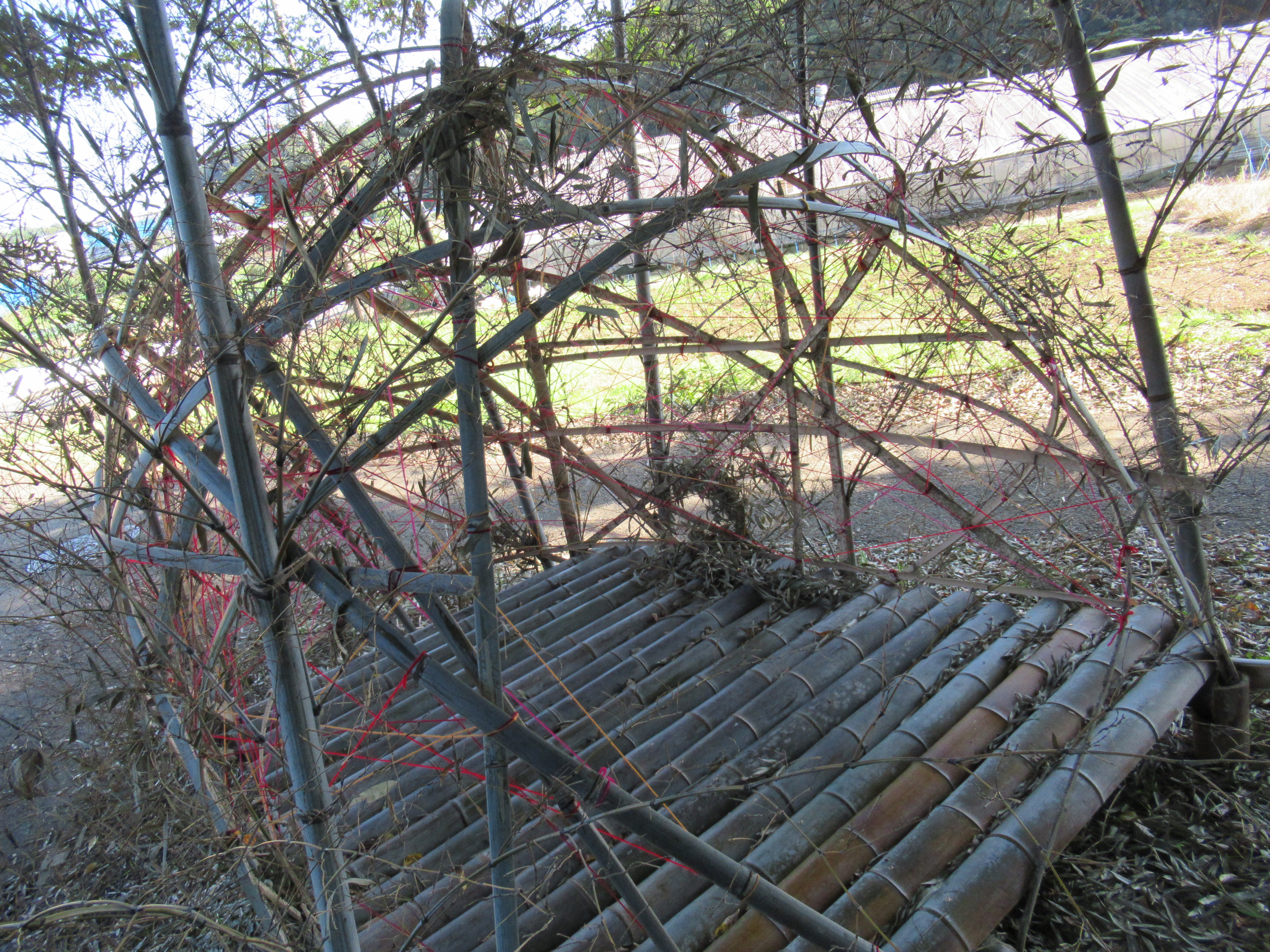
“TAKEMOTO Suguya, Floating Object in the Valley.”
This installation would be
from the same idea of Tanaka’s installment above.
But I was horrified to see this plastic seats floating
above the abandoned rice paddy.
Reason? Please wait till my next week’s post.

“SATO Hideyuki, Dinosaur Egg.”
Ditto for this fiber-reinforced plastic.

“LYU Dian, Fountain.” Ditto for this.

“TACHIKAWA Mariko, Surrounded by Delicious Sunlight.”

“HARADA Riito, Convey my heart.” This I like.

“MURATA Yuta, Place of Soil.”
His continuous work from the previous show.
I’d like to see how he develops
his way of communicating with the land.

“MACHI Kiiko, No!”
She emphasized she was strongly against all the wars of the planet,
and said NO in a large voice …
but why in this forest, I wonder.

“TSUKASA Kana, Scene.”

“UTSUMI Hitoshi, Secret Base.”
This one is also I like.
He tries to have a fun with the forest as a kid.

“ABE Yasumichi, Loop.”
He’s not the only artist of this show
who presented a sculpture made of stone.
In a sense, it’s a traditional way of humans in the relationship with nature.
What does it mean, I wonder.
Is it the beginning of gigantic stone palace of Versailles
with completely geometrical garden?
I suspend my opinion about this …

I have not yet met people from groups who engage in regular maintenance work for the forest. But according to this page, the area has lively communities, some of which do forestry works for the Forest. Moreover, they’re proud of their dirt-work beyond the desk theory. I had a feeling they are clearly succeeding in it. When I’ve been there last month, it was still a bit early for trees shedding leaves. Yet, the general impression Haruhino-Kurokawa Forest showed was bright with rustling sounds of leaves. The paths inside were well maintained for strollers to enjoy. People are controlling the undergrowth of the forest nicely and treating the damage by oak tree wilt. That’s something. As long as I know, the tenure of the land for Haruhino-Kurokawa Forest is a mixture of governmental, private and corporate entities. The teamwork of volunteers from many corners of Kawasaki and some help from pros hired by the City has done a really good job. Their endeavor in the end created the wide space the artists installed their work. Moreover, the success of such handiworks was scientifically measured in terms of basins.


When we check Yamap Basin Map, the ridgeway of Haruniho-Kurokawa Forest is the watershed between Tama River and Tsurumi River. The streams go down the north slope to the direction to Haruhino Station provides water for Tama River. The water from the south slope including an experimental farm of Meiji University goes to Tsurumi River. From 2015 this water to southward was checked by the group of researchers from Tokyo University of Science. The result was amazing. I tell you this next week. Please stay tuned!


If you find environmental issues in Kanagawa Prefecture, please make a contact with Kanagawa Natural Environment Conservation Center 神奈川県自然環境保全センター

657 Nanasawa, Atsugi City, 243-0121
〒243-0121 厚木市七沢657
Phone: 046-248-0323 

You can send an enquiry to them by clicking the bottom line of their homepage at http://www.pref.kanagawa.jp/div/1644/

Sunday, November 3, 2024

Egoist! Chinese silver grass and us


In Japanese psyche, Chinese silver grass (Miscanthus sinensis) is closely related with autumn. I guess some of you have seen the plant depicted in Japanese paintings, including Ukiyoe. The grass is important for decorations of seasonal festivals, such as Moon Viewing Festival. Hakone Sengokubara National Treasure site 箱根仙石原 is famous for its swinging silver grass field in fall (: my post on October 29, and November 5, 2021). In autumn, its green sword-like leaves turn into light brown with their fluffy ears. The vegetable forms large colony and tends to cover vast sunny space. So, in autumn, en masse they carelessly sway as wind blows. If setting sun cast autumnal light over them, it’s perfect scenery for feeling quiet and chilly dawn of the season. Mmmmmmmmm … meditative.

Chinese silver grasses in Sengokubara

Well, so it is, if we just admire them from a window. When we have to think about it in terms of environmental management, it’s a different matter. As Americans know, it can be invasive species and wreck a havoc for indigenous ecology. In Japan, as long as the land is dry and has full sunshine, the grass can form massive cluster whose uber-robust rhizome spreads in shallow topsoil. It is a species dominating a field at the final stage of plant succession. After establishing their kingdom, the grass field will gradually turn into a dry forest, first by invasion of drought-resistant trees like red pines. Unless artificially (oh, yes) controlling their dominance over the field, smaller wild vegetations such as violets et al cannot find a space. Moreover, if the march of silver grass is entering a wet land, such as Sengokubara, it’s a signal for the end of bogs. The plants that love soggy soil will be exterminated. If we want to preserve the ecosystem of swamp, Chinese silver grass can certainly be invasive species.

Sengokubara whose vegetation varies according to its undulation.
 When we see the site from outside,
the place looks like flat.
Nope.
Once we enter the national treasure site,
it has many tiny ups and downs
and so the varying availability of water
for living things on the ground.

To maintain the national treasure site of Sengokubara wetland, Hakone Town officially burns off the field once a year in the middle of March. The main target of this annual event is silver grass. Segokubara has three kinds of environment in terms of grasses. The driest part is for silver grass. The soil which is along streams where its not boggy but with enough moisuture is for common reed. The bog or shallow ponds are for Typha latifolia. When people burning the field, they first mow the border area of the field to make a fire buffer, then ignite fire on the silver grasses immediately inside of the firebreak. By doing so, aridification of marsh can be stopped. After the burning, spring ephemeral can come out in Sengokubara (; my post on May 12, 2023). The area near water streams will welcome common reed that can somehow stop the advance of silver grass.


The photo is taken 1 month after the burning.
Shoots of common reed are thriving along the artificial waterway.
Young spring leaves of Cirsium sieboldii,
a Japanese endemic thistle loving bogs.
It can come out only after the burning.

Viola hirtipes, the largest violet in Japan,
which also comes out after the burning in Sengokubara.

Their ability to suffocate the other plants over the land is not only alarming for marshes. They can also dominate small land patches of suburbs. Their hard rhizome causes headaches for gardeners or people who maintain walking paths in our neighborhood. The best way to control their invasion is digging them out while they are still young. The saving grace is silver grass takes time to be a large cluster. Even when they are seedlings, it’s hard to pull their root out, but definitely easier than dealing with established grass. Our battle with the wild grass continues ad infinitum …

For the silver grass to reach this size,
it must have taken enough time …
and I guess
the landlord gave it up at certain point of time.

Asphalt? What is asphalt?

Along a city road.
The City Office of Yokohama is supposed to
 be responsible for the management
of shrubbery for
such road.
It seems to me the Office cannot keep pace
 with the advancement of grass …
 more to it next week.

From silver grass’ point of view, all of this fuss would be pure egoism of humans … One time we admire them as a cultural icon. Then for another occasion, we regard them as nuisance. Anthropocene … Next week, I will tell you about one neighborhood’s endeavor to minimize the nuisance of wild grass, in the framework of Yokohama’s green policy. Please stay tuned. 😊

I took this photo for one of the urban river of Yokohama.
Silver grass is supposed to love dry land,
but no matter here …
Tough guys.


If you find environmental issues in Kanagawa Prefecture, please make a contact with Kanagawa Natural Environment Conservation Center 神奈川県自然環境保全センター

657 Nanasawa, Atsugi City, 243-0121
〒243-0121 厚木市七沢657
Phone: 046-248-0323

You can send an enquiry to them by clicking the bottom line of their homepage at http://www.pref.kanagawa.jp/div/1644/

Sunday, October 20, 2024

Vampires Strike Back! … not yet Halloween


Finally, it seems to me, fall has begun honestly for Kanagawa Prefecture. It’s about time. Although flower cycles are still in confusion (that’s for next week), all creatures including humans are feeling respite from LONG, HARSH, BOILING summer. Yeah. It’s a good thing. Autumn. We should be fair for all living things around us enjoying easier weather. Yet … the same condition also gives OK for vampire leeches in Tanzawa to be active.

Somewhere here, vampires are waiting …

In Yadoriki Water Source Forest, especially after showers, the blood suckers are eager to paste on the skins of mammals and amphibians. We simply walk around the strolling courses off the paved path, and they appear here and there, trying to reach our bare skin for blood. Poor creatures. They must have been starved during the days of baking sunshine + occasional downpouring of summer 2024. I guess those which poke out from the crannies of trekking roads are survivors. They endured strong sunlight, laying down under the pebbles for 3 or so months. They escaped landslides when torrential rains attacked the water source forest and washed over the topsoil. Vampire leeches. Tough guys. Still, I think they are smaller than in the previous years.

An apparent scenery of landslide in Tanzawa
I would say such foggy trekking road is so beautiful.
But … be ware of vampires.

If during summer they had sufficient nutrients = blood, they should be 3+cm long in October. This year, nope. They are skinny. They are more or less 1cm long. They move almost frantically on our trekking shoes for finding skins, even when we drenched our gear with DEET or some leech repellent. In encounter with tiny blood suckers trying to reach my skin for blood, I unusually felt sympathy for them. Oh, so, you must be very hungry, aren’t you? Haven’t you noticed your entire body is absorbing strong venom, called DEET, which would be lethal for you? Are you OK? What a Faustian question …

Japanese skimmia are having lots of fruits
these days in Yadoriki Water Source Forest.
Caution:
the plant is poisonous from the root to the tip of head.
Their ripening red fruits are attractive
but lethal for kids when they eat them.

I haven’t heard any news reporting annihilation of vampire leeches due to climate change. Rather, they say their habitat range is expanding. Previously snow-covered mountains during winter are now snow-less or ice-less, which is easy for leeches to ride over the cold days. Then, there is a nation-wide exploding population of deer. They can move around in mountains carrying leeches between the nails. Now, leech problem is in Sizuoka, Tokyo, and Yamanashi which are surrounding prefectures of Kanagawa. No need for sympathy for blood suckers. Yup.


Nonetheless, I feel sorry for the animal who do not have any means of changing the course of climate. Or they could be wise enough not to fight a losing battle. They would be clever by adapting the changing climate and spreading their “home” … What will happen in 5 years’ time for Tanzawa and vampire leeches on boiling planet?


By the way, sweet osmanthus are at last opening in Yokohama. I think they are 2 weeks late. Still, it is the time when our ordinary suburbia is in sweet natural fragrance. Thank God, at least we have them flowering as previous years …


If you find environmental issues in Kanagawa Prefecture, please make a contact with Kanagawa Natural Environment Conservation Center 神奈川県自然環境保全センター

657 Nanasawa, Atsugi City, 243-0121

〒243-0121 厚木市七沢657

Phone: 046-248-0323 You can send an enquiry to them by clicking the bottom line of their homepage at http://www.pref.kanagawa.jp/div/1644/

Sunday, September 1, 2024

Talking with Soil Creatures: counting soil animals in Yadoriki Water Source Forest やどりき水源林


Every July, we Forest Instructors for Kanagawa Prefecture do field research in Yadoriki Water Source Forest やどりき水源林. The main theme of this occasion is what kind of soil animals live underground of the Water Source Forest. We employ two approaches to collect tiny animals in the ground. One is collecting roughly 10cm deep dirt from 50cm*50cm square soil, sifting it by large sieve over a white plastic table cover, and inspecting the soil spreading over the cover to find out what comes out from the sieve. Another is using pitfall trap. 3 days before the research, we bury three medium-sized plastic containers with wide mouth. Each container has bites inside; chicken meat to lure carnivorous creatures, a banana for vegetarians, and for everybody crumbled kitchen paper drenched in brown sugar syrup. The opening of the boxes is at the surface level of the ground. It is covered by a lid with legs to shield the trap from pouring rain, but with wide enough gap for small living things visiting for bites. We make such instalments for two observation sites and go to see what’s inside 3 days after.


Collecting soil from 50*50

Three traps

Retrieved trap with chicken meat

This year, the team I joined was to check the soil creatures inside the fence before the toilet at the corner of the open space. The place is a mound made about 30 years ago when the water source forest was a commercial camping site. At that time, people made the heap there and planted seedlings of broad-leaved trees. They then enclosed the area by a fence in order to prevent deer came in and devour the baby trees. Now in 2024 surely we do not find droppings of deer inside the fence. But the trees remain lanky, and the entire ground is always dark as it is surrounded by tall coniferous trees. By simple guessing, we may expect there are lots of soil animals which in general do not like baking sun or drier soil condition … er, wait. Not so fast.

Surely, inside the fence is deer-free,
and rarely hosts vampire leech.
It’s a good place to install hammocks for nap.

First of all, there was an accident. We started our research from collecting the buried 3 boxes. In the box of chicken, there were lots of Anisodactylus signatus (in beetle family). Fine. In the box of syrup, there was not many bugs trapped. Syrup 3 days ago was almost dried up. The problem happened in the box of banana. This box was also almost empty, and above all, there was no banana, or the remnants of it. “Hmmmmmmmm. There must have been at least one thief.” “Indeed. It seems to me the thief came here early. May be immediately after we left this place. The box is so empty and clean.” “Wow.” “But how did it do it? The gap between the lid and the box is not wide, and it must have dug deep inside the box.” “No trace of pecking …” “It means the culprit was a mammal.” “But there is a fence!” “Somebody which is good at climbing up fences ...” Last year when we checked DNA from the water of Takigoh Fall 滝郷滝, near our soil study site, there were DNA bits of masked palm civet. It is a foreign species devouring commercial produce from farm fields. Also, the animal is good at climbing high, trees, roofs, etc. For it, penetrating inside the fence won’t be much problem. ***Sign*** We discussed how to make a lid of the trap from mammals. We have not reached the conclusion, but we must improve the design of the trap, for sure.

Empty bananas

Takigoh Fall.
Somewhere up there, masked palm civet is roaming.

Having said that, when we checked the number of families in the soil brought from the front forest for the toilet, it also was not much. Another location for the research was near the garage for forestry monorail. The number of creatures identified there this year was 53. The number we could identify from the artificial mound near the toilets was 45. Actually, such difference has been observed for several years.

Carrying collected soil for study

What’s there?

For example, here!
Geophilomorpha and earthworm.
Geophilomorpha can be found only in non-contaminated environments.
It
’s good news we could encounter it.

Come to think of it, inside the deer fence in front of the toilets shows only a small number of fungi either. According to Dr. Taizo Nakamori (2022) for Yokohama National University, fungi is like a sweet shop for soil animals. People often misunderstand soil animals like worms make fallen leaves or twigs on the ground into nutrients for soil, like nitrogen. Nah. That’s the job done by bacteria, not soil animals. Of course, tiny bugs eat such leaves to survive. But they eat them and simply poop them afterword, which makes the fallen leaves into a smaller bit for bacteria to digest. Their contribution for soil creation is in this way. Fallen leaves are litter after the plants stopped supplying sugar et al from their photosynthesis. The level of nutrients in it is inevitably low, consisting of mainly cellulose = hard to chew. The soil creatures make do with this poor diet. However, if the soil has lots of fungi which will become mushrooms when the climate is right, the story is different. Fungi decompose plant litter with their enzyme and recompose the nutrients to become fungi. For soil animals, eating fungi allows them skipping their hard labor of chewing cellulose. When mushrooms come out, the soil animals swam such “candy” which is a mass of fungi hypha. They will move to the ground of mushroom. i.e. When there are lots of mushrooms on the ground, there will be lots of soil animals. If not much mushrooms found, the number of soil creatures would be smaller. 

* Taizo Nakamori, Soil Animals and Fungi, in Tomoyuki Shimano; Motohiro Hasegawa, and Yasuo Ogiwara (eds.) “The Topics of Soil Creatures,” 39-56, Asakura Publishing, Tokyo, 2022.

A mushroom we found in a previous fall inside the deer fence.


“Is it because the place is made of artificially brought soil?” “Possibly. But the construction was tens of years ago, wasn’t it?” “Yeah, the effect still continues, maybe.” “Oh, … hmmmmmmmmmm …” “Why?” It’s a mystery. There would be an explanation why the shady artificial mound does not show the same level of biodiversity as the next door natural soil. Curious.


If you find environmental issues in Kanagawa Prefecture, please make a contact with Kanagawa Natural Environment Conservation Center 神奈川県自然環境保全センター

657 Nanasawa, Atsugi City, 243-0121
〒243-0121 厚木市七沢657
Phone: 046-248-0323

You can send an enquiry to them by clicking the bottom line of their homepage at http://www.pref.kanagawa.jp/div/1644/