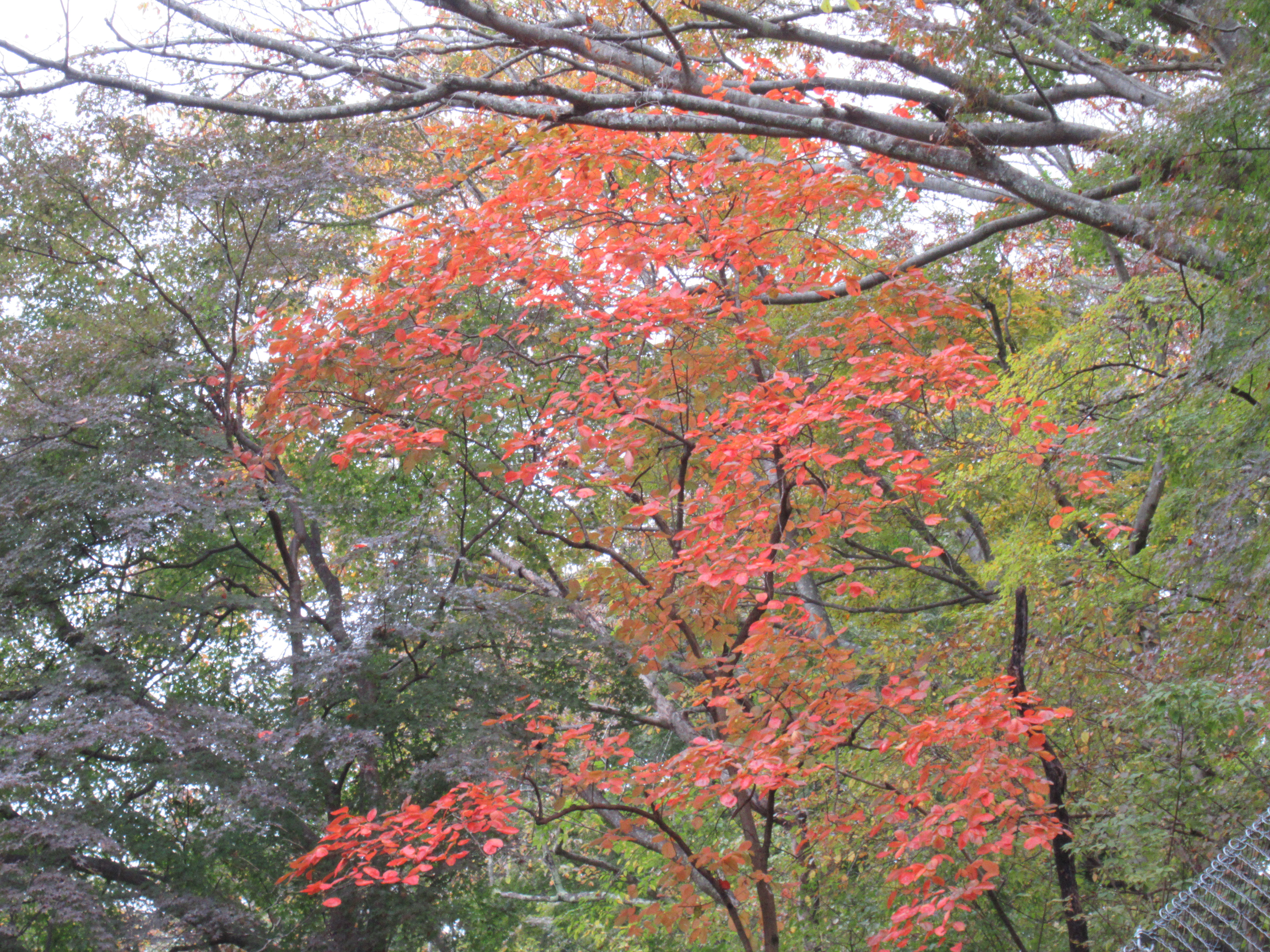
Showing posts with label Change of season. Show all posts

Sunday, March 31, 2024

Open! Cherry blossoms finally opened in Yokohama


So, we were anxious about the cherry blossoms this year. This weekend, THEY FINALLY OPENED THIS SPRING! Not only that, they are accelerating the speed of reaching full bloom, by hours.

Morning, Cerasus jamasakura in Yokohama
The same tree in the afternoon
It’s another type of cherry tree, garden species.

Somei Yoshino in Ikebuchi Open Space of Niiharu.
 Almost reaching to the full bloom ...

So, Naomi become suddenly uber-busy to visit the places with cherry blossoms. This is super short post for this week. I‘ll tell you my adventure with cherry blossoms next week. Sorry.

Cerasus incisa, an endemic species found around Mt. Fuji.


If you find environmental issues in Kanagawa Prefecture, please make a contact with Kanagawa Natural Environment Conservation Center 神奈川県自然環境保全センター

657 Nanasawa, Atsugi City, 243-0121
〒243-0121 厚木市七沢657
Phone: 046-248-0323

You can send an enquiry to them by clicking the bottom line of their homepage at http://www.pref.kanagawa.jp/div/1644/

Sunday, March 24, 2024

Please don’t tease me … Cherry blossoms this year in Kanagawa Prefecture


Two months ago in January, weather forecasters told us that it was a warm winter, and thus cheery blossoms would come early, maybe around 20th of March as in 2023. Now, it is March 24th, and the “official” opening doesn’t come to Kanagawa Prefecture. “Official opening” = The first day when a specimen tree has more than 5 opened flowers. Specimen tree for Kanagawa Prefecture is in Yokohama Local Meteorological Observatory at Minatono-mieruoka Park.” It has been a cold week. So far we have not had many March days that reached more than 15°C for max temp. Accordingly, cherries are not yet ready for blossoming … maybe.


Violets are open.

Last week, I planned to see cherry blossoms in one of the well-known hiking courses. It was a fine warm day compared with the previous days. The spot was in the southern part of the prefecture (more to this next week), so I expected I could meet early blossoms under relaxing sunshine. Nah. Yeah, there were lots of cherry trees along the trek, but no tree had flowers. Their buds looked very tight yet. When a cherry tree is ready to open its flowers, the buds have bright pale green which will be calyx supporting the petals when it‘s open. I could not find a tree reaching to this level of readyness. Sad.

Eyes tightly-shut
If all of them open, it‘ll be spectacular.

According to Dr. Hisanori Itoh, Prof. Emeritas of Kyushu Univ., when cherrys could not experience enough cold days of winter, they feel groggy even when spring comes. So, they cannot burst out their flower, but start to open them in a protracted way. For the worst case scenario, before all the flowers open the temperature reaches the level of early summer, and so the cherrys fail to acomplish full bloom. In Hachijojima Island 八丈島, this is already happening, and people cannot enjoy the spectacle there. I don‘t think we are at this stage in Kanagawa Prefecture yet. But still ...

They are all cherrys.

Please keep crossing your fingers for me to be able to tell my adventure next week with cherry blossoms.

Wind flowers were already open.

If you find environmental issues in Kanagawa Prefecture, please make a contact with Kanagawa Natural Environment Conservation Center 神奈川県自然環境保全センター

657 Nanasawa, Atsugi City, 243-0121

〒243-0121 厚木市七沢657

Phone: 046-248-0323 You can send an enquiry to them by clicking the bottom line of their homepage at http://www.pref.kanagawa.jp/div/1644/

Sunday, February 18, 2024

Pretty in Pink: Winter Buds


In the forests of Kanagawa Prefecture, unless that is of afforested conifers, the trees shed their leaves during winter. Yap, it’s natural for forests in cooler temperate climate, as in Japan. The trees show their trunks and boughs without any cover of leaves. Winter air is frozen. It’s a world of minimalists’ beauty in Zen like manner … Even though, there are several very talkative spots here and there. The first thing people notice is easier spotting of birds, especially little ones. There is no cover, aka leaves, for them to hide. Food is scarce and they are too busy pecking whatever meals, aka bugs, they can find in the boughs and twigs of trees. Hardworking birds sing and hop from twig to twig just before our eyes. It’s the best season for birdwatching, as you know. Another “lively” sites in winter forests of Kanagawa is winter buds.


Before trees have lots of leaves and flowers from spring to summer, they must have buds to sprout when the time comes, right? They need time for buds-preparation with enough nutrition, obviously. So, all trees, deciduous or otherwise, start producing buds when they have lots of leaves that manufacture nutrients through photosynthesis. For deciduous trees, they complete foundation building of buds by the end of summer. If we’re attentive, we can spot such buds within vigorous summer leaves of trees. When the season turns to chilly side, the buds are in gestation. Spring is approaching and the buds are mature enough at waiting wing to flush out their new leaves and flowers. In Kanagawa Prefecture, January and February are the best months to spot and admire these plump “winter” buds in forests. It’s fun, I tell you.


There’s a sort of trick to find winter buds. Look for the tip of twigs, then lower your eye along the twig. Basically, winter buds are formed on the first-year portion of a bough. Just think where we can find the leaves of summer. They are on the head of a bough, i.e. twig, right? So do the winter buds. Sometimes, the point of a twig is too fragile to be preserved during winter. In such a case, the first portion of a bough is gone at the point where buds start. The series of buds for such twig look like starting from the middle of a twig. That’s OK. In any case, winter deciduous forest can give us a clear vista of how the boughs and twigs are spreading from the trunk. It’s easy to spot buds.

It’s winter buds of Japanese maple.
The tips of twigs look like thin threads.
Inevitably, they are fragile and can be easily broken
 at the point where the series of winter buds starts.
More to this below.
Oh, by the way, I tell you next week
my adventure in a park where I took this photo.
It
‘s not in Kanagawa but in Tokyo and
in one of the
“oldest modern scientific botanical garden for Japan.”

You see?
Once we pick up only the orange lines in our mental map,
the scenery is like a modern painting …
I think they are Hydrangea luteovenosa
with dogwood like red in winter forest.

Their winter buds look like this.

There are several anatomical points if you’re serious about observing winter buds. But, today, let me just show you how pretty they are once we’ve noticed their existence. The opening act is by Ilex macropoda that will have handsome egg-shaped leaves which turn their colour from bright green to yellow in autumn. By that time, they have pretty and small red currants whose colouring scheme is perfect for gardens. Having said that, I think their winter buds are also cool. From that tiny gray triangular tip a bunch of leaves and flowers will sprout. It’s something of wonder.


The next, I think it’s Schizophragma hydrangeoides. Could you figure out some triangle beneath the bud? It’s where a previous season leaf was attached before it fell off as an autumn leaves.


Winter buds for Schizophragma hydrangeoides are strange looking. Their top bud at the point of a twig is often destroyed due to strong wind et al. Its leaves sprout adversely, i.e. the left-behind two winter buds sit neatly side-by-side, which look like hoofs of a cow. Also, this one is in bright pinky-red. By the way, their leaves and buds are larger than Japanese maple. If you’re hiking in Tanzawa during winter, look for them. It’s easier to find than for smaller Japanese maple.


Another pretty in pink is Quercus serrata. The trees are often big oak in our neighbhood, but its winter buds are this cute. They look like Christmas cake decorations. Come to think of it, they are baby part of a tree that would be vulnerable for UV rays. And during winter, not much is there for sun-shade for buds. A hypothesis is, red can protect babies and young leaves from such harms. Though it’s still a hypothesis.


Whateva. They are pretty, like winter buds for loose-flowered hornbeam. They stood out in greyish scenery of winter Tanzawa over a blue sky. Mmmmmmmmmmmmmmmmm!!!! Let’s take a deep breath!


Although the songs of birds sounds, probably, more clear in winter forest, it’ very quiet, meditative space. Then these winter buds come out almost mischievously with cute smile. Soon, they will be bushy extravaganza of summer forest. Metamorphoses ... It’s really a wonder.


If you find environmental issues in Kanagawa Prefecture, please make a contact with 

Kanagawa Natural Environment Conservation Center
神奈川県自然環境保全センター
657 Nanasawa, Atsugi City, 243-0121
〒243-0121 厚木市七沢657
Phone: 046-248-0323

You can send an enquiry to them by clicking the bottom line of their homepage at http://www.pref.kanagawa.jp/div/1644/

Friday, December 1, 2023

Out of Season: Forests in Kanagawa are turning their colors … but


We’re murmuring. This year fall is short. We had a day with more than 25°C temperature in early November. To the beach! Then, last weekend the max temp was around 12°C. Hello Christmas. If autumn had about 3 months, we could have enjoyed the changes of our forest in a more slow and relaxed way. Sad. Still the leaves are turning their colors in the mountains of Kanagawa. In Yokohama, the change has begun. Once it has started, the end it will come very soon …

Neoshirakia japonica, probably
the most beautiful tree in autumn for Japanese mountain forest.
 It’s Japanese endemic species.
 With some reason not many people know this tree …
 they show their bright red for just few weeks
 in remote mountains …

Not only we, but also some flowers might have been confused these days. Or, is it natural to find such baffled ones in forest? The other day, when we checked the autumn vegetation along Hadano Forestry Road 秦野林道, we met a pretty spotted bellflower, flowering. Er, excuse me? Do you think it is June?

What are you doing here now?

Then, in another slope we were welcomed by elegant Rhododendron wadanum, also flowering. Oh yeah, they welcome us every late spring to early summer in Tanzawa mountains. But … are you alright doing this in mid-November?

Hmmmm … the photo is out of focus … sorry.

Flowers are for making seeds to continue their species for generations. Both flowers we’ve found in November are dependent on insects for pollination. But could they find helpers? In late autumn, the number of bugs is also small, of course. Last summer we found two huge nests of wasps beneath Nakazawa Bridge 中沢橋 of the forestry road. They were terrifyingly buzzing. Now in November, everything was quiet. Wasps were carnivorous so if they are quiet, their meals, aka other bugs that can help pollination for flowers, must be scarce. Poor flowers. They are pretty. They must have spent huge energy to be beautiful. But all would be in vain … Sad.

Quiet nests in November

For everything there is a season, and a time for every matter under heaven:

a time to be born, and a time to die; a time to plant, and a time to pluck up what is planted;

a time to kill, and a time to heal; a time to break down, and a time to build up;

a time to weep, and a time to laugh; a time to mourn, and a time to dance;

a time to throw away stones, and a time to gather stones together; a time to embrace, and a time to refrain from embracing;

a time to seek, and a time to lose; a time to keep, and a time to throw away;

a time to tear, and a time to sew; a time to keep silence, and a time to speak;

a time to love, and a time to hate; a time for war, and a time for peace.

Ecclesiastes 3:1-8

Daurian redstart.
From Siberia, they come here to spend their winter.

Holiday season is coming!


If you find environmental issues in Kanagawa Prefecture, please make a contact with Kanagawa Natural Environment Conservation Center 神奈川県自然環境保全センター

657 Nanasawa, Atsugi City, 243-0121
〒243-0121 厚木市七沢657
Phone: 046-248-0323

You can send an enquiry to them by clicking the bottom line of their homepage at http://www.pref.kanagawa.jp/div/1644/