Showing posts with label DNA monitoring. Show all posts

Friday, March 10, 2023

30-by-30 with Yadoriki Water Source Forest; DNA sampling for water quality monitoring in Kanagawa Prefecture, 3


So, Kanagawa Prefecture recruits citizen volunteers to monitor water quality of Sagami 相模川 and Sakawa 酒匂川Rivers both of which provide tap water for the entire Kanagawa. Monitors are collecting biological data from the river system of these two rivers, including the biodiversity condition of land of the estuary. The scheme was started in 2007 when the General Principles for Water Source Environment Conservation and Regeneration Policy かながわ水源環境保全・再生施策大綱 began in effect (; my post for October 28th, 2022). From 2022, DNA sampling is added for monitors to collect data. By analyzing traces of DNA from river water, we can estimate the number of species and the quantity of them which live in that particular water. According to Mr. Yuta Hasebe, from roughly 1km upstream from the point of water sampling, the snippets of DNA can be collected in a DNA filter (; my post on February 17th) or in a 1L bottle (; last week’s post on March 3rd). The merits for employing DNA sampling for water quality monitoring are 5-holds.

1. It’s far easier to collect biological data in a field, compared with landing nets and vats to make specimen. For DNA, we just collect water in a research container, and done. Landing nets and vats require us to go very near or to enter the water, catch specimen, throw them in a bottle of alcohol, then do microscopic study. DNA is easier and safer, you see?

2. All the stages of studying samples can be divided into a simpler segment. If that is with a bottle-method, we collect water, the bottle is sent to the lab, the scientists filter the water to catch DNA, the DNA sample is checked with database, then the result is analyzed by researchers. Each stage can be done by a different person and/or team, and so collaborative work would improve productivity for environmental analysis. That’s VERY important as the budget of the Office is always tight.

3. Extracted DNA samples can be stored for 10-20 years in a freezer at -20 °C, which gives chances for future researchers to meta-monitor long-term changes in water quality.

4. Especially for DNA of fishes, Japanese database is the world largest. We can utilize it fully to analyze the environment fishes indicate for their living condition.

5. 
It is possible to find DNA for a creature that is not caught so far by landing nets. Say, no one has caught a fish ABC in that part of Sagami River, but the water from the point can contain their DNA. That’s news!


The total evaluation of water quality is done by counting the existence of indicator species. Indicators are not only for fishes, but also insects and the other water creatures. Though, the comprehensive DNA database is yet only for fishes. Scientists are not sitting idly to leave the matter as such. At this moment, the labs in Shinshu University and Kanagawa Institute of Technology are collaborating to expand the registered number of species of zoobenthos in the DNA database. Mr. Hasebe asked us, “Please send your specimen to our lab. We check it for identification, then do DNA sampling. The result will be reported to the team for creating zoobenthos database. We REALLY appreciate your help!!” As of February 2023, the database for non-fish species is nearing the start of operation. So, in FY 2023, the Prefecture is planning to analyze and report DNA samples of non-fish creatures collected by monitors. Such citizen mobilization for environmental DNA sampling is the first in Japan. Ahem! From this April Kanagawa Forest Instructors Association starts to collaborate with Kanagawa Environmental Research Center to monitor Yadoriki Stream. We have about 30 years of experience observing water creatures in Yadoriki Water Source Forest やどりき水源林 so that the partnership is a natural fit. DNA sampling last year (; my posts for February 17th and March 3rd) was our trial. We have had mixed results for the 3 spots in the estuary of Yadoriki Stream. By continuing the systematic monitoring with a help of professional researchers with the advanced technology we would be able to know more about our Water Source Forest … And there is more.

Need to be registered for their DNA …

Such water monitoring can be done only by continuous and patient efforts of local monitors cooperating with professional scientists. It should be followed by the next level endeavor to sustain and improve the biodiversity of the environment where the locals live. To this end, Prof. Michio Kondoh for Tohoku University has become a lead for creating a platform of citizen-scientists collaboration and for making the DNA database open source, usable for better nature conservation and management. The pals of Prof. Kondoh created a consortium named ANEMONE that is the portal for open database of fishes and zoobenthos of Japan. Citizen monitors and scientists feed the monitoring results to enrich the contents of this nationwide database. Kanagawa Prefecture is helping ANEMONE to have more data. Yadoriki’s last year’s result will become a part of ANEMONE’s database. But, alas, the problem is always money. For the help, the Ministry of Environment of Japan has bought Prof. Kondoh’s idea and now prepares preferential national tax treatment for private donation and cooperate sponsorship supporting activities for ANEMONE. At the moment, ANEMONE is welcoming registration of anybody who’s interested in it as a partner for the scheme. Especially corporate partners can expect benefit from the coming new tax system.


The reason why the MOE of Japan comes in here is the existence of international pledge Japan has made for 30-by-30 Conservation Goal at COP 15. The diplomats and national delegation brought back the homework to materialize what the international convention agreed, and give it to locals, like us in Kanagawa Prefecture, to meet the deadline of 2030. The tricky part for registering 30% of our land for 30-by-30 is, how we can prove that the area is environmentally protected with sufficient biodiversity possible to be counted for 30-by-30. Data stored in ANEMONE will provide evidence for that. Moreover, it can be a convenient tool for corporate accounting. When corporations help the idea of open database of environmental DNA, ANEMONE will give them certificate for helping improvement of biodiversity. Based on this paper, the national government will provide preferential tax treatment. “Donation to ANEMONE is nice money for your bottom line and CSR, isn’t it?” With more moneyed help, Japanese promise for international community will approach to the goal faster. Gotcha.


Actually, many corporations already financially support
 the management of Yadoriki Water Source Forest.
 This part of the Forest is generously funded by NGK.
 Hopefully they will be able to utilize coming new tax system
 with our monitoring data …

Within the scheme of General Principles for Water Source Environment Conservation and Regeneration Policy, Kanagawa Prefecture has Committee for Regenerating Nature of Tanzawa-Oyama Area. The panel for the Committee includes lots of names of professors, NPO chairpersons, Corporations, etc. They are people for mountains, and its Secretariat is at Kanagawa Natural Environment Conservation Center 神奈川県自然環境保全センター. Inevitably, they are now discussing how to verify Tanzawa-Oyama Area fit for 30-by-30 which requires properly scientific endorsement with data for biodiversity. Mr. Hasebe of Kanagawa Environmental Research Center 神奈川県環境科学センター says, “Well, at least for estuaries of Sagami and Sakawa Rivers, we have the system of citizen monitoring using professional resources and being connected to national database of ANEMONE. If corporations and large landlords help our monitoring with ANEMONE, we can provide sufficient certificate for 30-by-30 enrolment, and they have tax benefit. Not a bad deal, huh?”


This part of Yadoriki Water Source Forest is
funded by private donations …
Will they receive preferential tax treatment
as corporations under the new tax system?

In any case, nature monitoring using environmental DNA in Kanagawa Prefecture is just 1 year or so old. Let us see how we can proceed from here … Meanwhile, Yadoriki Water Source Forest is welcoming sweet smells of Oriental Paperbush. Yellow flowers are dotting here and there in the estuary of Yadoriki Stream. We are entering a nice season …

Now in Yadoriki Stream, tadpoles are having their form
 in eggs of Montane Brown Frog …

If you find environmental issues in waters of Kanagawa Prefecture, please make a contact with Kanagawa Environmental Research Center 神奈川県環境科学センター

1-3-39 Shinomiya, Hiratsuka City, 254-0014
〒254-0014平塚市四之宮1-3-39
Phone: 0463-24-3311
FAX: 0463-24-3300

k-center@k-erc.pref.kanagawa.jp
https://www.pref.kanagawa.jp/docs/b4f/index.html

Friday, March 3, 2023

Sense of Wonder from the Estuary of Yadoriki Stream; DNA sampling for water quality monitoring in Kanagawa Prefecture, 2


Alternative approach for sampling DNA from Kanagawa’s rivers is simply drawing a bottle of water, refrigerating, and sending it to the lab. We’re given a plastic bottle for 1L and asked to take river water. Simple. We have to be careful about just two things. One is avoiding contamination during water collection. We wear gloves, wash the bottle carefully before packing water, and always stand downstream during water collection. After gathering water into the bottle, we add RNAlater to suppress the break-down of DNA. Another important thing is trickier. The researcher must start processing the contents of the bottle within 48 hours of the collection, provided the water is preserved as is from the river. So, we refrigerate it immediately after the collection in a freezer bag, and rush to a courier’s office for express delivery to the Prefecture’s lab.

Collecting water

In any case, compared with the syringe method, it is far easier to collect DNA samples this way. In addition, it is guaranteed 1L of screening as we don’t have a problem of clogged-up filter. Maybe the only problem is the weight of 1L especially when we bring water from deep mountain. Mr. Hasebe originally worried about the burden and recommended the syringe-method. But in the middle of the year, he said the difference in amount of water possible to be checked could be crucial for studying the sample. So, he started to recommend the bottle-method “if you can carry additional 1K in your backpack.” In Yadoriki Stream 寄沢, I tried syringe-method twice; once during summer, and another in December. I also did bottle-method in December. All three samples showed different results. Curious. Let me explain.

Yadoriki Stream in one December weekend last year

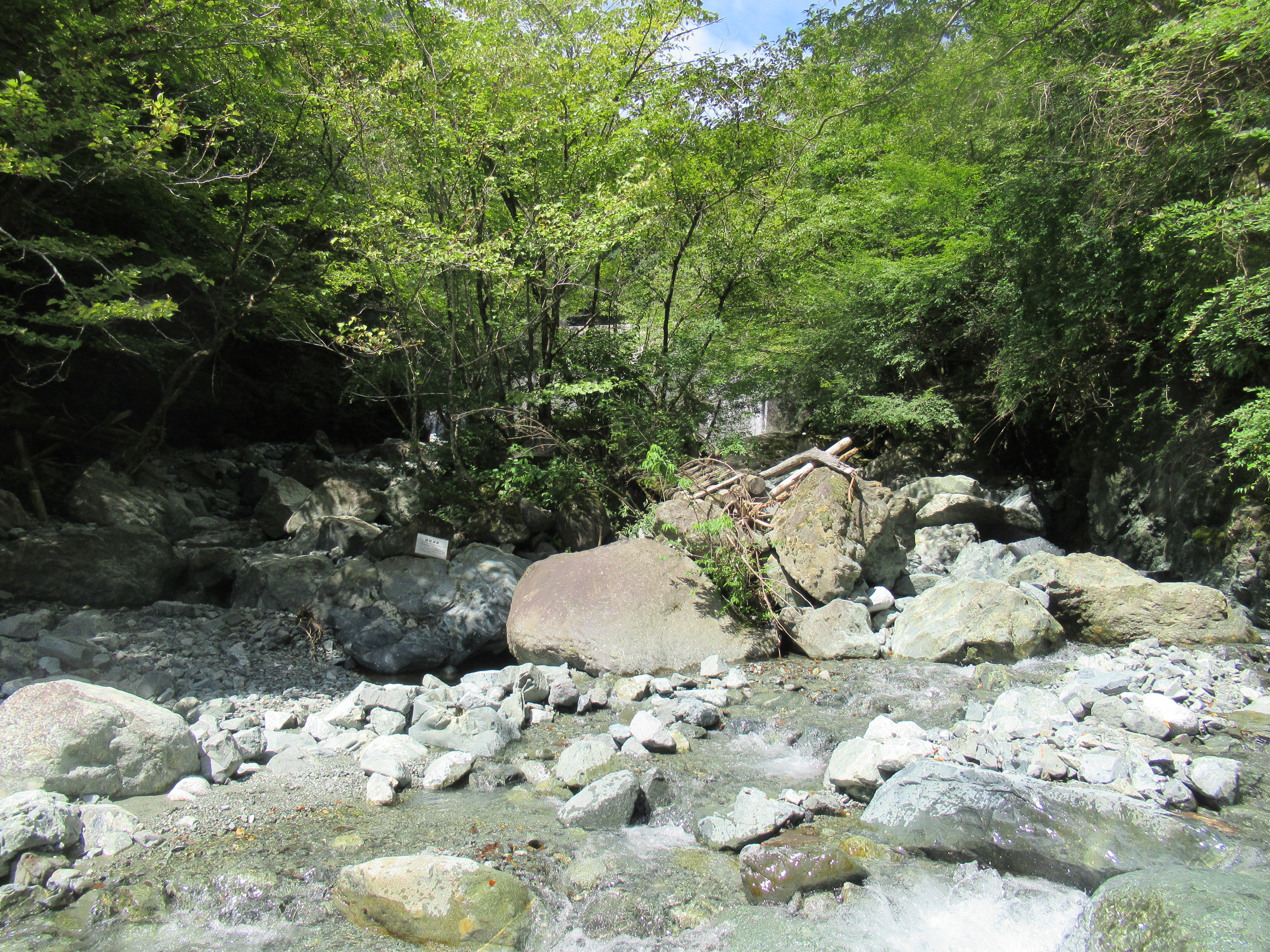
My first trial for DNA was during summer at the place where a forestry road from the gate for Yadoriki Water Source Forest やどりき水源林 ended by meeting with Yadoriki Stream. From that point, there is no road accessible for mechanized vehicles. Immediately beyond the spot, there is a weir to mitigate the impacts of debris flow from upstream. Do you remember there is a famous “always collapsing” south-west slope of Mt. Nabewari 鍋割山 that has the name “Collapse in Hell” (; my post on January 3rd, 2020)? Also, the physical power of stream at the point is perhaps the text-book example for torrent. From the fishes’ point of view, it would be difficult to go further up when they come from downstream. So, the water I filtered there at that time would reflect the lives of fishes swimming above the weir, near to ones of the very origins of Yadoriki Stream, and hence Sakawa River 酒匂川. The result of DNA analysis was … (drum rolls, please) ZILCH, nada, nobody.

Zilch-point

The end of the forestry road is like this
in Yadoriki Water Source Forest.
 Could you figure out the weir at the bottom of this photo?

Yeah, come to think of it I don’t have a memory of somebody saying “Oh, you see? I met a shadow of fishes at XYZ (beyond the end of forestry road in Yadoriki Stream).” But, even so, if that part of the estuary for Yadoriki Stream has a certain closed “community” of non-migratory fishes, like small Japanese fluvial sculpin, we might be able to catch the trace of them through DNA. The result may have influenced the design of DNA collecting in Mr. Hasebe’s head. He said “Well, straining the water in the field may have influenced the analysis. Besides, the amount of water is inevitably smaller with syringe compared with a bottle of water … Let’s continue monitoring for next year.” Roger. Very interestingly, a point slightly downstream from the Zilch-point, we had totally different result with bottle-method in December.

Actually, there are another two weirs
beyond the Zilch-point in Yadoriki Stream …

We tried the bottle-method in the estuary of Yadoriki Stream at a point slightly before Ushiro-zawa Stream 後沢 joining to Yadoriki Stream. When you take the standard route to Mt. Nabewari from Okura 大倉, the beginning of the final ascend to the peak is named Ushiro-zawa Nokkoshi 後沢乗越 which is a watershed for the east and west of the ridgeway of Mt. Nabewari. Ushiro-zawa Stream gathers water from that very steep western slope and joins with Yadoriki Stream when it meets with the forestry road. It’s a tiny flow of less than 500m long. Having said that, people often boast they spotted the fishes in Ushiro-zawa. (Oh, by the way, the road along Ushiro-zawa reaching Mt. Nabewari is closed for hikers. We need a permit to use the route from the landlord, aka Kanagawa Prefecture. Forest Instructors are OKed. 😊) So, we tried our DNA quest at the very end of Ushiro-zawa just before it joins with Yadoriki Stream. Bingo. Mr. Hasebe found DNAs for Japanese fluvial sculpin, Amur minnow, and Cherry trout.

This is the point we collected DNA from Ushiro-zawa.

Ushiro-zawa

We collected the Ushiro-zawa’s water about 10m before it joined with Yadoriki Stream. So, it might contain the trace of dwellers of larger Yadoriki Stream. But After Typhoon Hagibis of 2019 (my post on October 18, 2019), the prefecture almost “closed” the joint of two streams and laid an earthen pipe, some 1m in diameter, for Ushiro-zawa Stream to pour to Yadoriki Stream. The aqueduct often clogged after a storm. I don’t think fishes are regular commuters to use such unfriendly route … Maybe short Ushiro-zawa stream has very rich biodiversity, and fishes have their own exclusive community thriving happily there. Impressive …

Actually, the living things above water are
 also very rich along Ushiro-zawa.
Last summer, we met a blue-and-white-flycatcher there.
It sung a beautiful song …

The third point we did DNA sampling in Yadoriki Stream last year was at waterfall basin of Takigo-no-taki Fall 滝郷の滝, which is the end of Takigo-sawa Stream 滝郷沢. The water of Takigo-sawa dropped some 20m down at the point where it joins Yadoriki Stream. The water in waterfall basin would concentrate the entire water of Takigo-sawa Stream, we guessed. In December, we used syringe-method to collect DNA. At the time, we could figure out 2 shadows of fishes swimming at the very end of the basin … Promising! The result was … DNAs of Cherry trouts ONLY. The length of Takigo-sawa is more than 1k long, i.e. 3 times longer than Ushiro-zawa. On the other hand, the access to Yadoriki Stream from the waterfall basin is far easier there; constant and relatively shallow stream of some 10m long between the basin and the Yadoriki Stream. During casual summer visits of the Yadoriki Stream near Takigo-no-taki Fall, we can meet Japanese fluvial sculpin here and there. So, we expected the waterfall basin could have contained more variation in terms of DNA. This time, no. It may be due to syringe-method … Or, the 20m difference in elevation could prevent other fishes from entering Takigo-sawa? Curious, curious, curious …

Takigo-no-taki Fall point

When we visit Yadoriki Stream, we first notice large red Yadoriki-oh-hashi Bridge 寄大橋, and a high weir, maybe 10m high or more, below the bridge. Swimming beyond the weir could be impossible for a fish. It means all the fishes we meet beyond that point would be non-migratory and endemic. Stray fishes from fish farms downstream are unlikely, unless somebody deliberately discharged one, which is criminal offence in quasi-national parks of Japan. Actually, between the high weir below the red bridge and the one at the end of forestry road, there is another weir before the joints of Ushiro-zawa Stream with Yadoriki Stream. It is also relatively high, maybe of 5m or so. This one would also be difficult to pass for tiny fishes. Is it affecting the privateness of Ushiro-zawa? From last year’s trial, the stream of the richest biodiversity was the tiny Ushiro-zawa Stream. The lives there would be contained in a very small area … Or, was it a temporary result just for 2022? Mr. Hasebe, it seems to me, is wondering if the syringe method misses something due to a small amount of water sample. The quest continues this year … I’ll report you what we’ve met in 2023. Meanwhile, next week, I tell you more about the DNA sampling from Kanagawa’s water source rivers from prefectural policy’s point of view. Pls. stay tuned. 😊


Yadoriki-oh-hashi Bridge

Oh, I have to tell you this. Takigo-no-taki Fall is famous as it has handful of victims who tried to climb it up and fell to death. It is constantly washed by gushing water, i.e. very slippery. This is in the south of Mt. Nabewari where the fall can be almost vertical and the Greenschist is dominating rocks. The condition makes the wall for the waterfall easily collapsible against stresses the human weight of supporting points put. By now, we know very well the place does not have value to risk our lives. It’s better to admire it from below. Or, use the waterfall basin as a prayer spot … several religious groups use the place during summer … Please keep it safe.

Takigo-no-taki Fall

If you find environmental issues in waters of Kanagawa Prefecture, please make a contact with Kanagawa Environmental Research Center 神奈川県環境科学センター

1-3-39 Shinomiya, Hiratsuka City, 254-0014
〒254-0014平塚市四之宮1-3-39
Phone: 0463-24-3311
FAX: 0463-24-3300
k-center@k-erc.pref.kanagawa.jp 

Friday, February 17, 2023

Biodiversity at gene level; DNA sampling for water quality monitoring in Kanagawa Prefecture, 1


Since last year, I listed myself as a citizen monitor for the water quality of Kanagawa‘s rivers. They supply tap water to us living in Kanagawa (; my 5 consecutive posts from October 21 to November18, and one for 30 December). Our main approach for the task is good-ol‘ nature observation, sometimes with lab study with stereo microscopes. The method has its history starting 2007. It has accumulated data for biodiversity of the river environment and its surrounding forests and towns. Of course, it has limitation. Aside from familiar man-power or the like problems, there is inevitable difficulty to check wild habitat by humans. Not every point of earth is easy for homo sapience to go near, even if it‘s with simple landing nets and vats.

What‘s there?

Say, you walk in Tanzawa mountains and try to collect specimens of aquatic creatures for water monitoring. You encounter an almost vertical fall of stream. It has large and extremly slippery stone wall. The wall looks suspiciously rich for water lifes. They could cling to moss-eaten rock 5m high above from our narrow and precarious trecking route. CAUTION: don‘t try to collect specimen from such dangerous part of water flow. Or, below your feet on a simple mountain bridge, some 20m below, there is a waterfall basin. With binoculars we recognize fishes down there. But fishing from narrow and unstable mountain crossing cannot guarantee you a catch … CAUTION: don’t try to collect specimen from such dangerous part of water flow. You got the point, don’t you? Don’t worry. There is a possible solution for studying ecosystem of this kind of environment, thanks to the 21st century technology. It’s DNA sampling.

DNA sampling demonstration

Originally, the method of using DNA for cataloguing water creatures was started to study ocean. Well, no one expects humans to study comprehensively the entire sea of this planet. On the other hand, all the living things shed and spread the remnants of gene within the environment. Majority of us wash away our dirt peeled from the body in regular shower, or using toilet, don‘t we? It means our body accumulates and discards old body parts made by gene everytime. (er ... it sounds ... yack. But let‘s face the reality!) Same is happening for the water dwellers. Living or dead, they continuously leave the traces of their gene, aka DNA, in water they live. Scientists noticed this, and develped the way to collect DNA from a bucket of sea and the other natural waters. They feed the DNA data from water to powerful computer and analyze the result. Starting this fiscal year, Kanagawa Prefecture introduced this way of monitoring water quality by citizen monitors ... For more detail of the project scheme, I tell you later. This post and next are for my adventure with actual DNA collecting in Yadoriki Water Source Forest やどりき水源林.

Pacific Ocean!

Kanagawa‘s way to collect DNA from rivers has two approaches. One is using syringes. Another is literly collecting a bucket of water. For both approaches once the sample is taken, they must be at least cilled or frozen. Monitors must rush to a courier’s office to send it to the Prefecture’s lab by express. I realized, yeah DNA is ubiquitous in natural water but they are very fragile. DNA is broken apart quickly unless treated carefully. That’s the reason why there is no “DNA pollution” of river, lake, pond, sea, … Come to think of it, it would be why the ecosystem is happy to accept “natural” garbage and circulate everything in a sustainable way ... Anyway, let me show you what kind of thing we’ve done this fiscal year for DNA sampling. Let’s start with the syringe method. Here is a kit I received from the lab of the Prefecture.


The first thing we monitors must do is to wear gloves before collecting water. In the same token, we’re to stand downstream, when we collect water in a stream. It’s to avoid contamination. Researchers don’t need human DNA in the sample, you know.

Wearing rubber gloves

Or, standing downstream.

Next, a usage of bucket. Unlike oceanic study, we don’t need a large bucket to collect water. So, a plastic cup in a size of coffee mag is enough. I attached a rope to it in order to collect water from a point where we cannot have direct access, like a waterfall basin. Throwing the “mag” and pulling the string toward us would do the job. Also, we have to sanitize it before usage with dishwashing liquid, dry it under sunshine completely, then rinse the cup just before collecting sample with the same natural water from which we collect water.

A washed cup with a rope attached.

With it, we can collect water from a point like this, or

From a waterfall basin like this.

For syringe method, 50ml of collected water is sucked up into a syringe from a cup and discard the remaining water downstream. At the tip of the tool, we attach a Sterivex that is a filter to catch DNA. We push water from a syringe through the filter. Once 50ml is filtered, we repeat the same process until we draw1000m through the filter. But it is often the case we cannot filtrate 1000ml as the pump of syringe reaches to the point where it cannot go any further. Inorganic material like dust? Some other things? Very large DNA? We stop the process at this point, and record how much water we filtered for the Sterivex.


A syringe with Sterivex.
The amount of water is for one cycle.

Filtering ...

Once the filtering reaches to the max, we pump it for the last with air and squeez any remaining water inside the Sterivex. Mr. Hasebe of Prefecture told us, “This is VERY IMPORTANT process to preserve DNA!“ Then, remove the Sterivex from the syringe and seal the tip with a rubber cap securely.


We then pour 2mL of RNAlater in the Sterivex with a sterilized dropper. It‘s to suppress the break-down of DNA. Once all the RNAlater is added, close the end of Sterivex tightly, like this.


The next step must be taken quickly. We enclose the DNA sample filter in a cooler bag with frozen ice packs, and send it in prompt as a “frozen matter” from the nearest courier office. If the preservation of DNA goes OK with RNAlater and frozen packs, the DNA can reach the freezer of the Prefecture office in no time and the sample can be kept for a long period as long as the freezer works OK. Some people said the process is very tedious, but I found it very interesting. Actually the most difficult part of the task was to reach to the courier office smoothly (because traffic jam, etc.) and to send the sample as “water filter,” not a biological matter … sending biological or medical thing as courier is EXTREMELY difficult in Japan, of course ... I think I don’t tell a lie at the courier … It’s filtered water, to be sure. Phew! Next week, I tell you the “bucket method,” and more about the adventure of dipping up water in Yadoriki Water Source Forest for DNA. Please stay tuned!


If you find environmental issues in waters of Kanagawa Prefecture, please make a contact with Kanagawa Environmental Research Center 神奈川県環境科学センター

1-3-39 Shinomiya, Hiratsuka City, 254-0014
〒254-0014平塚市四之宮1-3-39
Phone: 0463-24-3311
FAX: 0463-24-3300

k-center@k-erc.pref.kanagawa.jp

https://www.pref.kanagawa.jp/docs/b4f/index.html