Showing posts with label Cypress. Show all posts

Friday, December 16, 2016

In search for hay-fever-less trees in Japan


Because of historical and cultural reason, direct engagement in forest management is one item in the job description of all the prefectural governors in Japan. Anyway, it gives Dr. Hidetsugu Saitoh of Kanagawa Natural Environment Conservation Center 神奈川県自然環境保全センター a job to improve reproductive process of trees in Kanagawa. One urgent to do list for him is to establish supply system of seedlings for cedar and cypress that produce fewer or no pollen, since their pollens are major allergen of hay fever for the mass of people these days.


Using Mendel’s Law, the methodology of creating such cedars and cypresses is relatively straight-forward. ... I didn’t know using male sterility is a well-established way to create “higher utility” crops and veggies. The defining gene for pollen counts in cedar and cypress is like human genes about blood types. Let’s call “AA” the gene of cedar that creates lots of pollens. We can also find “aa” gene in another cedar that does not produce pollen at all (i.e. “male sterility”). From here, it’s a high-school biology class. If we can match over 2 “aA” trees, there is ¼ chance of producing “aa” tree that is pollen-less. i.e. Recessive Inheritance. Better still, when a mom has “aa”, the chances of “aa” baby coming out is 50%. (… We can never have an “aa” dad, OK?) It’s same for cypress. So, the challenge for Dr. Saitoh is to make the plan operational.

The experimental scion garden for few / no pollen cedars
in the Kanagawa Natural Environment Conservation Center

Although, say, in 2010 cedar afforestation was done only for 1ha in Kanagawa, people did not plant just one tree in 100m*100m field. Actually, 13,000 cedar babies from “fewer pollen” lineage was planted in that year, where many of them will be thinned eventually. Moreover, trees are long-living plants that are definitely different from Mendel’s peas whose reproduction cycle can be less than one year. The number of original fewer pollen family lines was 17 in Kanagawa. Sure, it could be a matter of opinion if the biodiversity is enough at the gene level with 17 families for 13,000 seedlings of slowly maturing species … Everybody agrees the more diverse, the better the sustainability. “We need more families of aA and aa mom-trees.”

The cedars in the experimental scion garden in the Center

In Japan, a person who first found aa cedar tree in 1992 was Dr. Hideaki Taira who is now the professor emeritus for Niigata University. Dr. Taira’s approach was a standard mass-mobilization of college kids. They were dispatched into the deep forests of Toyama Prefecture early spring, each armed with a high-twig shear. They tap a flowering cedar one by one. When a tree was looked like emitting fewer or no pollen, the kids collected male flowers from the high-above twigs and brought them back to the Professor’s labo to inspect each anther under electron microscopes. The result was, statistically speaking, one in 5,000 cedars in Toyama has male sterility. … I haven’t read Dr. Taira’s celebrated paper, but I guess for reaching to this conclusion the army of kids must have tapped tens of thousands of cedars, and carried tens of thousands of anthers for checking. Even under a luckier scenario, Dr. Saitoh has to tap 5,000 cedars to identify one “aa,” doesn’t he? Fortunately, along with this “go fishing” approach, Dr Saitoh could use 17 families of aA in Kanagawa. He checked 888 (yet!) seedlings in the scion garden and found one aa in 2004. As of October 2016, the prefectural scientists who found their local sterile males in cedar forests are in Toyama, Ishikawa, Shizuoka, Oamori, and Kanagawa, i.e. 5 prefectures out of 47 … hmmmm, it’s a difficult task. Dr. Saitoh has managed it and is still searching for more aa.

The young cedars and cypresses in the Center’s field.
They are still too young to be moved to the scion garden.

Finding a tree is one thing. Preparing for the replacement of allergen spewing forest is another. The next task for Team Saitoh is realizing the mass production of aa cedar seedlings. Dr. Saitoh paired the pistil of this aa with aA pollen in a secluded glass house for controlled fertilization. It takes one more year after pollination for cedars to produce a fruit. He harvested 92g (2007) and 37g (2008) of seeds eventually. The Team then sowed the seeds in the professional cedar seedling farm (who is under the strict national regulation; more to this in the later post 😀). Cedars take 2 years from seeds to seedlings for planting. In the 2nd year, the Team Saitoh manually collected the male flowers from all the 4,816 seedlings to see if any of them were sterile. In the end, there were 1130 male sterile seedlings (39% of total). Dr. Saitoh keeps producing cousins for the 39% from the first aa and the other newly found aA and aa to expand the DNA pool ... His quest for achieving theoretically expected value of 50% from aa –aA is continuing ...

The fruits of cedar harvested this October.
They are handpicked one-by-one
from the trees in the scion garden.
They then are dried for a while.
Like pine, with enough dryness
they start to open their cones to release the seeds ...
Like these.

Dr. Saitoh is also doing the same for cypress … painstakingly labor intensive tasks all over again. According to him, for cedars or cypresses, the entire process is sometimes difficult to be understood by his non-scientist peers. Going into forest to tap trees, coming back to shut yourself for microscopic study, fertilize tiny flowers one-by-one by hands in a quiet glass house, harvesting Ø1cm cones in fine October day, tending carefully the seedlings in the fresh-air garden … all sounds quite a fun for uninitiated office workers. Especially for cypress, the pollen season of theirs is short and overlaps with the transition period of Japanese fiscal years. His office being in bureaucracy, the people are very busy to wrap up previous year’s documentations when Dr. Saitoh says “I go to mountain for cypress.” An inevitable reaction, it seems to me, has been “WHAT!?” I myself did not know harvesting cedar and cypress cones make your hands bruised with lots of scabs and hard-to-remove tree resins ...


The lesson learned from Japanese hay fever and Dr. Saitoh’s struggle is, once we’ve messed up with the nature it can bring us unintended consequences that is difficult to modify. We patients can only treat symptoms from the attack of pollens … We forest volunteers may be able to do something more, I guess. The easiest thing I can think of now is, joining afforestation exercise with aa cedars, or broadleaved trees … Planting trees are not that simple, in the end.


Seeds are sown first in pods.


The contact address for Kanagawa Natural Environment Conservation Center 神奈川県自然環境保全センター is

657 Nanasawa, Atsugi City, 243-0121 〒243-0121 厚木市七沢657
Phone: 046-248-0323

You can send an enquiry to them by clicking the bottom line of their homepage at http://www.pref.kanagawa.jp/div/1644/

Friday, December 9, 2016

Hay Fever!


Ah, December, the season of festivity ... “If winter comes, can spring be far behind?” That is to say, the time of year for hay fever is approaching fast. According to the Q&A site of Ministry of Health, Labor and Welfare of Japan, in Kanto Region the main culprits of our sneezing and itchy eyes are pollens of Cryptomeria japonica (cedar) and Japanese cypress. Cedars are used to cause troubles during February - April, and cypresses would do the same during April – May. Though, probably because of global warming, the beginning of the season could be even December and the amount of pollens is becoming larger with warmer climate. I don’t know if it’s true … the Ministry’s website says hay fever due to cedars is very very endemic in Japan. Their document diagnoses 70% of Japanese hay fever patients is due to cedars. Heck. I have to make a schedule to visit my otorhinolaryngologist for prescription … his office is always VERY congested during the hay fever months 😑.


OTC medications for hay fever are
year-round available these days.

I did not have problem like that before, but about 10 or so years ago the symptom suddenly attacked me. For some time I thought it was because I was not young enough anymore … my resignation was misplaced. It was because of the failure in Japanese economic policy 70 years ago! Immediately after the World War II, the government engaged in vigorous forestry promotion, which created vast artificial forests of cedars and cypresses. Now 18% (or 44% of artificial) forests in Japan is made of cedars, and 10% (or 25% of artificial) forests is of cypresses. The problem is, they were planted in quite a short period of time at once. Worse, in a forest they are often clones from cuttings. They grow in unison and have reached to maturity simultaneously. Around the turn of the century, lots of lots of cedars and cypresses in Japan started to puff out their pollens all together. The result? Seasonal weather forecast notifies us “Tomorrow, the amount of cedar pollens will reach to a critical amount. Please cover your nose and mouth with finely meshed masks. Never forget to take your medication …” TV news shows yellow mist covering the forest near you. Gosh.


… it’s a matter of perception …
the idyllic scenery of Okuyama
… the mass of pollen production site ...

Cedars start producing buds of female flowers in July. When July has fewer rain and lots of sunshine, the number of flower buds of cedars increases, which is a bad omen. During summer, they keep growing and maturing. In mid-October, the female flowers bloom and the male buds start to grow in the same tree. The guys keep maturing and begin spewing out Ø33 microns or so pollens in December or January. The cypresses also start in July the preparation for flowers of next year in a similar way, but they need cold spells to make their male flowers to mature. Dry and sunny July followed by freezing cold winter is ominous sign for sufferers of cypress pollens. In Kanagawa Prefecture, cypress males spurt out pollens of a bit smaller Ø30 microns during March to May. Cedar or cypress, the more vigorous the trees and the more numerous the flowers, the more pollens will be ejected. One saving grace might be when cedars produce lots of pollen early by warm winter, cypresses may not have enough cold weather for theirs. The overall hay fever season could be shorter, with intensive cedar pollens ... L  In the current environment in Yokohama, we have no choice other than confronting the problem with medication. S***!


In October, the cedars in scion gardens in
Kanagawa Natural Environment Conservation Center
are already having male and female buds
… They look innocently cute.

The life cycle of cedars and cypresses says we can at least know in the fall of 2016 the condition for 2017 hay fever. One of the perks as a trainee for Kanagawa Forest Volunteer is, we have rather quickly the latest research result done by the professional forest scientists. Dr. Hidetsugu Saitoh of Kanagawa Natural Environment Conservation Center 神奈川県自然環境保全センター is an expert in the reproduction of trees. Actually, he is the person responsible to the information about pollen counts in Kanagawa. In October 2016, he confidently notified us 2017 is better than 2016 in Kanto Region. i.e. The number of flower buds for cedar and cypress is fewer this year. Come to think of it, we had lots of rain and typhoon last July and August. A-ha.


Could you see an instrument shelter over there
at the bottom of this photo?
It’s one of pollen counting facilities in Kanagawa Prefecture.
During the season, the officials of
the Natural Environment Conservation Center
count once a day (normally in the morning)
how many pollens they can find
in 1cm2 of a board situated there.
In one October weekend morning this year,
Dr. Saitoh found one pollen already.
According to him,
one of those sites in the Center will be moved
to Hiratsuka City by the end of 2016
before the serious hay fever comes.
It’s in order to capture more accurately
the condition of residential area, he said.
Reasonable.

As an expert, Dr. Saitoh did organize thinning and other forest husbandry to mitigate the clouds of yellow pollens for some time. In the end he reached to the consensus conclusion of forest scientists in Japan: it’s futile to treat adult trees to solve the problem except by massive deforestation. Meanwhile, in Kyushu Island where traditionally cedar and cypress forestry is mainly with propagation by cutting, the problem is smaller due to fewer pollens. So, the possible treatment would be the choice of individual trees that produce fewer or no pollens. The key here is to consider the importance of local gene in trees. Especially for cedars, the locality issue was known for generations. Actually, Japanese forestry policy made a serious blunder in the early 20th century due to ignorance to this fact. (More to this, in a post next year.) Among scientists, the most popular theory for strong localization in Japanese coniferous trees refers to the ecology during the last Glacial Period in the North East Asia. The variation in cedars due to the climate is obvious even for a complete amateur like me. Cedars in the area directly facing to the Sea of Japan / East Sea have very edgy shape as their boughs develop tight to the trunk. They’ve evolved for avoiding the damage caused by wet and heavy snow fall. (Do you know Sea of Japan side in Japan is recording the world heaviest snow falls?) The cedars in the Pacific side are of more easy-going DNA for their boughs spreading (comparatively) wide.


The front garden of
Kanagawa Natural Environment Conservation Center
has several species of coniferous trees
imported from all over the world.
They were expected to be useful for daily lives of Kanagawa,
but the majority of them failed to pass the utility test.
Take the pine trees from Europe shown here.
They came to Japan about 50 years ago
with hope to be pest-resilient shelterbelt
against sand along Shonan Beach.
It turned out they could not withstand strong winds
from the Pacific Ocean.
The beachside forest now is from seedlings of pinus thunbergii,
Japanese and Korean endemic species, found in Kanagawa.
The Europeans in the Center are the remnants of a failed project.

So, Japanese forest scientists of each prefecture are searching for suitable local lineage of less or no pollen trees. In 1996, the prefectural scientists in Chiba identified 13 pedigrees of cedar with fewer pollens. Kanagawa followed Chiba’s pioneering feat with 17 local family lines in 1998, and in 2000 established the scion garden of cedars with fewer pollens, which was the nation’s first. In 2004, all the supply of cedar seedlings in Kanagawa Prefecture was switched to the special scion gardens for fewer pollens. Why such a total control is possible is due to Japanese forestry policy. (I’ll tell you about that later.) Anyway, the quest for fewer or no pollen cedars and cypresses in Kanagawa is continuing for Dr. Saitoh. His story was very interesting. I’ll report his tale more in the next week’s post. 😀


The prefectural model scion garden for less or no pollen cedars.
Their growth point is cut off
to make them bushy for easier access to flowers = seeds.
Could you see they spread their boughs?

The contact address for Kanagawa Natural Environment Conservation Center 神奈川県自然環境保全センター is

657 Nanasawa, Atsugi City, 243-0121 〒243-0121 厚木市七沢657
Phone: 046-248-0323

You can send an enquiry to them by clicking the bottom line of their homepage at http://www.pref.kanagawa.jp/div/1644/

Friday, June 26, 2015

In search of lost peaches: Tsunashima Citizen Forest 綱島市民の森


TsunashimaCitizen Forest is located near Tsunashima Station 綱島駅 of Tokyu Toyoko Line, right next to Tsunashima Park 綱島公園. It joined the Citizen Forest family in 1991 as the 18th Forest. (Map here.) It has 5.8 ha with 360 m of walking road, i.e. a small forest right next to the fashionable Toyoko Line running between Shibuya and Yokohama. Probably inevitably, it has a similar issue of urban desertification as the other Citizen Forests along the Toyoko Line, Kumano-Jinja, Komaoka-Nakagoh, or Shishigaya. The volunteers of neighborhood showed a sign board in Tsunashima Park saying that the soil is compacted and the entire forest showed stresses of long-time neglect. But, they declared, the community is striving for restoring the nature of the area as much as possible. I’ve met an old lady who is one of those volunteers for Tsunashima Forest, and inviting helping hands to deal with the bounty of the forest. ;)

To reach to Tsunashima Forest, the easiest is first going to Tsunashima Park. Leave Tsunashima Station from the North Exit, and take the west side road along the elevated railroad of Toyoko Line. It soon becomes a steep slope with greenery at the top. It is Tsunashima Park that has tennis courts (winter) cum an outdoor swimming pool (summer), and a log house for kids to play. Go through the Park up to the Log House (nicknamed “Mocky”) and find ancient tumulus at the back of the house. On the left of the remains, there is a path leading to the residential area. Keep going the left way of this path, and within 5 minutes we come to an entrance for the smaller part of Tsunashima Forest as we find in the map. Oh, by the way, there is no parking for both Tsunashima Park and Tsunashima Citizen Forest. Also, Tsunashima Citizen Forest does not have toilet. There is a toilet near Mocky, though.

Mocky
Toilet of Tsunashima Park
The remains of the 5th century tomb
for a local grandee of the time.
The excavation was done in 1989.
Take left,
and we meet an entrance
for the smaller portion of Tsunashima Forest.

This part of forest has only a paved walking path which serves as a kind of short cut to the Station for the community. In the middle of the forest there is a cemetery of local families which, I guess, provided the reason for the landlords to pave their way. The scenery we can see from the road is a typical Yokohama for us. Er, yeah, Yokohama for tourists is ports, China Town, and other attractions. Yokohama we live is, hm, like this ... lots of small hills and houses.

The Short Cut!
The local cemetery
This is our city.

Moving to the larger part of the Forest, we have to return to the entrance we come from Tsunashima Park. Pass the entrance to the smaller Forest, keep going the road running along the Forest. Soon the road straight ahead presents us a forest which is a larger part of Tsunashima Forest.

Small road leading to …
to …
the Forest.

At this entrance, there is Hinokinomori Hiroba (Cypress Open Space ひのきの森広場) with several picnic benches. Further into the forest, there is the remains of Ohkita-tani Shrine 大北谷神社跡. According to the signpost in the Forest, this shrine was built in 1599 by a local farming family to ask the gods of agriculture for a help developing farm land around the hill. The community held festivals for the Shrine till around 1950s, then the building became derelict. When the area became Citizen Forest, the volunteers cleared the Shrine for the safety of strollers; i.e. this Forest can again trace its origin to Village Forest Shrine.

Hinokinomori Hiroba
The remains of Ohkita-tani Shrine


Turn right at the remains, we can exit the Forest to the residential area. Else, keep going straight, the forest becomes somehow deeper, but we can still “feel” the daily lives of ordinary families living around the Forest. Passing the bamboo forest, and we will find another open space. It is a small viewing platform where we can see Minato-Mirai Area. 


Ahead is …
a platform.
Can you figure out the skyscrapers over there?

From the platform, the road soon descends to Momo-no-sato Hiroba (Peach Tree Open Space 桃の里広場). Thephotograph of the official site of Tsunashima Forest is the scenery of Momo-no-sato Hiroba circa 1991 when the concept of the Forest was “To restore peach growing tradition of the community.” The wooden pavilion in the photo is alive and well for us to have a picnic. The surrounding fruiting peach trees are now … well almost, gone. Instead the area is like a jungle of flowering (but not fruiting; they are different) peach trees, apricots, plum, and persimmon trees.

From above, the Hiroba looks like this,
and the inside is this much busy.
Baby persimmons
Good-ol pavilion
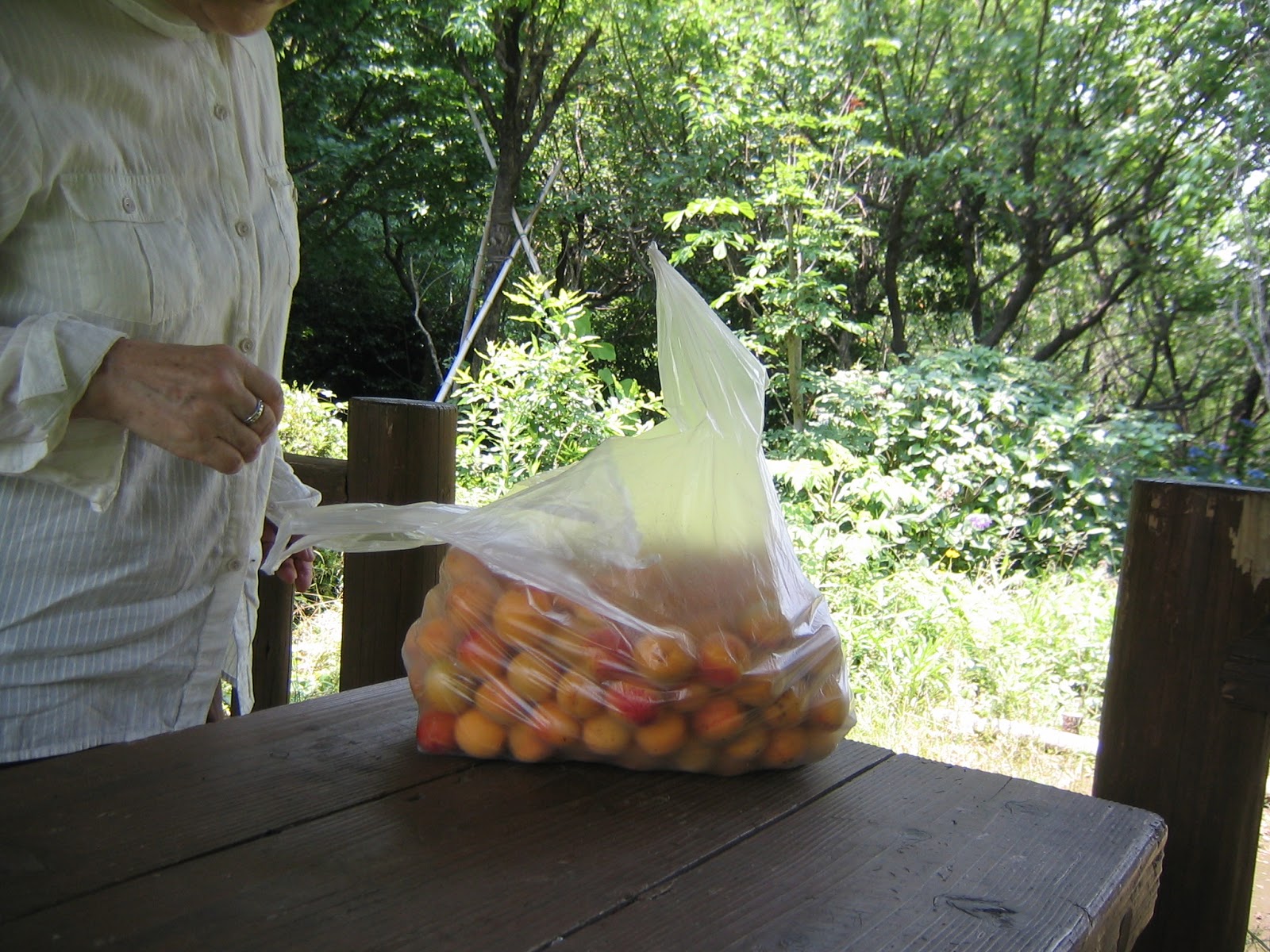
One day in June, when I visited the Hiroba, there was an old lady within the orchard, clearing the ground. She was a landlady and the guardian matron of the Forest. According to her, the original idea of keeping the fruiting peach trees flopped and the volunteers planted the other trees instead. Apricots become so-so successful fruiting once every 2 years. This year (2015) is disappointing for apricots as we had spring days of strong winds when apricots flowers were blown off. Though, trees for prunus mume fruit abundantly every year without fail. And so, she has the problem … too much ume fruits and she is the only one to cook. Volunteers to cook this bounty are seriously needed! Her ume fruits ripe well, and I guess they will be very good pickled plums (Umeboshi 梅干).

After about 20 minutes of clearing
This large plum trees with lots of fruits …
By the way, at the entrance of Momo-no-sato Hiroba from the residential area, there is a very tall tree whose leaves looks suspiciously like peach. At the top boughs, there are lots of plum-sized, but still green fruits in June … Japanese wild peaches are small, and the leaves are a kind of gourd shaped … Aren’t they peach?

Japanese wild peaches are not that large
nor too sweet,
but certainly loved for millennia.

If you find a problem in the Park, please make a contact with

Office for the Park Greeneries in the North 北部公園緑地事務所
Yokohama Municipal Government Creative Environment Policy Bureau 横浜市環境創造局
Phone: 045-311-2016 (I guess in Japanese only)
FAX: 045-316-8420 (I hope there is somebody who can read English …)