|
| woof,
Woof, WOOF! |
According
to Mr.
Kiyoshi Tanigawa 谷川潔 of
Kanagawa Prefecture, we have to take it for granted that all the slopes of
Tanzawa Mountains 丹沢 we can see from Odakyu Odawara Line 小田急小田原線 are
residential areas for the community of bear families, just like residential
areas of homo sapience spreading next to their forest. Ditto for the other wild
animals. So, in Yadoriki Water Source Forest やどりき水源林 in the south slope of Mt. Nabewari, a casual
hiking can present us surprises of poops of bears, traces of boars, deer
ravaged bushes of Boehmeria spicata, rushing
sounds of movement by birds, and, etc. etc. Er, well, if you know what to look,
of course. Kanagawa Forest Instructors are watching and recording such traces
of animals on regular basis in Yadoriki Water Source Forest. This year, as a
first year instructor, I joined the activities of my seniors several times.
That was, I tell you, a fun!
First,
Shika deer (Cervus Nippon) in Tanzawa
Mountains. As I told you in this blog several times (please see the post on April
27 this year, and a series in July 2017), deer is one of the major problems
Tanzawa Mountains face for its sustainable biodiversity. When Kanagawa Forest
Instructors enter the forest on the foot of Mt. Nabewari 鍋割山 (ASL 1272m), the route inevitably passes deer
fences which are expected to keep deer out of the area and protect the forest
from their appetite. As a part of monitoring the animal around the fences,
Forest Instructors have installed recordable infrared cameras here and there,
and check the data (and batteries) whenever the instructors pass by the area.
Yeah, I knew how the machine looked like thanks to televisions et al, but I
have never seen the real one till this summer. The equipment was a small box in
a size of tapper ware for lunch. They record the scenery watchable from the
camera 24/7, and record digitally in a micro SD card. “Yeah, these days there
are tools of higher resolution that can beam up the data to satellite and relay
it to our PC via internet.” “And they can be less than $200.” “But it eats up
batteries, unless we have reliable solar panels, or else.” ”Yeah, that’s the
machine difficult to maintain for projects of citizen science, like ours.” My
seniors change micro-SD cards and AA batteries regularly, but “Not every time
we come here, you know. No need to do that. This machine is economical and
reliable.” Although I have not yet seen the pictures the machines took, the
instructors say grainy continuous photos are good enough to identify the kind
of animals pass by. If a half-broken fence is nearby and the machine records a
stag slowly going to the direction of the defective point, it’s over-sufficient
data for the Prefecture to spend the budget for mending the deer barrier. It’s
one of the miniscule, but important tasks Kanagawa Forest Instructors engage in
for the forest of Kanagawa Prefecture.
 |
| Kanagawa
Forest Instructors change the SD card and batteries. |
 |
This
is the camera.
I think it is recording me and my camera now. |
 |
| It’s a
relatively common scene to find carcass of deer in Yadoriki. |
 |
| Poops
of deer |
Another
regular, quiet but fun activities the Forest Instructors do in Yadoriki Water
Source Forest is nature observation meetings with an emphasis on non-vegetative
land creatures. The objective includes not only mammals, but also bugs and
birds. They are often indicator species that can signal the ecological health
of the area. “That point has been a spot for beautiful tiger beetles (Cicindela japonica),” which means the
environment of the place is sunny and wet enough with shaded riverside nearby.
As the beetles are carnivorous, lots of the other bugs must be thriving for the
tiger beetles to sustain themselves. But. “Disappointing … we could not find a
tiger beetle here this year …” “Yeah. The summer is too hot for the insects to
be active.” “Yes, yes. The weather might do something for it …” We could
identify a kind of border for territorial birds by listening the changes in
bird songs. “In this side of the river (Yadoriki Stream 寄沢), don’t you think we do not have much voices of Japanese
Green Woodpecker (Picus awokera)?”
“Hmmmmm … let us see …” Quiet stroll ensued to listen carefully. Droppings are a
guide for daily life of mammals. “Er, well, this poop is certainly large.” “But
I think it’s too small to be feces for Asian Black Bear (Ursus Tibetanus).” “Yeah. It’s a size for a wild boar (Sus scrofa).” “I see.” That was a sort
of surprising thing to know for me. The way boars proceed in a forest looks
like a bulldozer excavating the ground for protein (insects, worms, …). Roots
probably taste like potato for boars I guess. Larger poops for boars sound
natural, don’t you think?
 |
A
mantis in our insect net.
Nets are a very important tool for recording the
species. |
 |
| Poops
of boars! |
 |
Montane
brown frog (Rana ornativentris Werner)
in Yadoriki Forest.
It’s still small.
After identifying and recording the
species,
we release all the creatures from captivity. |
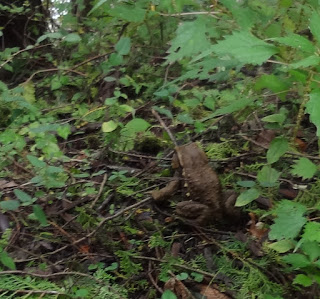 |
| Meditation
of a Japanese Toad (Bufo japonicas)
in Yadoriki … |
 |
Another
poop in Yadoriki.
My seniors discussed if it is for masked palm civet,
or
common raccoon,
both of which are designated “invasive” species.
Hm.
So,
Yadoriki is facing that problem now. |
 |
| Another
field sign … the result of hunting by a predator … |
One of
my senior instructors told me he can meet Japanese serow (Capricornis crispus) easily especially early morning along Hadano Forestry Road 秦野林道. “Yeah, the serow and I are a
kind of regulars. This morning (; I heard his story this July), I started to
hike around 7:00 from red Yadoriki Ohashi Bridge 寄大橋. I soon meet that guy in front of me. He looked
young, and I guess the place along Hadano Forestry Road is his territory. We
look each other for a while, and, believe me, I smiled at him. Though, he
started to take I’m-going-to-assault-you position. So I retraced my steps to the
Bridge!” He showed me the photos he took during his early morning adventure
with the serow. I think my first encounter of the species was with him. There
is a consensus among the instructors, which defines the character of the serow
as “young, vivacious chap that loves to come to see our face if he has a
chance.” Actually, we met him several times during our vegetation census along
the forestry road this summer. He always kept a safe distance and looked down
on us from higher slopes along the forestry road. Clever.
 |
This
photo was supposed to capture our encounter
with the friendly serow along the
forestry road.
He’s hiding in the trees almost in the upper middle of this
picture … |
 |
| The
serow I met tête-à-tête in Yadoriki. |
The
Japanese serow on Hadano Forestry Road may be friendly. But there is no guarantee
that all the animals we can meet along the forestry road share the same opinion
about humans with the serow. In late November, when I train myself to take
close-up photos of mosses, I heard a large animal sliding down a steep slope on
the south of the forestry road. Boar? Deer? Serow? Or, Bear? Anyway, it was
going away from the road, so no problem! I proceeded further to the direction
of Lake Tanzawa 丹沢湖. Then, suddenly, a familiar
scent of zoo was wafting around me. Boar? Deer? Serow? Or, Bear? Never mind, …
me and mosses further ahead … I eventually noticed that was a time to return to
the bridge to be on time for the meeting with my senior instructors. I turned
on my heel. At my back I hear a deep muttering sounds like from a gorilla. woof,
Woof, WOOF! Excuse me? Who are you? … Don’t look back. Don’t run. Walk calmly! I
explained my experience to the other instructors, and they concluded, “Naomi,
that was a bear.” Woooooooooooooooooooops ...
 |
Still,
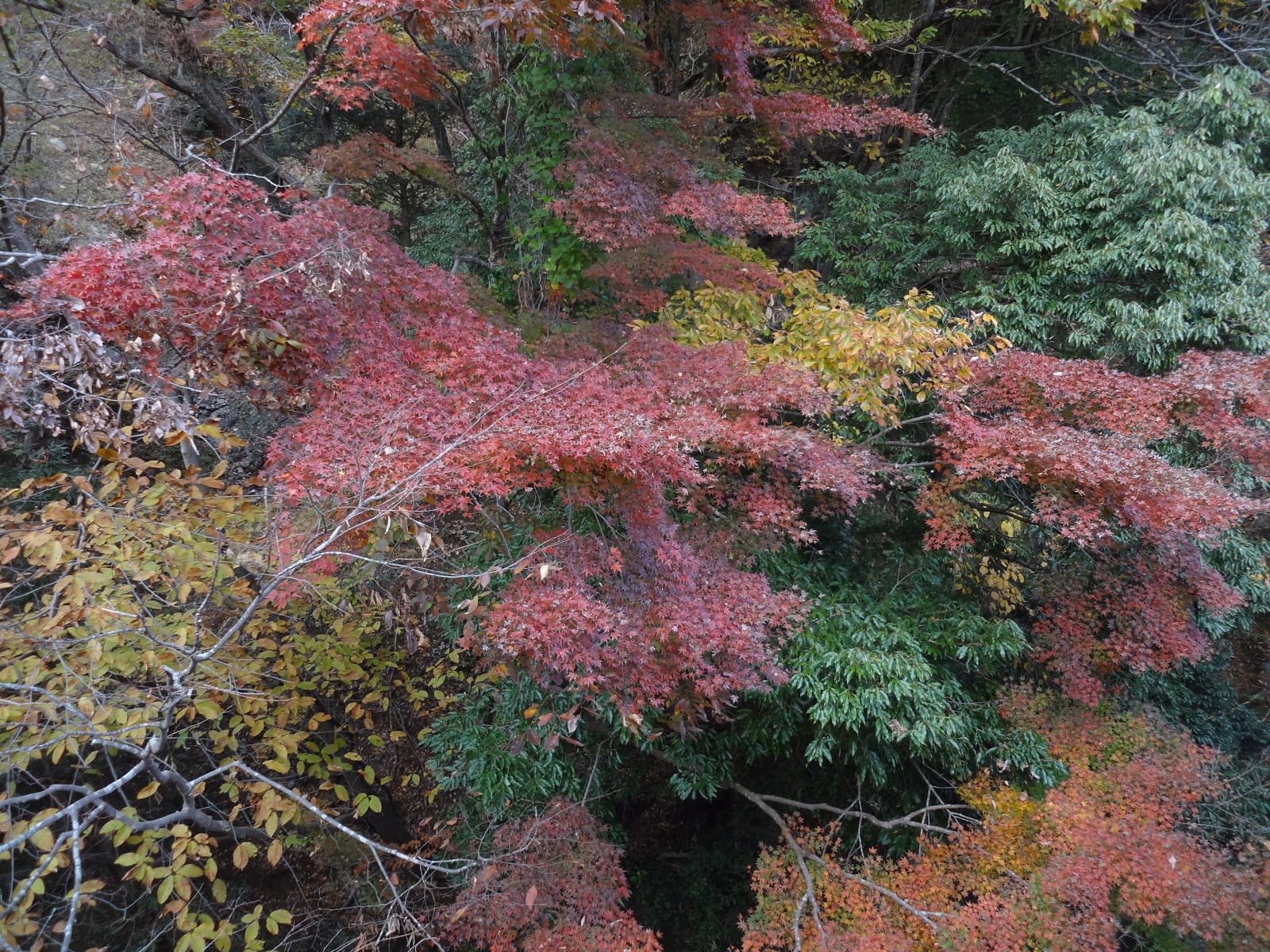
it was a beautiful afternoon of autumn in Yadoriki
… Do you find a menace of
bear in this photo? |
I
actually hate to carry a bear bell to enjoy walking in mountain. BUT …
If you find an environmental issues
in Kanagawa Prefecture, please make a contact with Kanagawa Natural Environment Conservation Center 神奈川県自然環境保全センター
657 Nanasawa, Atsugi City, 243-0121 〒243-0121 厚木市七沢657
Phone: 046-248-0323