Showing posts with label Hayama. Show all posts

Sunday, November 9, 2025

Keepsake of a Prince: Tenjin-jima Marine Biological Garden for the Yokosuka City Museum 天神島臨海自然教育園


The shores of Tokyo Bay are more or less concreted. Since Tokyo became the center of Japanese politics in 1600, people has continuosly engaged in massive civil engineering projects such as reclamation and changing the course of rivers. Now the look we have for the Bay is as such. Even though, there remains few spots where we can experience the remnants of original ecosystem. The previous Tone River and Arakawa River poured in the Bay from the east. The east shores of Tokyo Bay were a low land delta of these rivers. The remaining natural shores of the Bay for Chiba Prefecture are tidal flats of shallow sea. The west shores of the Bay, i.e. Kanagawa side, were the continuation of such flats until around Kan‘nai business district of Yokohama where in the 19th century many ships from overseas arrived. When Japan ended national isolation in 1854 and decided to have the Port of Yokohama in 1859, the first thing people thought was how to supply flesh water for longhaul ships. Yokohama at that time was a tiny village floating in a muddy swamp. Well water was/is salty. And so, there was the construction of the first modern water supply system in Japan for Yokohama, blah blah blah (; my post for January 12, 2018).

Concreted Port of Yokohama

The current Yokohama Chinatown is more or less the end of tidalflats. To the south from Yokohama Yamate (neighboring town to the Chinatown) to the tip of Miura Peninsula, the shores were created by plate techtonics. When the Philippine Plate crawled underneath the Eurasian Plate about 20 -15 million years ago, the earth‘s energy pushed up the deep sea sedimentary mass above water which is the origin of Miura Peninsula. Especially the south of the Miura Peninsula is coastal terraces where small but steep hills are tumbling down to the Tokyo and Sagami Bays, i.e. deep and rocky. That‘s the reason why the US 7th Fleet with an aircraft career uses the Port of Yokosuka. As its geological feature gives nice condition for humans to build ports, Miura Peninsula has lots of harbors, and so concreted. Even though, there are several natural seashores where we can enjoy the sea. One of such place is Tenjin-jima Marine Biological Garden 天神島臨海自然教育園 for the Yokosuka City Museum. It has a curious forest.

This is also Yokohama, 
in Nojima Island of Kanazawa Hakkei
 (; my post for September 2, 2022)
which is the south end of Yokohama.
Geologically,
this place shows one feature of coastal terrace.

The easiest access to the Garden is by car. It has an ample car park. You command your Car Navigation System to Tenjin-jima Marine Biological Garden, Yokosuka, and all set. I guess during summer, this parking MUST be very congested ... Using public transformation is another fun to go there. For this method, please go to the terminal station Zushi-Hayama of Keikyu Zushi Line. Leave the station from the South Exit and you immmeidately notice there is a Convini 7/11 over there and a bus stop in front of it. From there, please take Keikyu Bus Zu-71 逗-71 that brings us to Sajima Marina Entrance, the terminal stop. It‘s about 40 minutes bus ride, passing the gate of Imperial Summer House in Hayama, 葉山御用邸. I you remember our bus ride from the foot of Mt. Ogusu (; my post for April 24, 2024), this is the way we took from the opposite direction. Now we see Sagami Bay on our right from the bus. This time, the commuter service turn right before reaching the bus stop we used from Mt. Ogusu. The bus goes into Sajima housing area and reach the top of the hill, then descend down to Sajima Fishing Port. The final stop of this service, Sajima Marina Entrance, is next to the Fishing Port.

This is the bus which brings us to Sajima Marina Entrance,

and the terminal stop of Sajima Marina Entrance.

Get off at the terminal stop, and you‘ll find a cafe Portland‘s on your left. Take the road to the cafe‘s direction and turn left to a road in front of Portland‘s. Along the road, on your left is a Japanese restaurant Hikonoya, and on your right is a Italian restaurant AzzurrA Mare SAJIMA. I tell you both are at the high-end. There’s a reason for it. Passing AzzurrA Mare, there is a small bridge named Tenjin Bridge, and beyond of it on our right, there is an elegant white house with a large garden. It was a summer house of Prince Takeda … Explaining this princely house is a bit complicated … The Prince was a descendant of the 102nd Emperor Gohanazono (1419-1471). Emperor Meiji, Great-Great Grandfather of the current Emperor, had only one prince who came of age, i.e. Emperor Taisho, the Great Grandfather of the present Emperor. Japanese government at that time was afraid of the end of Imperial Family. Er, well, Meiji Emperor had 15 kids with 5 ladies (none the Empress). Among them 4 princesses survived and became adult enough to be a bride. So Meiji people did not have to worry if they were more female friendly. This way of thinking still continues for the current succession issues of Emperor in Japan … Anyway, the government at that time dug up the old documents to find a guy who had some blood relation to the Imperial family. They found and let him marry the 6th Princess of Emperor Meiji. In this way, the new Imperial family man became Prince Takeda and a younger brother of Emperor Taisho for the just-in-case scenario. Such thing did not happen, and the son of Emperor Taisho became Emperor Showa who met General McArther in 1945 after the defeat of the Pacific War. Prince Takeda returned to be a common man under the occupation by the US commander. Until that 1945 the graceful white house beyond Tenjin Bridge was the summer house of Prince and Princess Takeda. The princely family thought they should have such place near Hayama where their elder brother, Emperor Taisho, loved. Also, they secluded the place beyond the Tenjin Bridge as their private garden. That’s why now we had Tenjin-jima Marine Biological Garden, escaping concreat except the foundation of princely house. Next week, let‘s enter this nature reserve.

Portland‘s Cafe

Take the direction of the arrow.

Hikonoya

AzzurrA Mare SAJIMA

Tenjin Bridge. It‘s small.
Over there on the right is a former Imperial Summer House.
It is now a private property of a commoner.
Oh, by the way,
the place for Prince Takeda‘s principal residence is
 now Takanawa Prince Hotel in Tokyo.

Tenjin-jima Marine Biological Garden 天神島臨海自然教育園

3-7-3 Sajima, Yokosuka, 240-0103
〒240-0103  神奈川県横須賀市佐島3丁目7-3

Phone: 046-856-0717
Fax: 046-856-0717

Open 9:00 - 17:00 (April-September), 10月〜3月 9:00 - 16:30 (October-March)
Closed: Every Monday (or if Monday is National Holiday, Tuesday) and December 29 -January 3
Admission Free

You can send an enquiry to m-bes@city.yokosuka.kanagawa.jp

Friday, May 25, 2018

Beautiful forest and beautiful beach: Hayama Sangaokayamaryokuchi Park 県立はやま三ヶ岡山緑地


We are staying in Hayama. Seeing from the Hayama Beach to the northeast, we immediately notice a hill really close to the sea. Yeah, “Hayama, where the sea and mountains meet.” The hill is what we have observed from the top of Mt. Sengen-yama between us and the sea. It is a prefectural park, called Hayama Sangaokayamaryokuchi Park 県立はやま三ヶ岡山緑地. The paths in the Sangaokayama are for pure mountain trekking. The place is not for flip-flops of beach wear, but with good walking shoes and long-sleeved shirts and pants. Its steep slopes and cliffs rapidly come down to the sea, with roads often pasted on a cliff or narrow ridgelines. Though, they are well-maintained routes. Itinerary-wise, the place is self-contained and no tricky crossing exists as we have found in Mt. Sengen-yama. If you are accustomed to mountain roads, visiting the Park can be completed in 2 hours, lunch time included. i.e, Provided you prepare well, you can combine hiking with visiting beach and fashionable cafes in one weekend from Tokyo. Let us plunge into the forest of Sangaoka. 😄


When we see inland from Hayama Beach,
 the hill in front of us is Hayama Sangaokayamaryokuchi Park.


Before starting, I repeat myself since last week: please do not think you can visit Sangaoka with flip-flops and tank-tops. The peak of Sangaokayama Park, named Mt. Ohmine-yama (大峰山 ASL 143m), is on the top of cliffs. It has 3 approaches all of which have very steep steps constructed on narrow ridges. In addition, the place has rich vegetation in humid air from the sea. Except during deep winter, the forest floor of the place is a nice home for active Japanese pit vipers, or in Japanese, mamushi マムシ. The park does not have toilet or water faucets. We definitely need to be in good hiking gear to come there. Now, we are ready in our walking shoes, and there are 3 entrances to Sangaoka (a schematized map is here); to Shin’nase course 真名瀬コース, to Ajisai (Hydrangea macrophylla) course あじさいコース, and to Tsutsuji (Rhododendron) course つつじコース. I recommend to entering the forest from Shin’nace or Ajisai entrance and exit from Tsutsuji gate. Both Shin’nace and Ajisai courses first have very steep and long steps as in Mt. Sengen-yama that would be easier to manage climbing up than going down. In any case, first you take a commuter bus called “Kaigan-mawari (海岸回り Sea-Side Route)” from #2 Bus Stop in front of Keikyu Shin-Zushi Station 京急新逗子駅. They have lots of services so that you don’t have to worry time-table. All the entrances of the Sangaokayama Park can be accessible from the bus stops of Sea-side Route of the commuter bus services.


For Ajisai Course, we get off at Morito-jinja Stop (森戸神社 Morito Shrine), and walk north for about 100m to turn right at the corner of Starbucks. On your left is a venerable delicatessen Hayama Asahiya Beef 葉山旭屋牛肉店, and then Union Supermarket. Passing these and going south, please turn left at the first corner after the Union Supermarket. We proceed in a quiet residential area to turn right next at the third corner. The road starts to gain altitude although we are still in the community of uptown houses. Don’t be tempted to turn left or right and just keep on climbing to the hill in front of you which is actually the Sangaoka Park. Eventually, there will be a clinic on your right along the road. Around there, the slope becomes more mountain-like (but completely paved) and at the end of a short climb is another road with pedestrian crossing. Over there you’ll find a sign saying “Entrance to Ajisai Park.” Bingo. Enter that narrow, but paved climbing residential road which ends at the stone wall of the foot of Sangaoka Park. On your left, we can figure out the sign “Entrance to Ajisai Route.” ¡Adelante! This entrance is a kind of neighborhood garden with a view to Sagami Bay. In today’s itinerary, there is only one toilet which is at this entrance. If you need, please do not miss your chance here. Entering the forest, the road is immediately climbing up with steep steps for about 200m. This is the route shortest to the top of Mt. Ohmine-yama of ASL 143m. If you climb the hill in stride, it takes less than 20 minutes to the peak. As the entrance of the course is about ASL 25m, we gain more than 100m of altitude in 20 minutes’ time. 


Delicatessen Asahiya Beef
A clinic on your right
The sign to “Ajisai Park”
Find that sign. It’s the entrance to Ajisai Route.
Entering, the road soon diverges in two.
 To toilet please take right.
It ends with a community garden with lots of Hydrangea macrophylla.
 The place was once for Hirayama Hotel of Hayama established in 1893.
 The hotel was built in a European colonial style
 and a base camp for vacationing expats of 100 years ago.
 It was there until 1978.
From the garden, we have a nice view of Sagami Bay 相模湾.
 Mmmmmmmmmmmm,
 spring haze covers Mt. Fuji that was supposed to be in front of us …
 
Toilets, or remnant of the hotel.
Going back to the trekking road.
 All the 3 entrances of Sangaokayamaryokuchi Park
 have a small transparent box for us
 to pick up a map of the park.
 They also have storage for walking poles.
 The system is, we use one of those,
 and return it at another gate when we leave.
Up, up, up …
And the road becomes relatively spacy mountain ridge
 (compared with the other ridge ways of the Park).
And another (several) steep climbs …
approaching to the top of Mt. Ohmine-yama (ASL 143m).
 This park really has many picnic benches ... 
With a view.
 We can observe Shin’nase fishing port
真名瀬漁港 down there.


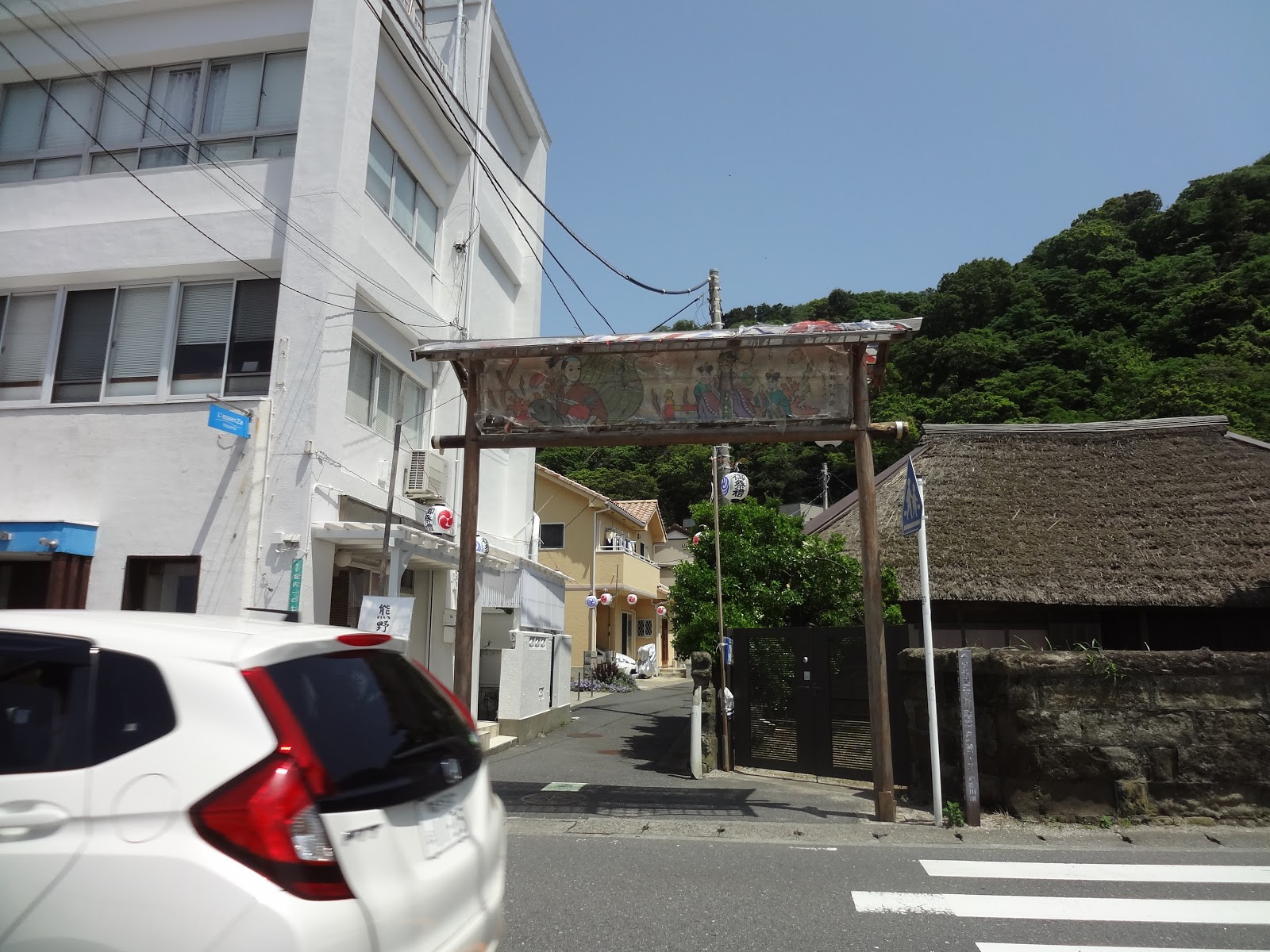
For Shin’nase course, please get off the bus at Shin’nase Stop 真名瀬 next to Morito-jinja Stop. Walking 50m or so to the south, on your left there is a Torii gate that was an entrance to Kumano Shrine 熊野神社 of Shin’nase Fishing Village. Through a narrow community road, we reach to the sanctuary of Kumano Shrine, where on the right of the shrine building there is a sign saying “Shin’nase Route, this way.” The route climbs up rapidly with steep steps along a narrow ridge way. In the middle there is a metallic gate coming up from the valley with a notice “Tsunami escape route.” Wow. People of Hayama Town must have prepared to conquer these cliffs in backyard if emergency happens …For about 10 to 15 minutes’ climb we reach to an open space, named Nishimine Open Forest 西峰疎林広場, which is a beginning of more leisurely walk on the ridge of Sangaokayama. The open space has a name plate saying “the place is open to the public thanks to the generosity of Kajima Family,” the founder and the largest shareholder of Kajima Co.  Oh, soooooooooooooo Hayama. From the ridgeway of Shin’nase course to the top of Mt. Ohmine-yama, we can observe Sagami Bay and Mt. Fuji to the left, and Pacific Ocean to the right. About 200m from the Nishimine Open Forest, there is a view point to Sagami Bay. The shape of Mt. Kintoki 金時山 is clearly recognizable from here. In May, chic rearing birds are very busy singing along the way. Lots of lesser cuckoos somewhere around me … in about 20 minutes or so from the open space, we reach to the top of Mt. Ohmine-yama.


The torii that we can find from the bus stop.
At the end of the road is Shin’nase Kumano Shrine.
 Every May 15th,
 they dedicated a special Kagura Dance
神楽 to show gratitude to the protection of
 the god of Kumano Gon’gen
熊野権現.
The entrance to Shin’nase course of Sangaokayama Park
The escape route from tsunami
 for Shin’nase community people …
This kind of steps continues for a while to
Nishimine Open Forest.
 The place also has several picnic benches.
A typical ridgeway of Hayama area.
 Both sides are tumbling down.
 I think this part is relatively wide.
A view to Sagami Bay.
 Spring in Kanagawa is always like this …
 a bit hazy even in very sunny day.
 Mt. Fuji should be in the center of this photo!
And we have arrived at the peak of Mt. Ohmine-yama.


From the top of Mt. Ohmine-yama to the foot of the hill, we now descend via Tsutsuji (Rhododendron) course. Distance-wise it is the longest in today’s itinerary, but I found the easiest as its road is not that steep nor narrow as the other two courses. The road continues leisurely with ups and downs, with a feel of deeper forest than the other two courses. I later checked to confirm that the road runs certainly a bit horizontally further from the towns down there ... but that’s not the only reason of its secludedness … The route has two more viewing points, and after the second point named Higashimine Open Space 東峰広場 it goes down steadily to the foot of the hill. The end (or beginning) of Tsutsuji course is Isshiki 一色 residential area. Just going forward in a narrow but paved road between houses, we come to the beautifully wide National Route 134 where on your right is a walled pine forest with a wide gate and a police. Yes. It’s Hayama Imperial Villa.


To Tsutsuji course from the top of Mt. Ohmine-yama,
 let’s simply go straight from Shin’nase course.
In general Tsutsuji course is gentler than the other two.
A picnic table at the first viewing point
 from Mt. Ohmmine-yama in Tsutsuji course.
And the view of Sagami Bay from there …
From the second viewing point,
 the route goes down in honest.
Almost to the goal …
all in all the forest of Sangaoka has a light-touch
 even if the forest itself is deep
 along Tsutsuji course such as here.
A photo taken from the outside of the gate for Tsustuji course.
Soon we come to a utility road of Isshiki Community of Hayama.
We come out from the road on the right of this photo.
 A small cake shop on the left is Hayama Lemon Tree
 famous for her donuts and cheese cakes.
 Some celebrities drive from Tokyo to bring the sweets home.
The nearest bus stop from
 Tsutsuji course gate is
 Kyu-Yakuba-Mae Stop
旧役場前.
A bit further down to the sea is Hayama Isshiki Post Office.
 Wow, the building looks like a café, but it’s a post office …
And over there is Hayama Imperial Villa.


Until 1945, from there to the current Museum of Modern Art, the Imperial Villa occupied the beach side far larger than now, and hence contributed to the wider and deeper forest in Tsutsuji course of Sangaokayama. As such, if you exit from Sangaoka Park from Tsutsuji course gate, you will meet with fashionable cafes, restaurants, or even apparel boutiques along Route 134. Bonus: take a narrow road along the wall of Imperial Villa to the sea, and before you is Hayama Isshiki Beach 葉山一色海岸. We people in Kanagwa secretly know this is the best beach in the entire Sagami Bay. Imperial Family traditionally has several marine biologists and this is their research field. Inevitably, the water is very clean, and the town ordinance controls the usage of the beach not for party of summer nudists. You can enjoy relaxing and far-quieter sun bathing during summer. If you still have time you can visit Hayama Shiosai Park 葉山しおさい公園, next to the Imperial Villa, where they preserve old Imperial buildings in which Emperor Hirohito was crowned at the time of his father’s death. Next to Shiosai Park is the Museum of Modern Art of Kanagawa Prefecture whose curators regularly organize interesting exhibitions that are certainly not for downtown Tokyo. And the view of Mt. Fuji from Isshiki Beach is (if you can see) straight from ukiyoe of Hokusai. Hayama is the town of Japanese royals, both its sea and mountain of deep but light forests.


If we take a small alley along the Imperial Villa,
 we will come to 
Hayama Isshiki Beach
The gate to Hayama Shiosai Park.
 Admission: 300 yen for adult, 150 yen for kids.
And next to Hayama Shiosai Park is
 Museum of Modern Arts in Hayama.


If you find problems in Sangaokayama of Hayama, please make a contact to

Yugawara Town Hall 葉山町役場
Phone: 046-876-1111

www.town.hayama.lg.jp