
The project for Western Nakagawa is 90% funded by the City of Yokohama for FY 2022-2024. For three years, the money from Green Tax they received was about 96 thousand dollars. Wow. With this money, people of Western Nakagawa formed Nakagawa Group for Green, Water and History 中川緑と水と歴史をつなぐ会 (NGWH) overhauled shrubberies along commuter pedestrian roads in the area starting from Nakagawa Station. They also developed “garden” in the bank of Hayabuchi River 早淵川. This garden, named HRG (Hayabuchi-Robaya Garden早淵-老馬谷ガーデン), was first created in 2017 at the time of the National Urban Greenery Fair for Yokohama (; my post on March 31, 2017). The objective of the project this time has been to brush-up HRG after 5 years of its inauguration, and gentrify the route connecting Nakagawa Station and the garden. The target is, hopefully, with Green-up booster money, the commuter routes achieve certain degree of autonomous maintenance system, supported by the locals who live and own their sweet home in Western Nakagawa. As this is the final year of the project, it is too early to evaluate whether their target is met, I think. Anyway, let me introduce you to what their work looks like at this moment.
 |
| A
member of the Nakagawa Group for Green, Water and History |
We started our tour from the Community Center for Western Nakagawa, near Nakagawa Station. It was still warm October afternoon. Around the Center, there were lots of lots of kids engaging in afterschool activities. I thought it was a promising sign of the community in this extremely aging nation. The town had potential for sustainable development for their greenery in the long run, hadn’t it? In front of the Center is a bamboo forest for Karasuyama Park, which is maintained by the City and Park volunteers. The basic design of the commuter route was done when the place was developed in the 1970s as a part of Kohoku New Town. The area around Community Center is public land so that the City’s engagement must have been continuous from the beginning. It had a nice atmosphere with well-maintained greens. Yeah, moms and dads should be relaxed for their kids to spend their afterschool there. The east of the Center and the Park was a 4-lane car road, and the north was condos. These two directions are in public domain. The responsibility of maintenance is mainly bore by the City and UR (Urban Renaissance Agency, a semi-public institution for housing in Japanese cities). The work by Nakagawa Group is in the west and south of the Community Center / Park.
 |
| Community Center for Western Nakagawa |
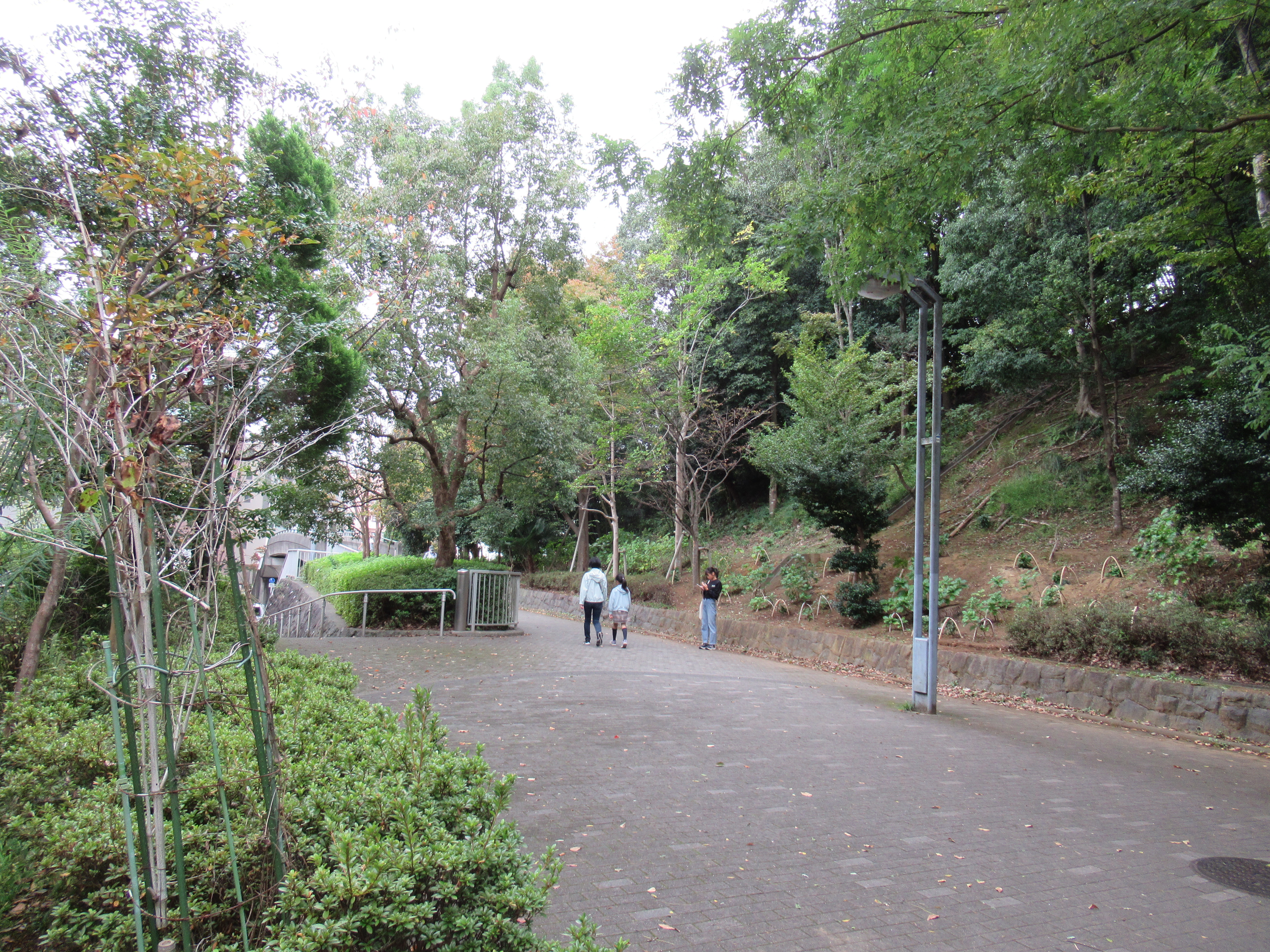 |
| Well-maintained environment around the Center |
 |
| Beautiful bamboo forest |
Basically, Japanese law defines land-tenure VERY important. Corollary of this stance is, the responsibility to manage one’s own property should be entirely taken by the landlord, even if that “lord” is an owner of small house. Many original owners of the detached houses to the west and south of the Center/Park bought and moved in the place roughly 30 years ago. Yeah, some household well transferred the ownership to the new generation. But not all of them may be so successful. It’s inevitable the appearance of the shrubberies on private land along the commuter road is getting untidy. One of the original intentions of the project was to treat this problem with subsidies from Green Tax. The members of NGWH include the neighborhood associations of the area. They asked and funded households along the main pedestrian route to plant unified ground cover, Sasa glabra 'Minor' to be exact, on their land and trim private shrubberies matching with the Sasa glabra. If the front yard space is paved as a car port, NGWH provided containers with plants suited for the color scheme of Sasa glabra. I thought it was a generous arrangement. Some pots may have costed USD 100 or so and it was funded by tax. Hmmmmmmm. Yes, by doing so if the security of the area is maintained for kids to grow up without worry, it should be worthwhile investment. I felt the determination of the people of NGWH to keep their hometown comfortable.
 |
| The
private property replying to the request for beautification of the corridor. |
 |
| Publicly funded front yard of a private house |
 |
| The
above two photos have a black plate telling it is funded by Green Tax. Another sign is this one with the mascot “Happy” for Yokohama’s Green-up Program. Oh, by the way, in Japanese, leaves are called “Happa.” So, it is Happy. |
Even though, there are several patched with (apparently) invasive silver grasses. A person of NGWH said there is a problem in coordinating the intentions of original member of New Town and recent comers. He said “The new residents moved in after the New Town is fully established. They could take the trimmed shrubberies for granted. Sometimes they do not have an idea of gardening …”
 |
| The front
is work done by NGWH people. The background along the wall is under the jurisdiction of the landlord living above the stone wall. |
I recalled a murmur of a landlady in London where I lived long ago … “Naomi, telling you the truth, I wonder how Japanese people garden their home in Japan. Many Japanese expats do not care the maintenance of their rented home. The property could end up with a very untidy garden after they leave. Because of this, some people do not like to have a Japanese tenant for their property …” Er, well, come to think of it, many urban Japanese, especially in their 50s and younger, may not have an experience to take care of private garden. Many of them live in condos whose garden space is extremely limited. You just glance at the aerial scenery of Tokyo from the airplane window when you take off from Haneda Airport. It’s a vast expanse of continuous houses and buildings sticking together without cushions of greenery. The other day, I met a lady who was excited to see red persimmons dangling from a tree in our garden for autumn. “Naomi, I didn’t know persimmons grew in this way! I’ve known them only in supermarket.” For her, taking care of the home garden should be a VERY new thing. The challenge for NGWH is to persuade such new people to maintain neat shrubberies of their property. Such tasks require commitment. It could be difficult for some to see the point of NGWH activities, I guess …
 |
| Keeping a garden is always a task requiring dedication. |
One solution to such problem is involving the PTA of Nakagawa Nishi Junior High. The campus sits in the center of NGWH’s project area. It’s big. The corridor surrounding the School is certain length. If that part of pedestrian road could keep the greenery, it can affect the morale of the community. From parents’ point of view, maintaining a nice environment around the school of their kids is surely good for education. Win-win! Currently, the dads’ club of Nakagawa Nishi Junior High PTA engages in gardening for a strip of land of 1m-or-so wide surrounding the campus. They plant several shrubs to renovate the place. It’s only their 3rd year, and the greens are still very tiny. Whether this collaboration is successful will be seen in another 3 years’ time, I suppose.
 |
| Dads’ work for Junior High |
Another focal point of NGWH’s project is the Garden along Hayabuchi River, HRG. Looking the structure of the land allocated for HRG, I think the place was intentionally made “vacant” by the original planner of the New Town for flood control of the River. The bank of Hayabuchi River at that point is heavily concreted probably after heavy dredging. Now it looks like an artificial canal, rather than a natural river. As Tsurumi River system was ferocious when it flooded (; my post on September 20, 2020), such treatment of its tributaries would be inevitable, especially when the area is developed for housing. Immediately above the river runs a commuter road, then the space for HRG. The detached houses are standing higher up on retaining wall above HRG. NGWH people try to gentrify such no-man’s land with flowers, lovely shrubs and climbers for the wall. Their intention is to make the flood controlling space for a strolling path at least the weather is fine and the river is OK.
 |
| A road running immediately along Hayabuchi River |
 |
| People want to make this space an established garden. |
 |
| I think this is fun! |

As the HRG garden started in 2017, this is their 8th year. It seems to me, there is a long way to go to make the place at the level of environment surrounding the Community Center where we started our walk. Er, well, Karasuyama Park is about 40 years old with heavy involvement of public money. Comparing HRG with Karasuyama Park is cruel. But it is their final year using the resources from Green Tax. I guess there would be inevitable funding problems. Flowers are not cheap. NGWH people plan to raise post-Green Tax money asking donations through fund-raising activities. For that matter, the maintenance of commuter roads after the project is also expected by the home-owners whose property happens to be facing these routes. i.e. Persuading households would be a task of Neighborhood Associations for a long run, say for 40 years, if people of Nakagawa wants to make the result of the project like for the Community Center and Karasuyama Park ... can we call it sustainable?


Strategic Planning Division, Green Environment Bureau, City of Yokohama
横浜市みどり環境局戦略企画課
Phone: 045-671-2712
FAX: 045-550-4093 Email: mk-kikaku@city.yokohama.lg.jp


