Showing posts with label Kohoku New Town. Show all posts

Sunday, November 24, 2024

My Garden: Yokohama’s Green Up Plan and management of neighborhoods environment 3


The project for Western Nakagawa is 90% funded by the City of Yokohama for FY 2022-2024. For three years, the money from Green Tax they received was about 96 thousand dollars. Wow. With this money, people of Western Nakagawa formed Nakagawa Group for Green, Water and History 中川緑と水と歴史をつなぐ会 (NGWH) overhauled shrubberies along commuter pedestrian roads in the area starting from Nakagawa Station. They also developed “garden” in the bank of Hayabuchi River 早淵川. This garden, named HRG (Hayabuchi-Robaya Garden早淵-老馬谷ガーデン), was first created in 2017 at the time of the National Urban Greenery Fair for Yokohama (; my post on March 31, 2017). The objective of the project this time has been to brush-up HRG after 5 years of its inauguration, and gentrify the route connecting Nakagawa Station and the garden. The target is, hopefully, with Green-up booster money, the commuter routes achieve certain degree of autonomous maintenance system, supported by the locals who live and own their sweet home in Western Nakagawa. As this is the final year of the project, it is too early to evaluate whether their target is met, I think. Anyway, let me introduce you to what their work looks like at this moment.

A member of
the Nakagawa Group for Green, Water and History

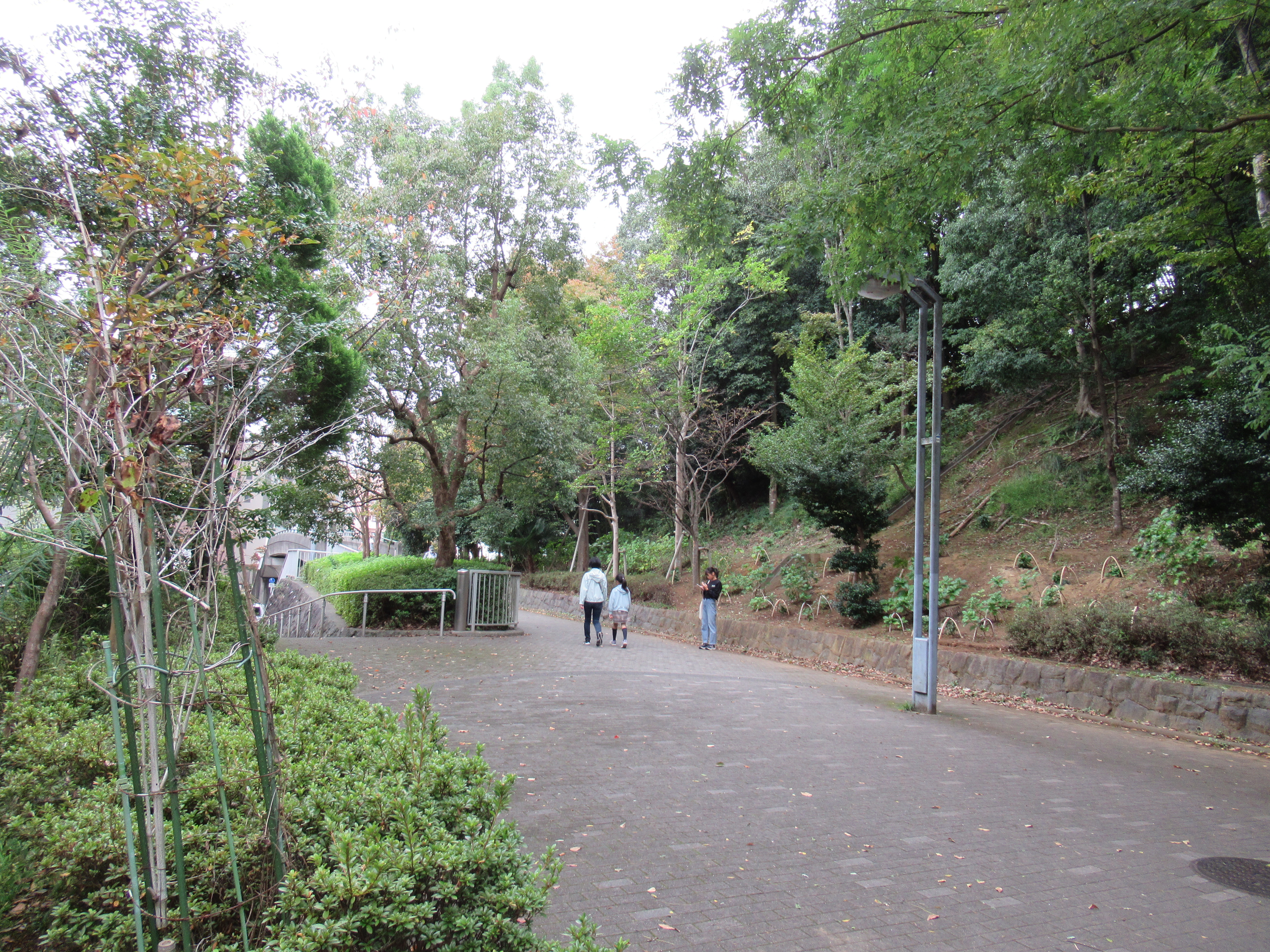
We started our tour from the Community Center for Western Nakagawa, near Nakagawa Station. It was still warm October afternoon. Around the Center, there were lots of lots of kids engaging in afterschool activities. I thought it was a promising sign of the community in this extremely aging nation. The town had potential for sustainable development for their greenery in the long run, hadn’t it? In front of the Center is a bamboo forest for Karasuyama Park, which is maintained by the City and Park volunteers. The basic design of the commuter route was done when the place was developed in the 1970s as a part of Kohoku New Town. The area around Community Center is public land so that the City’s engagement must have been continuous from the beginning. It had a nice atmosphere with well-maintained greens. Yeah, moms and dads should be relaxed for their kids to spend their afterschool there. The east of the Center and the Park was a 4-lane car road, and the north was condos. These two directions are in public domain. The responsibility of maintenance is mainly bore by the City and UR (Urban Renaissance Agency, a semi-public institution for housing in Japanese cities). The work by Nakagawa Group is in the west and south of the Community Center / Park.

Community Center for Western Nakagawa

Well-maintained environment around the Center

Beautiful bamboo forest

Basically, Japanese law defines land-tenure VERY important. Corollary of this stance is, the responsibility to manage one’s own property should be entirely taken by the landlord, even if that “lord” is an owner of small house. Many original owners of the detached houses to the west and south of the Center/Park bought and moved in the place roughly 30 years ago. Yeah, some household well transferred the ownership to the new generation. But not all of them may be so successful. It’s inevitable the appearance of the shrubberies on private land along the commuter road is getting untidy. One of the original intentions of the project was to treat this problem with subsidies from Green Tax. The members of NGWH include the neighborhood associations of the area. They asked and funded households along the main pedestrian route to plant unified ground cover, Sasa glabra 'Minor' to be exact, on their land and trim private shrubberies matching with the Sasa glabra. If the front yard space is paved as a car port, NGWH provided containers with plants suited for the color scheme of Sasa glabra. I thought it was a generous arrangement. Some pots may have costed USD 100 or so and it was funded by tax. Hmmmmmmm. Yes, by doing so if the security of the area is maintained for kids to grow up without worry, it should be worthwhile investment. I felt the determination of the people of NGWH to keep their hometown comfortable.

The private property replying to the request
for beautification of the corridor.

Publicly funded front yard of a private house

The above two photos have
a black plate telling it is funded by Green Tax.
Another sign is this one with the mascot “Happy”
for Yokohama’s Green-up Program.
Oh, by the way, in Japanese, leaves are called “Happa.”
So, it is Happy.

Even though, there are several patched with (apparently) invasive silver grasses. A person of NGWH said there is a problem in coordinating the intentions of original member of New Town and recent comers. He said “The new residents moved in after the New Town is fully established. They could take the trimmed shrubberies for granted. Sometimes they do not have an idea of gardening …”


The front is work done by NGWH people.
The background along the wall is
under the jurisdiction of the landlord
living above the stone wall.

I recalled a murmur of a landlady in London where I lived long ago … “Naomi, telling you the truth, I wonder how Japanese people garden their home in Japan. Many Japanese expats do not care the maintenance of their rented home. The property could end up with a very untidy garden after they leave. Because of this, some people do not like to have a Japanese tenant for their property …” Er, well, come to think of it, many urban Japanese, especially in their 50s and younger, may not have an experience to take care of private garden. Many of them live in condos whose garden space is extremely limited. You just glance at the aerial scenery of Tokyo from the airplane window when you take off from Haneda Airport. It’s a vast expanse of continuous houses and buildings sticking together without cushions of greenery. The other day, I met a lady who was excited to see red persimmons dangling from a tree in our garden for autumn. “Naomi, I didn’t know persimmons grew in this way! I’ve known them only in supermarket.” For her, taking care of the home garden should be a VERY new thing. The challenge for NGWH is to persuade such new people to maintain neat shrubberies of their property. Such tasks require commitment. It could be difficult for some to see the point of NGWH activities, I guess …


Keeping a garden is always a task requiring dedication.

One solution to such problem is involving the PTA of Nakagawa Nishi Junior High. The campus sits in the center of NGWH’s project area. It’s big. The corridor surrounding the School is certain length. If that part of pedestrian road could keep the greenery, it can affect the morale of the community. From parents’ point of view, maintaining a nice environment around the school of their kids is surely good for education. Win-win! Currently, the dads’ club of Nakagawa Nishi Junior High PTA engages in gardening for a strip of land of 1m-or-so wide surrounding the campus. They plant several shrubs to renovate the place. It’s only their 3rd year, and the greens are still very tiny. Whether this collaboration is successful will be seen in another 3 years’ time, I suppose.

Dads’ work for Junior High

Another focal point of NGWH’s project is the Garden along Hayabuchi River, HRG. Looking the structure of the land allocated for HRG, I think the place was intentionally made “vacant” by the original planner of the New Town for flood control of the River. The bank of Hayabuchi River at that point is heavily concreted probably after heavy dredging. Now it looks like an artificial canal, rather than a natural river. As Tsurumi River system was ferocious when it flooded (; my post on September 20, 2020), such treatment of its tributaries would be inevitable, especially when the area is developed for housing. Immediately above the river runs a commuter road, then the space for HRG. The detached houses are standing higher up on retaining wall above HRG. NGWH people try to gentrify such no-man’s land with flowers, lovely shrubs and climbers for the wall. Their intention is to make the flood controlling space for a strolling path at least the weather is fine and the river is OK.

A road running immediately along Hayabuchi River

People want to make this space an established garden.

I think this is fun!


As the HRG garden started in 2017, this is their 8th year. It seems to me, there is a long way to go to make the place at the level of environment surrounding the Community Center where we started our walk. Er, well, Karasuyama Park is about 40 years old with heavy involvement of public money. Comparing HRG with Karasuyama Park is cruel. But it is their final year using the resources from Green Tax. I guess there would be inevitable funding problems. Flowers are not cheap. NGWH people plan to raise post-Green Tax money asking donations through fund-raising activities. For that matter, the maintenance of commuter roads after the project is also expected by the home-owners whose property happens to be facing these routes. i.e. Persuading households would be a task of Neighborhood Associations for a long run, say for 40 years, if people of Nakagawa wants to make the result of the project like for the Community Center and Karasuyama Park ... can we call it sustainable?


To some extent, it is a natural conclusion for very strong concept of property rights in Japanese basically green-less cities. Within such legal framework, I think people in Western Nakagawa do extremely well. They are somehow preserving the original concept of housing development plan for Kohoku New Town, i.e. to stop unplanned housing sprawling in Megalopolis Tokyo. Otherwise, the former satoyama environment of north Yokohama could have become like green-less continuation of houses like 23 Wards in Tokyo. But in this rapidly aging society with shrinking population, can they keep going this way? The people I met from Nakagawa Group for Green, Water and History were all senior citizens, probably above 70. I don’t know how many young people are active in their project, especially at the planning and managing level. Unless young generation shares the same awareness as their grandpas and grandmas to make their community abundant in green, grandpas’ endeavor will die out together with them … Telling you the truth, the issue is more challenging for Yokohama’s Citizen Forest recently. I tell you the story soon (after a bit more relaxed topics). Please stay tuned.


If you have any questions about Yokohama’s Green Tax and Green Up Plan, please make a contact with

Strategic Planning Division, Green Environment Bureau, City of Yokohama

横浜市みどり環境局戦略企画課

Phone: 045-671-2712

FAX: 045-550-4093 Email: mk-kikaku@city.yokohama.lg.jp


Sunday, November 17, 2024

Kohoku New Town: Yokohama’s Green Up Plan and management of neighborhoods environment 2


Kohoku New Town, approximately 2530 ha, was once typical traditional hills, valleys, farming communities and forests of Tama Hills. From downtown Yokohama, it’s in only 12km distance. Even from downtown Tokyo, it’s sitting within the 25km radius. There was no reason to leave rural forests as such especially during the high-growth era of Japanese economy, 1950-1970. In 1965 the then-mayor of the City of Yokohama, Socialist Kazuo Asukata, announced the development plan of the area as a part of post-war reconstruction design for the City. The northwest forests of the City, bordering with Kawasaki City, was designated as “Kohoku New Town” and polished as housing area which was a mixture of high-rise condos and detached houses. To make the place attractive, the government promised the area municipal underground services and a new route of Metropolitan Expressway. The reasoning for tons of public expenditure was “to stop unplanned housing sprawling in Megalopolis Tokyo.” I think the original intention of the planner was successfully met. Roughly demarcated area by Tokyu Den’entoshi Line and two lines of Yokohama Municipal Subway System is now a typical suburb of Tokyo with a nice Prefectural high school (Kawawa High 県立川和高校), strategically located good parks, and shopping centers of laid-back atmosphere. Yokohama-Aoba IC in the New Town serves as an interchange and exits from Metropolitan Expressway and Tomei Expressway, the two main arterial motor roads of Metropolis Tokyo.


There must have been a very high-level politics for Kohoku New Town during the early days of Japanese post-war period in the 1950s. The landlords of the place agreed to sell their property for the development, which was news, I guess. One of the landlords of the area was a descendant of Samurai who was famous in the 16th century Yamanashi Prefecture. He had really a VAST land of the area. After the deal, the samurai offspring became VERY rich and concluded his life as an owner of a small and cute flower shop in front of Tsunashima Station. He once said to his acquaintances, “Now I don’t have to work for all my life. But doing nothing is not good for my health. Flowers are pretty.” He did not have to care for profitability et al. Oh, so enviable life … Now there is no flower shop by his offsprings in Tsunashima. In any case, Kohoku New Town is one of the most affluent areas of Yokohama. Naturally, those who bought and developed the land want to keep it as such, I mean, “a rich place of the City of Yokohama.” The people thinking along this line include the City of Yokohama.

Kohoku New Town near Center-Minami Station

In 2024, Yokohama Green Up Plan started its 4th Five Year Plan. The third pillar of the plan is about gentrification of neighborhood whose budget for FY 2024 is 580 million yen (= USD 3.8 million, wow). The City funds neighborhood associations and Lovers groups for small gardens in the City to keep flowers and shrubberies orderly year around. The citizens maintaining flower beds not only for neighborhood gardens, but also for shrubberies along the city roads. A part of the budget is invested in Kohoku New Town. I’ve met Kohoku New Town people who are engaged in gentrification and maintenance of shrubberies of the public road. I talked with them and realized, although the level of politics would be smaller than that for the original development of New Town, maintenance of the New area is the result of political endeavor in neighborhood activities. If you’re interested in such things in Tokyo’s suburbs, please read on.

Well-maintained pedestrian road in Kohoku New Town
Nakagawa Station is a subway stop for both Blue and Green Lines of Yokohama Municipal Subway. To the northwest is Azamino Station of Tokyu Den’en-toshi Line, and to the southeast is Center-Kita (North) Station of the Subway. The area around Nakagawa Station is sitting pretty in Kohoku New Town, surrounded by lots of amenities. Unlike Center-kita or Center-Minami (South) stations, the area for Nakagawa Station is more of detached houses, with some condos standing. South of the Station is Yamazaki Park, one of the strategically placed municipal Parks for Kohoku New Town. The tributary of Tsurumi River, called Hayabuchi River, goes from the northwest to the southeast of the town. A road running along Hayabuchi River 早淵川 which is now meandering in housing areas was a part of Oyama Street 大山街道 (; my post March 17, 2017). On that route there is a tiny but old shrine called Roba-Kajiyama Fudoh 老馬鍛冶山不動尊. In short, Nakagawa Town is a part of Kohoku New Town, but preserves some remnants of old rural community of Tama Hills.

Hayabuchi River

Former Oyama Street, aka Route 246

Roba-Kajiyama Fudoh

Eastern half of Nakagawa Town is nearer to Center-Kita Station, a commuter hub of the area. The area has Nakagawa Hachimanyama Park 中川八幡山公園 so that amenity-wise Eastern Nakagawa is somehow self-sufficient for gentrification or such matters. Western Nakagawa around Nakagawa Nishi Junior High is nearer to arterial Route 246, but was a bit too “ordinary” suburb to claim fashionable Kohoku New Town. So, the locals of Western Nakagawa created Non-Profit Organization, “Nakagawa Group for Green, Water and History,” and from 2022 begun 3-year gentrification project of their neighborhood, funded by 10% local donations and roughly 90% from Yokohama Green Up Plan. FY 2024 is the final year for them to expect municipal budgetary help. I happened to have a chance to be introduced to almost a final touch of their project. It’s basically a volunteer-driven works with public help. In this framework what the City is doing is the same for Niiiharu Lovers: budgetary help with occasional technical consulting. Though unlike forest, it’s a matter of commuter roads in rows of houses. I thought there could be a peculiar political issue to make the endeavor successful. Next week, I report you what I’ve found there. Please stay tuned.

Nakagawa Nishi Junior High

If you have any questions about Yokohama’s Green Tax and Green Up Plan, please make a contact with

Strategic Planning Division, Green Environment Bureau, City of Yokohama
横浜市みどり環境局戦略企画課

Phone: 045-671-2712
FAX: 045-550-4093 

Friday, September 4, 2015

Developing: Kawawa Citizen Forest 川和市民の森


I mentioned in my first post that there are 42 Citizen Forests in Yokohama. True, but 7 of them are not yet open for the public, as of September 2015. For the remaining 35 Forests, 7 of them have opened in the last 3 years. I.e. roughly 30% of the Yokohama Citizen Forests are VERY new. Kawawa Citizen Forest 川和市民の森 is one of those babies. It opened its “gate” in April 2014. As such, 4 ha Kawawa Forest does not have an official web-site or a link to the map. Though, it seems to me the Forest will be a part of a nice half-day walking destination within few years. It is developing.


Kawawa Citizen Forest is the only Citizen Forest in Tsuzuki Ward 都筑区 currently. It’s located near Kawawa Station of Yokohama Municipal Subway Green Line. We leave the station from the South Exit by going down the steps. Then, the forest is just over there, in less than 10 minutes’ walk from the station. From this direction, the Forest is beyond a farm land and a cemetery. There is a tombstone with the date of the 1860s. The village around here was relatively new. Tsuzuki Ward itself is full of new towns, including Kohoku New Town 港北ニュータウン, one of the mega-residential developments in metropolitan Tokyo, where young families are building their lives. On the other hand, the Ward has the largest agricultural population in Yokohama. So, it’s a bit strange that Kawawa Forest is the only Citizen Forest in Tsuzuki. Actually, Tsuzuki Ward is preparing for another Citizen Forest, Ikebe Citizen Forest 池辺市民の森, in the southwest of Kwawawa Forest. I suspect the City is waiting for Ikebe Forest to be ready before providing us official internet links and the like to Kawawa Forest. Although such things are new around Kawawa Forest, between Kawawa and Ikebe Forests, there is pre-historic remains that is called Kagahara Remains 加賀原遺跡 in Tsukidematsu Park 月出松公園 (in front of the Yokohama Lab of KYOCERA). According to the Board of Education of Yokohama, the remains could date back to 2500 BC. People are living in the area for millennia. When Ikebe Forest is open, a walk for Kawawa Forest, Tsukidematsu Park, and Ikebe Forest would be a fun. Things are developing now. 

Going down this steps from the Station,
then, the Kawawa Forest is over there on the right
 (when facing to the direction of
Tsuzuki Fureai no Oka Station of the Subway).
Vegetable fields and a cemetery in front of the Forest
Tsukidematsu Park.
Excavation was done in 1977,
and the remains are now returned underground.
So, at the moment, the only map of Kawawa Forest I can provide for you is this one.

Map of Kawawa Forest
As it’s a new Citizen Forest, everything in the forest is new, including small trees planted probably quite recently. The road is simple and gentle for our knees to walk. The Forest is a hill of 4 ha. At the top, there is an open place surrounded by bamboos and large sawtooth oaks. The top of the hill also has a picnic table. So the trekking road of Kawawa Forest is first climb up to the open space, and then go down to the foot of the hill. In the middle of the road on the side of the City Subway station, there is a wooden deck where in a fine day we can see Tanzawa Mountains and Mt. Fuji.

Up from the entrance, Kawawa Station side

Bamboos and oaks,
a typical combo in Kawawa Forest
Everything is new here.
Though, trees are high.
When I go there, Mt. Fuji was under the cloud.
At the top of the hill
Basically, Kawawa area is comprised of farm lands and residential areas so that the Forest itself is very quiet and calm. I found many sawtooth oaks and their green acorns in August. I guess, before the area provided lots of foods for animals, humans inclusive. Japanese before the Emperor family declared the dominance in the 5th century ate lots of acorns, along with newly introduced rice … Have you heard that this summer City of Sagamihara, neighbor of Yokohama, had a problem of bears coming to town to feed themselves out of trash bins? 


If you find a problem in the Park, please make a contact with

Office for the Park Greeneries in the North 北部公園緑地事務所
Yokohama Municipal Government Creative Environment Policy Bureau 横浜市環境創造局
Phone: 045-311-2016 (I guess in Japanese only)
FAX: 045-316-8420 (I hope there is somebody who can read English …)