In
Yadoriki Water Source Forest やどりき水源林, we
have a hidden and beautiful “artefact” explaining why we need 50 Year Plan for Forest Regeneration, and Forest Environment Tax 森林環境税. It’s several colonies of oriental paperbush (Edgeworthia Chrysantha), or Mitsumata in Japanese. You would say,
“Hey, they are plants, not ‘artefacts’.” Oh, yeah. They are artefacts, objects
by humans of cultural and historical interest. Let me tell you their story this
week.

Oriental paperbush is not
endemic species of Japan. Their origin is somewhere in Himalayas and southern
China. When they first came to Japan is not known. But at least several ancient
poems in Manyoshu 万葉集, compiled in 759CE, mention them so that they could
have been well-known already by the 8th century. The plant is
deciduous shrub of Thymelaeaceae
family, and grows in a peculiar way: its brunch always becomes a trident. So
when we count how many nodes for forks a tree has, we can deduce the age of the
tree. In any case, it’s not a long-living bush. Average lifespan of an oriental
paperbush in Japan is max 5-6 years. Then, a succession of tridents dies and a new
shoot comes out. Because of spreading tridents, an old and wild oriental
paperbush looks like a half-ball. The tallests are about 2m high in Yadoriki. At
the tip of tridents they have yellow flowers from mid-March to mid-April,
before green leaf buds are coming out. Moreover, they have subtle but noble
scent. In deep forest of still cold Tanzawa Mountains 丹沢, yellow half-balls covering slopes with
wafting sweet aroma is categorically stunning. That’s the reason why they
appear in ancient love songs, like
Don’t cry, my love.It can’t be long before we’ll
be together again,like flowers of oriental
paperbushescoming out first in early
spring.Let us hope nothing worse
would happentill then …
春されば まず三枝(さきくさ)の 幸(さき)くあれば 後にも逢む な恋ひそ吾妹
柿本人麻呂
 |
| Yellow
half balls |
I
guess if they were just moderately sized good-looking imported tree with noble
aroma, they won’t colonize slopes of Tanzawa. In Tanzawa, one of the most
spectacular colonies of the plant is in the area ASL 800m along a route to Mt. Hinokiboramaru (檜洞丸 ASL 1601m) from West Tanzawa Visitor Center 西丹沢ビジターセンター. I
tell you that’s really in a deep mountain ... Yadoriki’s largest colony of oriental
paperbush is in ASL 600-700m where 2008 and 2009 Forests of Growing reside. (Map
here.) To visit there, you have to cross rapid Yadoriki Stream 寄沢 by turning to the left departing from a standard
trekking route to the peak of Mt. Nabewari (鍋割山 ASL 1272m) via Ameyama Pass 雨山峠 (approx. ASL1100m). Even the regular route from
Yadoriki Forest to Mt. Nabewari can become a stage of accidents. A guy went
missing about 6 months ago around the Pass, and police and rescuers have not found
a trace of him yet … Last November a hiker had a near miss with a bear cub in
the vicinity of paperbushes. An angry mother bear could come out any time.
Please don’t think crossing Yadoriki Stream lightly. Having said that, if you
come on Saturdays and Sundays at 10:00 and 13:00 from March to November at the
entrance of Yadoriki Water Source Forest, we Kanagawa Forest Instructors are
ready to guide you to the forest of oriental paperbush with a mobile bridge
over the torrent. (Welcome!) In any case, it’s rather wild places for poetry
loving aristocrats to plant exotic trees with dreamy eyes for their flowery
lovers. (er, well, background info: Japanese aristocrats of the ancient times seldom
ventured out from the capital city Kyoto 京都. They
were ultimate city dwellers. You just flip through a novel or poetry of the
time and understand their urban life style.) Why are foreign paperbushes
thriving in such places of Tanzawa?
 |
Mitsumata.
They don’t have petals. Look-a-like is their
calyces |
Shrubs
of Thymelaeaceae family have very
strong fibers. Among them, Diplomorpha
sikokiana and Edgeworthia Chrysantha
(= oriental paperbush) are used for paper making in Japan for possibly more than
1000 years. It is said that oriental paperbush came to the archipelago with
paper making technology. Paper made of Diplomorpha
sikokiana was very popular among noble ladies around the turn of the 1st
millennium. It is fine and lustrous, i.e.suitable for love letters sent to
noblemen. There is a catch. Cultivating Diplomorpha
sikokiana is very difficult, if not impossible. Moreover, Diplomorpha sikokiana needs moderate
climate to grow. They cannot come further northeast from Shizuoka Prefecture 静岡県. In contrast, foreign-born oriental paperbush is
tougher. Unlike Diplomorpha sikokiana,
Edgeworthia Chrysantha can be easily
propagated by cutting in chilly mountainous areas. Though it’s not shiny as
papers of Diplomorpha sikokiana,
paper made of oriental paperbush can record writings clearly. Bonus: manuscripts
made of Mitsumata last for centuries.
It’s very suitable for governmental records and studies to be written. By the 16th
century when cultural supremacy of Kyoto was gone and Japan became more diverse
regionally, papers made of oriental paperbush were common among warlords to document
official business in their territory. There remain artifacts, public records of
territorial management written on papers of Mitsumata,
in cold mountainous Yamanashi Prefecture 山梨. By
the 17th century, with abundant supply of water from Fujikawa River 富士川 and of
oriental paperbush cultivated or otherwise, the basin of Fujigawa River running
from Nagano 長野 to Shizuoka via Yamanashi
became the main region for paper industry in Japan. We just open a map for
Kanagwa Prefecture, and find our west neighbors are Yamanashi and Shizuoka
Prefectures. The historical region for paper industry is right there beyond Mt. Fuji 富士山. Climatically speaking, the condition in Tanzawa
and Hakone is not much different from mountains in Yamanashi or Shizuoka …
In 1871, Japanese government decided to print paper money to be circulated
nation-wide. Whenever and wherever, one of the problems of government about
paper money is to stop counterfeit. First, they asked companies in Germany and
then in the US to manufacture Japanese money by the latest western technology and
to ship them to the Far East. European technology for massive printing was studied
with intesnsity. In addition, Japanese mandarins in the late 19th
century noticed traditional Japanese paper made of oriental paperbush could
stand many tricks they wanted to equip. In 1879, papers made of Mitsumata were started to be employed
for Japanese bills. In 1887 Japan began printing money by ourselves
domestically. The first factory for manufacturing paper money was in Ohji town 王子, now in North Ward of Tokyo. It was destroyed by
Great Kanto Earthquake of 1923. The replacement was built in 1931 at the place
where the current Tokyo Factory of the National Printing Bureau stands. It was
already a time of Japanese militaristic adventure … pressures on national
budget and inflationary policy … In 1942, a far larger factory for bill-making
started to operate in a place right next to Sakawa River 酒匂川 with
the enough water supply. It was the beginning of Odawara Factory 小田原工場 of the Bureau which had the largest paper mill to
manufacture paper for Japanese bills. Next year, the Shizuoka Factory 静岡工場 followed.
Both of the new factories were right next to the traditional producing center
for oriental paperbush. Odawara Factory in Kanagawa Prefecture now is the only
place where papers for Bank of Japan Notes are manufactured.
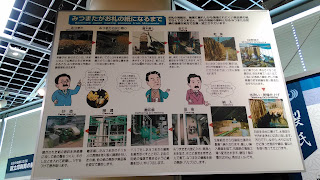 |
Odawara
Factory has a museum
for the process of money bill manufacturing.
RSVP from
here.
Needless to say,
all the process of making money is “top national
secret.”
Those who guide you in the site won’t reply your question
if they
think the topic tricky to be frank.
Diplomacy, please. |
I’m
not certain yet if Tanzawa had an established production area for oriental
paperbush before Japanese government began printing money. One thing for sure
was, by the time Odawara Factory was open with for the National Printing
Bureau, western Tanzawa, around the present-day Lake Tanzawa 丹沢湖 and Yadoriki, did a very good business of
supplying Mitsumata to the Bureau. Though,
it had a hidden problem … Yap. Cultivating paperbush is easy. They multiply by
simple cutting and planting. Making product deliverable to the National Bureau
was, and IS, a different story. It is a very labor intensive procedure. Left to
its own devices, oriental paperbush spreads their brunches like a dome which is
not a good shape for processing. So, farmers cram the cuttings in a bunch for
one hole, and cut lanky tree of 3-4 years old before they extend their another
tridents to all directions. Planting and harvesting is done by human hands in
steep slopes of mountains. Next, their leggy logs are manually steamed and
peeled their outer skin. Finally, the remaining inner whitish fibers are washed
by clean rapid water, like of Yadoriki Stream, and dried for the National
Bureau where their paper mill treats them chemically. With large population
relatively near the capital city, the villages in western Tanzawa were good
place to do all that. However, when World War II vacuumed all the labor force
from the villages, their ability to comply such production requirement
dramatically reduced. Furthermore, after 1945 rapid economic development pulled
out the people from villages for jobs in cities. Mitsumata industry in western Tanzawa disappeared. The same thing
happened all over Japan. Domestic supply for oriental paperbush for bank notes
could not respond to the demand. Around 1950, Japanese government started to
import materials for Japanese bills. Although it is a top national secret the
composition of the paper for money, it is said that the current Japanese bills
are made of more than 90% with manila pulp from the Philippines and fibers of Edgeworthia Chrysantha imported from
Nepal and China. Yeah, that’s where the plant originated some 2 millennium ago.
It’s fair, I guess.
 |
The
left is fibers of oriental paperbush.
The right is manila pulp. |
As of
2005, the suppliers of domestic Mitsumata
for the National Bureau were agricultural cooperatives from Shimane 島根, Okayama 岡山,
Kochi 高知, Tokushima 徳島,
Ehime 愛媛, and Yamaguchi 山口 Prefectures.
With rapid aging and depopulation of rural Japan, in 2016 only Okayama,
Tokushima and Shimane remain contracting with the Bureau for Mitsumata delivery. What happened for
the abandoned oriental paperbushes in the slopes of Tanzawa? They are in the
end resilient immigrants. They escaped the yoke of staffed planting, and spread
over the deep mountains, probably recalling the Himalayas where their ancestors
lived. And so, beautiful yellow domes dotting western Tanzawa every early
spring are an artifact with noble scent. They were once money tree, but now one
of the results of neglected forests in Japan. Some argue it is a serious
problem for national security relying so much on foreign supply of the material
with respect to money bill. In this age of bit coins for fiat money, let me see
if their assertion has a merit to consider. One anecdote. After April 2015 Nepal earthquake, the delivery of fibers of Edgeworthia
Chrysantha stopped completely from Nepal. The National Bureau scrambled to
secure the ingredients. One of the former production areas in mountains of
Kyoto called
the Bureau to invite a visitor from the Bureau asking to resurrect the cultivation of
oriental paperbushes. Who knows? The money raised from the new Forest
Environment Tax may be used to promote Mitsumata
cultivation. In 50 years’ time, yellow half balls of Tanzawa may change the
meaning of being an artifact of “money tree” to “neglected forest.” And farms
of lanky paperbushes could be found in the communities on the foot of Tanzawa
mountains. What would the regeneration of forests bring in 50 years’ time?
By the way, on March 14,
2020, Kanagawa Forest Instructors will host an annual event to visit the fully
bloomed colonies of Edgeworthia
Chrysantha in Yadoriki Water Source Forest. RSVP by email to
k-inst0981@friend.ocn.ne.jp.
Please come. 😄
If you find an environmental issues
in Kanagawa Prefecture, please make a contact with Kanagawa Natural Environment Conservation Center 神奈川県自然環境保全センター
657 Nanasawa, Atsugi City, 243-0121 〒243-0121 厚木市七沢657
Phone: 046-248-0323
You can send an enquiry to them by clicking the
bottom line of their homepage at http://www.pref.kanagawa.jp/div/1644/