Showing posts with label Niiharu. Show all posts

Friday, March 9, 2018

Black Flowers: an interim report of my challenge to flower charcoal花炭


The Association of Niiharu Lovers 新治市民の森愛護会 has the Charcoal Baking Club. During winter, we cook charcoal 3 times from bamboos of Niiharu. I posted my first experience in the Charcoal Making Hut of Niiharu in February and March last year. Since then, I did a bit of research and found several variations that could be applied to our kilns for bamboo charcoal. This season I experimented with one of these alternatives in a fireplace. It is an interim report of my petit project to bake “different” charcoal, called Flower Charcoal, or in Japanese Hana-zumi 花炭. I don’t know if a fresh flower can turn into charcoal … what we call flower charcoal is made of acorns, burrs for chestnuts, torus of lotus flowers, … have you got the idea? They are not so substantial as trees or bamboos, but have a solid structure somehow. At times people call bamboo charcoals as flower charcoal when they are from bamboo trunks baked to be charcoal flower bases for a tea-ceremony room. (An example of charcoal flower base can be seen here.) Such as the flower bases of bamboo charcoal, flower charcoals are normally used for interior ornaments in tearooms. Since they are pitch-black, they are perfect for the color scheme of Japanese tea ceremony.


Niiharu’s hut for charcoal kilns


In theory, any vegetation will turn into charcoal, if enough heat is given for inducing self-combustion of the subject sealed in a space sans oxygen during a sustained period of time. For full-fledged daily use like cooking and heating, charcoal made of woods from broad leaved trees is the best. The finest quality charcoal in Japan, named Bincho-tan 備長炭, is made of Quercus phillyraeoides cooked for about 8 days by craftsmen who have accumulated traditional knowledge of Japanese forest life. In Japanese tea ceremony, charcoals made of Quercus acutissima in proper size is sliced and nicely put in a fireplace for teakettle. Tea masters demand meticulously defined forma and texture of charcoal for the “best tea ceremony.” In any case, charcoals of woods require several days of cooking, or industrial kiln with computerized temperature monitoring that is out of question for Niiharu Lovers. So, our kilns are for bamboo charcoals that demands less than 24 hour of firing-up before self-combustion. Comparing with charcoals of woods, bamboo charcoals do not have much energy when it is used for cooking or heating and will turn into ashes much sooner. Though, the bamboo charcoals have many tiny holes that can capture odor molecules, which is good for air and water purification. i.e. Bamboos have a structure with lots of holes bigger than woods. So I thought, if bamboos with lots of holes can turn into charcoal much sooner than woods, material-wise the more packed the texture is, the longer it is necessary for the time of baking charcoal. If the material is more fragile than bamboos, could it mean they are less dense than bamboos? If so, can we economize the time to bake flower charcoals? The answer for this question was, it seems to me, “NO.” Well, it’ll be easy for you to know from the photos how flower charcoals look like, and how my experiment went. I show you below how I cooked flower charcoals.


1. First, the material. I gathered cones of pines, cedars, cypresses, etc. from Kanagawa’s forests and put them in a can for paint. The size of this can was 1L, and the cones occupy about ¾ of it. Please remember the amount of cones I stored in the can. This is a wrong example.


2. I then located the loosely sealed can in a campfire which we made during charcoal baking session for the kilns.


3. Very quickly, steam came out from the gap between the can and the lid.


4. I left it for a while. Lots of steam gushed out. After 30 min. or so, the color of steam turned blue. It was a sign for the beginning of self-combustion.


5. At around 40 min. point, steam stopped.


6. I then took the can out from the fire and closed the lid completely. In theory, as long as the contents had enough heat it kept on self-combusting in oxygen-less chamber.


7. The can was left outside until it cooled wholly.


8. After cool-down, I opened the lid. The contents looked like this.


9. The product. They are flower charcoal, but this photo shows several problems of this approach.

The method I took above was a standard summer-camp procedure in Japan when kids make flower charcoal in campfires. Yeah, the charcoals made in this way are still pretty. BUT,

  • Could you see some cone charcoal had a collapsed shape? That’s because I became stingy and staffed too much materials in a can. In the cooking process, the steam pressured the crowded contents too much and the tops of cones collapsed. It’s bad.


  • Please look the inner side of the lid on the left in the final photo. It is coated completely by tar. After the water and other lighter elements came out, the heavier components of cones, such as phenol and lignin, evaporated as long as there was enough heat from campfire or self-combustion. However, unless the escape route was provided when the heavier components were cooled they turned into liquid, and then solid within the can which is the most visible on the inside of the lid. That’s the problem. The tar was left not only on the lid but dripped down on the flower charcoals themselves, which make the final product less than perfect. In a more close shot, they look like


this. It may be a matter of opinion … I found a kind of greasy texture in some parts of the charcoal. It’s surely not so perfect for OM of tea-ceremony room.

The senior Niiharu Lovers suggested 2 reasons for the result. First, I closed the lid completely when the visible steam stopped emitting. That’s because I feared leaving the can with a loosely closed lid in open fire could ignite the contents easily and turn them into ashes quickly. Though, it robbed the opportunity for the molecules to evaporate into the air after coming out during the self-combustion. The cooled tar-molecules coated the surface of the charcoal. So, I should have made the holes on the lid for letting the tar vapor escape even after tight closing. Second, I terminated the heating process too early. In order to get rid of volatile elements completely by evaporation, we need to sustain self-combustion in oxygen-less environment much longer while providing the exit for the tar vapors. The suggested solution was, it would be better cooking flower charcoal in the kiln. We could place paint cans with the lid with holes on the bamboos and close the kiln completely by cray. Then, let the standard baking process for bamboo charcoal work for the flower charcoals as well to turn them into a pure carbon while maintaining their pretty form. Hmmmmmmmmm. OK. That’s the homework I can try next winter. Come to think of it, although the cones or burrs feel fragile, at the molecule level they are similar to the woods. It can take time for the chemicals they contain to evaporate totally. 40 minutes of cooking could not do the job.


Though they are pretty, aren’t they?


Actually, there is another hurdle to clear to make this project better. I found collecting the material for flower charcoal took time. Say, we can place six 3L paint cans on the bamboos in a kiln. Let the cones and burrs occupy only 50% of a can, but it still is 9L. This year I have to be more strategic to gather the material for flower charcoal ... They might be a good product to raise fund for the activity of Niiharu Lovers …


Charcoal making is a task during the dead-winter.


When I did a research for flower charcoal, I encountered with articles from the research labo of Dr. Kazuo Akagi 赤木和夫 of Ritsumeikan University 立命館大学. Prof. Akagi refines the creation of solid polymer electrolyte fuel cell by expanding the mechanism of flower charcoal making. The successful way of creating flower charcoals preserves the forma of the material and transforms them into a pure carbon. Prof. Akagi wrote the methodology can be applied to create high-powered fuel cell. Wow. I now engage in the elementary procedure for fuel cell technology, don’t I. That’s … uber-cool.


If you find a problem in Niiharu Forest, please make a contact with

Office for the Park Greeneries in the North 北部公園緑地事務所
Yokohama Municipal Government Creative Environment Policy Bureau 横浜市環境創造局
Phone: 045-311-2016 (I guess in Japanese only)
FAX: 045-316-8420 (I hope there is somebody who can read English …)

Niiharu Administrative Office / Satoyama Exchange Center 新治管理事務所・里山交流センター
Phone: 045-931-4947
Fax: 045-937-0898

Friday, September 29, 2017

Fixing a hole with Red Clay: repairing charcoal kilns in Niiharu


Last winter, Charcoal Making Club of Niiharu Lovers struggled to bake bamboo charcoal. We lit the fire at 6:00 for the charcoal kilns, and they could not be hot enough at 20:00. Later, when we opened the kilns, we found out the bottom of the metal barrels had huge holes which made it impossible for the kilns to cook bamboos efficiently. This summer, Charcoal Making Club did a major overhaul for kilns by replacing the broken metal barrels with high spec oil drums provided with the courtesy of one of the world majors. There are many designs for modern charcoal kilns in Japan. (Photos can be seen here.) Niiharu’s kilns are made of a drum of 57cm of diameter and 90cm tall, buried in red clay. The bottom of a drum has a hole of 11cm diameter. The bottom wall of the drum also has 4 holes each of which is connected with a pipe of 5cm diameter. The top of a drum is a lid with a hole for a Ø3cm pipe. The drum is then put on a U shaped concrete gutter as its Ø11cm hole is over the trough. The drum and gutter are held by red-clay loaded in a space surrounded by four 150cm*120cm metal walls. The clay holds the drum and 4 pipes by piling up the square tightly to the rim of the drum. When we see the kiln from a side, it looks like a metal box situated on a clay mount with 4 pipes sticking out from the top.


A sectional view of Niiharu’s charcoal kiln
It’s a view from the above of the kiln.
The Lovers took out the metal barrels
from the structure.
The new kilns.
I didn’t know there were several kinds of metal barrels.
My seniors said the new barrels had thicker wall
so that it can keep the heat well.


The science of charcoal making is, when we add heat on logs slowly but continuously in an almost sealed-up space, they start to heat up themselves and release volatile substances their cells hold. If we keep burning them by firewood, they will eventually become ashes which are the materials, such as metals, that cannot evaporate with the energy created by camp fires. In contrast, if we stop adding external energy, but create tightly sealed environment for the heated logs, they continue to burn themselves slowly with very limited supply of oxygen and discharge unstable oils from their body as much as possible. Though, without new fire supplied, the closed structure eventually cools down and the self-combustion of logs inside also stops. The logs burned in this way end up as a chunk of carbon. They are now charcoals which are incompletely combusted logs in a shut room. When a charcoal is very close to pure carbon, they do not contain volatile element much. Unlike firewood, they can burn for a long time without creating flame. In other words, a charcoal kiln intends to let the logs free the unstable elements completely during combustion. Niiharu’s kilns are designed to do that just by burning firewood in the concrete gutter. As this is for weekend forest volunteers, it’s not for cooking wood charcoal for days, but for one day making with bamboos. Even though, the inside of the kilns must reach around 700ºC that made the previous metal drums porous, and the concrete slab that sealed the U-shaped gutter with the metal drum crumbled when we removed the red clay to take out the metal drums. The power of fire and heat …


The difference between completely burned woods and charcoal.
One of my senior Lovers showed me how different they were.
Completely burned woods looked like a charcoal,
but they were very fragile and easily became ashes
just by rubbing them between the fingers.
In contrast, our bamboo charcoal maintained its form
and emitted metallic sound when we gently tapped them.
The dug-out metal barrel, upside down.
It was surely worn out.
The side wall of the barrel.
No wonder the kilns could not heat itself up well.


I now know the pipes at the bottom wall of a drum were not welded but inserted to the hole and stabilized by clay. The pipes are for volatile substance inside the bamboo free to evaporate. The red clay is typical soil in Kanto region especially where the volcanic ashes from Mt Fuji fell. I asked if we can just burrow up the land wherever allowed in the Niiharu Forest to replenish the stock. “Huh? Of course not. Niiharu is rich forest with lots of fallen leaves and the other organic materials. When we use the top soil, those organic materials will be burned during the charcoal cooking, and the mud cannot seal the kilns tightly.” So, we’ve been to a place in the forest where we can harvest the clay beneath the top soil. We have to DIG deeply. I also noticed the difference in red clay between “before” and “after” of charcoal cooking. When we dug out the drums from the structure, the “clay” was hard by tapping, but could crumble easily into very fine grains with a strike of spade. We needed face masks to operate to avoid coughing. In contrast, freshly procured red clay is dense. By adding water, we can make mud balls easily. I understand why a desert is desert … The tierra of desert was exposed to direct sun light continuously. It must have turned into the “after” clay of Niiharu’s kilns. I guess the organic richness of the soil is definitely greater in Niiharu than those places in desert in China …


Red clay in Niiharu
We dug a hole to harvest the clay.
You may say there are lots of red clay
in our charcoal making hut.
Actually, we used up almost all of them during the repair.
My seniors said this winter we have to procure more
before baking charcoals in order to seal the kiln.
Hmmm, it may be difficult to see in this photo
the difference between the “fully-baked clay” and newly procured one
... I hope you sense the texture of before-baked clay
in the bucket by comparing the baked clay surrounding it.


The red clay was in full-operation during the renovation. After replacing the crumbling drums and slabs, the mud balls were applied to seal the gaps and holes of the metallic materials, to act as a plaster for bricks and U-shaped gutters to stay together, and to attach tightly the pipes at the bottom wall of a drum. Hmmmmm … playing with mud balls in kindergarten must be something in order to learn the basic technology of human settlement. Hey, moms in the world, don’t stop your kids to play in mud. Certainly their garment could be damaged beyond repair, but that’s an important experience to understand human history! The mud-pasted structure is next stabilized by piling dry red clay within the 4 metal walls. … In the end we worked reticently to fill the once emptied space. Digging the thing out, and digging the thing in. Zen ...


The walls were temporarily removed to work in the kiln.
The worn-out walls were replaced by new metallic panel.
But …
Lovers noticed the newly procured panels have holes.
So, they were sealed by mud balls.
“Hey, I’m a city boy of Yokohama,
and have never done indecent things of
soiling my pants when I was a kindergartener.”
“Well, so you have to do it now.”
Preparing mud balls
Plastering the bricks was also with mud balls.
Before setting the barrel
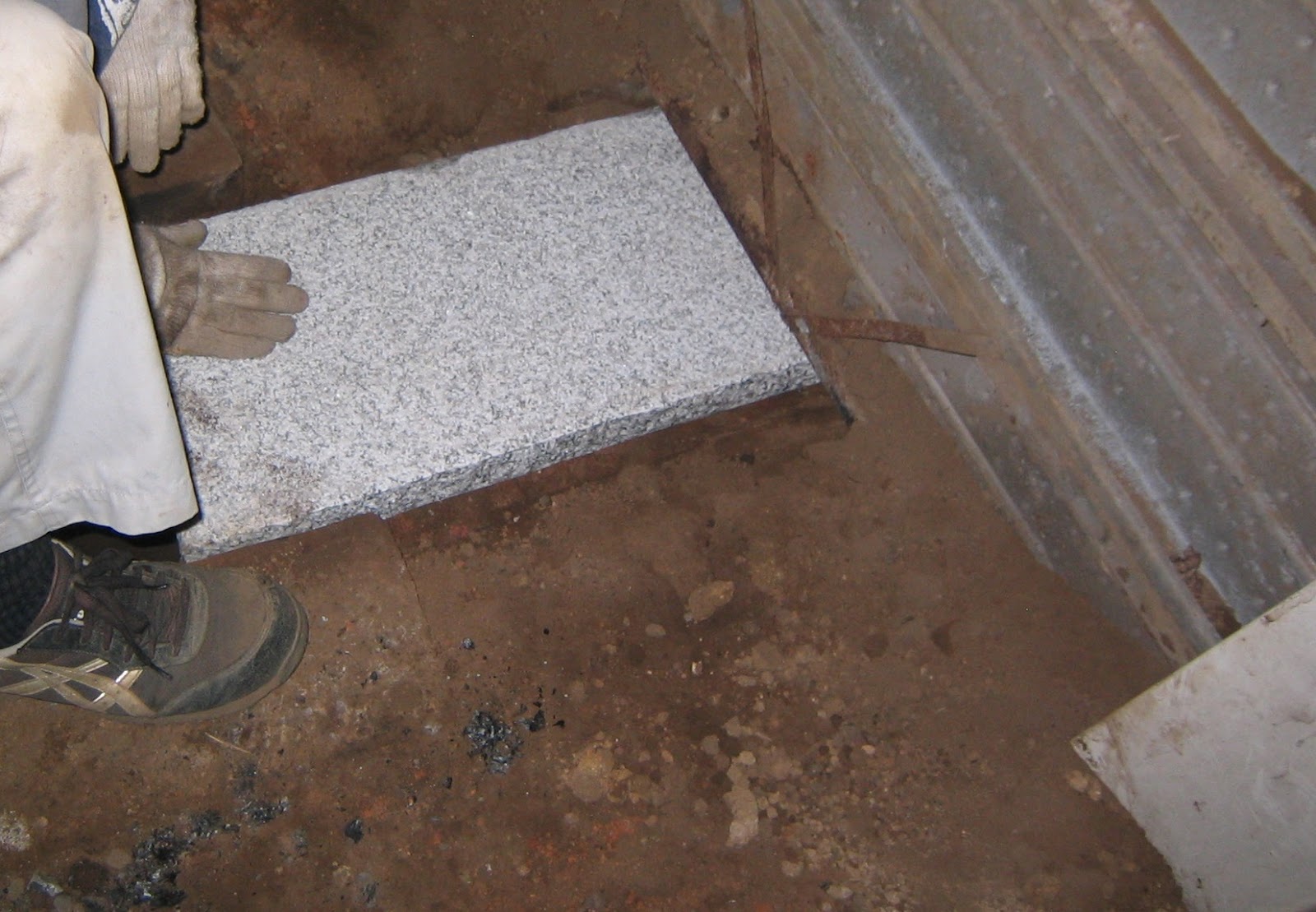
First, situate the marble …
Then, seal the space with the clay,
Put the marker for the Ø11cm hole,
and seal the remaining gaps with more clay …
And set the metal barrel.
“Watch out for the direction of the 4 holes.
They must be on the diagonal line of the space.”
Next, we inserted the pipes
and adjusted the direction of the kiln in diagonal.
It’s because when we bake the charcoal,
long bamboo chimneys will be attached to the pipes
which go out from the holes of the walls of the hut.
The diagonal direction of the pipes is determined
by the locations of the side holes.
An operating kiln with chimneys should look like this.
At this stage, we made it sure
the mouth of the pipes inside the barrel smooth.
Otherwise, when we load bamboos to be baked,
the ledge created by a pipe impedes packing.
When we cook charcoal,
inside of the barrel should be tightly filled as much as possible
so as to make the circulation of the heat efficient.
Now the pipes were provisionally stabilized with a hemp line.
Then the gaps between the pipes and the barrels were
sealed by mud balls from outside.
All in all, sealing the space inside of the barrel is very important.
Now cover the bottom of the barrel with red clay a bit
and stomp it over to make the closure for sure.
And pile the clay up, up, up …
Done!


Now the new charcoal kilns have pretty red and blue lids in Niiharu. We hope this winter we can finish our baking within 8 hours. Fingers crossed.

If you find a problem in Niiharu Forest, please make a contact with

Office for the Park Greeneries in the North 北部公園緑地事務所
Yokohama Municipal Government Creative Environment Policy Bureau 横浜市環境創造局
Phone: 045-311-2016 (I guess in Japanese only)
FAX: 045-316-8420 (I hope there is somebody who can read English …)

Niiharu Administrative Office / Satoyama Exchange Center 新治管理事務所・里山交流センター
Phone: 045-931-4947
Fax: 045-937-0898
http://www.niiharu.jp/


Friday, September 8, 2017

Harvesting chestnuts in Niinaru


In Niiharu, the last weekend of August is the start of collecting chestnuts. So, in sweltering weather, we entered the old chestnut orchard and looked down to find chestnuts in burrs. The place was once a property of local farming family, but the current patriarch is now old and could not find the way to take care of it. He transferred the deed of the place to the City of Yokohama, in exchange for tax concession. Sure enough, the trees of 30 or more years old are growing on a very steep hill … It would be difficult for a senior citizen owner alone to collect fallen chestnuts. Niiharu Lovers are in charge of managing the place including harvesting. So, we collect chestnuts there. Telling you the truth, I’ve never done serious chestnuts harvesting in my life before. It was a fun!


The place is this steep.

A Niiharu Lover is operating down there.


First, we looked around to find burrs. I learned when a burr did not have an opening, even when I pried it open, inside did not have chestnuts mature enough to be collected. So, we had to find the burrs whose mouth was open. Sometimes, when it fell off nicely, the matured chestnuts popped out from the burr and scattered around leaving the burr empty. Otherwise, we widen the opening of the burr with foot, and raked out the chestnuts from the burr. “Careful! Spikes of burrs are really prickly. Better using the pig-skin working gloves.” My seniors advised me. Usually, long metal tongs are to collect the chestnuts, but “Using biggish screw driver is easier for amateurs, you know.” It was a delicate task to be performed in a steep slope of bushy hill. We soon became very quiet and concentrate for finding good chestnuts. “Look carefully. Some have worm-hole. The blackened skin is a sign that part is damaged. Better to leave them in the forest.” “Well, I don’t think so. They are edible if you just cut the damaged part off. The place produces chestnuts certainly organic!” According to the senior Niiharu Lovers, this year’s harvests are “wow, big.” We collected about 100kg of chestnuts in just 1 hour operation. The forest of Niiharu was generous.


Hello!

Lots of chestnuts! There are normally 3 nuts in a burr.
It was difficult to find a burr containing all 3 matured nuts
… many had one huge nut and 2 flat siblings in a burr …
Then, a week later,
we could find many siblings of fat 3 nuts.
I was amazed to see what a week could do.
A burr has a 3-layered structure.
The outermost part is spikes,
then, there is a kind of skin similar to a bark of a tree.
The inner part is for chestnuts.

Some burrs are in two-toned.
When we opened it,
the nut under the browned burr is fully matured,
but the nuts behind the green burr are not at all matured.


“Hmmm, those trees are too tall for commercial cultivation of chestnuts.” “Yes, normally they are 3m high at most. But here …” “The previous owner did not manage the growth well.” I asked if it is possible to coppice chestnuts. “No. If you cut the trunk, that’s the end of the tree. Here, as the ground is too steep. We cannot bring mechanized tools to dig out the large roots. So, if we cut these old trees here, we have to leave the roots.” “Yes, the management of the ground is tricky.” “And too much pruning will kill the trees.” “Yes, yes.” “No wonder the previous owner took the deal with the City.” “Actually, cultivating chestnuts is a demanding job.” I see … I imagined our ancestors in Japan who started to plant chestnut trees around their settlement some 10,000 years ago. Properly taking care of trees is not a piece-of-cake. Collecting the nuts out of the spiky burrs sometimes hurts us. Even though, the archeological remains, such as San’nai-maruyama Remains of Aomori Prefecture 三内丸山遺, keeps the evidence Japanese already nurtured huge chestnuts forests in some 5500-4000 years ago. And now, some chestnuts orchards are under the management of the municipality due to maintenance issues. The relationship between the forest and us is … not simple.


Carrying one of the crates of chestnuts
A bounty!
But with sub-par nuts.
Those with wrinkles, with worm-holes,
with blackened skins were thrown in the “outlet bag.”
I brought some less-bad nuts from the bag,
and peeled the skins.
Sure enough,
I had to cut rather big damaged chunks off before cooking.

Anyway, the chestnuts from Niiharu became chestnuts pilaf next day for our family. Yammy. 😋


If you find a problem in the Niiharu Forest, please make a contact with

Office for the Park Greeneries in the North 北部公園緑地事務所
Yokohama Municipal Government Creative Environment Policy Bureau 横浜市環境創造局
Phone: 045-311-2016 (I guess in Japanese only)
FAX: 045-316-8420 (I hope there is somebody who can read English …)

Niiharu Administrative Office / Satoyama Exchange Center 新治管理事務所・里山交流センター
Phone: 045-931-4947
Fax: 045-937-0898
http://www.niiharu.jp/