Ahhhhhhhhhh … summer. “Let’s go to beach!” In Kanagawa, the incantation normally evokes the beach of the prefecture, Shonan 湘南海岸. So many times, Shonan Beach has been the set of Japanese popular culture. This is the place where Japanese started to enjoy American style surfing in the 1950s. Lots of movies, music, novellas, etc, of summer passion, young angst, or anything of this kind chose Shonan Beach as their stage. Slam Dunk, anybody? Do you love Southern All Stars? Yukio Mishima was a regular for Oiso Prince Hotel. Now Haruki Murakami lives in Oiso Town 大磯町, etc. etc. Inevitably, especially during summer, somewhere along the beach is the place of party people. The revelry spot changes according to the city ordinances against loud music. Until 3 years ago, Zushi beach 逗子海岸 was the place for teenagers with loud speakers to dance till dawn. Grown-ups of beach-front home complained to the police. Now playing music in Zushi beach is prohibited. People have moved on to Kamakura, and these days Yuigahama beach 由比ガ浜 is the mecca of anything, including walking naked and brawls. Kanagawa Prefectural Police is watching Yuigahama very seriously ... In the middle of Shonan Beach, there is Enoshima Island 江の島 that is actually the grand-mother of commoners’ beach party in Japan. And it was Mt. Oyama 大山 inviting this island of Mm. goddess some 500 years ago to be a part of their merrymaking. This week is a summer holiday of my adventure in the forest, of Enoshima!
 |
Actually,
from Enoshima Mt Fuji is supposed to be seen
beautifully just like some Ukiyoe
paintings.
If weather permitting, that is … |
Enoshima Island is situated 400m out from Katase beach 片瀬海岸. During high tides it is completely separated from the Honshu Island, otherwise sandbank remains between the two. The basic geology of the island is a hill (60m ASL) surrounded by 4km of vertical sea cliffs and sea caves. Ancient people thought something sacred about the place, and many celebrities of Japanese monks and literati, such as Kukai 空海 and Matsuo Basho 松尾芭蕉, came for meditation. On the other hand, Minamoto-no Yoritomo 源頼朝, who started Kamakura Shogunate Government 鎌倉幕府 in 1185, donated the seed money in 1182 for the construction of Enoshima Shrine 江の島神社 in the island. Since then, the place was also for rich and powerful to pray for their good luck to the sea goddess of Enoshima Shrine, Benzaiten (Saraswati) 弁財天. Have you noticed a similarity of the story with Mt. Oyama? Yeah. When in the 17th century commoners of Edo (Tokyo) discovered a pleasure of pilgrimage, Enoshima Shrine became a part of the itinerary for Oyama Pilgrimage 大山詣り. The macho boys with tattoos from Shibuya climbed up Mt. Oyama via Route 246, then went south from around present-day Atsugi City to Shonan Beach, asked more good luck to Benzaiten in Enoshima, admired ancient temples in Kamakura, and returned to Edo along Tokaido 東海道 (present-day Route 1) via Yokohama’s Hitorizawa Citizen Forest 氷取沢市民の森. I think that’s a pretty good holiday schedule even now. The package became super popular, and Enoshima Island for beach party was born. After Mathew C. Perry of the US Navy arrived in Japan in 1852, Japanese government allowed foreigners who were confined in Yokohama to travel within 40km radius of Yokohama. Enoshima Island was comfortably within this range, and the place has very moderate climate with beautiful ocean view. Expats flocked the place. Among them was American zoologist/ethnologist Edward Sylvester Morse who introduced Darwinism and modern archeology to Japan, and English merchant Samuel Cocking. Dr. Morse established marine biology center in Enoshima that was the mother of all the oceanology institutions of Japan. Mr. Cocking built a country house with a high-tech (of that time) glass house at the top of the island, which is now a botanical garden of the City of Fujisawa 藤沢市. Number of locals coming to Enoshima kept growing, especially since 1929 when Odakyu Enoshima Line 小田急江ノ島線 connected Enoshima and Shinjuku. So, Enoshima Island has been, and will be, a very well-liked tourist destination, both for Japanese and foreign visitors. As Morse and Cocking found, it has interesting forests accommodating native temperate vegetation and imported tropical plants.
 |
Enoshima
Island has lots of monuments
celebrating the visits of Japanese cultural celebrities.
This photo contains a commemoration of Matsuo Basho,
the great Haiku poet. |
Visiting Enoshima Island is easy. You hop on a commuter train of Odakyu-Enoshima Line, and go to the terminal station, Katase Enoshima 片瀬江ノ島駅. Leaving from the station (one exit only), you’ll see a pedestrian bridge crossing over Sakai River 境川. Beyond the bridge on the right there is a tourism information office of the City of Fujisawa, and behind it is an entrance for an under-path reaching to 389m Enoshima Benten Bridge 江の島弁天橋 that connects Enoshima and Honshu Islands for pedestrians. Simply walking cross it, and we are in front of a bronze Torii built in 1821. It’s a gate for Enoshima Shrine. By now, you notice the place is full of souvenir shops and seafood restaurants, in addition to inns and a spa. Of course. The place has been like this for centuries. One of the protagonists in a popular Kabuki story, Shiranami Five 白波五人男, was modelled from a real page boy who worked for the Island’s most prestigious hotel, Iwamotoroh 岩本院・岩本楼, in the 19th century. Enjoy your stroll along steeply climbing up alley, called Benzaiten Nakamise Dori Street 弁財天仲見世通. Eventually, you’ll meet a bright red Torii of the Shrine that notifies us the beginning of an inner sanctuary of the religious institution. Around here, the forest, rather than shops, begins to dominate the scenery. Enoshima Shrine maintains a typical structure of Shintoism shrine. The places of worship are surrounded by forests.
 |
Everybody
loves Odakyu Katase Enoshima Station.
They have been like this before Disney
Land! |
 |
On the
right of Katase Enoshima Station,
you’ll find a satellite restaurant of
Kua’aina Burger
from O’ahu’s Haleiwa.
Their Avocado Burger remains strong. |
 |
Enoshima
Tourism Information and entrance to
Benten Bridge under-path.
The place has
well-stocked English / Chinese / Korean /Thai
information for tourists to
Shonan.
It’s worth a visit. |
 |
Beginning
of Benten Bridge.
Parallel to Benten Bridge, a vehicle bridge,
Enoshima
Oh-hashi Bridge 江の島大橋, runs.
Occasionally we find tourists,
especially
foreign visitors, walking over there.
According to the Japanese Road Traffic
Law, it’s an illegal act.
In the middle of Benten Bridge,
there is a small
harbor for boats
that carries tourists to the south shore of the Island.
If you
don’t like to walk, using their service would be an option. |
 |
| The
entrance to Enoshima Shrine |
 |
| Alley
way of souvenir shops in Enoshima |
 |
Welcome
to the place of worship!
Everybody agrees the whole design is defiantly
“kitsch.” |
 |
A bit
further up, there is a station for Escar, an open-air escalator
that brings us
to the botanical garden at the top,
making the place barrier-free.
Adult one
way, 360 yen.
Kid’s one way, 180 yen. |
Enoshima Shrine is for Benzaiten or Saraswati, but strictly speaking the Indian goddess of the Island is transformed into 3 sisters of Japanese sea goddesses. Each goddess has a dedicated shrine dotted within the hilly forest: Ho’anden Shrine 奉安殿 for Sarawati, Hetsu-no-miya Shrine 辺津宮 for Taguitsuhime-no-mikoto 田寸津比賣命, Nakatsu-no-miya Shrine 中津宮 for Ichikishimahime-no-mikoto 市寸島比賣命, and Okutsu-no-miya Shrine 奥津宮 for Tagirihime-no-mikoto多紀理比賣命. This arrangement of Indian and Japanese goddesses is exactly the same for Itsukushima Shrine 厳島神社 in Hiroshima. Perhaps, it was a common thinking in those says. From the red Torii, we go up the green hill of Enoshima to visit first Ho’anden Shrine and Hetsu-no-miya Shrine, then Nakatsu-no-miya. I warn you it’s not a gentle climb, but a continuation of steep steps. What this mountainous place made popular among young tattooed guys of the 17th century was the statue of Sarawati in Ho’anden shrine, called Hadaka Benzaiten, aka Naked Sarawati 裸弁財天 … This is a party place, I told you. The most popular job description of these goddesses is their superpower for anything about popular arts, such as music, dance and theatre. Kabuki actors and TV stars frequently visit and hike Enoshima Shrine for the success of their business. Inevitably, the couples and single ladies searching for “the one” come here to ask their movie-like love stories. The romance must let them forget the sharp climbs …
 |
| For love, love, love, … |
 |
| Ho’anden
shrine |
 |
Next to Ho’anden Shrine,
there is Yasaka Shrine 八坂神社
which has annually a wild summer festival
with
Koyurugi Shrine 小動神社
in Koshigoe Fishing Harbor 腰越漁港 of the
opposite shore.
On July 14,
the elaborated portable shrine from
Yasaka Shrine
dives into the sea,
and is carried to Koyurugi Shrine for a joint
ritual.
If you have a chance,
just go there and watch beach bums
doing the
sacred but fun tradition. |
 |
| Hetsu-no-miya
Shrine |
 |
Between Hetsu-no-miya Shrine and Nakatsu-no-miya Shrine,
we
have a viewing spot for east Shonan Beach
where we can see beaches of Kamakura,
Zushi, and the others till the tip of Miura Peninsula.
Have you noticed a
vacant lot below in front of a yacht harbor?
The harbor is Enoshima Yacht
Harbor
where 1964 Tokyo Olympics was held,
and the empty space is preparing for
Sailing for
2020 Tokyo Olympics. |
 |
| Nakatsu-no-miya
Shrine |
 |
On the
side of Nakatsu-no-miya Shrine,
there is a small Japanese garden with Suikinkutsu
水琴窟.
Suikinkutsu is a musical instrument
where a
ceramic jar is buried under the ground
with a lid as an opening.
A visitor
pours water through the hole of the lid,
and the dropping water makes ambient
sound,
in the style of Brian Eno.
Though the place is often too congested to enjoy meditative
music,
you can try. |
We walk up further from Nakatsu-no-miya to the entrance of Samuel Cocking Garden. Then, the one way road of steps, called Oiwaya-michi Dori Street 御岩屋道通, goes down rapidly. The both sides of the street have another continuation of souvenir shops, restaurants and inns. In the middle of this route, there is a sheer valley called Yama-futatsu 山ふたつ that was created by sea erosion. From there, the road climbs up again to Okutsu-no-miya that is actually the main shrine of Enoshima. According to the mythology, the original divine grace of the goddesses was their power to pacify a mad 5-headed dragon who harassed the villagers along Shonan Beach. The dragon annually demanded people to sacrifice cute babies of their community otherwise he brought any natural disaster of his choice, such as draught or flood. Then, a sexy goddess of the ocean suddenly appeared and created Enoshima Island. By seeing her, the dragon fell in love at once and proposed marriage. She flatly rejected his offer saying he’s a shameless asshole tormenting poor humans. He deeply regretted his deed and promised her he would help the villagers if she became his wife. She said OK, and from then the dragon worked very hard to protect Shonan people from any water-related natural disasters. Everybody was happy, but the workload for the dragon was enormous. Finally, he was burned out, said goodbye to the goddess, and went to the opposite shore of the Island to become Tatsunokuchi-yama hill 竜口山 where now Ryukohji Temple 龍口寺 stands. Some believed the eldest sister of the three goddesses, Tagirihime-no-mikoto, was actually the lady who dominated the mad dragon, and thus for her main residence she uses the most sacred place in Enoshima, the largest sea cave called Iwaya 岩屋 in the south shore, and resides Okutsu-no-miya Shrine during typhoon season. Now the Japanese engineering protected her ocean front condo from any storm damage, and let the place one of the tourist attractions with top-notch sound and lighting show inside (admission: 500 yen for 16 years old and up, 200 yen for kids). ... Even if her terms of reference includes entertainment business, I don’t think the goddess is happy to live in the cave-full of light and music with lots of audience all year long … If I were she, I would prefer quieter Okutsu-no-miya Shrine surrounded by the forest ... 😄
 |
Further up from
Nakatsu-no-Miya,
there is Samuel Cocking Garden where
a lighthouse named
Enoshima Sea Candle stands.
Admission:
500 yen for 13 years old and up, 250 yen
for kids. |
 |
Inside the Garden, there are rare specimens of
floras
Cocking collected from tropical South Pacific.
This photo is for Araucaria heterophylla and Araucaria columnaris. |
 |
The English country house Cocking built was
destroyed by the Great Kanto Earthquake 関東大震災.
Though, there remains its foundation,
including the underground heating
system for the glass house. |
 |
Enoshima Sea Candle.
You
can go up to the observatory.
In addition to be a tourists’ attraction,
this is a fairly
well-functioning lighthouse,
maintaining safe maritime traffic in Sagami Bay 相模湾. |
 |
| The road goes down from the
Cocking Garden. |
 |
The Yamafutatsu
valley was created by waves and strong winds.
The resilient but deformed plants,
such as Miscanthus condensatus and Boehmeria biloba,
thrive here. |
 |
Welcome
to Okutsu-no-miya Shrine.
This Torii
is said to be donated by Minamoto-no Yoritomo
in the 12th century. |
 |
Okutsu-no-miya
Shrine.
The lady of the Island lives here. |
 |
From
Okutsu-no-miya Shrine,
the steps go down rapidly to … |
 |
the
south shore of the Island.
Could you figure out Izu Peninsula there? |
 |
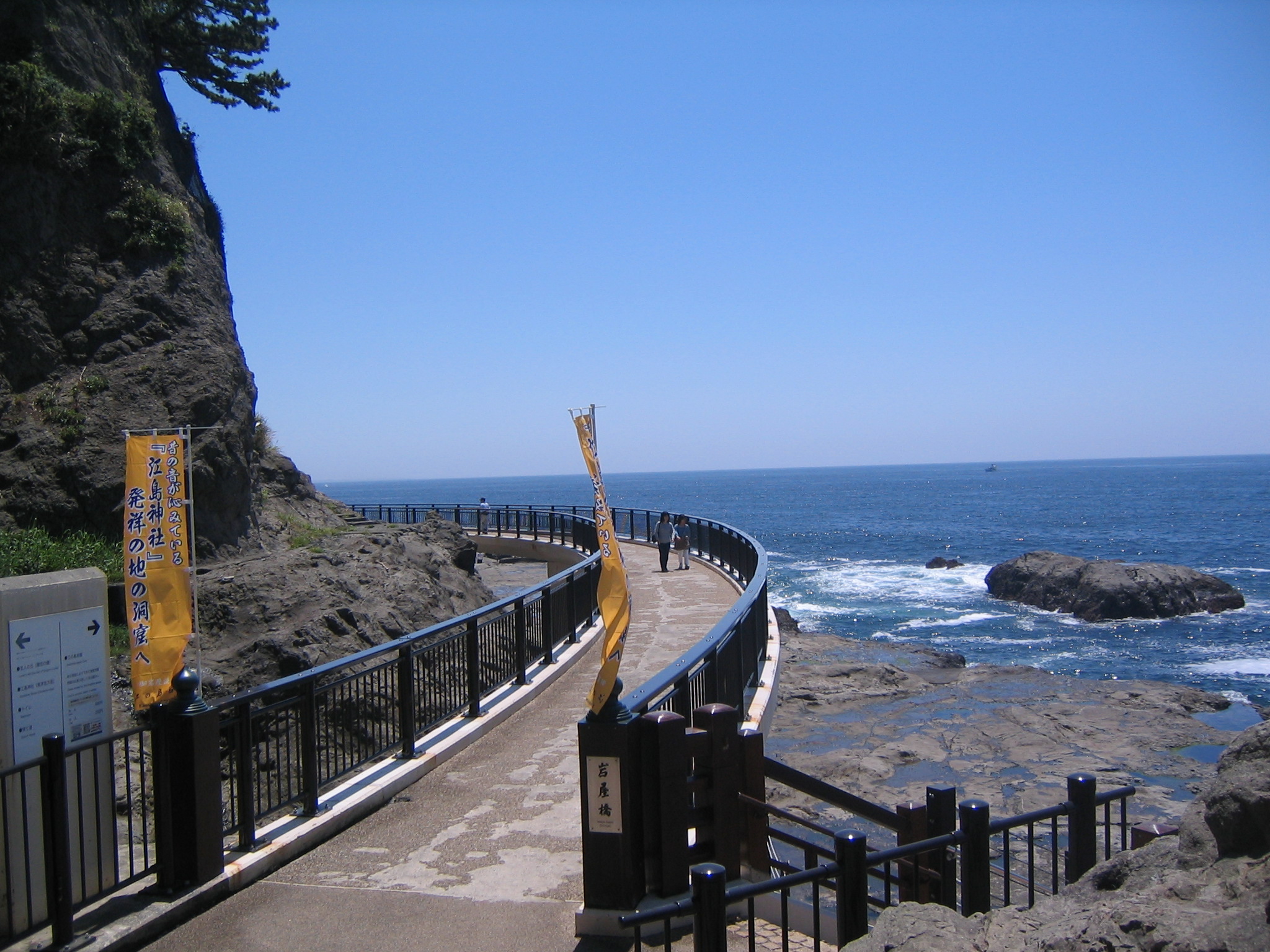
Although
we have to use a very tourists-friendly pedestrian bridge
to the sea cave Iwaya
… |
 |
it’s a
fun to walk below the bridge on the rock ledge
raised from the sea bed by the
Great Kanto Earthquake. |
 |
| Fishes
were trapped! |
 |
| Entrance
to Iwaya. Ticket, please. |
 |
And the goddess’s
ex-husband is over there,
seen from the north shore of the Island.
Hmmmm, now
it’s behind the tall seaside condos …
but the dragon is certainly admiring
Enoshima Island. |
From the ledge near Iwaya, we can see a natural forest of Enoshima Island spreading at the top of the island. To go there, we return Okutsu-no-miya Shrine. Just before the Shrine, there is an entrance on the right to a small trekking route to visit the forest of Enoshima, Enoshima Tatsunogaoka Natural Forest 江の島龍野ヶ岡自然の森. Inside, there is a dating spot, called Ryuren-no-kane 龍恋の鐘, for couples to swear eternal love in front of the beautiful ocean … Often couples with polished shoes and pin-heels just visit the Ryuren-no-kane and won’t venture into the woodland itself. The forest is made of evergreen broad-leaved trees typical in Kanagawa Prefecture. Thanks to the ocean, the climate for this forest is more stable than in, say, Tanzawa mountains, and on average 1°C warmer with larger precipitation than for the opposite shore of Honshu Island. The vegetation of Castanopsis sieboldii, Machilus thunbergii, Camellia japonica, Farfugium japonicum, … is very lush, while the warm sea breeze blows through the trees. If you just walk in the forest, it won’t take more than 10 minutes to go around, but the place has lots of picnic benches for visitors, of a couple or otherwise, happily to have lunch. The forest is a relaxing and quieter place for anybody who loves trees. If you visit Enoshima Island for sightseeing, please just drop by to this forest which is actually a hidden gem in a traditionally partying beach.
 |
| We can
observe the forest from the below. |
 |
| Entrance
to Tatsunogaoka Natural Forest |
 |
| For
couples to eternal love, to the right, please. |
 |
| You
ring the bell to declare your passion. |
 |
| But to
the left is more for the forest. |
 |
| Let’s
have a relaxing lunch! |
 |
| Lots
of Farfugium
japonicum |
If you find environmental problems in Enoshima Island, please make a contact to
Local History Section, Continued Learning Promotion Division, Fujisawa City
Fujisawa Plaza, 1-2 Kugenuma-Higashi, Fujisawa, 251-0026
Phone: 0466-25-1111 (ext.) 5313, FAX: 0466-27-0201
藤沢市生涯学習部郷土歴史課
〒251-0026 藤沢市鵠沼東1番2号 藤沢プラザ5階
You can send an enquiry to them from their homepage at