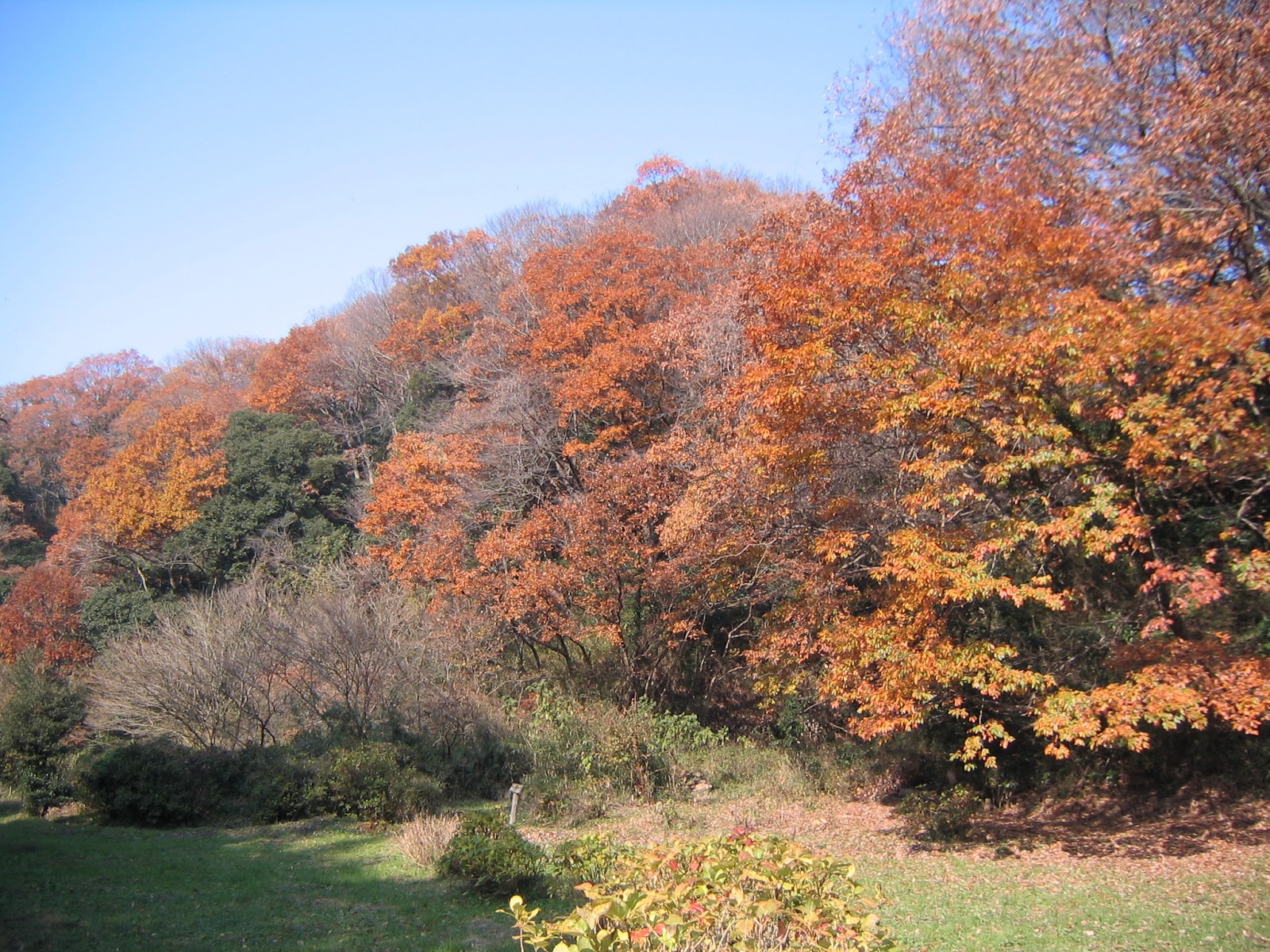
This year so far, Kanto Region has had two uber-destructing typhoons. One was Typhoon Faxai on September 9th, and another was Typhoon Hagibis on October 12th. Both gave us a heck of scenery in our forest. Let me show you what they did.

In Niiharu 新治市民の森, the slopes facing to north-east received a ton of mess after Typhoon Faxai. The slope in front of the Satoyama Civic Center had lots of broken trees and bamboos, large and small, like this.

Also in Niiharu, our chestnut orchard had a substantial damage. It was just before we would have harvested this years’ nuts. Many trees have been wrung their trunks in the middle by strong winds, with not-yet-open burrs. Currently, Lovers of Niiharu is discussing with the City if we have to deforest the slope, and replant chestnuts, or else, from a scratch. I’m SOOOOOOOOOOOOOO sad we cannot harvest Niiharu’s chestnuts this year. The taste of these trees was definitely earthier and richer than that of supermarket version. Baking chestnut cake from them was becoming my annual ritual … One of my seniors consoled me. “Naomi, it is said 3 years for chestnuts and peaches. You wait for only 3 years.” I will. *sigh*

Bamboo forests in Niiharu also became a jumble with Faxai.

Basically, cedars and cypresses are the species which do not take their roots deeply in Japan. So, when strong winds, like 50 meters/s (180 km/h), hit their sweet spot, they are turned over from the root, like here.

Cedars and cypresses can be snapped easily as well, like this found near Yokohama Zoorasia. One of the reasons they are loved by foresters is they are soft so that it’s easy to process them for building materials. With super typhoons, their merit becomes their weakness.

So, it was shocking to me to find out hard but elastic Quercus myrsinaefolia were broken here and there, just like conifers. They looked so large and mighty, but …
The condition is worse for Segami Citizen Forest 瀬上市民の森. Typhoon Faxai not only broken trees but brought lots of land slides there. At this moment, almost all their walking routes for visitors are off-limit. One of my friends who is a member of Segami Lovers told me they were also shocked to see their rice paddies are filled with the soil avalanche. “You see? We were planning to harvest rice several days after September 9th, and now this. All the crops of ours are damaged. I guess Segami’s fireflies are also experiencing disaster to survive … I’m not sure if we can enjoy their night dance next June …” Cities of Kamakura and Hayama have black outs both with Faxai and Hagibis due to strong winds and land collapsing with torrential rain. These places are very near to Yokohama’s South Forest, including Segami Forest. Segami Forest could have another fresh landslides after Typhoon Hagibis ... I don’t know … I won’t see her till next week ... As landslides and flood can happen long after the storm passes, the place would be vulnerable at least till the end of October … The Lovers of Segami are currently very busy to clean up the aftermath. I guess they are having a hard time … We Niiharu Lovers are also crisscrossing our forest to tidy up the situation at least along the trekking routes for visitors. This is a mighty task, I tell you.

You see? This cherry tree was broken in the middle by Faxai. And below is a popular promenade. Lovers of Niiharu took care of the situation.

This one is definitely to be removed. We reported the situation to the City. We hope they will treat the matter promptly.

A falling cedar, even if it’s just less than 30cm of diameter, can broke a concrete fence with a ∅2cm iron mandrel, as such.

Typhoon Hagibis made almost all the trekking route of Niiharu Forest into tiny streams, sometimes with gushing water. This photo was taken in our proud forest of ferns. I was a sort of convinced why this part of Niiharu has diverse colonies of ferns. It must have sufficiently high underground water levels that can come out when it’s ready, like this.

After Typhoon Hagibis, Niiharu Forest suddenly had lots of small ponds here and there. Thank God, we didn’t have floods and landslides like elsewhere.
At the beginning when I saw dramatic scenery with super typhoons this year first hand, I was astonished and thought about the tasks we had to do to tidy up the mess. Then, I realized it’s just a part of life for forest. There even is a moniker to describe such things, aka, Disturbance. Yap. Forest needs such things. When a large tree is snapped, the sky it blocked for the undergrowth suddenly open. Who knows what kind of vegetation comes out next spring in newly created “Empty” space? Extraordinary amount of rainfall due to global warming may have changed the underground water system for Niiharu’s forest of ferns. That’s something larger than the argument between professors and Lovers of Niiharu about mowing there. Amazing. We humans are just a tiny part of forests. I have to remember it.

Regarding Yadoriki Water Source Forest, Kanagawa Forest Instructors have information of substantial damage by Typhoon Hagibis. With Hagibis there have been several deaths in Kanagawa Prefecture by engaging with surged streams in the mountains. I guess Yadoriki Stream has changed its face dramatically again. Prefectural Office is warning us not to go there until they complete the damage assessment. As of today, I have not been there so that I cannot tell you the situation with my own words. I’m planning to go there to see the forest by myself, once the weather becomes more stable. Today, it’s raining hard again. I can see an egg of typhoon might be growing off Philippines with satellite data … PLEASE DO NOT ENTER YADORIKI WATER SOURCE FOREST until the safety is assured. I will report the situation once I have a chance to go there.

A gap in the forests’ canopy. A new day is born.
If you find an environmental issues in Kanagawa Prefecture, please make a contact with Kanagawa Natural Environment Conservation Center 神奈川県自然環境保全センター
657 Nanasawa, Atsugi City, 243-0121 〒243-0121 厚木市七沢657
Phone: 046-248-0323
You can send an enquiry to them by clicking the bottom line of their homepage at http://www.pref.kanagawa.jp/div/1644/
657 Nanasawa, Atsugi City, 243-0121 〒243-0121 厚木市七沢657
Phone: 046-248-0323
You can send an enquiry to them by clicking the bottom line of their homepage at http://www.pref.kanagawa.jp/div/1644/