Showing posts with label Typhoon Faxai. Show all posts

Friday, June 25, 2021

Resilience: Aquatic lives in Yadoriki Water Source Forest, summer 2021 やどりき水源林


In Yokohama, very urban place, a part of megalopolis Tokyo, people play THE major role for messing up the habitat for aquatic creatures, such as dragonfly. In the same prefecture, I mean Kanagawa Prefecture, story can be different. The case in point: Yadoriki Water Source Forest やどりき水源林. There, the protagonist, it seems to me, is in the end Mother Nature. Let me tell you my recent adventure there.


Kanagawa Forest Instructors are doing a guiding service at Yadoriki Water Source Forest. At 10:00 and 13:00 every weekend between March and November, two forest instructors are on duty at Yadoriki admin cottage near the gate. We are showing the forest for visitors. The place has lots of interesting things like vegetation, animals, and geological features that seasonally change. Our guiding is on demand base. If a visitor request to see flowers in season, for example, we guide the person according to the theme. We also have a rough half-day program to suggest if you don’t have a particular idea about Yadoriki Forest (; the calendar is available from here). The themes we offer every month are,

1. General nature experience, aka small hiking
2. Forest relaxation walk
3. A bit of woodcraft experience, and
4. Visiting Forests of Growing (; my post on June 9, 2017)

In addition, we have a special program only for July and August. It’s a small observation session of aquatic creatures.


Actually, this summer-only program is popular. What we do is catching tiny water creatures from Yadoriki Stream and observing them swimming in a tray. After the session, we return the living things to the stream. The educational level of the program is for 4-5 years old, and up. Often parents, not kids, become too involved in and we instructors must do babysitting to ensure the safety of participating babies. Elementary school kids can have a fun day and finish their homework of “independent research over the summer holiday.” Visitors don’t have to bring anything. We instructors bring all the necessary equipment, including pencil and a note. Above all, it’s free! Bargain, don’t you think?

A larva of caddisfly

So, we, Kanagawa Forest Instructors, are watching Yadoriki Stream all year around to make it sure we will have special summer program safely. Meanwhile two mega-typhoons hit the area during September and October of 2019. The feature of Yadoriki Stream was changed radically + there has been some possibility of debris avalanche to the downstream. Luckily or not last year, due to COVID-19 the entire summer program for Yadoriki was cancelled. The prefectural office was busy stabilizing the banks and riverbed of the Stream. In early spring this year, the scenery of the area where kindergarteners once enjoyed their hunt for aquatic creatures was totally different (; my post on March 18). In March, one of my senior Instructors watched bulldozed riverbed and murmured “… how cheerless …” We were worried if we could have aquatic observation session this summer.

Yadoriki stream in spring 2019.
 It was before the monster typhoons …

In fall 2019. Typhoons changed the scenery.

In April 2021.
 The riverbed of Yadoriki Stream was bulldozed.

The major construction works for Yadoriki Stream was completed in April. Since then, there were several mini storms, if not typhoons, for Yadoriki area. When I returned Yadoriki early June, once mechanically excavated river flow was already altered with crumbling banks constructed by bulldozers. Hmmmmmmm … maybe from civil engineers’ point of view it was a depressing scenery. But for us forest instructors, the situation offered a hope for fun observation of aquatic creatures once again with kids. “Let us check 3 points along Yadoriki Stream. One in the mainstream, and the other for two branch valleys.” We entered the water course with nets and buckets. It turned out we were not disappointed.

Whatever the civil engineers intended,
 the artificial riverbanks are crumbling now,
 by just  tiny storms.

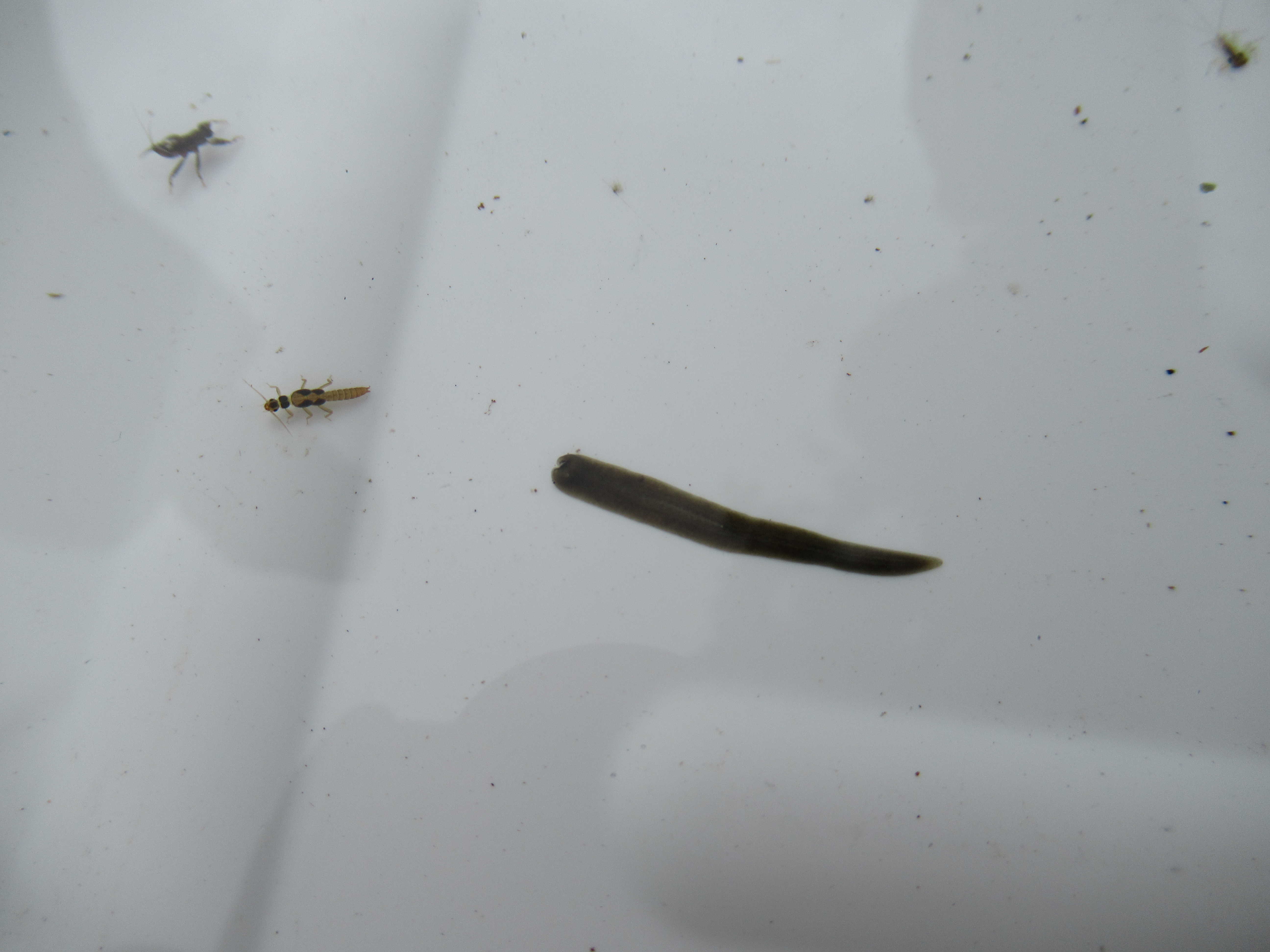
Water was still a bit cold. But we could find several nests of caddisfly larva here and there at the bottom of rocks. Lots of small nymph of stonefly came out of our nets. Tadpoles of Buerger’s flog were swimming in small but many pools of warmer water diverted from the stream. Amphibs of several dragonflies and megaloptera were already in certain size, meaning they were eating well as predator of the other smaller aquatic living things. We even found planarian flatworms, in plural.

A planarian flatworm and friends

“Well, it was needless anxiety, in the end.” “Yes. It may be difficult for kindergarteners to enter several spots we’ve checked today. But there are the other corners of the stream we would bring them for observational sessions.” “Indeed. For adults, we may think to prepare some facilities down to the stream.” “That’s a matter of budget.” “Hmmmm …” In any case, weekends of this summer, we forest instructors could guide you for observation fun of aquatic creatures. Thinking such an industrial vista of last March, it is amazing Yadoriki Water Source Forest recovering its natural environment this quick. Don’t underestimate Mother Nature, I presume.

These days,
 many families are having picnic on the Yadoriki Stream.

Oh, by the way, a wild serow may have decided to make Yadoriki Water Source Forest its territory. As we encounter it so many times, it seems to me the animal doesn’t have any problem having lunch next to us humans. Please let it be naturally in peace if you’re lucky enough to see her/him munching grass along the forestry road.

A photo taken not in a zoo


If you find environmental issues in Kanagawa Prefecture, please make a contact with Kanagawa Natural Environment Conservation Center 神奈川県自然環境保全センター

657 Nanasawa, Atsugi City, 243-0121
〒243-0121 厚木市七沢657
Phone: 046-248-0323

You may send an enquiry to them by clicking the bottom line of their homepage at http://www.pref.kanagawa.jp/div/1644/

Friday, April 9, 2021

Sisyphus: Eagle fern and Golden-rayed Lily in Niiharu Citizen Forest 新治市民の森


Niiharu Forest 新治市民の森 was once agricultural farmlands for local farmers. Urbanization has made much of the area for forest and park. Still, it has several patches of chestnut orchard that was cultivated by previous owners of the land. The largest one is spreading on a slope facing north to a small community of landlords of Niiharu, and Tokaichiba Housing Complex 十日市場団地 (my post on September 9, 2016). In 2018 Mr. Hideshige Uchino, the Director of Nagaike Park 長池公園 for the City of Hachioji 八王子, Tokyo, praised the site. “Keeping natural environment of the north facing slope is scarce these days in Tama Hills 多摩丘陵 where urbanization has concreted the nature en masse. This spot in Niiharu is one of such precious places. Looking the vegetation here, I guess the level of underground water is high. North-facing slope with stable moisture makes flourishing the plants for wet and cold climate. It is also rare in Megalopolis Tokyo. Please take care the chestnuts, Niiharu Lovers Association, will you?”

Chestnuts orchard in Niiharu in May 2018
The same orchard in July 2019. So lush vegetation …

Then in 2019, mega typhoons hit Kanagawa Prefecture. Normally, Typhoons move from the west to the east for Yokohama, which spares the north facing side of a hill from damages. In 2019, it was not. Especially Typhoon Faxai in early September, a freak storm trespassed Tokyo Bay from the south to the north, caused devastations to north slopes in Megalopolis. Niiharu’s largest chestnut orchard suffered hard. The chestnuts supposed to be collected by Niiharu Lovers in few days were completely destroyed. Moreover, many trees, including old chestnuts trees were snapped in half, or rooted out by strong winds. The scenery of once productive orchard became so sad. That year, the other Citizen Forests in Yokohama, such as Segami Citizen Forest had massive landslides due to Faxai. Niiharu Forest scored better than such worst incidences. Still, we Lovers of Niiharu were aghast and disappointed. “We cannot have chestnuts this year!” “Or, can we have chestnuts next year or future? So many trees were completely damaged …” A sort of hopelessness made Lovers Association to leave the place “as is” for a while. In normal years, we collect chestnuts in September, then mow the place 1-2 times before the next harvest time comes. We skipped it for 2020. In any case, COVID-19 restricted the activity of Lovers Association … a sort of excuse. Then, something miraculous happened.

The orchard immediately after Faxai
The same orchard after Typhoon Hagibis in October 2019.
 Hagibis took relatively standard course for Yokohama
 so that additional damage to the orchard was contained …

About 7 months later. May 2020.
The slope had lots of invasive Eastern Daisy Fleabane
 (Erigen annuus) coming from the North America.
 Could you figure out lots of snapped trees?

In July 2020, suddenly, the chestnuts orchard had lots of large buds of Golden-rayed lilies (Lilium auratum). They soon made the slope flower garden of gorgeous lilies, filled with noble fragrance. One of the veteran Lovers said. “Er … yeah, the landlord lady who donated the ancestral orchard to the City of Yokohama left word like ‘Please take care of flowers here that thrived for hundreds of years …’ That was true, now I know.” The word of mouths spread. Many people, not only locals but also from Tokyo and the other prefectures, came to admire the place. The City invited many professional botanists to check the place. Their conclusion was, the typhoon was a typical disturbance of nature removing the dominating old trees. The skies once covered by leaves of trees are now open, which let in the sunshine and air freely to the north facing slope. The dormant floor vegetation became awake. Phew. We Lovers Association are allocated the task “To take care of the place and keep the lilies thrive even more, will you?”

Lily field in July 2020.
 Those whitish spots in the photo are all lilies.

So, last summer in 2020 Niiharu Lovers have returned to the chestnut orchard. We cleared the damaged trees and mowed the slope “very carefully.” Before, we mowed the ground by brush cutter roughly. No more. We keep clearing the slope by brush cutter but with at most care not to damage the lilies. We then use our sickles to weed sasa bamboos (Pleioblastus chino) and grasses covering young lilies that cannot flower yet. Since last August we have done this at least 4 times as of February 2021. I’ve joined the task 3 times, and found not only sasa bamboos and grasses, but also ferocious Eagle ferns (Pteridum aquilinum) covering the field thick. “Well, Mr. Uchino said the site is north-facing and humid. Come to think of it, the environment is ideal for ferns, isn’t it.” “Yeah. Look. We mowed this much of ferns …” In front of us is a mount of mowed grasses, or ferns, that must be neatly collected and cleared for the flower bed of next year. They will return next year for sure …

The first result of 2020 machine mowing
for the chestnuts orchard … still lots of ferns remained.

It then clicked with me. “The buds of Eagle ferns are edible! Why not collecting them in spring? It’s really a Nip-in-the-bud situation!” Senior Lovers told me. “Well, Naomi, if you want, do it by yourself. We think it’s a useless endeavor.” “Eagle ferns are ferocious. Picking their bud don’t solve the problem. When we want to reduce their population, we must dig out the root. It’s a too much task.” Well, OK. I’ll come back here alone in spring to collect the buds of ferns. Just do it, doesn’t it? COVID or not, spring 2021 comes. In early April, I entered the chestnut orchard. Collecting vegetation in Niiharu Citizen Forest is a NO-NO thing, but the ferns must be mowed sooner or later and discarded as garbage. At least, I’ll collect them for our family dinner, which is more sustainable! Sure enough, there were lots of buds of eagle ferns … Soon, I found myself in a miserable feeling. The slope is filled with REALLY LOTS OF ferns sprouting vertically like skyscrapers of Manhattan or Hong Kong. In few minutes, my plastic bag was full of fern buds, and I was still surrounded by eagle ferns. What kind of difference will I be possible to make? I was sure it would end up NOTHING for the orchard, even as a negative effect. I was powerless …

March 2021 of the north slope of chestnuts orchard.
 Oh-so-cleared field, thanks to our effort, …
… bristles with buds of Eagle ferns.

At least, I brought home fresh edible buds of eagle ferns. It can be a good preserved-food that can last till spring next year. Here is the recipe I used with eagle ferns.

(1) Making dried buds of Eagle ferns, or Warabi わらび (in Japanese).

Buds of Eagle ferns are edible, but they taste harsh without removing the tartness. Here is the way:

1. Wash freshly collected buds of eagle ferns in running water, and cut the hard part near the root. The way is exactly the same as preparing asparagus.

2. Put them in a boiling pan filled with water and baking soda, like 3L of H2O and 2 Tbsp of soda. If you have cooking ash, you can use it instead of baking soda. When the pan returns to boiling, stop cooking and drain the contents and wash them in a running water. Now we can use Warabi undergone this treatment for salads, stir fries, etc. (recipe is here). But I proceed to the next stage such as … 

3. Dry them on a basket under sunshine. Massage Warabi gently several times while they are soft.

Drying Warabi. They are at the beginning of the process.

4. Within a week, Warabi shrinks and dried completely. When they reach to this stage, we can store them with a packet of desiccant, for almost “forever.”

5 days later. They’ve shrunk completely.
 They are now ready to be stored.

 (2) How to eat dried Warabi.

I think it’s a matter of opinion, but I believe dishes made of dried Warabi is tastier than that of “boiled-only” one. Here is one of my recipes to cook dried Warabi:

1. Put 20g of dried Warabi with plenty of water in a pan. Cover it with a drop-lid and bring the pan to boil.

Dried Warabi in water, ready to be boiled.

2. When it starts to boil, turn off the fire and cool the pan. In the process change the water several times. When you do it slowly, say for 24 hours, the dried Warabi returns to its former size, and very soft.

The pan after boiling.
Could you figure out the liquid is tinted with green?
If you prefer slight tartness of dried Warabi in you dish,
 you can start cooking immediately now.
Otherwise, this is the result of few more ours of soaking.
Some say their fiddleheads are not good to eat.
But I didn’t care, and still alive now!

3. Drain the Warabi well. Cut Warabi to 3-4cm long. Put them in a pan with 4 julienned fried-tofu (Abura-age), 3 cups of vegetable broth, 1/2 Tbsp sugar, 3/2 Tbsp Mirin, and 2 Tbsp soy source.

Abura-age.
You can have it from any Japanese supermarket.

Warabi, Abura-age, and vegetable broth, et al in a pan

4. Cover the pan with a drop-lid and simmer by low heat until the seasoned broth is reduced enough.

Drop-lid is like this.

5.Bon Appetit!

😋

… Yeah. It’s like the task of Sisyphus. Never-ending. Though, according to Camus, Sisyphus have found some meaning to it. At least, mine is yummy. I’ve returned to the same conclusion as I munched steamed bread of Red deadnettle. Human limitation … Naomi’s philosophical spring. Mutated COVID-19 could dominate here Yokohama, soon …


If you find a problem in the greenery of north-half of Yokohama, please make a contact with

Office for the Park Greeneries in the North
北部公園緑地事務所
Yokohama Municipal Government Creative Environment Policy Bureau
横浜市環境創造局
Phone: 045-311-2016
FAX: 045-316-8420

Niiharu Administrative Office / Satoyama Exchange Center
新治管理事務所・里山交流センター
Phone: 045-931-4947
Fax: 045-937-0898
Email: info@niiharu.jp
http://www.niiharu.jp/

Thursday, March 18, 2021

Quiet conqueror: Yadoriki Water Source Forest, early spring 2021 やどりき水源林

Euptelea polyandra in March 2021 for Yadoriki Forest


The last time I’ve been to Yadoriki Water Source Forest やどりき水源林 was October 2020. The place was under heavy reconstruction from the destruction by typhoons in 2019. Early this month, I’ve returned there. The works are still on-going, but several parts are open to hikers.

Japanese green alder (Alnus firma)
 in March 2021 for Yadoriki Forest

The prefecture has almost completed the repair works for the forestry road from the gate of Water Source Forest. We can walk a paved road almost to the end of the former route. The collapsed section is detoured by a new cutting through the western slope of Mt. Nabewari 鍋割山 (ASL 1272.4m). The debris of landslides 2 years ago still remain, but they definitely become a small part of the course. I think finally families with kids can walk there now. Though, we forest instructors have recognized that the prefecture, i.e. the landlord, does not intend to recover the pavement fully that before reached to the starting point to the trail to Ameyama Pass 雨山峠 (ASL 957m). Anyway, there is undeniably an improvement.

The collapsed part of the previous route is detoured.

The work is still going on …

Yadoriki Stream 寄沢, which caused flash floods and debris flows in 2019, is undergoing a substantial intervention. The Prefectural Office flattened the riverbed with heavy machinery and digging artificial water way in the middle. We seriously doubted how long such synthetic river can last if another monster typhoon hits the area again … In 2019, the Open Space near toilets suffered heavy erosion to be reduced in half. The place is still off-limit. We hope the site becomes accessible by summer holiday. But … could we find a place for kids to play with water, I wonder …?


This is the flattened riverbed.
 We cannot see the stream from this point,
 but a fissure at the foot of these destroyed logs
 is artificially dug water way.

Woooooooow.
 The stream looks like a road now …
 the construction work is going-on.

The afforestation expanded on the western slope of Yadoriki Stream is receiving an intense forestry by thinning cedars and cypresses. The prefecture told us the place is accessible only for professional foresters who contracted the work from the Office. In 2019, Yadoriki Stream was flooded with broken and uprooted afforested trees. So, doing professional forestry up there to stabilize the slope certainly has a good reason. They say the work will continue at least until summer this year. We will be able to have a quiet autumn walk in Hadano Forestry Road 秦野林道 this year …

The trolley line for forestry to the western slope is
 fully operational now.

We found lots of Astraeus sp. as well.
 They love gravelly place so that encountering them
 in Yadoriki of under-construction may not be surprising.

Despite of massive civil engineering, I personally find the nature of Yadoriki Forest is recovering strongly. After the typhoons in 2019, I felt sad to find many decimated points where before beautiful mosses secretly but cheerfully sprouted their capsule to procreate. Now they are coming back, if not fully. Impressive. In Chinese character, mosses are written as 苔. It’s a hieroglyph. The top part which looks like a hat means “row of grasses.” The middle symbolizes “plow”, and the bottom is “mouth.” When a farmer starts his/her work in the spring, the first thing s/he normally does is plowing the ground like opening the mouth of soil. So, the Chinese character for mosses means “it’s the beginning of vegetation.” Yeah. Yadoriki Water Source Forest was covered with mountain debris two years ago. Aside from the endeavor of humans restoring the place, tiny mosses may be quietly taking a lead for the recovery of the forest ... Petit conquerors!

I think, they are Palamocladium leskeoides.
 Such delicate apparitions of mosses were
 gone after monster typhoons of 2019
 … Now, they’re back!

The beloved Racomitrium japonicum are recovering in Yadoriki.
 Hurrah!

If you find environmental issues in Kanagawa Prefecture, please make a contact with Kanagawa Natural Environment Conservation Center 神奈川県自然環境保全センター

657 Nanasawa, Atsugi City, 243-0121
〒243-0121 厚木市七沢657
Phone: 046-248-0323

You can send an enquiry to them by clicking the bottom line of their homepage at http://www.pref.kanagawa.jp/div/1644/

Friday, October 16, 2020

Flower arrangement with living cedars: Pruning in Hakone 箱根

Hakone Sengokubara 仙石原

Last year’s monster typhoons threw Hakone 箱根 into a mess. Lake Ashinoko 芦ノ湖 overflew. Town’s roads system was destroyed by landslides. Railroads lost their tracks with collapsed mountain slopes … One year has passed since then. Fortunately (or not), according to this analysis, Japanese have accumulated the know-how to swiftly deal with such problems. The transportation system in Hakone has restarted its normalcy this July, 3 months earlier than the original schedule. Recently, I’ve been there. Yeah, in spite of the COVID-things, Hakone is resuming its tourism business. Traffic congestions were here and there. Impressive.

Fukuzumiro 福住楼,
 one of traditional Japanese hot-spa inns in Hakone

Though, the effect of Japanese oak tree wilt (; my post on August 23, 2019) is remaining in Hakone. The area was the first in Kanagawa Prefecture where we noticed the dying trees, some 3 or 4 years ago. Several mountain slopes in Hakone are now covered with desiccated brown patches that are definitely-not autumn leaves. Sad. Despite of ferocious typhoon winds last year, those dead trees keep on standing … It is remarkable, certainly. But, how long will it take for Hakone to recover mountains covered with healthy greens? I wonder.

The restored train operation,
 and unrestored mountain with oak tree wilt
 in Hakone

Hakone is also seeing the problems of overpopulated Shika deer. Tanzawa 丹沢, Hakone’s eastern neighbor, is having this problem for years. When we enter Tanzawa mountains we must cover our foot against vampire leeches carried by deer population (; my post on 14 July 2017). Shizuoka Prefecture 静岡県, the western neighbor of Hakone, also having the issues with the animal. Hakone has spared such challenges so far, but it could be a matter of time if its adjacent areas are full of deer (; my post on 21 July 2017). Actually, when we mow the forest floor in Hakone, saplings and young trees are often become lunch for hungry deer. As the place is the National Park, the authorities are more alarmed if such popular tourist destination having bold mountains and pestering vampire worms as her neighbors.

Lunch for deer

So, one day when we pruned the boughs of young pollen-free cedars (my post on December 16, 2016), the Prefectural office asked forest instructors to have a novel measure to protect the trees. Trees can withstand a bit of bites on their body, but once stripping of their skin becomes substantial enough, it dies. Voracious deer don’t care if a forest is dying due to their eating habit. So it comes the novel way to protect the young trees. We covered the foot of pruned cedars with its removed boughs, just like wearing skirts. Our intention was, by protecting trunks of young trees, deer cannot gnaw barks of the forest. “You see? Christmas wraths made of cedars keep its green for at least 2 years. The protection we made today would last for some time. Trees can grow stronger meanwhile.” I see. “You try to have a viewpoint of hungry deer. They come here and try to chew the vegetation within the reach of their mouth.” I imagined myself entering the forest on all fours and extending my neck to have a lunch. “Well, this lower space looks appetizing.” i.e. We had to cover that part. We fastened the branches leaned on a trunk by tying them with a longer cedar bough. They were flexible enough to be a securing band. “We cannot do this with cypress, you know.” It was a fun operation. We were becoming more artistic to make an interesting barrier around the trunks. It was like doing a flower arrangement in a forest.

Cedars wearing skirts
This installation is figurative,
 don’t you think?

We don’t know if our approach is effective to protect the forest from insatiable herds of deer. In any case, something is happening for forests of Japan. This fall, we’ve heard so many news about hungry wild animals, like deer, serow, bear, boar, … wondering into human settlement for food. It’s rainy fall this year. Winter is approaching …


If you find environmental issues in Kanagawa Prefecture, please make a contact with Kanagawa Natural Environment Conservation Center 神奈川県自然環境保全センター

657 Nanasawa, Atsugi City, 243-0121
〒243-0121 厚木市七沢657
Phone: 046-248-0323

You can send an enquiry to them by clicking the bottom line of their homepage at http://www.pref.kanagawa.jp/div/1644/

Friday, October 9, 2020

Under construction: Yadoriki Water Source Forest, Fall 2020 やどりき水源林


Now we know we have to learn to co-live with COVID-19. Kanagawa Forest Instructors Association has resumed our activity in Yadoriki Water Source Forest やどりき水源林 with new measures. When we guide the forest for visitors, we wear face masks and carry hand sanitizers. We check enough supply of soaps in toilets frequently … Having said that, actually, Yadoriki Water Source Forest is closed for its 4/5 coverage for the rest of the year.


The latest map for Yadoriki Watersource Forest.
 The area enclosed by black arrows are
 the only part we can enter now.


Kanagawa Prefecture decided to utilize this “with-COVID” situation when we are a sort of hesitant to go out. They are doing the civil engineering works to restore forestry roads that were destroyed last year by monster typhoons (; my post on November 1 and 22, 2019). The prefecture is also busy in forestry for the afforested area, especially in the westside of Yadoriki Stream. That was a part devastated by the typhoons last year. They are clearing the broken trees. In addition, the contract foresters are thinning the forest for the “fittest” cedars and cypresses, hoping they become large enough trees to secure the soil against future huge storms.


Restoration work for the embankment of the Open Space.
 I guess, their idea is piling up huge rocks along the bank
 would lessen the damage of flush flood.
 Er … let us see.

So, trucks loaded by rocks are busy commuting
 between the forest and some depot for rocks.

Especially during Monday to Saturday, when you visit Yadoriki Water Source Forest now, you will be greeted by thunderous noise of road constructions, for creation of embankments, and of thinning chainsaws … It’s totally up to you to enjoy the scenery, or not. Yeah. The noise is not non-stop for sure. That’s the difference between the construction works in city center and in deep forest … We forest instructors are a bit sad to find our beloved hazelnuts trees were cut to make a new forestry road. My seniors were also disappointed a pillow lava, which they polished to confirm its crystalized surface due to its formation millions of years ago, was thrown away as a trash … The area where we instructors have been doing the forestry is now inaccessible due to bulldozers. *Sigh*


Where is the polished lava?

The Prefecture plans to end all of these hubbubs by the end of the year. We are waiting now … Anyway, by the time the new forestry roads are ready in Yadoriki Forest, we may have some remedy against COVID-19. Let’s be patient and keep crossing our fingers.


If you find environmental issues in Kanagawa Prefecture, please make a contact with Kanagawa Natural Environment Conservation Center 神奈川県自然環境保全センター

657 Nanasawa, Atsugi City, 243-0121
〒243-0121 厚木市七沢657
Phone: 046-248-0323

You can send an enquiry to them by clicking the bottom line of their homepage at http://www.pref.kanagawa.jp/div/1644/