Showing posts with label Typhoon Hagibis. Show all posts

Friday, June 25, 2021

Resilience: Aquatic lives in Yadoriki Water Source Forest, summer 2021 やどりき水源林


In Yokohama, very urban place, a part of megalopolis Tokyo, people play THE major role for messing up the habitat for aquatic creatures, such as dragonfly. In the same prefecture, I mean Kanagawa Prefecture, story can be different. The case in point: Yadoriki Water Source Forest やどりき水源林. There, the protagonist, it seems to me, is in the end Mother Nature. Let me tell you my recent adventure there.


Kanagawa Forest Instructors are doing a guiding service at Yadoriki Water Source Forest. At 10:00 and 13:00 every weekend between March and November, two forest instructors are on duty at Yadoriki admin cottage near the gate. We are showing the forest for visitors. The place has lots of interesting things like vegetation, animals, and geological features that seasonally change. Our guiding is on demand base. If a visitor request to see flowers in season, for example, we guide the person according to the theme. We also have a rough half-day program to suggest if you don’t have a particular idea about Yadoriki Forest (; the calendar is available from here). The themes we offer every month are,

1. General nature experience, aka small hiking
2. Forest relaxation walk
3. A bit of woodcraft experience, and
4. Visiting Forests of Growing (; my post on June 9, 2017)

In addition, we have a special program only for July and August. It’s a small observation session of aquatic creatures.


Actually, this summer-only program is popular. What we do is catching tiny water creatures from Yadoriki Stream and observing them swimming in a tray. After the session, we return the living things to the stream. The educational level of the program is for 4-5 years old, and up. Often parents, not kids, become too involved in and we instructors must do babysitting to ensure the safety of participating babies. Elementary school kids can have a fun day and finish their homework of “independent research over the summer holiday.” Visitors don’t have to bring anything. We instructors bring all the necessary equipment, including pencil and a note. Above all, it’s free! Bargain, don’t you think?

A larva of caddisfly

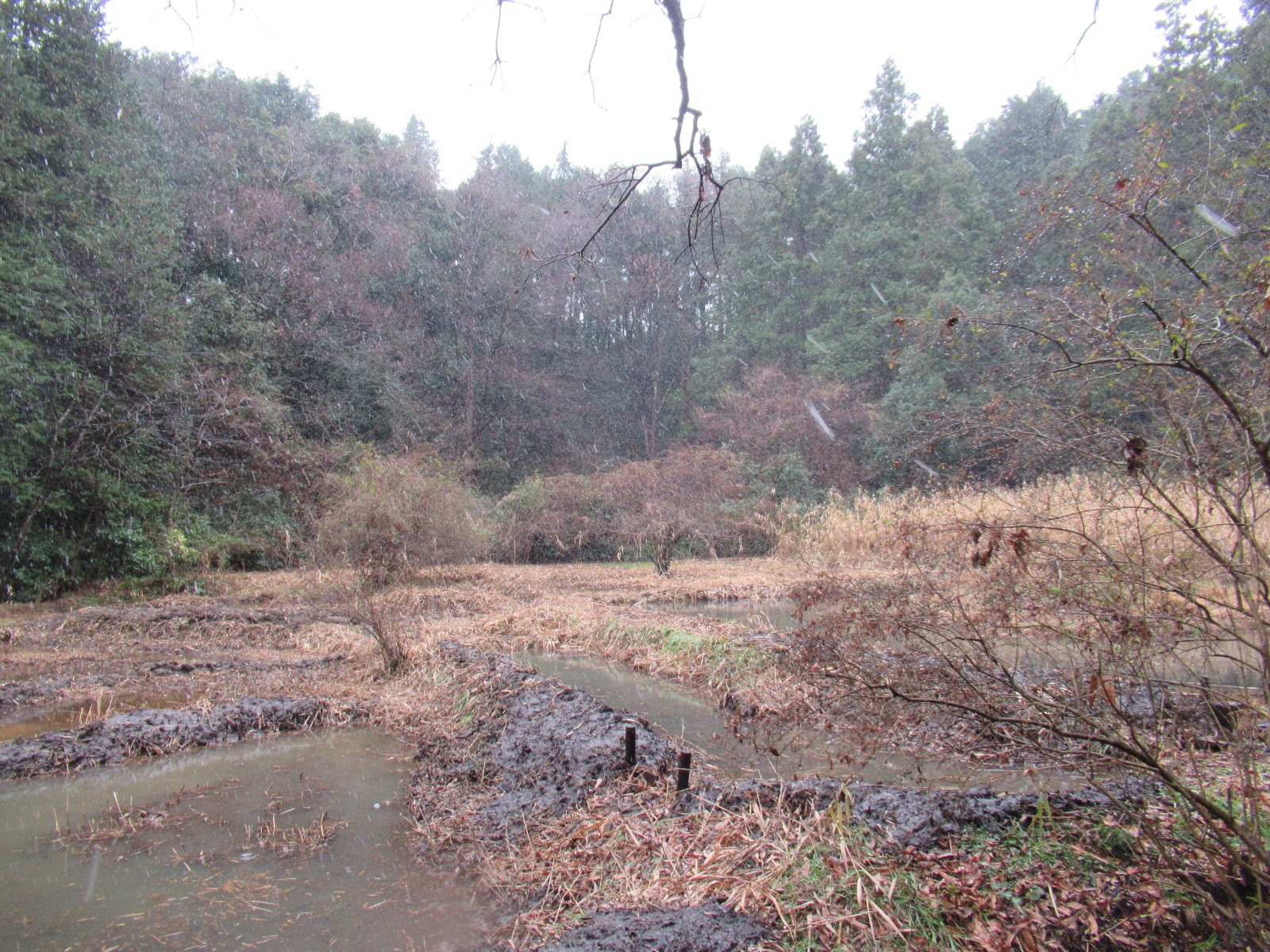
So, we, Kanagawa Forest Instructors, are watching Yadoriki Stream all year around to make it sure we will have special summer program safely. Meanwhile two mega-typhoons hit the area during September and October of 2019. The feature of Yadoriki Stream was changed radically + there has been some possibility of debris avalanche to the downstream. Luckily or not last year, due to COVID-19 the entire summer program for Yadoriki was cancelled. The prefectural office was busy stabilizing the banks and riverbed of the Stream. In early spring this year, the scenery of the area where kindergarteners once enjoyed their hunt for aquatic creatures was totally different (; my post on March 18). In March, one of my senior Instructors watched bulldozed riverbed and murmured “… how cheerless …” We were worried if we could have aquatic observation session this summer.

Yadoriki stream in spring 2019.
 It was before the monster typhoons …

In fall 2019. Typhoons changed the scenery.

In April 2021.
 The riverbed of Yadoriki Stream was bulldozed.

The major construction works for Yadoriki Stream was completed in April. Since then, there were several mini storms, if not typhoons, for Yadoriki area. When I returned Yadoriki early June, once mechanically excavated river flow was already altered with crumbling banks constructed by bulldozers. Hmmmmmmm … maybe from civil engineers’ point of view it was a depressing scenery. But for us forest instructors, the situation offered a hope for fun observation of aquatic creatures once again with kids. “Let us check 3 points along Yadoriki Stream. One in the mainstream, and the other for two branch valleys.” We entered the water course with nets and buckets. It turned out we were not disappointed.

Whatever the civil engineers intended,
 the artificial riverbanks are crumbling now,
 by just  tiny storms.

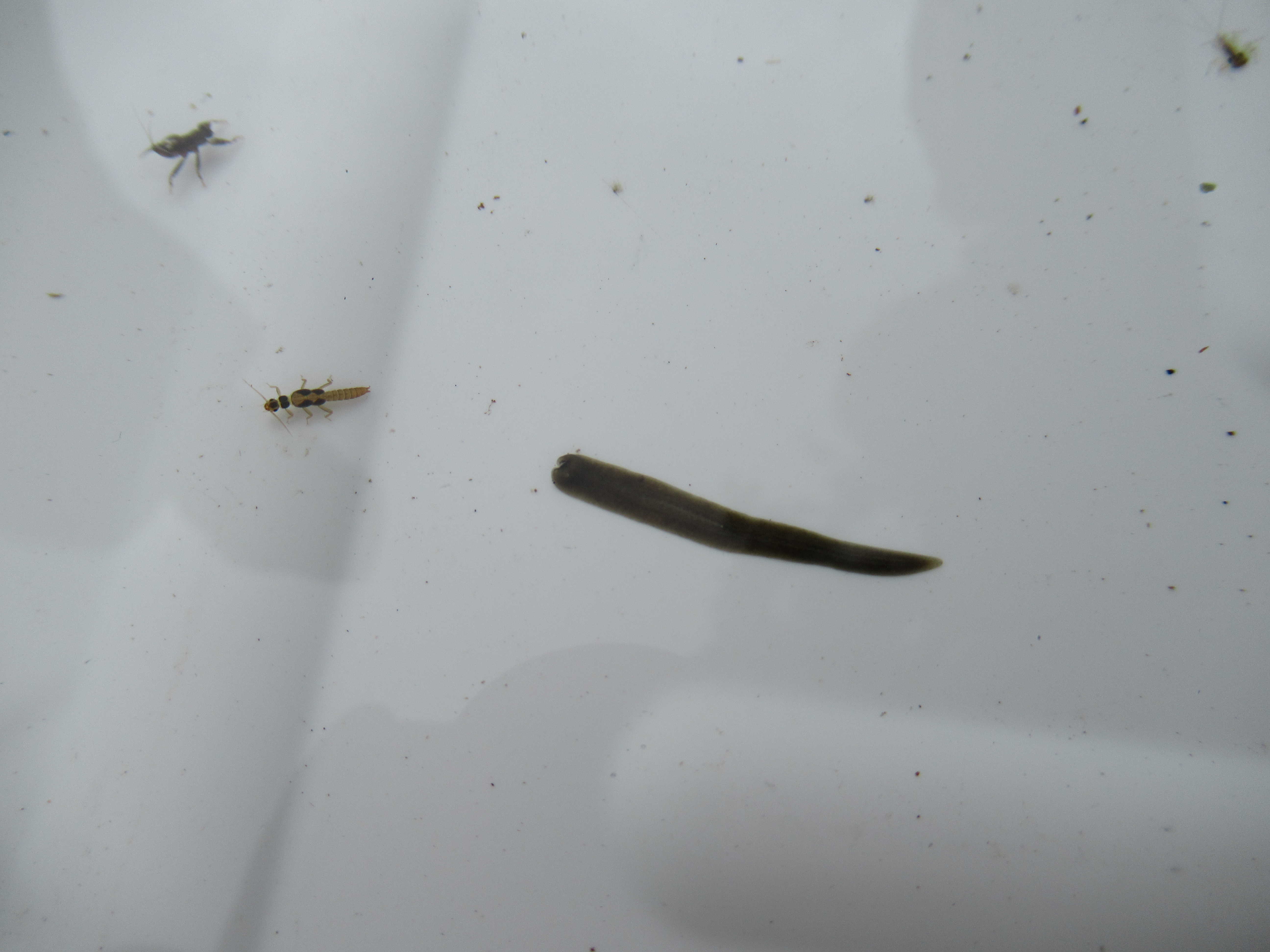
Water was still a bit cold. But we could find several nests of caddisfly larva here and there at the bottom of rocks. Lots of small nymph of stonefly came out of our nets. Tadpoles of Buerger’s flog were swimming in small but many pools of warmer water diverted from the stream. Amphibs of several dragonflies and megaloptera were already in certain size, meaning they were eating well as predator of the other smaller aquatic living things. We even found planarian flatworms, in plural.

A planarian flatworm and friends

“Well, it was needless anxiety, in the end.” “Yes. It may be difficult for kindergarteners to enter several spots we’ve checked today. But there are the other corners of the stream we would bring them for observational sessions.” “Indeed. For adults, we may think to prepare some facilities down to the stream.” “That’s a matter of budget.” “Hmmmm …” In any case, weekends of this summer, we forest instructors could guide you for observation fun of aquatic creatures. Thinking such an industrial vista of last March, it is amazing Yadoriki Water Source Forest recovering its natural environment this quick. Don’t underestimate Mother Nature, I presume.

These days,
 many families are having picnic on the Yadoriki Stream.

Oh, by the way, a wild serow may have decided to make Yadoriki Water Source Forest its territory. As we encounter it so many times, it seems to me the animal doesn’t have any problem having lunch next to us humans. Please let it be naturally in peace if you’re lucky enough to see her/him munching grass along the forestry road.

A photo taken not in a zoo


If you find environmental issues in Kanagawa Prefecture, please make a contact with Kanagawa Natural Environment Conservation Center 神奈川県自然環境保全センター

657 Nanasawa, Atsugi City, 243-0121
〒243-0121 厚木市七沢657
Phone: 046-248-0323

You may send an enquiry to them by clicking the bottom line of their homepage at http://www.pref.kanagawa.jp/div/1644/

Thursday, March 18, 2021

Quiet conqueror: Yadoriki Water Source Forest, early spring 2021 やどりき水源林

Euptelea polyandra in March 2021 for Yadoriki Forest


The last time I’ve been to Yadoriki Water Source Forest やどりき水源林 was October 2020. The place was under heavy reconstruction from the destruction by typhoons in 2019. Early this month, I’ve returned there. The works are still on-going, but several parts are open to hikers.

Japanese green alder (Alnus firma)
 in March 2021 for Yadoriki Forest

The prefecture has almost completed the repair works for the forestry road from the gate of Water Source Forest. We can walk a paved road almost to the end of the former route. The collapsed section is detoured by a new cutting through the western slope of Mt. Nabewari 鍋割山 (ASL 1272.4m). The debris of landslides 2 years ago still remain, but they definitely become a small part of the course. I think finally families with kids can walk there now. Though, we forest instructors have recognized that the prefecture, i.e. the landlord, does not intend to recover the pavement fully that before reached to the starting point to the trail to Ameyama Pass 雨山峠 (ASL 957m). Anyway, there is undeniably an improvement.

The collapsed part of the previous route is detoured.

The work is still going on …

Yadoriki Stream 寄沢, which caused flash floods and debris flows in 2019, is undergoing a substantial intervention. The Prefectural Office flattened the riverbed with heavy machinery and digging artificial water way in the middle. We seriously doubted how long such synthetic river can last if another monster typhoon hits the area again … In 2019, the Open Space near toilets suffered heavy erosion to be reduced in half. The place is still off-limit. We hope the site becomes accessible by summer holiday. But … could we find a place for kids to play with water, I wonder …?


This is the flattened riverbed.
 We cannot see the stream from this point,
 but a fissure at the foot of these destroyed logs
 is artificially dug water way.

Woooooooow.
 The stream looks like a road now …
 the construction work is going-on.

The afforestation expanded on the western slope of Yadoriki Stream is receiving an intense forestry by thinning cedars and cypresses. The prefecture told us the place is accessible only for professional foresters who contracted the work from the Office. In 2019, Yadoriki Stream was flooded with broken and uprooted afforested trees. So, doing professional forestry up there to stabilize the slope certainly has a good reason. They say the work will continue at least until summer this year. We will be able to have a quiet autumn walk in Hadano Forestry Road 秦野林道 this year …

The trolley line for forestry to the western slope is
 fully operational now.

We found lots of Astraeus sp. as well.
 They love gravelly place so that encountering them
 in Yadoriki of under-construction may not be surprising.

Despite of massive civil engineering, I personally find the nature of Yadoriki Forest is recovering strongly. After the typhoons in 2019, I felt sad to find many decimated points where before beautiful mosses secretly but cheerfully sprouted their capsule to procreate. Now they are coming back, if not fully. Impressive. In Chinese character, mosses are written as 苔. It’s a hieroglyph. The top part which looks like a hat means “row of grasses.” The middle symbolizes “plow”, and the bottom is “mouth.” When a farmer starts his/her work in the spring, the first thing s/he normally does is plowing the ground like opening the mouth of soil. So, the Chinese character for mosses means “it’s the beginning of vegetation.” Yeah. Yadoriki Water Source Forest was covered with mountain debris two years ago. Aside from the endeavor of humans restoring the place, tiny mosses may be quietly taking a lead for the recovery of the forest ... Petit conquerors!

I think, they are Palamocladium leskeoides.
 Such delicate apparitions of mosses were
 gone after monster typhoons of 2019
 … Now, they’re back!

The beloved Racomitrium japonicum are recovering in Yadoriki.
 Hurrah!

If you find environmental issues in Kanagawa Prefecture, please make a contact with Kanagawa Natural Environment Conservation Center 神奈川県自然環境保全センター

657 Nanasawa, Atsugi City, 243-0121
〒243-0121 厚木市七沢657
Phone: 046-248-0323

You can send an enquiry to them by clicking the bottom line of their homepage at http://www.pref.kanagawa.jp/div/1644/

Friday, October 16, 2020

Flower arrangement with living cedars: Pruning in Hakone 箱根

Hakone Sengokubara 仙石原

Last year’s monster typhoons threw Hakone 箱根 into a mess. Lake Ashinoko 芦ノ湖 overflew. Town’s roads system was destroyed by landslides. Railroads lost their tracks with collapsed mountain slopes … One year has passed since then. Fortunately (or not), according to this analysis, Japanese have accumulated the know-how to swiftly deal with such problems. The transportation system in Hakone has restarted its normalcy this July, 3 months earlier than the original schedule. Recently, I’ve been there. Yeah, in spite of the COVID-things, Hakone is resuming its tourism business. Traffic congestions were here and there. Impressive.

Fukuzumiro 福住楼,
 one of traditional Japanese hot-spa inns in Hakone

Though, the effect of Japanese oak tree wilt (; my post on August 23, 2019) is remaining in Hakone. The area was the first in Kanagawa Prefecture where we noticed the dying trees, some 3 or 4 years ago. Several mountain slopes in Hakone are now covered with desiccated brown patches that are definitely-not autumn leaves. Sad. Despite of ferocious typhoon winds last year, those dead trees keep on standing … It is remarkable, certainly. But, how long will it take for Hakone to recover mountains covered with healthy greens? I wonder.

The restored train operation,
 and unrestored mountain with oak tree wilt
 in Hakone

Hakone is also seeing the problems of overpopulated Shika deer. Tanzawa 丹沢, Hakone’s eastern neighbor, is having this problem for years. When we enter Tanzawa mountains we must cover our foot against vampire leeches carried by deer population (; my post on 14 July 2017). Shizuoka Prefecture 静岡県, the western neighbor of Hakone, also having the issues with the animal. Hakone has spared such challenges so far, but it could be a matter of time if its adjacent areas are full of deer (; my post on 21 July 2017). Actually, when we mow the forest floor in Hakone, saplings and young trees are often become lunch for hungry deer. As the place is the National Park, the authorities are more alarmed if such popular tourist destination having bold mountains and pestering vampire worms as her neighbors.

Lunch for deer

So, one day when we pruned the boughs of young pollen-free cedars (my post on December 16, 2016), the Prefectural office asked forest instructors to have a novel measure to protect the trees. Trees can withstand a bit of bites on their body, but once stripping of their skin becomes substantial enough, it dies. Voracious deer don’t care if a forest is dying due to their eating habit. So it comes the novel way to protect the young trees. We covered the foot of pruned cedars with its removed boughs, just like wearing skirts. Our intention was, by protecting trunks of young trees, deer cannot gnaw barks of the forest. “You see? Christmas wraths made of cedars keep its green for at least 2 years. The protection we made today would last for some time. Trees can grow stronger meanwhile.” I see. “You try to have a viewpoint of hungry deer. They come here and try to chew the vegetation within the reach of their mouth.” I imagined myself entering the forest on all fours and extending my neck to have a lunch. “Well, this lower space looks appetizing.” i.e. We had to cover that part. We fastened the branches leaned on a trunk by tying them with a longer cedar bough. They were flexible enough to be a securing band. “We cannot do this with cypress, you know.” It was a fun operation. We were becoming more artistic to make an interesting barrier around the trunks. It was like doing a flower arrangement in a forest.

Cedars wearing skirts
This installation is figurative,
 don’t you think?

We don’t know if our approach is effective to protect the forest from insatiable herds of deer. In any case, something is happening for forests of Japan. This fall, we’ve heard so many news about hungry wild animals, like deer, serow, bear, boar, … wondering into human settlement for food. It’s rainy fall this year. Winter is approaching …


If you find environmental issues in Kanagawa Prefecture, please make a contact with Kanagawa Natural Environment Conservation Center 神奈川県自然環境保全センター

657 Nanasawa, Atsugi City, 243-0121
〒243-0121 厚木市七沢657
Phone: 046-248-0323

You can send an enquiry to them by clicking the bottom line of their homepage at http://www.pref.kanagawa.jp/div/1644/

Friday, October 9, 2020

Under construction: Yadoriki Water Source Forest, Fall 2020 やどりき水源林


Now we know we have to learn to co-live with COVID-19. Kanagawa Forest Instructors Association has resumed our activity in Yadoriki Water Source Forest やどりき水源林 with new measures. When we guide the forest for visitors, we wear face masks and carry hand sanitizers. We check enough supply of soaps in toilets frequently … Having said that, actually, Yadoriki Water Source Forest is closed for its 4/5 coverage for the rest of the year.


The latest map for Yadoriki Watersource Forest.
 The area enclosed by black arrows are
 the only part we can enter now.


Kanagawa Prefecture decided to utilize this “with-COVID” situation when we are a sort of hesitant to go out. They are doing the civil engineering works to restore forestry roads that were destroyed last year by monster typhoons (; my post on November 1 and 22, 2019). The prefecture is also busy in forestry for the afforested area, especially in the westside of Yadoriki Stream. That was a part devastated by the typhoons last year. They are clearing the broken trees. In addition, the contract foresters are thinning the forest for the “fittest” cedars and cypresses, hoping they become large enough trees to secure the soil against future huge storms.


Restoration work for the embankment of the Open Space.
 I guess, their idea is piling up huge rocks along the bank
 would lessen the damage of flush flood.
 Er … let us see.

So, trucks loaded by rocks are busy commuting
 between the forest and some depot for rocks.

Especially during Monday to Saturday, when you visit Yadoriki Water Source Forest now, you will be greeted by thunderous noise of road constructions, for creation of embankments, and of thinning chainsaws … It’s totally up to you to enjoy the scenery, or not. Yeah. The noise is not non-stop for sure. That’s the difference between the construction works in city center and in deep forest … We forest instructors are a bit sad to find our beloved hazelnuts trees were cut to make a new forestry road. My seniors were also disappointed a pillow lava, which they polished to confirm its crystalized surface due to its formation millions of years ago, was thrown away as a trash … The area where we instructors have been doing the forestry is now inaccessible due to bulldozers. *Sigh*


Where is the polished lava?

The Prefecture plans to end all of these hubbubs by the end of the year. We are waiting now … Anyway, by the time the new forestry roads are ready in Yadoriki Forest, we may have some remedy against COVID-19. Let’s be patient and keep crossing our fingers.


If you find environmental issues in Kanagawa Prefecture, please make a contact with Kanagawa Natural Environment Conservation Center 神奈川県自然環境保全センター

657 Nanasawa, Atsugi City, 243-0121
〒243-0121 厚木市七沢657
Phone: 046-248-0323

You can send an enquiry to them by clicking the bottom line of their homepage at http://www.pref.kanagawa.jp/div/1644/


Friday, January 24, 2020

The things to come: Winter for coming summer in Niiharu Citizen Forest 新治市民の森


Last Saturday, it finally snowed in Niiharu Citizen Forest 新治市民の森. So far, this is a very odd winter … Statistically speaking, Niiharu is the coolest (for summer) or the coldest (for winter) in the City of Yokohama. But this winter the Forest had had only sleet, not snow. Moreover, the snow last Saturday was not enough to cover the ground white even for few minutes. It’s too mild, and very wet, winter. Strange, strange, strange …


There are murmurs saying in coming spring, and summer, there will be outbreaks of insects in the forests of Kanagawa. If the place could not become cold enough during winter, too many eggs and overwintering critters will survive. They surely start their battle for food when it becomes warmer. Will birches of Tanzawa 丹沢 endure the attack of Fagineura crenativora? What happens with those affected areas of Japanese oak wilt, such as in Hakone 箱根, Miura Peninsula 三浦半島, or beyond? (My post on August 23, 2019) Not only that. Lots of insects mean numerous chics to be adult birds. Many ordinary birds mean many raptors. If we unusually often meet birds of pray flying over the forests in Tanzawa, it could indicate overpopulated birds in the forest. Normally, watching them circling calmly over the ridge is very soothing. But, this year, it could suggest different, or even cynical, things in the forest. Sad. Further more, few snow in Tanzawa means many bambis will survive over the winter. In few months, they become mass of voracious adult deer denuding the vegetation of the mountains. For our forests in Kanagawa, the nature may not be capable of overcrowding insects, birds, hawks, deer … Will we frequently encounter the starved dead bodies of deer in Tanzawa Mountains again (my posts on 7, 14, 21 July 2017) this summer?


Yet, at this moment, we are having a bit of strange population of birds for Niiharu. I tell you next week what we have found this winter for birds’ life in our beloved Niiharu Citizen Forest. Warm, wet, with scars of super typhoons for Niiharu …


If you find environmental issues in Kanagawa Prefecture, please make a contact with Kanagawa Natural Environment Conservation Center 神奈川県自然環境保全センター

657 Nanasawa, Atsugi City, 243-0121
〒243-0121 厚木市七沢657
Phone: 046-248-0323

You can send an enquiry to them by clicking the bottom line of their homepage at http://www.pref.kanagawa.jp/div/1644/

Friday, January 17, 2020

Survival Game: Lives and the Lingering Effects of Flood Threats from Rivers in Kanagawa Prefecture


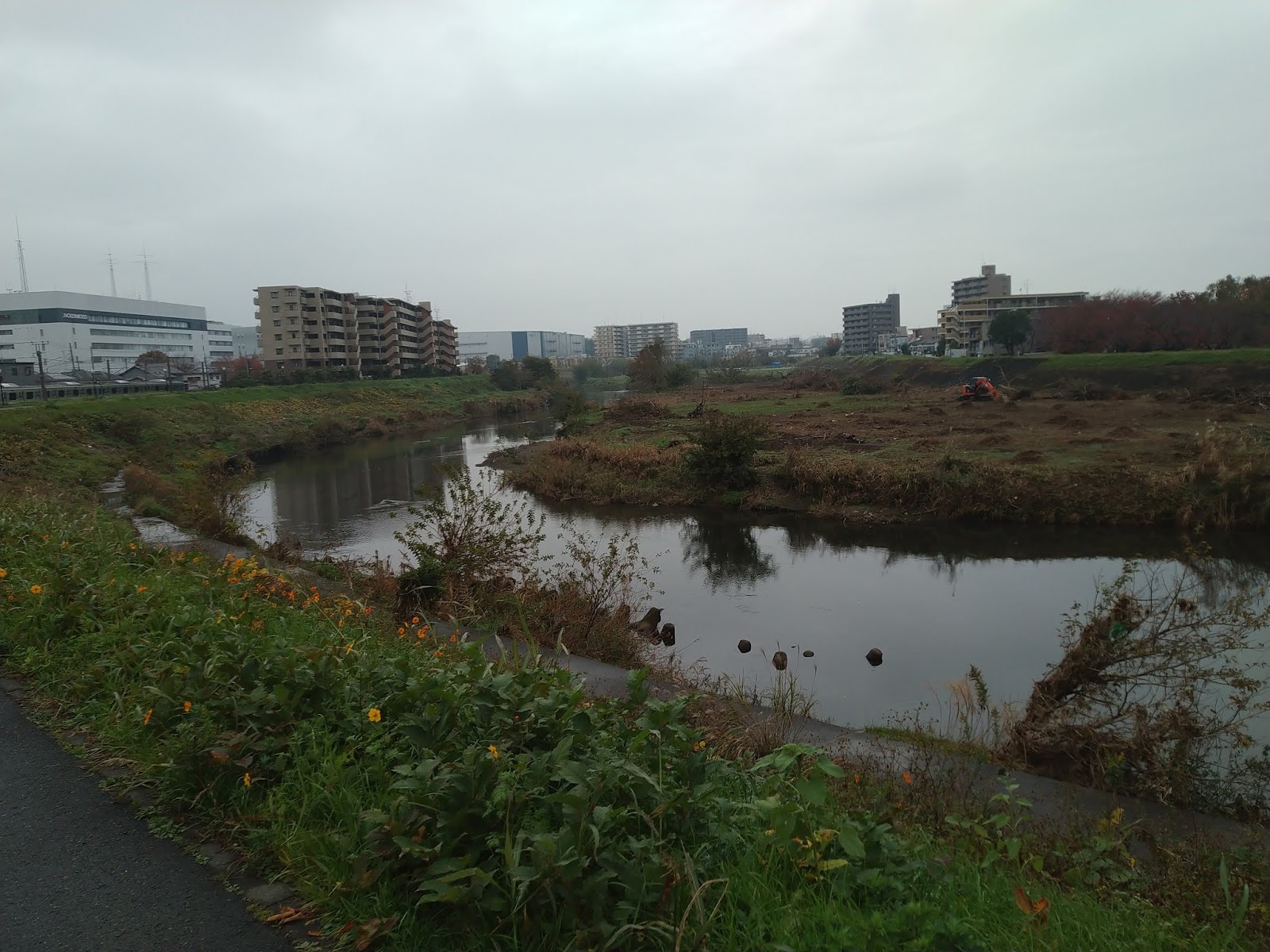
Last fall, we live in Metropolitan Tokyo area were hit twice by Super Typhoons, Faxai and Hagibis. In Kanagawa Prefecture, several were killed by landslides and flood. Tama River, marking the border between Tokyo and Kanagawa, flooded to kill a person in Kawasaki. Very fortunately, though, the banks of large rivers flowing in Kanagawa Prefecture did not collapse. It kept the damage from the typhoons somehow lesser in our towns compared with the other places like in Chiba or Nagano. In any case, it was a terrible experience. (For the photos about the disaster by Hagibis in Kanagawa, you can find them here, the site by Kanagawa Shinbun Newspaper Co.) 


A scenery showing how close it was for Sakawa River.


One of my seniors of Kanagawa Forest Instructors lives in Hiratsuka City 平塚市 along Sagami River 相模川. The bank of the river has been for her relaxed strolling. Then on 12th of October, the city issued an evacuation order to her neighborhood because of the torrential rain, and the warnings from 4 dams, Doshi Dam 道志ダム, Miyagase Dam 宮ケ瀬ダム, Sagami Dam 相模ダム, and Shiroyama Dam 城山ダム, for imminent release of water to Sagami River. “You see, our 50-inch TV was brand-new, and it was on the first floor. So my husband and I brought it first to the second floor. Then, my son came home. We all three frantically moved our furniture to the second floor. Gosh, how heavy our microwave was! Finally, only the refrige remained. We discussed if we can carry it to the second floor. It was impossible. We decided to let go the machine and the food if the flood comes …” Then, they got into the car with few items of their belongings and headed for the designated shelter that was a nearby elementary school. “We found the place was damned full. No room was left for our family. In any case, the school was also near the river so that we moved on to another school that was in higher elevation. It was full again. We drove around for some time to find a safer place, and ended up in a school not in a walking distance from our home, but on a hill safely away from the river.” Her family stayed in the gymnasium of that elementary for the night of October 12th. They were distributed 2 blankets per person to sleep on a hard wood floor. “You see? I don’t know why but I grabbed my yoga mat when we evacuated our home. It turned out to be a jackpot-move. At least I could lay on the floor more easily. It was hard to sleep at that night. Many kids started to cry, and lots of elderly people had hard time to get up to go to toilet …” Thank God. Sagami River held up even with the discharge from four dams.


A goal post for soccer turned into a jumble of scraps
 thanks to the inundation from Sagami River last fall.


One of my pals as Forest Instructor is an officer working for Kanagawa Water Supply Authority 神奈川県内広域水道企業団. They are in charge of Doshi Dam, Sagami Dam, Shiroyama Dam, Miho Dam and water intake weirs in Sagami and Sakai Rivers. On that night they were on an emergency night shift. “You see? We did not want to discharge water but the speed of rising water level was abnormal. In the end, the gate of Shiroyama Dam was opened 5 minutes before the final warning was issued by the Prefecture. It was a close call. Thank God, Sagami River did not overflow … That was a super night.” Well, even though, the water of rivers in Kanagawa, Sagami, Sakawa, Tsurumi, et al rose quite close to the limit. My instructor senior went to the river bank several days later. “You see? Only the top 10cm of tall reeds kept its green, and the rest was covered by mud. In addition, quite many of them were completely beaten down to the same direction. The power of flood water was horrible …”


Could you see in this photo at least
 the water reached to that level from Sagami River?
The phot was taken on the bank of Sagami River early January.
 The vegetation was recovering to green,
 but those flatten muddy reeds tell the power of water.


It could be indeed miraculous the only death by flood of rivers in Kanagawa Prefecture was on the border with Tokyo. I’ve heard several communities received substantial damage in their rice paddies and tangerine orchards in the west of the Prefecture. Water of the rivers kept muddy for more than a month after Hagibis. Humans are still struggling to recover from the weather incidents. Having said that, to some extent, it would be an evidence the Prefecture does well to control rivers in the territory. Yeah, on October 13th, a Rugby World Cup match between Scotland and Japan was held in Nissan Stadium even though the flood basin of Tsurumi River inundated the sports park surrounding the Stadium. It was thanks to a very good civil engineering design for flood control. Still, the power of Tsurumi River from 12th of October was shocking. It extirpated many forests that existed along the Tsurumi River before Hagibis.


Sakawa River in the middle of November 2019.
 The water was still raging.
This photo of Tsurumi River was taken last August
 before super typhoons came.
This is for the same place as above
 after the typhoons in November.
 Frankly, I was shocked.


Then, what happened for wildlife along the river? In January, the waters of rivers have finally returned non-muddy. But the effect is still lingering. I knew there was a large Japanese walnut tree on a bank of Tsurumi River that was a home for lots of pacific reef herons. Then, the flood uprooted the tree, and these days I cannot find black herons there … The birds have received the damage too. Still, the place near Sagami-Ozeki Weir 相模大堰 on Sagami River has welcomed many migratory water birds as usual this winter. In the area, we have found accumulation of poops by Japanese raccoon dog family, and feces of wild Japanese hare. A peregrine falcon perched high-up on the power transmission tower near railroad bridge for Odakyu Line. Aster kantoensis, which is an endangered species (CR+EN in Kanagawa) were survived … Whatever happens by super typhoons, they are resilient at least for now. Is there anything we can do to ride on this strange series of weather with them together in 2020?


102140: This is also the photo of last August
in the bank of Tsurumi River where
 pacific reef herons returned before sunset.
Immediately after the typhoons,
 the tree itself stood with herons.
 But could you figure out
 the back of their nest is in a mess with uprooted trees
 and garbage from the river?
The city cleared the space for further riparian maintenance.
 No tree in January 2020. No herons.
 But could you see a Eurasian coot in the middle?
 Life goes on after the storm …
Poops of Japanese raccoon dogs
 on the dusty bank of Sagmi River this month.
Humans are busy to restore the bank for Sagami River.
I was a sort of impressed with these
 as hare was so resilient to leave their dropping here
 on the riverbed after the flood.
Sagami-Ozeki Weir in early January 2020.
 It withstood with the flood water
 which left such muddy vegetation and sandbags around.
But goose came to the Weir as usual this winter.
A nice couple of Eurasian teal,
 regulars for winter at Sagami-Ozeki Weir.
Somewhere in this photo,
 there must be a peregrine falcon …


If you find environmental issues in Kanagawa Prefecture, please make a contact with Kanagawa Natural Environment Conservation Center 神奈川県自然環境保全センター

657 Nanasawa, Atsugi City, 243-0121
〒243-0121 厚木市七沢657
Phone: 046-248-0323


You can send an enquiry to them by clicking the bottom line of their homepage at http://www.pref.kanagawa.jp/div/1644/