Showing posts with label Yadoriki Water Conservation Forest やどりき水源林. Show all posts

Friday, June 23, 2017

An animal kingdom: trekking roads in Yadoriki Water Conservation Forest やどりき水源林


Route B for Yadoriki Forest starts immediately after the management cottage. Although the slope is steep, it’s a relatively gentle area for a short circular route in one hour. The trekking road is well-organized with clear signposts so that it’s difficult to get lost in the Route. The basic design of the forest along Route B is coniferous trees planted by Morimura Bros. Inc. some 100 – 80 years ago. The prefecture plans to make the area either a forest of gigantic conifers, conifers of different ages, or of conifers and broad-leaved trees. Along the trekking road, we can find typical shrubs for Tanzawa mountains here, with a twist. Those relatively old thickets, probably 30-40 years old, stand OK with vigorous leaves and berries in 1.5-2m high. Below, they look like being trimmed by power mower at 70-80cm. Baby seedlings are rare … That’s because they are eaten by deer whose population is exploding all over Japan … You may say, “Well, what if the limited vegetation is the natural ecosystem in Tanzawa sans heavy commercial forestry?” OK. Let’s go to see Forests of Growing which are dotted along Route A in Yadoriki Forest.


Along the Route B,
there are several exhibition boards explaining forest transition.
The management of many areas on this side of the stream
is funded by the donations of TOPIX 100 companies.
An established tree of Orixa japonica,
one of the common plants in Tanzawa, in Route B.
It reaches more than 3m high so that
deer cannot reach to the upper branches,
which allows the plant bear lots of berries in fall.
They are still visible in March.
Boehmeria spicata (Thunb.) Thunb. is not so lucky.
By nature they are short bushes, and have soft vigorous leaves.
They are loved by deer.
The animal holds the softer tips of the plant and bites them off.
After their lunch the place looks like being mechanically clipped.
Skimmia japonica is short bushes as well,
but they survive the attack of deer.
Why?
Because they are poisonous
(I warn you who grow them in your garden …),
and deer know it very well.
These days, Pteris cretia thrives in Tanzawa,
including Yadoriki Forest.
Do you remember we’ve met tons of them in Mt. Oyama?
They are hated by deer.
Daphne pseudomezereum is also a survivor.
For one thing, they are poisonous.
Moreover, its leaves are extremely difficult
to cut off by the tooth of deer.
The consequence.
The variety of the plants is fairly limited for
the undergrowth of established conifers
even the Prefecture thinned the place to let the sunshine in.
Edgeworthia chrysantha struggles in the sea of Pteris Cretia


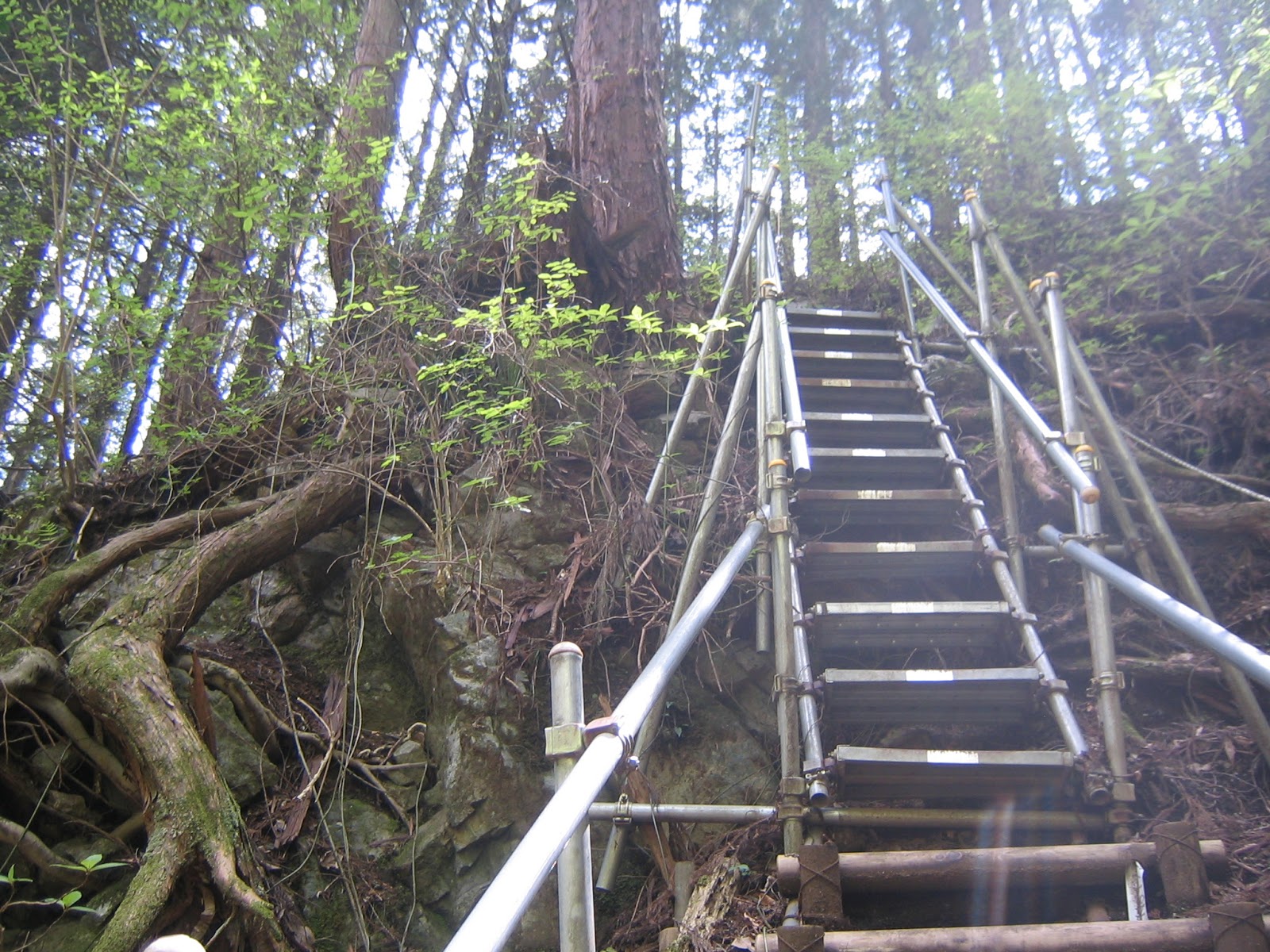
Route A can be entered from the other side of Yadoriki Oh-hashi Bridge. From there, we walk for about 1.5 hours to reach to the west riverbed of Yadoriki Stream near the first Forests of Growing (2007-2010). The trekking road runs over the surface of steep slopes of Mt. Hinokidakka (檜岳 1167m ASL), and we have to cross six gorges by small aluminum bridges which are permanent structures. There are several points to use chains and ropes provided along the road so that bringing your gloves for Route A is wise. As the Forest Instructors do regular activities here, lots of small forest roads branch off from Route A. In order to avoid accident, following the direction of signposts is the must for the visitors. If you take Route A by yourself without Forest Instructors, you have to return to the foot of Yadoriki Oh-hashi Bridge from the end of the route, tracing the same journey. Having said that, I bet Route A is a good introductory course for the beginners of Tanzawa mountains. Its steepness, often crumbling surface, gorges and mini-rock climbing … within deep rush green … all are of Tanzawa. The route has many educational mini-panels explaining the vegetation at each point. In addition, unlike Mt. Oyama or other popular destinations, the place is often quiet which is ideal for walking meditation …


We cross the Bridge …
Viewing Yadoriki Stream from the Bridge.
It’s tempting to pitch a tent there, but it is not at all advisable.
For one thing, this is the place where wild animals,
including bears, come to drink very frequently.
Another is the high risk of flush flood and debris avalanche.
My senior Forest Instructor told us until 10 or so years ago,
the place where a handful of trees standing
in the riverbed now was a part of more solid mountain.
(Could you figure them out in the southeast part of this photo?)
Due to the debris from upstream, it is as such now.
The area has frequent and sudden downpours
which cause rapid increase in water level,
and thundering landslides.
Probably deer can be one of the culprits of this
… I tell you about it next week.
Over there is the gate for another permit-holder-only route
(for cars) of Hadano-toge Forest Road
秦野峠林道.
Never mind for us pedestrians.
In April, just after passing the gate,
there was a small puddle with lots of tadpoles.
I was amazed … in such a small place?
Why?
About 100m ahead from the gate,
there is an entrance to Route A.
Immediately after entering the Route,
we are greeted by the first gorge crossing.
Can you see this tree has a hand tag?
And at the foot of this is an exhibition:
it is Callicarpa mollis.
Following the explanation,
I examined their young leaves.
Sure enough, they are very suave like velvet. 😍
One of the signposts with a map of the area.
If you don’t read Japanese, just follow “A.”
The trekking road of Route A
Along Route A, at the third gorge, Takigoh-sawa Stream 滝郷沢,
we have to use ladders to cross the gorge.
Mind you, the experience’s like
going down from a roof of a house with a carpenters’ ladder.
The place is above the Takigoh Fall 
滝郷ノ瀧 for ghosts I told you last week.
Viewing upstream of Takigoh-sawa from the bridge.
The place was once popular for gorge scrambling,
but now it is strongly discouraged to try
after several deaths along the way
due to very fragile rock surface.
Thanks to this human-less condition,
the place is good for wild animals.
I found a large fish swimming below the bridge in Takigoh-sawa.
After Takigoh-sawa Stream,
Route A crosses a truck rail for forestry.
Basically the west side of Yadoriki Stream is
also an afforested area by Morimura Bros. Inc.
There are lots of benches along the Route
… I think they are bones of deer … aren’t they?
A junction of Route A and forestry road(s) has
always a signpost like this.
Just go to the direction of “A,”
unless you are with Forest Instructors.
In the middle, about an hour from Yadoriki Oh-hashi,
there is a point near 2007 Forest of Growing
where we can have a very nice view of
Mt. Nabewari
(鍋割山 1272m ASL)
that
is the highest peak in this photo.
After the view of Mt. Nabewari,
we descend …
oh, hello, …
to the riverbed of Yadoriki Stream.
You see?
Passing Yadoriki Stream without a help is not at all advisable.


The Forest of Growing is planted by kids for wishing their happy life, remember? So, the Prefecture fights hard in defense against the onslaught by deer. What they’re doing is “building the wall.” Each Forest of Growing in Yadoriki Forest is surrounded by wire-mesh whose bottoms are secured under the ground in order for preventing deer from finding a gap to sneak in. Several other trees which are not in the Forest of Growing, but the Prefecture wants to protect, are also covered by plastic meshes to fend off the biting of deer. In front of these cages there stands a panel listing the name of kids who donated the funds for the seedlings planted within. The effect is obvious. Within the secluded area, there are lots of undergrowth constructing a bush that was once famous for the mountains of Tanzawa … Before, it was a routine for hikers of Tanzawa to wade in the chest-high bushes to progress along the trekking road.  It made very common, especially on the fragile grounds or ridges, sliding down to death by missing the footing ... Outside the enclosure, the surviving vegetation is only with what deer hates. Actually, this way of guarding forests is now getting momentum within the community of environmental protection in Japan (more to it, next week). OK, kids are to be nurtured for our future, so are the trees planted by them. And we have to shield off the space for baby trees’ survival … it’s so symbolic for the environment the kids of the 21st century live, isn’t it?


The class of 2007 is getting this big!
… within the cage.
Within you without you …
could you see the difference in vegetation?
The names of kids who
helped create the 8th block for 2007 Forest of Growing
It’s another afforested area by kids
other than for the Forest of Growing.
They are protected.
Outside the crate for 2007 Forest of Growing,
we can find vigorous Rubus palmatus var. coptophyllusand Zanthoxylum piperitum both of which are
very popular for gourmands of Japanese cuisine.
The plants have thorns so sharp that deer don’t take,
but eat up the rest in the area.
Losing the competitors, the thornies thrive in the Forest.
It might be one of a few benefits of having deer problem.


Unlike very popular Mt. Oyama, Yadoriki Forest is a quiet place. It makes the place loved by many wild animals. The identified animals by zoologists in the Forest include Japanese wild boar, Asian black bears, Japanese squirrel, Japanese giant flying squirrel, Japanese marten, Japanese deer, and the nation’s special natural treasure, Japanese serow. When you are in the Forest attentively, it’s possible to find their droppings and other things very frequently … or sometimes they are inspecting us. One spring day this year, when I walked Yadoriki Oh-hashi Bridge, I felt somebody is watching me from the Yadoriki Stream … I turned my eye, and found a four-legged creature over there too roly-poly to be deer … I think I was examined by a Japanese serow. That was my first time to encounter with a wild national treasure ... I was smitten. Hello, do you mind me having a walk in your garden? Among those fellows in the forest, especially Japanese deer run amok in Yadoriki. Next week, I tell you what I’ve learned about them during the Instructor Training ...


The list of wild things I’ve encountered in Yadoriki Forest,
#1. Droppings of Japanese wild boar
The list #2.
Leftovers of a dinner by Japanese squirrel
or Japanese giant flying squirrel
The list #3.
Droppings of Japanese deer
The list #4.
Actually, it was still VERY fresh
(I mean, very wet)
droppings of Japanese marten.
The list #5.
A footprint of Japanese serow
After this photo,
the animal entered into the Forest
whose figure was definitely not a bear …
I think it’s one of the Japanese serow
live in Yadoriki Forest.
People said Japanese serow is curious bunch
who can come to observe homo sapience
when they like.
I was their measuring object, then.


If you find environmental problems in Yadoriki Forest, please make a contact to
 
Kanagawa Nature Conservation Center 神奈川県自然環境保全センター
657 Nanasawa, Atsugi City, 243-0121 2430121 厚木市七沢657
Phone: 046-248-0323

You can send an enquiry to them by clicking the bottom line of their homepage at http://www.pref.kanagawa.jp/div/1644/


Friday, June 16, 2017

A relaxing stroll in deep mountains: introduction to Yadoriki Water Conservation Forest やどりき水源林


The access to Yadoriki Forest is the easiest by car. From Tokyo or Yokohama, you simply leave Tomei Express Way at Ohi-Matsuda IC, and go to Route 246 to the direction of Tokyo. Approx. 20K from the IC, on the left, you’ll see 7/11 Convenience Store and Restaurant Mimi 三味 (that is famous for its beef dishes). Turn left at the corner of 7/11, which directs us into Prefectural Road #710. Go straight till the end and in front of you is Yadoriki Forest. Route 710 is also a commuter bus route for the Forest. When you use public transportation, get off Odakyu Odawara Line 小田急小田原線 at Shin-Matsuda Station 新松田駅, and leave from the north exit. From # 3 stop, take a commuter bus service for about half an hour by Fujikyu-Shonan Bus 富士急湘南バス (Time table, here). Route 710 is a bit of a surprise road. When we turn left at 7/11, the scenery from the car window suggests we are leaving behind human settlements … Then, we first meet with a huge construction site that is for the Daini Tomei Expressway (the Second Tomei) 第二東名 that is coming from Toyota City 豊田市 (Toyota-Higashi 豊田東 JCT) and currently reaching to Gotemba City 御殿場市 (Gotemba 御殿場 JCT) at the foot of Mt. Fuji. … No matter, the 710 road continues to run along the surface of the mountain. An entrance to Odawara Golf Club Matsuda Course appears on the right, and soon the way starts to descend. All of a sudden, a town appears below us along the Nakatsu-gawa River 中津川. It is Yadoriki community . When I’ve first been there via Route 710, I was honestly surprised: I didn’t expect there was that large human district tucked in the deep mountains. The community gained its name in 1876 when 7 villages along Nakatsu-gawa River decided to merge together. Yadoriki in Japanese means “coming together to cooperate.” Sounds nice, doesn’t it?


#3 Bus Stop
in front of the north exit of Shin-Matsuda station
When we leave Shin-Matsuda station bldg.,
you turn left, and find a small stand
almost next to the railway track
which is a ticket booth for Fujikyu-Shonan Bus.
They sell return tickets between the station
and Yadoriki
that can save 100 yen for adult.
For a while,
this is almost all for what you see
from the window after 7/11.
Then, suddenly, this.


We arrive at Yadoriki bus terminal stop either by car or by bus. When we use the commuter bus service, we walk from here along the road 710 and Nakatsu-gawa River for 2K until the parking lot of the Forest. When you drive, please drive carefully especially from here as there is no guardrail but occasional road blocks due to mini landslide with rocks tumbling down to the paved road. Having said that, this path is pretty present to walk. It’s going up one way, but surely is a good strolling experience in quiet and pure mountain air. In early March, the route is adorned by Kawazu-zakura (Cerasus lannesiana Carrière, 1872 ‘Kawazu-zakura’) whose flowers of bright pink have enthusiasts. This cherry blossom can last for about one month so that unlike Someiyoshino, whose peak could be less than a day, we can take it easy to enjoy the show. 😊 The riverbed has lots of Japanese knotweed and sorrell. Though they are public enemy #1 in the UK, they are one of the early spring delicacies for Japanese cuisine. (Recipes, here.) It seems to me locals are harvesting them regularly. The river runs fast, with very clear water. Warning: to fish here, you need license. Please check Matsuda Town Office, here. At the point where the road gets narrower there is an inn, Yadorogi Villa やどろぎ荘. We just keep on going in front of the inn, to meet on the left a camping site, Miroku Camp Field ミロクキャンプ場 (whose homepage is the same as Yadorogi Villa), and on the right an entrance of Mimawaribu Forest Road 三廻部林道 (permit-holders-only route). After half an hour of relaxed amble, we’ll be welcomed an impressive red of Yadoriki Oh-hashi Bridge 寄大橋. You can park your car at the foot of this bridge. We are now at the entrance of Yadorki Forest. Oh, by the way, the river changes its name from Nakatsu-gawa River to Yadoriki Stream 寄沢 at Yadoriki Oh-hashi Bridge. So, I call it Yadoriki Stream from here.


Yadoriki terminal bus stop.
Here, if you eat something in the restaurant
which we can see on the right in the photo,
it’s OK to use their toilet.
Otherwise, just start walking to Yadoriki Forest
and within 5 min. or so,
there is a public facility on the right.

Standing back to the bus stop,
turn right to Nakatsu-gawa River is
the road to Yadoriki Forest.
The ridge over there, in the bottom of this photo,
continues to the peak of Mt. Nabewari
鍋割山 (1272m ASL).
On the left of this route is Nakatsu-gawa River,
and on the right is adorned by
pink flowers of Kawazu-zakura every March.
Alternatively, turning left at the bus stop is
one of the safer routes to Mt. Nabewari
via Omote-Tanzawa Kanagawa Citizen Forest
表丹沢県民の森.
Here is the public toilet.
Looking Yadoriki community
from a point near Yadorogi Villa.
 Pastoral …
Nakatsu-gawa River along Route 710.
Jolly gargling of stream is really refreshing!
The river is important resource for agri-business of the area.
Please do not change the flow by building stone dams for fun.
The entrance of Miroku Camp Field is decorated with
wooden sculptures of animals we can find in the area.
Please remember the figure of deer is prominent here.
To the right is permit-holders-only route of
Mimawaribu Forest Road.
After the junction with Mimawaribu Forest Road,
we can find lots of Corydalis pallida var. tenuis along the road side.
During March-May, they show pretty yellow flowers,
but … they are poisonous.
This plant loves mountainous soil prone to collapse.
Oh, so typical for Yadoriki …
Over there is Yadoriki Oh-hashi Bridge.
The end of Road 710, i.e.,
the beginning of Yadoriki Water Conservation Forest. You can park your car
where the yellow arrow suggests in the photo.
We can see the gate of the Forest over there.


Kanagawa Prefecture takes care of Yadoriki Water Conservation Forest やどりき水源林, and often Kanagawa Forest Instructors help the Office in actual management activities, like thinning conifers and weeding the undergrowth. The Instructors helped the donners for Forests of Growing to plant their seedlings in Yadoriki. They arrange fun activities for anybody coming to the Forest, such as concerts and napping events in hammocks (; for FY2017, the schedule is here). The most regular activity by the Instructors is weekend walks. When you come to the gate of the Forest at 10:00 or 13:00 every Saturday and Sunday (except for December - February), your Forest Instructor is ready to guide you. The Forest has 3 excursion routes: Route A, B, and Forest-Road. Route B and semi-paved Forest-Road routes are on the east side of Yadoriki Stream. Route A is on the west. Yadoriki Stream has very fast flow going down a steep valley especially near the entrance to the trekking road to Mt. Nabewari. It makes having lasting structure very expensive. i.e. there is no permanent bridge to cross the river after Yadoriki Oh-hashi Bridge. (Caution: when you read the map for Yadoriki Forest. It looks like there is a permanent bridge.) If you walk with the Instructors, Routes A and Forest-Road can be combined by crossing Yadoriki Stream with a mobile bridge the Instructors provide. That could be a bonus!


When you enter from the gate of Yadoriki Forest,
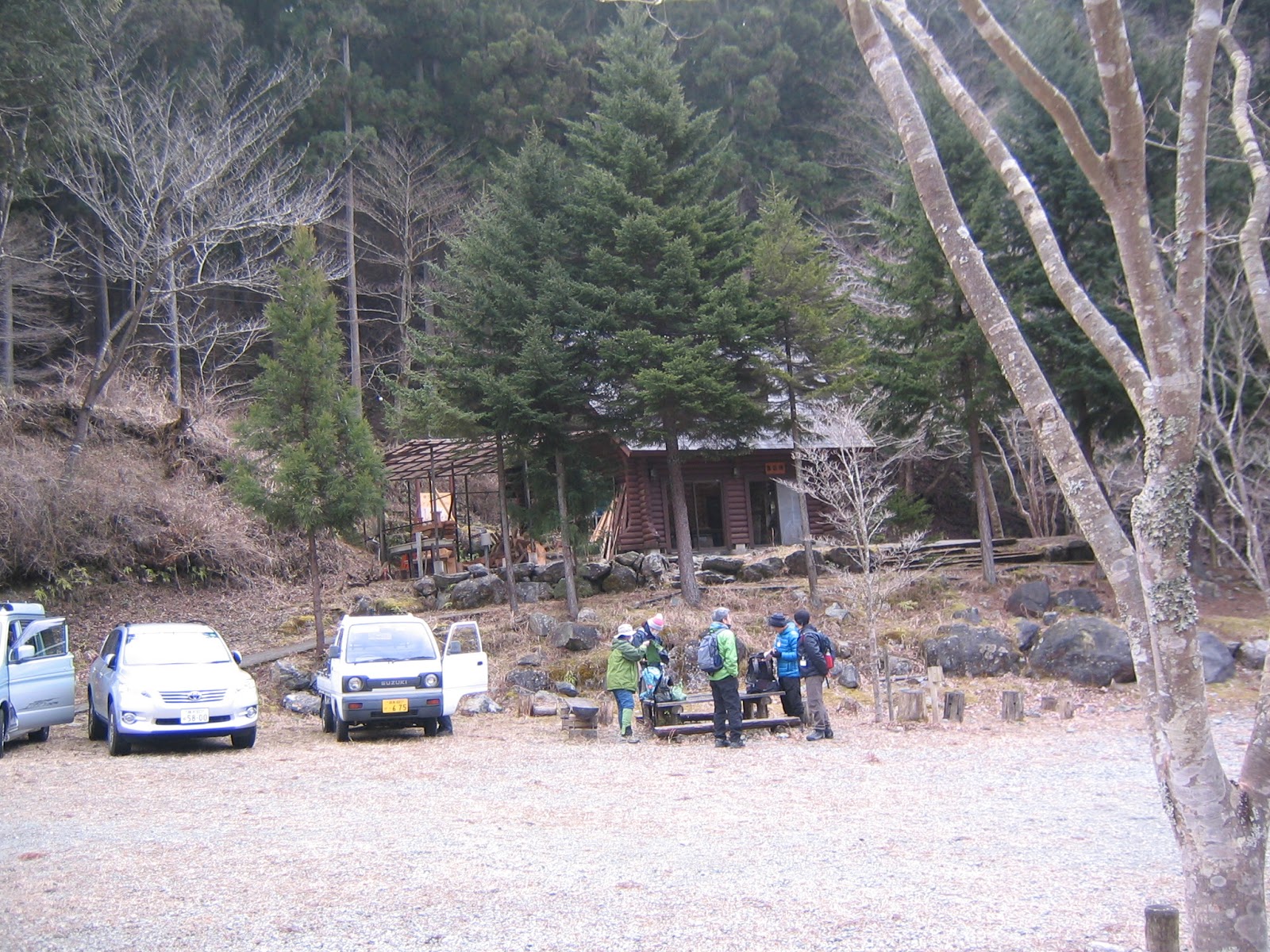
ahead of you is the management cottage of the Forest.
It is open when Instructors are there.
The outside shelf of the cottage provides
free maps and other info for the visitors.
The place also has a form of mountaineering registration
with a drop box.
In case you plan to go up to Mt. Nabewari
(鍋割山 1272m ASL),
Mt. Ameyama (
雨山 1176m ASL),
and/or Mt. Hinokidakka (
檜岳 1167m ASL),
it is highly advisable to leave your note here.
As I tell you last week,
this is the gateway to the routes many died with crumbling rocks.
The prefectural police strongly recommends
to take this route only for very well experienced group of people.
In front of the cottage,
a notice board is telling us any news in the Forest.
About 200m from the management cottage,
there are public toilets, soaps provided.
Would you please switch off the light after your use?
And please carry back used sanitary products.
(Flushing toilet papers is OK.)
Thank you.
50m or so up from the toilet, there is a meeting cottage
(with another toilets; open only for events).
Only when you join the tour by the Forest Instructors,
you can park your car here.


Less than 1K semi-paved Forest Road Route starts from the gate of Yadoriki Forest and ends at the entrance to the way to Mt. Nabewari, which is the other side of the end of Route A across the Yadoriki Stream. It includes a part of Route B till the meeting cottage. From the meeting cottage, the slope of the Forest Road is getting steeper, and lasts as such till the end. On the left, down there is the Yadoriki Stream. During winter and early spring when the leaves of deciduous trees don’t exist, we can see Takigoh Fall 滝郷ノ瀧 across the Stream from the point near the meeting cottage. (Photos taken by an expert mountaineer can be seen here.) At the foot of Takigoh Fall which is a double fall of 15m high, there is a memorial for a guy who died several years ago. We cannot approach there from the Forest Road as there is no bridge to cross Yadoriki Stream now. A legend says if you visit around this point of Yadoriki Forest during night, ghosts of hikers welcome you for cursing. 😖 Horror stories aside, the scenery of along the Forest Road Route is frankly pleasant. Birds, including Asian stubtail and Daurian redstart, are happily singing with the back chorus of bubbling from the stream. The riverbed is occupied by Alnus sieboldiana that is a pioneer plant for colluvium. On the right of the route shows why this plant is thriving down there … Very steep slope is here and there collapsing. Actually, the place is popular among geologists to explain the soil of Tanzawa for beginners. At the end of the Route, there is a notice board saying from there is a trekking road to mountain peaks only for experts. It’s the terrain of Asian black bears. Let’s go to Route A and B, then.

We can see a bit of Takigoh Fall here.
A forest of Alnus sieboldiana in winter
on the riverbed of Yadoriki Stream
On the Forest Road Route,
we will be greeted by this fine specimen of pillow lava
created at the bottom of Pacific Ocean
some 1.7 billion years ago.
It’s here now because of plate tectonics.
And so, the land is collapsing …
have you noticed the layer of granite is not horizontal?
It’s also the result of crush between
the Eurasian and Philippine plates.
Near the end of the Forest Road Route,
there is a colony of Euptelea polyandra hich is an endemic species of Japan.
This photo was supposed to be for the full-bloom
of their brownish-pink peculiar flowers in March …
Theirs are very understating flowers …
The end of the Forest Road Route.
Be aware of bears!


If you find environmental problems in Yadoriki Forest, please make a contact to
 
Kanagawa Nature Conservation Center 神奈川県自然環境保全センター
657 Nanasawa, Atsugi City, 243-0121 2430121 厚木市七沢657
Phone: 046-248-0323

You can send an enquiry to them by clicking the bottom line of their homepage at http://www.pref.kanagawa.jp/div/1644/