Showing posts with label Japanese deer. Show all posts

Friday, February 15, 2019

Ink Painting: a bit of walk along Hadano Forestry Road in winter 秦野林道


One January weekend, we’ve been Hadano Forestry Road 秦野林道 from Yadoriki Water Source Forest やどりき水源林 for a little survey. Immediately after Super Typhoon Trami last October, the road was covered by debris, and we could figure out lots of broken trees on both sides of the way (; my post on October 19, 2018). It seems to me the Prefecture is doing a clean-up now. One of my senior forest instructors told me the Office is harvesting the logs from there. Some afforested areas are currently under works of forestry with new graveled roads for heavy machineries. Are they using harvesters? “No. Tanzawa is too steep to use such vehicles. I think they use chainsaws, and bring out the logs by a forwarder,” she said. Will it be some help for the prefectural budget to manage healthy Tanzawa-Oyama Quasi-National Park 丹沢大山国定公園? Considering the current market condition, I’m not optimistic for the yen-amount they collect from the work … But surely the afforested trees must be harvested, or thinned, from time to time to keep the forest healthy. If some money can be raised from the activity, it should be better than nothing …


After the super typhoon last October
And after the clean-up, this January
Men at work
A new road


Weekends of winter forests in Tanzawa Mountains 丹沢 are for deer hunters. We’ve met members of Kanagawa Hunting Club 神奈川県猟友会 who are cooperating with the Prefecture to control deer population in the National Parks. They said the catch of the morning was 2-layer angle stags, and then continued their hunt late afternoon. We’ve found a trace of deer on a trunk of Japanese Larch (Larix Kaempferi (Lamb.) Carrière) from which an animal rubbed resin on its body for anti-ticks. Droppings of deer were found several places as well. Still, my senior instructor told me the situation was far better than, say, 10 years ago. “You see, we could even find bodies of deer along a road busy with hikers. They were starved to death … Now the situation is stabilizing, I think.” Hmmmmmmmmmmm. (Please see my posts about deer in Tanzawa in July 2017.) A Hunter was sitting still, and concentrating on somewhere over there. We could hear faint barks of dogs from the other side of a deep valley. The catch was coming …


Could you see hairs of deer here?
They did it.
A hunter is here.
You see?
 The plants along the road are unnaturally ‘mowed’ by deer.
 They ate the top soft part of these plants.


The mountain was cold and quiet otherwise. The majority of the sound we could hear was the hum of airplanes high above and intermittent bird calls. Voices of impatient Japanese tit (Parus minor) were mixed with occasional easy-going calls of Varied tit (Parus varius). Listening them “in Japanese,” they were pronouncing the same word, but the speed was definitely different. “Tsu-tsu Pea, tsu-tsu pea (Japanese tit)” vs. “Tsu-u-Tsu-u Pea-a, tsu-u-tsu-u pea-a (Varied tit).” As they are in the same genus, there might be some interesting story during their evolutionary process … We’ve found several couples of Red-billed leiothrix (Leiothrix lutea) which is designated as one of the worst invasive species to Japanese archipelago. “Wow, this is my first time to record them in Yadoriki Forest.” A veteran instructor said. There happened so many things in a seemingly silent winter Tanzawa …


A feather of White-bellied green-pigeon (Treron Sieboldii).
 They live in this area of Tanzawa,
 and go to Oiso Beach
大磯海岸 to drink salty water.


I found the scenery was very contemplative and, beautiful. There is not much color in winter forest. Understating ever-green trees. Various hues of greys from trunks and boughs of deciduous trees. Dry January of Kanagawa Prefecture gave us the clearest blue sky that contrasted astonishingly with the ridge lines of mountains. Before the maples shed their leaves we could only imagine the depth of the valley from the canopies that could be seen from high bridges. Now it is clear down there were streams with very rocky riverbed. That was a landscape we found in traditional ink paintings of China and Japan. Hadano Forestry Road is not yet opened thoroughly due to the slope failure between Mushizawa Forestry Road Junction 虫沢林道分岐 and Shin’nashi Bridge しんなし橋. Though, it’s the route where 4-wheel vehicles can run. If you plan to have a small peek of deep Tanzawa Mountains 丹沢 during winter, please try this road if only for the first 1 hour stroll from Yadoriki O-hashi Bridge 寄大橋. I guarantee you a meditative but relaxed weekend afternoon in quiet and monotonous mountains ... The world of Zen.


In July
The same place in January
In July
And the same place in January.
 Oh my … the slope is collapsed here …
Yadoriki O-hashi Bridge in July
The bridge in January


Oh, by the way, all the forestry roads in Japan are for permit-holders only to drive by whatever vehicle, i.e. car, bikes and motorbikes. Please walk!


If you find an environmental issues in Kanagawa Prefecture, please make a contact with Kanagawa Natural Environment Conservation Center 神奈川県自然環境保全センター

657 Nanasawa, Atsugi City, 243-0121 2430121 厚木市七沢657
Phone: 046-248-0323


You can send an enquiry to them by clicking the bottom line of their homepage at http://www.pref.kanagawa.jp/div/1644/


Friday, July 14, 2017

Bambi’s Vampire Diaries: ecological havocs with wild life in Kanagawa, and in Japan


To think about Japanese deer (Cervus nippon) in forest, it’d be better starting from the behavior of them. They are artiodactyla with slender legs and 4 stomachs. According to Dr. Seiki Takatsuki 高槻成紀, the boss for the Life Museum of Azabu University 麻布大学いのちの博物館, their normal days are almost entirely dedicated to eat and ruminate. On average, an adult deer eats 5-6kg of fresh vegetation daily. They are a typical grazer. Comparing with endemic Japanese serow (Capricornis crispus) which is a browser, i.e. picky eaters, deer eat almost anything of vegetable. Serows eat sasa bamboos and Miscanthus sinensis only in winter when their regular dish of dicotyledon are scarce. Deer simply don’t care. They are also fecund. When they have enough food and a girl Bambi weighs more than 35kg on their 1 year old birthday, deer teenagers start to carry babies. Moreover, they keep delivering a fawn yearly until they reach to 10 or more years old. I.e., a doe has 9 offspring on average. The social life of deer is a harem. An alpha male dominates several pairs of a mom and a kid. They move around together in forest. All suggests when deer stay put for a happy family life, they can rapidly denude the vegetation of the place, or leave only the plants they don’t like.

Foot prints of deer


Let’s return to the 1970s. Animal rights’ movement was gaining momentum in Japan. It was reflected on the management strategy of national parks. By then, ordinary people did not meet wild animals in Tanzawa or Hakone. They simply thought they became so rare as one of the casualties of environmental destruction caused by rapid economic growth. The policy within Fuji-Hakone-Izu National Park 富士箱根伊豆国立公園, and Tanzawa-Oyama Quasi-national Park 丹沢大山国定公園 was protection of the victims of human activities. On the other hand, outside the national parks there still were hunters and other human expansion such as motorization which were menace for the survival of wild animals. The animals simply found refuge within national parks that is roughly 800m ASL and up in Kanagawa Prefecture. Moreover, the afforested coniferous trees were tall enough by the 1970s, which made the forest floor darker. Those mice and hares that competed for food with larger animals lost the habitat and reduced their numbers. Without competitors, deer in particular started to have a protected comfortable life in Kanagawa with lots of food.  Well-nourished does constantly gave births to fawns. Around this time, Kanagawa Prefecture began to receive fewer snow falls. Before, it was common in the peaks of Tanzawa and Hakone to be covered by 1m or more snow for months during winter. Slender legged deer are not at all suitable to weigh in deeply snow-covered mountains. Especially for small fawns, snow is deadly. Many actually died during winter in Kanagawa. But since the mid-1970s, Kanagawa has not had deep snow even in the higher altitudes. More girl fawns could now have one year birthday in June and start to mate coming fall. Japan is a small country. The available forest a family of deer can roam freely has a limited acreage even if there were no national parks. By the beginning of the 1980s warmer mountains in Tanzawa had lots of deer harems concentrated in the national park area. They started to eat anything they could find. 


Yokohama’s annual average temperature and annual precipitation.
Er, well, it’s better to have data for Tanzawa or Hakone.
Unfortunately, for these places the older numbers are not retrievable from
the homepage of Japan Meteorological Agency.
(I guess we have to visit their office next to the Imperial Palace.)
Anyway, the mountains are just 40-60km away from the observation point of Yokohama,
without obstruction to the flows of air between the places.


As long as vegetables can reproduce themselves no matter what, the deer concentration won’t be a problem. Instead, from around 1980 the hikers noticed beautiful forests of Fagus crenata in 800m+ ASL of Tanzawa-Oyama began blighted. At the same time, Sasa borealis, which was a typical undergrowth of Fagus crenata in Tanzawa, was eaten by deer and often dead en masse. Then, the research projects started from 1993-1996 (more to them in the next week) confirmed for the first time scientifically a large increase in deer population. Moreover, the scholars realized in Tanzawa flora and fauna were interlinked closely. First, they found Tanzawa was receiving acid rain and photochemical oxidiants emitted by humans from nearby Metropolitan Tokyo. The chemicals weakened the plants in the area. Fagus crenata started to take more time to establish vigorous leaves and tannin which was natural insect repellant. Next came deer. They voraciously ate the plants reachable within the length of their necks. Sasa borealis and other plants including any seedlings were eaten up. The ground around tall trees received direct sunshine and (often polluted) rain, and started to be eroded massively. Fagus crenata is always a home for Fagineura crenativora which found their new dry habitat with less tannin wonderful. Moreover, the denuded undergrowth cannot be a habitat for birds and small mammals that were predators of Fagineura crenativora. The insect increased their numbers explosively, and devoured rapidly all the leaves of Fagus crenata. Unable to photosynthesize, the trees were starved to death. Other species of the already established tall trees may have escaped the fate of Fagus crenata, but their seedlings in Tanzawa-Oyama Quasi-national Park were not so lucky. The variety of forest floor plants became very limited at best, and the forest consisted only of old trees.


Deer cause damages to forests not only by
eating but also by grinding their antlers.
Their behavior can practically thin trees
by stripping away their cambium.
Last winter Dr. Takatsuki introduced us
an incident in Oku-Nikko
奥日光 where
centuries-old cedars died-back due to deer grinding
... I hope this still young cypress in Tanzawa
can survive the damage done in this way …


From around 2000, Japanese rural area began to notice unprecedented influence of deer and the other wild animals. Dr. Takatsuki constructed a picture using the data from Ministries of Environment and of Agriculture, Forestry and Fisheries and concluded the acreages started to grow exponentially for the agriculture and forestry lands that suffered damages from deer. The number of deer caught by hunters also sky-rocketed, along with the number of locations they were captured/killed. His colleague of professional botanists were/are witnessing drastic impoverishment in their field including massive landslides. The red-listed plants, such as Viola kitamiana, were/are nearing the extinction because lots of Japanese/Yezo deer eat them. Ozegahara Marshland 尾瀬ヶ原 has started to dry-up because deer, wild boar and the other wild animals with increasing population forage the leaves and roots of the plants in the area. Okutama Mountains 奥多摩 in Tokyo were/are suffering the landslides as deer denuded the steep slopes, which is now a serious problem of water supply to the capital city. The trend continues today. These days, collecting wild spring herbs in Japanese mountains is a sort of desperate act. The season for herbs coincides with the time when now-numerous mama bears come out from hibernation with their cubs. Hearing nation-wide news for unlucky herb collectors who were killed by Asian black bear or brown bear has become a routine. Exploded boar population dominates the evacuated community around the Fukushima Dai-ichnuclear plant, and ravaged the land. The City of Kobe that is practically pasted to Rokkoh Mountains 六甲山地 has now a boar problem. Gourmet boars attack old ladies carrying cakes and puddings from famous patissiers, because the animals know the grandmas have wonderful sweets. Clever Japanese macaques invade into commercial orchards, and even rice paddies, just before the harvest and eat up the precious crops that would have sustained the farming households for the next year …


A billboard near Hinata Yakushi Temple 日向薬師 in Tanzawa.
It is warning the visitors the place is monkey infested.
“Please do not give bait to monkeys,
and be sure to carry the left-over of your lunch home.
Thank you for the cooperation
to reduce agricultural damage by monkeys in this area.”


The effect is not necessarily found directly from wild animals, but diseases. Some have started to worry a spread of Lyme diseases in Japan due to roaming herds of deer with ticks. More visibly, thanks to the skyrocketed number of deer and hikers from cities, especially Tanzawa is now infested by blood-thirsty land leeches.  It is not uncommon for people to show allergic symptoms with a leech-bite. Vampire leeches keep clinging to mammals to suck blood until they drink enough. Unless a prey notices and takes off the leeches from the body, they will be carried anywhere the animal go. Even if you stamp them hard, those slimy creatures simply survive. To stop spreading land leeches, when you find them in Japanese mountain, please kill them immediately by (1) showering them with salt, vinegar, ethanol or DDT, (2) (not recommended) roasting them by fire with at most caution for preventing wild fire. Those uninitiated hikers did/do not do these important tasks. Moreover, the leeches are hermaphrodite and lay thousands of eggs immediately after finishing their blood meal. Suppose you simply shake them off at a bus stop returning from a weekend hike, without terminating them. The formerly peaceful bus stop is now a home for many leeches. And don’t ask deer to deal with the problem. Thus, the larger the number of deer and hikers becomes, the wider the infested area is. Actually, around the turn of the century, some parts of Chiba Prefecture began to observe farmers giving up lands due to overwhelming land leeches carried by exponential growth of deer’s and hikers’ population. Luckily or not, Kanagawa Prefecture is more urbanized than Chiba, but the problem is serious nonetheless.


A leech showered by ethanol to death.
Have you noticed it’s a sort of chubby?
It sucked lots of blood from a guy,
and became like a pea like this.

If you find yourself a prey for leeches,
(1) peel them off with your finger,
(2) kill them immediately,
(3) on site, squeeze out the saliva of leeches
and wash the wound by clean water or ethanol,
and (4) if you carry anti-histamine cream,
apply it to avoid itches.
You’d better visit doctors afterward.
Having said that, the most effective strategy
against land leeches is not being sucked.
Especially in Tanzawa from May to October,
always cover your skin with
something difficult for leeches to stick.
Vinyl garment is not advisable.
In a sunny day, they crawl up from the ground.
If it rains, they shelter themselves
under any tree leaves, and drop down
to a prey when we pass below them.
The first line of defense is spraying leech repellent
your feet and legs,
and if it rains around your shoulders and neck too.
The standard chemical for this purpose is still DDT,
but I prefer the product of this photo as it’s DDT-free.


At least in Kanagawa, the system to cope with this 21st century ecological problem has been in place and evolving. Our prefecture is actually the leader for this matter in the nation, although we can say for sure the problem is not at all solved even in our backyard. Next week, I tell you what Kanagawa Prefecture is doing these days, including hiring for a new job. For some of you who are interested in pursuing this particular career in Japan, I report you the terms of reference next week. It seems to me the vacancy ads for the posts are increasing nation-wide these days …


Sorry for this out-of-focus photo …
They are the stags I’ve met last March in Mt. Oyama.
They were actually fighting.


If you find environmental problems in mountains of Kanagawa Prefecture, please make a contact to

Kanagawa Nature Conservation Center 神奈川県自然環境保全センター
657 Nanasawa, Atsugi City, 243-0121 〒243-0121 厚木市七沢657
Phone: 046-248-0323

You can send an enquiry to them by clicking the bottom line of their homepage at http://www.pref.kanagawa.jp/div/1644/


Friday, July 7, 2017

FYI, humans are animals: a saga of wild animals and Japanese Satoyama


Japan is a mountainous archipelago (378 thousand km2) covered by forests, in temperate and semi-tropical climates with lots of rains all year round. She is a group of not-so-big islands separated from a gigantic land mass of Eurasian Continent far enough to prevent “foreign” species from immigrating massively. It’s been like this at least for more than 10000 years. Thanks to this condition, we Japanese happen to live in a peculiar environment. Seiki Takatsuki 高槻成紀, the boss for the Life Museum of Azabu University 麻布大学いのちの博物館, wrote in his 2015 book that Honshu Island (230 thousand km2) is home for vegetation whose number of species is equal to the number of varieties growing in the European Continent (10 million km2). He pointed out the number of terrestrial mammal species live in our archipelago is more or less the same in the entire Europe. Hmmm, a quick google search says, including homo sapience, we are a team of 130 species in Japan. Life of mountainous and smallish islands inevitably limits possible distance among the lives of different animals. Although now Metropolitan Tokyo is concreted almost entirely, until about 70 years ago, people lived in a hilly (at best) place where in spring and summer plants grew ferociously all over and lots of non-human animals regularly poked their heads from grasses and trees. Deer, bears, boars, hares, mice, foxes, weasels, insects, reptiles, etc. etc. found the things humans ate tasty. Annihilating them was practically impossible due to deep mountains surrounding a village. The traditional design for human settlement in Japan takes into account this. To grow foods in fields and to keep gathering nuts, herbs, mushrooms, firewood … in the neighboring mountainous forests, people had to find a way to control the encounter with animals. Satoyama was planned for this purpose.


Seeing Niiharu Citizen Forest
and houses of Niiharu Town
from Miho Nenju-zaka Park


Take a recent photo above, for Niiharu 新治 in Yokohama. A house is surrounded by trees such as persimmon and loquat in addition to horticultural flower trees. It also has bamboo forest behind that was once an important resource for making daily utensils. Before petrochemicals and electricity, the tall cedars beyond were broad-leaved trees such as Quercus acutissima that could be baked for good charcoals. Due to watchful eyes of humans the fruit trees near houses were tricky target for wild animals in the firewood forest. The middle in this picture is an agricultural field running along Umeda River 梅田川. Have you noticed for animals to invade into the field they had to pass human settlement or the river? This is the very basic strategy of Satoyama community. The villages in deeper forest had additional arrangements. For example, in traditional Japanese Satoyama from Kanto Region to the west it was common to build stone walls or fences, called shishigaki しし垣 between forests and agricultural fields in order to fend off large mammals like deer, boars and bears. Development of such human settlement needs well-planned mobilization of time and resources, even with the 21st century mechanized tools. In addition, Japanese forest grows fiercely during spring and summer. Unless we mow the undergrowth frequently, and maintain the defense walls regularly, the community would be swollen by the forest within weeks. Once the defense shield, such as open views and walls, is covered by a forest, it is a boulevard for wild animals coming for a gourmet lunch in agricultural field. You see? Co-habitation among mammals in this crowded archipelago required lots of lots of jobs by humans. Historically, it was not uncommon Satoyama villages overpowered by animals. People lost all the food after a long struggle against animals, and left the place for good. “Foxes and raccoons could be smarter than us as they are apparitions of some divine spirit of the forest, couldn’t they?” “No, no, bears and wolves are far more powerful gods.” “Well, deer are messenger of gods in Kasugataisha Shrine 春日大社 of Nara 奈良. They are the gods …”


The footprints left in Niiharu.
Although Niiharu Forest is surrounded now by
the ocean of condos and detached houses,
it’s still a home for many small animals
such as hares, raccoons, and civets.
(More to them, next week.)
Oh, by the way,
I recently learned Peter Rabbit is in the end English.
The rabbit I’ve met last year in Niiharu is a Japanese hare
who lives a quiet solitary life in grass field.
Peter has a happy family life in tunnel, doesn’t he?
It’s the lifestyle of European rabbit.


It seems to me, the forests in Japan may not have been so abundant historically … I’ll return to it in my later post ... Anyway, for today’s topic, especially after Commodore Matthew C. Perry came in 1853 near Yokosuka, and western-style industrialization started in honest, the relation between forest animals and Japanese changed. Especially after Meiji Restoration in 1868, with growing population (… oh so by-gone era language …), deregulation about Buddhism-based dietary restriction, and hunting with firearms which became common after the introduction of universal conscription in 1873, villagers went into the forest and hunted animals massively for food and to protect newly introduced European style farming. Dr. Takatsuki suggested the effect of western style anthropocentric approach to the nature could have been enormous. Until then, Japanese may have thought humans and the nature were 50-50 at best. Now, people started to think the forest of geometrically planted “beautiful” trees in Versailles. The problem was, the ecosystems in Europe and in Japan were, and of course are, different. Europe is cooler, and has far smaller annual precipitation than Japan. Inevitably, biodiversity in their forest is smaller. In addition, the area north of Apes was covered by glaciers for longer time during Ice Age. Many living creatures were frozen to die, and never came back under limited supply of sunshine and water. For homo sapience, it’s easier in Europe to believe in the permission of the God to “rule” the rest of the living creature, with smaller disturbance to the environment, or even being beneficial to restore ecosystem. Japan was, and is, different. From wild animals’ point of view, their lives in Japanese forest became more perilous by humans with more aggressive will to kill. Japanese wolves and Hokkaido wolves were the most famous casualties of the change in people’s attitude. Hokkaido wolf was eradicated by 1896. The final body of a Japanese wolf was found in January 1905. They were extinct. But they were not the only sufferers. People ate voraciously meat of deer, boar, bear, rabbit etc. etc., and traded furs for European style clothes. By World War II, finding deer in Japanese forest became exceptional.


A day in a supermarket in Yokohama these days.
Now we in metropolitan Tokyo eat meat more than fish.


When Japan surrendered to the Allied Forces in 1945, the nation was in starvation, and almost all the cities in the archipelago were turned to ashes by regular and atomic bombs. Soon young soldiers came home and made babies. Starving and homeless population exploded. Inevitably, the mountains were deforested for reconstruction, and wild animals were hunted even more for food and fur. A sort of saving grace was people reforested stripped slopes with coniferous trees whose logs fetched wonderful price in the market during the 1940s and the 50s. According to Dr. Takatsuki, the coniferous forests of baby cedars and cypresses first covered by mantle vegetation that was an ideal ground for hares and field mice to multiply. The skyrocketed population of them flowed out from the mountain to villages. The farmers catch them for protecting their crop. Meanwhile, “new thinking” of environmental protection was imported from America and Europe. With this latest trend, the city folks saw casual approaches to wild animals in “backward” rural community “barbarous,” and began to call for “animal protection.”  Whatever the goings among humans, the baby conifers in the mountain kept growing and the forest floor got darker. The environment became unfit for mice and hare and their problem subsided. Eating hare became occasional, but the fever for Euro-American style animal protection movement kept momentum.


It’s the scenery of a village
in Aomori Prefecture
青森県 in the 1950s.
A big barn and lots of houses for farmers were there.
The place must have been very vibrant with lots of kids …


Japan entered the 1960s for a miracle economic growth. Factory jobs in cities offered more pecuniary rewards compared to labor-intensive ag-works. At the same time, expensive Japanese logs completely lost the market to cheaper imported materials from all over the world. The forestry industry in Japan was destroyed. The young population in rural community moved in drove to urban life where everything must be bought from shops. Japanese started to be dependent on imported foods, not grown domestically.  Industrially manufactured ramen-noodles became the coolest cuisine. The produce organically grew in their home by their parents were something of outdated. “Oh, by the way, how so-unfasionable is killing wild animals entering to boring ancestral rice paddies to eat that uncool rice our stupid parents planted!” In the 1970s, former kids from agricultural villages were urban parents dreaming their kids to be MDs or bankers to spend entire life in the middle of concreted skyscrapers and shopping centers, removed far from agriculture and forestry. The notion of animal protection was the “idea,” not something grounded on practical daily life. “In any case, it is rare to spot deer or any wild animals when we vacation in National Parks. Surely Bambi must be cute, isn’t it? I’ve never seen her in wild …” Hunters were seen as “enemies of modernity.” Not many young people joined hunting even for leisure. The average age of hunters began to get older ...


The peak of Mt. Daibosatsurei 大菩薩嶺 of
Yamanashi Prefecture 
山梨県 in the middle of 1970s.
Don’t you think the afforested trees were still young?
The place was still in the process of post-war reconstruction.
It’s interesting to compare it with the recent photo
of the same place in this tourism web site.


Dr. Takatsuki is an expert of ecosystem for Japanese deer. When Japan started its 1980s, he noticed something was happening between Japanese forests and deer. Farmers began complaining deer, and his academic colleagues of botany said their research field began to change drastically. In his 2016 book, he referred a research by Toru Ohi 大井徹 published in 2012 and pointed out in 1985 the reports of agricultural damages caused by deer increased rapidly nation-wide. In 1987, the deer affected fields became larger than the mice-eaten places. In the 1990s deer-harm started to grow exponentially, while mice-problem became a mouse-size. But since the 1960s Kanagawa Prefecture has always been the opening ground of environmental research done by a plethora of universities in Metropolitan Tokyo. The scientists have been demanding a thorough and comprehensive research to be funded to tackle the problem scientifically. When in 1993 the officially recorded crop destruction by deer reached 45 thousand km2 nation-wide, the prefecture initiated a 3 year project to collect data of environmental problem in Tanzawa-Oyama Quasi-National Park 丹沢大山国定公園. This was the first scientific and comprehensive monitoring about deer problem in Japan, and became the basis of 180° turn of Japanese policy for wild animals.


Kanagawa’s Deer stuffing displayed in
the museum of the 21st Century Forest of Kanagawa Prefecture


Next week, I tell you the continuation of the story. And today, we again heard news boars were running around in the middle of big cities, like Kobe or Kyoto …


If you find environmental problems in mountains of Kanagawa Prefecture, please make a contact to
 
Kanagawa Nature Conservation Center 神奈川県自然環境保全センター
657 Nanasawa, Atsugi City, 243-0121 〒243-0121 厚木市七沢657
Phone: 046-248-0323

You can send an enquiry to them by clicking the bottom line of their homepage at http://www.pref.kanagawa.jp/div/1644/


Friday, June 23, 2017

An animal kingdom: trekking roads in Yadoriki Water Conservation Forest やどりき水源林


Route B for Yadoriki Forest starts immediately after the management cottage. Although the slope is steep, it’s a relatively gentle area for a short circular route in one hour. The trekking road is well-organized with clear signposts so that it’s difficult to get lost in the Route. The basic design of the forest along Route B is coniferous trees planted by Morimura Bros. Inc. some 100 – 80 years ago. The prefecture plans to make the area either a forest of gigantic conifers, conifers of different ages, or of conifers and broad-leaved trees. Along the trekking road, we can find typical shrubs for Tanzawa mountains here, with a twist. Those relatively old thickets, probably 30-40 years old, stand OK with vigorous leaves and berries in 1.5-2m high. Below, they look like being trimmed by power mower at 70-80cm. Baby seedlings are rare … That’s because they are eaten by deer whose population is exploding all over Japan … You may say, “Well, what if the limited vegetation is the natural ecosystem in Tanzawa sans heavy commercial forestry?” OK. Let’s go to see Forests of Growing which are dotted along Route A in Yadoriki Forest.


Along the Route B,
there are several exhibition boards explaining forest transition.
The management of many areas on this side of the stream
is funded by the donations of TOPIX 100 companies.
An established tree of Orixa japonica,
one of the common plants in Tanzawa, in Route B.
It reaches more than 3m high so that
deer cannot reach to the upper branches,
which allows the plant bear lots of berries in fall.
They are still visible in March.
Boehmeria spicata (Thunb.) Thunb. is not so lucky.
By nature they are short bushes, and have soft vigorous leaves.
They are loved by deer.
The animal holds the softer tips of the plant and bites them off.
After their lunch the place looks like being mechanically clipped.
Skimmia japonica is short bushes as well,
but they survive the attack of deer.
Why?
Because they are poisonous
(I warn you who grow them in your garden …),
and deer know it very well.
These days, Pteris cretia thrives in Tanzawa,
including Yadoriki Forest.
Do you remember we’ve met tons of them in Mt. Oyama?
They are hated by deer.
Daphne pseudomezereum is also a survivor.
For one thing, they are poisonous.
Moreover, its leaves are extremely difficult
to cut off by the tooth of deer.
The consequence.
The variety of the plants is fairly limited for
the undergrowth of established conifers
even the Prefecture thinned the place to let the sunshine in.
Edgeworthia chrysantha struggles in the sea of Pteris Cretia


Route A can be entered from the other side of Yadoriki Oh-hashi Bridge. From there, we walk for about 1.5 hours to reach to the west riverbed of Yadoriki Stream near the first Forests of Growing (2007-2010). The trekking road runs over the surface of steep slopes of Mt. Hinokidakka (檜岳 1167m ASL), and we have to cross six gorges by small aluminum bridges which are permanent structures. There are several points to use chains and ropes provided along the road so that bringing your gloves for Route A is wise. As the Forest Instructors do regular activities here, lots of small forest roads branch off from Route A. In order to avoid accident, following the direction of signposts is the must for the visitors. If you take Route A by yourself without Forest Instructors, you have to return to the foot of Yadoriki Oh-hashi Bridge from the end of the route, tracing the same journey. Having said that, I bet Route A is a good introductory course for the beginners of Tanzawa mountains. Its steepness, often crumbling surface, gorges and mini-rock climbing … within deep rush green … all are of Tanzawa. The route has many educational mini-panels explaining the vegetation at each point. In addition, unlike Mt. Oyama or other popular destinations, the place is often quiet which is ideal for walking meditation …


We cross the Bridge …
Viewing Yadoriki Stream from the Bridge.
It’s tempting to pitch a tent there, but it is not at all advisable.
For one thing, this is the place where wild animals,
including bears, come to drink very frequently.
Another is the high risk of flush flood and debris avalanche.
My senior Forest Instructor told us until 10 or so years ago,
the place where a handful of trees standing
in the riverbed now was a part of more solid mountain.
(Could you figure them out in the southeast part of this photo?)
Due to the debris from upstream, it is as such now.
The area has frequent and sudden downpours
which cause rapid increase in water level,
and thundering landslides.
Probably deer can be one of the culprits of this
… I tell you about it next week.
Over there is the gate for another permit-holder-only route
(for cars) of Hadano-toge Forest Road
秦野峠林道.
Never mind for us pedestrians.
In April, just after passing the gate,
there was a small puddle with lots of tadpoles.
I was amazed … in such a small place?
Why?
About 100m ahead from the gate,
there is an entrance to Route A.
Immediately after entering the Route,
we are greeted by the first gorge crossing.
Can you see this tree has a hand tag?
And at the foot of this is an exhibition:
it is Callicarpa mollis.
Following the explanation,
I examined their young leaves.
Sure enough, they are very suave like velvet. 😍
One of the signposts with a map of the area.
If you don’t read Japanese, just follow “A.”
The trekking road of Route A
Along Route A, at the third gorge, Takigoh-sawa Stream 滝郷沢,
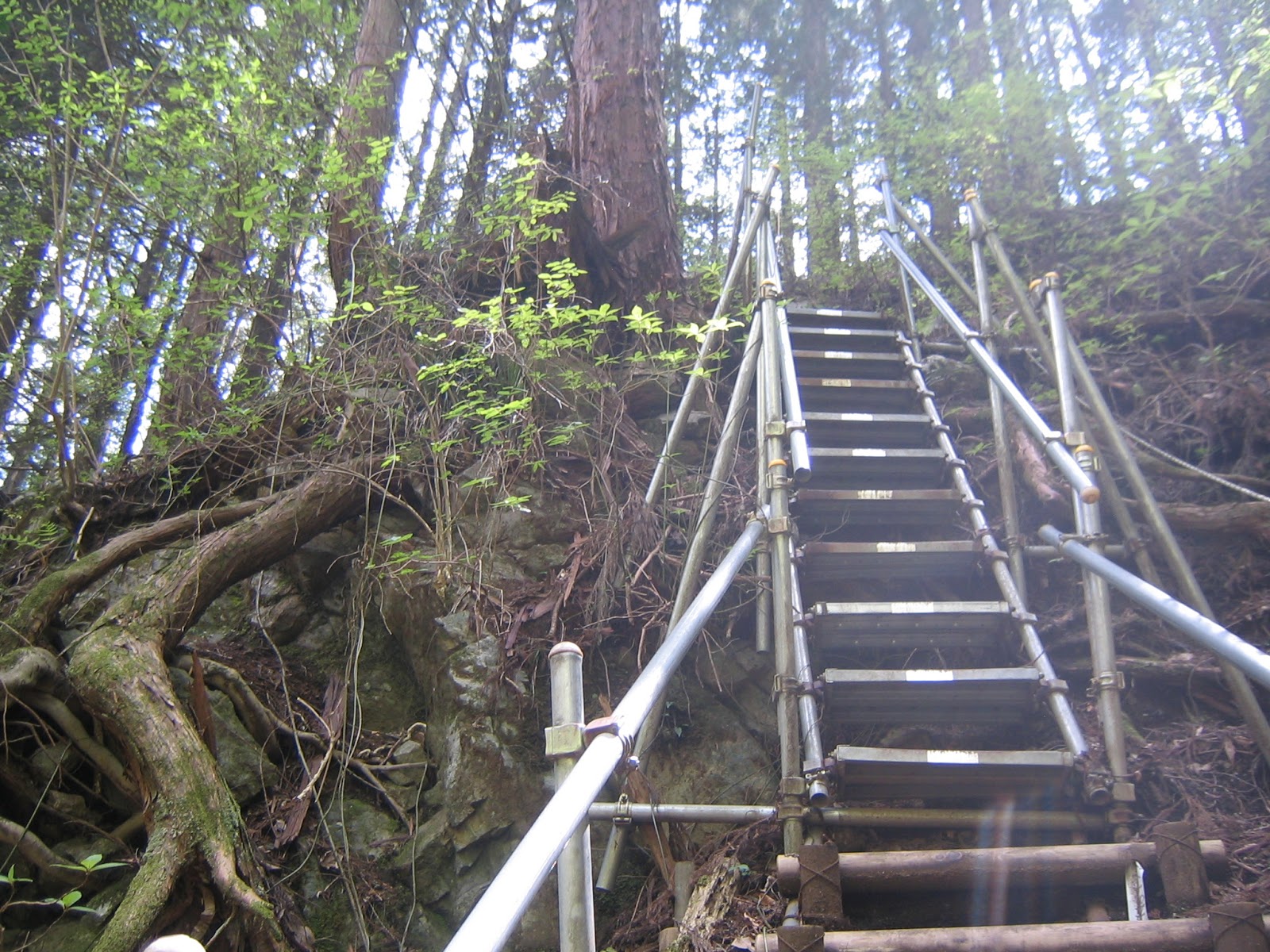
we have to use ladders to cross the gorge.
Mind you, the experience’s like
going down from a roof of a house with a carpenters’ ladder.
The place is above the Takigoh Fall 
滝郷ノ瀧 for ghosts I told you last week.
Viewing upstream of Takigoh-sawa from the bridge.
The place was once popular for gorge scrambling,
but now it is strongly discouraged to try
after several deaths along the way
due to very fragile rock surface.
Thanks to this human-less condition,
the place is good for wild animals.
I found a large fish swimming below the bridge in Takigoh-sawa.
After Takigoh-sawa Stream,
Route A crosses a truck rail for forestry.
Basically the west side of Yadoriki Stream is
also an afforested area by Morimura Bros. Inc.
There are lots of benches along the Route
… I think they are bones of deer … aren’t they?
A junction of Route A and forestry road(s) has
always a signpost like this.
Just go to the direction of “A,”
unless you are with Forest Instructors.
In the middle, about an hour from Yadoriki Oh-hashi,
there is a point near 2007 Forest of Growing
where we can have a very nice view of
Mt. Nabewari
(鍋割山 1272m ASL)
that
is the highest peak in this photo.
After the view of Mt. Nabewari,
we descend …
oh, hello, …
to the riverbed of Yadoriki Stream.
You see?
Passing Yadoriki Stream without a help is not at all advisable.


The Forest of Growing is planted by kids for wishing their happy life, remember? So, the Prefecture fights hard in defense against the onslaught by deer. What they’re doing is “building the wall.” Each Forest of Growing in Yadoriki Forest is surrounded by wire-mesh whose bottoms are secured under the ground in order for preventing deer from finding a gap to sneak in. Several other trees which are not in the Forest of Growing, but the Prefecture wants to protect, are also covered by plastic meshes to fend off the biting of deer. In front of these cages there stands a panel listing the name of kids who donated the funds for the seedlings planted within. The effect is obvious. Within the secluded area, there are lots of undergrowth constructing a bush that was once famous for the mountains of Tanzawa … Before, it was a routine for hikers of Tanzawa to wade in the chest-high bushes to progress along the trekking road.  It made very common, especially on the fragile grounds or ridges, sliding down to death by missing the footing ... Outside the enclosure, the surviving vegetation is only with what deer hates. Actually, this way of guarding forests is now getting momentum within the community of environmental protection in Japan (more to it, next week). OK, kids are to be nurtured for our future, so are the trees planted by them. And we have to shield off the space for baby trees’ survival … it’s so symbolic for the environment the kids of the 21st century live, isn’t it?


The class of 2007 is getting this big!
… within the cage.
Within you without you …
could you see the difference in vegetation?
The names of kids who
helped create the 8th block for 2007 Forest of Growing
It’s another afforested area by kids
other than for the Forest of Growing.
They are protected.
Outside the crate for 2007 Forest of Growing,
we can find vigorous Rubus palmatus var. coptophyllusand Zanthoxylum piperitum both of which are
very popular for gourmands of Japanese cuisine.
The plants have thorns so sharp that deer don’t take,
but eat up the rest in the area.
Losing the competitors, the thornies thrive in the Forest.
It might be one of a few benefits of having deer problem.


Unlike very popular Mt. Oyama, Yadoriki Forest is a quiet place. It makes the place loved by many wild animals. The identified animals by zoologists in the Forest include Japanese wild boar, Asian black bears, Japanese squirrel, Japanese giant flying squirrel, Japanese marten, Japanese deer, and the nation’s special natural treasure, Japanese serow. When you are in the Forest attentively, it’s possible to find their droppings and other things very frequently … or sometimes they are inspecting us. One spring day this year, when I walked Yadoriki Oh-hashi Bridge, I felt somebody is watching me from the Yadoriki Stream … I turned my eye, and found a four-legged creature over there too roly-poly to be deer … I think I was examined by a Japanese serow. That was my first time to encounter with a wild national treasure ... I was smitten. Hello, do you mind me having a walk in your garden? Among those fellows in the forest, especially Japanese deer run amok in Yadoriki. Next week, I tell you what I’ve learned about them during the Instructor Training ...


The list of wild things I’ve encountered in Yadoriki Forest,
#1. Droppings of Japanese wild boar
The list #2.
Leftovers of a dinner by Japanese squirrel
or Japanese giant flying squirrel
The list #3.
Droppings of Japanese deer
The list #4.
Actually, it was still VERY fresh
(I mean, very wet)
droppings of Japanese marten.
The list #5.
A footprint of Japanese serow
After this photo,
the animal entered into the Forest
whose figure was definitely not a bear …
I think it’s one of the Japanese serow
live in Yadoriki Forest.
People said Japanese serow is curious bunch
who can come to observe homo sapience
when they like.
I was their measuring object, then.


If you find environmental problems in Yadoriki Forest, please make a contact to
 
Kanagawa Nature Conservation Center 神奈川県自然環境保全センター
657 Nanasawa, Atsugi City, 243-0121 2430121 厚木市七沢657
Phone: 046-248-0323

You can send an enquiry to them by clicking the bottom line of their homepage at http://www.pref.kanagawa.jp/div/1644/