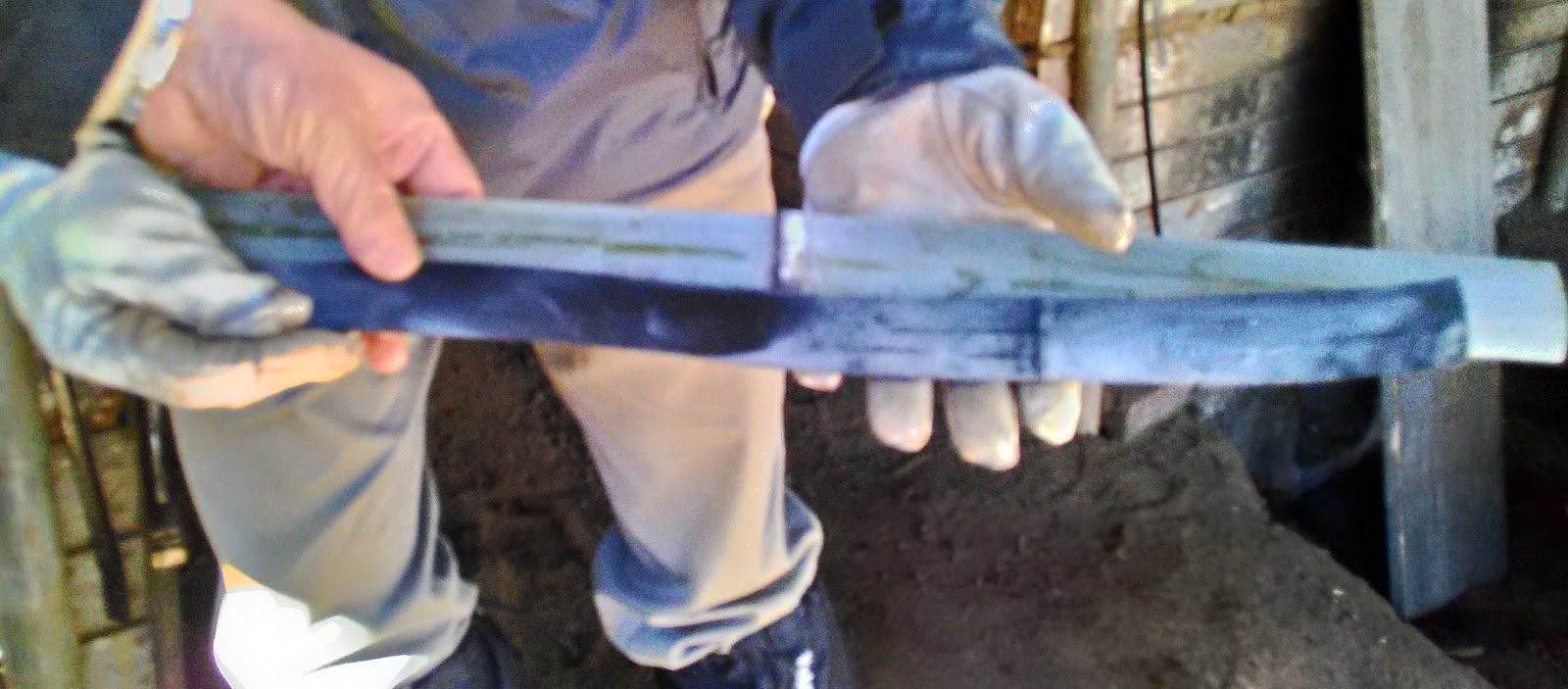
Bincho charcoal 備長炭 is made by professionals for
continuous 2 weeks. Unless we have a high-tech kiln, Niiharu Lovers, i.e.,
weekend citizen volunteers, cannot do this obviously. Having said that, even if
Niiharu’s charcoal cooking is a one-day task, I understood it was a LONG activity.
How long? According to my senior volunteers, it was about 8 or so hours’ activity
so that when we began cooking at 6:00 in the morning, the task would be
completed at 14:00 … well, it was an estimate when the kiln was (at least) not
old. I joined the charcoal making this winter. It took 14 hours … and we
figured it out why when we opened the lids 3 weeks later. Before going to this
point, I tell you my adventure on that charcoal cooking day.

So, it
takes time to make charcoal. Starting a day earlier, the better. It is a kind
of tradition for Lovers to fire up the charcoal kilns at 6:00 in the morning. Luckily,
it was a very fine day. The air in Ikebuch Open Space was clear and crisp. Wonderful!
Basically, as we have to operate kilns for hours, firewood for charcoal making
should be able to keep fire long. I didn’t know firewood made of coniferous
trees were not good in this regard. “…Look for woods dry enough ... You know,
fallen branches of cedar or cypress are good for starting fire since they can
burn very quickly. But to maintain the firepower continuously, it’s tricky to
use their logs. Firewood from Quercus
family, like Quercus acutissima and Quercus serrata is far better …” One of
the senior Lovers told me when we gathered firewood from a shed in Ikebuch Open
Space. Hmmmmmmm … so, the artificial forests made of coniferous trees are
really for urban development, I surmise. The broad-leaved forests for coppicing
had a very good raison d'être when people depended on mountains for energy ...
Needless
to say, it took a while for inside of kilns to be heated up. Making and
maintaining the flow of hot air is the key. It translates into the position we
burn the firewood. “Keep the fire at the mouth of the gutter, and make large
enough space at the end. The end of the U-gutter is under the hole of the drum.
Let the hot air created at the mouth flow to the end and go up through the
stove pipes. The air will steam the bamboos inside.” I realized it was a matter
of will when we guard the fire. It’s so tempting to add more firewood hoping
the fire deep in the gutter may grow bigger. Wrong. When we stuffed the furnace
with logs, the end of the gutter was deprived of oxygen. The fire there could be
extinguished even if the flame was large at the mouth. The air did not flow
smoothly to the drums, and cooking would not go well. Patience was needed, in
addition to adjust the fire-force at the mouth. Really, PATIENCE!
 |
Fuzzy,
fuzzy …
I was sleepy then. |
 |
| Firewood
of Quercus acutissima |
 |
The
pipe from the lid is holding
the end of industrial thermostat
to measure the
temperature inside.
Being a part of industrial regions of Japan,
Kanagawa
Prefecture has
leading manufacturers of industrial thermostat.
One senior
member of Lovers has
a very good connection with them
to procure such tools at
reasonable price. |
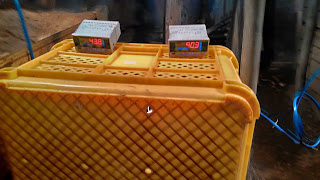 |
Whatever,
it takes time for the inside to get hotter …
You may notice the difference
between the two kilns
… That’s the problem. More to it below … |
The
seniors told me the temperature inside goes up exponentially. The slope of the
curve depends on the amount of moisture the material contains. The thinner the
bamboo wall is, the quicker it heats up. At the beginning of cooking, bamboos
release steam with the heat from firewood, and hence the gas comes out of the
bamboo funnels are mainly water vapor. Comparing with woods, bamboos are
constructed of far larger number of micropores that contain H2O. That’s
why we often encounter bamboos vigorous enough to ooze out droplets from a cut
end. When we cook charcoal from bamboos, chimney of a kiln would emit lots of
white smoke that is mainly water steam. Sure enough, eventually, the bamboo
chimneys of Niiharu kilns started to spew out white smokes. Or, observing the
reaction of my seniors, it seems to me checking out how fast the white smoke
comes out is the first target of operation. “Hurrah! The white smoke comes!”
 |
The
bamboo chimneys from the kilns
gushed out white vapor. |
It
also means we have to be ready to collect wood vinegar. Bamboos contain acetic
acid which made them good material as insect repellent for the base of mud
walls in traditional Japanese houses. The acid is vaporized during charcoal
making and released through the conduits from a charcoal kiln. With cold winter
atmosphere the vapor containing H2O and acetic acid from the drum
rapidly cooled and dripped in the bamboo buckets situated at the mouth of metal
pipes. At the beginning the collected liquid was more of water, but gradually it
was tinted darker and darker in amber. I licked little bit of them from time to
time. The beginning, it tasted … er well, water. Then, it became more and more acidic.
Accordingly, the color of smoke from the vents turned from white to bluish. The
seniors told me when the smoke obtained purple, it’s the sign we should stop
adding firewood. I was looking for that mysterious purple … Oh, by the way,
till 100 or so years ago, wood vinegar was used by married Japanese ladies to tint their tooth black and to shampoo their tightly coiffured hair. (Please
imagine Madam Butterfly in the Met or the Covent Garden.) At that time, tooth blackening was the social norm for married women, and coiffured long hair
invited lots of lice. Wood vinegar was safe must-have to treat both issues. It
would be a very good research topic for anthropology, “Evolution of Satoyama
and Japanese power structure of gender”, wouldn’t it?
 |
| Bamboo
vinegar drops in … |
The
liquid collected in this way inevitably holds soot. Niiharu Lovers sell
charcoal and bamboo vinegar manufactured in this way at City festivals year-round
to raise funds. In order to make the vinegar marketable, we have to strain it.
Traditionally it’s done by “a bamboo funnel” in Niiharu. It goes like this …
 |
The
funnel,
a 1m bamboo log tied up straight
to a pillar of the charcoal hut |
 |
Inside
the log is hollowed out,
except the very last section that has
a tiny 3mm hole
opened by an awl. |
 |
And
above the last section, the Lovers tightly stuff rags,
leaving the top for
about 10cm.
There is an order to pack, a sort of.
The texture of fabric gets
coarser to the bottom
so that the rag immediate above the 3mm hole is a mesh. |
 |
The
top is a woolen fabric.
Here is a good logic.
The top of the funnel is to
strain the soot,
and the materials removed get fewer
as the bamboo acid
trickles down inside the funnel. |
 |
| Stuffing
the rags |
 |
The
collected liquid is poured in the funnel,
and … |
 |
comes
out about 20 minutes later as
“purely hand-made” bamboo acid. |
 |
We
collect the strained liquid,
and repack them
in cleaned 500ml plastic bottles
for
fund-raising. |
So we
watched the fire, collected the bamboo vinegar, cleaned the metal pipe coming
from the drums from time to time, and … waited for the bamboos to be heated up
in the kiln. In theory, when the inside temperature reaches more than 500°C, the smoke from the chimney
becomes blue-purple, which is the sign the water is completely extracted from
the wood. When we add more external heat after this point, the bamboos in the
drum become ashes. We have to close the kiln completely ASAP to deny the oxygen
inside. Nonetheless, for a while bamboos inside will keep on burning themselves
to touch 700°C or so, with the heat it
stored during our firing. After the max temperature, they gradually simmer down
to the level of outer atmosphere. The charcoal cooking is the process until we
blockade the kiln. (Bincho charcoal is made of a final fire-up after opening
the blocked kiln, which is a skilled task of professionals.)
 |
| We
were hopeful at this stage… |
 |
| The
pipe cleaning stick |
 |
| Cleaning
the vents during cooking |
 |
| During
the wait, we prepared for the next cooking day … |
 |
We
also cleaned, trimmed, measured and packed
the products made in the previous
operations for selling.
Ours is popular and easily sold out in City fairs.
Recently, the City Office asked the Niiharu Lovers
to keep on opening the
marquees during any event
even when we sold out all the products we brought
from the charcoal kilns and the atelier for wood crafts. |
Before,
the Lovers could seal the furnace at around 14:00 … this time, er, no. At
14:00, inside of both kilns was still 200°C. The Lovers frantically added more firewood and cleaned the pipes, and
waited, waited, waited … Meanwhile, cone-shaped Ikebuchi Open Space was filled
with the bluish, but no-purple, smoke. Now I understood why the people of
Hikarigaoka Housing Complex were in a rage to volunteers of Shikinomori Park.
(er, of course, Lovers of Niiharu obtained the permission from the fire station
to do this in the forest.) Woooooooow. The operation from the dawn reached to
the dusk, and the kilns’ temperature was still less than 400°C. “Well, it’s strange.”
“Why?” “Anyway, we have to keep on burning the firewood.” Eventually, we ran
out of Quercus
firewood. We were forced to burn the logs of coniferous trees. The forest
entered into the night ... I could not see any purple smoke from the kilns in
the end … I didn’t know either Yokohama’s sky could be that dark with lots of
stars above us … beautiful hole
in light polluted sky of Tokyo Megalopolis … come to think of it, that’s why no one came us to
complain. No light pollution means none lives near from Ikebuchi Open Space.
 |
| I
would say the smoke is … a kind of blue … isn’t it? |
 |
| Wooooooow |
 |
| Night |
 |
| And we
are still here … |
 |
| So,
let’s clean the vents … |
The
kilns finally arrived 500°C at around
19:00. We checked if the air from the pipe vents from the drum can ignite
matches. They did! It’s a sort of ritual, whose practical meaning was to see the
sign the smoke contents from the drums included very few water, if any, and hot
enough for the bamboo sticks to self-steam to be charcoal. The Lovers then hurriedly
made another butch of red cray paste, sealed the furnace with bricks and cray,
and finally went home to bed. Phew. 3 weeks later, we opened the lids, and
found nicely charcoaled bamboo sticks … surrounded by crumbling wall of drums.
One of the drums actually had huge holes on the wall near the bottom. Ah-ha. That’s
why we struggled to heat up inside.
 |
| Night
playing with mud |
 |
| Fire
ignition! |
 |
Closing
the furnace, hurriedly.
Otherwise, the fire would turn the bamboos into ashes. |
 |
We
also removed the bamboo conduits
and covered tightly the mouth of pipes
from
the drum with
aluminum foils and bamboo buckets.
The sealed-off was complete. |
 |
The
change in temperature inside the kilns. The vertical axis measures the
temperature.
The horizontal one is for hours. I won’t say they are not
exponential, but … |
 |
| 3
weeks later. Digging out the kilns. |
 |
| Opening
the lid … |
 |
| Voilà! Bamboo charcoals we
made! |
 |
| Our product |
 |
| And one of the large holes we
found |
“Er,
well, yes, the kilns are reaching to their limit.” “Hmmmmm … will we replace
them with new drums?” “That’s the option we’ll think this summer, isn’t it?”
For now, we have covered the holes with bits of metals, and operated the kilns
two more times for this winter with
lots of vent cleaning to reduce operation time. It has been shortened to 9 hours! … In any case, due to the porous
structure of bamboo charcoal, they are ideal deodorant. We can use them almost
permanently as such when we dry them with direct sun once in every 2 months for
dry season, or in every month during rainy season. Caution: never wash them by
chlorined tap water. The chemical remains the micropores of bamboo and block
the space where the molecule of smelly staff comes in, i.e., destroys the
ability of bamboo charcoal as deodorant. If you visit any City fair of Yokohama
for environmental matters, Lovers of Niiharu would be there with our charcoal. Good
to see you, and thank you for your donation!

If you find a
problem in Niiharu Forest, please make a contact with
Office for the Park Greeneries in the
North 北部公園緑地事務所
Yokohama Municipal Government
Creative Environment Policy Bureau 横浜市環境創造局
Phone: 045-311-2016 (I guess in
Japanese only)
FAX: 045-316-8420 (I hope there is
somebody who can read English …)
Niiharu Administrative Office /
Satoyama Exchange Center 新治管理事務所・里山交流センター
Phone: 045-931-4947
Fax: 045-937-0898
http://www.niiharu.jp/