One
reason why forests in Yokohama have been left in neglect was, people no longer
needed the resources forests can provide for daily lives. In bygone era of
Satoyama, woods and bamboos were the materials to be crafted into fuels,
utensils, tools, etc. Once cheap plastics and aluminum pans became readily
available from shops around the corner, people stopped to bother entering the
forest to collect the bounties. Now IKEA Kohoku sells rice bowls for less than
100 yen, who cares nurturing good beech trees to craft a wooden bowl in KozukueCastle Citizen Forest, located within less than 2k from IKEA Cafe?

Basically,
volunteers in Yokohama Citizen Forest are expected to do 3 things. One is to
manage the forest vegetation with thinning, weeding, scraping fallen leaves,
and collecting trashes in and around trekking roads. Second is to monitor the
health of the Forest, by recording the changes and animal lives. The third
mission is to enlighten the community about the joy of living with healthy
forests. Lovers of Niiharu volunteers have several regular events for the third
category. In their schedule, 4 festivals in each season are mainly for kids to
enjoy forest. All of them include some forest works of the season, hand-craft
session using the collected materials from the Niiharu Citizen Forest,
information session about nature in Niiharu, games, and cooking. 2016 WinterFestival in Niiharu was held one recent Sunday. I have been there. It was a
fun!
 |
To
Ikebuchi Open Place.
Red and white plum flowers
and tangerines welcomed us. |
The
program of this year’s festival was 1. Bamboo thinning, 2. Bamboo cup and chop
sticks making for lunch with miso soup with lots of organic veggies and pork, 3.
Fun-booths for information about early spring buds in the Forest and for cocklebur
darts, and 4. Bambuskuchen. Bambuskuchen?
 |
| It was
really a fine day. |
The
melee started at 10:00 in Ikebuchi Open Space of the Niiharu Forest. About 70
people, kids + moms + dads, gathered to enjoy weekend bringing family bento
boxes. (Fee: 300 yen for adults, 100 yen for kids under 15). Forest volunteers prepared
huge pots of quasi-traditional miso soup with lots of winter vegetables with
pork, which was free refill. Veggies were brought from the field of the farming
club of the Lovers of Niiharu. The leader of the Club proudly declared:
“AUTHENTICALLY organic!” They were leeks, carrots, Chinese cabbages, and taros,
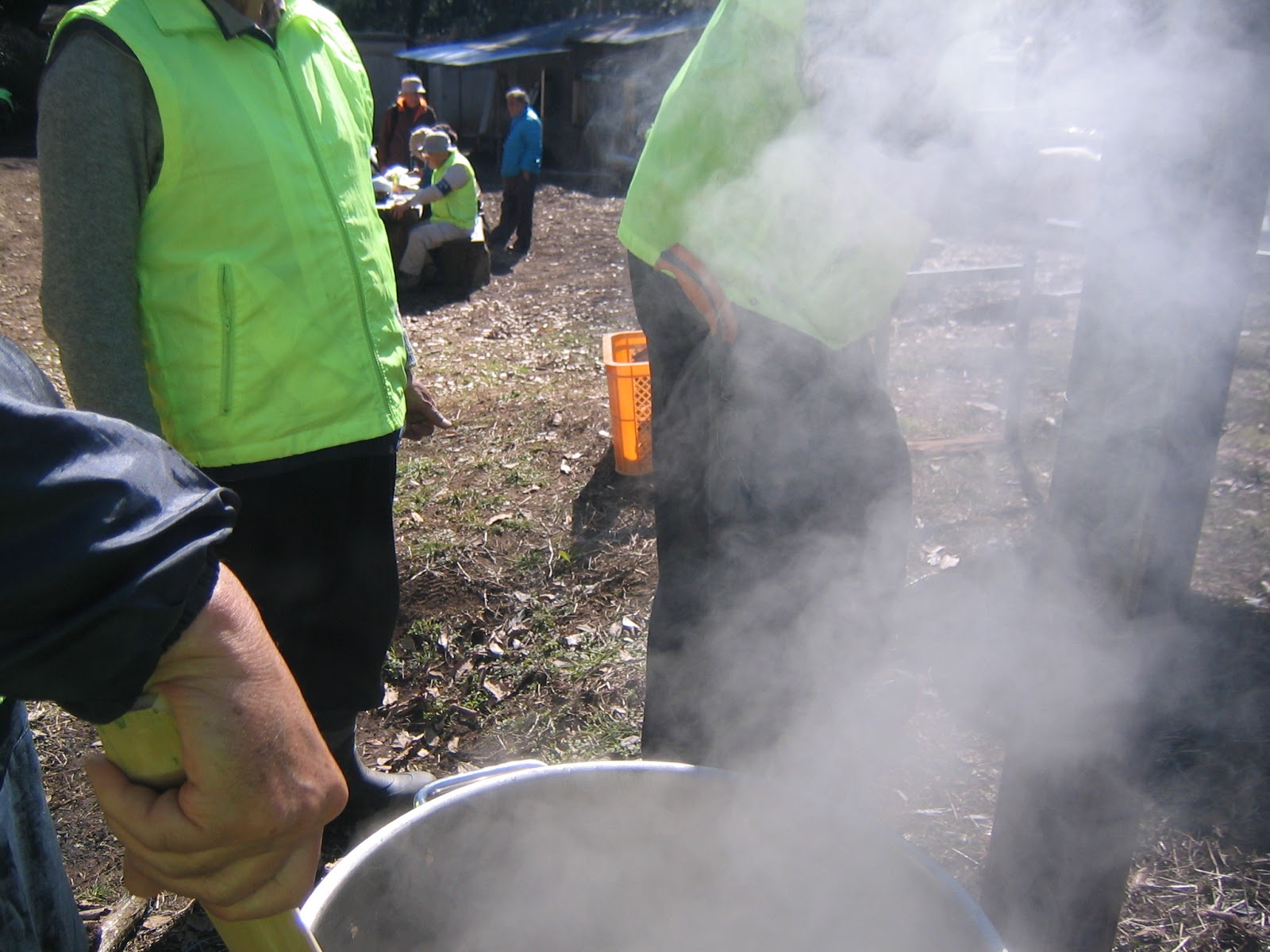
with konjak. The Lovers used stoves made of empty drum cans. The source of the
heat was gentle firewood. The smell of miso (+ shoyu + mirin + veggie broth +
pork) started to waft already in 10:00. But we must wait … Gentle heat of logs
cooked the ingredients thoroughly. Kids loved it. Some 1st graders
ate 3 cups of it. The time of winter in the Forest was slow and tender.
 |
| The
very first family to register |
 |
| Forest
miso soup is to be cooked there. |
 |
| Hot
soup in the Forest |
 |
| Picnic
with miso soup |
Though
families brought bento boxes for lunch, the utensil for miso soup was made on
site. The Lovers invited kids to work in one of the bamboo forests before
lunch. We all went into the forest to
search for suitable bamboo trees for cups. “How do you reckon the height of
this bamboo?” A 2nd grader replied, “100m!” “Er, it’s not that tall,
but more than 10m already.” A volunteer leader told us. “Have you noticed the
color of sections of this bamboo? It is white, isn’t it? This one is young,
sprouted last spring. It’s still too tender to be a good cup. Look for a
well-sized bamboo of 2-3 years old. Find one with brownish sections …” “Was it
born just last year?” “Oh, yes.” “Wow… so tall …”
 |
| Let’s
go to a bamboo forest! |
 |
| We are
getting there. |
 |
| A young
bamboo tree |
 |
They
were more matured, and stood a bit densely.
Good place for thinning. |
Our
group chose an older bamboo tree, of diameter about 17 cm, stood side by side
with the other older ones. Our leader instructed us to look upwards. “First, we
have to notice this forest spreads on a very steep slope, and the canopy of all
the bamboos are drooping to the valley side. Which side of a bamboo do we start
to cut for harvesting?” “Hmmmm, the valley side?” “Well done! Correct. You
know, bamboos have sections that get narrower upwards. Maybe we can have good
cups from this tree near the bottom. So, we cut the tree at here … First we cut
a section of this tree facing the valley. Safety first! I’ll do it for you to
look.” He inserted his saw at the bottom of the trunk, and cut a section from
there. It looked like a chunk of small pumpkin. 4 years old got excited and
decided to have it for his treasure. “Bamboo pumpkins!” “Now, you can saw the
tree from the other side.” “Yap!” the 2nd grader big brother started
to saw the ridge-facing side of the trunk with an angle. This was his first attempt to tackle
with a real tree.
 |
| Let’s
cut it here. |
 |
| I can
do it! |
He and
his kindergarten brother came to the festival with their grandma and grandpa
who was a professional carpenter. Grandpa looked his grandsons grinning, and
gave very sharp advices. “Hey, hey, why do you think a saw has lots of tooth?
You use the tool in its length!” “Ha, ha, ha, you need 10 years to cut this
tree.” The 2nd grader replied. ”No! I can do it instantly!” The
volunteer leader supported the trunk and advised, “Use your both hands and
clench the handle when you catch the saw … yes, well done. Keep your pace,
don’t rush …” 4 years old joined the fight. “I want to do it too!” After kids’
endeavor for a while the bamboo fell over the slope, and its top was caught by the boughs of 2
other bamboos. “Hey, Grandpa, it was only 5 minutes!” From both the stump and
the cut end of the tree oozed out water, real bamboo water. “Look, the tree was
drinking from the ground this much …”
 |
| Coming
doooown … |
 |
| Wow,
water, water … |
The
grandpa and the volunteer leader cut the trunk of the fallen bamboo to release
it from the tangle, and laid the entire tree on the slope. The canopy part was
bushy with several dead branches. “Hmmmm, the canopy was a bit damaged. It was
good to thin this tree for the forest. For the lunch, we need only the bottom 4
sections. Let’s cut the tree in several parts, and bring the bottom with us to
the lunch place. The rest are to be gathered over there for clearing later.”
So, we all attempted to dissect the bamboo. Grandma helped her grandson. “I’ll
hold your body from slipping into the valley. You cut here.” I delimbed the
busy branches of the bamboo. Each branch went to a different direction even
when they came out of the same section. When I muddled, the volunteer leader
showed me an example. “You hold all the branches at once, and saw the bottom of
them just above the section ... like this. There, it’s easy.” True. My 3 minutes
per branch was shortened into 1 minute per two branches that were cut
simultaneously. “Wow, he’s quicker than my grandpa.” “Grandpa does not cut
bamboo branches for his job, you know.” “Oh, yeah.”
 |
| Grandma
as a stopper |
 |
| These will be utilized later for forest management. |
 |
| Today’s
bounty! |
We
brought the trunk at Ikebuchi Open Space, and cut it into 4 sections for lunch
bowls of the family + chop sticks. The bamboo cups are large enough as soup
mugs whose edge was trimmed by Lovers of Niiharu members. During lunch,
educational exhibitions about early spring buds in the Forest and handcrafting
for bamboo toys were presented, and kids gathered around a cocklebur darts
contest.
 |
| Cups
and chopsticks |
 |
| We
hold the trunk for cutting. |
 |
| This
is my cup! |
 |
| And
this is mine! |
 |
| Chop
stick making |
 |
| The
mouth of a bamboo cup is trimmed for safety. |
The
finale of the festival was to bake baumkuchen … no, bambuskuchen. 3 bamboo
trunks whose sections were pulled out became the “baum.” The ladies of Lovers
of Niiharu developed a special recipe for bambuskuchen whose slippery
bamboo-baum requires a bit different consistency in dough. For about 50cm
kuchen around a 10cm diameter bamboo with
3cm thickness,
- Separate whites and yolks of 20 eggs. Beat yolks and 600g of sugar
in a VERY large bowl until thick and pale yellow.
- Fold in 600g of flour and 600g of pancake mix.
- Fold in 400ml of milk and 600g of melted butter and stir until just smooth.
- Whisk whites until it forms stiff peak. Gently fold in the flour
mix. The dough is now ready.
- For
the first batch as the base of the kuchen, repeat 1-4 with smaller amount of
ingredients in a smaller bowl. Fold milk and butter in a smaller portion than
the main dough that makes the consistency of this bowl is heavier.
The
volunteers caused charcoal in open stoves, and bambuskuchen making began.
First, 3-4 ladles of the first dough from the small bowl was poured around the
middle of about 2m bamboo trunk. Then, two people held each side of the trunk,
rotated the bamboo once (and a bit) to drain little the dough, and moved the bamboo
with dough over the heated charcoal to roast it by rotating continuously.
 |
| First,
cover the bamboo with dough … |
 |
| Now
the bamboo is over the oven. |
How to
turn was tricky. Especially when the dough was still wet, unless we rotated the
“bambus” at a proper speed, the dough fell down over the fire. At the very first roasting, the diameter of
the kuchen was still small, and so the speed of dough-dripping over one
rotation was faster. Though, too quick spin made the distribution of the dough
over the bamboo uneven, which made valleys and hills covering a bamboo trunk. In
addition, the heat from charcoal only was not enough. The good firing up from added
logs could brown the dough with nice color and aroma so we had to add logs and
to watch the distribution and the height of the fire continuously to maintain
the proper oven operation. Once the entire layer was nicely colored and dried,
the next ladles were added, and the “bambus” returned over the oven. People
took turns to rotate and ladle the kuchen. We roasted the bamboo for more than
30 minutes.
 |
| It is
still at an early stage … |
 |
| Growing
kuchen |
There
were several kids who ended up with the charge of rotating. I asked them “Are
you OK? If you’re tired, I’ll follow you up …” But they were remarkably
diligent and determined. “I DO want to finish it by myself!” Their labor of
persistence became very sweet. During the roasting, everybody was wondering if
the kuchen could come out smoothly from the bamboo. No problem. Though the
shape of kuchen was rough with hills and valleys, it emerged as really a “bambuskuchen.”
We cleaned the plate in no time!
 |
First
the burnt chunks at the edge were removed.
By the way, they too were tasty to
nibble. J |
 |
| Done! |
The City Office who’s in charge of
execution of Green-up Plan is
Yokohama Municipal Government
Creative Environment Policy Bureau 横浜市環境創造局
Phone: 045-671-2891
FAX: 045-641-3490
http://www.city.yokohama.lg.jp/kankyo/