Friday, February 21, 2020

How to Train Your Dragon: Tsurumi River and a pond near Niiharu Citizen Forest


On the eastside of Niiharu Citizen Forest, there is a man-made pond, connected to Umeda River that is a second tributary for Tsurumi River 鶴見川 via On’daRiver 恩田川. The existence of it has been always a mystery for me. The pool is made of concrete walls, although now it is full of aquatic life with muds flown in from the forests. The size of Niiharu Forest gives us a feeling we are standing in a traditional agricultural area. It is not at all true. Just 5 minutes’ walk from the pond, we are surrounded by ordinary suburbia of Megalopolis Tokyo. There is no agriculture needing water reservoir for their business. Then, what’s for that pond? It must have costed lots of money to build such structure. I know it’s not a private property, but of the City. So, that pool is made of taxpayers’ money. There must be a good reason for the existence of the pond. Recently, I learned the raison d’être of it. It has a VERY serious duty to perform, I realized.


This is the pond.
 The forest over there is the eastside of Niiharu Forest.


If you’re familiar to ordinary towns of Yokohama, you may notice there are lots of signs like this:


The panel says, “Below this building, there is a storm water reservoir.” It is a way of controlling flood often caused by small rivers running in our city. You see? Yokohama is a port town, i.e. we have many small but steep hills falling down to Tokyo Bay. Such geological feature makes the place good for port. At the same time, in Yokohama very tiny water streams go down the ubiquitous small valleys between the steep hills. They may be pequeños, but for a densely populated city can be troublesome enough with torrential rains. As they are small, they can quickly reach to the capacity, and cause floods in downtown. How to control such incidents is always the important issue for ages in Japan.


Small Umeda River


The other day, Prof. Yuji Kishi of Keio University explained to us Kanagawa Forest Instructors the basic method of controlling such flood. Before, when our society was mainly for agriculture, the flat places where water entered easily was used for rice paddies. The sites were good for staple cultivation, and acted as an important buffer for overflow caused by rains and rivers. Many traditional rice cultivars in Japan were resilient for floods so that their quality was not affected much, even after several weeks of inundation in late summer and fall. Those were the days. Now, especially Yokohama and Kawasaki in Metropolitan Tokyo area, the places prone to flood are developed for factories, offices, housings, shopping centers … with millions of people. Meanwhile, rivers won’t change their course when we build our sweet home on their way. When a storm comes, nature wins, and humans face devastation with deluge.


The mouth of KatabiraRiver 帷子川 at the Port of Yokohama.
 Here, we have brackish water, but not yet of sea.
 You see?
 Global HDQ of Nissan stands at the lovely waterfront,
 but if flood occurs,
 the building does not stand at the pole position.


The professor pointed out, especially for Tsurumi River (my post on August 2, 2019), its geological condition presents THE serious threats. It’s a very short river; 42.5km in total starts from a spring at ASL170m in Machida City of Tokyo. Direct distance between the origin to its mouth is less than 20km, whereas the river creates 235km2 of catchment area. i.e., The flow is meandering the relatively flat flood plain before ending at Tokyo Bay. No wonder it overflows very often when strong typhoon comes. The flood plain of Tsurumi River is home of huge population larger than the City of Osaka. During the high growth era of the 1960s, regularly 20000 households of Yokohama and Kawasaki suffered a lot with the flood of Tsurumi River. I imagine the situation could be similar to the current problem of people in Dhaka, Bangladesh … In the early 1970s, the mandarins of Japanese government reached the conclusion they could not contain Tsurumi River with a “standard way.” In terms of civil engineering, Professor Kishi continues, the easiest way to avoid inundation in Yokohama and Kawasaki area by Tsurumi River is to cut all the trees in upstream hills, including Niiharu Forest, concrete every slopes for rain water to pass smoothly, and widen the river by removing all the human activities from the flood plain. In this way, rainwater would smoothly flow into the sea. BUT, of course, we cannot take this method in Megalopolis Tokyo.


Recent Tsurumi River near Kamoi Ohashi Bridge 鴨居大橋.
 People are busy restoring the bank
 destroyed by Typhoon Hagibis
 (; my post on January 17, 2020).


Even though, if we can control the amount of water flowing into the river at least to some extent, we can protect our life. People living along Tsurumi River including municipal governments + the central government gathered their brain to come up with a plan. In 1980, the Integrated Flood Management Policy for Tsurumi River went into the effect. 2020 is its 40th anniversary. The measure is unique in Japan as this is a cross-municipal arrangement where the central government and civil society organizations act as a mediator, or connector, of sorts among 3 regional governments; Machida, Kawasaki, and Yokohama along the river. Prof. Kishi presides TRnet 鶴見川流域ネットワーキング which is a civic organization covering the Tsurmi River itself and sits at the Inter-municipality + National Office Council regarding Tsurumi River Basin 鶴見川流域水協議会.


Despite of a substantial flood last fall,
 water birds are surviving ...


The Ministry of Land, Infrastructure, and Transport is executing civil engineering projects to fortify banks, smoothing out the river flow with various measures (including underground aqueducts) to lessen the impact of flood water running down the sea. It also created the huge multipurpose anti-flood pond which is the New YokohamaSports Park with Nissan Stadium for 2002 FIFA World Cup and 2019 Rugby World Cup. (More to this next week.) The inter-municipal arrangement is also engaging in the measures to improve the quality of forests along the river in order to advance forests’ ability to retain rainwater before washing down to Tsurumi River. Each municipality supports civil society activities to maintain the health of forests along Tsurumi River. Yokohama has 12 Citizen Forests in Tsurumi River Basin. Each has Lovers Organization of volunteers that receive financial and technical assistance from the City with Green Tax funding. Lovers of Niiharu Citizen Forest is the largest. We are busy with maintaining our forest to keeping its ability of retaining water. For Niiharu Forest, also the Council for Fun Learning along Umeda River 梅田川水辺の楽校協議会, a member for Niiharu Council together with the Lovers (; my post on April 22, 2016), works closely with TRnet. Machida and Kawasaki too have their own scheme to promote civic activity for the health of forests in Tsurumi River Basin. In addition, municipal governments constructed numerous storm water ponds not only for Tsurumi River but also for the other rivers under their territory. The pond next to Niiharu Forest is one of them.


The New Yokohama Sports Park with Nissan Stadium
Umeda River becomes maddeningly beautiful
 with
Spiraea thunbergii in Spring.
 Please come in late March to early April
 for your relaxed walk along the river, next to Niiharu Forest.
 The Council for Fun Learning along Umeda River is
 in charge of picking up garbage and mowing in the riverbed.


I was a little taken aback to the map shown by the professor which showed the location of flood reservoirs along the river. The shape of the basin for Tsurumi River looks like a cute tapir. Then, the dots representing ponds were like polka dots decorating the entire body of the animal, like some object created by Yayoi Kusama. In total there are more than 4900 ponds for flood control of Tsurumi River. Woooooooooow. The professor told us this arrangement was possible because it is for Tsurumi River that runs the richest municipalities in Japan, very near to the offices of the central government. The place has money to mobilize all the relevant actors, national and local governments + civil society, to control the flood. “I think the only place possible to replicate Tsurumi River model would be in Osaka whose budgetary scale could support such project. However, the local governments of Osaka are at odds with the national offices in Tokyo so that mandarins in Tokyo do not like to touch it …” Prof. Kishi told us. That’s sounds depressing. If such coordination is rare even for tiny rivers, what would happen for those rivers flowing internationally? How can people manage natural (or otherwise) disasters caused by their river when your neighbor speaks completely different “language”? 


A tapir wearing a coat of polka dots


Prof. Kishi added more in his seminar; with such ferocious downpouring these days, the era we can count on the ability of forests to retain rainwater is over. Yes, healthy forest with enough mulch absorbs droplets from heaven, up to a point. If an extreme shower occurs in a very short period of time like that of Typhoon Hagibis last year, or, if substantial raining continues for unusual period of time like we had last October and November, any forest cannot keep water beneath the system of roots and soils. Once the ground reaches to the max capacity, it gives in to the law of gravity, and causes landslide. Any landslip with lots of living trees causes the max devastation. Debris flow contains not only earth and rocks, but also logs, huge roots, and anything that was once a part of a forest. The impact of such avalanche is far worse. Say, if they reach to the river, mixture of logs and earth destroys bridges far rapidly than the slide only with tumbling rocks. “The arrangement for Tsurumi River is not yet at all adequate to tackle frequent ‘once in 100 years’ typhoons. Considering its extremely urban circumstances, we may have hit the technical limit already.” Hmmmmmmmmm … At least last year, the reservoir attached to Niiharu Forest retained water while Umeda River next to the forest run maddeningly to On’da River. How long it can go that way? At least, we Lovers of Niiharu Citizen Forest are every weekend busy maintaining our forest with its mulch, hoping it retains rain …


The collapse


By the way, this Sunday, February 24th, from 13:30 at Tsurumi River Watershed Center  鶴見川流域センター next to Yokohama Sports Center, Prof. Kishi will have a workshop about Tsurumi River and the New Yokohama Sports Park with Nissan Stadium. RSVP at

Tsurumi River Watershed Center
Phone: 045-475-1998
FAX: 045-475-1999

The participation fee is 100 yen for a cup of coffee served there. Anyway, when you find issues in Tsurumi River, please make a contact with

Keihin River Office, Kanto Development Bureau
Ministry of Land, Infrastructure and Transport of Japan
国土交通省 関東地方整備局 京浜河川事務所
2-18-1 Tsurumi-chuoh, Tsurumi Ward, Yokohama, 230-0051
〒230-0051 神奈川県横浜市鶴見区鶴見中央2-18-1
Phone: 045-503-4000

Friday, February 14, 2020

A bit of dawdling before riding a bus: Togawa Prefectural Park of Kanagawa 神奈川県立戸川公園


Ohkura Community 大倉 in Hadano City 秦野市 is the main entrance to Tanzawa Mountains 丹沢. I guess some of you have visited there in order to climb up to Mt. Nabewari (ASL 1272.4m 鍋割山), Mt. Tonodake (ASL 1490.9m 塔ノ岳), Mt. Tanzawa (ASL 1567m 丹沢山), and beyond. The access is from the North Exit of Odakyu Shibusawa Station 小田急渋沢 where we take Kanachu Bus to Ohkura 神奈中バス大倉, the terminal stop (; the timetable is from here). From the stop there are many hiking courses to the peaks. As it is really a popular portal for Tanzawa, sometimes catching a return bus to Shibusawa Station can be an experience similar to riding Metro in downtown Tokyo. It’s not uncommon to wait for the second next bus at Ohkura Stop, especially around 16:00 in summer (; well, FYI, the timetable is here). The saving grace is, near the bus stop there are several food venues, like for soba noodle or ice cream. Besides, the bus stop is at the entrance to Togawa Prefectural Park of Kanagawa 神奈川県立戸川公園. This week I tell you my mini-adventure at Togawa Park. It’s a lovely place for family weekend.


Ohkura terminal stop.
 On our right of this photo is the rest house where
 you can drop your hiking registration to Tanzawa area.
 Please report when you enter the mountains.
 In case you have an accident,
 the registration card will be a vital info for rescuers.


As the location of Ohkura suggests, Togawa Park is spreading over hill-slopes of Tanzawa. In the middle, there runs Mizunahsi River 水無川 originating from Mt. Tonodake. Mizunashi River is the main river which have created an alluvial fun for a main part of downtown Hadano City. As I told you in my post for Shinseiko Lake 震生湖 on November 15 last year, the area is on the crushing point between the Philippines and North American Plates. Here, a gigantic force pushes up ancient gravel layers from the bottom of the Pacific Ocean. It makes the riverbed and banks of Mizunashi River sandy and porous for water seeping in easily. Consequently, the water flow looks few, if any, for Mizunashi River. It often turns into underground. Actually, “Mizunashi 水無” in Japanese means “No Water.” Togawa Park uses such feature of the river. On the very wide riverbed it equips BBQ space, kids’ playground, fields for baseball and the other sports. As long as the river is “dry” we can go very near to the shore. It’s a popular summering spot. Between April to November, we can have a BBQ party there; RSVP via internet only.


On the riverbank they have a tea house,
 open 9:00-16:00 (the last order at 15:30),
 where we can enjoy Japanese maccha tea and sweets.
 The most expensive menu is 500 yen (USD 5).
 It’s a nice place.
Traditional Japanese Garden at the tea house.
The BBQ place, closed during winter.
Kids’ planground. Beyond that are sports fields.
Could you see a sort of cobbled road
 running in the middle of the stream?
 It’s actually a bridge over Mizunashi River.
 Those on the right is the BBQ place.
And this is the photo taken from the bridge shown above.
 You see?
 Mizunashi River is really “Mizunashi.”
Many roads in the Park is wide and well-managed.
Pergolas very near to the bus stop.
 We can use them to have a mini-break while
 you’re waiting for the next bus after your hiking.


But the first thing we notice when we arrive at Ohkura bus stop must be a large but elegant suspension bridge over Mizunashi River. Its name is “Kaze-no-Tsuribashi (Bridge of Wind 風の吊り橋)” that is for pedestrian only. One of the standard routes to the main peaks of Tanzawa starts from here. We cross the bridge, turn left, and meet with (mostly) two roads; one via Togawa Forestry Road 戸川林道 climbing up to the peak of Mt. Tonodake, and another via San’no Toh 三ノ塔 (aka Mt. Bodai 菩提山, ASL 1204m) going the ridge way, with a view to the Pacific Ocean, to Mt. Tonodake. Anyway, many people notice at the end of the bridge, on the middle of the hill, there is a log house. It’s the Prefectural Mountaineering Sports Center 神奈川県山岳スポーツセンター. If you ponder to acquire proper skills of mountaineering for, say, Mt. Everest someday, this is the main entrance to such world.


Kaze-no-Tsuribashi
A picture taken from the Bridge
 towards Tanzawa Mountains.
 Could you see Togawa Forestry Road
 running along the River on the right of this photo?
At the end of the Bridge from the Bus Stop,
 there is this signpost.
 To the right is for the Tea House,
 Prefectural Mountaineering Sports Center,
 and an ample Parking space.
 To the left is to San’no Toh.
If you just pass the parking,
 we enter Ohkura Community where we can see Pacific Ocean …
Opposite direction from the above photo is
 to “the Front Ridgeway of Tanzawa.”
 This is the entrance to the hiking road to San’no Toh.
Just this point for San'no Toh,
 we can find this panel explaining wild animals of the area,
 and
A pond where wild birds might congregate if you’re lucky.
A shortcut to the Prefectural Mountaineering Sports Center
is going up this narrow road on the left of this photo.
The Prefectural Mountaineering Sports Center


Inside the Center, they have seminar rooms, a training gym, a kitchen, a dining room, and lodging facility. It also acts as the main office for Kanagawa Mountaineering Federation. Throughout a year, they have numerous seminars and training sessions for the mountaineering and sports climbing; their HP is here. Thanks to Tokyo 2020 Olympics Games, the interest into sports climbing is going up now. So, the Prefecture is currently updating the bouldering gym here. They plan to open the new facility by the end of March, in time for the opening of Tokyo Olympics Games (although 2020 Olympics match for Sports Climbing will be held at a temp venue in Tokyo Bay Area). Basically, the usage of the Prefectural Mountaineering Sports Center requires reservation via HP or phone at 0463-87-9025. But, if, say, there is a vacancy for accommodation on a day at 15:00, we can check in without reservation. It’s a Youth Hostel kind of place, 3140 yen per night, with showers (but no spa, we lament). We have to bring our pajama, towels, and toiletry with ourselves. Also, they do not sell food itself so that we have to bring our own food to cook in the kitchen. Their kitchen has stoves, pans, sinks, refrigerator, a microwave and dishes; but no oven (mind you, this is Japan). Especially during winter when the Federation does not have seminars, the place often has a vacancy. It may be a bargain.


15m mobile climbing wall before the renewal.
They are having a heavy construction work now.
 Anyway, RSVP.
Next to the new wall,
 a new building is under construction now.
 May be it would be a gym with more walls.
A drop box for hiking registration next to the Center.
 You see? I took this photo around 15:30,
 and the inside of the box is this much full.
(Normally, the police collect the cards once a day.)
 Many hikers passed by here …


The Togawa Park has another main information center of the Prefecture. It is Hadano Visitor Center for Tanzawa-Oyama Quasi-national Park 丹沢大山国定公園・自然公園秦野ビジターセンター, open 9:00-16:30 daily except December 29-January 3. It’s right next to the ice-cream shop in front of the bus stop so that some of you may have known. The place has the latest information of hiking roads and nature of Tanzawa-Oyama area. When we enter there, we’ll be welcomed by mini libraries and nature museum on the left. On the right is the admin office. When you have any question about the Quasi-national Park, you can inquire there … I hope their English is improving. If you need to borrow binoculars, magnifying glass, and illustrated graphic books for the nature of Tanzawa, you may ask them: they rent, free of charge, such tools for nature observation (; you have to return them before the closing time). Every second and forth Saturday of a month, the rangers have a kids-friendly nature talk between 13:30-14:00, free of charge and no reservation necessary. You just pop in the museum area, and you’ll be the member for the talk. Besides those regular info services, they preside special events throughout the year. Please check the latest at their HP here.


Hadano Visitor Center for Tanzawa-Oyama Quasi-national Park
Mini-museum for the nature of Tanzawa at the Visitor Center


Paradoxically, it’s difficult to know Togawa Park as we’re always busy for weekend hiking in Tanzawa from Ohkura. But if we just stop running around, and take a deep breath looking Bridge of Wind and the Pacific Ocean over there, we’ll notice the Park is a comfortable place. Spring is coming and soon the Park will be full of tulips and cherry blossoms local volunteers are taking care of. BBQ will follow!


Mountaineering Sports Center of Kanagawa Prefecture
神奈川県立山岳スポーツセンター
1392 Togawa Hadano, Kanagawa Prefecture, 259-1306
〒259-1306 秦野市戸川1392Phone: 0463-87-9025

Hadano Visitor Center for Tanzawa-Oyama Quasi-national Park
丹沢大山国定公園・自然公園秦野ビジターセンター
1513 Horiyamashita, Hadano, Kanagawa Prefecture, 259-1304
〒259-1304 秦野市堀山下1513Phone: 0463-87-9300

If you find environmental issues in Kanagawa Prefecture, please make a contact with

Kanagawa Natural Environment Conservation Center 神奈川県自然環境保全センター
657 Nanasawa, Atsugi City, 243-0121
〒243-0121 厚木市七沢657
Phone: 046-248-0323

You can send an enquiry to them by clicking the bottom line of their homepage at http://www.pref.kanagawa.jp/div/1644/

Friday, February 7, 2020

Clean Forest Air vs. (Corona)virus: Naomi is flu free so far this year!


Novel Coronavirus is the talk of the town. Last weekend in Niiharu Citizen Forest 新治市民の森 we had the annual Bambuskuchen baking festival for kids (; please check my post on February 12, 2016). You know? Last year, in 2019, I helped this event and had a high fever next day. Docs diagnosed me as “Oh, it’s flu. Please stay in your bedroom 5 days. You have to take this medicine immediately. Don’t share meals with your family until next week.” OK, OK, OK. I put myself into quarantine. FYI, the latest flu medicine is similar to that for asthma. We inhale powdery substance (a neuraminidase inhibitor, like Lanimamivir) just once, and stay in bed until the virus is cleared … 😷


Anyway, Niiharu’s Bambuskuchen event is always with many kids. I thought I may have gotten the flu from the elementary shoolers. At that time there were lots of school closures due to flu epidemic in Yokohama. Cute super-spreaders … This year, with that coronavirus thing, I armed myself with lots of clothes + of disposable masks + of disposable body warmers + of drinks + hand gel … Niiharu Lovers for the Citizen Forest thought there would be smaller number of participants to the Winter Festival.


We’re making bambuskuchen.


Nope. We welcomed lots of kids as last year. In addition, at least so far, nothing happens. Our event was successful. Kids ate lots of kuchen, and played lively in Niiharu Forest. I’m in a good shape. Lovers jokingly talk “Well, it’s the power of nature! If we can breathe deeply clean air in the forest, coronavirus won’t come!” Er … with my experience last year, I have a serious reservation before believing this statement. But! I think my full bodyarmor + drinks and hand gel have worked. Oh, I must add, this season I had a flu shot from my doc early October. Lessons: Don’t panic. Coronavirus or flu, we can be prepared and avoid (serious) harm. Let’s enjoy our winter forest, wisely. 😓

Many neighbors came! Thank you.
I’ve met a flock of Dusky thrush on the winter festival day.
 Finally, they’ve come to Niiharu from the Continent!


Oh, yes. Niiharu Lovers hold 4 seasonal kids’ festivals in a year: winter, spring, summer, and autumn. Next one will be Spring Festival in May in which we harvest tea leaves and prepare fresh Japanese green tea in a traditional way. Please check here for the exact schedule of the event.


White plum blossoms have flowered.
 Spring is near in Niiharu.

If you find a problem in Niiharu Forest, please make a contact with

Office for the Park Greeneries in the North 北部公園緑地事務所
Yokohama Municipal Government Creative Environment Policy Bureau 横浜市環境創造局
Phone: 045-311-2016
FAX: 045-316-8420

Niiharu Administrative Office / Satoyama Exchange Center
新治管理事務所・里山交流センター
Phone: 045-931-4947
Fax: 045-937-0898
Email: info@niiharu.jp
http://www.niiharu.jp/


If you find environmental issues in Kanagawa Prefecture, please make a contact with

Kanagawa Natural Environment Conservation Center 神奈川県自然環境保全センター
657 Nanasawa, Atsugi City, 243-0121
〒243-0121 厚木市七沢657
Phone: 046-248-0323

You can send an enquiry to them by clicking the bottom line of their homepage at http://www.pref.kanagawa.jp/div/1644/

Friday, January 31, 2020

We miss you: Annual line census of birds in Niiharu Citizen Forest 新治市民の森


Every winter, City of Yokohama invites registered city forest volunteers to participate in a line census of wild birds in Niiharu. FYI, “a line census of birds” is to record species and number of bionts observed roughly 50m radius around a researcher who walk leisurely along a regular route. Ideally, a census would be done once in a certain period of calendar at the regular time of the day, like “a day of every January, between 10:00-14:00.” In this case, the invitation for volunteers is once a year (a bit too long interval, admitting) every mid-winter, i.e. late January or early February, around noon. The location is in Niiharu Citizen Forest 新治市民の森. There are two routes to cover: one starts from the admin office for Niiharu Satoyama Park 新治里山公園, adjacent to the Citizen Forest, and proceed to the west along the houses and veggie fields facing the Citizen Forest to the south (i.e., from B1 to B2, then to B3 of the map). We enter further to B-10 along the organic rice paddies cultivated by a volunteer group, the Organization for Promoting Niiharu Satoyama Community 新治里山「わ」を広げる会 (; please see my post on March 4, 2016). Another route for the census begins at the admin office, and moves to the east walking the community road running in front of Niiharu Elementary 新治小学校 to meet with Ipponbashi Bridge 一本橋 over Umeda River 梅田川. We then turn right to go south along the River up to the water reservoir and return to the admin office taking the course to the north running in the mixture of houses and farms. I attended this event for 2018, 2019, and this year 2020. January 2020’s result turns out to be a bit odd.


A scenery from the course of line census
 returning from the Umeda River reservoir


First, Good news. Around 7:30 in the morning of our event, our leader-cum-lecturer Mr. Ken’ichiro Jimbo found 2 Northern gashawk played a love dance above the forest. Niiharu was known to be amazing as home for hawks and owls amid the housing complexes of suburban Tokyo. Then, some 7 or so years back, one too-enthusiastic photographer pitched a tent below the nest of a hawk family to take “best shots of lovely eyas in Megalopolis,” with his million yens’ single lens reflex. You see? Northern gashawks are very prudent birds. When they found something shiny near their home, they will not approach to their nest. Photographer’s gorgeous lens twinkled incessantly below their house reflecting sun light. Parent hawks could not come back to incubate their eggs. City officers, police, and volunteers for Niiharu Forest begged the guy to leave the site for the sake of birds. He did not yield, claiming (1) his camping site was in a public land, (2) this is a free country so that without legal endorsement no one was able to force him out to remain temporarily in a public land (; at least he did not “live” there), and (3) Japanese Constitution guarantees the freedom of expression so that his effort to take photos without invading another human being’s right was completely legal. Er, OK. The time was up for the eggs of hawks. They all died, and the parent birds left the forest. Since then, mentioning about the existence of Northern gashawks in Niiharu became a sort of taboo. “You know? In this age of SNS and Instagram, telling the observation of hawks in such-a-such point of Niiharu is the first act of destroying nature.” Pathetic … Though, about 3 years ago, people visiting and caring Niiharu Forest started to notice the hawks fling over the forest again. In 2018, volunteers identified a new nest of Northern gashawks in Niiharu. (I will never tell you where in this roughly 80ha area.) Still we have not known if the new nest is a home for babies. If a couple did a dance, we may welcome newborn hawks this spring! This time, we humans will be prudent as the hawks …

Somewhere in that forest of Niiharu,
 there is home for Northern gashawks, and owls.


Raptors are important for a forest like Niiharu. The species sit on the pinnacle of food chain especially in forests of suburbs. If they can rear their kids in the place, it means the area has enough food, aka biodiversity, with creatures in the lower stratum of the pyramid. Now, Northern gashawks come back. Our forest is showing its robustness to preserve the environment! … Maybe. No man is an island. Niiharu Forest, floating in the ocean of buildings in Megalopolis Tokyo, is not an island either. Birds, especially itinerant birds, tell us something curious this year about that.


Cute, isn’t he?
 A male Bull-headed shrike I’ve found in Niiharu.


On that census day, we started our walk leisurely as it was supposed to be. You see? Birds are sensitive bunch. If they find us nervous or excited, they fly away from us. In order to identify species, we need a certain level of proximity to them even with good binoculars and monocles. So, we began our expedition calmly from the admin office. That was a strangely warm January day, not sunny but not rainy either. The route went first in front of the houses of the locals. We met several familiar Brown-eared bulbul, crows, White-cheeked starling, Oriental turtle dove, and Japanese tit. Sparrows were coming and going between the veggie field and houses. When we reached the full body of the forest, Japanese pygmy woodpecker and Warbling white-eye started to appear … They are in Niiharu Forest year-round. During winter when many trees become only with boughs and trunks, it becomes easier for us to notice them. Then, here came a Daurian redstart. Oh, hello, long-distance travelers! How was the Continent last summer? Did you have a nice August there? Er, what happened with your fellow traveler, Rustic bunting? We haven’t seen them yet …


City dwelling White-cheeked starling in Niiharu
Japanese pygmy woodpecker in Niiharu this January
Female Daurian redstart


We then switched our course along Umeda River. A Great egret did hunting in a mincing manner along the river. Old Grey heron stood on the roof of a house watching us down philosophically. Beautiful Common kingfisher showed off their feather in mesmerizing blue … They live along Umeda River all year around. But how about teals? Didn’t they come this year to Niiharu? In the end we could not meet many itinerant birds normally come to Niiharu to overwinter. Not only those migratory birds, but also the number was smaller for domestic creatures coming down from higher mountains or Northern Japan. Admitting, chestnuts of Niiharu has had a substantial damage with the super-typhoons this fall. But the change in Niiharu area was not as substantial as, say, in Tanzawa Mountains 丹沢 (; for example, my post on January 3, 2020), or along Tsurumi 鶴見川 or Sagami Rivers 相模川 (; my post on January 17, 2020). There would be another reason why we were not able to meet enough regular visitors this winter in Niiharu ...


Grey heron. I think he is magnificent
… with impressive decorative feathers.
Common kingfisher lady
 with charming rouge of her lower beak.


Our guess is, those birds which usually pass the winter in Niiharu do not find their summer home much cold this year. Well, they may have left their dacha as usual, but could find a nice place nearer and decide to stay there. If they can manage the winter without flying long distances, why bother to venture out thousand miles with lots of dangers along the way? Niiharu Forest may have restoring its biodiversity very locally. But something much bigger can be happening in this planet … Don’t you think?

< What we've found during 2-hour line census in Niiharu Forest>

* Birds in blue font are migratory coming from overseas.
* Birds in green font are wandering species visiting warmer places domestically during winter.


Ubiquitous Brown-eared bulbul


If you find a problem in Niiharu Forest, please make a contact with

Office for the Park Greeneries in the North 北部公園緑地事務所
Yokohama Municipal Government Creative Environment Policy Bureau 横浜市環境創造局
Phone: 045-311-2016
FAX: 045-316-8420

Niiharu Administrative Office / Satoyama Exchange Center 新治管理事務所・里山交流センター
Phone: 045-931-4947
Fax: 045-937-0898
Email: info@niiharu.jp
http://www.niiharu.jp/


If you find environmental issues in Kanagawa Prefecture, please make a contact with
 
Kanagawa Natural Environment Conservation Center 神奈川県自然環境保全センター
657 Nanasawa, Atsugi City, 243-0121
〒243-0121 厚木市七沢657
Phone: 046-248-0323

You can send an enquiry to them by clicking the bottom line of their homepage at http://www.pref.kanagawa.jp/div/1644/


Friday, January 24, 2020

The things to come: Winter for coming summer in Niiharu Citizen Forest 新治市民の森


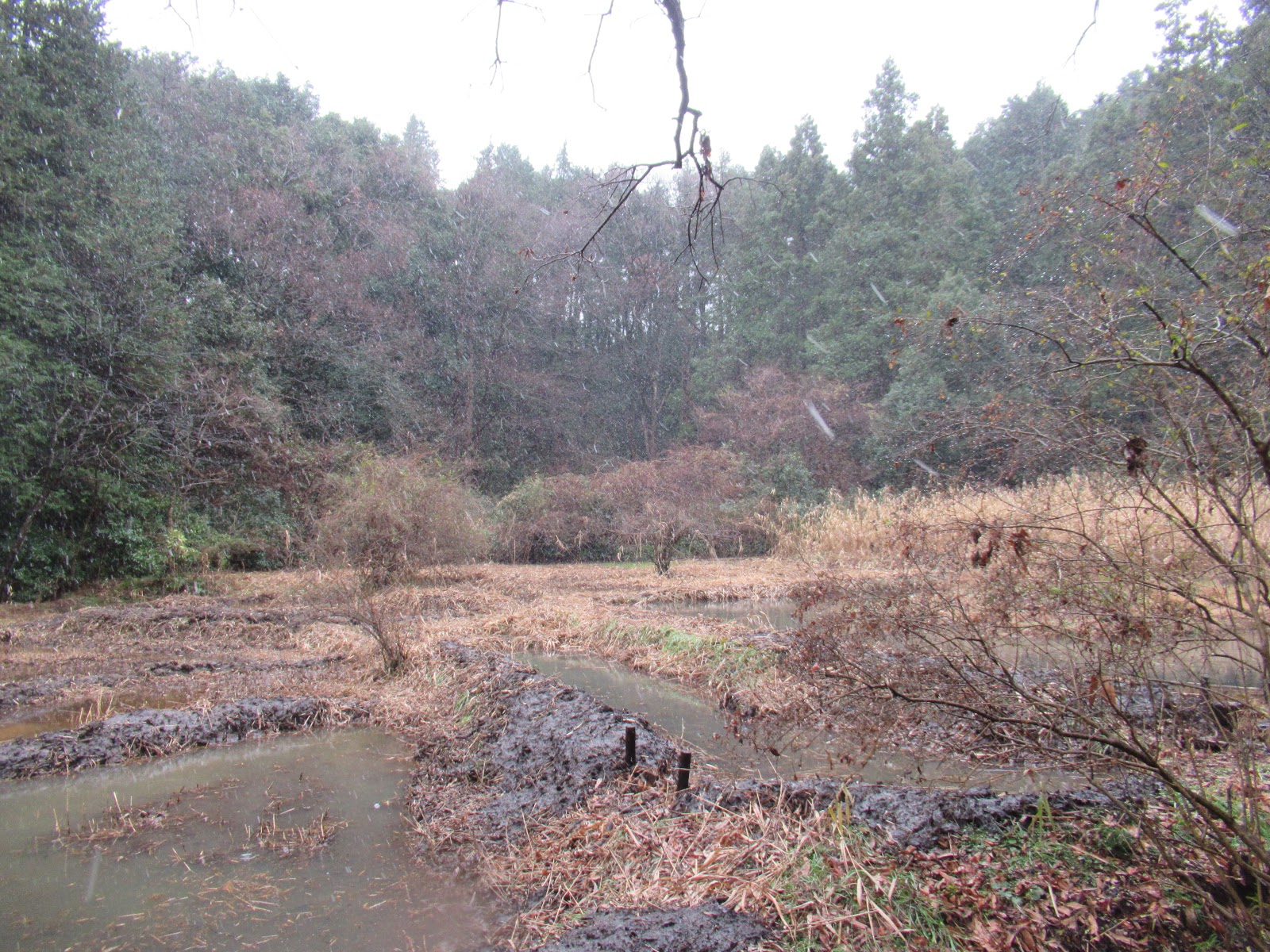
Last Saturday, it finally snowed in Niiharu Citizen Forest 新治市民の森. So far, this is a very odd winter … Statistically speaking, Niiharu is the coolest (for summer) or the coldest (for winter) in the City of Yokohama. But this winter the Forest had had only sleet, not snow. Moreover, the snow last Saturday was not enough to cover the ground white even for few minutes. It’s too mild, and very wet, winter. Strange, strange, strange …


There are murmurs saying in coming spring, and summer, there will be outbreaks of insects in the forests of Kanagawa. If the place could not become cold enough during winter, too many eggs and overwintering critters will survive. They surely start their battle for food when it becomes warmer. Will birches of Tanzawa 丹沢 endure the attack of Fagineura crenativora? What happens with those affected areas of Japanese oak wilt, such as in Hakone 箱根, Miura Peninsula 三浦半島, or beyond? (My post on August 23, 2019) Not only that. Lots of insects mean numerous chics to be adult birds. Many ordinary birds mean many raptors. If we unusually often meet birds of pray flying over the forests in Tanzawa, it could indicate overpopulated birds in the forest. Normally, watching them circling calmly over the ridge is very soothing. But, this year, it could suggest different, or even cynical, things in the forest. Sad. Further more, few snow in Tanzawa means many bambis will survive over the winter. In few months, they become mass of voracious adult deer denuding the vegetation of the mountains. For our forests in Kanagawa, the nature may not be capable of overcrowding insects, birds, hawks, deer … Will we frequently encounter the starved dead bodies of deer in Tanzawa Mountains again (my posts on 7, 14, 21 July 2017) this summer?


Yet, at this moment, we are having a bit of strange population of birds for Niiharu. I tell you next week what we have found this winter for birds’ life in our beloved Niiharu Citizen Forest. Warm, wet, with scars of super typhoons for Niiharu …


If you find environmental issues in Kanagawa Prefecture, please make a contact with Kanagawa Natural Environment Conservation Center 神奈川県自然環境保全センター

657 Nanasawa, Atsugi City, 243-0121
〒243-0121 厚木市七沢657
Phone: 046-248-0323

You can send an enquiry to them by clicking the bottom line of their homepage at http://www.pref.kanagawa.jp/div/1644/