Sunday, June 23, 2024

Wild Grass … er, OK: Lu Xun, 2024 Yokohama Triennale, and ...


Shiga Leiko, “Dialogue in the Fog: Fire
 – What Nozomi Onodera, a hunter, told me
 in the mountains of the Oshika Peninsula
in Miyagi Prefecture”

When I heard “Wild Grass: our lives” is the main theme for 2024 Yokohama Triennale (March 15 - June 9, 2024), once in 3 years contemporary international art show in Yokohama, my heart felt a joy. Hurrah! Finally, mainstream art world decided to talk with the Nature! I quickly realized that I misunderstood completely the intention of the two Chinese art directors for the show, Liu Ding and Carol Yinghua Lu.


Sandra Mujinga, “Unearthed Leaves”


Their “Wild Grass” is from “Wild Grass” by Lu Xun, the 20th Century Chinese Literary Giant. The work was written during 1925-26. Lu studied medicine in Tohoku University in Sendai, while ruminated colonialism, political tumults, economic and social upheavals for his homeland China in his entire life. Inevitably perhaps, his “Wild Grass” is not for vegetation, but as a metaphor of human world. I think his idea about “Wild Grass” is the most directly expressed in “Forward” written by himself in 1927 for the book “Wild Grass” after he completed the 23 chapters of the work.

Wild grass strikes no deep roots, has no beautiful flowers and leaves, yet it imbibes dew, water and the blood, and flesh of the dead, although all try to rob it of life. As long as it lives it is trampled upon and mown down, until it dies and decays.

Tomiyama Taeko, “My Liberation”

Ahem. May I? Scientifically speaking in 2024,

“Wild grass strikes no deep roots”  FALSE,

“has no beautiful flowers and leaves”  FALSE, but it could be depending on the taste of the viewer, 

“dew, water and the blood, and flesh of the dead, although all try to rob it of life”  ecologically FALSE. All natural elements is interconnected for circular economy. So, nothing is simply to “rob” but simultaneously everyone must give … Maybe, some orchids have success in this regard (my post on August 12, 2022), but it is the most contentious and cutting-edge issue in botany these days.

Özgür Kar, “Fallen Tree”

“As long as it lives it is trampled upon and mown down, until it dies and decays.”  FALSE. Yeah, we Lovers of Niiharu mow, mow, and mow “wild grass” in our Niiharu Citizen Forest for more than 20 years. But no place has succeeded in eradicating “Wild Grass.” I really want to ask Lu “How are you doing it in China?” If it is so easy to do that, there cannot be problems of destructive spread of bamboo in Yokohama’s Satoyama environment!

Joar Nango, “Ávnnastit/Harvesting Material Soul”

Raffaella Crispino, “Nous”

Real Wild Grass in Niiharu Citizen Forest

… Yeah, mine’s very infertile argument. Lu’s idea for wild grass is more of the world of human of his century and beyond. The 1930s candidate for Nobel Laureate for Literature picked up familiar vegetation of his daily life to express his art, based on the scientific knowledge of his age. Fine. Then in 2024, an art show of the title “Wild Grass” was held based on the notion of “Wild Grass” 100 years ago, it could cause misunderstanding, I guess. The majority of the works in the show was about class struggle, inequality, unfairness, war, … I don’t say they are insignificant. The video collaging verbal expression of sounds by Ukrainian refugees based on their experiences of explosion of bombs. Wow. It is so eloquent to let us think about what war is. The protagonists in the film would be the perfect fit for Lu’s “As long as it lives it is trampled upon and mown down, until it dies and decays.” But, yet.

Open Group (Yuriy Biley, Pavlo Kovach and Anton Varga),
curator: Waldemar Tatarczuk,
“Repeat after Me”

Salote Tawale, “We Are Better Together”

Taichi Yoshimura, “35°27’43”N 139°37’38”E”

Maybe, 2024 Yokohama Triennale was so-eloquent expression how these days people in world-wide downtown think about “Wild Grass.” Anger for world problems is really important for us to proceed for a better world. But summarizing the power of “Wild Grass” in human scale might cause catastrophe, I wonder. Wild Grass in Nature may not be something able to be minimized for the words of “Human Inequality” et al. Otherwise, why do we have the crisis of Boiling Planet? Don’t underestimate the power of non-humans in this universe, I argue.

Pyae Phyo Thant Nyo, “A Story of Our Lives”

which is decorated by these wings of Jewel Beetles.

Unintended art

If you find a problem in the greenery of north-half of Yokohama, please make a contact with

Office for the Park Greeneries in the North
北部公園緑地事務所
Yokohama Municipal Government Creative Environment Policy Bureau
横浜市環境創造局
Phone: 045-311-2016 
FAX: 045-316-8420


Sunday, June 16, 2024

Hydrangea


Hydrangea macrophylla is Japanese endemic species. The original species is lacecap hydrangea we can easily find in Kanagawa’s coast area. There are several theories how the Japanese lacecap flower was introduced to European Court Society. Though, the established story is it was during the 17th century. From the Society the flower spread world-wide and received numerous selective breeding. Now the garden variety would have more than 2000 kinds and decorating our garden.

Lacecap hydrangea is casually decorating
a strolling path in Hayama Town.

In more mountainous area of Kanagawa, we have also the other kinds of wild hydrangea, like

Hydrangea involucrata Siebold, in Tanzawa.
Hydrangea serrata, aka Tea of Heaven, in Hakone.
Hydrangea hirta, in Hakone.

They are also very attractive. Japan has seasonal rainy season between spring and summer. During these wet days, hydrangea is THE flower occupying the center stage of our psyche. In suburbs Yokohama, we can find many varieties here and there in our neighborhood gardens. Like


Recently, one of my friends told me hydrangea had scent. Really? At least ubiquitous hydrangea in my neighborhood does not assert itself in this way, unlike morning roses. I tried to find a scent of hydrangea. The flashy “flower” part of hydrangea is sterile sepals. The fertile part is in the middle surrounded by sepals. Thinking the role of flowers for seeds, and the scent is to attract pollinators to carry pollens to pistils, I surmise the fragrance of hydrangea would be from the center part. I stick my nose into the center of the above flowers, and … could not smell it. I continued my smelling adventure, and finally found delicate aroma from this.


It’s strange. This hydrangea has almost sepals only, i.e. it is a heavily modified variety. Having an attractive smell for sterile parts does not make sense, don’t you think? I guess its faint scent is the result of human intervention … it’s a successful breeding for sure. Later I noticed its smell is the aroma we are surrounded by in a park when it is raining for a June day. A-ha. It’s a calming smell. Quiet park, rain, and slight scent wafting unconsciously into our psych …


Lacecap hydrangea can actually be found in relatively mild climate area of Japanese archipelago, like Kanagawa’s coastal area. Familiar sighting of the flower in our backyard forests might be our local specialty. True, hydrangea is not rose or jasmine. Still, it could be flower of subtle scent in June for Yokohama’s Machado-moment.

The wind, one brilliant day, called 
to my soul with an odor of jasmine.


'In return for the odor of my jasmine, 
I'd like all the odor of your roses.'


'I have no roses; all the flowers 
in my garden are dead.'


'Well then, I'll take the withered petals 
and the yellow leaves and the waters of the fountain.'


the wind left. And I wept. And I said to myself:


'What have you done with the garden that was entrusted to you?'


If you find environmental issues in Kanagawa Prefecture, please make a contact with Kanagawa Natural Environment Conservation Center 神奈川県自然環境保全センター

657 Nanasawa, Atsugi City, 243-0121
〒243-0121 厚木市七沢657
Phone: 046-248-0323

You can send an enquiry to them by clicking the bottom line of their homepage at http://www.pref.kanagawa.jp/div/1644/

Sunday, June 9, 2024

Counting greens: Forest meditation


Japanese language, especially ancient ones, has lots of words to express “green.” It’s fun observing forest and thinking which classic Japanese word would apply for a part of the scene. For example, let’s play with this young Arisaema limbatum.


It already shows the characteristics of vertical stripe in its spatha. I would say, the green part of spatha is in Mist Green, or Ura-yanagi 裏柳 from the 18th century Japanese. Its leaves are mainly in Willow, or Yanagi-zome 柳染 whose expression might have the ancestral notion of the 10th century. The veins of the leaves are in Apple Green, or Usu-moegi 淡萌黄 whose illustration can be found in the Tale of Genji of the 11th century. We’ve already counted 3 different greens, haven’t we? (I’m using this book for identifying the color names. It’s a good reference book, small enough to carry during hiking, and has English translation for each color.) Please try how many greens you could find in the next photo.


Simply sitting in a forest and counting the number of different hues of colors is very meditative. During COVID recovery I tried it for about 2 hours in one spot of a forest, and found myself really relaxed and calm. Actually it’s a method for feeling Oneness at the beginning of Forest Therapy. If you’re tired and interested in meditation, please try. Just watch a forest and play with the greens. It’s fun.


If you find environmental issues in Kanagawa Prefecture, please make a contact with Kanagawa Natural Environment Conservation Center 神奈川県自然環境保全センター

657 Nanasawa, Atsugi City, 243-0121
〒243-0121 厚木市七沢657
Phone: 046-248-0323 

You can send an enquiry to them by clicking the bottom line of their homepage at http://www.pref.kanagawa.jp/div/1644/


Monday, June 3, 2024

After Crashes: beautiful rocks found in the stream of Tanzawa Mountains 2


So, the base of Tanzawa Mountains has the ancient volcanic origin. “Volcanic” can be ashes, lapilli, or lava itself. The rocks that become rocks straight from lava are magmatic/igneous rock. In the riverbed of streams in Tanzawa, we can find several igneous kinds. Roughly speaking we can categorize such volcanic rocks into two families. One is extrusive rocks. They were rapidly cooled lava when it came out of the earth’s crust. In our neighborhood the familiar extrusive ones are andesite and basalt. Andesite contains more silicic acid than basalt. Andesite is often created on the edge of tectonic crash. Actually, andesite is the major component of earth’s continent, so it could be a familiar rock for some of you reading this post somewhere away from the sea. It can be found easily in riverbeds of Tanzawa too. Here is one of my collections.

Andesite
The microscopic view of the above pebble.
The white mineral is zeolite
penetrated in the lava’s holes
at the time of formation and crystalized later.

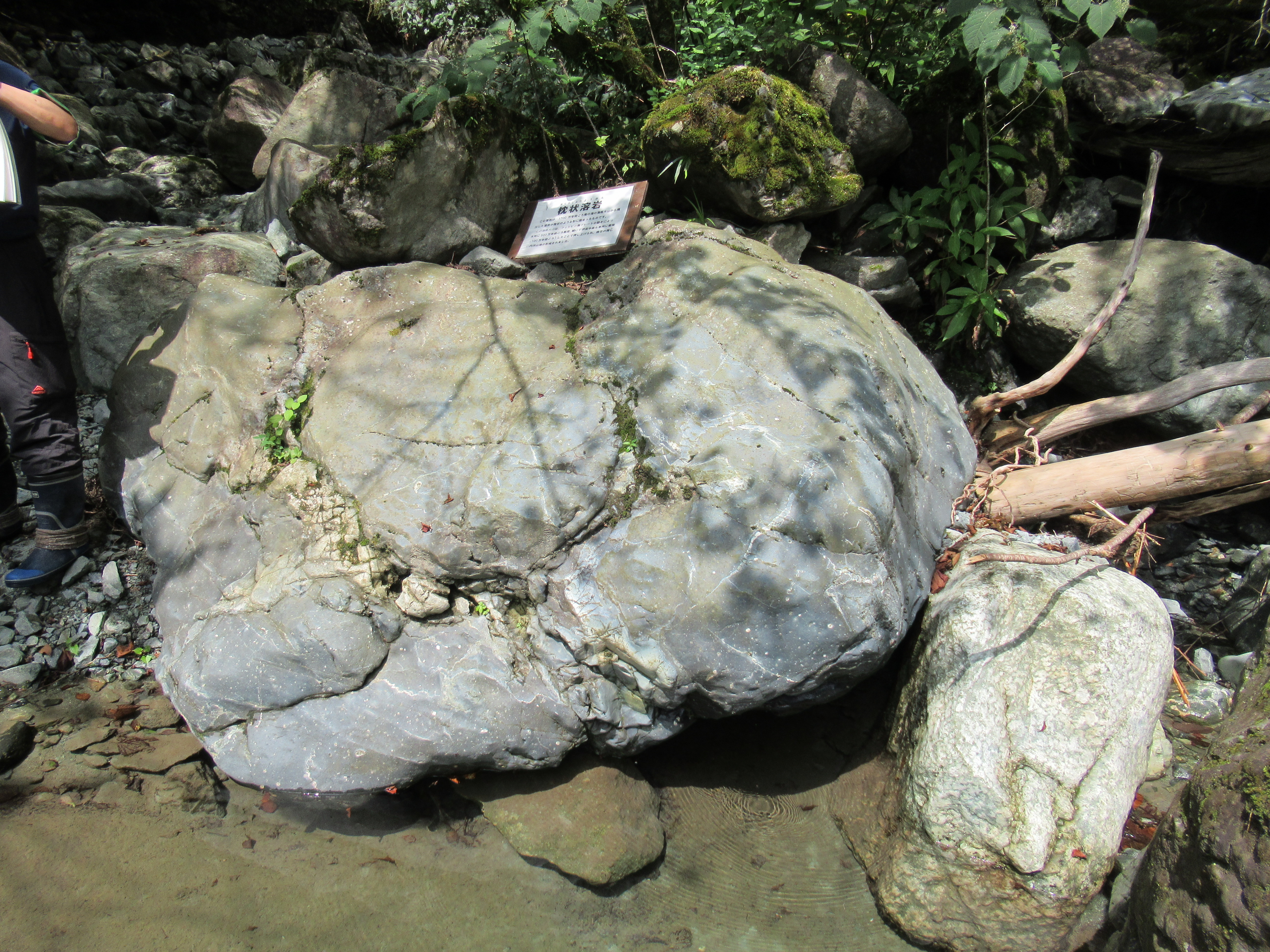
In contrast, basalt is made of smoother lava with less silica. The amount of silicic acid changes the way lava flows at the time of eruption. The less silicic, the smoother the movement of lava. It affects the way a volcano erupts. In general, the less silicic, the calmer an explosion is. At the time of burst basalt lava can be splashed over and flow rapidly that creates a volcano of gentler slope. Come to think of it, such a volcano is situated very near to Tanzawa, i.e. Oshima Island floating at the mouth of Sagami Bay. Mt. Fuji, famous for its basalt, has the origin of volcanic activity from 7 hundred thousand years ago. Compared to this, the crash of tectonic plates for Tanzawa is far older. For Tanzawa the estimated tectonic undersea eruptions began about 1.5 to 1.7 million years ago. The age of basalt we find in and around the streams of Tanzawa Mountains are definitely older than for Mt. Fuji. There is another difference between these two neighbourhood mountains. Mt. Fuji stands always on land since its birth. Tanzawa was once under sea. At the time of undersea eruption, the lava enters the mass of water directly from the crust. The surface of the lava is cooled immediately. When its texture is fluent, the instant check of water creates flow of lava like whipped cream squeezed from piping. Such lava can be solidified in a form similar to pillows, and so it is called Pillow Lava. When we walk along streams in Tanzawa Mountains, we sometimes find a pillow-like boulder. That’s a Pillow Lava containing ancient memories of the earth. It has smooth surfaces. Please touch them calmly, close your eyes, and feel the essence of the planet …

Oshima Island seen from the top of Mt. Ogusu 大楠山, ASL 241.1m (; my posts on 1, 16, 24 of April).
Could you see a wispy shadow in the middle of the ocean?
That’s Mt. Mihara, ASL 758m, famous for its very gentle ridge line.


Pillow Lava in Yadoriki Stream.

When lava is cooled slowly, it is called plutonic or intrusive rock. The creation of intrusive rock is easier to understand when we talk the origin of Tanzawa Mountains. Tanzawa is by the crash of tectonic plates, right? Philippines Sea Plate is crawling under the Eurasian and the North American Plates. Imagine the pressure inside the planet there. By the force, the lava stayed deep down is pushed up through the crack of crust near the surface, like toothpaste squeezed out of tube. It does not necessarily end up with volcanic eruption, but sometimes stays underground for a very very long time. The humongous compression continues affecting such mass of lava but in the environment of lower heat temperature, I mean, compared with that for the core of the planet. The wedged lava slowly becomes rocks. This is basically the way diamonds are created. This kind of phenomenon often occurs at the edge of tectonic collision and creates large underground geology, called metamorphic rock. Tanzawa is not an exception. About 5 to 4 million years ago, pools, or rather lakes of lava were created underground, cooled slowly, and formed metamorphic rocks. The rocks made of this process were continuously pushed up from the deep down and eventually reached the surface. The rock is ginormous. Do you remember we visited Mt. Yagura 矢倉岳, ASL 870m, located at the edge of Hakone Mountains (; my post on August 4, 2017)? When we watch the mountain from the bank of Sakawa River 酒匂川 near Odakyu Shin-Matsuda Station, don’t you think it has a particular shape, like a bump on earth? It is indeed a hump 100% made of one metamorphic rock pushed up by the pressure of tectonic crash.

Mt. Yagura is here.

The base rock of Mt. Yagura is called quartz diorite, or tonalite. In 2016, Kanagawa Prefecture designated the rock as the official rock of the Prefecture. As it has such a celebrated status, it is not so difficult to find one in the streams of Tanzawa Mountains. Here is my collection.

Tonalite. White part is plagioclase,
and black dots are amphibole and the others.

Microscopic view of the pebble.

Casually quartz diorite shows its huge face
in a riverbed of Tanzawa’s stream.
This one had
a span of at least 1m.

Not all intrusive rocks are tonalite in Tanzawa. The sedimentary rocks of vocanic ashes and lapilli do not necessarily come soon to the cooler surface of the planet after they became rock. It stayed for a while near magma, and baked for a harder rock called hornfelse. The mass of hornfelse can be found along the western ridge of Mt. Nabewari, ASL 1272.4m. Inevitably, when it crumbles, it tumbling down Yadoriki Stream, and we can find hornfelse there. It is a hard rock, and broken into peaces as if it produces sharp knives. I‘ve heard the rock was an important tool for the European Stone Age. I guess that would be the same for Japan.

There is a hornfelse in this photo.

In this blog, I several times told you Tanzawa Mountains have very fragile geology, and the forests stand on a very thin soil covering the scree beneath. By studying the tectonic origin of the area, I realized it‘s no wonder the place has such feature. Tanzawa can never have rich soil as Mississippi, but the place has its own charm, including beautiful rocks witnessing the tectonic crashes from long ago. When you hike there next time, please enjoy the scenery of rocks and boulders in Tanzawa. It tells the life of the planet earth.


If you find environmental issues in Kanagawa Prefecture, please make a contact with Kanagawa Natural Environment Conservation Center 神奈川県自然環境保全センター

657 Nanasawa, Atsugi City, 243-0121
〒243-0121 厚木市七沢657
Phone: 046-248-0323

You can send an enquiry to them by clicking the bottom line of their homepage at http://www.pref.kanagawa.jp/div/1644/

Monday, May 27, 2024

After Crashes: beautiful rocks found in the stream of Tanzawa Mountains 1


Very large Pyroclastic breccia in front of us,
found in Yadoriki Stream. More to it below.

So, thanks to the birth secrets (; my post last week), what we find beneath Tanzawa Mountains is of volcanic origin, more or less. In my post for July 19, 2019, I told you my adventure with the soil in Tanzawa. Beneath the very thin topsoil, there was 40 cm or so volcanic scoria ashes due to Fuji 1707 tephra. In Tanzawa, typical soil for Kanto region is covered by the thing came from Mt. Fuji in the 18th century. Then, deeper down from that, we can encounter the proof of tectonic crashes since 13 million years ago. How can I see such an ancient mega drama? We don‘t have to dig deep down the mountain. The thing we do is simply do picnic on the valleys of Tanzawa Mountains. There are several good valleys we can visit safely especially for escaping summer heat.

Very thin topsoil of Tanzawa area

You just hike Tanzawa Mountains and cross small mountainous valleys. The rocks and riverbeds there are the basic structure of Tanzawa that made by tectonic collides millions of years ago. The topsoil once covered such ancient earth is washed away by the stream. Often, they are tuff created by volcanic ashes and rocks spewed out by primeval under-oceanic volcanos, and piled up in the bottom of antediluvian ocean. It went through humongous pressure machine of tectonic movements which in the end pushed up the volcanic sediment above the sea level.

It’s near Nishi-Tanzawa Visitor Centre.
Lots of rocks, yeah.

Have you noticed the riverbed often have green colour? It‘s green tuff, made by East Pacific Rim Orogeny from 26 to 5 million years ago. For the other kinds of tuffs, we know Tanzawa has fine tuff, coarse tuff, pyroclastic breccia, tuff breccia, lapilli tuff … Yadoriki stream which run through Yadoriki Water Source Forest is an easy place to find these rocks. Below is from my collection found in the riverbed of Yadoriki Stream.

Green tuff

It’s also green tuff with white stripes.

Seeing it through the microscope,
I think it shows piles of ashes.

Coarse tuff

A microscopic photo of the above rock.
It’s a rock which relatively coarse volcanic ashes,
roughly 1/16 to 2mm in diameter,
piled up at the bottom of the sea,
then went through the tectonic pressure machine.

Lapilli tuff

With microscope,
we can see it is made of 2-64mm lapilli
 with volcanic ashes.

Tuff breccia

Now the size of the lapilli is larger than for lapilli tuff,
but the lapilli is less than 50% of the entire rock.

Pyroclastic breccia

Unlike the previous rock,
now the lapilli occupy more than 50 % of the rock.

These palm-sized rocks are probably from large ones that were cracked by landslides and continuous rapid torrent over steep slopes. When we climb upstream for water sources of mountainous valleys in Tanzawa, we can find huge rocks piling up and the amount of water flowing between boulders is smaller. One evidence that sustains the hypothesis can be found at the plunge pool of Takigo Fall 滝郷の滝, in front of the open space with picnic benches of Yadoriki Forest. The height of the fall is about 30m with average width of 2m. We can approach to the shore of the pool and observe rocky layers of earth. With large lapilli inside, we can recognize pyroclastic breccia. This waterfall is famous for its very fragile walls which killed so many climbers trying to rock-climbing. Either using aids of ropes et al or bouldering, the fragile breccia easily collapses by the weight of a climber. If a person falls down 30m on a rock, it would be an instant death. Such crumbly stone can simply become a small souvenir-sized rocks, right? In the end the rocks here are sedimentary.

The upstream of Yadoriki Stream.
The place is famous for its large boulders covering the riverbed.

The plunge pool of Takigo Fall

The riverbeds of Yadoriki Water System can keep having small rocks even around 1000m ASL. Do you remember my adventure to Ameyama Pass 雨山峠 to Yushin Valley ユーシン渓谷 in 2019? Ameyama Pass is at ASL 957m. From the Yadoriki main stream to the Pass, the entire itinerary is on the rocks and scree. Come to think of it, they were once volcanic ashes and lapilli that went through gigantic pressure of crusts and became a mass. Since then, they continue receiving the same pressure to be pushed up to ASL 1000m and beyond. No wonder they become crumbly … Having said that, the rocks we find in Tanzawa mountains are not sedimentary alone. I’ll tell you the other kind next week. They are also very beautiful. 😄

We’re reaching to the Ameyama Pass …
and the route is still like this.

Oh, by the way,
the riverbed in front of the Open Space near Yadoriki Bridge
 (that red one) is not natural one,
 but goes through riparian works many times.
 Reason?
 Frequent monster typhoons cause landslides often
 along Yadoriki Stream,
and block the water flow
that could trigger debris flow to the communities downstream.
 The prefectural office does continuous construction there,
 but Mother Nature always wins.

If you find environmental issues in Kanagawa Prefecture, please make a contact with Kanagawa Natural Environment Conservation Center 神奈川県自然環境保全センター

657 Nanasawa, Atsugi City, 243-0121
〒243-0121 厚木市七沢657
Phone: 046-248-0323

You can send an enquiry to them by clicking the bottom line of their homepage at http://www.pref.kanagawa.jp/div/1644/