Friday, July 8, 2016

Ferocious Rain Forest, even it is temperate: thinning (BMI) ctd.


You may remember it. Niiharu Lovers thinned chamaecyparis obtusa and pisifera last March, near Zone C. Carrying out the logs continues as of July 2. Well, granted, we are doing it by hands with minimum intervention of machine. However! more than 4 months to complete the job testifies this thinning is really a large project. After joining the troop for this task, I became more aware of the forest maintenance news, and learned thinning is becoming a huge problem in Japanese forests everywhere.


Late June in Niiharu

First, I apologize for the wrong information I posted at the very beginning of this blog. The reason why every spring we suffer hay fever with chamaecyparis obtuse and cryptomeria japonica was not due to a stupid decree of Japanese Imperial HDQ during World War II. It was because of economic force in the post-war reconstruction. Thanks to very diligent carpet bombings by the US B-29s, all the houses in any cities of Japan were burnt down by 15 August 1945. When the war was ended, the first thing people thought was food and shelter. There came a huge demand for housing materials. Unfortunately, Imperial HDQ drafted every possible resource in the archipelago, including woods in the forests. E.g. there was a very famous beautiful pine-tree in Nokendo of RokkokuToge Hiking Trail. The tree was often the subject of haiku, paintings, etc. for hundreds of years. Then, during the last war, the HDQ ordered to cut it in order to extract pine oil for fuels of fighter airplanes, a kind of renewable biomass energy for war. Old 200 pine trees were thought to produce fuel for a Zero to fly 1 hour that was enough for a Kamikaze suicide attack. Our great-granpas were desperate but not that fool. The idea was scrapped, but the deforestation was done anyway. So, when people needed roof over heads at the time General Douglas MacArthur came, there were not enough woods in the mountain. Those landlords who still had some did a wonderful business in the housing market, and owners of deforested spaces planted chamaecyparis and cryptomeria massively hoping for striking big as their neighbors did. It was about 70 years ago, and now is the time to harvest them.


Satoyama scenery in Niiharu.
The middle is an artificial forest of huge
chamaecyparis obtuse.

Unfortunately, in the 21st century Japanese timbers cannot compete with cheap imports from the US and Canada. (The latest stats can be found here.) Moreover, many landlords were elderly people who, like landlords of Niiharu as Mr. Asaba met in the late 1990s, have not taken care of the trees for decades due to labor shortage for forestry. It makes the trees not-good enough for the market. A good timber for Japanese hand-made house (I mean not 2-by-4 American style) is harvested from woods that have been taken care of for 50 years at least. When they are still 3-5 years old, the thinning and pruning must be started and continued annually until they became tall enough, say 30 m high. Otherwise growth in a crowded ground shall be stunted, as we can find in some area of Zone C of Niiharu. In addition, the tree-trunks will have gnarls and lots of branches that make the logs unsuitable for robust and straight enough pillars that can stand even with strong earthquakes. A standard MBA thinking says business under the high labor cost environment must offer high-quality products. Japanese forestry cannot provide the quality corresponding to the labor cost … and hence they are kept abandoned. From the 1990s, freak storms are attacking Japanese forests large and small. The abandoned trees were struck by thunders, bended / broken by violent winds, and washed away by spontaneous streams. The forests became a mess. Small earthquakes, of like magnitude 3-4 (er, they are small for Japanese, mate), easily caused landslides. It became serious problems, especially in cities where people live densely near the disaster sites. It was the time some people became spontaneously Yokohama forest volunteers. Those who were able to operate chainsaws entered the neighborhood forests and treated the dangerous situation without charge. And that’s why wielding chainsaws is a kind of “badge of honor” in Yokohama’s citizen forestry. Now, Niiharu Lovers Volunteers cut the over-grown Chamaecyparis obtusa and pisifera a lot in order for the veggie field of an abuelita landlord receiving enough sun-light. The trend continues. After the Great Tohoku Earthquake, some young people begin to re-think Japanese forestry as one of the 21st century’s sustainable economic activities that can maintain the forest resistant to landslides. (For new business in Okutama of Tokyo, an article is here. This is an example in trials in Tohoku. About self-harvesting housing in Shikoku, a newspaper article is here.) Niiharu Loveres also meet teenagers and parents of elementary school kids who come to see what we are doing in the forest. So, our on-going project with logs may be at the vanguard (wow, “Really!?”).


The tree with damaged core
does not have market value.
Volunteers pruned the branches at the time this tree was cut.
So, it has lots of marks and
the market value of this log is very low.
Volunteers who are “almost pro” of wood curving are grinning.
Such branches are practically “thin-version” of the trunk.
They accumulated the growth of the tree
in a more packed way than the body.
The texture becomes denser but suave,
which made them ideal for small wood sculptures.

When I saw the slope after the thinning last March, the place became really bare. I asked my seniors, “Will the ground recover? It is now exposed … The veggie field will have more sunshine, but the slope with only stamps could be dried up, couldn’t it?” They laughed and said “Well, you don’t know the forest here. You’ll see what happens very quickly.” They are damned right. By the end of June, the place, including the logs left on the top of the slope waiting for us to be carried out, is covered, really COVERED, with grass. Puerania montana, commelina communis, gynostemma pentaphyllum, lxeris japonica … ferocious. Some even have thorns. Their seeds, rhizomes, roots … were sleeping silently under the seemingly naked ground when the volunteers cut the trees. Once the sun shines merrily, and the monsoon season comes with abundant rain, they spring awake and grow savagely to out-compete the opponents for the better positioning of sunshine and water. Every weekend, the first thing we do to take out the logs is identifying the size of the logs under the cover of thick grass. We cut, pulled-out the part of the rhizome, and pushed them out from the logs. Then, the next week, the same thing we have to do: the “weeds” simply don’t care.

Hmmmmmm.
The seemingly green hill on the right is
actually a pile of branches we made last March.
It looked like this in April.
Baby hemp palm is sprouting!
I didn’t know there was a seed for trachycarpus fortunei
… or is it from birds’ droppings?
Well, OK. The scenery has a kind of charm.

The Lovers are loading the logs in a tiny truck to carry them out. The field next to the place has now good sunshine and the landlord grows beautiful eggplants. The abuelita will plant another veggie once the logs are taken out to Lovers’ work shed. But she has to wait. We stuff the truck by hands, as always. The volunteers resort to teamwork and put the logs one-by-one on the bed with ropes and fire hooks. Although after being left for a couple of month on the ground they are dried somewhat and must be lighter, they are still HEAVY. Lovers have two trucks both of which were donated by a supporter of Lovers in Tokyo. They are designed to carry less than 350 kg, whose limitation we are sure is violated in this project. Moreover, the truck does back and forth between the field and the shed at least 3 times in one volunteer activity morning. Some volunteers are worrying if the suspension of the truck can sustain under the pressure ... But it is impossible to take the huge logs out without a car, which is definitely cheaper than borrowing a horse in Yokohama.

The aubergines she planted look like bigger than
the standard Japanese eggplants in supermarkets …
Are they of different kind, or, a-hem, thanks to our labor?
Lumber yard, now. It will be veggie field later.
An “excavated” log is first roped,
and dragged to position at the loading site.
We hook the supporting logs on the bed of the truck …
and rope the log using a fire hook.
This log is ready to be pulled.
Though, constant vigilance is necessary to load a log.
This one could be stuck on the right so that
the person with a fire hook pulled it slightly to the left.
During the adjustment, the team must balance the log with ropes.
"Pull here, but relax there, one-two-three, now!”
The teamwork is essential.
I am also very impressed with smart usages of fire hooks.
The principle of leverage works everywhere without brute force.
Though, unless the operation is executed cleverly,
serious injuries could occur. Hmmmmmm.
How to load the logs is also important.
The route between the field and the working shed
goes through private farmlands,
narrow commuter roads within a residential zone,
and a steep slope.
Collapsing cargo is definitely No-No.
The proper rope works for safely laid logs are the Must.

The plan is, with the logs possible to be lumbered we are going to make picnic tables, benches and materials for trekking road maintenance at the work shed. Because of the long term neglect, not all the logs are suitable for processing so that those failed to pass the “inspection” of senior volunteers will become fire woods. Majority of the product will be used within Niiharu Citizen Forest, but, frankly, the amount of logs will exceed the capacity the Forest can utilize for hikers and kids at festivals. We fantasized to build beautiful log houses for our meeting places, new working sheds, bath-tubs made of fragrant hinoki cypress … “Who gonna pay for carpenters, then?” “Ha, ha, nobody.” Lovers are joking we will have enough life-time supplies of fire woods. So, any customers are welcome! At the moment, a lady from the downtown has reserved a picnic table that will be used for BBQ parties at her place. Fire woods can be also on sale. They are definitely cheaper than you can find in internet; the price, and design, is negotiable. Your purchase will support our volunteer activities in Niiharu! Er … we do not have delivery service, though. You have to come to Niiharu and carry them by yourself. If any of you want to have them, please call Mr. Okawa, at 045-934-9898 (Japanese only), or come to see us during our weekend activity morning. Activity calendar for FY 2016 is downloadable from here. We meet at Ikebuchi Hiroba (A-4) at 9:00 of activity morning. … By the way, if you want to have a product from those logs, you have to wait till next spring (at least in principle). Reason? For a good Japanese lumber, the cut logs are left to stand to be dried before processing. My mother’s side is in the west of Japanese archipelago, and there people wait for at least 3 years after cutting to use the trees for anything. My senior at Niiharu told me this part of Japan is much wetter so that we cannot leave the logs that long. “They will be molded and become unusable.” The standard of lumbering in Yokohama is one year of waiting so that the trees cut in last March will be processed coming spring. Forest takes its time. ;)

The logs are left to stand for one year
in front of the working shed of Lovers of Niiharu.
They can be a nice log house, honestly …

If you find a problem in the Niiharu Forest, please make a contact with

Office for the Park Greeneries in the North 北部公園緑地事務所
Yokohama Municipal Government Creative Environment Policy Bureau 横浜市環境創造局
Phone: 045-311-2016 (I guess in Japanese only)
FAX: 045-316-8420 (I hope there is somebody who can read English …)

Niiharu Administrative Office / Satoyama Exchange Center 新治管理事務所・里山交流センター
Phone: 045-931-4947
Fax: 045-937-0898
http://www.niiharu.jp/


Friday, July 1, 2016

The grass is always greener … but surely it has utility: about chameleon plant lotion


For ages, I patronized Lavender Water of Neal’s Yard Remedies for skin moisturizer. My skin has a slight symptom of atopic dermatitis, and their product worked superb. Decades ago, the product was difficult to find in Tokyo. Actually, there was only one place where we could find it (a-hem, in Roppongi Wave, a legendary – for some – shopping venue during pre-bubble Tokyo), and I commuted the shop only for the Lavender Water. Then, I read an essay by Banana Yoshimoto who also had a similar tendency for her skin as mine, discovered the Lavender Water almost at the same time as I did, and praised the thing with zeal. I was like, “You see, you see, you see!!!?” … Japan has spent more than “lost 2 decades” since then. Neal’s Yard expanded their Japanese business to become nothing-special shop in our nearby shopping centers. One day a couple of years ago, I saw shocking news in their storefront. Neal’s Yard decided to discontinue the Lavender Water. I was, honestly, panicked. Whaaaaaaat!? I visited 4 Neal’s Yard shops in Tokyo and Yokohama to collect the last inventory of Lavender Water. My inventory has gone about half a year ago ... and I decided to be pro-active this year. Let me try traditional Japanese herbal remedy with chameleon plant. Actually, chameleon plant lotion has enthusiastic followers as you can find in Amazon entry here. It costs about 2000 yen per 200cc. My approach would be more cost effective.


芭蕉Natsu-kusa ya/tsuwamono-domo ga/yume no ato
(Mounds of summer grass
- the place where noble soldiers one time dreamed a dream).

Chameleon Plant どくだみ, aka Houttuynia cordata, is ubiquitous in Japan. Especially in June and July, they bear white orangy scented flowers that make us realize the arrival of rainy season. If you google chameleon plant, you may find “Don’t plant them! They are really invasive.” Oh yeah. Unless you live in upstairs of a high-rise apartment, a shady part of your garden or forest in Japan will have chameleon plants aplenty even for a tiny space. They are damned strong and vigorous. They spread by rhizome hard to eradicate. The upshot is, they have been used widely in Asia for herbal remedies. This US-NIH site says the plant really has useful phytochemistry that renders numerous medicinal benefits, including anti-cancer effects. The most convenient usage of chameleon plant in forests of Yokohama comes when we have cut or abrasion. We look around for the leaves of houttuynia cordata, harvest few of them, rub them between the fingers, and apply it to the wound. According to the NIH site, the plant has anti-inflammatory, anti-viral, and anti-bacterial effects, so that our traditional treatment in forests are in the end scientific. If it is so, it shall be effective for my sensitive skin! This is my theory.

For them, no problem with a tiny space ...

There are two methods to make chameleon plant lotion: with alcohol or without alcohol. For me, with alcohol is a kind of no-no. So, in this post, I report you my adventure for chameleon plant lotion without alcohol, found here. Though, using alcohol is certainly easier. FYI, you collect leaves, wash them, dry them with towel for sure (otherwise the leaves become moldy), and preserve them in white liquor (35°+, 180cc for 100g of leaves) for about 6 months to 1 year, just like home-made fruit liquor. When the color of the liquid becomes amber, it is ready for skin lotion. ½ tsp. of vegetable oil of whatever (olive, grape seed, etc.) is mixed with 200cc of the plant extract for skin care. The leaves after the extraction can be stored in refrig to be used for bath-additive. With or without alcohol, the first thing we have to do is collecting leaves. Actually, it is not difficult in any forests of Yokohama; we can find tons, probably literally, of them from late May till September. Many recommend not to pick the plants on roadside as they are covered with car exhaust that is hard to be washed off. Harvesting time may be also important. Some say when they are in full-bloom before the leaves turns red, the effective chemistry is the strongest. So, early June this year, I visited a nearby forest in Yokohama, and harvested about 120 stems of chameleon plant. If you think I overharvested, we are sure you have never known chameleon plant. Collecting them too much is really difficult for an individual to do. Oh, yes.

Lots of lots of lots of chameleon plant!
They are also everywhere along trekking roads in forests.

To make houttuynia cordata lotion without alcohol, we make infusion of the plant. The standard method is making chameleon plant “tea leaves,” i.e. drying them. I collected the plant, discarded the flowers and those damaged or insects-eaten leaves, washed them well, and hung the bundle from a well-ventilated ceiling without direct sun light. In Yokohama, after 1 week or so, they were nicely desiccated – keeping their green somewhat, but certainly rustling. I cut them in approx. 3cm pieces by scissors. Now chameleon plant “tea leaves” were ready. In traditional Chinese medicine, the drink is laxatives and diuretics, to be taken 3 times a day. I don’t think it is not a cordial drink, but really a medicinal potion to be prescribed with caution. Besides it’s not tasty, they say. It is a popular “medicine” for weight control. NIH site says it was effective in mice with high-fat-diet-induced obesity. Well, try it, if you dare.

Chameleon plants are being dried. It’s their 2nd day.
Dried chameleon plants. They are not brown, you see?
Both stems and leaves were cut by scissors.
In total, they weighed about 50g.
To store, we can use Ziploc with moisture absorbents.

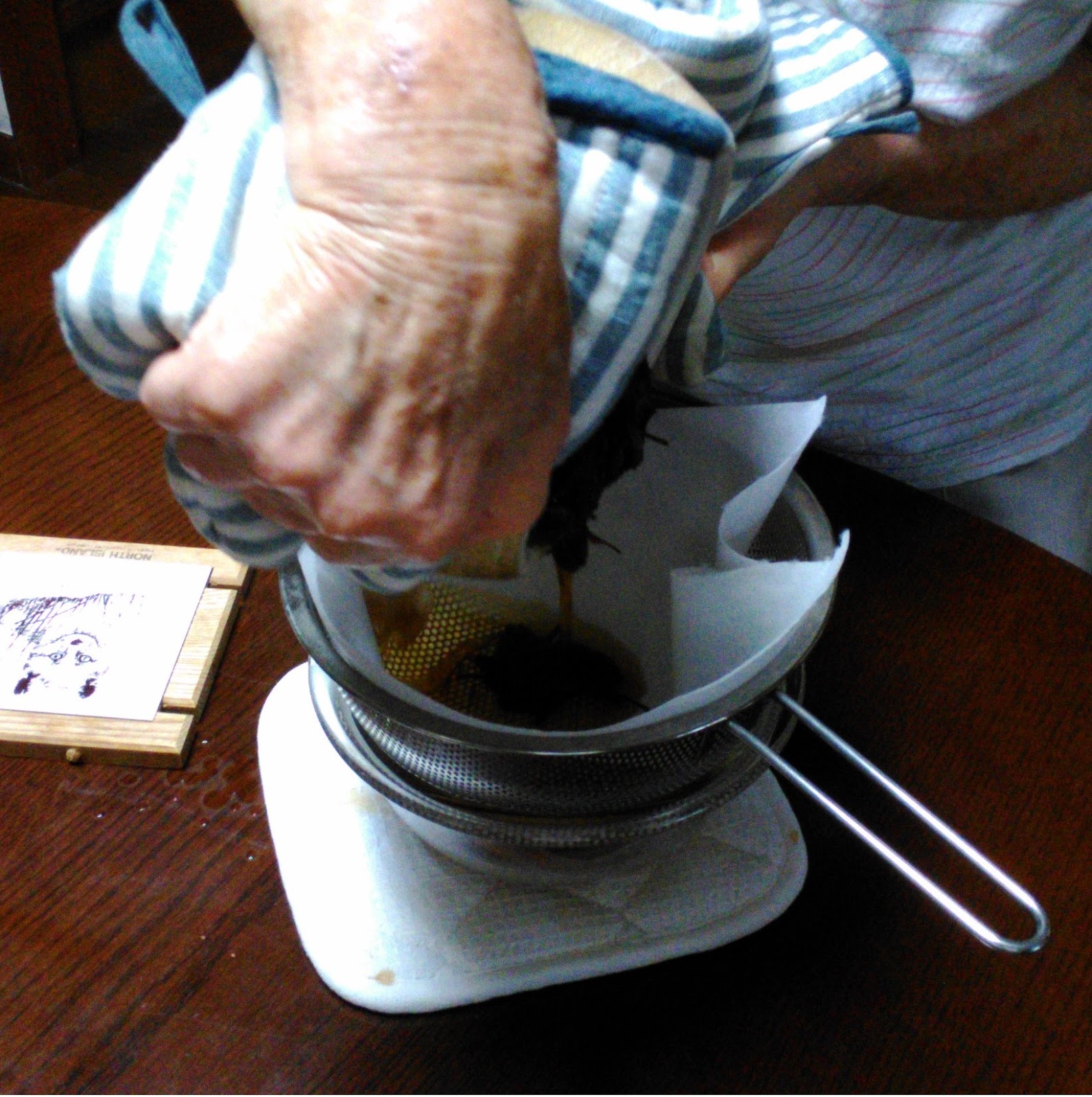
To drink it, or to make skin lotion, we have to use non-metallic pot without boiling the water. Especially when the pot contains iron and / or copper, they react with the chemical component of chameleon plant, which changes the structure of them, i.e. make the potion useless. I used an earthen pot to cook rice. The plant also contains useful chemicals that can be destroyed by intense heat. So, we have to put the pot on low heat to keep the liquid 60° - 70° C for about 30 min to 1 hr. The recipe says with 30g of “tea leaves” we add 500cc of water and wait for approx. 1 hour until the contents becomes half, i.e. 250cc or so. The liquid should be strained immediately in order to prevent the leaves from absorbing back the effective components. The hot potion can be drunk as medicine. For skin lotion, after it is cooled we have to add the same amount or more of glycerine in Pharmacopoeia for long-term preservation. … Well, yeah, glycerine is OH-, just like liquors, but at least my skin does not react with proper amount of glycerine. So, that’s that.

This time
I used 25g of dried chameleon plant leaves
with 400cc water.
This is how glycerine
in Japanese Pharmacopoeia
looks like.
My pot.
Our family memory told us our great-grandma did not use lid
when she infused h
outtuynia cordata.
So, the lid was not used.
25g leaves with 400cc water looked like this.
Heating with very low fire.
It soon started to bubble.
Keeping 60
° - 70° C was tricky.
30 min. later.
The liquid had more than 80
° C. Woops.
The kitchen was filled with very “clinical” aroma.
1 hour later.
I thought the liquid was reduced to the half.
The content was strained immediately.
Thank you mom!
The product. The liquid is drinkable.
We can put the used leaves in a sachet
and throw it in a hot / cold bath.
They say it is effective for heat rash and sun burn.
It might be handy this summer, so it went to our refrig.
Oh, by the way,
liquid of infused chameleon plants stain cloth,
which is difficult to remove.
Unless you plan to dye your white shirt earthy brown,
be careful.
Cooled potion.
It was less than 200cc. Hmmm.
So I add slightly less than 200cc of glycerine.

The chameleon plant potion + glycerine is stored in a bottle with a good lid. Important: we have to keep it in refrig, and make skin lotion once a week or so to be used up promptly. The lotion is so natural that it can be moldy if it’s left for days at room temperature. For making standard lotion, add 80cc of purified water to 20cc of chameleon plant undiluted potion. Mix well, and it is ready for use. The ratio of water and the potion can be changed according to your skin. The undiluted chameleon plant potion (with glycerine) can be used directly as a kind of remedy for very dry skin.


Undiluted potion for my new skin lotion.
It now stays in our refrig snuggly.

My google search told me chameleon plant is eaten as salad leaves and for other dishes in Asia where we have enough rain. I guess too much of them will let us commute to toilet after dinner. Come to think of it, lavender oil is almost only one essential oil we can apply directly to our skin. Chameleon plant skin lotion would be a lot stronger than lavender water … In any case, it would be wise to do patch test before using it, I guess. I’m OK with it, and my skin lotion problem is solved now. *Relief*


By the way, I found the other day
this acorn flour sold in Korean Supermarket
in Shin-Okubo, Tokyo.

Home-made bread with it became sweet with nutty flavor. J

The City Office who’s in charge of execution of Green-up Plan is

Yokohama Municipal Government Creative Environment Policy Bureau 横浜市環境創造局
Phone: 045-671-2891
FAX: 045-641-3490

http://www.city.yokohama.lg.jp/kankyo/


ha ha

Friday, June 24, 2016

The Birth of Niiharu Citizen Forest


These days, Niiharu Citizen Forest is a forestry model case for partnership between volunteers and the municipal government, welcoming lots of “official” visitors to learn the system. But, according to Mr. Yoshikazu Asaba浅羽良和in The Story of Making Satoyama Park and CitizenForest: Yokohama Maioka Park and Niiharu Citizen Forest「里山公園と『市民の森』づくりの物語」 (Tokyo: Haru-shoboh はる書房, September 2003, ISBN 4-89984-042-X), it was not so at the beginning. Before Niiharu, Citizen Forests of Yokohama were managed by Lovers of each forest that was organized by landlords who were active managers of the place with a help of neighbors. Niiharu was different. When the city started in 1996 the negotiation for Niiharu as a Citizen Forest, the landlords were OK to make a contract with the city, but clarified they could not participate in forestry. They told the city they had not entered their property for years, and the landlords did not think they were young enough to engage in physically demanding works in the field. In addition, the north of Yokohama is a typical bed town of Tokyo where housing development along Tokyu Den’entoshi Line from Shibuya has been ferocious. The landlords of Niiharu felt a kind of neglect when in the 1970s the municipal government designated their property a development-controlled area. OK, the city decided to preserve the nature of our ancestral land. That’s good, but we also have to eat. If the city restricts the business we can do with our land, you should present more comprehensive development plan to help our community. What’s going on with the city’ idea for tourism promotion and agricultural development in Niiharu? 20 years has passed already, haven’t they? Although the city managed to secure the enough acreage by the end of 1996, the discussion between the city and the landlords was difficult. The issue was who were going to take care of the citizen forest really. Mr. Asaba and Ms. Shizuka Tanami 田並静, both of whom were in charge of actual construction of Niiharu Citizen Forest at the city’s Green Policy Division, could not attend the meetings with the landlords to talk about the detail of the contract for some time.  Helplessly, they used their connections from the 1998 Congress for the Coppice of Japan to discuss the future of Niiharu with Mr. Makoto Okutsu (Yeah, that previous owner of Okutsu House, and the largest landlords in Niiharu then). They gradually formulated the idea of volunteers’ initiative with helps of landlords for Niiharu, i.e. the other way round of the other citizen forests.


It was May 1999, 9 months before the planned opening of the Niiharu Citizen Forest, when Mr. Asaba and Ms. Tanami for the first time attended a meeting with the landlords. Probably without preparation for the regulars of the negotiation, Ms. Tanami declared that before the opening of the Citizen Forest the city organized a forestry training course for 50 citizen volunteers who were expected to be the core member of Lovers organization together with the landlords. The lecturers and trainers of the course would be professional educators of forestry and the landlords themselves. The landlords, led by the leader of residents’ association, Mr. Heihachi Nakamaru 仲丸平八, were taken aback, and expressed openly the concern of this idea of volunteer forestry. Did the bureaucrats consider busy calendar of professional agriculture for training schedule of amateurs? It takes decades for result of good forestry. Those strangers will soon be bored, and gone to leave undone jobs on us. Could the city slickers thin the forest and mow the undergrowth? The 50 downtown guys may attend the lectures and disappear without becoming the Lovers member. We cannot trust them … The discussion turned into an exchange of harsh words, and Mr. Asaba left his words to momentum by guaranteeing the success of the course in front of his boss without permission (ha ha). He also assured the construction design within the forest, such as the course of trekking roads and waterworks, should be determined based on the requests from landlords. After the meeting, Ms. Tanami and Mr. Asaba held a two-day meeting with the expected lecturers of the course, and made it sure the intention of the landlords were respected at most. They also programmed the course where the landlords became the leading instructors, with several sessions for communication between the landlords and the volunteers. The city thought building the trust between the landlords and the forest volunteers was the most important.


In order to prepare for the opening of the citizen forest, a twice monthly 10-day course was scheduled from July to December 1999. Ms. Tanami and Mr. Asaba had less than one month for public subscription for the course, and rain or shine run around the neighborhood of Niiharu for town hall meetings and flyers. The concern was proved unfounded for the seriousness of attendees to the course. The originally planned 50 volunteers became 60, whose applications stated, without fail, their eagerness to join conservation efforts of neighborhood forests. The curriculum included the methodology of assessing forests, the ways and practice to care each kind of trees, ecology of Niiharu, and networking events for volunteers and landlords. Reading the curriculum of the course, I noticed the Niiharu training course 20 years ago became the prototype of forestry training courses the city organizes now. Ms. Toshiko Kitagawa who last April gave us the instruction about spring wild flowers was one of the lecturers. One training day consisted of morning lectures and afternoon field-practices of hard labor with huge logs. It is exactly what we had last fall during Citizen Forestry 101. The course was concluded with networking with veterans, the same as ours last year. For the first Forestry 101 course in 1999, almost all the attendees completed twice a month full-day training of 5 months.


In the process the eager students dispelled the concern of landlords about the fickleness of downtown guys. After the course, preparation to establish the Lovers of Niiharu Citizen Forest began in earnest, and Mr. Nakamaru became the first representative of the Lovers of Niiharu. Early 2000, the newly born Lovers of Niiharu constructed roads in Mukaiyama area which is the area of C-1 to C-5. It was the idea of Mr. Nakamaru. He strongly recommended Mikaiyama for urban novices to learn the land, and Mr. Asaba decided to leave the area for graduation project of volunteers of Niiharu forestry course. In the Niiharu Conservation and Management Plan 新治保全管理計画, the area is defined as an introductory place for urbanites to experience Satoyama ecology. Now the route is one of the most frequented roads by the visitors. Moreover, Mr. Nakamaru researched old names and history of the places within Niiharu that are now shown in the Niiharu map. Mr. Asaba wrote Mr. Nakamaru was one of the reliable community leaders he met during his long tenure for the city office. He understood the 21st century concept of partnership between a community and a municipal government, with the strong trust from his community. Above all, Mr. Asaba concluded, all the community leaders who successfully concluded a citizen forestry project really loved the place they called home, as Mr. Nakamaru did.


Mr. Okutsu, Mr. Asaba, Ms. Tanami, and all the people who contributed to the opening of Niiharu discussed about the projects of Forest Café and educational activities for kids, using Okutsu House as a base. Mr. Okutsu was hospitalized few days before the opening of Niiharu Citizen Forest in March 2000, and passed away 6 months later. In one Sunday afternoon of May this year, there was a yearly general meeting for Lovers of Niiharu. At the occasion, the present representative for Lovers, Mr. Ohkawa, told us Mr. Nakamaru had retired this March from the honorary representative for Lovers, since “he thinks he is old enough.” We will carry the torch of them further. Yeah, “In the long run, we are all dead.” But forests are another long run thing. J


The City Office who’s in charge of execution of Green-up Plan is

Yokohama Municipal Government Creative Environment Policy Bureau 横浜市環境創造局
Phone: 045-671-2891
FAX: 045-641-3490
http://www.city.yokohama.lg.jp/kankyo/