Showing posts with label picnic. Show all posts

Friday, August 24, 2018

A Quick Introduction to Outing to the Riverside in Japan: Play It Safe 101


It’s HOT! Basically Japanese summer is very humid, e.g. 80% or above humidity, always. This year, the dampness often dances with extremely high temperature, like 38 or 40C. I’ve heard a conversation, “Well Jakarta is far cooler now than in Tokyo, honestly.” OK, OK, OK. So, we in Megalopolis Tokyo are devising remedial measures to cope with the reality. Let’s go to riverside! Japanese culture has lots of traditional ways to summer with river. You may know tourists’ attractions like shows of fishing with cormorants 鵜飼 (for example, here or here), having banquets on houseboat (for example in Tokyo Bay, here or here), or watching fireworks on the riverside. Er, well, it would be nice to feel a breeze from a river during those shows, but they are (A) expensive, and/or (B) for you to cram yourself in a limited space of a city. Take Sumida River Fireworks Festival 隅田川花火大会; it attracts more than 1 million people within 2.5km2 along Sumida River 隅田川. Looking up to see fireworks with 1 million people situating shoulder-to-shoulder in humidity 80% at 35C◦ would be … not for cool breeze, I guess. There is another up-to-date kind of summering with Japanese rivers. That is BBQ or picnic on the riverside in forests.


Having said that, strolling and having lunch on riverbed
 can be relaxing during spring.
 It’s a scenery along Arakawa River
荒川 in March.
But during mid-summer,
 rivers in the city cannot offer much retrieve
 compared with the streams in the mountain
 … It’s Tsurumi River
鶴見川 this august.
 The banks are deserted, aren’t they?


Kanagawa Prefecture 神奈川県 has many rivers with dry riverbed when weather is nice. So people go there with cooler boxes staffed with foods and drinks. We set up a tent for shade, and prep for a riverside party. Nice, isn’t it? Yeah, but before that, a basic info: Japanese rivers and riverbeds are the property of the government. The biggest or the nationally important ones are owned by the national office. For smaller ones, prefectural or municipal governments take the ownership. In any case, the national government delegates day-to-day management of the rivers to local governments so that local offices have actual jurisdiction over the usage of Japanese rivers. They are responsible for flood control and environmental conditions of the rivers. Inevitably, there are several protocols for picnic with rivers. Let me list them.


The riverbank of Sagami River 相模川 near Samukawa Water Intake Facility 寒川取水堰.
 Sagami River and its riverbeds are owned by the national office,
 and Kanagawa
神奈川県 and Yamanashi Prefectures 山梨県 are
 commissioned to manage it within each border.
 The Kanagawa Prefectural Office has built
 an athletic field-cum-retarding basin here.


1.     Not all riverbeds are safe.

It would be a common sense. Especially in Japan, many rivers are short and rapid with upstream dams for flood control. May be due to global warming, these several years we are having sudden and unexpectedly heavy downpours in deep mountains around such dams. A short and small river can quickly turn into a wide muddy stream and running down to the downstream riverbed within 10 minutes. The place you think is safe enough for picnic can abruptly be swallowed up by Tsunami-like river water, even under sunny blue sky. So,

A) Please check locals beforehand if it is safe for pitching a tent for your BBQ or picnic at your chosen riverbed. If they recommend not to, just follow their local knowledge.


B) During the consultation, locals can tell you if there would be emergency sirens or the notices issued by the authority when the imminent danger is coming. Please do take this information seriously and follow the local instruction if you unfortunately are facing such calamity. Where is the megaphone for the sirens? Where can the officers come to let you know the time to escape? Which direction is safe if the muddy water chases you? You must make it sure at least these points, and be ready for such contingencies.


One day, we’ve found trashes
 beneath Yadoriki-ohashi Bridge
寄大橋 in Tanzawa 丹沢.
 Disgusting … who did it?
And a week later,
 the riverbed beneath the Bridge was almost cleared …
We found only a chair at 10m below of the weir.
 The thing is,
 during that week no substantial rain came in Yokohama,
 and it was difficult for us to imagine
 Yadoriki River
寄沢 had such a massive flow
 to push down the garbage.
 Hmmmmmmmmmm.


2.     Don’t underestimate Japanese river.


A) Yeah, ours are tiny, but often rapid, or hiding swift stream underneath. These days, lots of city folks come to a riverside, having a beer party, jumping into a river laughing, and drawn dead due to the ferocious torrent. This newspaper article is one of the recent ones calling our attention to the issue. Be very prudent, please.

B) Tiny rivers in Japanese mountains are almost always surrounded by forests. In order to stop forest fires, unless the place is designated, fire is prohibited in all the riverbeds in Japan. You’d better check if you can BBQ over there, first. Otherwise, you’ll be charged by criminal offense.


A riverbed of Ushiro-zawa Stream ウシロ沢 running on the south-west slope of
 Mt. Nabewari
鍋割山 (ASL 1272m) of Tanzawa.
 Yeah, when it’s a fine day, the river width is not much
 but the water runs very rapidly.
 Moreover, tiny but high water falls
 join with the stream here and there,
 and we find lots of large rocks with sharp edges along the river.
 i.e. When it rains,
 this refreshing small flow becomes destructive torrent
 gouging out the porous soil of Tanzawa.
On the riverbed Yadoriki-sawa River 寄沢,
 any fire usage is prohibited.
 Instead, people can come for sun-bathing
 and have sandwiches.


3.     Often a nice picnic riverbed is attached to a business right.


A) The most obvious one is fishing rights. It’s safe to think all the attractive rivers in Japan are covered by fishing rights of some fisheries cooperatives. Do you know even the estuary of Tama River 多摩川 of Tokyo-Kanagawa is divided by the rights of several cooperatives who fish for Conger-eel, aka Anago あなご, for sushi? So, if you go fishing in Japanese river, please check first where to buy an appropriate fishing license. Otherwise, your deed can be a theft punishable by a jail-time.

B) OK, you plan to have a BBQ party on that riverbed. But is it allowed to do so? You see, if no one looks, weekend revelers can trash the place with garbage, play loud music without thinking the residents nearby, leave poops et al anywhere, and, for the worst case, invite crimes. So, municipalities often request local business to watch for the manner of visitors by giving them business rights on the riverbed. The nicer the riverbed, the more lucrative for business. Almost all the nice-looking BBQ places in Japan are covered by local BBQ proprietary these days. Before start a fire with your charcoal, you’d better know if it is OK to bring your BBQ gear to that riverbed. The place could be only for the customers who borrow such things from the vender situated nearby. Making trouble with them would be charged by an obstruction of business. 


A sign of selling fishing license
 for Hinata River
日向川 on the foot of Mt. Oyama 大山 (ASL 1252m).
Doshi River 道志川 is famous
 for its large choices of camping and BBQ sites.
 (For Doshi River, pls see my previous posts in last January and February.)
 It’s Lower Doshi area,
 Aone community
青根 of Kanagawa Prefecture,
 where we can recognize the camping business
 down there along the river.


Huh, you may think these are all the cumbersome rules for your summer ... er, well, it’s your choice to think so … One anecdote. On August 13, 1999, there were lots of campers who used the informal riverbed of Kurokura River 玄倉川 pouring into Lake Tanzawa 丹沢湖. There suddenly came typhoon rain around 15:00, and the water level of the river got rapidly higher. Upstream is KurokuraDam 玄倉ダム as an intake weir that protects Miho Dam 三保ダム of Lake Tanzawa, one of the main water sources for 9 million people in Kanagawa Prefecture. The authority saw the danger of an outburst in Kurokura Dam and decided to open the gate if the time comes. From 15:20, the dam officers ran around the area calling for evacuation, but 21 people from Yokohama poo-pooed the warning and stayed on the riverbed. At 20:06, the dam asked local police to enforce the evacuation of those “remained,” and at 20:20 Kurokura Dam reached the limit to open the gate. At 21:10, their camping site became a sandbank within a violently muddy stream that prevented the police, firefighters etc. from reaching to their place. After midnight, the main mass of the typhoon clouds hit the area, and August 14 was the day of rescue and search by the emergency rangers of the Japanese Defense Force in the storm and the angry river. 13 dead bodies of them, including a 1-year old baby girl, was found in Lake Tanzawa. The authority even opened the gate of Miho Dam to find them, which was criticized because it could cause water shortage among 9 million people if the weather condition was worsened. Not much sympathy for those campers was found in the public.


… so they tried to drain the Lake Tanzawa
 for finding a body of a baby …
 Looking Kurokura River joining with the Lake Tanzawa,
 at the bottom of this photo.
In Yamakita Town 山北町,
 there are wide riverbeds
 in the downstream for Miho Dam in Sakawa River
酒匂川.
 No locals stay there for a long time.
 They know it.


Happy summering with Japanese rivers! Take care, and be prudent. Oh, yes, please don’t leave any garbage after your picnic or BBQ. 😉


The office of Kanagawa Prefecture which deals with the issues of rivers is

Division of Rivers, Prefectural Land Development Bureau 
神奈川県土整備局河川下水道部河川課
1 Nihon-Ohdori, Naka-ku, Yokohama, 231-8588
Phone: 045-210-1111
Fax: 045-210-8897
http://www.pref.kanagawa.jp/docs/f4i/index.html


Friday, May 29, 2015

Porridge, FIFA World Cup, and Shinkansen: Kumanojinja Citizen Forest 熊野神社市民の森


As Tokyu Toyoko Line 東急東横線 connects Shibuya and Yokohama, it is a fashionable commuter line. One of the “trendy” stations of Toyoko Line is Okurayama 大倉山. The west of the station has several cute patisseries and restaurants. This side also has Okurayama Park 大倉山公園 where its plum blossom party in every early March has been famous since its inception of 1931. The east of the Station is more ordinary, urban, and residential. KumanojinjaCitizen Forest 熊野神社市民の森 is on this side. (Map here.) 5.3 ha of Kumanojinja Forest joined the family of Citizen Forests in 1980.
Get out of the Station from its east exit, we can find a small alley (where a vegan restaurant resides) beyond the area map signpost. Go into this way forward, up then down the steep slope (actually, below your feet around here is a tunnel for Tokaido Shinkansen, which I will mention later), to meet Tsunashima Street 綱島街道. Go north Tsunashima Street and soon there is a bus stop and a traffic signal both of which are named Kumanojinja Iriguchi (“Entrance to Kumanojinja” 熊野神社入口). The other side of the crossing at Kumanojinja Iriguchi traffic light has a large stone signpost saying Moro’oka Kumanojinja 師岡熊野神社. We take the road running northeast from this signpost. Soon on the left there is a temple, Hokkeji 法華寺, and the next to this temple is Kumanojinja 熊野神社, the beginning of our Forest.

An area map in the east exit of Okurayama Station
If you miss vegan food …
Tsunashima Street
Bus Stop. The traffic light is over there.
Stone signpost.
Hokkeji
Moro’oka Kumanojinja

If you travel around Japan, you may notice there are lots of Kumanojinja. It’s a franchise of Shito Shrine whose HDQ is in Wakayama Prefecture 和歌山県. For a brief explanation of Kumanojinja’s historical “business” expansion, please see here (in Japanese). Kumanojinja here was established in 885 AD by Emperor Kohkoh 光孝天皇. As it is ancient, its influence remains in names of towns in Yokohama. E.g. Oguchi 大口, a name of a town and a JR station next to Kikuna 菊名, was taken from the name of an official pants, Oguchibakama 大口袴, wore by Imperial Envoy for this Kumanojinja. The Shrine has a small museum containing historical artifacts of itself and the neighboring community (RSVP; Admission, 200 yen for adults, 100 for kids).
 
Kumanojinja Main Shrine
No-no-ike Spring 「の」の池 at the back of the main shrine
Toilet at Kumanojinja

It is said that their annual festival on January 14, Tsutsugayu-shinji 筒粥神事, began in 949. The event is one of those traditional Japanese agricultural prayers to predict happenings of a year, done all over Japan. In Moro’oka Kumanojinja version, the priests prepare rice porridge in a huge rice cooker using water from No-no-ike Spring, the spring back of the main shrine. They insert empty and open bamboo or reed containers before boiling rice. Naturally some rice float in the bamboo during the cooking. When the porridge is done, the priests read the way the rice is in the container. You can see how it is done hereAnybody can join this ritual, starting at 14:00. Added bonus for the spectators; the shrine distribute the cooked rice to the people attended the ceremony. The porridge is said to have a magical power to fend off flu of the year as a kind of mystically subsidized flu shot. The prediction for 2015 is displayed here: it seems to me the harvest for 2015 is not bad, but not so good either. The general prediction for 2015 is “Well enough.” OK-dokay.

Kumanojija Forests contains several historical remains. One of them is I-no-ike pond 「い」の池 in front of the Shrine that becomes a protagonist for another festival of Kumanojinja every August. The pond could be very old and used for irrigation to rice paddies since the 8th century or so. Now it is home of Water God and lots of sun-bathing turtles.

I-no-ike pond
Kame

Back of I-no-ike is a small hill, Shikisaka Hiroba 式坂広場, here Imperial Envoy did official rite before entering the Shrine. This tiny hill is also a part of the Kumanojinja Citizen Forest. Despite of its steep slopes, it’s a piece of cake to walk.

From the pond, the steep steps lead us to
Shikisaka Hiroba.

The way around Shikisaka Hiroba

The back of the main Shrine is another part of the Forest with an steep slope leading to Gongenyama Hiroba (“Gongenyama Space” 権現山広場). The hill is a typical Shasoh-rin 社叢林, or forest village shrine 鎮守の森. Japanese have been finding something to assimilate to the place for a long time. In Gongenyama Hiroba, there is a kitchen midden, Moro’oka Kaizuka 師岡貝塚, of about 10,000 BC which tells us our ancestors had their daily life here.

The slope to Gongenyama Hiroba
Gongenyama Hiroba with picnic tables.
We can enjoy the view of ordinary urban residential area from here.
Moro’oka Kaizuka.
The excavation was completed in 1994.
The area is now covered for protection.

So far, Moro’oka Kumanojinja sounds like a well-established spiritual place to pray. Er, well, this shrine is also famous among local athletes to pray for a good result in their competition. I know at least one official cheer leading troop of a college 某大学体育会応援団 brought their school banner to the Shrine to be “purified” for successfully supporting a season of inter-collegiate championships. There is a reason; please see this coat of arms of Kumanojinja franchise;


It is a 3-legged crow that is a sacred bird that led the way when the legendary first Emperor, Jinmu, 神武天皇 to conquer and build a country of Japan. And here is the emblem of Japan Football Association. Of course, Kumanojinja is the first and JFA borrows the legend. Anyway, as this Kumanojinja is nicely located very near to Nissan Stadium, the venue for 2002 FIFA World Cup Final, lots of soccer funs visit this Shrine to ask victory for their team to the three-legged crow. For their convenience, the Shrine sells the talisman for soccer. (They also accept internet orders worldwide. For your spiritual and soccer experience, please visit here! No FBI investigation necessary!)

I don’t know if this talisman is valid to cheer for the Brazilian side.
Guardian Lion Dog狛犬at the entrance of Moro’oka Kumanojinja.
It is NOT an official World Cup Match Ball.
“A”
Guardian Lion Dogs always have a ball all over the world!
It’s a pre-era Chinese invention.

In addition, the product line of omikuji おみくじ by this Shrine is substantial. According to your aesthetics, you can choose omikuji and its accompanied talismans. You love cats? There is omikuji that comes with Manekineko. Do you like a kitsch version of Japanese traditional lucky charms? No problem. On budget? Of course, there is the simplest version of 100 yen …

Omikuji Booth in Moro’oka Kumanojinja

Returning to the map of the Forest, you may have noticed 5 ha of Kumanojinja Citizen Forest is divided in 3 parts by roads and residential areas. 2 sections are directly connected to Kumanojinja. The third part is a bit away, and has the majority of 1.7 km of roads in the Forest. Considering the historical background of Kumanojinja, I guess the larger area was owned by Kumanojinja before it became Citizen Forest in 1980. Between the Shrine and the larger part of the Forest, there is a community of residences. Somebody developed this area for housing before 1980.

I found a notice board of the Residents’ Association along the way from Kumanojinja. Dated November 2014, the President of the Association notified to his/her neighbor that the Association had a meeting with JR Tokai concerning the noise and vibration caused by Shinkansen Bullet Trains. According to the communication, the vibrations would be due to the aging of the tunnel so that JR Tokai is currently engaging in the upgrades of tracks and related machineries underground. “Please be patient, and we keep you informed for every communication we have with JR Tokai.” … Shinkasen of this part began its service in 1964. When did the people move in here?

The residences with vibe.
Ahead is our destination Forest.

Coming from Kumanojinja, the larger part of the Forest first has only one road. Simply keep going, and we eventually come to Tenshinhira Hiroba (“Tenshinhira Open Space” 天神平広場). This space has lots of picnic tables, and 3 roads to go out of the Forest. You can also hear a humming of Shinkansen Trains coming and going every 5 minutes or so …

The Forest entering from the direction of Kumanojinja
Soon we will find the road sign.
Just go strait,
to visit the backside of this residential area,
and finally to meet Tenshinhira Hiroba
with lots of picnic tables.

It seems to me Tenshinhira Hiroba is frequented by locals a lot. The entire space and the surrounding road have a compacted soil … a kind of sign for urban desertification. At the corner of the Hiroba there is a sign by the Forest administrator begging the visitors, “Please mind the steps. Trees cannot move, but you can.” Hmmmmmmmmmm

For spoiled urbanites, pls be kind to the nature.

The end of this part of the Forest is another Shrine, Sugiyamajinja 杉山神社. According to Kanagawa Shrine Agency 神奈川神社庁 website, it was once an abandoned shrine with the village forest behind (ah-ha). The current structure is rebuilt in 2002-2005. I thought it makes sense … a compacted soil in the Forest, the begging notice, a brand-new shrine, shaken residences, Shinkansen …

The Brand-new Sugiyamajinja

If you find a problem in the Park, please make a contact with

Office for the Park Greeneries in the North 北部公園緑地事務所
Yokohama Municipal Government Creative Environment Policy Bureau 横浜市環境創造局
Phone: 045-311-2016 (I guess in Japanese only)
FAX: 045-316-8420 (I hope there is somebody who can read English …)


Friday, May 15, 2015

Underneath cherry trees, there are dead bodies: Bugenji Citizen Forest 豊顕寺市民の森

There are dead bodies buried underneath cherry trees! Kajii Motojiro桜の樹の下には屍体が埋まっている梶井基次

One of the smallest Yokohama Citizen Forest is near from Yokohama Station. It has only 2.3ha, attached to Bugenji Temple 豊顕寺, next to Mitsuzawa Park 三ツ沢公園Mitsuzawa Park is one of the most established park for physical activities in Yokohama, with TRiM courses, and horse riding facilities. You can combine your visit to Bugenji Forest with Mitsuzawa Park for your weekend exercises, if you find Bugenji Citizen Forest too small. Bugenji Citizen Forest was officially opened as a Citizen Forest in April 1983. Map of the Forest is (in Japanese) here.

Bugenji Temple 豊顕寺

The temple itself has about 500 years of history. Originally it was Honkenji Temple 本顕寺 in currently Aichi Prefecture, established in 1515 by a warlord, Tame Moto’oki 多米元興. Tame moved the temple to the current place and changed the name to make it his home after his retirement in the late 16th Century. The family of this warlord was extinct when in 1590 Toyotomi Hideyoshi 豊臣秀吉, the ultimate chief warlord of the late 16th century, attacked them who were a strong ally of Go-Hojoh 後北条 family, the original owner of Odawara Castle 小田原城 near Hakone and the last enemy of Hideyoshi. When we enter through the main gate of the temple, there is a complex of tomb stones that is for the Tame family.

After Tokugawa Shohgunate 徳川幕府 was established in 1600, the political center of Japan moved to Edo 江戸 and Tokugawa Shohgun wanted to have something cultural near his home castle in Edo (Imperial Palace now). In 1720, the Shohgunate allowed Bugenji temple to have a school for Buddhist monks, called MitsuzawaDanrin 三沢檀林 teaching the Jinmon lineage of Hokke sect 法華宗陣門 with an emphasis on the importance of the mantra of Hail Lotus Stra. The school thrived. At its heydays, Bugenji-Mitsuzawa Danrin had more than 300 student monks with 25 dorms and 5 teaching buildings.

Mitsuzawa Danrin. I thank for the kindness of Kanagawa Sunako (金川砂子

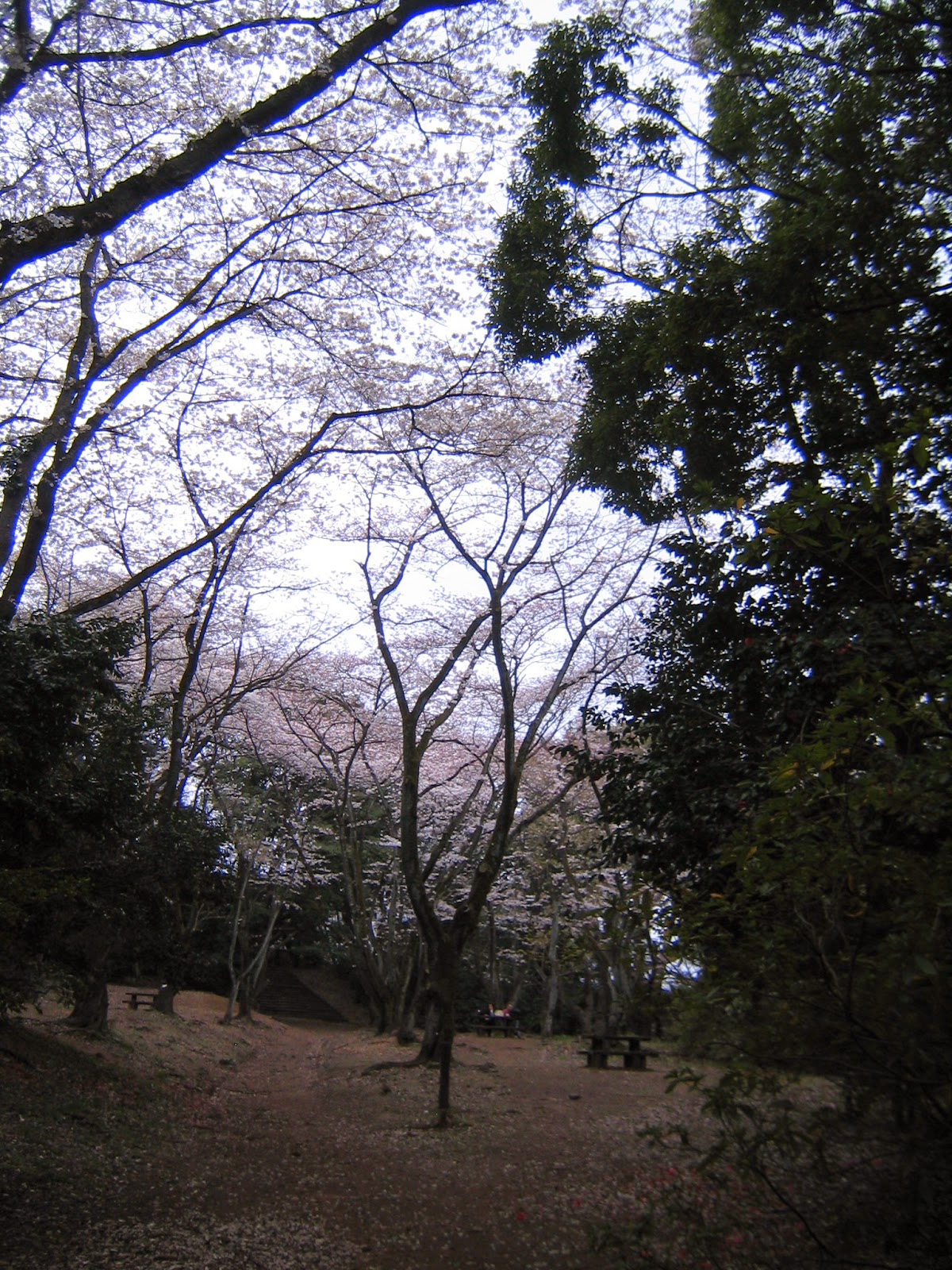
It seems to me the students at that time were a bit of hot-headed young kids; there is a saying that “You’d better waiting for a fight until you completed your cherry blossom party at Bugenji.” And so, the Bugenji Citizen Forest is famous for its gorgeous cherry blossoms of Yae-zakura and Somei-yoshino kind in spring.


It might be the nearest cherry blossom party spot from Yokohama Station. If you enter from the main gate of the temple, it’s just less than 5 minutes small hill walk to find the huge canopy of cherry blossom trees in Sakura Hiroba (“Cherry Blossom Square” 広場). There are several picnic tables where you can enjoy your meal. Mind you, the place is well-known for the locals. At the peak of the cherry blossoms, there always is a fierce competition among many groups to secure the space for lunch parties. I suggest to go there early morning; the air is clean, the park is calm, and above all the blossom is magnificent.

Sakura Hiroba

From the Sakura Hiroba, we will continue walking up to Fujidada Hiroba (“Wisteria trails Square” 藤棚広場) and Hachiman Hiroba 八幡広場 where the other side is Mitsuzawa Park. These two squares also have beautiful flower trees including wisteria and the other kinds of cherry blossoms. (Do you know there are more than 2,000 kinds of cherry blossoms in Japan?) The entire Bugenji Citizen Forest has a cozy feel of neighborhood garden. To circulate the entire “Forest,” it takes less than 15 minutes for a healthy adult. If schools are off, many kids of the area come here to play.

Hachiman Hiroba
No Smoking in the Forest
It is not the toilet of the temple, but for the Forest. It is in Western style. ;-)

By the way, if you are interested in the latest information of Japanese cemetery, it is a good place to watch what is going on. Bugenji temple is now tiny, but a well-established institution. As such, it has a cemetery for its parishioners, which is also ancient.


In the standard Japanese practice for a cemetery attached to a temple, aside from investing lamp-sum for the right of using a patch of land for a grave, a family must become a parishioner, then, pays dues to the temple in order for keeping their space. A typical expense consists of annual “membership” fee, regular donations to each religious festival, and a special donation when the temple plans to renovate their facilities such as a prayer dome where the main statue of Buddha is situated. As you can imagine, it is not cheap. In addition, unless your family gets deeply involved in religious matters of the temple, you will visit the grave of your family once in a year at maximum, especially when the place is far from your current home. Hence, these days it is very common many graves become “muen-botoke” 無縁仏 meaning “the grave without clear genealogical title,” i.e., the grave which the temple does not have a clear grasp of the “owner” of the site. If a tomb does not have a visit for years (; some say, the standard criteria is 30 years), a temple automatically considers the site is abandoned as “muen-botoke,” and clear the place for the new parishioner family who wants to have a grave in that temple. When the nation observes rapid aging and a temple is in the densely populated city like Yokohama, the cycle of this sorting game is short.

So, it seems to me, Bugenji temple is busy sorting out their timeworn cemetery. There are many notices saying “Please make a contact with the temple office, if you are related to this grave.”


Indeed, it is difficult to read the date when some of these graves were established. One tomb stone says it was about 150 years ago when the person under the tomb stone died (, and marked as “muen-botoke”). I visited the temple one Sunday, and noticed a monk was busy showing the possible grave sites for the parishioner candidates.

… er, well, yes, monks must eat to survive. I have heard many of the temples in rural Japan face difficulties to maintain their institution as many parishioners simply disappear, probably to Tokyo or Yokohama, and no funding become available. There is a horror story that the remaining parishioners are asked to pay 2 million yen each for a repair of the temple; long ago, the cost of such things could be divided by many families, but now … Then, Bugenji will be OK. It has many visitors now, for cherry blossom parties, or for a grave site that had been occupied before by somebody … As 2015 is the 500 anniversary year of its original temple of Honkenji, Bugenji is raising money to renovate its facilities, including toilets to become in Western style which is easier to use for elderly people waiting to move into their final home.


Bugenji Citizen Forest is accessible on foot with about 15 minutes stroll in Mitsuzawa Park. From the West Exit Square of Yokohama Station, Yokohama Municipal Bus (Service 34, 35, 44, 50, 83, 87, and 291) and Sotetsu Bus (Hama 5, Hama 11, and Hama 7) operate services to Mitsuzawa Sogo Ground Entrance 三ツ沢総合グランド入口. It’s about a 5-minute bus ride so that you may choose to walk from Yokohama Station. The nearest subway station for Bugenji Forest is Mitsuzawa-kamicho 三ッ沢上町 of Yokohama Municipal Subway Blue LineGo out from Exit 1 of Mitsuzawa-Kamicho Station. At the mouth of Exit 1 facing the Route 1, go to the right, then turn right at the second next corner. Ahead, if you visit the Forest in the cherry blossom season, it is easy to recognize the entrance of Bugenji Temple.


By the way, Route 1 is an ancient road Tokaido 東海道 connecting Edo (Tokyo) and Kyoto-Osaka. When you go along the Route 1 between Mitsuzawa-kamicho Station and Tan’machi 反町 Station of Tokyu Toyoko Line, there are several shops, such as a Japanese sweet shop, that can be traced back its history for ages. The Bugenji Citizen Forest is about in the middle of two Hatagomachis, (旅籠町 “the towns for the travelers to have a rest”; do you remember Ukiyoes by Hiroshige?), Kanagawa 神奈川 and Hodogaya 保土ヶ谷.

From Yokohama to Shizuoka
Er, OK, we’re now above 24m from the sea level.

If you find a problem in the Park, please make a contact with

Office for the Park Greeneries in the North 北部公園緑地事務所
Yokohama Municipal Government Creative Environment Policy Bureau 横浜市環境創造局
Phone: 045-311-2016 (I guess in Japanese only)
FAX: 045-316-8420 (I hope there is somebody who can read English …)

If you plan to make a contact with the Bugenji temple,

Phone: 045-411-7021 (in Japanese only, perhaps …)
FAX: 045-314-8890 (Again, I hope there is somebody who can read English …)