Showing posts with label Tsunashima. Show all posts

Friday, June 26, 2015

In search of lost peaches: Tsunashima Citizen Forest 綱島市民の森


TsunashimaCitizen Forest is located near Tsunashima Station 綱島駅 of Tokyu Toyoko Line, right next to Tsunashima Park 綱島公園. It joined the Citizen Forest family in 1991 as the 18th Forest. (Map here.) It has 5.8 ha with 360 m of walking road, i.e. a small forest right next to the fashionable Toyoko Line running between Shibuya and Yokohama. Probably inevitably, it has a similar issue of urban desertification as the other Citizen Forests along the Toyoko Line, Kumano-Jinja, Komaoka-Nakagoh, or Shishigaya. The volunteers of neighborhood showed a sign board in Tsunashima Park saying that the soil is compacted and the entire forest showed stresses of long-time neglect. But, they declared, the community is striving for restoring the nature of the area as much as possible. I’ve met an old lady who is one of those volunteers for Tsunashima Forest, and inviting helping hands to deal with the bounty of the forest. ;)

To reach to Tsunashima Forest, the easiest is first going to Tsunashima Park. Leave Tsunashima Station from the North Exit, and take the west side road along the elevated railroad of Toyoko Line. It soon becomes a steep slope with greenery at the top. It is Tsunashima Park that has tennis courts (winter) cum an outdoor swimming pool (summer), and a log house for kids to play. Go through the Park up to the Log House (nicknamed “Mocky”) and find ancient tumulus at the back of the house. On the left of the remains, there is a path leading to the residential area. Keep going the left way of this path, and within 5 minutes we come to an entrance for the smaller part of Tsunashima Forest as we find in the map. Oh, by the way, there is no parking for both Tsunashima Park and Tsunashima Citizen Forest. Also, Tsunashima Citizen Forest does not have toilet. There is a toilet near Mocky, though.

Mocky
Toilet of Tsunashima Park
The remains of the 5th century tomb
for a local grandee of the time.
The excavation was done in 1989.
Take left,
and we meet an entrance
for the smaller portion of Tsunashima Forest.

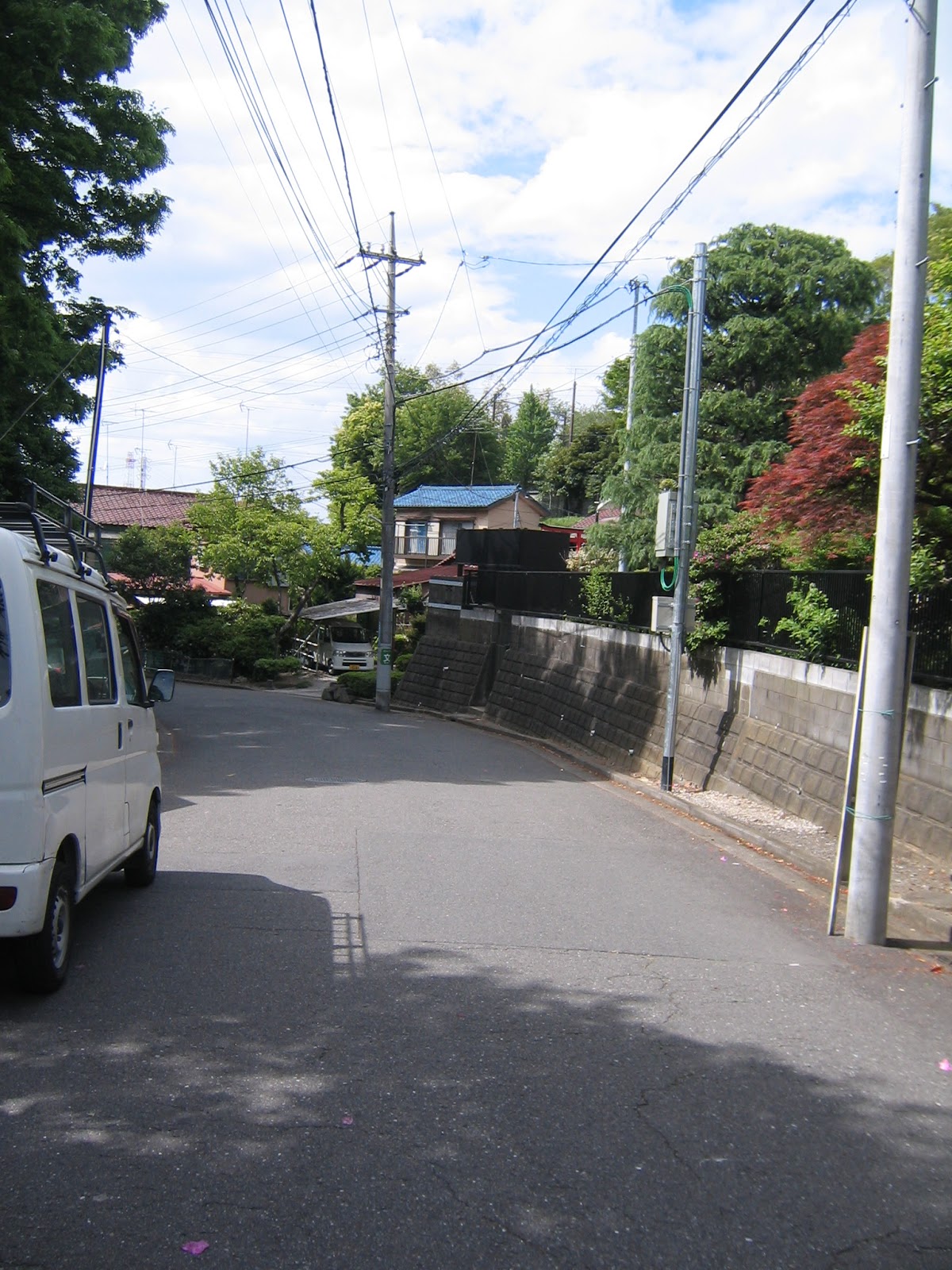
This part of forest has only a paved walking path which serves as a kind of short cut to the Station for the community. In the middle of the forest there is a cemetery of local families which, I guess, provided the reason for the landlords to pave their way. The scenery we can see from the road is a typical Yokohama for us. Er, yeah, Yokohama for tourists is ports, China Town, and other attractions. Yokohama we live is, hm, like this ... lots of small hills and houses.

The Short Cut!
The local cemetery
This is our city.

Moving to the larger part of the Forest, we have to return to the entrance we come from Tsunashima Park. Pass the entrance to the smaller Forest, keep going the road running along the Forest. Soon the road straight ahead presents us a forest which is a larger part of Tsunashima Forest.

Small road leading to …
to …
the Forest.

At this entrance, there is Hinokinomori Hiroba (Cypress Open Space ひのきの森広場) with several picnic benches. Further into the forest, there is the remains of Ohkita-tani Shrine 大北谷神社跡. According to the signpost in the Forest, this shrine was built in 1599 by a local farming family to ask the gods of agriculture for a help developing farm land around the hill. The community held festivals for the Shrine till around 1950s, then the building became derelict. When the area became Citizen Forest, the volunteers cleared the Shrine for the safety of strollers; i.e. this Forest can again trace its origin to Village Forest Shrine.

Hinokinomori Hiroba
The remains of Ohkita-tani Shrine


Turn right at the remains, we can exit the Forest to the residential area. Else, keep going straight, the forest becomes somehow deeper, but we can still “feel” the daily lives of ordinary families living around the Forest. Passing the bamboo forest, and we will find another open space. It is a small viewing platform where we can see Minato-Mirai Area. 


Ahead is …
a platform.
Can you figure out the skyscrapers over there?

From the platform, the road soon descends to Momo-no-sato Hiroba (Peach Tree Open Space 桃の里広場). Thephotograph of the official site of Tsunashima Forest is the scenery of Momo-no-sato Hiroba circa 1991 when the concept of the Forest was “To restore peach growing tradition of the community.” The wooden pavilion in the photo is alive and well for us to have a picnic. The surrounding fruiting peach trees are now … well almost, gone. Instead the area is like a jungle of flowering (but not fruiting; they are different) peach trees, apricots, plum, and persimmon trees.

From above, the Hiroba looks like this,
and the inside is this much busy.
Baby persimmons
Good-ol pavilion
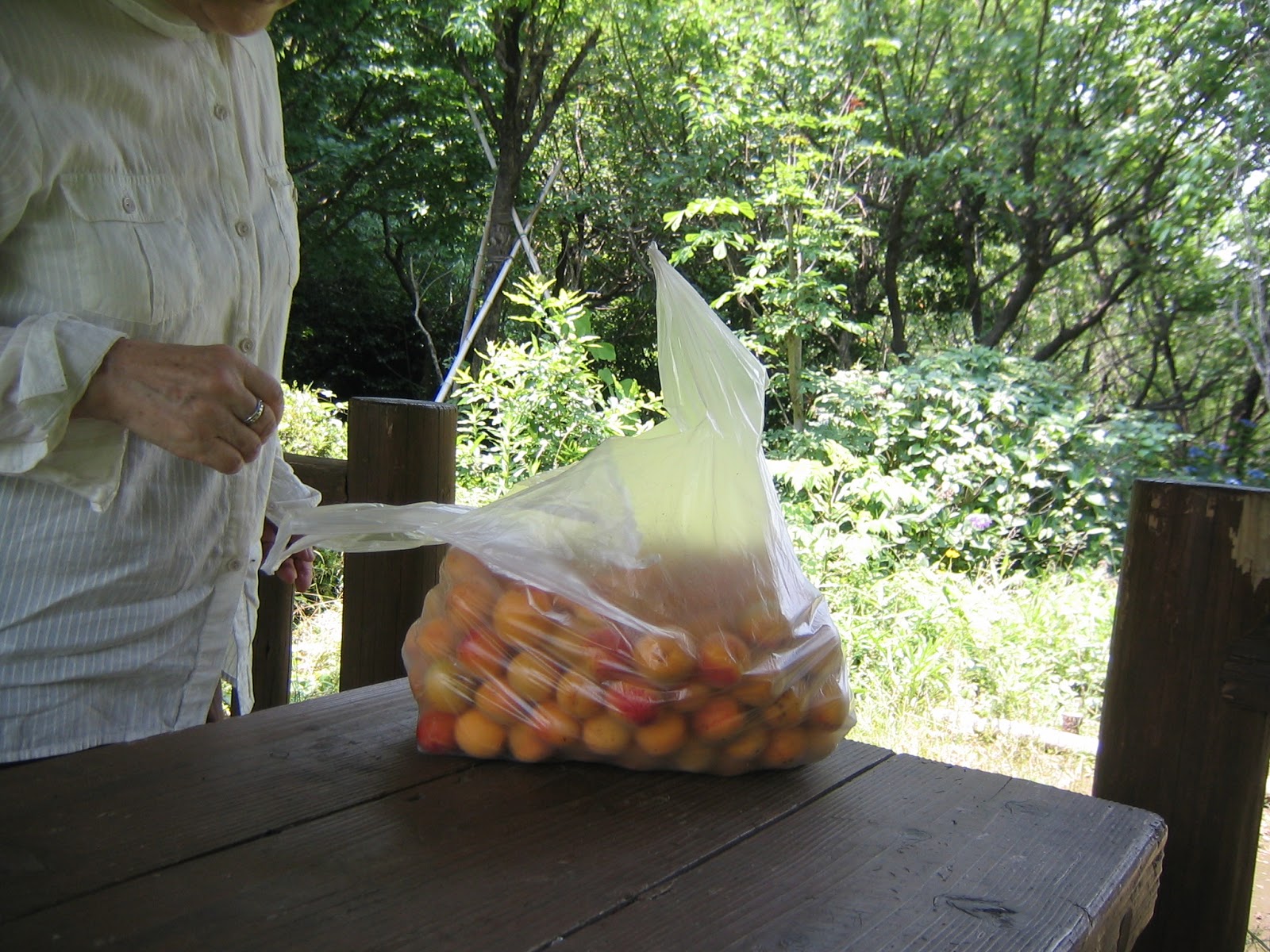
One day in June, when I visited the Hiroba, there was an old lady within the orchard, clearing the ground. She was a landlady and the guardian matron of the Forest. According to her, the original idea of keeping the fruiting peach trees flopped and the volunteers planted the other trees instead. Apricots become so-so successful fruiting once every 2 years. This year (2015) is disappointing for apricots as we had spring days of strong winds when apricots flowers were blown off. Though, trees for prunus mume fruit abundantly every year without fail. And so, she has the problem … too much ume fruits and she is the only one to cook. Volunteers to cook this bounty are seriously needed! Her ume fruits ripe well, and I guess they will be very good pickled plums (Umeboshi 梅干).

After about 20 minutes of clearing
This large plum trees with lots of fruits …
By the way, at the entrance of Momo-no-sato Hiroba from the residential area, there is a very tall tree whose leaves looks suspiciously like peach. At the top boughs, there are lots of plum-sized, but still green fruits in June … Japanese wild peaches are small, and the leaves are a kind of gourd shaped … Aren’t they peach?

Japanese wild peaches are not that large
nor too sweet,
but certainly loved for millennia.

If you find a problem in the Park, please make a contact with

Office for the Park Greeneries in the North 北部公園緑地事務所
Yokohama Municipal Government Creative Environment Policy Bureau 横浜市環境創造局
Phone: 045-311-2016 (I guess in Japanese only)
FAX: 045-316-8420 (I hope there is somebody who can read English …)


Friday, June 5, 2015

This is our playing ground: Komaoka-Nakagoh Citizen Forest 駒岡中郷市民の森


One of the projects City of Yokohama started in 2014 is to expand pubic greenery inthe downtown. Tsurumi Ward 鶴見区 is designated as “downtown” area. When we see from the windows of Keikyu Line 京急線 or JR East Keihin-Tohoku Line 京浜東北線 between Kawasaki and Yokohama stations, it is easy to think Tsurumi as a vast expansion of houses and buildings with occasional tiny dots of minuscule trees. Forest? Forest here? It is understandable, policy-wise, that Tsurumi Ward is a part of focal area for environmental treatment.

Komaoka-NakagohCitizen Forest 駒岡中郷市民の森 is in Tsurumi Ward … we would convince ourselves that this tiny hill (1 ha in total) is entitled to be a member of Citizen Forest System of Yokohama given the condition of Tsurumi Ward.  To some extent, it is a final front to stop ever-growing urban desert in Yokohama. It became a Citizen Forest in 2007. (Map here.)

Although Komaoka-Nakagoh Forest is in the downtown part of Yokohama, reaching there is a bit tricky. If you go there by car, the best option for parking would be a gigantic parking space of nearby shopping center, Tressa Yokohama. It’s a shopping mall created by none-other-than Toyota Motor Co. (I don’t know if GM or Daimler is managing a shopping center.) Before, the place was occupied exclusively by a dealership of Corolla. Probably they thought their land would earn more profit with a shopping mall. Anyway, thanks to this arrangement, the parking is free there. From Tressa, it takes about 10 or 15 minutes to the entrance of Komaoka-Nakagoh Forest. Hey, we go to the forest to walk, don’t we? Tressa stands on the both side of busy Kendoh Route 14 (Prefectural Rd. #14 県道14号線).

Tressa and Toyota

From Tressa go east along Route 14, and turn left at the 6th crossing. Keep going, passing Yokohama Komaoka Post Office 駒岡郵便局 on the left. We see on the right a cemetery of Chosho-ji Temple 長松寺  (which, Oh my Buddha!, is engaging in hotel business. The Lonely Planet site is here), and a hill covered by trees. It is Komaoka Nakagoh Forest.

Chosho-ji Temple

If you use public transportation, go to either Tsurumi Station 鶴見駅 of JR East, or Tsunashima Station 綱島駅 of Tokyu Tohyoko Line 東急東横線. From the West Exit of Tsurumi Station, take Rinkoh Bus 臨港バス service Tsuru-04 -04 to Shin-Kawasaki Station 新川崎駅入口 from #9 Bus Stop. (Time Table, here.) From Tsunashima Station, ride Tokyu Bus Hi-93 -93 serviced to Hiyoshi Station East Exit 日吉駅東口 from #5 Bus Stop. (Time Table, here.) With both services, we get off the bus at Asahi Hendensho Mae 旭変電所前 (“Asahi Transformer Substation Entrance”). If you walk from Tressa, the first destination to find is also this bus stop. Find this sign at the opposite side of the transformer substation.

Asahi Hendensho Mae Stop

Beyond the stop is an agricultural land with one small path towards the Forest. I expect this land will be kept as such, because there is an official sign on the right of the path saying this place is to serve as an emergency gathering point for the neighborhood if a large catastrophe, e.g. earthquake, hits. I was surprised to find a sign near Tressa indicating the area is just 4m above the sea level.

The way to the Forest
Only 4m above the sea level …

As Tsurumi River 鶴見川 runs about 1km north from Tressa, if a gigantic tsunami comes into the River, this place could be … The same thinking may go into the mind of the people around here. At the back of Chosho-ji there was a notice from the Ministry of Land, Infrastructure and Transport, 国土交通省 saying, the hill and the nearby area do not have a robust soil structure so that people must be ready for evacuation with a short notice. We are standing on the flood plain of Tsurumi River.

Hmm…, anyway
the warning for the catastrophe is done
 in manga by the national government.

As of today, the area is not yet hit by monster tsunami. So, at the bottom of the small way from the bus stop, on the right is a small playground for kids with swings, and on the left the road curves to the other side, which is actually going around the Forest. When we raise our sight a bit, there is a small Shintoh Shrine, Shinmeisha 神明社.

… going up the stairs,
there is this shrine.

It is easy to imagine the shrine is a typical forest village shrine 鎮守の森. Since the forest is to revere, changing its natural habitat was a sort of sacrilegious. As this theory goes, forest village shrine is an implicit sign that the original habitat has been preserved for generations with high probability.  Sure enough, in front of Shinmeisha Shrine, there are ancient looking small monuments some of which keeps the engravings. One of them says it was made in either Kan’en 寛延 or Kansei 寛政 period, which was in the 18th century. I could not figure it out exactly, though … On the left corner of the small square of the Shrine, there is a sign saying “Uguisu Hiroba うぐいす広場  (Nightingale Square), this way.” From there, a small path leads us into the Forest.

This monument, it seems to me,
tells us the name of the donor to the shrine
and the date it was done.
The sign to Uguisu Hiroba …
and the path from the sign.
Vegetation of the Forest

The entire length of the path in Komaoka-Nakagoh Forest is only 200m or so. In addition, from the shrine, there is a single road so that it is difficult to lose the way. Although the way first climbs steeply and then descends rapidly, even kids under 5 years old can come to Uguisu Hiroba which will soon appears ahead of you.

Uguisu Hiroba with picnic benches
Potable water
From Uguisu Hiroba, there are 2 ways of about 50m each reaching to residential areas … so near … Komaoka-Nakagoh Citizen Forest probably does not preserve the original habitat anymore. It is too small to fight against the encroaching urban desert of metropolis. But, hey, sometimes the intention matters to start something better. Uguisu Hiroba has a water faucet for potable water, and for kids to play with. Actually, the entire Forest serves as a playground for kids. The length and the steepness of the promenade in the Forest could be ideal for them to play tag. Butterflies fly. Stag beetles come out during summer holiday … After dusty industrial roads from Tressa, the Forest is really something of an oasis. No wonder kids come out suddenly in the Forest (as I encountered). Hey guys, you go home before the Forest becomes dark … won’t you? 

The paths are this wide from Uguisu Hiroba
The Forest actually stands
next to the residential area.

If you find a problem in the Park, please make a contact with

Office for the Park Greeneries in the North 北部公園緑地事務所
Yokohama Municipal Government Creative Environment Policy Bureau 横浜市環境創造局
Phone: 045-311-2016 (I guess in Japanese only)

FAX: 045-316-8420 (I hope there is somebody who can read English …)


Friday, May 29, 2015

Porridge, FIFA World Cup, and Shinkansen: Kumanojinja Citizen Forest 熊野神社市民の森


As Tokyu Toyoko Line 東急東横線 connects Shibuya and Yokohama, it is a fashionable commuter line. One of the “trendy” stations of Toyoko Line is Okurayama 大倉山. The west of the station has several cute patisseries and restaurants. This side also has Okurayama Park 大倉山公園 where its plum blossom party in every early March has been famous since its inception of 1931. The east of the Station is more ordinary, urban, and residential. KumanojinjaCitizen Forest 熊野神社市民の森 is on this side. (Map here.) 5.3 ha of Kumanojinja Forest joined the family of Citizen Forests in 1980.

Get out of the Station from its east exit, we can find a small alley (where a vegan restaurant resides) beyond the area map signpost. Go into this way forward, up then down the steep slope (actually, below your feet around here is a tunnel for Tokaido Shinkansen, which I will mention later), to meet Tsunashima Street 綱島街道. Go north Tsunashima Street and soon there is a bus stop and a traffic signal both of which are named Kumanojinja Iriguchi (“Entrance to Kumanojinja” 熊野神社入口). The other side of the crossing at Kumanojinja Iriguchi traffic light has a large stone signpost saying Moro’oka Kumanojinja 師岡熊野神社. We take the road running northeast from this signpost. Soon on the left there is a temple, Hokkeji 法華寺, and the next to this temple is Kumanojinja 熊野神社, the beginning of our Forest.

An area map in the east exit of Okurayama Station
If you miss vegan food …
Tsunashima Street
Bus Stop. The traffic light is over there.
Stone signpost.
Hokkeji
Moro’oka Kumanojinja

If you travel around Japan, you may notice there are lots of Kumanojinja. It’s a franchise of Shito Shrine whose HDQ is in Wakayama Prefecture 和歌山県. For a brief explanation of Kumanojinja’s historical “business” expansion, please see here (in Japanese). Kumanojinja here was established in 885 AD by Emperor Kohkoh 光孝天皇. As it is ancient, its influence remains in names of towns in Yokohama. E.g. Oguchi 大口, a name of a town and a JR station next to Kikuna 菊名, was taken from the name of an official pants, Oguchibakama 大口袴, wore by Imperial Envoy for this Kumanojinja. The Shrine has a small museum containing historical artifacts of itself and the neighboring community (RSVP; Admission, 200 yen for adults, 100 for kids).
 
Kumanojinja Main Shrine
No-no-ike Spring 「の」の池 at the back of the main shrine
Toilet at Kumanojinja

It is said that their annual festival on January 14, Tsutsugayu-shinji 筒粥神事, began in 949. The event is one of those traditional Japanese agricultural prayers to predict happenings of a year, done all over Japan. In Moro’oka Kumanojinja version, the priests prepare rice porridge in a huge rice cooker using water from No-no-ike Spring, the spring back of the main shrine. They insert empty and open bamboo or reed containers before boiling rice. Naturally some rice float in the bamboo during the cooking. When the porridge is done, the priests read the way the rice is in the container. You can see how it is done hereAnybody can join this ritual, starting at 14:00. Added bonus for the spectators; the shrine distribute the cooked rice to the people attended the ceremony. The porridge is said to have a magical power to fend off flu of the year as a kind of mystically subsidized flu shot. The prediction for 2015 is displayed here: it seems to me the harvest for 2015 is not bad, but not so good either. The general prediction for 2015 is “Well enough.” OK-dokay.

Kumanojija Forests contains several historical remains. One of them is I-no-ike pond 「い」の池 in front of the Shrine that becomes a protagonist for another festival of Kumanojinja every August. The pond could be very old and used for irrigation to rice paddies since the 8th century or so. Now it is home of Water God and lots of sun-bathing turtles.

I-no-ike pond
Kame

Back of I-no-ike is a small hill, Shikisaka Hiroba 式坂広場, here Imperial Envoy did official rite before entering the Shrine. This tiny hill is also a part of the Kumanojinja Citizen Forest. Despite of its steep slopes, it’s a piece of cake to walk.

From the pond, the steep steps lead us to
Shikisaka Hiroba.

The way around Shikisaka Hiroba

The back of the main Shrine is another part of the Forest with an steep slope leading to Gongenyama Hiroba (“Gongenyama Space” 権現山広場). The hill is a typical Shasoh-rin 社叢林, or forest village shrine 鎮守の森. Japanese have been finding something to assimilate to the place for a long time. In Gongenyama Hiroba, there is a kitchen midden, Moro’oka Kaizuka 師岡貝塚, of about 10,000 BC which tells us our ancestors had their daily life here.

The slope to Gongenyama Hiroba
Gongenyama Hiroba with picnic tables.
We can enjoy the view of ordinary urban residential area from here.
Moro’oka Kaizuka.
The excavation was completed in 1994.
The area is now covered for protection.

So far, Moro’oka Kumanojinja sounds like a well-established spiritual place to pray. Er, well, this shrine is also famous among local athletes to pray for a good result in their competition. I know at least one official cheer leading troop of a college 某大学体育会応援団 brought their school banner to the Shrine to be “purified” for successfully supporting a season of inter-collegiate championships. There is a reason; please see this coat of arms of Kumanojinja franchise;


It is a 3-legged crow that is a sacred bird that led the way when the legendary first Emperor, Jinmu, 神武天皇 to conquer and build a country of Japan. And here is the emblem of Japan Football Association. Of course, Kumanojinja is the first and JFA borrows the legend. Anyway, as this Kumanojinja is nicely located very near to Nissan Stadium, the venue for 2002 FIFA World Cup Final, lots of soccer funs visit this Shrine to ask victory for their team to the three-legged crow. For their convenience, the Shrine sells the talisman for soccer. (They also accept internet orders worldwide. For your spiritual and soccer experience, please visit here! No FBI investigation necessary!)

I don’t know if this talisman is valid to cheer for the Brazilian side.
Guardian Lion Dog狛犬at the entrance of Moro’oka Kumanojinja.
It is NOT an official World Cup Match Ball.
“A”
Guardian Lion Dogs always have a ball all over the world!
It’s a pre-era Chinese invention.

In addition, the product line of omikuji おみくじ by this Shrine is substantial. According to your aesthetics, you can choose omikuji and its accompanied talismans. You love cats? There is omikuji that comes with Manekineko. Do you like a kitsch version of Japanese traditional lucky charms? No problem. On budget? Of course, there is the simplest version of 100 yen …

Omikuji Booth in Moro’oka Kumanojinja

Returning to the map of the Forest, you may have noticed 5 ha of Kumanojinja Citizen Forest is divided in 3 parts by roads and residential areas. 2 sections are directly connected to Kumanojinja. The third part is a bit away, and has the majority of 1.7 km of roads in the Forest. Considering the historical background of Kumanojinja, I guess the larger area was owned by Kumanojinja before it became Citizen Forest in 1980. Between the Shrine and the larger part of the Forest, there is a community of residences. Somebody developed this area for housing before 1980.

I found a notice board of the Residents’ Association along the way from Kumanojinja. Dated November 2014, the President of the Association notified to his/her neighbor that the Association had a meeting with JR Tokai concerning the noise and vibration caused by Shinkansen Bullet Trains. According to the communication, the vibrations would be due to the aging of the tunnel so that JR Tokai is currently engaging in the upgrades of tracks and related machineries underground. “Please be patient, and we keep you informed for every communication we have with JR Tokai.” … Shinkasen of this part began its service in 1964. When did the people move in here?

The residences with vibe.
Ahead is our destination Forest.

Coming from Kumanojinja, the larger part of the Forest first has only one road. Simply keep going, and we eventually come to Tenshinhira Hiroba (“Tenshinhira Open Space” 天神平広場). This space has lots of picnic tables, and 3 roads to go out of the Forest. You can also hear a humming of Shinkansen Trains coming and going every 5 minutes or so …

The Forest entering from the direction of Kumanojinja
Soon we will find the road sign.
Just go strait,
to visit the backside of this residential area,
and finally to meet Tenshinhira Hiroba
with lots of picnic tables.

It seems to me Tenshinhira Hiroba is frequented by locals a lot. The entire space and the surrounding road have a compacted soil … a kind of sign for urban desertification. At the corner of the Hiroba there is a sign by the Forest administrator begging the visitors, “Please mind the steps. Trees cannot move, but you can.” Hmmmmmmmmmm

For spoiled urbanites, pls be kind to the nature.

The end of this part of the Forest is another Shrine, Sugiyamajinja 杉山神社. According to Kanagawa Shrine Agency 神奈川神社庁 website, it was once an abandoned shrine with the village forest behind (ah-ha). The current structure is rebuilt in 2002-2005. I thought it makes sense … a compacted soil in the Forest, the begging notice, a brand-new shrine, shaken residences, Shinkansen …

The Brand-new Sugiyamajinja

If you find a problem in the Park, please make a contact with

Office for the Park Greeneries in the North 北部公園緑地事務所
Yokohama Municipal Government Creative Environment Policy Bureau 横浜市環境創造局
Phone: 045-311-2016 (I guess in Japanese only)
FAX: 045-316-8420 (I hope there is somebody who can read English …)