Showing posts with label Hadano Forestry Road. Show all posts

Friday, October 9, 2020

Under construction: Yadoriki Water Source Forest, Fall 2020 やどりき水源林


Now we know we have to learn to co-live with COVID-19. Kanagawa Forest Instructors Association has resumed our activity in Yadoriki Water Source Forest やどりき水源林 with new measures. When we guide the forest for visitors, we wear face masks and carry hand sanitizers. We check enough supply of soaps in toilets frequently … Having said that, actually, Yadoriki Water Source Forest is closed for its 4/5 coverage for the rest of the year.


The latest map for Yadoriki Watersource Forest.
 The area enclosed by black arrows are
 the only part we can enter now.


Kanagawa Prefecture decided to utilize this “with-COVID” situation when we are a sort of hesitant to go out. They are doing the civil engineering works to restore forestry roads that were destroyed last year by monster typhoons (; my post on November 1 and 22, 2019). The prefecture is also busy in forestry for the afforested area, especially in the westside of Yadoriki Stream. That was a part devastated by the typhoons last year. They are clearing the broken trees. In addition, the contract foresters are thinning the forest for the “fittest” cedars and cypresses, hoping they become large enough trees to secure the soil against future huge storms.


Restoration work for the embankment of the Open Space.
 I guess, their idea is piling up huge rocks along the bank
 would lessen the damage of flush flood.
 Er … let us see.

So, trucks loaded by rocks are busy commuting
 between the forest and some depot for rocks.

Especially during Monday to Saturday, when you visit Yadoriki Water Source Forest now, you will be greeted by thunderous noise of road constructions, for creation of embankments, and of thinning chainsaws … It’s totally up to you to enjoy the scenery, or not. Yeah. The noise is not non-stop for sure. That’s the difference between the construction works in city center and in deep forest … We forest instructors are a bit sad to find our beloved hazelnuts trees were cut to make a new forestry road. My seniors were also disappointed a pillow lava, which they polished to confirm its crystalized surface due to its formation millions of years ago, was thrown away as a trash … The area where we instructors have been doing the forestry is now inaccessible due to bulldozers. *Sigh*


Where is the polished lava?

The Prefecture plans to end all of these hubbubs by the end of the year. We are waiting now … Anyway, by the time the new forestry roads are ready in Yadoriki Forest, we may have some remedy against COVID-19. Let’s be patient and keep crossing our fingers.


If you find environmental issues in Kanagawa Prefecture, please make a contact with Kanagawa Natural Environment Conservation Center 神奈川県自然環境保全センター

657 Nanasawa, Atsugi City, 243-0121
〒243-0121 厚木市七沢657
Phone: 046-248-0323

You can send an enquiry to them by clicking the bottom line of their homepage at http://www.pref.kanagawa.jp/div/1644/


Friday, November 1, 2019

Disturbance: Typhoon Hagibis for Yadoriki Water Source Forest


Yadoriki Water Source Forest やどりき水源林 also had substantial disturbance by Typhoon Hagibis. At this moment, the Forest is off limit for visitors, and the gate for the forestry roads to Yadoriki Forest is locked. As of November 1st, after Hagibis, the area had two more long torrential rains, and numerous mini squalls. Yadoriki Forest’s recovery from the Hagibis is unpredictable at best.  We Kanagawa Forest Instructors have not received information from the Prefectural Office when the gate is open ... This week, I report you scars I’ve found in Yadoriki two weeks after the visit of Hagibis. I hope you could have some idea about the situation.


The way Nakatsugawa River 中津川 / Yadoriki Stream 寄沢 flows has changed. Above photo was taken at the point before Hadano Forestry Road begins. The river goes around nearer to the banks so that many points have collapsed by strong rains from Hagibis and others. (Oh, yes, Nakatsugawa River and Yadoriki Stream are the same flow. It changes name at Yadoriki Bridge 寄大橋.)


Mini landslides are here and there along the community road from Yadoriki community to the gate of Yadoriki Water Source Forest. It would take a couple or so of dry months before the soil stabilizes. As we have to think the effect of frost and frozen ground during winter in this part of our prefecture, it may be difficult to expect the situation improves quicker. If you plan to drive to red Yadoriki Bridge, please be very careful.


Red Yadoriki Bridge over there.
 Could you see a large log was caught by the weir?


Inside the gate for Yadoriki Water Source Forest, the road condition is worse. Its forestry road which was passable for a city car before is now for off-road types only.


It seems to me
 animals are taking the advantage of
 human-less environment in Yadoriki now.


Yadoriki stream inside the Yadoriki Water Source Forest has changed its shape drastically after the rains. It destroyed trekking roads along the stream from the gate and eroded the open space. It seems to me substantial amount of large rocks and logs were carried by the flood to the downstream.


Destruction
It’s a matter of time before these picnic benches are gone.


Forestry road in the Water Source Forest collapsed in the middle. So, beyond this point it is strictly closed for the unauthorized visitors. The soil was washed away below the asphalt.


Here and there, Yodoriki’s utility forestry roads are covered by landslides like this. Though, these points could be cleared soon as the season of logging is approaching.


And cones of conifers promptly utilize the chance
of sunshine for sprouting thanks to the land collapses.
 Mini-forest. Cute.
 (And they will be gone quickly by the next slide …)


It seems to me Hadano Forestry Road 秦野林道 also has large disturbances due to these rains by typhoons and others. The streams along the road certainly experienced large flows and landslides. This is Teshiro Stream 手代沢. Before we could not see the waterfall from the forestry road. Now both sides of the valley collapsed and trees that concealed the vista were broken or washed away. Yeah, the view from Teshiro Bridge 手代橋 is nicer now, but can the bridge last when the next big storm comes?

Map of Hadano Forestry Road


Above is a stream that is filled with soil avalanches. This is a naturally made dam creating a pond whose surface was just few inches below the paved forestry road. I will not be surprised if Hadano Forestry Road collapses here when the next large rain comes.

Majority of Yadoriki Forest is owned by the Prefectural Government so that how to deal with the situation is, in the end, totally up to the budgetary condition of Kanagawa Prefecture 神奈川県. Geologically Tanzawa mountains are very fragile. (More to this soon.) Scars in the forest by 2019 storms can easily expand. They may turn into debris-avalanche that would swallow human settlements downstream … I don’t know. I’ve heard all the people in Yadoriki Community inherited a warning from their ancestors, saying “When the water of Nakatsugawa River turns white, run!” Fingers crossed.


If you find environmental issues in Kanagawa Prefecture, please make a contact with Kanagawa Natural Environment Conservation Center 神奈川県自然環境保全センター

657 Nanasawa, Atsugi City, 243-0121 

〒243-0121 厚木市七沢657

Phone: 046-248-0323


You can send an enquiry to them by clicking the bottom line of their homepage at http://www.pref.kanagawa.jp/div/1644/

Friday, February 15, 2019

Ink Painting: a bit of walk along Hadano Forestry Road in winter 秦野林道


One January weekend, we’ve been Hadano Forestry Road 秦野林道 from Yadoriki Water Source Forest やどりき水源林 for a little survey. Immediately after Super Typhoon Trami last October, the road was covered by debris, and we could figure out lots of broken trees on both sides of the way (; my post on October 19, 2018). It seems to me the Prefecture is doing a clean-up now. One of my senior forest instructors told me the Office is harvesting the logs from there. Some afforested areas are currently under works of forestry with new graveled roads for heavy machineries. Are they using harvesters? “No. Tanzawa is too steep to use such vehicles. I think they use chainsaws, and bring out the logs by a forwarder,” she said. Will it be some help for the prefectural budget to manage healthy Tanzawa-Oyama Quasi-National Park 丹沢大山国定公園? Considering the current market condition, I’m not optimistic for the yen-amount they collect from the work … But surely the afforested trees must be harvested, or thinned, from time to time to keep the forest healthy. If some money can be raised from the activity, it should be better than nothing …


After the super typhoon last October
And after the clean-up, this January
Men at work
A new road


Weekends of winter forests in Tanzawa Mountains 丹沢 are for deer hunters. We’ve met members of Kanagawa Hunting Club 神奈川県猟友会 who are cooperating with the Prefecture to control deer population in the National Parks. They said the catch of the morning was 2-layer angle stags, and then continued their hunt late afternoon. We’ve found a trace of deer on a trunk of Japanese Larch (Larix Kaempferi (Lamb.) Carrière) from which an animal rubbed resin on its body for anti-ticks. Droppings of deer were found several places as well. Still, my senior instructor told me the situation was far better than, say, 10 years ago. “You see, we could even find bodies of deer along a road busy with hikers. They were starved to death … Now the situation is stabilizing, I think.” Hmmmmmmmmmmm. (Please see my posts about deer in Tanzawa in July 2017.) A Hunter was sitting still, and concentrating on somewhere over there. We could hear faint barks of dogs from the other side of a deep valley. The catch was coming …


Could you see hairs of deer here?
They did it.
A hunter is here.
You see?
 The plants along the road are unnaturally ‘mowed’ by deer.
 They ate the top soft part of these plants.


The mountain was cold and quiet otherwise. The majority of the sound we could hear was the hum of airplanes high above and intermittent bird calls. Voices of impatient Japanese tit (Parus minor) were mixed with occasional easy-going calls of Varied tit (Parus varius). Listening them “in Japanese,” they were pronouncing the same word, but the speed was definitely different. “Tsu-tsu Pea, tsu-tsu pea (Japanese tit)” vs. “Tsu-u-Tsu-u Pea-a, tsu-u-tsu-u pea-a (Varied tit).” As they are in the same genus, there might be some interesting story during their evolutionary process … We’ve found several couples of Red-billed leiothrix (Leiothrix lutea) which is designated as one of the worst invasive species to Japanese archipelago. “Wow, this is my first time to record them in Yadoriki Forest.” A veteran instructor said. There happened so many things in a seemingly silent winter Tanzawa …


A feather of White-bellied green-pigeon (Treron Sieboldii).
 They live in this area of Tanzawa,
 and go to Oiso Beach
大磯海岸 to drink salty water.


I found the scenery was very contemplative and, beautiful. There is not much color in winter forest. Understating ever-green trees. Various hues of greys from trunks and boughs of deciduous trees. Dry January of Kanagawa Prefecture gave us the clearest blue sky that contrasted astonishingly with the ridge lines of mountains. Before the maples shed their leaves we could only imagine the depth of the valley from the canopies that could be seen from high bridges. Now it is clear down there were streams with very rocky riverbed. That was a landscape we found in traditional ink paintings of China and Japan. Hadano Forestry Road is not yet opened thoroughly due to the slope failure between Mushizawa Forestry Road Junction 虫沢林道分岐 and Shin’nashi Bridge しんなし橋. Though, it’s the route where 4-wheel vehicles can run. If you plan to have a small peek of deep Tanzawa Mountains 丹沢 during winter, please try this road if only for the first 1 hour stroll from Yadoriki O-hashi Bridge 寄大橋. I guarantee you a meditative but relaxed weekend afternoon in quiet and monotonous mountains ... The world of Zen.


In July
The same place in January
In July
And the same place in January.
 Oh my … the slope is collapsed here …
Yadoriki O-hashi Bridge in July
The bridge in January


Oh, by the way, all the forestry roads in Japan are for permit-holders only to drive by whatever vehicle, i.e. car, bikes and motorbikes. Please walk!


If you find an environmental issues in Kanagawa Prefecture, please make a contact with Kanagawa Natural Environment Conservation Center 神奈川県自然環境保全センター

657 Nanasawa, Atsugi City, 243-0121 2430121 厚木市七沢657
Phone: 046-248-0323


You can send an enquiry to them by clicking the bottom line of their homepage at http://www.pref.kanagawa.jp/div/1644/


Friday, July 13, 2018

Apprentice! My first step for citizen science along Hadano Forestry Road 秦野林道


Kanagawa Forest Instructors’ Association has secretly famous experts who can perform as sentinels of environment in Kanagawa Prefecture. Several senior members are active policy makers for environmental revitalization in the Prefecture. Some others are for more than 20 years crucial contributors to the Nature Revitalization Plan for Tanzawa-Oyama Quasi-National Park 丹沢大山自然再生計画. Their voice is based on scientific data collection, patiently continued for decades in the forests and mountains of Kanagawa. I’ve heard some of my seniors were retired professors of the field, but majority were enthusiastic “amateurs” who have kept learning and reached to the level to make presentations for academic meetings. i.e. Perfect example for the achievement of citizen scientists ... Er well, for a freshman instructor like me, they are Hall-of-Famers, and so, beyond my reach. But, yeah, Rome was not built in a day, and a freshman is an easy assistant for them to collect data in the forest. Recently, I’ve joined their line-census for vegetation along Hadano Forestry Road 秦野林道. The day was a fun, and, … well, as a whole, that was really an educational experience.


Experts of citizen science are entering the forest.


This post is the second time I tell you about Hadano Forestry Road. (The first one was about Gabicho, aka Chinese hwamei, remember?) Actually, the area is like a main activity field for Kanagawa Forest Instructors’ Association, and hence I’m visiting the place frequently these days ... Anyway, the 13.7K road connects Yadoriki Community of Matsuda Town 松田町 and Kurokura Community 玄倉 of Yamakita Town 山北町. It’s a blacktop road wide enough for a car to pass, though it’s for permit-holding cars only. In theory, if we walk with a pace of 4K per hour, we should be able to conquer the entire itinerary in one day. Hmmmm, I’ve learned if we collect plant data along the road, it was more like 1K per hour at best even for the veterans. Do you think it leisurely? Well, please think again.


A Map of Hadano Forestry Road, provided at the entrance of the road. I tell you this map is well-crafted.
Indeed, the road is pleasant enough for light hiking.


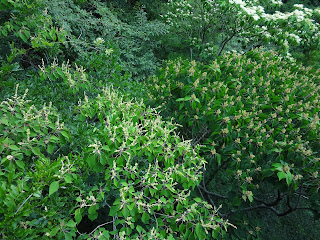
In early summer, yellow flowers of Mallotus japonicas is in full-bloom along Hadano Forestry Road. The plant is dioecious. So, we have to differentiate male and female trees and record accordingly. “Hey, Freshman! Look at this. It’s a male flower for Mallotus japonicas. Those fluffy parts are for their stamens. You see?” Figuring out such differences in the trees of a valley at least 10m up is, I tell you, not easy. Or, discerning Carpinus laxiflora from Caprinus tschonoskii is tricky. Text books say when its leaf has less than 12 lateral-veins, it’s Carpinus laxiflora, whereas 12-15 veins are for Caprinus tschonoskii. Now you have a suspect tree 5m down on the slope from the forestry road. At least a very good binocular is needed. Oh yeah. Those veterans could spot noteworthy specimen along the road quickly, identify them, and then gave me their diagnosis with plants’ name. I took a photo and a note, together with the label of a plant, a place we’ve found them, and the condition of the plant (color of leaves, flowering, number of specimen found, insects’ trace, …).
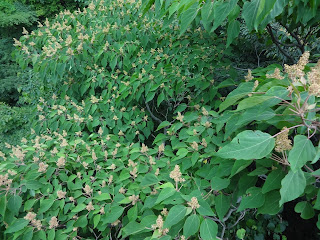

The girl-flowers for Mallotus japonicas are chatting merrily here.
Male and female flowers of Mallotus japonicas with a young fruit of Caprinus japonica and a leaf of Acer cissifolium.
Boys and girls of Mallotus japonicas are standing nearby here.
Don’t you think
 those flowers of Cornus kousa look floating
 in the ocean of green leaves …


Telling you the truth, when I started to attend training courses for forest volunteers, which includes the seminars presided by academic experts of the nature, I found my brain was overwhelmed by massive amount of new information from forests. Is it Polygonatum odoratum, polygonatum falcatum, Polygonatum involucratum, or Disporum sessile? PANIC!!!! I think it was because I was clueless where to see in order for identifying a plant. In contrast, my senior forest volunteers know the thing, and take a cool step-by-step approach to classify a subject methodically. Even though, “Yes, in today’s DNA-based cataloging, maples are a part of Sapindaceae, and Aceraceae family was merged with Sapindaceae.” “Yes, we have to be careful here …” The process goes like this for each finding. It’s completely different from sports hiking to gain mileage or altitude quickly. The time in a forest flows very slowly, with an intellectual tension. That was a fun! Besides, at least on that evening, my feet were easy enough compared with them after a mountaineering day … My seniors gave me homework. “So, Naomi, you create a record of today’ study and email it to us. We’ll help you to check it collectively. Don’t worry.” Sounds very easy and kind offer for help, isn’t it?


The instructors are discussing … it’s fruits of Deutzia crenata.
These black-ish balls on the stem of Miscanthus sinensis are barns for aphids ants created.
 The famous symbiotic relationship is in action!
Large Phytolacca americana are
 easy to find along Hadano Forestry Road.
 They came Japan some 150 years ago,
 and expanding their territory since then …


The Kanagawa Forest Instructors’ Association has a format to record each of these findings, and I was tasked to fill the cells of the spreadsheet based on my note. That has been, I would say, very complicated procedure. On my desk every evening for a while, I matched my photo and memos, google-sought to figure out the characteristics of each plant to identify the picture, and double-checked APG Plant Classification System if I was correctly recording the data in the latest denomination. Is this photo is on the right or left side of the road? Which bridge we were crossing when I wrote this memo? Etc. etc. … It took 10 nights to complete a form with the data collected during 4 hours’ walk. At the end of the day, I felt I’ve done something. Very educational experience, I tell you.


The main theme of the day was
 to identify flowering Lilium auratum,
 but they were still in green buds
 early July in Hadano Forestry Road.
 One of my seniors told me
 this year spring flowers came very early,
 but the summer cadre keeps their regular pace no matter what.
Phew! An abbreviated (and translated) version of my report.
 Actually, on that day we recorded more than 100 kinds of plants including some endangered species.


My seniors told me they are now circulating my excel table to multiple-examination … Oh My Buddha … have I created a record receiving at least “Pass” grade? Being a sentinel of environment is a task required to be meticulous and patient … Don’t rush. I’ve learned a lesson.


Cute. I’m still carrying last week’s theme.😍


If you find an environmental issues in Tanzawa, please make a contact with Kanagawa Natural Environment Conservation Center 神奈川県自然環境保全センター

657 Nanasawa, Atsugi City, 243-0121 2430121 厚木市七沢657
Phone: 046-248-0323


You can send an enquiry to them by clicking the bottom line of their homepage at http://www.pref.kanagawa.jp/div/1644/