Showing posts with label Rural development. Show all posts

Friday, February 16, 2018

Always Look on the Bright Side of Life: the largest Citizen Forest of Yokohama, Doshi Forest 道志村水源林


So, about silver lining after the voting incident in 2003 for Doshi 道志村 and Yokohama. In 2004, Doshi Village and the City of Yokohama established an official “Agreement regarding Friendship and Exchange 友好・交流に関する協定書 between the two, and Doshi Village became “Our Home Village for the Citizens of Yokohama 横浜市民ふるさと村.” The municipal budget of Yokohama has beefed up its grant for the welfare improvement of Doshi villagers. In 2006, Doshi Water Source Forests Fund 水のふるさと道志の森基金 was inaugurated by the Yokohama Waterworks Bureau. The fund is to solicit donations from the citizens and corporations to sustain further the exchange of people of two communities. The Bureau also sells bottled water “Hamakko Doshi the Water はまっ子どうし the Water” from Doshi River 道志川 to augment the Doshi Forests Fund. In 2014, two municipalities created a system to help each other in case a mega-natural disaster hit and the offices could not function to support the residents of each community. In 2016 Doshi Village has opened a café named Mizu Café Doshi 水カフェどうし in Yokohama’s downtown. The place is to introduce the village and numerous products from Doshi including fresh watercress harvested daily. Now the two municipalities jointly hold PR events about Doshi Water Source Forests year round. Yokohama Board of Education makes special programs for grade schoolers to learn Yokohama’s waterworks and the role of Doshi Village. When the people of Yokohama can show an ID mentioning our residency in Yokohama, Doshi Village offers numerous “Home Village” discounts for tourism attractions, such as hotels, meals, spas, sports facilities, etc. etc. And, the scheme introduced forest volunteers to help forestry in Doshi Village.


After the Agreement was signed
the City of Yokohama is actively involved with
utilization of woods produced in Doshi Village.
This is the decorative wall for Asahi Ward Office of Yokohama,
using the cedars of Doshi forests.
Water Café Doshi.
They serve beverages using Hamakko Doshi Water,
and hot meals with veggies and meats from Doshi.
There we can also purchase veggies,
smoked trout, jam, wood crafts, etc. of Doshi.
The place also provides tourism information.
Or, if you plan to start business or move in Doshi Village,
the café connects you with the village office
that can help you for paper works.
Matsubara Shopping Street 興福寺松原商店街where the café operates.
It is really in downtown Yokohama.


The land owned by Yokohama in Doshi is surrounding privately owned forests nearer to human settlement. These two areas form the system of water source that creates the amazing Doshi River 道志川. If private forests become a sorry state, even if Yokohama’s forests are healthy (which is unlikely; you know, the land is continuous), Doshi River cannot provide good water. Many of the private forests are afforested area whose coniferous trees require constant human engagement. Though, landlords alone cannot handle the works anymore. As Doshi Village faces aging and decreasing population, man-power to sustain the forests is in short supply. So, the City of Yokohama invites citizen volunteers who can help such grandpas and grandmas of Doshi for thinning and weeding. The City of Yokohama gives generous grants to forest volunteer organizations in Yokohama who can go to Doshi Village at least twice a year to do forestry. Moreover, in 2008 the city helped to establish the Association of Forest Volunteers for Doshi Water Source Forests 道志水源林ボランティアの会. The group is now engaging in forestry works in Doshi Village about 10 times a year. All the funding for the volunteer forestry comes from the Water Source Forests Fund together with a heavy involvement of Administration Office for Doshi Water Source Forests 水源林管理所. The policy is an amalgam of welfare measures for Doshi pensioners and water management projects, all funded by the City of Yokohama.


A part of forests where volunteers operate
had a colony of baby Lindera umbellate.They produce very fragrant oil.
It’s rare to find it in forests near population centers.
This was a kind of testimony about the environment of Doshi forests.


Actually, the Association for Niiharu Lovers 新治市民の森愛護会 is receiving the funding yearly. So, last fall I joined Niiharru Lovers’ activities in Doshi Village, paid completely by the Water Bureau of Yokohama. That was a gorgeous late summer vacation! We’ve been there by cars drove by the members of Lovers, and entered one of those privately owned forests of Doshi. We did thinning for 2 days with chainsaws to cut roughly 100 cedars of about 30 years’ olds. We stayed in an old traditional inn which was a house of a village chief decades ago, enjoyed open-air spa in a forest, and had delicious meals … sukiyaki with Koshu beef 甲州牛, BBQed freshly caught trout from Doshi River, tempura of mountain vegetables, etc. etc. I was knocked out, and on a sort of “the spur of the moment,” became a member of Association of Forest Volunteers for Doshi Water Source Forests.


Niiharu Lovers are ready for action in Doshi forest.
Lunch. I was a particular partisan for omelet.
Niiharu volunteers are in action.
Hikari-so Inn 光荘 where we stayed.
The house is equipped with a traditional Japanese hearth,
called Irori
囲炉裏.
Look!
The forest floor is receiving sun light after our work!


The Association goes to Doshi Village from April to October by charter buses hired by the Water Bureau of Yokohama, and engages in forestry works mainly by non-powered tools, like handsaws and sickles. In case you consider joining volunteer works for Doshi Water Source Forests of Yokohama, you can send an email to the Association from here. The forestry activities are basically for members only, but the Association allows visitors to try it once. RSVP. Any activity with the Association is free, including transportation to the Village. (Remember? It costs about USD 100 for a return ticket.) On the activity day, you have to come to the north exit of Kan’nai Station 関内駅 by yourself to catch the chartered bus, don the attire for forestry, and bring your lunch + water + snacks. I could slip in myself for one of their last activities of 2017, sweated in thinning within a clean and calm autumn air of Doshi Village, and enjoyed shopping for mountain products at their main shopping venue. … After this fun in Doshi, I did a little study whose result was reported during the last several posts of this blog … So, here I confess. Though I told you the story like I have known the relationship with Doshi Village and Yokohama for years, I did not. I was one of those city rats skeptically hearing the requests from the people of Doshi to be a part of the city of Yokohama. … Now, when the new fiscal year begins in coming spring, I will visit Doshi Village regularly as a forest volunteer. I know I’m a minuscule in front the Doshi Water Source Forest, but I think my saw-works would be better than nothing for the people of Doshi and the water for our community. 2873ha Doshi Water Source Forest is the largest Citizen Forest of Yokohama.


Association of Forest Volunteers for Doshi Water Source Forests
can use the facilities Yokohama’s Water Bureau has
in Doshi Village.
Cut somewhere here.
Oh, by the way, Japanese way is conventional face notch.

Doshi Michino-eki Shopping Lodge 道の駅どうし.
Michino-eki is roadside stations providing
resting places and shopping opportunities for drivers.
It’s a part of rural development project funded by
Ministry of Land, Infrastructure, and Transport.


… A postscript: last November, I have completed the course for becoming Kanagawa Forest Instructor, and received from the Governor of Kanagawa Prefecture a letter of appointment to a forest instructor. Now one of my missions is to let the people like me know Doshi Village has sacrificed so much for us in the city, really.


Doshi Village Office 道志村役場

6181-1 Doshi Village, Minamitsuru-gun, Yamanashi, 402-0209
402-0209 山梨県南都留郡道志村6181-1

Phone: 0554-52-2111
FAX: 0554-52-2572

http://www.vill.doshi.lg.jp/

Friday, December 29, 2017

Mt. Fuji, falcon, aubergine


In Japan, there is a saying 一富士二鷹三茄子, meaning,

After going to bed on January 1st if you have a dream of Mt. Fuji, and/or falcon, and/or aubergine, you will have a lucky year.

(But, WHY!?)
I hope the above photo might be a help for all of you.


Season’s Greetings from Yokohama

Friday, October 27, 2017

Landslide! A very short story for water source forests in Japan


On 11 July 2004, a slope near the peak of Mt. Gozen-yama 御前山 in Okutama 奥多摩, Tokyo, collapsed. At that time it rained heavily for sure, but the place had sustained itself till then with down-pouring. Nonetheless, the landslide of 2004 was huge and damaged the weir beneath the slope. It seriously affected the community of Okutama Town where the water from the weir was their life-line. Metropolis Government of Tokyo paid hundreds of millions of yen for the restoration. They also called for experts to investigate the reason why formerly stable mountain slope collapsed that time. Among the civil engineers for the study group, there was a zoologist, i.e. Dr. Seiki Takatsuki 高槻成紀who was then for Univ. of Tokyo. Reason? He is a leading expert for Japanese deer, and everybody knew the forest of the collapsed slope was eaten up by deer. The afforested coniferous forest had tall damaged trees only where starving deer gnawed at even the barks of such unappetizing stuff. There was no undergrowth or litter that could carry rain to the underground water system.


According to Dr. Yoshiharu Ishikawa 石川芳治 of Tokyo University of Agriculture and Technology, when deer gobble up the ground vegetation, the fallen leaves from the tree canopy can be easily washed away by rain, especially on a steep slope. Once litter has gone, the soil beneath can be swept away rapidly, 1000 times more in volume than a place with 200g of fallen leaves covering 1m2. It’s the recipe for landslides. Moreover, even when a slope holds somehow, the rain water running down the mountain slope pushes down anyway the soil and debris into streams that are often water source for metropolitan area. River water becomes muddy at best. In worst case scenario of the most fortunate no-landslide situation, the stream collects lots of fragments from forests, like fallen trees and unfortunate deer swept away by the torrent. Purifying such water for safe human consumption requires lots of work and, hence, money. … Huh, it’s really Minimax. Game theorist must rejoice to have a practical example for their equations ... That’s why there is a kind of silent consensus among forest volunteers around me: if you want to attract lots of public fund for forest maintenance, it’s better persuading Water Authorities, rather than Environmental Protection Offices.


After rain in Tanzawa, sometimes we can find petit Cappadocia
where a collapsing slope has lots of tiny soil pillars with a stone on each top.
If there is something to hold on its head,
soil resists to be washed away completely,
as famously found in Cappadocia.

I’ve sensed that the offices for water have unspoken power within any governmental buildings in Japan. Even though, aging Japan cannot provide enough man-power to sustain optimal management for water source forests. Kanagawa Prefecture, including the City of Yokohama, is damned happy to work with forest volunteers. I suspect it’s one of the reasons why the Kanagawa Forest Volunteer training course can provide us such a generous grants … Yeah, Kanagawa Green Trust works closely with Nature Conservation Society of Japan, but we have almost equal lecture hours for the maintenance of water source forests and for nature conservation. Some of my class mates who are more inclined to the nature protection seem like a bit frustrated … “Well, so, we have to thin that forest for water management, don’t we?” At the other end, there are veteran forest volunteers who are not satisfied with prefectural policy of water source management with forest volunteers. “OK, we are enthusiastic volunteers happy to enter deep forests to preserve mountain soil for water. But, it’s obvious our effort is not at all enough to achieve the better conditions for the forests. There must be larger fiscal measure to deploy professionals who can do the job more efficient than we.”


I personally support prefectural policy of water source management that works with civil society volunteers. For one thing, I’ve learned Japanese forest has been for millennia a place of collaboration between government and civil society. The reason would be technical difficulty in Japanese forests. Japan is a relatively substantial archipelago that can be covered by deep forests unless humans concrete the ground and maintain it as such with continuous mowing. Our ancestors knew it, or I would say far better-understood the situation than we do in the 21st century. There is a book written by Dr. Conrad Totman of Yale, “The Green Archipelago; forestry in preindustrial Japan” (University of California Press, 1989). It’s a book written by an academic for general public, almost for the first time, about historical forest management in Japan. Certainly, 30 years later now from its first publication, there have been accumulated counter-evidences against Totman’s description. Even though, the basic conclusion of him looks robust.


According to Totman, for ages Japanese government had to find ways to mobilize commoners for physically demanding long-term jobs in mountainous forests. Quasi-slavery of 1500 years ago may have been able to harvest trees for massive temple constructions in Nara and Kyoto. It denuded the forests in Kansai Area, but soon people in ancient cities had to think how to manage the soil erosion and devastating floods during seasonal monsoons. They always returned to the same conclusion: planting and nurturing forests for generations is the MUST. Coercion did not work for jobs in steep mountains requiring 100 years as one unit time. There is no better way than asking long-term commitment from communities near forests, which demanded attractive policy incentives. That’s the conclusion Tokugawa Shogunate government reached in the early 17th century. Hmmmm … yeah, Japan is not suitable for palm oil plantation of shorter time span. Our forest is not on a flat semi-arid land like in Europe or America … Even today, mechanization of Japanese forestry is not much practical as for Germany. Man-power is needed as before. If shrinking population in mountainous community brings problems for traditional community-based water source management, why not soliciting helping hands from city folks? Thanks to very good highway systems, it does not take much time to commute between urban condos and deep mountain-forests during weekends. It’s like a present-day community can have a wider area with the 21st century technology. Attractive incentive nowadays could be generous grant for adult-education program, and free weekend getaway to take care of water source forests. That’s not bad, at least for us forest volunteers. Then, how about the result volunteers can provide for water source forests? Is it inadequate as the frustration of our senior volunteers says?


Volunteers are learning
how to hand-mow grass in water source forest.


Simply comparing the available number of men for forests between now and 100 years ago, it’s true the forests of the yesteryears definitely had a leg-up. But, it seems to me, the consequence for the forest itself was not that simple. The concept of land ownership and user rights, established 350 years ago with economic incentives from Shogun, is still very important in the 21st century Japan. (Oh, how difficult it is to take away goodies once it was given …) It means, when there lived more people in mountainous area, our grandpas did whatever they wanted to extract rents as much as possible from mountains and forests. According to Joe Suga 須賀 , Atsushi Ushimaru 丑丸 敦史, and Toru Okamoto 岡本 in “Grassland and Japanese: a journey of 10000 years in Japanese green field” (2012, Tsukiji Shokan,「草地と日本人―日本列島草原1万年の旅」, ISBN-13: 978-4806714347), Japanese were crazy to cut trees until very recently, say the 1950s. First of all, Japan had a long period of population growth that required more ag-land. People “developed” the forests for farms and rice paddies. Subsistence agriculture in Japan required lots of inputs from forest … leaf litters for fertilizer and logs for energy and tools. Such demand created intensive exploitation of forests. Moreover, the technology of Japanese agriculture was not much different from the present day thrush-and-burn. Even mountainous areas could not have enough time for establishing a thriving forest of lots of undergrowth. The 3 scholars had found many archeological evidences and old travelogues that showed the present day deep mountain forests were grasslands for hundreds of years. The authors said the majority of Japanese afforested area now (some 40% of the entire forests) returned to be a forest during the 1950s almost for the first time in a couple of millennia. Why people suddenly agreed to plant trees then? Government gave lucrative subsidies for afforestation, and the price of cedars and cypresses were phenomenal due to the post-war reconstruction boom. Money, money, money … The massive human intervention, being professional or not, is not necessarily useful to maintain reliable water source forests. Although juries are still out to give final evaluation about activities of forest volunteers, I think it would be better than abandoning the mountains all together as it has been so until the 1980s. Especially for securing clear and safe water from mountain forests …


A grassland
expected to be a broad-leaved forest in 20 years’ time


When we think such history of Japanese forestry, Kanagawa Prefecture scores relatively well. During Tokugawa Shogunate, 2/3 of the area was directly governed by Shogun in Edo, and the remaining 1/3 that was around Odawara City and Hakone was the domain of the Lord of Odawara who directly reported the Shogun the security situation of strategically important Hakone Checkpoint. The majority of the forests in Kanagawa were once the property of Shogun, and, after the Meiji Restoration in 1868, of the Imperial Family. The continuous protection by the central government spared many forests in Kanagawa from clear-cutting for about 500 years. We have preserved afforested areas of different ages, from roughly 450 years’ old forest of Daiyusan Saijoji Temple 大雄山最乗寺 to about 60 years’ old forest of Niiharu. (Oh, yeah, our Niiharu forest is a baby forest.) In addition, due to the proximity to many research institutes in metropolitan Tokyo, forests and mountains of Kanagawa are the most scientifically studied and monitored nature in Japan. Actually Dr. Ishikawa confirmed the importance of leaf litters from his experiments of soil erosion in Tanzawa 丹沢. Their research became the basis of collaboration between local governments and civil society in Kanagawa. Kanagawa Forest Instructor scheme is the oldest and the best in Japan with lots of public money. Admitting it is not sufficient for the entire forests of the prefecture, volunteers at least engage in responsible maintenance for several water source forests. It’s a kind of popular belief we, people of Kanagawa, do not have much water crisis as Tokyo or any other areas in Kanto Region because water source forests are relatively well-taken care of. Water system in Kanagawa does not have to go far as the other prefectures of Kanto, including Tokyo. The dams for water supply are in the forest of Kanagawa itself, and weirs are well-protected. All are at least partly because of historical reason and the measures taken from the lessons learnt. From next week, I tell you my adventure with dams and water source forests in Kanagawa Prefecture. They are beautiful nature spots worth a visit. 😊  Oh, by the way, the historical reasons for good maintenance of water source forests in Kanagawa is not exclusive for Shogun, but with international geopolitics and colonialism. I return to it in my later post. Stay tuned!


A water pipe joint once used for the City of Yokohama


Kanagawa Natural Environment Conservation Center 神奈川県自然環境保全センター can follow up if you find something unusual during your hiking in water source forests in Kanagawa. The contact address is

657 Nanasawa, Atsugi City, 243-0121 2430121 厚木市七沢657
Phone: 046-248-0323


You can send an enquiry to them by clicking the bottom line of their homepage at http://www.pref.kanagawa.jp/div/1644/

Friday, July 21, 2017

Japanese sniper: Wild life and ecological restoration in Kanagawa Prefecture

Could you figure out footprints here?


In 1993, Kanagawa prefecture initiated a 3 year project to collect environmental data in Tanzawa-Oyama Quasi-National Park 丹沢大山国定公園. This was the first scientific and comprehensive monitoring for deer problem in Japan, and became the basis of 180° turn of Japanese policy for wild animals. For tackling the problem I told you last week, the 1993-1996 study recommended the prefecture to systematize coordinated policy among prefectural bureaus for tourism, primary industries, and environment. Following the proposal, the prefecture made in 1999 the Conservation Plan for Tanzawa-Oyama Area 丹沢大山保全計画 which is the blueprint for the currently ongoing efforts to tackle the ecological problems in Kanagawa. Next year in 2000, Kanagawa Nature Conservation Center 神奈川県自然環境保全センター was established and the offices who were in charge of the above 3 policy subjects situated themselves under the same roof in Atsugi City. Such coordination was the first attempt in Japan. Then, they drafted and implemented the 1st Conservation and Management Plan for Deer 二ホンジカ保護管理計画 for 2003-2006. As a part of the plan, the office asked Kanagawa Hunting Club to cull the herds in the entire Kanagawa. At that time, reducing the deer population in this way was indeed revolutionary in Japan since the popular idea was dominated by “wild life protection.” Though, the policy had limitations. They asked the hunters to act within the framework of traditional “environmental conservation” that limited the hunting season from November 15 to February 15, and required to avoid killing does.


Kanagawa Nature Conservation Center


At the turn of the century, not many young mountaineering types joined the hunting club. “Oh, killing cute Bambi is barbarous!” became a cool mantra among Japanese by the 1990s … In 2003 Kanagawa, out of approximately 3500 licensed hunters roughly 1700 were over 60 years old. Though the mountains are not large in our prefecture, the terrain consists of very steep and often fragile cliffs and slopes. Deer are cautious animal. They normally move around in thick undergrowth and dark afforested area of congested trees. Now majority senior citizen hunters in Kanagawa were asked to stay put for hours in frozen bushes in craggy mountains to hunt for deer, with so-so emphasis on animal protection. Inevitably, the result of the 1st Plan was … limited at best. The estimated Kanagawa’s deer population reached its peak in 2006 at about 6000. The deer crowded in the national park area ate up the vegetation and started to die in starvation. In the middle of the last decade along popular trekking roads of Tanzawa, many hikers encountered dead deer whose ribs stood out of their body … Meanwhile the prefecture did an additional and detailed scientific study for 2004-2006, and formulated the 2006 Basic Framework for Nature Restoration in Tanzawa-Oyama Area 丹沢大山自然再生基本構想. Consecutively in 2007, the prefecture introduced a tax earmarked for water resource environment conservation 水源環境保全税 that solidified the funding for the 2006 Framework. The Conservation and Management Plan for Deer was included in the Framework and the 1st Plan was took over by the 2nd Plan for 2007-2011.The Deer Plan is now in its 4th from this year, which includes Japanese macaques as a target. 2006 Basic Framework is also revised periodically, and the current 2017 Basic Framework is its 3rd. The most importantly, the methodology established in 2006 Framework has started to yield results these recent 2-3 years.


So, what’s the difference between the 1st Plan and the consecutive ones? With 2006 Study as the scientific foundation, the prefecture took a holistic approach with 4 pillars to deal with the ecological problem. First, the botanists, including Dr. Jun Tamura 田村淳 of Kanagawa Nature Conservation Center, began to build walls against deer as much as the budget allowed. Unless the defense is just right, creative deer and the other wild animals invade into the protected space from a less than 20cm-high crack, and have lunch as much as they want to. With trials and errors, the scientists are tinkering the design of traditional fences, for its height (“About 1.5m is enough”), density of wire mesh, how deep the bottom should be (“Dig 30-50cm to tack in the hem of mesh”), how much width between the mesh-supporting pillars should be, suitable materials, colors, the way to twine the meshes to the pillars, etc. etc. Next, the prefecture has expanded civil engineering projects in mountains to stop soil erosion. Mobilizing forest volunteers to thin and mow the abandoned afforested areas is a part of the plan to restore the natural vegetation preserving the soil. The office also has been constructing small and big earth-retaining structures with whatever material suitable and economical within deep mountains. Thinned trees and rocks from screes in Tanzawa are one of the favorites. They also locate grating floors here and there to stop thin-legged deer approaching to the critical environment. These incessant improvements in defense against deer have started to produce the result. Within the walls the seedlings escaped the predation by wild animals and grow taller as we have seen in the Forests of Growing in Yadoriki . Kanagawa’s approach is becoming a standard against deer in Japan. … Though, in contrast, the third and fourth pillars are more difficult to implement.


An old kind of deer fence,
or probably against hare.
The current deer fence.
The structure is definitely sturdier than the above photo.
In Mt. Oyama, a scene of land slide.
Grating floors near the peak of Mt. Oyama.
This is to protect the seedling of fir.
People say when the tree reaches to 2-3m high
so that its canopy cannot be reached by deer,
it’s safe to remove the protective fence.
This one needs a bit more nursing.
These trees have stomach bands.
They are to protect the trunks from deer grinding their antlers.
Babies are in the cradle …
Could you see the difference
between the area within the fence and the outside?
Soil retaining structures in the back of this photo?
They were constructed in almost bare forest floor
along Mt. Oyama Urasando
大山裏参道.
This one is in Hakone region.


The third column about ecological problem is hunting. In the end, unless humans act as the pinnacle in the food chain, wolf-less Japanese mountains do not have predator for deer. Effective deer walls simply push the herds to somewhere else and spread devastation in forests, or, at best, create boom and bust cycles of deer population. Hunting Club of Kanagawa Prefecture has been asked to kill more. From the 2nd Deer Plan, does are positive target. The hunting season has been gradually expanded, and this year it becomes really all year round, for every Wednesday and Saturday. On the other hand, aging in the hunting community advances relentlessly. The active 65 years old hunters in 2006 are now 75. They are requested to keep wading in leech-infested summer bushes in Tanzawa. Actually it is a serious issue nation-wide. Although Japan Hunting Club and each prefectural Hunting Club are enthusiastically recruiting young hunters, nowhere is succeeded in increasing its membership. For example, Kanagawa Hunting Club has several public events, such as gibier BBQs, all year round to promote their activity and to persuade novices to train themselves for deer hunting. (Their coming events can be checked here.) Though, according to my fellow forest trainee who is a member of Kanagawa Hunting Club, the hurdle is VERY high to be a hunter in Japan.


A yesteryear notice for “Wild Life Protection Area,” in Yadoriki.
The Hunting Club’s ground this year can be checked here.
Even when the place is designated as a “Protected Area,”
if it’s also a “Deer Control Area,” hunting takes place.
Like this in Yadoriki, if hunting is on-going in a Protected Area,
a special notice is posted at the entrance of hunting ground.
When you hike in Kanagawa,
you’d better being attentive these notices.
You can enter the area, but knowledge is power.
And don’t deviate from the route.
You may be tempted to wade in the bushes,
and the hunters are waiting for
any animal moving through non-road.
Save your life,
and keep the environment of our national park as is at least.
A red hunting banner in the outskirt of Hakone region.
The flags like this are also an important sign for hunting area.


First of all, you have to have a permit to have guns in Japan, issued by police. Hey, we are not Americans, but the nation of the Constitution declaring “The right of belligerency of the state will not be recognized.” For you to carry guns in Japan, (0) you have to attend training sessions instructed by police in lecture and practice (; this year’s detail is here with Kanagawa Prefectural Police) for handling guns in Japan and pass the exam at the cost of approximately USD 200; (1) you have to submit the police all the necessary official documentations including the detail of your assets, income, family, and any proof you have no motivation to kill people; (2) your family members must pass the interview done by police to vouch your family life which does not have any possibility for murder, and (3) your neighbors and acquaintances must pass the interview done by police to make it sure your reputation is impeccable and they do not have problem living in a community with guns. Next, you must have a license for hunting in each prefecture. i.e. Your license in Tokyo is not valid in Kanagawa. When you want to hunt in several prefectures you have to go through the similar procedure for each place you plan to go. Now, to obtain license, you have to pass another exams that take one whole day to sit, and medical clearance emphasizing clinical appraisal of your mental stability. The cost? When you try to obtain full-license for Kanagawa, you have to pay about USD160 + documentation fee for your doctor that costs normally at least USD 50. (The detail of Kanagawa’s hunting license can be found here.) Next, of course you have to have your gun that is normally in the range of USD 5000 per rifle. You need bullets with price tag of at least USD10 per shot. Finally, you have to renew your gun permit and hunting license every 3 years with similar process including interviews by detectives about your current family and community life. My fellow forest instructor trainee said, “In the end, hunting in Japan is a typical status symbol!” It should be difficult finding a 20-something who can stay in snowy or leech-dominating mountains for days, AND satisfy these requirements. So, rich senior citizens are toiling this summer in hot and humid bushes of Tanzawa with vampire leeches to be the pinnacle of a food chain.


A poster for Kanagawa hunting license exams of 2016


Having said that, it is undeniable that the aging hunters engage in very important role to restore ecological balance in Tanzawa. Not only culling, they also record the ecological data of deer and environmental condition of the place where the hunting occurred. Their data is the basis for monitoring the progress in the Nature Restoration Plan for Tanzawa-Oyama. Since around 2015, it becomes more and more uncommon for hunters to record starved deer. The average annual number of deer culled is around 1500 these 2 years, which yields with a Bayesian estimation the current deer population in Kanagawa would be 3000-2000, or 20-30 deer per km2. This is a decrease from 6000, or 50-60 deer per km2 in 2006. It is the nation’s first scientifically confirmed decrease in deer numbers. Furthermore, the prefecture has a secret weapon: Kanagawa is the first prefecture who hires professional snipers to control deer population. They are called the Wild Life Rangers who are in 2017 a team of 6 snipers-cum-public servants of Kanagawa Prefecture. Their standard skill is ability to bring down a smallish doe within 300m range in deep forests + physical fitness to keep their skill for about a week in Tanzawa mountains of freezing winter, or of leech-fiesta of summer. Needless to say, they must have gun permits and hunting license of Kanagawa. The major location of their job is the places where senior citizen Hunting Club members cannot go, i.e., very harsh terrain. They also act as instructors for Hunting Club, and collect scientific data of the environment in their field. They are paid by tax payers and entitled to have sponsored health insurance, pensions, and any other perks public servants can enjoy. Observing a success in Kanagawa, many other prefectural governments started to employ Wild Life Rangers. Now, all the snipers of the world, if you are sure to pass every requirement to be a hunter in Japan + for your fluent communication skill in Japanese, this is your chance to have a stable job in Japanese nature! Job openings are often posted at the homepage of Japan Hunting Club.


A notice on a route from Kotakuji Temple 広沢寺 to Mt. Oyama:
“A bear was spotted around here in September 30.”
Er, it does not say which September 30,
but it’s not surprising to encounter bear in Tanzawa.
 
Oh, by the way, the public toilet in Yabitsu Pass
was closed in May due to drying-up wells.
I don’t know if it’s related to soil erosion because of ecological havoc.
Actually at the entrance to
Ninoashi Forestry Road
二ノ足林道 from Kotakuji Temple,
the prefecture has posted this notice for hunting.
It also says
“In order to avoid meeting with bears,
choose your route with clear view.
In case you encounter with a bear,
never panic, and move away from the individual
as quiet as possible.”


You may have noticed all the pillars I’ve explained so far for 2006 Basic Framework in Kanagawa are symptomatic treatments. Indeed. The prefectural office knows it of course. And so, the forth, and probably the most difficult, pillar for the Deer-Macaque Plan comes in. It is in the end the problem of a weakened community management for human life in nature. Meanwhile, by killing-off wolf in Japan humans are responsible to act as the apex of the food chain in Japanese mountains. The duty includes maintenance of reasonable distance between the territory of wild lives and human community. It’s like an ultimate nobles oblige … The current chief for the prefecture in charge of wild animals is Mr. Kiyoshi Tanigawa 谷川潔, who quit his job about 10 years ago as a national park ranger to come back to Kanagawa from the Shiretoko Peninsula 知床半島, a UNESCO World Natural Heritage site. He is a sort of sanguine about the fundamental cause of “wild life problem” in Japan. The other day, he told his situation assessment to us forest instructor trainees. “We should regard all the slopes of Tanzawa and Oyama we can see from the Odakyu Line are home for Japanese bears. The community situating themselves along the border with the forests must maintain at least 100m wide clearance from the forests. Otherwise, not only deer, but also bears, boars, monkeys, and any other animals can use the poor view with bushes as a safe corridor for foods in human settlements. Once an animal learns the passage, it is extremely difficult to stop the individual to come back other than by killing it. I don’t like calling those repeater-animals pests to agricultural damage. They learned their animal road because humans were negligent for the land of our own livelihood. The animals are not at all guilty.”


Near Hinata Yakushi Temple 日向薬師.
These rice paddies are surrounded by high-voltage fences
to repel invading animals, including humans.
If you spot these during your walk, never touch it.
Few years ago, a similar kind of structure
electrocuted to kill several people in Shizuoka Prefecture.
Though it was an accident,
the owner of the fence killed himself afterward.
The 21st century tragedy in Japanese mountain …


Mr. Tanigawa’s office is engaging in the execution of the fourth pillar. They financially and technically support aging rural community of Kanagawa to restore at least a semblance of populated Satoyama community of the yesteryears. In addition to the activities of Wild Life Rangers and monitoring in the national park areas, the people from the Nature Conservation Center go round the villages to encourage senior citizens to clear all the fruits of the orchards without delay before animals approach. They coordinate community meetings to nudge members to organize community-wide Satoyama maintenance activities, and clear bushes encroaching from the forests. They promote membership campaign for Hunting Clubs especially in villages right next to the national parks. Actually, with the help of prefectural budget, the townships of Yamakita 山北 and Matsuda 松田 have fairly generous subsidy for newly relocated folks from the metropolitan Tokyo to obtain gun permits and hunting license. (“And that’s unfair, I think,” so my fellow forest instructor trainee living in Kawasaki 川崎 said.) Probably because of Mr. Tanigawa’s office’s endeavor, Kanagawa Prefecture in recent memory does not have an incident where wild animals kill or seriously harm humans. But the situation stays critical. For one thing, restoring Satoyama management with fewer and older residents is something our society has never done before. The aging is the fundamental problem for Japanese society. Heroic community coordination efforts by officers whose main job is about wild animals have their limitation. Moreover, stabilizing national park ecology is showing the new phase of problems.


The agricultural community near Kotakuji Temple.
This place has maintained clear view for their orchard from houses.
That’s the way.
And you may notice it along the community road
from the Kotakuji Onsen
広沢寺温泉 bus stop;
 the forests and human settlement is demarcated
by high voltage fences for at least 500m.
In Kotakuji community.
Beyond the fence is a passage for wild animals including boars.
An anti-animal noizer in Kotakuji community.
It is set at near the end of the community road,
and reacts whatever moving object
(animals, humans, cars, bikes, etc.) approaches.
The sound of it is disquieting and, I would say, very sad.


These days, the wall-protected areas have unnaturally dense vegetation within the cage, whereas the outside remains under the deer pressure. If the environment is in balance, wild animals including deer would eat some of the plants without making the place bare so that artificial mowing of undergrowth by forest voluteers should be unnecessary. In such a case, deer fences can be removed altogether. Since the situation has been improved, can we do away the deer fences now? “No, no, no. The animals will come back to devour our forests again. Besides, the neighboring prefectures and beyond, Tokyo, Yamanashi, Shizuoka, … are some 20 years behind from Kanagawa. If we relax our guard now, the animals from there will enter into our land and the same thing will occur.” So Mr. Tanigawa said. The most devastated areas around Mt. Hirugatake 蛭ヶ岳 and Mt. Tanzawa 丹沢山 still have not recovered its former glory with centuries’ old beeches. Mr. Tanigawa added “We don’t know yet the timing of withdrawing vegetation protection or Wild Life Ranger activities … perhaps, having this human system would be the 21st century way of being the pinnacle of food chain.” Japanese snipers are here to stay for foreseeable future in our forests.


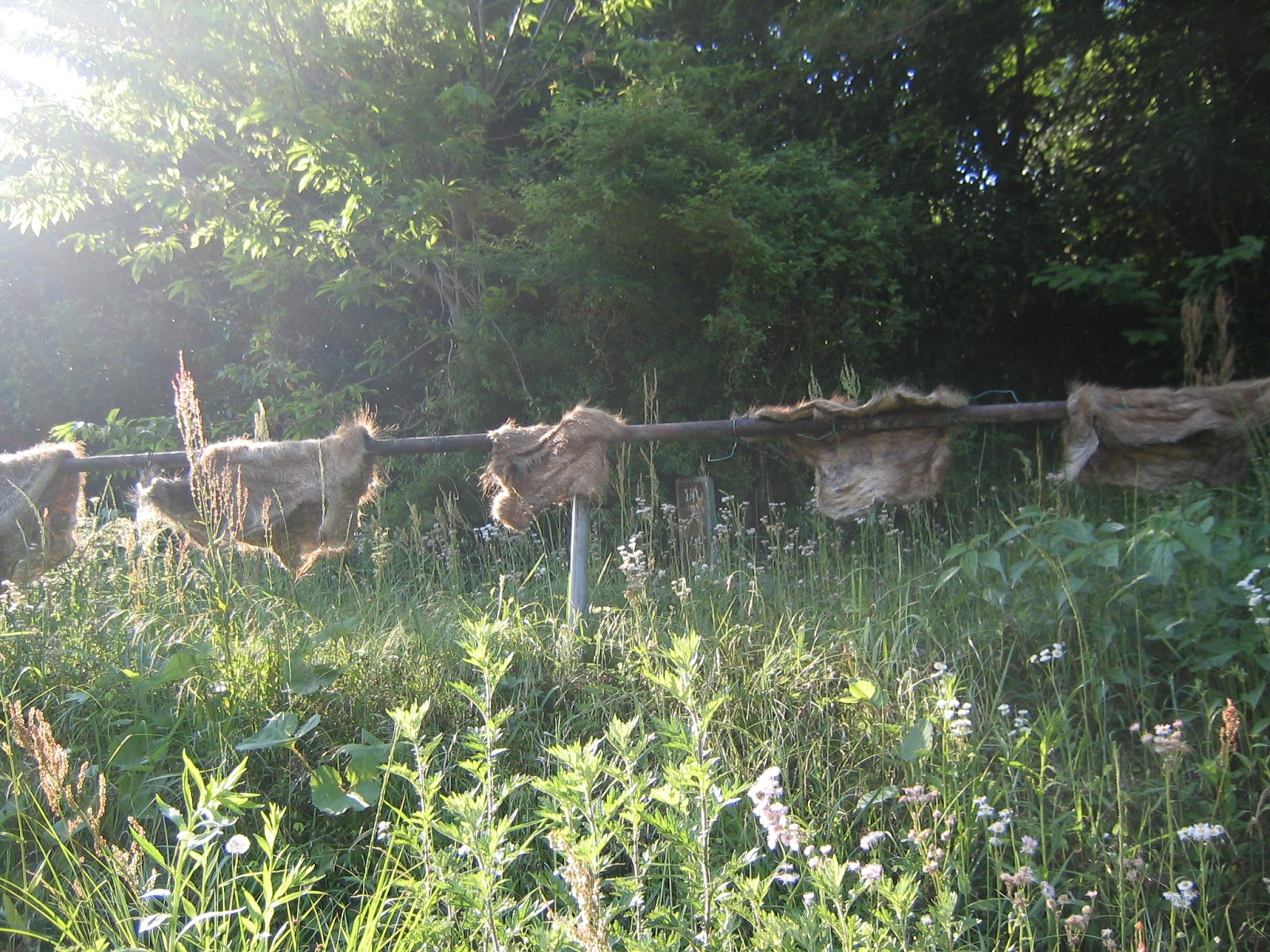
This May, in Zizohdoh 地蔵堂 community in Hakone area,
we’ve encountered with this scenery.
A total of 7 wild boar hides were sun-dried along the community road.
According to a resident guy there,
the community did a traditional group hunting this winter,
and caught a family of boars by driving them into a pit.
The largest hide had at least 1m length.
“You see, it’s dried and shrunk this small.
The original was at least 1.5m long!”
North exit of Odakyu Hon-Atsugi Station.
You may ponder if it’s feasible to introduce wild wolves
from Siberia where genetically closer wolves
to extinct Yezo wolves are surviving.
There is a group who actually proposing this method.
According to Mr. Tanigawa, the prefecture simulated
an introduction of Siberian wolf at the north-most point of the prefecture
where Kanagawa, Tokyo and Yamanashi meet.
An individual set loose there late morning will come here within 2 hours.
The prefecture thinks Japan has too small territory
for very active Siberian wolves to co-exist with humans.


If you find environmental problems in mountains of Kanagawa Prefecture, please make a contact to

Kanagawa Nature Conservation Center 神奈川県自然環境保全センター
657 Nanasawa, Atsugi City, 243-0121 〒243-0121 厚木市七沢657
Phone: 046-248-0323
You can send an enquiry to them by clicking the bottom line of their homepage at http://www.pref.kanagawa.jp/div/1644/